Effect of Ultraviolet-C and Organic Acid Treatment on Fungi Isolated from High Carbohydrate Confectionery
Ji-Eun Lee
1, Xiaotong Xu
1, So-Mi Jeong
2, Woo-Sin Kang
1, Si-Hyeong Ryu
1, Ye-Seung Kim
3and Dong-Hyun Ahn
1*
1Department of Food Science and Technology, Pukyong National University, Busan 48513, Korea
2Institute of Fisheries Sciences, Pukyong National University, Busan 46041, Korea
3Shin Heung Food, Busan 10839, Korea
Received November 26, 2020 /Revised May 7, 2021 /Accepted May 24, 2021
The purpose of this study was to identify fungi that degrade product value during the storage and distribution of confectionery products, and to investigate the antifungal effect of organic acid and UV-C treatments on high carbohydrate products. Fungi isolated from spoiled high carbohydrate con- fectionery were identified as Wallemia sp., Aspergillus sp-1 and Aspergillus sp-2 depending on ho- mologies with ITS1 and ITS4 sequences. The isolated fungi were assayed for antifungal activity by treatment with acetic acid, citric acid, lactic acid or maleic acid. As a result, it was confirmed that the growth of Wallemia sp. and Aspergillus sp-2 was suppressed by treatment with 0.2 M and 0.35 M acetic acid, respectively. In addition, as a result of confirming the antifungal effect according to the UV-C irradiation time, the growth inhibitory effects of Wallemia sp. and Aspergillus sp-2 were shown in irradiation for 30 min and the growth inhibitory effect of Aspergillus sp-1 was shown in irradiation for 40 min. The result of the sensory evaluation of the untreated and 0.35 M acetic acid-treated high carbohydrate confectionery, there were not significant changes in taste, color, abnormal taste, hardness and texture, but there were significant differences in sour taste and smell. As a result of the above study, the effect of inhibiting fungi growth on the product by treatment with organic acid and UV-C irradiation was confirmed, and it is expected to be used in confectionery that were concerned about the occurrence of fungi in the distribution process.
Key words : Antifungal activity, high carbohydrate confectionery, organic acid, ultraviolet
*Corresponding author
*Tel : +82-51-629-5831, Fax : +82-51-629-5824
*E-mail : [email protected]
This is an Open-Access article distributed under the terms of the Creative Commons Attribution Non-Commercial License (http://creativecommons.org/licenses/by-nc/3.0) which permits unrestricted non-commercial use, distribution, and reproduction in any medium, provided the original work is properly cited.
서 론
현대사회에서는 다양한 형태 및 종류의 가공식품들이 지속 적으로 개발되고 있으며, 식품의 가공, 유통 및 저장과정에서 식품 부패에 대한 안전관리가 중요시되고 있다[1]. 최근 식품 의 미생물학적 안전성 및 품질 향상을 위한 방법으로 ultra- violet (UV) 조사[37], 유기산 처리[31], 방사선 조사[32], 오존 [30] 및 초고압 처리(high pressure processing) [23] 등의 비가 열 처리 기술이 응용되고 있다. 이 중 UV (ultraviolet)는 전자 기 스펙트럼 중 100-400 nm 범위의 파장으로써 UV-A (315- 400 nm), UV-B (280-315 nm) 및 UV-C (100-280 nm)로 구분되 어 사용되고 있다[39]. 식품 표면의 미생물학적 오염을 줄이는 데 주로 사용되고 있는 영역은 UV-C이며, 특히 수분과 온도에 대한 영향을 크게 받지 않고 기존의 전자빔이나 감마선 조사
방법과 비교하여 잠재적 위해 요소에 대한 소비자 거부감이 적으며, 설치와 조사 비용이 저렴한 장점을 가지고 있어 다양 한 식품의 미생물 오염을 방지하기 위한 연구가 진행되고 있 다[3, 16, 24, 28].
유기산은 항균 활성 및 낮은 pH 영역에서 미생물 활성을 감소시키는 것으로 알려져 있어[12, 20, 21] 저장성 향상을 위 한 식품의 처리에 유용하게 활용되고 있다. 주로 연구에 이용 되고 있는 유기산으로는 구연산(citric acid), 초산(acetic acid) [11, 14], 및 젖산(lactic acid) [34] 등이 있다. 특히 구연산과 젖산은 미생물 제어제로 널리 알려져 있으며 Escherichia coli O157:H7과 Salmonella typhimurium과 같은 병원균의 제어에 효과가 있는 것으로 알려져 있다. 현재 식품의 미생물학적 안 전성 및 품질 향상을 위한 방법으로 다양한 비가열 처리 기술 이 응용되고 있지만, Wallemia sp.와 Aspergillus sp. 등의 곰팡 이 오염에 대한 유기산 처리 효과 연구는 부족한 실정이다.
“식품 유형으로서의 과자는 곡분 등을 주 원료로 하여 굽기,
팽화, 유탕 등의 공정을 거친 것이거나 이에 식품 또는 식품첨
가물을 가한 것으로 비스킷, 웨이퍼, 쿠키, 크래커, 한과류, 스
낵과자 등을 말한다[17].” 고당류 과자는 고열처리에도 불구하
고 유통과정 중 곰팡이 오염의 문제가 발생되어 반품 물량이
많은 편이고, 이로 인한 유통기한의 감소로 경제적 손실이 증
가하고 있다. 현재까지 곶감[15], 반시[32], 간장 소스[8] 등의 고당류 식품에서 곰팡이 오염에 대한 품질 특성 변화와 기초 연구가 진행되고 있지만 고당류 과자 제품에 대한 곰팡이 제 어 연구는 부족한 실정이다.
따라서, 본 연구에서는 고당류 제과류의 저장·유통 중 상품 적 가치를 저하시키는 곰팡이를 분리 및 동정하였고, UV-C와 유기산 처리에 의한 항진균 효과를 검증하고자 하였다.
재료 및 방법
실험재료
본 연구에 사용된 고당류 과자(쫀듸기)는 ㈜신흥물산(Busan, Korea)으로부터 제공받아 시료로써 사용하였다. 시험균주 배 양에 사용한 potato dextrose broth와 sucrose는 각각 Difco (BD Difco, New Jersey, USA)와 Wako (Wako Pure Chemical, Osaka, Japan) 제품을 사용하였다. 또한 agar, citric acid mon- ohydrate, acetic acid 및 maleic acid는 Junsei (Junsei Chemi- cal, Tokyo, Japan) 제품을, lactic acid는 Sigma (Sigma Aldrich, St. Louis, Missouri, USA) 제품을 구입하여 사용하였다.
미생물의 분리 및 동정
고당류 과자(쫀듸기)는 시중에 유통되고 있는 제품을 부패 가 일어날때까지 자연적으로 실온에 방치하였고, 발생된 미생 물을 순수 분리하였다. 부패된 쫀듸기 시료를 멸균 phosphate buffered saline (PBS, pH 7.4)에 현탁하고, 각 단계별 희석액을 sucrose를 첨가한 potato dextrose agar (PDA) 배지에 도말하 여 25℃에서 3-5일간 배양하였다. 육안으로 군락의 형태와 색 깔을 관찰하여 서로 다른 곰팡이 3종(A-yellow, B-dot, C- green)을 streak method로 분리하여 single colony를 얻었다.
분리된 곰팡이는 ㈜코스모진텍(cosmogenetech Inc. Dae- jeon, Korea)과 ㈜마크로젠(Macrogen Inc. Daejeon, Korea)에 서 ITS1 (5’-TCC GTA GGT GAA CCT GCG G- 3')과 ITS4 (5'-TCC TCC GCT TAT TGA TAT GC-3') primer set [13, 40]
를 사용하여 ITS 영역 염기서열분석을 하였다. 분석된 염기서 열은 NCBI (National Center for Biotechnology Information) BLAST (Basic Local Alignment Search Tool) search를 이용하 여 GenBank 유전자 염기서열과 비교하였다.
진균의 생장 억제를 위한 유기산 최소 농도 측정
부패된 고당류 과자(쫀듸기)로부터 분리한 3종의 곰팡이 single colony를 sucrose가 첨가된 potato dextrose broth (PDB) 배지에 각각 접종하고, 3-5일간 25℃에서 배양하였다.
1차 배양 된 각 곰팡이 배양액 100 μl를 취하여 sucrose가 첨가 된 PDB배지에 접종하여 3-5일간 25℃에서 배양하였다. 2차 배양 된 3종의 균주 배양액 100 μl씩을 초산, 젖산, 구연산 및 말레산이 0.025-0.55 M 농도 별로 첨가된 PDB 배지에 각각
접종하여 25℃에서 3-5일간 배양하였다. 이후 배양액을 4℃에 서 4,000 rpm으로 20분간 원심 분리하여 상층액을 제거하고, 침전된 균주 40 μl를 취해 sucrose를 첨가한 PDA 배지에 도말 하여 3-5일간 25℃에서 배양하였다. 배지 상에서 각 균주의 생장 상태를 확인하여 농도별 유기산 처리에 따른 분리 균주 의 생장 억제 농도를 확인하였다.
UV-C 조사 시간에 따른 진균 생장
2차 배양 된 3종의 균주 배양액을 각각 100 μl씩 취하여 sucrose가 첨가된 PDA 배지에 도말하였다. UV-C 조사는 253.7 nm UV-C 램프를 사용하였고, 균주를 도말한 배지와 램프 사이의 거리를 6 cm로 하여 19.5 W/m
2의 강도로 각각 30, 40, 50, 60분간 조사하였다. UV-C 조사 후, 3-5일간 25℃에 서 배양하여 UV-C 조사 시간에 따른 각 균주의 생장 여부를 확인하였다.
유기산의 제품 표면처리에 따른 항진균력 측정
각 균주별로 사용한 유기산의 농도는 제품으로부터 분리한 진균의 생장 억제를 위한 유기산 최소 농도 측정에 의해 결정 되었다. 말레산은 식품에 사용할 수 없기 때문에 제품 처리에 적용하지 않았다.
유기산의 제품 표면 처리 시 각 균주에 대한 유기산의 항진 균력을 알아보기 위해 고당류 과자 제품(쫀듸기)에 젖산, 초산 및 구연산을 각각 30초 또는 60초 동안 표면 처리하고, 3종의 분리균주 배양액 100 μl씩를 제품에 각각 도말 한 후 25℃에 저장하면서 저장 기간 동안 항진균 효과를 관찰하였다.
기호성
앞서 실험한 유기산의 제품 표면처리 결과에 따라 곰팡이 증식 저해 효과가 뛰어난 초산을 이용하여 0.35 M로 제조한 초산액에 고당류 과자(쫀듸기)를 60초 동안 담근 후 상온에서 건조시킨 뒤 무처리와 초산처리 제품의 기호도를 평가하였다.
관능검사 경험이 있는 부경대학교 식품공학과 학생 11명을 대상으로 본 실험의 목적과 평가방법 및 평가항목에 대해 설 명한 후 실시하였다. 고당류 과자(쫀듸기)의 기호도 항목(색, 향, 맛, 질감 및 전체적 호감도)은 7점 기호척도(1=아주 나쁘 다, 7=아주 좋다)에 의한 방법을 이용하였으며, 관능특성 중 색(의부), 향, 맛(신맛의 강도, 이미) 및 질감(경도)의 정도를 평가항목으로 선정하여 평가하였다. 관능검사는 부경대학교 기관생명윤리위원회에서 승인을 받은 후 시행되었다(Approval number: 1041386-202005-HR-30-02).
통계처리
본 연구결과의 평균값과 표준오차는 SAS software (Statis-
tical analytical system V8.2, SAS Institute Inc., Cary, NC,
USA)를 이용하여 분산분석을 실시하였다. 유의적 차이가 있
A B C
Fig. 1. Fungi isolated from spoiled confectionery product. (A) Wallemia sp.. (B) Aspergillus sp-1. (C) Aspergillus sp-2.
Table 1. Identification of fungi isolated from spoiled confectionery product
Strain Related strain in NCBI Accession No. Query coverage (%) Identity (%) Nomenclature A-dot Wallemia sebi strain WR1993
Wallemia canadensis MUCL15061
KP997212.1 NG062401.1
100 100
99.93
99.80 Wallemia sp.
B-green Aspergillus amstelodami strain CSR01 Aspergillus chevalieri strain DUCC5718
KT232081.1 MT582758.1
100 91
98.17
99.08 Aspergillus sp-1 C-yellow Aspergillus pseudoglaucus strain KAS7570
Aspergillus cibarius strain KAS6165
KX463362.1 HE974462.1
88 88
99.81
99.81 Aspergillus sp-2
Table 2. Minimum treatment concentration of organic acids to Wallemia sp., Aspergillus sp-1 and Aspergillus sp-2 Fungi
Organic acid (M) Acetic
acid
Lactic acid
Citric acid
Maleic acid Wallemia sp.
Aspergillus sp-1 Aspergillus sp-2
0.2 0.35 0.35
0.15 0.55 0.35
0.25 0.25 0.25
0.025 0.025 0.05
는 항목에 대해서 Duncan의 다중범위검정(multiple range
test)을 통해 p<0.05 수준에서 시료 간의 유의 차 검정을 하였다.
결과 및 고찰
미생물의 분리 및 동정
부패된 고당류 과자(쫀듸기)에서 분리한 3종의 균주를 ITS 영역 염기서열분석을 한 결과는 Fig. 1, Fig. 2, Fig. 3에 나타내 었다. 3종의 곰팡이 중 A-dot 균주는 Wallemia sp.로 확인되었 으며, B- green과 C-yellow 균주는 Aspergillus sp.로 동정되었 다(Table 1). A-dot 균주의 colony는 검회색의 구형으로 규칙 적인 모양을 가지고 있었고, B-green 균주는 진한 녹색으로 규칙적(regular)이며 거친 표면의 colony가 관찰되었다.
C-yellow 균주의 colony는 붉은 갈색으로 불규칙적(irregular) 이며 표면이 부드러운 것으로 관찰되었다. B-green과 C-yel- low 균주 모두 Aspergillus 속이지만 형태학적으로 차이가 있 기 때문에 B- green균주는 Aspergillus sp-1, C-yellow 균주는
Aspergillus sp- 2로 명명하여 각각 실험을 진행하였다(Fig. 1).Wallemia sp.는 일반적으로 수분이 적은 식품에 발생하며
잼, 빵, 케이크, 베이컨, 소금에 절인 고기 및 생선과 같이 설탕 이 많거나 소금에 절인 재료에서 주로 발견된 바 있고, 광범위 한 서식지에 걸쳐 많은 식품에서의 오염이 보고되었다[25].
Wallemia sp.는 투명한 균사를 가지고 있으며, 일반적으로 폭
이 1.5-2.5 μm이고, 촘촘한 균사체를 형성하고 있다[38].
Wallemia sp.가 광범위한 건조 식품에 존재하는 것으로 밝혀졌
지만, 식품에 대한 Wallemia sp.의 독성에 대해서는 보고된 바 없다[4].
또한, Graves 와 Hesseltine [10]은 밀가루와 냉장 반죽 제품
에서 500여종 이상의 곰팡이를 분리하였고, 그 중 A. am-
stelodami를 분리한 바 있다. Aspergillus 속은 일반적인 무성포자 형성 구조인 aspergillum을 공유하는 수백 종으로 구성된 다. Aspergillus 종은 호기성이며 거의 모든 종이 산소가 풍부한 환경에서 발견되고, 보통, 기질의 표면에 생육하는 것으로 알 려져 있다. 일반적으로 곰팡이는 단당류 및 다당류와 같은 탄 소가 풍부한 기질에서 성장하는데, Aspergillus 종은 빵이나 감 자와 같은 전분성 식품의 일반적인 오염 물질이며, 많은 식물 과 나무에서 생장하는 것으로 알려져 있다[5].
진균의 생장 억제를 위한 유기산 최소 농도 측정
고당류 과자(쫀듸기)에서 분리된 균주 Wallemia sp., Asper-
gillus sp-1및 Aspergillus sp-2에 대한 항진균 효과를 알아보기위해 4가지 유기산(초산, 젖산, 구연산, 말레산)을 이용해 생장 억제 농도를 확인하였다(Table 2).
Wallemia sp.는 0.2 M 초산, 0.15 M 젖산, 0.25 M 구연산
및 0.025 M 말레산 처리에 의해 증식이 억제되는 것을 확인할 수 있었다. Aspergillus sp-1의 경우, 0.35 M 초산, 0.55 M 젖산, 0.25 M 구연산 및 0.025 M 말레산의 처리에 의해 증식이 억제 되었다. 또한, Aspergillus sp-2는 0.35 M 초산, 0.35 M 젖산, 0.25 M 구연산 및 0.05 M 말레산의 처리에 의해 증식이 억제됨 을 확인하였다.
초산, 구연산, 젖산 및 말레산의 전처리에 따른 메밀 새싹의
저장 중 품질 변화를 연구한 Chang 등[7]의 결과에 의하면
메밀 새싹에 유기산, 특히 0.5%의 구연산과 0.05%의 초산을
처리함으로써 미생물의 증식 제어 효과와 유통 중의 품질 유
지가 증가되었다고 보고된 바 있다. 또한, Park 등[27]은 연근
절편을 1% citric acid와 열처리를 함께 병행하는 것이 연근의
품질 유지와 갈변 억제에 가장 효과적이라는 연구 결과를 보
Table 3. Antifungal activity according to ultraviolet-C (UV-C) irradiation time on Wallemia sp., Aspergillus sp-1 and Aspergillus sp-2
Control 30 min 40 min 50 min 60 min Wallemia sp.
Aspergillus sp-1 Aspergillus sp-2
+1) + +
-2) +
- - - -
- - -
- - -
1)Growth
2)No growth
고한 바 있다. 이에 따라 미생물의 종류에 따른 생장 억제 농도 는 각기 다르지만 초산, 구연산 및 젖산 등의 유기산이 식품에 서 발생한 미생물의 증식을 억제하는데 유의적인 효과가 있는 것으로 사료된다. 유기산의 항균 활성은 비해리된 분자가 이 온화되면서 세포내 pH를 변화시키고, NADH 산화를 막아 전 자 전달 체계에 이상을 줌으로써 작용 한다고 알려져 있다[9].
UV-C 조사 시간에 따른 진균 생장
고당류 과자(쫀듸기)에서 분리된 균주 Wallemia sp., Asper-
gillus sp-1 및 Aspergillus sp-2의 UV-C 조사 시간에 따른 진균생장 억제 효과는 Table 3과 같다. Wallemia sp.와 Aspergillus sp-2의 경우 30분간 UV-C 조사에서 colony가 관찰되지 않아 진균 생장 억제 효과를 확인 할 수 있었다. 또한 Aspergillus sp-1의 경우 40분간 UV-C 조사에서 생장 억제 효과를 확인하 였다.
이러한 결과는 볶은 커피 원두에 대한 Aspergillus flavus 및
Aspergillus parasiticus 에 253.7 nm UV-C 램프(1.0 mW/cm2) 를 15 cm 간격으로 0-2시간 조사했을 때, 조사 시간이 증가함 에 따라 A. flavus 및 A. parasiticus 포자의 수가 약 90% 이상 감소한다는 연구 결과[6]와 부패된 말린 감을 254 nm UV-C (2 mW/cm
2)로 조사했을 때, 말린 감의 주요 부패 곰팡이인
Rhizopus oryzae, Alternaria tenuissima 및 Aspergillus niger가 유의하게 억제되었다는 연구 결과와 일치한다[36]. 또한, 딸기의 주요 병원균인 Botrytis cinerea의 균사 생장 억제에 관한 연구 [22]에서 배지와 램프와의 거리 14 cm, 1.50 J/cm
2의 UV-C (254 nm)조사에 의해 균사의 생장이 완전하게 억제된다는 결 과와 유사하다. Kim 등[19]의 연구에서는 배지와 램프와의 거 리 40-50 cm, 12 W/m
2로 UV-C (264 nm)를 조사할 때, 딸기의 병원성 곰팡이인 딸기 탄저병균(Colletotrichum gloeosprioides) 과 시들음병균(Fusarium oxysporum)의 생장을 억제할 수 있다 고 보고한 바 있다. Stevens 등[35]은 UV-C (254 nm) 조사(과 일, 채소와 램프와의 거리 10 cm, 1.25 mW/cm
2)에 의해 과일 과 채소의 미생물을 억제해 부패 발생률을 감소시킨다고 보고 한 바 있으며, Nam 등[26]의 연구에 의하면 UV-C 조사에 의한 미생물 제어는 UV-C가 미생물의 DNA 손상을 일으킴에 의한 것으로, 조사 선량이 증가함에 따라 미생물의 생존율이 급격 히 감소한다고 보고하였다.
따라서 본 연구에서 부패된 쫀듸기로부터 분리한 Wallemia sp., Aspergillus sp-1 및 Aspergillus sp-2 균주뿐만 아니라 식품 에서 발생한 미생물을 제어하는데 UV-C 조사가 효과적일 것 으로 판단된다.
유기산의 제품 표면처리에 따른 항진균력 측정
Wallemia sp., Aspergillus sp-1 및 Aspergillus sp-2 균주를
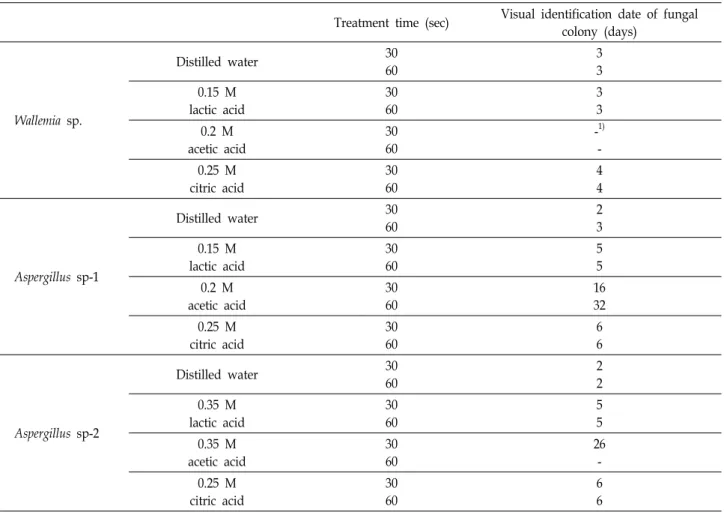
접종한 고당류 과자(쫀듸기) 시료에 구연산, 젖산 및 초산 등의 유기산을 표면에 처리하여 항진균 효과를 확인한 결과는 Table 4와 같다.
Wallemia sp.를 접종한 시료의 경우, 증류수와 0.15 M 젖산
을 처리한 시료는 3일 후, 0.25 M 구연산을 처리한 시료는 저장 4일 후에 곰팡이가 육안으로 관찰되었다. 또한, 0.2 M 초산을 처리한 시료는 저장 90일 동안 곰팡이가 관찰되지 않음을 확 인할 수 있었다.
Aspergillus sp-1를 접종한 시료의 경우, 증류수를 시료의 표
면에 처리하였을 때 저장 2-3일 후 곰팡이가 관찰되었고, 0.55 M 젖산을 처리한 시료는 저장 5일 후, 0.25 M 구연산을 처리한 시료는 저장 6일 후에 곰팡이가 관찰되었다. 또한, 0.35 M 초산 을 30초 또는 60초 처리한 시료는 저장 16일과 32일 후에 각각 곰팡이가 관찰되었다.
Aspergillus sp-2 균주를 접종한 시료에 대한 항진균력을 확
인한 결과, 증류수를 처리한 시료는 저장 2일 후에, 0.35 M 젖산을 처리한 시료는 저장 5일 후에, 0.35 M 구연산을 처리한 시료는 저장 6일 후 곰팡이가 관찰되었다. 0.35 M 초산으로 30초 처리한 시료는 저장 26일 후에 곰팡이가 관찰되었고, 60 초 처리한 시료는 저장 90일 동안 곰팡이가 관찰되지 않았다.
이와 같은 결과는 0.1% 초산을 S. typhimurium과 E. coli O157:H7에 처리했을 때, 뚜렷한 증식 저해 효과를 보였다는 연구 결과[2]와 초산 및 말레산을 이용한 생마 저온 부패균의 제어에 대해 연구한 Ryu 등[29]의 연구 결과와 유사하다. Ryu 등의 연구에서는 생마에 1% 농도의 초산, 구연산, 말레산 및 아스코르빈산을 각각 처리한 후 4℃에서 14일간 저장하며 갈 변 및 부패 억제 활성을 확인하였고, 그 결과 초산 및 말레산 처리구가 구연산과 아스코르빈산 처리구보다 우수한 갈변 억 제 및 부패 억제 활성을 나타내었다. 본 연구에서는 3가지의 곰팡이에 대한 초산의 항진균력이 가장 우수한 것을 확인한 바, 초산을 제품에 처리한다면 장기간의 유통과 저장이 가능 할 것이라고 사료된다.
기호성
제품 샘플을 0.35 M의 초산에 60초 동안 담근 후, 상온에
건조 시킨 뒤 비처리와 초산 처리한 고당류 과자(쫀듸기) 제품
의 기호도를 평가한 결과는 Table 5와 Fig. 2와 같다. 맛, 색,
이미, 경도 및 질감의 항목에서는 초산을 처리한 제품과 비처
리 제품간의 유의적인 변화가 크지 않았으나, 신맛과 향에 대
Table 5. Sensory evaluation of high carbohydrate confectionery treated with 0.35 M acetic acid
Control 0.35 M acetic acid Taste (%)
Color (%) Smell (%) Sour taste (%) Abnormal taste (%) Texture (%) Hardness (%)
Overall preference (%)
4.82±0.93A1) 5.09±1.51A 4.00±1.10A 1.18±0.40B 6.36±0.92A 4.73±1.49A 4.45±1.21A 5.27±0.90A
5.45±1.08A 5.45±0.93A 1.64±0.67B 2.73±2.00A 5.64±1.21A 5.36±1.21A 5.45±1.13A 3.82±1.25B
1)Means in the same column (A-B) bearing different superscript in samples are significantly different (p<0.05).
Fig. 2. Sensory evaluation of high carbohydrate confectionery treated with 0.35 M acetic acid (AA). 1)Means in the same column (A-B) bearing different superscript in samples are significantly different (p<0.05).
Table 4. Antifungal activity according to the treatment of organic acids on Wallemia sp., Aspergillus sp-1, Aspergillus sp-2 Treatment time (sec) Visual identification date of fungal
colony (days)
Wallemia sp.
Distilled water 30
60
3 3 0.15 M
lactic acid
30 60
3 3 0.2 M
acetic acid
30 60
-1) - 0.25 M
citric acid
30 60
4 4
Aspergillus sp-1
Distilled water 30
60
2 3 0.15 M
lactic acid
30 60
5 5 0.2 M
acetic acid
30 60
16 32 0.25 M
citric acid
30 60
6 6
Aspergillus sp-2
Distilled water 30
60
2 2 0.35 M
lactic acid
30 60
5 5 0.35 M
acetic acid
30 60
26 - 0.25 M
citric acid
30 60
6 6
1)No fungi have been identified for 90 days.
한 항목에서는 약간의 신맛과 향이 강하게 나타남으로 유의적
인 차이를 보였다. 초산을 처리한 제품의 경우 겉이 옥수수
전분으로 싸여있는 고당도 과자이기 때문에 초산이 많이 스며
들지 못해 신맛이 크게 느껴지지 않았지만, 초산 특유의 향이
강하게 나타남으로 인해 종합적인 호감도 점수가 무처리 샘플
보다 낮은 것으로 사료된다. Kim 등[18]의 연구에서는 2%의
코팅구연산을 제조하여 화이트 초콜릿에 첨가하였을 때 단맛
과 신맛의 조화가 잘 이루어져 가장 높은 기호도를 나타내었 다. 따라서 초산 처리시 농도 및 처리 시간을 조절한다면 Kim 등[18]의 연구에서처럼 관능적 품질 차이에서 긍정적인 작용 을 할 것이라 여겨진다.
감사의 글
본 연구는 2019년 사회맞춤형 산학협력 선도대학(LINC
+) 육성사업 부경대학교 산학공동기술개발과제의 지원을 받아 수행되었으며, 이에 감사드립니다(해조류 유래 천연물과 UV 를 이용한 제과류 품질안정화와 저장성 증진 기술 및 공정의 개발).
The Conflict of Interest Statement
The authors declare that they have no conflicts of interest with the contents of this article.
References
1. Ahn, S. M., Choi, T. H., Kwun, I. S. and Sohn, H. Y. 2011.
Antifungal activity of methylene chloride fraction of Pim- pinella brachycarpa against Aspergillus niger. Kor. J. Microbiol.
Biotechnol. 39, 168-174.
2. Ahn, Y. S. and Shin, D. H. 1999. Antimicrobial effects of organic acids and ethanol on several foodborne microorgan- isms. Kor. J. Food Sci. Technol. 31, 1315-1323.
3. Allende, A. and Artés, F. 2003. UV-C radiation as a novel technique for keeping quality of fresh processed ‘Lollo Rosso’lettuce. Int. Food Res. J. 36, 739-746.
4. Arora, D. K. and Arora, D. 1991. Handbook of applied mycology. 3. Foods and feeds. Marcel Dekker Inc. NY, USA.
3, 415-443.
5. Bennett, J. W. 2010. An overview of the genus Aspergillus.
Aspergillus: Mol. Genet. Genom. Caiser Academic Press, Port- land. 238, 1-17.
6. Byun, K. H., Park, S. Y., Lee, D. U., Chun, H. S. and Ha, S. D. 2020. Effect of UV-C irradiation on inactivation of Aspergillus flavus and Aspergillus parasiticus and quality pa- rameters of roasted coffee bean (Coffea arabica L.). Food Addit. Contam. Part A. Chem. Anal. Control Expo. Risk Assess.
37, 507-518.
7. Chang, S. K., Lee, H. H., Hong, S. I. and Han, Y. S. 2010.
Effect of organic acid treatment on the quality attributes of buckwheat sprout during storage. Kor. J. Food Sci. Technol.
42, 190-197.
8. Choi, Y., Oh, J. H., Bae, I. Y., Cho, E. K., Kwon, D. J., Park, H. W. and Yoon, S. 2013. Changes in quality characteristics of seasoned soy sauce treated with superheated steam and high hydrostatic pressure during cold storage. Kor. J. Food Cook Sci. 29, 387-398.
9. Freese, E., Sheu, C. W. and Galliers, E. 1973. Function of
lipophilic acids as antimicrobial food additives. Nature 241, 321-325.
10. Graves, R. R. and Hesseltine, C. W. 1966. Fungi in flour and refrigerated dough products. Mycopathol. Mycol. Appl.
29, 277-290.
11. Hamby, P. L., Savell, J. W., Acuff, G. R., Vanderzant, C.
and Cross, H. R. 1987. Spray-chilling and carcass decontami- nation systems using lactic and acetic acid. Meat Sci. 21, 1-14.
12. Ingram, M., Ottaway, F. J. H. and Coppock, J. B. M. 1956.
The preservative action of acid substances in food. Springer, Boston, MA, 42, 1154-1163.
13. Innis, M. A., Gelfand, D. H., Sninsky, J. J. and White, T.
J. 1990. PCR protocols: a guide to methods and applications.
Academic press, Inc. San Diego, pp. 3-169.
14. Jeong, E. J., Lee, H. K. and Kim, Y. S. 2019. Shelf life ex- tension of Wasabi paste products by addition of citric acid.
J. Food Hyg. Saf. 34, 354-360.
15. Kang, B. H., Jo, M. Y., Hur, S. S., Shin, K. S., Lee, D. S., Lee, S. H. and Lee, J. M. 2012. Isolation and identification of contaminated organisms on dried persimmon. Kor. J. Food Preserv. 19, 939-945.
16. Keyser, M., Műller, I. A., Cilliers, F. P., Nel, W. and Gouws, P. A. 2008. Ultraviolet radiation as a non-thermal treatment for the inactivation of microorganisms in fruit juice. Innov.
Food Sci. Emerg. Technol. 9, 348-354.
17. KFDA. 2012. 2. Rice-cake of Bread, Korea Food Standards Codex(I), KFDA, pp. 50-51.
18. Kim, B., Kim, D. M., Lee, S. H. and Shin, H. J. 2010.
Preparation of coated citric acid for sensory improvement of chocolate products. KSBB J. 25, 443-448.
19. Kim, S., Ahn, S. Y., Oh, W. and Yun, H. K. 2012. In vitro test of mycelial growth inhibition of 5 fungi pathogenic to strawberries by ultraviolet-C (UV-C) Irradiation. Kor. J. Food Sci. Technol. 44, 634-637.
20. Luck, E. and Jager, M. 1997. Antimicrobial food additives:
characteristics, uses, effects . Springer, New York, USA, pp.
116-119.
21. Macris, B. J. 1975. Mechanism of benzoic acid uptake by Saccharomyces cerevisiae. Appl. Microbiol. Biotechnol. 30, 503- 506.
22. Marquenie, D., Lammertyn, J., Geeraerd, A. H., Soontjens, C., Van Impe, J. F., Nicolaı, B. M. and Michiels, C. W. 2002.
Inactivation of conidia of Botrytis cinerea and Monilinia fructi- gena using UV-C and heat treatment. Int. J. Food Microbiol.
74, 27-35.
23. Matser, A. M., Krebbers, B., van den Berg, R. W. and Bartels, P. V. 2004. Advantages of high pressure sterilisation on quality of food products. Trends Food Sci. Technol. 15, 79-85.
24. Mok, C. K. and Lee, N. H. 2008. Distribution of ultraviolet intensity and UV leaking of commercial UV sterilizers used in restaurants. Kor. J. Food Sci. Technol. 40, 228-233.
25. Moore, R. T. 1986. A note on Wallemia sebi. Antonie Van Leeuwenhoek 52, 183-187.
26. Nam, J. H., Shin, J. H., Lee, J. Y. and Lee, D. H. 2017. Effects of ionizing and ultraviolet radiation on microbial mutation and DNA damage. Kor. J. Microbiol. 53, 20-28.
초록:고당류 제과에서 분리한 진균에 대한 UV-C와 유기산 처리 효과
이지은
1․쉬시아오통
1․정소미
2․강우신
1․류시형
1․김예승
3․안동현
1*
(1부경대학교 식품공학과/식품연구소, 2부경대학교 수산과학연구소, 3신흥식품)
본 연구는 고당류 제과의 저장 및 유통 과정에서 상품 가치를 저하시키는 진균을 확인하고, 고당류 제과에 대한 유기산 및 UV-C 처리에 대한 항진균 효과를 조사하였다. 부패된 고당류 과자로부터 3종의 진균을 분리하였고, ITS 염기서열분석 결과 Wallemia sp.와 Aspergillus sp.로 동정되었다. 3종의 진균에 대한 유기산의 농도를 확인한 결과, 0.2 M, 0.35 M 초산이 Wallemia sp., Aspergillus sp-1 및 Aspergillus sp-2 균주의 생육 억제 효과가 있는 것으 로 판단되었다. 또한 UV-C 조사 시간에 따른 항진균 효과를 확인한 결과, 조사 30분 후, Wallemia sp.와 Aspergillus sp-2 균주의 생육 억제 효과가 관찰되었으며, Aspergillus sp-1은 조사 40분 후, 생육 억제 효과를 나타내었다. 비처 리 및 0.35 M 초산처리 고당류 과자의 기호도를 평가한 결과, 맛, 색, 이미, 경도 및 질감은 유의적인 변화가 크지 않았으나, 약간의 신맛과 향에 의해 유의적인 차이를 보였다. 따라서 본 연구를 통해 제품에 유기산 처리 및 UV-C 조사에 의한 진균 억제 효과를 확인하였으며, 유통 과정 중에 진균의 발생이 우려되었던 과자류에서의 이용이 기대된다.
27. Park, J. H., Hong, S. I., Jeong, M. C. and Kim, D. 2013. Effect of mild heat and organic acid treatments on the quality of fresh-cut lotus roots. Kor. J. Food Preserv. 20, 23-29.
28. Perkins-Veazie, P., Collins, J. K. and Howard, L. 2008. Blue- berry fruit response to postharvest application of ultraviolet radiation. Postharvest Biol. Technol. 47, 280-285.
29. Ryu, H. Y., Kwun, I. S., Park, S. J., Lee, B. H. and Sohn, H. Y. 2007. Inhibition of browning in Yam fresh-cut and control of Yam-putrefactive bacterium using acetic acid or maleic acid. Kor. J. Microbiol. Biotechnol. 35, 135-141.
30. Selma, M. V., Beltrán, D., Allende, A., Chacón-Vera, E. and Gil, M. I. 2007. Elimination by ozone of Shigella sonnei in shredded lettuce and water. J. Microbiol. Biotechnol. Food Sci.
24, 492-499.
31. Seol, K. H., Kim, H. W., Jang, O. K., Oh, M. H., Park, B.
Y. and Ham, J. S. 2012. Effect of organic acid and water washing on meat quality and surface population of E. coli of pork loin. Kor. J. Agric. Sci. 39, 569-575.
32. Sim, H. J., Kang, J. R., Kang, M. J., Choi, M. H., Suh, H.
J. and Shin, J. H. 2016. Changes in quality characteristic of immature flat persimmon (Diospyros kaki Thunb) during heat treatment aging. Kor. J. Food Preserv. 23, 301-309.
33. Smith, J. S. and Pillai, S. 2004. Irradiation and food safety.
Food Technol. Biotechnol. 58, 48-55.
34. Smulders, F. J. and Woolthuis, C. H. 1985. Immediate and delayed microbiological effects of lactic acid decontamina-
tion of calf carcasses-influence on conventionally boned ver- sus hot-boned and vacuum-packaged cuts. J. Food Prot. 48, 838-847.
35. Stevens, C., Khan, V. A., Lu, J. Y., Wilson, C. L., Pusey, P. L., Igwegbe, E. C. K. and Droby, S. 1997. Integration of ultraviolet (UV-C) light with yeast treatment for control of postharvest storage rots of fruits and vegetables. Biol.
Control. 10, 98-103.
36. Vurmaz, A. K. and Gündüz, G. T. 2020. Inhibition of mold growth on the surface of dried persimmons using combined treatments of UV-C light and clove oil. Innov. Food Sci.
Emerg. Technol. 61, 102336.
37. Waites, W. M. and Warriner, K. 2005. Ultraviolet steri- lisation of food packaging. Culture 25, 1-8.
38. Zalar, P., De Hoog, G. S., Schroers, H. J., Frank, J. M. and Gunde-Cimerman, N. 2005. Taxonomy and phylogeny of the xerophilic genus Wallemia (Wallemiomycetes and Wallemiales, cl. et ord. nov.). Antonie Van Leeuwenhoek 87, 311-328.
39. Zhang, J., Zivic, N., Dumur, F., Xiao, P., Graff, B., Fouassier, J. P. and Lalevee, J. 2014. UV-violet-blue LED induced poly- merizations: Specific photoinitiating systems at 365, 385, 395 and 405 nm. Polymer 55, 6641-6648.
40. Zhang, Z., Schwartz, S., Wagner, L. and Miller, W. 2000.
A greedy algorithm for aligning DNA sequences. J. Comput.
Biol. 7, 203-214.