• 검색 결과가 없습니다.

A service design approach to sustainable service innovation in prison contexts - Taking the Service Design of

N/A
N/A
Protected

Academic year: 2021

Share "A service design approach to sustainable service innovation in prison contexts - Taking the Service Design of"

Copied!
14
0
0

로드 중.... (전체 텍스트 보기)

전체 글

(1)

A service design approach to sustainable service innovation in prison contexts

- Taking the Service Design of “Yu Fu Bao” as an Example

Chen Xie

1

, Younghwan Pan

2*

1

Ph.D. Course, Dept. of Experience Design, Graduate School of Techno Design, Kookmin University

2

Professor, Dept. of of Experience Design, Graduate School of Techno Design,Kookmin University

교도소 컨텍스트속에서 서비스 디자인 방법을 통한 지속가능 서비스 혁신에 관한 연구

- "Yu Fu Bao" 금융 서비스를 중심으로

진섭

1

, 반영환

2*

1

국민대학교 테크노디자인전문대학원 경험디자인학과 박사과정,

2

국민대학교 테크노디자인전문대학원 경험디자인학과 교수

Abstract In recent years, China has gradually made clear its decision to modernize the governance system and governance capacity of the government by the virtue of digital transformation. As for the smart prison, as a penal institution of the state, technological reform is a key element in the sustainable development of smart prisons; however, relying on technology does not necessarily lead to a better service experience. Service design concept, as a coordinator of technology and social sustainability, needs to be adapted to the technological integration of smart prisons and to the needs for service design in the prison context in a new mode of thinking about services. This paper takes the development of the Jail Pay financial services system, one of the twelve sub-systems of the Smart Prison, as an entry point to explore the characteristics and shortcomings of the service design approach in achieving sustainable service innovation in the Smart Prison, it proposes an experience-based lead collaborative design (EBLCD) that is suitable for the specific needs in the prison context. The EBLCD is a theoretical framework and practical experience for sustainable service innovation in the construction of smart prisons.

Key Words : Service Design, Smart Prison, Situational wareness, “Yu Fu Bao” financial service, Sustainable service innovation

요 약 중국은 최근 몇 년 사이 디지털기술을 활용하여 정부의 통치체계와 통치능력을 현대화하겠다는 결정을 내렸다.

스마트 감옥은 국가의 형벌 기관으로서 기술개혁은 스마트 감옥의 지속가능한 발전을 위한 관건이다. 기술에 의존한다 고 해서 반드시 더 나은 서비스 경험을 가져다 줄 수는 없다. 서비스 디자인적 사고는 기술과 사회의 지속가능한 발전 을 위하여 조율 역할을 하면서 스마트 감옥 건설의 기술융합에 새로운 서비스 디자인 사고를 적용하고 교도소 콘텍스 트속의 서비스의 디자인 수요에 대응해야 한다. 그리하여 본문은 스마트 감옥의 12개 서브시스템 중 옥부보 금융서비 스 시스템 개발을 중심으로 스마트 감옥의 지속가능한 서비스 구현을 위한 서비스 디자인 방법의 특징과 부족함을 탐 구하고 이에 따라 감옥의 특수한 상황적 요구에 부합하는 경험에 기초하여 시너지를 유도하는 설계이념(EBLCD)을 제시했다. 이를 바탕으로 장래 스마트 감옥의 혁신 문화, 창의력 및 혁신 방법에 대한 심도 있는 연구를 통해 궁극적으 로 스마트 감옥 건설의 프레임을 마련했다.

주제어 : 서비스디자인, 스마트감옥, 콘텍스트감지, “Yu Fu Bao” 금융 서비스, 지속가능 서비스

*Corresponding Author : Yonghwan Pan([email protected]) Received May 24, 2021

Accepted August 20, 2021 Revised June 26, 2021

Published August 28, 2021

(2)

1.Introduction

Service design is still in the initial stage in many countries around the world, which provides opportunities for embedding service design methods into different local governments.

However The Chinese government is also gradually shifting from an economy- construction-oriented government to a public-service-oriented government[1]. The Fourth Plenary Session of the 19th CPC Central Committee has specifically defined the decision to modernize the government governance system and governance capability through digital transformation, Prison, as the criminal penalty execution agency of the state, shoulders the mission of combining punishment with reform, and combining education with labor, to transform prisoners into law-abiding citizens ,thereby maintaining the sustainable and stable development of society.

“Prison Pay” financial service system (“Prison Pay”) is one of the 12 smart prison systems. With the development of “Prison Pay” as the breakthrough point, this paper introduces the service design method, and conducts service innovation for the financial service system of prisoners under the limitations of technology and system. “Prison Pay” not only provides a package solution for prisoners to deposit, withdraw and pay their money, but also integrates mainstream payment channels such as Alipay and WeChat, offering a convenient and safe way to deposit money on mobile phone. In addition, prisoners can use the product service systems inside the prison, such as tablet computer, touchscreen and education PC, through a safe way to login for intuitive purchase.After the prison guards set up the “treatment” and purchase rules on the management interface, the system automatically judges the purchase limits of prisoners according to the rules and sends orders to suppliers, changing the manual supervision of the guards

into the system’s smart processing, etc.

However, during the construction, smart prison has special contexts that other public service organizations do not have. We will discuss from the following points around the particularity of prison.

1.1 The change of thinking inserving the reform of prisoners

The value base of prison service is to serve the reform of prisoners. Prisoners are special citizens of the country. Like other common interests, their common interests are not aggregated by individual self-interests, but generated from a dialogue based on common values [2].With the construction of smart prison, the theory of prison management should be to serve the reform of prisoners, rather than serve the prisoners, which includes the promotion of the civil rights of prisoners, the v improvement of the living environment of prisoners, the guarantee of basic living, etc.

In December 2018, the Ministry of Justice published the "Smart Prisons Technical Specification", which provides a practical manual for the system-wide implementation of "Smart Prisons". The same reliance on technology does not necessarily lead to better customer experience. For smart prisons to innovate in terms of technical feasibility, other factors need to be adapted to respond to any new findings.

Service design thinking, as an orchestrator of sustainable development of technology and society, needs to adapt to the convergence of technology with new ways of thinking about service design that respond to the needs of different technologies.

1.2 Sustainability of public services is the way to maintain social stability and development

In the process of building a harmonious

(3)

socialist society, the social value of prison lies in maintaining social order and stability, and realizing social fairness and justice. Besides, its whole essence lies in improving the quality of reforming offenders to realize there-socialization of prisoners. Improving the quality of reforming prisoners is not just reflected in technological innovation, and it also includes humanistic care, fairness and justice, which is also the basic value orientation of a harmonious, stable and sustainable society. Due to the particularities of the prison context, technical configuration is likely to cause problems. How to take into account the interests of all parties through soft services, reduce the negative emotions of prisoners in the process of reform, effectively help them, eliminate discrimination, and help service personnel integrate into society is the decisive factor for the sustainable and stable development of the society.

(1)This paper takes the construction of a smart prison 1.0 as the starting point, introduces the service design thinking and design methods, and explores the feasibility of traditional service design methods for the innovation of the financial service system of smart prison.

Compared with other professional fields (anthropology, management, organizational research, etc.), what are the main aspects of service design in getting along, analyzing and influencing smart prison projects? What is special about the service design approach?

(2)In the construction of a smart prison, these institutions will continue to evolve after the designers leave the project. At this point, do the problems and solutions that design will solve take on a new meaning?This paper redefines the EBLCD (Experience-based lead collaborative design) concept to achieve sustainable service innovation for smart prison in prison context.

2. Design Process and Design Research 2.1 Project procedures

The “Prison Pay” project carried out innovation research from the following five aspects:

(1) Understanding: The team participating in the design explored the particularity of the

“prison” context to the maximum extent permitted by laws and regulations, and understood the key users, stakeholders and the inside of the organization. Based on the research and analysis results, a more comprehensive and systematic conceptual preconception was made for “Prison Pay”

platform.

(2) Design opportunity evaluation: With the capital flow as the main line, the team conducted specific design and evaluation around its business process, service space, special service mode and service chance points.

(3) Design principle: The team proposed the design principle of sustainable innovation of service according to prison laws and regulations, organization and context.

(4) Service design and implementation: The team evaluated and improved the use of prisoners and prison guards in the procedures, and expanded the service across different platforms.

(5) Definition of the concept of sustainable service design for smart prison: EBLCD

2.2 Prison context-awareness

The best way to gain an in-depth understanding of this knowledge is on-the-spot context investigation[3] and consideration of all stakeholders together, which is also the advantage of service design. We will perceive it from the following three aspects:

(1) Context-awareness of prisoners and prison managers

(2) Backward fund management system and

(4)

prison “treatment” mechanism

(3) Current social cognitive environment 2.2.1 Context-awareness of managers and prisoners

We first analyzed it from the perspective of prisoners:

(1) We tested the service appeal behavior of prisoners, and found that the service behavior of prison guards, which existed in the behavioral belief of prisoners, could not produce a positive attitude to the reform of prisoners, because such service was not people-oriented. According to the standard belief of prisoners [4], it’s the established status difference that has led to the prison guards and society treating them as tools of labor, and prisoners have no illusions about the care and response of the prison guards and the use of such services.

(2) The families of prisoners have a lack of service awareness. It is not difficult to find that, due to the traditional social cognition of high prison walls and the society’s unequal view of offenders, exclusion injury and social pain are very sharp, far beyond the imagination of those who are excluded.

(3) In the face of the armed police, high walls and iron nets, the prisoners are always reminded that they are criminals. Anxiety and fear are common in this environment, which is also the psychological pressure generated by the “management” attitude of the department of prison managers for a long time.

From the perspective of prison supervisors, the analysis includes the following aspects of context-awareness:

(1)Prison police are the custodians of prisons as well as the service providers.

(2)Rigid ideas, deep-rooted “official standard”

consciousness, patriarchal style in cadre management, sluggish institutions, simplified working methods, and indifferent attitude of

jailers, whichfall behind the development of the times .

2.2.2 Prison “treatment”mechanism

From the context-awareness of service receivers and service providers, this paper finds that it is a core and difficult problem to effectively enhance the enthusiasm of reform in prison management and reform of prisoners. In actual management, hierarchical treatment, known alsoas treatment of offenders( treatment of offenders. traitmeent des delisquants), was established with the aim of improving the offenders’ incentive mechanism, rebuildingtheir healthy personality and helping them return to society smoothly. In this mechanism, offenders are divided into different grades, given corresponding treatment and implemented with corresponding management methods depending on their reform performance and prison time, based on scoring and assessment, according to the nature and degree of their crimes, rewards and punishments [5].According to Article 39 of the Prison Law[6], a prison may conduct separate management for prisoners based on their reform performance and implement different punishments. Specifically, it can be divided into strict management, ordinary management and lenient management. Different treatment is carried out for offenders with different risks. The hierarchical treatment is dynamic.

Prison guards assess the performance of

prisoners on the basis of the daily management

and assessment regulations. The assessment

results are a factor for the life preferential

treatment of prisoners, the number of family

calls, the amount of consumption in prison, the

improvement of food, family help and education,

labor skills training, interviews, education and

entertainment, etc., by which different treatment

standards of prisoners with different

performance in reform are implemented,

reflecting the differentiation. Life preferential

(5)

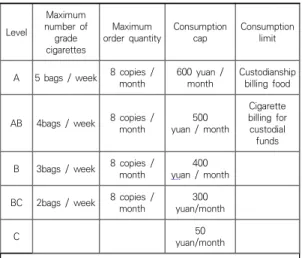
treatment refers to the improved life treatment that prisoners can choose depending on their reform performance, including ordering nutritious meals, fruits, cigarettes, etc.As shown the table 1, there is a tiered limit for in-prison spending but the specific types, standards, prices and quantities are stipulated by the prison.

Accounting is closely related to prisoners, and it determines all the consumption of prisoners.

Therefore, “treatment” is the foundation of

“PrisonPay” service, and also an important basis for service design. Traditional prisons are often faced with difficult top-up, error proneness, bribability and other problems. Smart prison calls for reform democratization, fairness and the protection of the civil rights of prisoners.

However, these remaining rights can hardly be realized only through technology, and it is more necessary to realize fairness, democracy and efficiency through service innovation. On the premise of ensuring effective reform of prisoners, it protects their own interests, and boosts there-socialization of smart prison and the equal sharing of social values through he use of service design methods.

Level

Maximum number of grade cigarettes

Maximum

order quantity Consumption

cap Consumption

limit A 5 bags / week 8 copies / month 600 yuan /

month Custodianship billing food AB 4bags / week 8 copies /

month 500

yuan / month

Cigarette billing for custodial funds B 3bags / week 8 copies /

month 400

yuan / month BC 2bags / week 8 copies /

month 300

yuan/month

C 50

yuan/month

Labor compensation consumption money (reward nature, regardless of level restrictions).

A la carte food (1 of each kind/month), cigarettes under 20 yuan (10 packs/month), no overspending

Table 1. A tiered limit for in-prison spending

2.3 Stakeholders

Through the visual presentation of the parties involved in financial services in the prison system (as shown in Fig. 1), the innovation team found that the guards bridged the gap between the outsiders and the prisoners due to the prison walls, acting as a link between the inside and the outside. In this service design, we classified the stake holders according to their importance and influence through designer’s collation and stakeholder analysis. As service providers, prison guards are divided into two different service forms: external service for the public and internal service for the reform of prisoners. The internal service mainly involves the operation manager of Prison Management Department, financial manager of Finance Section, supply station manager of Department of Health and manager of sub-prison area.

Fig. 1. Stakeholder Map

2.4 Design requirement

Based on context investigation, stakeholder

analysis and traditional capital flow and service

blueprint (as shown in Fig. 2), the accounts of

prisoners include deposit accounts and labor

compensation accounts. Labor remuneration

account is divided into two sub-accounts, one of

which is the available labor remuneration

account, and the other account is the reserve for

release from prison. As is shown in the figure,

(6)

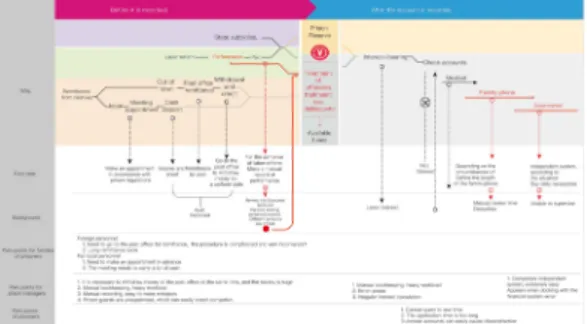
Fig. 2. User Journey Map

the purple part is the state subsidy, and the green part is the labor remuneration. In this process, the performance of the prisoners directly determines their “treatment” level. They will enjoy different treatment, as shown in the light gray part. However, the orange part is the way of families’ remittance, which is still a traditional way of remittance, completely out of line with the current process of data, information and intelligence, bringing great inconvenience to the families of local or foreign prisoners.

Although prisoners are imprisoned inside the walls, there-socialization of prisoners is a right of prisoners. The results of re-socialization, to a certain extent, will determine the level of recidivism, which is directly related to the sustainable development of the society.

Therefore, the re-socialization of the prisoners should be the highest pursuit in the execution of punishment. To this end, when drafting the 1976 Prison Act, the drafters set out three guiding principles, which were eventually codified [7]:

(1) Prison life should reflect, as far as possible, the general relations of external social life, which is called “adjustment principle” that obliges the penalty enforcement agencies not to exceed the difference between the prison facilities and the outside world when establishing the prison;

(2) The penalty enforcement agencies should take measures to reduce the harm caused by imprisonment, which is called “counter-measures principle”that empowers the penalty

enforcement agencies to reduce the possible negative effects of imprisonment as far as possible;

(3) The penalty enforcement agencies should set goals to help prisoners adapt to a free life in the future, which is called the “integration principle” that promotes the establishment of a prison system encouraging prisoners to return to normal social life.

The traditional prison account structure is complex. It has problems such as various accounts like consumption fund account, basic account and reserve account, complex accounting procedures and complex consumption control rules. Heavy workload of manual interest calculation is the main situation of the financial services in the prison, which directly distracts the energy of the prison police.

Existing accounting problems will lead to heavy workload and long cycle, disputes, complaints, high mistake rate and other problems. In addition, the traditional management thinking of the prison police is restricted, so the humanized service can only be a slogan. Therefore, through the establishment of empathy between the service and the serviced, we classified the existing problems and summarized the pain points for different groups, as shown in Table 2.

To sum up, stakeholder analysis and requirement design return to essential issues.

First, the prison managers have a weak sense of service. Second, the prisoners and their families lack cognition of service.

Therefore, how to assist the smart prison to achieve a balance between the needs of all parties and the sustainable development of the society based on the three guiding principles of prison law? As service design is sustainable, and service design thinking and sustainability have been part of the project

from the very beginning, the team formulated

three basic principles of sustainable innovation

for “Prison Pay” service innovation:

(7)

Group Pain points analysis Families

of prisoners Foreign personnel

(1)Need to go to the post office for remittance, the procedure is complicated and very inconvenient

(2)Long remittance cycle Local

personnel (3) Need to make an appointment in advance (4)A lot of cash carried for the meeting

Prisoners

(1)Failure to query in real time (2)Long application time

(3)Unclear accounts which easily cause dissatisfaction

(4)Difficulty in buying products they need due to limited supermarket products

Prison managers

(1)Inconvenience of manual accounting and paper archiving, query difficulties, poor security;

(2)Independent supermarkets and inconvenient bookkeeping;

(3)Manual book keeping, heavy workload, error-prone;

(4)Manual records of medical treatment, family phone deduction fee;

(5)No bank coordination, long remittance cycle, irregular interest calculation.

Table 2. Service Groups and Analysis of Pain Points

(1) Introducethe “Internet +”thinking mode.

prisons should introduce the cutting-edge thinking mode and service concept inside the walls, form the regional network innovation mode, and help the prisoners to connect with society.

(2) Improve service efficiency by product service system. Special contexts, such as the educational level of prisoners, banned use of electronic devices by prison guards, should be considered to design a simple, efficient, easy-to-learn and easy-to-use product service system.

(3) Optimize the “treatment” mechanism, carry out prison environment reform .

3. Design implementation

It is more effective to divide the service design into different stages by service participation (as shown in Fig. 3).We divided the service into two stages, the stage of serving the masses and the stage of reforming prisoners.

Fig. 3. Prison Guards Serve Different Groups as Two-way Interaction People

3.1 Service innovation for the reform of prisoners

The discovery of innovation opportunities covers all service chance points and contexts before service (prison), during service (labor reform), and after service (release from prison).The reform service for prisoners is based on “treatment”, which involves three aspects, entry into account, consumption and query.

Therefore, in the service design and development, with “treatment” as the standard, and with focus placed on mastering the steps and chance points in the business process, the “pain points” and design opportunities in the business process of “serving the reform” were deeply analyzed. Fig. 4 shows the process optimization of prisoners’ use of Prison Pay financial service system.

Fig. 4. Flow Chart of Use of Prisoners

3.1.1 Product service system innovation

Product service system is the carrier of

delivering the deepest inner emotion and some

cognitive experience of the prisoners. With this

system, prisoners can enjoy the convenience

brought by material products, experience various

(8)

“non-material” feelings, and even retain such feelings for a long time after the experience.

Besides, it can also promote positive reform of prisoners.

In this service design, aiming at the pain points of the reform of prisoners, we put more focus on the integration of the overall service experience on the basis of technology. We designed multi-functional touch query machine, labor reform presentation system, online shopping system and other hardware and software products respectively.

In the final implementation model, first, prisoners can query their account balance,

“treatment” level and consumption records in real time on the multi-functional touch query machine through an all-in-one card.

Second, through the labor reform presentation system of prisoners, prisoners can clearly understand their own reform performance, term and commutation status. With attention paid to the details, the system can stimulate the enthusiasm of prisoners in reform and reflect the fairness of prison management to the maximum extent, and safeguard the interests of prisoners.

Third, based on the special contexts of low educational level of prisoners, banned use of mobile phones by prison guards in the prison room, the operation process was simplified so that the prisoners, without the help of others, can quickly solve the problems encountered in the operation through the help function.

Fourth, the online shopping system was introduced to help the prisoners to buy what they need for their life, study and reform to the greatest extent, experience the convenience of online shopping, and build up their confidence to integrate into society.

3.1.2 Simplified cognition makes invisible become visible

According to the preliminary investigation, financial status query is the biggest challenge of

the design. Prisoners have no right to query their own financial details, which can only be queried with the organization application and approval.

Due to the long approval time, the information has been lagging behind the consumption and accounting conditions, forming information asymmetry, which can easily cause corruption.

Such corruption and unfair phenomenon have produced a huge impact on the psychology of prisoners, thus affecting the effect of reform.

In order to improve the situation, through integration of technology, organizational collaboration, terminal information query environment construction and query interface optimization and other ways, we conducted a systematic analysis of the traditional query way before, during and after the process. Prisoners with different levels of “treatment” were given the opportunity to enjoy different levels of query service for a month. They could easily query their own account details on the self-service machine only through the all-in-one card. In addition, in the interface design, vague words were avoided as far as possible, and ambiguous forms of expression were planned [8],so as to realize a simple and easy-to-use interaction mode to avoid prisoners’ learned helplessness [9]

and improper self-accusation [10] and other psychological states that affected the query experience. Furthermore, the simplified data list can directly reflect the situation of “income” and

“expenses”, and show the main sources and consumption status of income and expenses through different colors, so as to help the prisoners to easily understand their own accounting details within the limited query time.

3.1.3 Improved service environment raises the enthusiasm of prisoners in reform

In the prison meeting environment

transformation, “treatment” was also taken as the

basic principle. On the principle of rewarding to

promote the reform, we re-planned the process

(9)

Fig. 5. Process of Services for Families of Prisoners and chance point of the meeting business, so as so as to put forward a new planning standard for the meeting hall environment. Service space design is the design of user experience and user process, including environmental positioning, functional partition and facility product design, with an aim of ensuring a comfortable balance of prisoners and prison guards and good service experience for people in the prison. Therefore, we carried on the humanized transformation on the lenience interview room. The lenience interview room mainly aims at prisoners with

“treatment” level ranking at five per cent or above in the prison. Besides, we designed face-to-face meeting bar, family tea bar and other facilities to reflect the prison’s hierarchical management and humanistic care for prisoners.

Furthermore, in the family tea bar, prisoners can use their all-in-one card to make purchases and share their earnings with their families.

Moreover, the environment of the hall was upgraded, with the columns of the original hall being designed into the shape of big trees, which not only added warmth to the meeting hall, but also symbolized the purpose of the prison to serve the reform of prisoners from the roots.

3.2 Service innovation for the families of prisoners

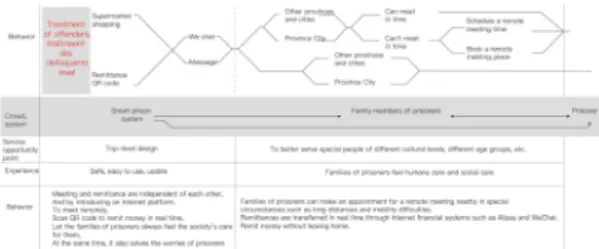
We divided the meeting notice and remittance into parallel paths, as shown in Fig. 5. Taking the business process as an opportunity, focusing on the steps and chance points in the process, we deeply analyzed the “pain points” and design

opportunity points in the business process, and defined and redesigned specific problems.

3.2.1 Improved service environment raises the enthusiasm of prisoners in reform

The system utilizes the technical advantages of smart prison to help prisoners automatically generate external dynamic QR code through data storage and calculation. It enables families of prisoners to scan the code through Alipay, WeChat and other means to check the

“treatment” level and reform performance of prisoners, etc. In the system, remittance amount and effective remittance time of families of prisoners are suggested, families of prisoners can independently choose the amount of remittance, and give feedback through information and other means after the remittance is received. In this way, the remittance process is greatly simplified, the service efficiency is improved, and the waiting time of the families of the prisoners is reduced. This way of service reflects the humanistic care of the prison management department and the society to the families of prisoners.

3.2.2 Service innovation for the vulnerable groups among the families of prisoners

In the preliminary survey, we found that

families of prisoners can be divided into local

and foreign families, and their respective family

situations are also different, and we tried our

best to take care of all groups and classes of

users. Elderly families of prisoners and families

of prisoners with lower educational levels can

either learn from prison guards when they meet

with prisoners, or make an appointment at a

nearby remote meeting point to have operation

training. We also designed door-to-door teaching

services for families of prisoners in special

circumstances such as mobility difficulties. For

elderly, the sick, disabled and unwell families of

prisoners, who cannot timely participate in the

(10)

meeting due to various reasons, we built a remote meeting platform and designed a reservation mechanism for the remote meeting based on the smart prison system. They can also make appointments through the Internet, and choose the nearest remote meeting point or meet with the prisoners online. Through more practical and more humanized design, we helped the vulnerable groups and prisoners to relieve themselves of worries about the reform in prison.

3.3 Design summary

Characteristics of service design in the construction of smart prison:

(1) People-oriented: It takes aim at the services for the reform of prisoners and for stakeholders, and is limited by the prison system. The reform service for prisoners needs to continue to find failure points for optimization and innovation;

(2) Integrity: It aims at the reform of prisoners and obtains the needs of families of prisoners through stakeholder analysis. The service process is redesigned to relieve the worries of prisoners.

(3) Closer to the real world: Service behavior and life behavior are more close to the real world environment and help prisoners integrate into social life upon completion of their sentences, which are conducive to the long-term peace and stability of the society. For example,

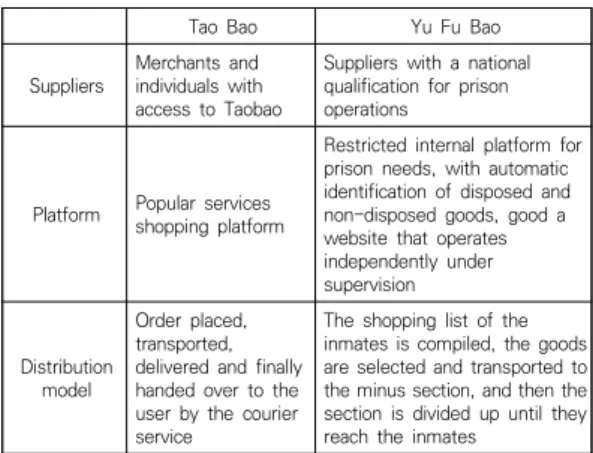
“Taobao” in prison has the same shopping mode as “Taobao” and “Pinduoduo” that we are familiar with.But there are also some differences, such as the Table 3.

(4) Collaborative innovation: Service design includes collaborative innovation in different fields such as collaborative design, technology and management. The development of “Prison Pay” integrates multi-disciplinary collaborative innovation

Deficiencies of service design in the construction of smart prison:

Tao Bao Yu Fu Bao

Suppliers Merchants and individuals with access to Taobao

Suppliers with a national qualification for prison operations

Platform Popular services shopping platform

Restricted internal platform for prison needs, with automatic identification of disposed and non-disposed goods, good a website that operates independently under supervision

Distribution model

Order placed, transported, delivered and finally handed over to the user by the courier service

The shopping list of the inmates is compiled, the goods are selected and transported to the minus section, and then the section is divided up until they reach the inmates

Table 3. The difference between Taobao and YuFuBao

Sustainability: Reform of prisoners is a long process. As the construction of smart prison goes deep, new technologies and new ideas are constantly emerging to enable service design to continue the way of design thinking and continuously innovate service for the reform of prisoners.

However, due to the limitations of prison, professional designers cannot spend as long in prison environments as they do in business or other public services to discover the needs of prisoners

4. Smart prison sustainable service innovation strategy

However, compared with commercial service and design thinking, the difficulty of public service design is that it tends to ignore the continuous influence of the system [11]. Although the design of “Prison Pay” financial service innovation has been strongly supported by the management unit and the technology provider, in the specific implementation process, due to various factors such as the prison management system, institutional and organizational structure, the innovation team met with many difficulties.

How to realize the sustainable service innovation

of smart prison is what we need to discuss and

study next.

(11)

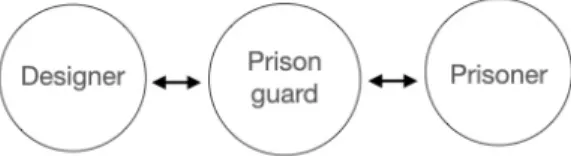
Fig. 7. Relationship Between Designer, Prisoner and Prison Guard

4.1 Redefining the concept of prison sustainable service: EBLCD

Drawing upon participatory design principles, the co-design element in EBCD aims at opening up the boundaries of designing in healthcare services in order to include new stakeholders and forms of expertise; patients are called to share their specialist form of expertise (knowledge) and participate in the design process from the idea generation stage [12].

In the fields of public services such as medical care, the relationship between designers and users is significantly different from that between designers and prisoners in smart prison. In EBCD (as shown in Fig. 6), the “collaboration” in collaborative design.

Fig. 6. Relationship between Patient, Designer and Medical Related Personnel

focuses on the partnership and joint leadership between patients and professionals in hospitals .Collaborative design means more than responding to patients and paying heed to their needs. Patients are not merely active partners who “have a voice” in care, they also make a positive contribution to the design of care [13].

However, for prisoners (as shown in Fig. 7), the enclosed wall is a closed, isolated and

occluded space throughout the whole process of serving a sentence. They have the right to be served under the prison’s strict rules, but other activities are strictly restricted. As the carrier between prisoners and designers, prison managers and guards are the transmitters of prisoners’ emotions, psychology, life and other aspects, and can provide insights into the reform of prisoners in daily life, including which service solutions are currently effective and which are not, and accurately convey the service requirements. Designers cannot use observational methods[14], empathy[15], ethnography[16], ethnology[17] as they look at other public services. Therefore, the innovation team proposed EBLCD based on EBCD. (as shown in Table 4,) EBLCD emphasizes the leading position of prison guards and managers in the design process. Based on their experience in getting along with prisoners, they propose innovative service modes adapted to the development of prisons with design thinking inside the organization, and lead designers, technicians and other personnel to carry out collaborative innovation outside the organization.

Inside the

organization Outside the organization

EBLCD

Apply design thinking to lead internal renovation service optimization

Use their own experience to lead designers, technicians and other team members to understand the prison context, and collaborate with team members to carry out renovation service innovation

Table 4. How EBLCD Is Used Inside and Outside the Organization

4.2 Theoretical significance

The service design method provides a new

perspective for prison service innovation. The

design practice confirmed the feasibility of

service design method in prison service

innovation, and found the insufficient

application of service design methods in prison

context. Therefore, smart prison construction

(12)

Traditional service design

methods EBLCD

Cognition of the context

Within the scope permitted by laws and regulations, the designer carries out research. It remains at the surface of the context that the designer can see

Lead cognition and help project team members to understand prison context

Research on users

For specific projects, the designer can interview very few prisoners with the approval from the leaders(for the Prison Pay project, no approval is obtained)

Lead cognition, be able to find the physiological and psychological needs of prisoners in real time, and convey them

Role of prison guards in

design the process

Collaborate with the designer to assess the design proposal

Based on the experience of getting along the prisoners, they propose the innovative service mode adapted to the development of the prison and lead innovation by design thinking inside the organization. Outside the organization, they use and lead designers and technicians to understand the prison context and carry out collaborative innovation Table 5. Differences Between EBLCD and Traditional

Service Design Concepts

aims to design suitable design concept and method for the special context of prison.

Meanwhile, EBLCD emphasizes the role of leading and collaboration. The experience led approach, dominated by managers and guards, can effectively help the innovation team to understand the prison environment, bridge the gap between service receivers and designers, and realize the smart prison “sustainable service innovation”。

4.3 Practical impact

A part from the theoretical significance, this design practice also has a practical impact.

Smart prison has distinctive construction characteristics. In order to realize smart prison sustainable service innovation, it is necessary to create sustainable value both inside and outside the organization, rather than relying on external innovation team for service innovation. For internal and external interaction of the organization, it is necessary to make clear that

the prison managers and guards need to play a core role in service innovation [18.19], The construction of smart prison also provides more references for the smart prison development. As model prison, it can provide experience for other smart prisons, and help other smart prisons design and implement sustainable innovation for reconstruction in accordance with their own development depending on different contexts, thereby maintaining the sustainable development of society.

5. Research limitations and future studies

The limitation of the study lies in the particularities of the context. As a management organization with strict system, prison greatly differs from commercial service agencies and even other public service agencies. Firstly, compared with other subsystems of the smart prison system, Prison Pay financial service focuses more on the reform service for prisoners and the service for their families. Although this subsystem is representative to some extent, it cannot radiate other subsystems, such as the design of transition services for prisoners. In other words, when prisoners are about to be released after serving their sentence, how to provide sustainable skills learning services and psychological counseling services so that prisoners can better integrate into society?

Stakeholders at this stage are more open. Is the experience-based sustainable service design concept suitable for service innovation at this stage? Even so, based on this design experience, further in-depth analysis may be conducted to expand the coverage of service design and application and establish better service innovation system thinking.

Secondly, due to insufficient verification of the

(13)

scheme, However, it is a long-term process to construct smart prison, and only under the unified leadership of the government can the scheme proposed in the early stage be verified.

Third, the limitation of empirical research depth. As prison has a special environment, the number of data samples is relatively small and some data is highly confidential, which will result in some conclusions of the author’s subjective speculation. The author also hopes to do further exploration and research in the future if the conditions permit.

REFERENCES

[1] Yi Sheng Tong Xin Child Development Foundation.

(2016. Reduce Crime and Recidivism to Make Society more Stable and Peaceful. Njytf.cn

http://www.njytf.cn/nd.jsp?id=169&_ngc=-1&groupId=2.

[2] Q. Ma, X. Y. Zhang & Z. L. Li. (2006). Reform of the Prison System and Exploration of the Establishment of Service-oriented Prisons. Journal of Anhui Vocational College of Police Officers, 5(2), 63-65.

DOI : 10.3969/j.issn.1671-5101.2006.02.022

[3] Karen Holtzblatt & Hugh Beyer. (2019). Contextual Interaction Design: Design for Life. Cambridge, Ma Morgan Kaufmann

[4] S. Victors & J. Z. Li. (2018). Seven Principles of Persuasive Design: Influencing User Choice by Design=Design for the Mind, Post & Telecom Press, Beijing. P.37.

[5] Bureau of Prisons of the Ministry of Justice. (1991).

Revised Draft of Opinions on the Trial Implementation of Division of Custody, Charge and Education for Criminals . Ministry of Justice.

[6] General Office of the State Council. (1994). Prison Law of the People’s Republic of China.

www.gov.cn[Online ].

Http://www.gov.cn/ziliao/flfg/2005-09/12/content_31 186.html.

[7] N. Loucks. (2005). Contrasting Prisoners’ Rights: A Comparative Examination of England and Germany.

By Liora Lazarus. The British Journal of Criminology, 45(6), 999–1001.

DOI : 10.1093/bjc/azi088.

[8] L. T. Jia, F. N. Jia & S. Z. Dong. (2011). Web Form Design. Posts &Telecom Press, Bei Jing: Ren Min You Dian Chu Ban She.

[9] D. A. Norman. (2013). The Design of Everyday Things.

Massachusetts: Mit Press.

[10] Han & L Y. Zhang. (2014). The Laws of Simplicity.

China Machine Press, Bei Jing: Ji Xie Gong Ye Chu Ban She.

[11] J. Vink, K. Koskela-Huotari, B. Tronvoll, B.

Edvardsson, & K. Wetter-Edman. (2020). “Service Ecosystem Design: Propositions, Process Model, and Future Research Agenda.” Journal of Service Research. 24(1), 1-19.

DOI : 10.1177/1094670520952537.

[12] E. B. N. Sanders & P. J. Stappers. (2008). “Co-Creation and the New Landscapes of Design.” CoDesign, 4(1), 5-18. DOI : 10.1080/15710880701875068

[13] P. Bate & G. Robert. (2007). Bringing User Experience to Healthcare Improvement: The Concepts, Methods and Practices of Experience-Based Design.

International Journal of Health Care Quality Assurance, 20(5), 533-534.

DOI : 10.1108/ijhcqa.2007.06220eae.001.

[14] M. Arvola, J. Blomkvist, S. Holmlid & G. Pezone.

(2012). A Service Walkthrough in Astrid Lindgren’s Footsteps. In Servdes-Service Design & Innovation Conference

[15] J. F. Dovidio, J. A. Piliavin, D. A. Schroeder & L. A.

Penner. (2012). The Social Psychology of Prosocial Behavior. New York: Psychology Press/Taylor &

Francis Group.

[16] Mariampolski Hy. (1999). The Power of Ethnography.

Market Research Society Journal, 41(1), 1-12.

DOI : 10.1177/147078539904100105.

[17] J. Blomberg, M. Burrell & G. Guest. (2003). The Human-Computer Interaction Handbook:

Fundamentals, Evolving Technologies, and Emerging Applications. Choice Reviews Online, 40(8), 964–986.

DOI : 10.5860/choice.40-4648.

[18] A. Kouadio, Brice, Y. Emery & O. Boukamel. (2020).

Leading Public Sector Innovation: Co-Creating for a Better Society. Policy Press.” Management International, 24(4), 165.

DOI : 10.7202/1074368ar

[19] Terrey Nina. (2013). Managing by Design: Enacted through Situated Networks. Design Management Journal, 8(1), 52–61.

DOI : 10.1111/dmj.12003

(14)

진 섭(Chen Xie) [정회원]

․ 2011년 7월 : Southwest Jiaotong University,China(학사)

․ 2014년 7월 : Southwest Jiaotong University,China(석사)

․ 2019년 9월 ~ 현재 : 국민대학교 테 크노디자인전문대학원 경험디자인학 과 박사과정

․ 관심분야 : 상호디자인, 서비스디자인, 디자인사고

․ E-Mail : [email protected]

반 영 환(Younghwan Pan) [종신회원]

․ 1991년2월:한국과학기술원 산업공 학과(공학사)

․ 1993년2월:한국과학기술원 인간공 학(공학석사)

․ 1999년 8월 : 한국과학기술원 인간공 학(공학박사)

․ 2006년 9월 ~ 현재 : 국민대학교 테크 노디자인전문대학원 교수

․ 관심분야 : 인터랙션 디자인, 사용자 경험(UX)

․ E-Mail : [email protected]

수치

Fig.  1.  Stakeholder  Map
Fig.  2.  User  Journey  Map
Fig.  3.  Prison  Guards  Serve  Different  Groups  as  Two-way  Interaction  People
Fig.  5.  Process  of  Services  for  Families  of  Prisoners  and chance point of the meeting business, so as so as to put forward a new planning standard for the  meeting  hall  environment
+3

참조

관련 문서

웰드라인의 위치를 위치를 옮기는 옮기는 방안 방안 - 게이트 위치 변경. - 제품 두께분포 변경 -

And this systemic risk has become even more potent due to the complex and interconnected global financial system we have today.. Unfortunately, regulators were not

The Joseon government designed and promulgated the Taegeukgi as a national flag for diplomatic and political purposes, but it was the independence movement that made it

• 이명의 치료에 대한 매커니즘과 디지털 음향 기술에 대한 상업적으로의 급속한 발전으로 인해 치료 옵션은 증가했 지만, 선택 가이드 라인은 거의 없음.. •

Modern Physics for Scientists and Engineers International Edition,

If both these adjustments are considered, the resulting approach is called a bootstrap-BC a -method (bias- corrected-accelerated). A description of this approach

· 50% exemption from tuition fee Ⅱ for the student with a TOPIK score of level 3 or higher or completion of level 4 or higher class of the Korean language program at the

웹 표준을 지원하는 플랫폼에서 큰 수정없이 실행 가능함 패키징을 통해 다양한 기기를 위한 앱을 작성할 수 있음 네이티브 앱과