• 검색 결과가 없습니다.

Households' Characteristics, Forest Resources Dependency and Forest Availability in Central Terai of Nepal

N/A
N/A
Protected

Academic year: 2021

Share "Households' Characteristics, Forest Resources Dependency and Forest Availability in Central Terai of Nepal"

Copied!
10
0
0

로드 중.... (전체 텍스트 보기)

전체 글

(1)

548

F OREST S OCIETY

Households’ Characteristics, Forest Resources Dependency and Forest Availability in Central Terai of Nepal

Menaka Panta * , Kyehyun Kim and Cholyoung Lee

Department of Geoinformatic Engineering, Inha University 253 Yonghyun-dong, Namgu, Incheon 402-751, S. Korea

Abstract : For centuries, forests have been a key component of rural livelihood. They are important both socially and economically in Nepal. Firewood and fodder are the basic forest products that are extracted daily or weekly basis in most of the rural areas in Nepal. In this study, a field survey of 100 households was conducted to examine the degree of forest dependency and forest resource availability, households’

livelihood strategy and their relationship with forest dependency in Chitwan, Nepal. A household’ response indexes were constructed, Gini coefficient, Head Count Poverty Index (HCI) and Poverty Gap Index (PGI) were calculated and one way ANOVA test was also performed for data analysis. Data revealed that 82/81%

of all households were constantly used forest for firewood and fodder collection respectively while 42% of households were used forest or forest fringe for grazing. The Forest Product Availability Indexes (FPAI) showed a sharp decline of forest resources from 0.781 to 0.308 for a 20-yr time horizon while timber wood was noticeably lowered than the other products. Yet, about 33% of households were below the poverty threshold line with 0.0945 PGI. Income distribution among the household showed a lower Gini coefficient 0.25 than 0.37 of landholdings size. However, mean income was significantly varies with F-statistics=

246.348 at P=0.05 between income groups (rich, medium and poor). The extraction of firewood, fodder and other forest products were significantly different between the income group with F-statistics=16.480, 19.930, 29.956 at P=0.05 respectively. Similarly, landholdings size and education were also significantly different between the income groups with F-statistics=4.333, 5.981 at P=0.05 respectively. These findings suggested that income status of households was the major indicator of forest dependency while poor and medium groups were highly dependent on the forests for firewood, fodder and other products. Forest dependency still remains high and the availability of forest products that can be extracted from the remaining forestlands is decreasing. The high dependency of households on forest coupled with other socioeconomic attributes like education, poverty, small landholders and so on were possibly caused the forest degradation in Chitwan.Therefore, policy must be directed towards the poor livelihood supporting agenda that may enhance the financial conditions of rural households while it could reduce the degree of forest dependency inspired with other income generating activities in due course.

Key words : forest dependency, rural livelihood, field survey, chitwan, nepal, household response index

1. Introduction

Forests provide a wide range of natural assets, includ- ing household goods, cultural values, physical and bio- logical products, and other services that are vital to the livelihood of many people (USDA, 2007; NRC, 2008).

Sunderlin et al. (2005) found that household surveys and case study research demonstrated that the rural poor tend to be disproportionately dependent on forest resources in the sense that a higher proportion of their total income

comes from forest resources (Reddy and Chakravarty, 1999). Similarly, Odihi (2003) noted that one cause of deforestation was the lack of alternative energy sources and high profit margins from the fuelwood economy.

Moreover, forests are promoted to improve the well- being of local communities (Elands et al., 2004), and extensive forest areas are occupied with large numbers of poor people that depend on the forest for their live- lihoods in the tropics (Wunder, 2001). In Nepal, forests are closely related to the basic needs and survival of the rural poor. The dependency on timber and non-timber forest products exceeds 95% and the procurement of fuelwood for cooking and house heating accounts for

*Corresponding author

E-mail: [email protected]

(2)

83% of the energy consumption (Gautam, 2006; SOE, 2001; ADB, 2004). Fodder collection and grazing are also traditionally practiced for livestock production, a major food resource for people of all regions in Nepal (FRA, 2000). However, human dependency on forest resources has had adverse impact on flora and fauna, and excessive pressure on these resources has led to severe environmental deterioration (FAO, 1999). Conse- quently, various problems i.e. climate change, desertifi- cation, deforestation and forest degradation have been also continually observing and rural livelihood is also threatening in the recent years.

Growing levels of concern have been leading to the studies of forest resource dependence among the rural households (Mamo et al., 2007), socio-economic factors and their related activities (Namaalwa et al., 2007), fuel- wood consumption and forest degradation (Heltberg et

al., 2000), microeconometric analysis of forest biomass extraction by households (Dayal, 2006), models of pol- icy changes (Grainger and Malayang III, 2006) in var- ious part of the world. However, except few researches and individual studies (Fox, 1984; Adhikari et al., 2004;

Adhikari et al., 2007; Sapkota and Oden, 2008; Panta et

al., 2009), yet fewer studies has been carried out in Nepalese Terai addressing this type of issues.

It is widely known that degree of forest dependency is also determined by the various households’ characteris- tics. Therefore, we considered some households’ char-

acteristics such as education, poverty, income and landholdings size related with forest resources extraction pattern in Chitwan. Thus, this paper attempted to ana- lyze the socioeconomic attributes of households’ and their dependency on forest in terms of using firewood, timber, fodder and grazing land in Chitwan district of Nepal based on information gathered from field visit during the household survey. This information could be useful to planner in decision making process by under- standing the households’ livelihood, forest dependency, and their critical consequences in deforestation and for- est degradation process of Nepalese Terai.

Methods and Materials

1. Study area

Chitwan district is located between 27° 00'-27

o

45' N latitude and 84°15’-85°15’E longitude (Figure 1). It cov- ers a total area of 2,218 sq km and ranges from 244 m to 1,945 m in altitude. The district is divided into two municipalities, and there are 36 Village Development Committees as the lowest administrative unit. Diversi- fied socioeconomic structure with traffic junction for east-west highway and connection to the country’s cap- ital in north is another characteristic of Chitwan. It was one of the resource-rich districts of the country, having immense natural and commercial forests and agricultural commodities which, covered by virgin forest, had been

Figure 1. Study area containing VDCs in the Chitwan district of Nepal.

(3)

preserved for centuries and an undisturbed wildlife hab- itat. Forests resources were predominantly covered with Sal ( Shorea robusta ), relatively in good form compared with another districts nearby; however, it is surrounded by human settlement and therefore under heavy pressure to meet the basic desires of settlers hence forest are also deteriorating very rapidly. Moreover, since the 1960s, the land cover has been heavily disturbed by humans.

Hence, a heavily degraded narrow Sal forest passage in the middle of the district is the last remaining forest cor- ridors linking Chitwan national park with the wider mountain ecosystem of Nepal in north.

2. Data collection

This study was carried out mainly based on primary data collection in VDC/Wards level through a house- holds’ survey in 2007. In Nepal, Village Development Committee (VDC) in rural areas and Municipality in urban area are the grass root level administrative units, and each is further divided in to the smaller units called Wards. A VDC constitutes 9 wards and a Municipality constitutes more than 9 wards. First, we selected 8 administrative units including both VDCs and Munici- palities purposely considering the location advantages using a stratified random sampling. However, due to time and financial constraints later we preferred only five units where forest boundary is one of the boarders of these administrative units. Accordingly, three Wards from each VDC and Municipality were selected pur- posely giving consideration to sharing a border and loca- tion nearest to the forest boundary for sample households.

Such a way, 15 Wards were selected and then only 5 Wards were reselected randomly for the purpose of field survey. From each selected Wards 20 households and the total of 100 households was selected randomly using Random Number generating calculator for interview.

Systematically designed survey questionnaires were governed and triangulated to gather both qualitative and quantitative information. Questionnaires were prepared in Nepali language for the convenience of the respon- dents and were asked about the demographic, education, landholdings size, major sources of income, occupation and households’ consumption, forest resources availabil- ity, uses and their monetary value based on local price, and households views about the forest management/deg- radation was also considered. All the households’ infor- mation gathered from the questionnaires were coded and analysis in MS Excel and SPSS. Key informant/elite per- son interview, consultation of meetings and small group dis- cussions, meeting with elderly people and direct observation were also carried out during the field work. In this way, households’ survey and forest inventory data together Participatory Rural Appraisal were served as the primary

information sources from the study area. While second- ary information was collected from VDCs and Munici- palities offices, previous research, documents and other publications. Local people nearby forest boundary who are mostly depend on forests as well as key informants involved in forest management were asked to interview and gather data on the status of livelihood, forest resources availability and the extent of forest depen- dency in the study area.

3. Data analysis

Forest Product Availability Response Index was con- structed to reflect the household perception regarding the concentration of forest resources in the study area. This index was calculated on the basis of responses from sample households regarding the availability status of forest resources and forest products over the three dif- ferent time horizons (20 years before, 10 years before and currently considered for 2007). Scores were assigned to measure the availability status over time (abundant=1, as required=2, less than required=3, and scarce=4). The average household score was then decoded into a scale between 0 and 1 (where 1 is perfect) and the results were interpreted. MS Excel and other simple statistics were also used for the data analysis.

Foster-Greer-Thorbacke (FGT) indices recommended by World Bank (http://www.worldbank.org/) like Head Count Poverty Index (HCI) and Poverty Gap Index (PGI) were used to calculate the economic strength of sample house- holds. HCI explains the proportion of units (households or individuals) below the poverty line while GPI explains the total economic deficit of poor and depth of poverty.

Both indexes were calculated in this analysis as below:

Where, HC I = Head count poverty Index

N

p

= Number of units below poverty line

N = Total population PGI was calculated based on:

Where, P

i

= Poverty Gap Index

N = Total Population

N

p

= Number of people below poverty line

Y

p

= Poverty Line Income ($1 per day of 14,942 NRs per annum considering, household avail- able only 210-215 days of working day/year) Yi = Individual income

The Gini coefficient is a measure of statistical disper- sion which is commonly used to quantify the inequality of income or wealth. However, it has also applied in the

HCI N p --- 100 N ×

=

P i 1

N ---- Y p – Y i Y p ---

i 1 = N

p

=

(4)

diversified fields such as ecology, health science and chemistry to study inequalities. It can ranges from 0 to 1. A low Gini coefficient indicates a more equal distri- bution while 0 indicate perfect equality. Oppositely, higher Gini coefficients indicate more unequal distribu- tion with 1 perfect inequality (http://en.wikipedia.org/wiki/

Gini_coefficient). Thus, Gini coefficient was also calcu- lated to measure the inequality in income and landhold- ings distribution among the sample households in this study. Forest consumption and the degree of forest depen- dency are highly determined by the households’ charac- teristics such as poverty, income, education/occupation, cast, distance to forest, landholdings size and so on (Sap- kota and Oden, 2008) which is directly or indirectly related with rural livelihood. Poor households’ are highly depended on forest for their basic needs because they are much benefited from the forest (Reddy and Chakravarty, 1999; Sapkota and Oden, 2008). Therefore, we also ana- lyzed the forest dependency in terms of using forest prod- ucts/services like firewood, timber, fodder, other forest products and grazing with respect to households’ liveli- hood characteristics in the area. Households economic was considered as a key basis for analysis so households were divided in the three income groups namely: poor (Nrs. <14,942), medium (Nrs.14, 942-25,000) and rich (Nrs. >25,000) based on annual income and poverty

threshold of the households. Finally, one way ANOVA test has performed in SPSS for further analysis.

Results

1. Forest products and energy sources at household level

Out of 100 sampled households, 82% responded that they collect firewood only from forest while 12%

responded that collected from both their own land and forest; 81% of households collect fodder from the forest and approximately 42% of households use the forest or forest fringe to graze their animals. Types and quantities of various forest products extracted from the forest are presented in Table 1.

Similarly, 95% of the households responded that elec- tricity was mainly used for lighting and electronic house wares. However, 34% of households were also used ker- osene for burning lamps during power cut-off. Firewood, LP gas, and biogas are used as major fuel energy source for cooking at the households. Based on households’

response, a total of 82% of households were using fire- wood for cooking in the study area (Table 2).

2. Monetary value of forest resources

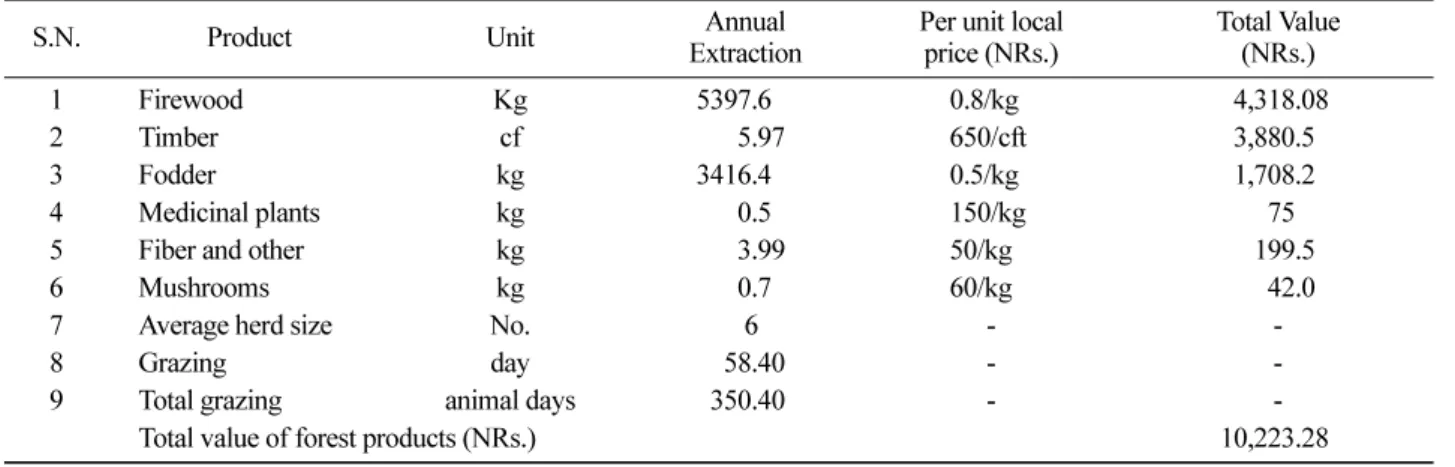
The annual extraction values of forest products and

Table 1. Type and quantities of forest products used at household.

S.N. Description Households Average Quantity Used (per household)

Number Percent Local Unit

(Bhari/Week) Standard Unit/week

1 Fire wood from the forest 82 82 3.46 103.8 kg/week

2 Fire wood both from the forest and respon-

dent’s own land 12 12 - -

3 Fire Wood from respondent’s own land 5 5 - -

4 Timber 12 12 - 5.970 cf/year

5 Fodder from Forest 81 81 2.19 65.7 kg/week

6 Medicinal Plants 21 21 - 0.5 kg/year

7 Mushroom 10 10 0.7 kg/year

9 Fiber and other Products 5 5 - 3.99 kg/year

10 Grazing 42 42 - 1.21 hr./day

Table 2. Types and purpose of energy use at households.

S.N. Description Household

No Purpose Percent

1 Electricity 95 lighting, radio, television, ironing 95

2 Kerosene 34 light during electric cut-off 34

3 Firewood from the forest 82 cooking 83

4 Firewood both from the forest and own land 12 cooking 12

5 Both firewood and Biogas 20 cooking 20

6 Both firewood and LP gas 23 cooking 23

7 Biogas and LP gas 2 cooking 2

(5)

services used by local people in monetary terms are pre- sented in Table 3. The sum total of Nrs. 10, 223.28 is the total annual value of the forest products and services that are consumed by individual households. Among the forest products, firewood constitutes the largest value (Nrs. 4,318.08) followed by timber wood (Nrs. 3,880.8), fodder (Nrs.1, 708) and fiber Nrs.200/yr.

3. Forest product availability in the study area

The forest products and services availability response ratio revealed that the forest availability was quite good (0.781) before 20 yrs. However, the response ratio was slightly declined for the next 10-year period from 0.781 to 0.621; but, it was sharply declined from 0.621 to 0.308 (reached at half) from 10-year period to the cur- rent year (current year considered for this study is 2007, the year of sample household survey data collection for this analysis) (Figure 2A). Moreover, a response index for some of the key forest products was also constructed.

It explained that there was a sharp decline in timber wood availability as compared to the firewood and fod- der in between time horizon (Figure 2B). However, in

the case of fodder and firewood, there was slightly decline of availability between 20 years before to 10 years before, but the declining trend was accelerated for 10 years before to the current year 2007 as similar trend followed by the timber wood.

4. Poverty level at households

Poverty status was generated based on the income assessment of the sample households during the field survey. Income from different sources was calculated considering the local price of agriculture and forest com- modities that produced or extracted by the villagers (Table 3). HCI and PGI was used to calculate the pov- erty status considered the threshold poverty line Nrs.

14,942/yr based on the per capita income US $ 1 per day with assumption of 210-215 working days available for them. This was generalized in whole study area. Our results showed that almost 33% of households were still below the poverty thresholds (Nrs.14, 942) with PGI 0.0945. This was considerably higher than the NLSS II (2003/2004) which was estimated by almost 28% of head count poverty in rural Terai.

Table 3. Forest services used and their valuation based on local price.

S.N. Product Unit Annual

Extraction Per unit local

price (NRs.) Total Value (NRs.)

1 Firewood Kg 5397.60 0.8/kg 4,318.08

2 Timber cf 5.97 650/cft 3,880.50

3 Fodder kg 3416.40 0.5/kg 1,708.20

4 Medicinal plants kg 0.50 150/kg 750.0

5 Fiber and other kg 3.99 50/kg 199.50

6 Mushrooms kg 0.70 60/kg 42.00

7 Average herd size No. 60.. - -

8 Grazing day 58.40 - -

9 Total grazing animal days 350.40 - -

Total value of forest products (NRs.) 10,223.28

Note: NRs. = Nepali Rupees

Figure 2. (A) Total forest product availability index (B) major forest products response index.

(6)

5. Distribution pattern of income and landholdings Gini coefficient was calculated to foresee the income and landholdings distribution pattern within the sample households. It was observed that income and landhold- ings were not equally distributed however the Lorenz curve for income was nearer to the perfect line with low Gini coefficient 0.25 compare with moderately unequal Gini coefficient of landholdings size 0.37. Nevertheless, one way ANOVA test showed that the mean income was significantly different between the three income groups (poor, medium and rich) with F- tatistics 246.348 value at P=0.05 level (Table 5). The descriptive statistics for the income groups are presented in Table 4.

6. Forest dependency with respect to households char- acteristics

It was observed that the extraction or consumption pattern of forest resources like firewood, fodder and other products were significantly different in three income groups with F-statistics=16.480, 19.930, 29.956 respec- tively at P=0.05 level (Table 7). Poor and medium income group households were much depended on the forest for their firewood, fodder and other products (mushroom, fiber, herbs etc) desire than the rich group. Interestingly, firewood extraction/use was significantly higher in medium group while other minor forest products were in poor groups. There was no significant difference between the three income groups using timber wood and forest fringe for grazing, however, the rich groups were consumed more timber wood than the others two. The descriptive statistics for forest products use and some households’

characteristics are presented in Table 6. Similarly, the livelihood characteristics of households such as land- holdings size and education were also significantly dif- ferent with F-statistics 4.333, 5.981 at P=0.05 level respectively in three income groups. Landholdings size and education number both were increased as income

increases at households. Poor groups had a smaller size land and less number of educated than the other two groups.

4. Discussion and conclusions

Results found in this study with about 82% of house- holds collected approximately 104 kg firewood and 81%

of households collected 66 kg fodder on a weekly basis from the forest, and 42% of households were using for- est to grazing their animals (Table 1) are the facts of high forest dependency. United Nations (1995) study also reported that 84% of household were used energy as firewood while 82% of households’ firewood source was forest in Chitwan. Similarly, the households using LP gas and biogas with firewood accounted >50% of their cooking energy from firewood was another evidence of high reliance on the forest for fuel energy. That could be due to the high cost of LP gas and the low production of biogas which couldn’t sufficiently meet their needs during the winter. Panta et al. (2008) mentioned that dis- proportionately reduction in Chitwan forest types and forest area could be the reason of forest land conversion or excessive forest extraction in the past. Both processes have had a dramatic and negative impact on forest reli- ance and forest availability as well.

Angelsen and Kaimowitz (1999) found that greater access to forests and markets can often hasten the forest extraction process. The same situation might have also happened in Chitwan district due to the accessibility of market and open entrance to the government managed forest. Consequently, it was observed that forest products availability found to be sharply declined from 0.781 to 0.368 compared with 20 years before and current year 2007 (Figure 2A). Moreover, based on Forest Product Availability Response Index we found that a sharp lost of timber wood products as compared to firewood and fodder for the year 2007 (Figure 2B). This shows the Table 4. Descriptive statistics for households’ income groups.

Income

groups N Mean Std. Error 95% Confidence Interval for Mean Minimum Maximum Lower Bound Upper Bound

Poor 32 10770.9375 391.77101 9971.9152 11569.9598 5438.00 13875.00

Medium 38 18977.6579 452.95714 18059.8796 19895.4362 15075.00 24258.00

Rich 30 34862.3667 1261.17145 32282.9814 37441.7519 25233.00 50160.00

Total 100 21116.9200 1058.48141 19016.6632 23217.1768 5438.00 50160.00

Table 5. ANOVA test among the income groups.

Sum of Squares df Mean Square F Sig.

Between Groups 9267283255.966 2 4633641627.983 246.348 .000

Within Groups 1824507403.394 97 18809354.674

Total 11091790659.361 99

(7)

forest dependency is still higher and that the availability of forest products that can be extracted from the remain- ing forestlands is decreasing, whether from local pro- cesses or through other socioeconomic causes in Chitwan.

Some authors came close with the issues of households’

fuelwood sources and they tried to differentiate fuel- wood from forests and private farmland (Pattanayak et

al., 2004; Heltberg et al., 2000). However, due to the open access in government owned forest, the largest part of firewood, fodder and other products are normally available from the government or community manage forest rather than the private land in Nepal. Therefore, there was only 5% firewood that household were col- lected from the private land; while 12% firewood was shared with both forest and private land in this study too (Table 1).

Several researchers realized that woodland degradation is associated with a high level of dependency on fuel-

wood harvesting and charcoal production (Ribot, 1993;

Geist and Lambin, 2001; Sankhayan and Hofstad, 2001;

Luoga et al., 2002). While other mentioned, poverty is blamed as one of the root cause of deforestation and for- est degradation because poor people may have higher dependency on the forest for their endurance (UNCED, 1992). Nevertheless, other many socioeconomic inequal- ities among the rural households could play an indis- pensable role in both forest dependency and forest degradation process. Therefore, socioeconomic attributes of households must be considered in understanding the relationship between rural livelihood and their level of forest necessity.

Descriptive statistics revealed the differences in house- holds’ characteristics, income groups and forest resources use with respect to income groups among the sample households (Table 4 and 6). The F- test statistics showed that households’ income was significantly varied between

Table 6. Descriptive statistics for households’ characteristics and forest products use.

N Mean Std. Error 95% Confidence Interval

for Mean Minimum Maximum

Lower Bound Upper Bound

fw_kg

Poor 32 7531.8750 381.42862 6753.9462 8309.8038 4680.00 14040.00

Medium Income 38 4864.7368 484.67345 3882.6951 5846.7785 1560.00 12480.00

Rich 30 3796.0000 494.35378 2784.9330 4807.0670 .00 10920.00

Total 100 5397.6000 304.96369 4792.4859 6002.7141 .00 14040.00

Tm_cf

Poor 32 5.1563 1.29912 2.5067 7.8058 .00 20.00

Medium Income 38 7.0263 1.26530 4.4626 9.5901 .00 20.00

Rich 30 5.5000 1.93798 1.5364 9.4636 .00 50.00

Total 100 5.9700 .85652 4.2705 7.6695 .00 50.00

Fd_kg

Poor 32 2193.7500 251.18499 1681.4548 2706.0452 .00 4680.00

Medium Income 38 4926.3158 360.42499 4196.0254 5656.6062 .00 9360.00

Rich 30 2808.0000 354.00058 2083.9875 3532.0125 .00 6240.00

Total 100 3416.4000 224.69668 2970.5530 3862.2470 .00 9360.00

Oth_fpd

Poor 32 11.0000 .95962 9.0428 12.9572 4.50 30.00

Medium Income 38 3.3026 .66017 1.9650 4.6403 .00 15.00

Rich 30 3.7667 .72506 2.2838 5.2496 .00 13.00

Total 100 5.9050 .56932 4.7753 7.0347 .00 30.00

gz_day

Poor 32 55.6156 12.50236 30.1169 81.1144 .00 182.50

Medium Income 38 61.2421 12.08068 36.7643 85.7199 .00 182.50

Rich 30 57.8033 12.65076 31.9296 83.6770 .00 182.50

Total 100 58.4100 7.10709 44.3080 72.5120 .00 182.50

hsz_kattha

Poor 32 8.3281 .96083 6.3685 10.2877 2.00 28.00

Medium Income 38 13.1053 1.60049 9.8624 16.3482 1.00 60.00

Rich 30 17.0333 3.16236 10.5656 23.5011 1.00 75.00

Total 100 12.7550 1.20599 10.3620 15.1480 1.00 75.00

edu_yr

Poor 32 4.3438 .69214 2.9321 5.7554 .00 14.00

Medium Income 38 4.8947 .75975 3.3553 6.4341 .00 14.00

Rich 30 7.9333 .83036 6.2351 9.6316 .00 18.00

Total 100 5.6300 .46268 4.7119 6.5481 .00 18.00

(8)

three poor, medium and rich income groups (Table 5).

As Sapkota and Oden (2008) noted that the amount of fuel wood collection varied greatly between the rich and poor, we also found the extracted amount of firewood, fodder and other forest products were significantly var- ied between the income groups in this study (see Table 6 and 7). Which offer income could be one of the deter- minant factor of forest dependency in the rural commu- nity where their life mostly reliant in forest resources.

Moreover, poor and medium groups were much involved in firewood, fodder and other products collection than rich. One reason could be, firewood is the only acces- sible source of households’ energy at rural areas for poor simply they can’t afford for the other sources i.e. LP gas, Kerosene and electricity etc. But other thought “Due to greater dependence, poor people extract more resources and hence generate higher income from the common”

(Jodha, 1992; Iyenger and Shukla, 1999 cited in Sapkota and Oden, 2008). F-test statistics further showed a sig- nificant variation in landholdings size and number of educated within the income groups which could also

influenced in forest resources collection. Our results were also in favor with Reddy and Chakravarty (1999), that who mentioned the poor have less land so are dependent on the forest for greater income. Numbers of educated person and landholdings sizes was determined by the income group i.e. poor group contained with lesser number and smaller land size and vise versa. Due to the absence of their schooling and less work in their own farmland, uneducated and petite landholder could have much free time. So that they can spend compara- tively long hours in collecting and selling firewood and other minor forest products (mushroom, honey, medici- nal plants, verities of forest fruits etc) which can proffer their better economy. Interestingly, extraction of timber wood and using grazing land didn’t show any significant difference between the groups. However, rich groups were extracted timber wood much than the other two.

The reason behind this could be the ability of timber wood consumption, economic strength, consciousness in forest value, and their supremacy in the society.

As Dayal (2006) thought, programs encouraging the

Table 7. ANOVA test between households’ characteristics and forest products.

Sum of Squares df Mean Square F Sig.

fw_kg Between Groups 233507669.132 2 116753834.566 16.480 .000

Within Groups 687220554.868 97 7084747.988

Total 920728224.000 99

Tm_cf Between Groups 70.218 2 35.109 .473 .624

Within Groups 7192.692 97 74.151

Total 7262.910 99

Fd_kg Between Groups 145574589.789 2 72787294.895 19.930 .000

Within Groups 354262514.211 97 3652190.868

Total 499837104.000 99

Oth_fpd Between Groups 1225.211 2 612.606 29.956 .000

Within Groups 1983.636 97 20.450

Total 3208.848 99

gz_day Between Groups 565.706 2 282.853 .055 .947

Within Groups 499490.704 97 5149.389

Total 500056.410 99

hsz_kattha Between Groups 1180.897 2 590.449 4.333 .016

Within Groups 13217.850 97 136.266

Total 14398.748 99

edu_yr Between Groups 232.646 2 116.323 5.981 .004

Within Groups 1886.664 97 19.450

Total 2119.310 99

Note: fw _ kg = firewood in kilogram Tm _ cf = Timber in cubic feet Fd _ kg = Fodder in kilogram Oth _ fpd = Other forest products gz _ day = grazing in day

hsz _ kattha = landholding size in kattha (1 kattha [Nepal] = 0.033 8 hectare)

edu_yr = education number in year

(9)

use of alternative fuels help to reduce the intensity of biomass extraction from the forest. Odihi (2003) also emphasized that improvement of the socioeconomic con- ditions of the poor and recruitment of alternative energy sources can lessen the forest dependency and deforesta- tion problems as well. Therefore, the findings and per- spective presented in this study could be prominent in planning and administration process to move ahead searching for the alternative sources of fuel wood desires and employing the various rural developmental installa- tions. Programs encouraging those issues could help pro- moting in households’ income, employment and education opportunity while reduce the degree of forest depen- dency ultimately. That may also significantly affect in rural livelihood hence traditional sources of energy pos- sibly substitute with the modern fuel types at households so that achievement can be taken to reduce the degree of deforestation and forest degradation as well.

Acknowledgements

This research was supported by an Inha University Research Grant. The authors would also like to thank the anonymous reviewers of this manuscript.

Literature Cited

1. Angelsen, A. and Kaimowitz, D. 1999. Rethinking the Causes of Deforestation: Lessons from Economic Mod- els. The World Bank Research Observer 14: 3-98.

2. ADB. 2004. Asian Development Bank. Country Envi- ronment Analysis for Nepal.

3. Adhikari, B., Di Falco, S. and Lovett, J.C. 2004. House- hold Characteristics and Forest Dependency: Evidence from Common Property Forest Management in Nepal.

Ecological Economics 48: 245-257.

4. Adhikari, B., Williams, F. and Lovett, J.C. 2007. Local Benefits from Community Forests in the Middle Hills of Nepal. Forest Policy and Economics 9: 464-478.

5. Dayal, V. 2006. A microeconometric analysis of house- hold extraction of forest biomass goods in Ranthamb- hore National Park, India. Journal of Forest Economics 12: 145-163.

6. Elands, B.H., O’Leary, T.N., Boerwinkel, H.W. and Wiersum, K.F. 2004. Forests as a Mirror of Rural Con- ditions; Local Views on the Role of Forests Across Europe. Forest Policy and Economics 6: 469-482.

7. Fox, J.M. 1984. Firewood Consumption in a Nepali Vil- lage. Environmental Management 8: 243-250.

8. FAO. 1999. Annotated Bibliography, Forest Cover Change, Nepal. Forest Resources Assessment Programme (FRA), Forest Resources Division (FRD), FAO Rome.

9. FRA. 2000. Global Forest Resource Assessment Main

Report 2000. Food and Agriculture Organizations of the United Nations.

10. Geist, H.J. and Lambin, E.F. 2001. What Drives Defor- estation? A Meta-Analysis of Proximate and Underly- ing Causes of Deforestation Based on Sub-National Case Study Evidence, LUCC Report Series, vol. 4.

LUCC International Project Office, Louvain-la-Neuve, Belgium.116p.

11. Grainger, A. and Malayang III, B.S. 2006. A Model of Policy Changes to Secure Sustainable Forest Manage- ment and Control of Deforestation in the Philippines.

Forest Policy and Economics 8: 67-80.

12. Gautam, K.H. 2006. Forestry, Politicians and Power- Perspectives from Nepal’s Forest Policy. Forest Policy and Economics 8: 175-182.

13. Heltberg, R., Arndt, T.C. and Sekhar, N.U. 2000. Fuel- wood consumption and forest degradation: a household model for domestic energy substitution in rural India.

Land Economics 76: 213-232.

14. Luoga, E.J., Witkowski, E.T. and Balkwill, K. 2002.

Harvested and Standing Wood Stocks in Protected and Communal Miombo Woodlands of Eastern Tanzania.

Forest Ecology and Management 164: 15-30.

15. Mamo, G., Sjaastad, E. and Vedeld, P. 2007. Economic Dependence on Forest Resources: A Case from Dendi District, Ethiopia. Forest Policy and Economics 9: 916- 16. Namaalwa, J., Sankhayan, P.L. and Hofstad, O. 2007. 927.

A Dynamic Bio-economic Model for Analyzing Defor- estation and Degradation: An Application to Wood- lands in Uganda. Forest Policy and Economics 9: 479 -495.

17. NRC. 2008. Natural Resources Canada. Ecosystem Ser- vices: The Total Value of the Forest. http://canadafor- ests.nrcan.gc.ca/articletopic

18. Odihi, J. 2003. Deforestation in Afforestation Priority Zone in Sudano-Sahelian Nigeria. Applied Geography 23: 227-259.

19. Pattanayak, S.K., Sills, E.O. and Kramer, R.A. 2004. See- ing the forest for the fuel. Environment and Develop- ment Economics 9: 155-179.

20. Panta, M., Kim, K. and Joshi, C. 2008. Temporal map- ping of deforestation and forest degradation in Nepal:

Applications to forest conservation. Forest Ecology and Management 256: 1587-1595.

21. Panta, M., Kim, K. and Lee, C. 2009. People’s liveli- hood and their perception towards forest degradation in central Nepal: The households’ perspective. NSDI Korea, 2009, GIS joint Conference of KSISS, KOGSIS, GISAK, Sept, 10, 2009, KINTEX, Korea.

22. Ribot, J.C. 1993. Forestry policy and Charcoal Produc- tion in Senegal. Energy Policy 21: 559-585.

23. Reddy, S.R. and Chakravarty, S.P. 1999. Forest Depen-

dence and Income Distribution in a Subsistence Econ-

(10)

omy: Evidence from India. World Development 27:

1141-1149.

24. SOE. 2001. State of the Environment. Report on State of Environment of Nepal.

25. Sankhayan, P.L. and Hofstad, O. 2001. A Village-level Economic Model of Land Clearing, Grazing, and Wood Harvesting for sub-Saharan Africa: With a Case Study in Southern Senegal. Ecological Economics 38: 423- 26. Sunderlin, W.D., Angelsen, A., Belcher, B., Burgers, P., 440.

Nasi, R., Santoso, L. and Wunder, S. 2005. Livelihoods, Forests, and Conservation in Developing Countries: An Overview. World Development 33: 1383-1402.

27. Sapkota, I.P. and Oden, P.C. 2008. Household Charac- teristics and Forest Dependency on Community Forests

in Terai of Nepal. International Journal of Social For- estry 1: 123-144.

28. UNCED, 1992. National Report on United Nations Conference on Environment and Development. Kath- mandu: HMG.

29. UN, 1995. The world’s women 1995: Trends and sta- tistics. New York: United Nations.

30. USDA, 2007. The US Department of Agriculture. http:/

/www.fs.fed.us/ecosystemservices

31. Wunder, S. 2001. Poverty Alleviation and Tropical For- est-What Scope for Synergies? World Development 29:

1817-1833.

(Received June 11, 2009; Accepted October 19, 2009)

수치

Figure 1. Study area containing VDCs in the Chitwan district of Nepal.
Table 1. Type and quantities of forest products used at household.
Table 3. Forest services used and their valuation based on local price.
Table 5. ANOVA test among the income groups.
+3

참조

관련 문서

Purpose: This study was designed to evaluate the clinical characteristics and the treatment of colonoscopic perforation and the availability of

key words: forest healing, forest healing factor, forest healing program, forest for healing, urban forest.. 특히 급 격한 도시화 및 산업화에 따라 여가시간

Incheon Metropolitan City's green projects took first place in the 2016 Green Fund Support Program organized by the Korea Forest Welfare Institute. The ‘Eco Garden’ plan

In the broad approach, a country would define a system of forest management practices (without the requirement that a specified forest management practice

intensive properties are available. • The calculation of these properties from measurable ones depends on the availability of simple and accurate relations between the two

Böcher, 2008, Integrated Rural Development Policy In Germany and its Potentials for new Modes of Forest Governance, Institute of Forest, Environmental, and

내삶을 바꾸는 숲, 숲 속의 대한민국.. KOREA FOREST

1 John Owen, Justification by Faith Alone, in The Works of John Owen, ed. John Bolt, trans. Scott Clark, &#34;Do This and Live: Christ's Active Obedience as the