- 772 -
등가회로 법을 이용한 Thomson Coil Actuator 특성 해석
리웨이*, 루지앙*, 정영우**,고창섭* 충북대학교*, LS산전**
A Numerically Efficient Performance Analysis of Thomson Coil Actuator of Arc Eliminators Using Equivalent Circuit Method
Wei Li*, Jiang Lu*, Young-Woo Jeong**,Chang-Seop Koh* Chungbuk National University*, LSIS, Co. Ltd**
Abstract - A numerically efficient performance analysis method for Thomson coil actuator of an arc eliminator is developed by transferring the problem to an equivalent circuit model considering the distribution of eddy current in conducting plate. Through a numerical analysis, the developed method is proven to give a solution, with only 1.3% of computing time, as accurate as finite element method. The developed method is testified by comparing with FEM calculation and experiment results.
1. Introduction
An arc eliminator is a fault throwing device to protect systems from an arc inside a switchgear by bypassing the power current from the distribution line to a ground. For this, very high speed action in terms of just a few milliseconds from arc ignition to fully effective short to a ground is required. For this reason, Thomson coil actuator, which is remarkable for its high speed, is being more and more employed as the driving unit of the arc eliminator [1]. For the dynamic performance analysis of the actuator, time-stepping finite element method (FEM) combined with circuit and motional equations have been the most popular method. It is, however, very time consuming[2]. In this paper, a novel computationally efficient analysis method is proposed by transferring the problem into an equivalent circuit model considering the distribution of the eddy current in the plate.
An adaptive refinement algorithm is also suggested based on the field continuity condition to get minimum required segmentation of the plate for precise performance analysis.
The accuracy and efficiency of the proposed method are verified through comparison with FEM results.
2. Performance Analysis
2.1 Equivalent circuit model
The simplified structure of the Thomson coil actuator for an arc eliminator is shown in Fig.1 (a). The actuator is mainly composed of opening and closing coils and a moving plate with high conductivity. The moving space of the plate is the area between the opening and closing coils. The other assistant elements such like the spring for supporting the plate will not be introduced here. The exciting current of the coils are supplied by a capacitor storage system.
close coil open coil close position open position
fixed contact
Normal Current
C-Bank
Signal from Arc monitoring
system S2
moving contact
plate
Fig. 1. The simplified mechanism of the arc eliminator.
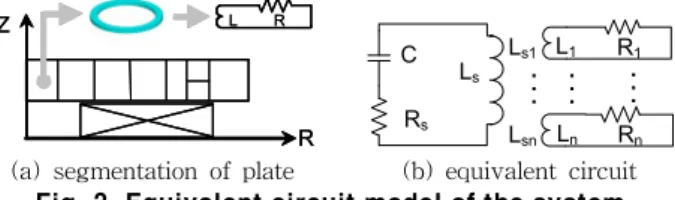
In order to construct an equivalent electric circuit model which can represent the distribution of eddy current in the moving plate, the plate is divided into a series of segments.
The individual segment physically corresponds to a conductive ring with circuit parameters of resistance and inductance as shown in Fig. 2(a). The equivalent electric circuit model of the system is presented in Fig. 2(b). Each segment is represented by one circuit loop with parameters of resistance, self inductance and mutual inductances with other circuits.
The electromagnetic relationship between the exciting coil and the moving plate is abstracted as the parameter of mutual inductance between exciting coil and each segment.
R
Z L R
R
Z L R
C Ls
Rs
. . . R1
L1
Ln Rn
Ls1
. . .
. . .
Lsn
(a) segmentation of plate (b) equivalent circuit Fig. 2. Equivalent circuit model of the system.
2.2 Governing equations
The circuit equations as well as the flux equations are shown as follow:
(1)
(2)
(3-a)
(3-b) where and are the resistance and flux linkage of the exciting circuit. is the exciting current. Q and C stand for the charge and value of the capacitor. and are the resistance and flux linkage of the i-th circuit. stands for the eddy current in the i-th circuit. is the mutual inductance between the exciting circuit and i-th circuit. is the mutual inductance between the i-th and j-th circuits. As there is no magnetic material in the system, the inductance only depends on the geometry dimension. The self inductance will not change with the relative position between the exciting coils and the levitation plate, therefore, the derivative of the self inductance to the position of the plate is zero.
Furthermore, all the segments move together as a whole plate, it is unnecessary to calculate the derivative of mutual inductance between two segments.
The expressions of energy and electromagnetic force are shown as follow:
(4)
(5) The dynamic state equations of the system can be obtained 2009년도 대한전기학회 하계학술대회 논문집 2009. 7. 14 - 17
- 773 -
0 10 20 30 40 50 60 70
-10 0 10
Radial direction (mm)
Axial direction (mm)
0 1.0 2.0 3.0e8
0 10 20 30 40 50 60 70
-10 0 10
Radial direction (mm)
Axial direction (mm)
0 1.0 2.0 3.0e8
Calculation method
Relative error (%)
Computing time (seconds)
FEM - 10 hours
proposed (number of
segments)
4 1.13 1.81
13 0.29 6.50
49 0.12 82.24
94 0.09 456.6
by combining circuit and motion equations.
(6-a)
(6-b)
(6-c)
(6-d)
(6-e)
where , , represent the displacement, speed and charge respectively. , m are load force and plate mass. The dynamic characteristics can be obtained by solving these ordinary differential equations with initial conditions.
2.3 Adaptive refinement
The accuracy of the solution strongly depends on the segmentation of the conducting plate. In order to achieve precise performance analysis with less computing time, an adaptive segment refinement is developed. According to the electromagnetic field theory, the tangential component of electric field intensity should be continuous at the interface of two segments. From this, together with Ohm’s law, we get, at the interface of segments, the condition of . In this paper, local field continuity error for a segment (e), shown in Fig. 3, is defined as follows:
∙ (7)
where Ne is the number of the neighboring segments of e-th segment, J(e) and Jk are the eddy current densities of the e-th segment and the k-th neighboring segment, respectively, lk is the length of the overlapped interface between e-th segment and the k-th neighboring segment.
1 (e)3 2 1 (e)3 2
1 3 2
1 3 2
(a) before refinement (b)after refinement Fig. 3. Segment refinement.
In the first loop, the plate is initially divided into some segments uniformly, the local error for all segments are computed, the segments with big error will be refined into more segments. Therefore, during the second calculation loop the refined segments will be used instead of the old segments.
The calculation will stop until the result is convergent. Fig. 4 shows the segmentation of the plate and distribution of eddy current density. As the number of segments increases, the distribution of the eddy current density becomes continuous.
(a) initial segmentation
(b) final segmentation
Fig. 4. Distribution of eddy current density and segmentation.
2.4 Verification of results
The program based on the proposed method is used to analyze the dynamic characteristics of the Thomson coil type actuator which is also solved by using FEM. The aluminum is taken as the plate material. The comparison between the calculation results and experiment results are shown in Fig.5.
0 5 10 15 20
0.0 0.4 0.8 1.2 1.6 2.0
0 5 10 15 20
-0.5 0.0 0.5 1.0 1.5 2.0
0 5 10 15 20
0 2 4 6 8 10
0 5 10 15 20
0 40 80 120
exciting current (kA)
time (ms) Proposed FEM
Experiment Force (kN)
time (ms) Proposed FEM
speed (m/s)
time (ms) Proposed FEM Experiment
displacement (mm)
time (ms) Proposed FEM Experiment
Fig. 5. Comparison of calculation results of Aluminum plate.
As seen from the results, the calculation results of proposed method match very well with the FEM results. Compare to calculation results, the experiment results show the same changing trend with a tolerant error. If the FEM result is taken as the reference, the maximum displacement relative error of the results form proposed method with different number of segments are shown in Table 1. It can be easily seen that with FEM computation, the computing time is about 10 hours, while by adopting the proposed method; the computation time is less than 8 minutes even with 94 segments, which is much more efficient.
Table 1. Comparison of calculation accuracy and efficiency.
3. Conclusion
The dynamic characteristics of Thomson coil type actuator used in an arc eliminator have been analyzed by using a novel solving technique which is developed based on the equivalent circuit model. An adaptive segment refinement algorithm is proposed based on the field continuity condition to get minimum required segmentation of the conducting plate for precise performance analysis. Compare to the FEM, this solving technique is much more efficient to get the same accuracy, which is quite important for design and analyze electromagnetic devices.
[Reference]
[1] Toshie Takeuchi, "Electromagnetic Analysis Coupled with Motion for High-Speed Circuit Breakers of Eddy Current Repulsion Using the Tableau Approach," Electrical Engineering in Japan, vol.152,no.4,pp.8-16,2005.
[2] Seung Myen Lee, "Reduced Modeling of Eddy Current Driven Electromechanical System Using Conductor Segmentation and Circuit Parameters Extracted by FEA,"
IEEE Trans. on Magn., vol.41,no.5,pp.1448-1451,May2005.