• 검색 결과가 없습니다.

Isolated Double-Chambered Right Ventricle in a Young Adult

N/A
N/A
Protected

Academic year: 2022

Share "Isolated Double-Chambered Right Ventricle in a Young Adult"

Copied!
4
0
0

로드 중.... (전체 텍스트 보기)

전체 글

(1)

272

Print ISSN 1738-5520 / On-line ISSN 1738-5555 Copyright © 2011 The Korean Society of Cardiology CASE REPORT

DOI 10.4070/kcj.2011.41.5.272

Open Access

Isolated Double-Chambered Right Ventricle in a Young Adult

Jung-Gil Park, MD, Han-Jun Ryu, MD, Yeun-Su Jung, MD, Ki-Ju Kim, MD, Bong-Ryeol Lee, MD, Byung-Chun Jung, MD, and Hyunjae Kang, MD Department of Internal Medicine, Daegu Fatima Hospital, Daegu, Korea

ABSTRACT

Double-chambered right ventricle (DCRV) is a rare congenital heart disorder in which the right ventricle is divided by an an- omalous muscle bundle into a high pressure inlet portion and a low pressure outlet portion. We report a case of isolated DCRV without symptoms in adulthood, diagnosed through echocardiography, cardiac catheterization and cardiac magnetic reson- ance imaging. (Korean Circ J 2011;41:272-275)

KEY WORDS: Heart defeets, congenital; Cardiac catheterization; Echocardiography; Magnetic resonance imaging.

Received: June 16, 2010

Revision Received: August 20, 2010 Accepted: September 27, 2010

Correspondence: Hyunjae Kang, MD, Department of Cardiology, Dae- gu Fatima Hospital, 183 Ayang-ro, Dong-gu, Daegu 701-600, Korea Tel: 82-53-940-7227, Fax: 82-53-954-7417

E-mail: [email protected]

• The authors have no financial conflicts of interest.

cc

This is an Open Access article distributed under the terms of the Cre- ative Commons Attribution Non-Commercial License (http://creativecom- mons.org/licenses/by-nc/3.0) which permits unrestricted non-commer- cial use, distribution, and reproduction in any medium, provided the origi- nal work is properly cited.

Introduction

Double-chambered right ventricle (DCRV) is a rare con- genital heart disease characterized by the division of the right ventricular cavity into two chambers by anomalous muscle bundles.

1)

Typically, DCRV is diagnosed at childhood or ad- olescence, and most DCRV patients have associated conge- nital anomalies, such as ventricular septal defect (VSD), pulmo- nary stenosis, and subaortic stenosis.

2)

Here, we report a case of an isolated adult DCRV patient who had no symptoms.

Case

A 26-year-old man was referred to the hospital for the ev- aluation of his abnormal cardiac murmur found during a rou- tine health examination program. The patient had no cardi- ac symptoms, such as chest pain or dyspnea. During the phy- sical examination, a prominent grade 5/6 systolic ejection murmur was heard on the left parasternal border. His blood pressure was 110/72 mmHg, and his heart rate was 66/min.

In addition to mild cardiomegaly on the chest radiography,

the electrocardiogram showed increased amplitude of the R

wave on V1 and inverted T waves on V1-V3, suggesting right

ventricular overload. The two-dimensional (2-D) transthor-

acic echocardiogram on the parasternal short axis view sh-

owed a marked muscle band protruding from the right ven-

tricular free wall to the interventricular septum (Fig. 1A). In

addition, right atrial enlargement, right ventricular hyper-

trophy and dilation, and moderate tricuspid regurgitation

were found. A turbulent Doppler color flow jet with a mosaic

pattern was seen through the stenotic mid-right ventricle on

the parasternal short axis view (Fig. 1B). Continuous wave Dop-

pler revealed tricuspid regurgitation between the right atrium

and right ventricle with a flow acceleration of 7.0 m/s, corre-

sponding to a pressure gradient of 196 mmHg calculated us-

ing the simplified Bernoulli equation (Δp=4ν

2

) (Fig. 1C).

3)

Tr-

ansesophageal echocardiography demonstrated an anoma-

lous muscle bundle dividing the right ventricle into two parts

(Fig. 2). There was no shunt flow between the right and left

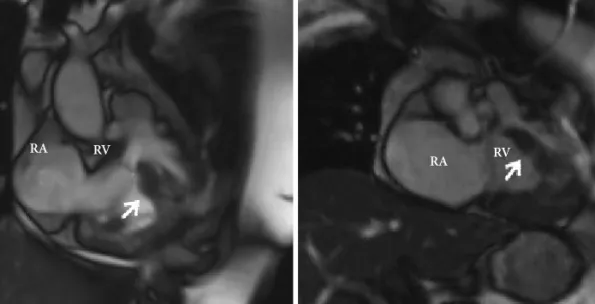
parts of the heart. In addition, cardiac magnetic resonance

imaging (MRI) revealed that hypertrophied muscle bundles

transected the right ventricle from the free wall to the ventri-

cular septum, resulting in the division of the right ventricle

into two chambers (Fig. 3). Coronary angiography revealed

normal coronary arteries; however the right ventriculogram

demonstrated severe right ventricular muscle bundle hyper-

trophy, separating the right ventricle into the inflow and

outflow chambers (Fig. 4). Cardiac catheterization was per-

formed, and the pull-back pressure from right heart cathe-

terization was recorded. The systolic pressure of the right ven-

tricular inlet and the outlet pressure were 135 and 25 mmHg

(2)

Jung-Gil Park, et al. 273

respectively, while the pressure gradient of the right ventricle was 110 mmHg (Fig. 5). There was no pressure gradient be- tween the right ventricle outlet tract and the main pulmonary artery. Based on these findings, the patient was referred to a thoracic and cardiovascular surgery clinic for surgical cor- rection, but the patient refused operative correction and was thus discharged, with local follow up.

Discussion

DCRV is a rare form of congenital heart disease in which the right ventricle is divided into a proximal high pressure ch- amber and a distal low pressure chamber. There are several subtypes of divided right ventricle. A simple classification of the associated pathology was proposed by Galiuto, who divid- Fig. 2. Transesophageal echocardiography showing anomalous

muscular bundles (arrow) dividing the right ventricle into two parts. RV: right ventricle, LV: left ventricle, RA: right atrium, LA: rig- ht atrium.

A

C

B

Fig. 1. Double-chambered right ventricle demonstrated by transthrorasic echocardiography. A: two-dimensional echocardiography showing a stenotic mid-right ventricle with an anomalous muscle bundle (arrow). B: turbulent Doppler color flow with mosaic pattern. C: continuous-wave Doppler showing tricuspid regurgitation between the right atrium and right ventricle and indicating the flow acceleration and pressure gradient.

RV: right ventricle, LV: left ventricle, RA: right atrium.

(3)

274 Isolated Double-Chambered Right Ventricle

ed DCRV into two distinct types of intracavitary obstruc- tion.

4)

Type 1 DCRV is characterized by an anomalous mus- cle bundle crossing the right ventricular cavity, recognized as the cause of the intraventricular obstruction. In type 2 DC- RV however, no anomalous muscle bundle is found. The ob- struction in this case is caused by marked parietal and septal muscle hypertrophy. The intraventricular pressure gradient of type 1 DCRV is greater than that of type 2 DCRV, where- as VSD was found to be highly associated with type 2 DC- RV.

4)

The patient in the case presented herein falls under the category of type 1 DCRV.

Associated cardiac anomalies are common in DCRV. The most common associated cardiac anomaly is VSD, present in

63-77% of the cases, while other reported associated anoma- lies include valvar pulmonary stenosis, atrial septal defect, aor- tic valve regurgitation, tricuspid valve regurgitation, persis- tent left superior vena cava, ruptured sinus of valsalva aneu- rysm, tetralogy of Fallot, complete or corrected transposition of the great arteries, and Ebstein anomaly.

1)2)

Thus, it is nec- essary to look for associated congenital anomalies when DC- RV is diagnosed. Most cases of DCRV are diagnosed and treated during childhood, but the right ventricular outflow tract is not always a routine part of the adult echocardiogra- phic examination. It can be difficult to obtain an image ow- ing to the proximity of the right ventricular outflow tract to the transducer.

5)

If an image is available, the subcostal plane has the most diagnostic value.

6)

In older patients however, the parasternal short axis at the level of the aortic valve is found to be very useful,

7)

and in these cases, of superior value to the subcostal plane. Imaging with transesophageal echocardiog- raphy from the esophageal junction provides an excellent vi- sualization of the right ventricle and coronary sinus because the gastroesophageal junction is close to the right atrium, co- ronary sinus, and right ventricle. Therefore, whether trans- esophageal echocardiography is helpful in reducing misdi- agnosis prior to operation for VSD associated with DCRV re- PA

RA

RV

Fig. 4. Right ventriculogram demonstrating a severe hypertrophied muscle bundle (arrow). RV: right ventricle, RA: right atrium, PA: pul- monary artery.

RVIT RVOT

Fig. 5. Cardiac catheterization showing systolic pressure gradient between RVIT and RVOT. RVIT: right ventricular inlet tract, RVOT:

right ventricular outlet tract.

RA RV

Fig. 3. Two-dimensional cine MRI showing anomalous muscle bundle (arrow). RV: right ventricle, RA: right atrium.

RA RV

(4)

Jung-Gil Park, et al. 275

mains to be seen.

8)

Finally, cardiac MRI has enabled three-di- mensional visualization not only of the cardiac chambers and great vessels but also of the coronary artery system, with ex- cellent spatial resolution. This may prove to be the most effec- tive noninvasive means of imaging DCRV.

9)

The nature of DCRV entails a tendency towards progres- sive obstruction by the muscle bundles, presumably second- ary to both muscle hypertrophy and endocardial fibrosis. Pa- tients can develop severe and varied symptoms, such as easy exhaustion, shortness of breath, recurrent chest infection, and in younger patients, retardation of growth. Therefore, treat- ment of most DCRV cases is surgical which often constitutes a part of the corrective procedure. Generally, the surgical pro- cedures consist of the resection of the anomalous muscular bundle and correction of the associated cardiac anomalies.

The period for surgical repair usually depends on the associ- ated cardiac anomalies. In the absence of a significant coex- isting defect, observation is possible as long as the intracavi- tary systolic gradient is not greater than 40 mmHg and the obstruction is not progressive.

10)

The long term prognosis for patients after the intracardiac repair of DCRV is excellent, but postoperatively, three-quarters of the patients were shown to have had complete or incomplete right bundle branch block in some studies.

2)11)

There are some cases, however, where an- tiarrhythmic agents or catheter ablation are required to treat ventricular tachycardia, or the insertion of a permanent pace- maker is required to treat the atrioventricular block during the postoperative period.

8)11)12)

Most cases of DCRV are diagnosed during childhood and are commonly associated with VSD. However, if DCRV with- out an associated anomaly shows a tendency towards a slowly progressive obstruction, it is difficult to diagnose DCRV with- out symptoms. In our case where the patient had no prior me- dical history or symptoms, DCRV was accidentally diagnos- ed through the auscultation of a cardiac murmur during a routine pre-employment medical exam. Furthermore, in other studies concerning DCRV, patients were incidentally diagnosed during a non-cardiac surgery pre-operative ex- amination, similar to what transpired in our case.

9)13)

2-D echo- cardiography demonstrated right ventricular pressure over- load and moderate tricuspid regurgitation, but there was no pulmonary stenosis or right ventricular outflow tract (RVOT) obstruction. The pressure gradient of the right ventricle add-

ed to the right atrial pressure is equal to the right ventricular systolic pressure. Estimates of right ventricular pressure can be helpful in the diagnosis of a variety of disorders, includ- ing pulmonary hypertension, RVOT obstruction and pulmo- nary stenosis.

14)

However, in this case, abnormal muscular ob- struction in the right ventricle caused a pressure gradient.

Therefore when evaluating a patient with elevated right ven- tricular systolic pressure, it is better to view the entire right heart complex before considering pulmonary hypertension, especially if there is no RVOT obstruction or pulmonary ste- nosis present .

REFERENCES

1) Cil E, Saraclar M, Özkutlu S, et al. Double-chambered right ventri- cle: experience with 52 cases. Int J Cardiol 1995;50:19-29.

2) Kim CJ, Chai IH, Koh KK, et al. Double chambered right ventricle in adult and adolescence. Korean Circ J 1990;20:248-55.

3) Nishimura RA, Miller FA Jr, Callahan MJ, Benassi RC, Seward JB, Tajik AJ. Doppler echocardiography: theory, instrumentation, tech- nique, and application. Mayo Clin Proc 1985;60:321-43.

4) Galiuto L, O’Leary PW, Seward JB. Double-chambered right ventri- cle: echocardiographic feature. J Am Soc Echocardiogr 1996;9:300-5.

5) Choi YJ, Park SW. Characteristics of double-chambered right ven- tricle in adult patients. Korean J Intern Med 2010;25:147-53.

6) Hoffman P, Wojcik AW, Rozanski J, et al. The role of echocardiogra- phy in diagnosing double chambered right ventricle in adult. Heart 2004;90:789-93.

7) Galal O, Al-Halees Z, Solymar L, et al. Double-chambered right ventricle in 73 patients: spectrum of the disease and surgical results of transartial repair. Can J Cardiol 2000;16:167-74.

8) Chang RY, Kou CH, Rim RS, Chou YS, Tsai CH. Transesophageal echocardiographic image of double-chambered right ventricle. J Am Soc Echocardiogr 1996;9:347-52.

9) Sato Y, Matsumoto N, Matsuo S, et al. Double-chambered right ven- tricle: depiction at three-dimensional whole heart magnetic reso- nance imaging. Int J Cardiol 2007;119:e14-6.

10) McElhinney DB, Chatterjee KM, Reddy VM. Double-chambered right ventricle presenting in adulthood. Ann Thorac Surg 2000;70:

124-7.

11) Kim J, Park TI, An SG, et al. Electrical storm late after surgery for a double-chambered right ventricle, aortic regurgitation and a ventric- ular septal defect: a case of successful catheter ablation. Korean Circ J 2008;38:60-5.

12) Hachiro Y, Takagi N, Koyanagi T, Morikawa M, Abe T. Repair of double-chambered right ventricle: surgical results and long-term fol- low-up. Ann Thorac Surg 2001;72:1520-2.

13) Yang SM, Chung WJ, Oh KJ, Kim MJ, Kim MK, Ahn TH. Two cas- es of double-chambered right ventricle without other congenital car- diac anomalies. J Korean Soc Echocardiogr 2005;13:37-41.

14) Vieillard-Baron A. Assessment of right ventricular function. Curr

Opin Crit Care 2009;15:254-60.

수치

Fig. 1. Double-chambered right ventricle demonstrated by transthrorasic echocardiography
Fig. 4. Right ventriculogram demonstrating a severe hypertrophied  muscle bundle (arrow)

참조

관련 문서

During transthoracic and transesophageal echocardiography, a spontaneously healed membranous type ventricular septal defect (VSD) with malaligned interventricular septal

excludes bundle branch reentry 16) and 3) good efficacy was noted for the endocardial ablation at the apicolateral and mid lateral walls of the left ventricle where the