Veterinary Science BSE situation and establishment of Food Safety Commission in Japan
Takashi Onodera*, Chi-Kyeong Kim
Department of Molecular Immunology, Graduate School of Agricultural and Life Sciences, University of Tokyo, Yayoi 1-1-1, Tokyo 113-8657, Japan
Eight major policies were implemented by Japanese Government since Oct. 2001, to deal with bovine spongiform encephalopathy (BSE). These are; 1) Surveillance in farm by veterinarian, 2) Prion test at healthy 1.3mi cows/yr, by veterinarian, 3) Elimination of specified risk material (SRM), 4) Ban of MBM for production, sale use, 5) Prion test for fallen stocks, 6) Transparent information and traceability, 7) New Measures such as Food Safety Basic Law, and 8) Establish of Food Safety Commission in the Cabinet Office. At this moment, the extent of SRM risk has only been indicated by several reports employing tests with a limited sensitivity. There is still a possibility that the items in the SRM list will increase in the future, and this indiscriminately applies to Japanese cattle as well.
Although current practices of SRM elimination partially guarantee total food safety, additional latent problems and imminent issues remain as potential headaches to be addressed. If the index of SRM elimination cannot guarantee reliable food safety, we have but to resort to total elimination of tissues from high risk-bearing and BSE-infected animals. However, current BSE tests have their limitations and can not yet completely detect high- risk and/or infected animals. Under such circumstances, tissues/wastes and remains of diseased, affected fallen stocks and cohort animals have to be eliminated to prevent BSE invading the human food chain systems. The failure to detect any cohort should never be allowed to occur, and with regular and persistent updating of available stringent records, we are at least adopting the correct and useful approach as a reawakening strategy to securing food safety. In this perspective, traceability based on a National Identification System is required.
Key words: bovine spongiform encephalopathy, BSE, Food Safety Comission, specified risk material, surveillance test, traceability
Introduction
In April 1985 the first cases in the United Kingdom of a new disease of cattle were seen; bovine spongiform encephalopathy (BSE) which has commonly become known as “mad cow disease.” This disease was characterized by gray matter vacuolation and fibrils similar to those observed in sheep scrapie [10,20]. Epidemiological studies established the most probable cause of the outbreak of the new disease as changes in the rendering process for the offal used in animal feed. This allowed some agent-either scrapie agent from infected sheep carcasses or a previously uncharacterized BSE agent-to contaminate high protein cattle feed [22,24].
Between 1981 and 1982 most of the rendering plants had changed their process such that there was no longer a solvent based fat-extraction step followed by steam distillation of the solvent. Solvents have been shown to inactivate the scrapie agent [8]. Without the steam distillation step, the offal failed to reach the high steam temperature known to destroy the scrapie agent (138
oC for 1 hour 3 bars) [3,8,19].
The change in offal processing preceded the subsequent outbreak of BSE in 1986-7. It is possible that the agent was always present in this type of feed, but that the reduction in fat content with hydrocarbons and the subsequent steam treatment of the product kept the number of infectious particles down so that a clinical disease was not seen (the disease symptoms being dose related). In Scotland, where the hydrocarbon extraction continued to be used during high protein feed production, the number cases of BSE was significantly fewer per head of cattle in England [23].
The magnitude of the BSE epidemic was probably amplified by infected cattle being included in the rendering process. It does appear, however, that BSE is not readily transmitted either horizontally or vertically [21], and as a result of feed ban in July 1988 the size of the epidemic has been self-limiting to a large extent [24]. Indeed, the incidence of disease in cattle born after the feed ban took effect has dropped dramatically through years [23,24]. However, it is not clear whether or not maternal transmission of BSE does occur [9].
The start of the BSE epidemic was followed by reports of
*Corresponding author
Tel: +81-3-5841-5196, Fax: +81-3-5841-8020
E-mail: [email protected]
Review
spongiform encephalopathies in a variety of animals including many exotic animals housed in zoos and wildlife parks [7,12,15,26]. These infections were all associated with ruminant-derived feed [13] or from maternal transmission [12]. These infections all produced the same lesion profiles when injected into mice as BSE and feline spongiform encephalopathy (FSE) [4]. The transmission of spongiform encephalopathy across the species barrier by oral dosing is of great concern to the government in all over the world.
However, it appears that primates are protected by a considerable species barrier; indeed from transmission data with marmoset, primates are more likely to contact scrapie than BSE [1]. Since epidemiological studies have never linked human transmissible spongiform encephalopathy (TSE) with exposure to sheep scrapie and transgenic mice expressing that human prion protein (PrP) are not more susceptible to BSE than non-transgenic controls [6] it is possible that humans are not threatened by BSE zoonosis. In early 1996, however, the CJD (Creutzfeldt-Jakob disease) Surveillance Unit reported ten cases of a human TSE; CJD in unusually young patients [25], which prompted the European Union (EU) to ban export of British beef and beef derived products in world-wide. Mouse transmission and strain typing studies from four of these cases are performed at the Institute of Animal Health. These results showed the same lesion profiles when injected info mice as BSE [2,5].
In this review cases of Japanese BSE are reported. Risk Assessment and Risk Management in the Japanese BSE incidents are discussed.
History of Japanese BSE
In January 2001, Japan banned the import of beef and processed beef products from 18 countries, including those
in EU, to prevent BSE from entering Japan. Scientific Steering Committee (SSC), which is in charge of nutritional safety in the EU, evaluated the risk-level of BSE in Japan as three on a scale of one to four according to the sources close to the SSC, but the report has yet to materialize.
On August 6, 2001, one five-year-old milking cow was slaughtered at the abattoir which showed difficulty in standing. We examined the brain at the National Institute of Animal Health (NIAH) and according to the results, we confirmed August 15 it was negative, but later on, we carried out brain tissue tests in which we found spongy lesions in the tissue of the brain (Table 1).
The sample was delivered to the Institute again, and the Institute confirmed the presence of the holes, and then we confirmed signs of (BSE) positive on September 10 through another test, such as Bio-Rad ELISA and Prionics.
British government scientists determined that a 5-year-old Holstein at a dairy farm in Shiroi, near Tokyo, carried the disease, formally called bovine spongiform encephalopathy, or BSE.
Accordingly, Japanese Government, Ministry of Agriculture, Forestry and Fisheries (MAFF) reported first Japanese Case to OIE (World Organization for Animal Health), as written below.
Disease Name: Bovine Spongiform Encephalopathy (suspicion) Code: B115
Suspicion: A five year old Holstein cow kept on a dairy farm in Chiba prefecture was slaughtered on 6 August 2001 at an abattoir. As the cow had dystacia, a brain sample was taken and sent to the National Institute of Animal Health and subjected to Prionics Check Test with a negative result on 15 August. A brain sample from this cow was also sent to the prefecture Livestock Hygiene Service Center and subjected to histopathological examination and found to have vacuoles
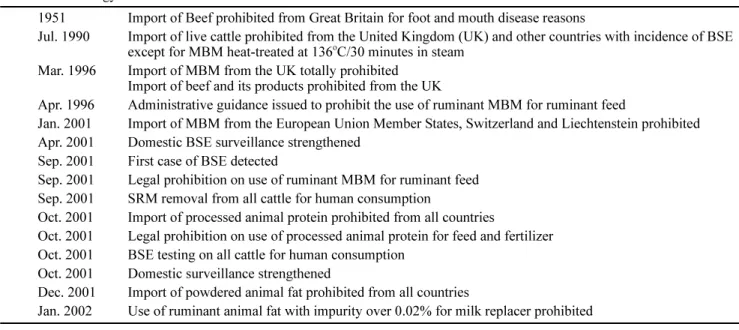
Table 1. Chronology of BSE measures: Measures taken before the detection of the first case of BSE 1951 Import of Beef prohibited from Great Britain for foot and mouth disease reasons
Jul. 1990 Import of live cattle prohibited from the United Kingdom (UK) and other countries with incidence of BSE except for MBM heat-treated at 136
oC/30 minutes in steam
Mar. 1996 Import of MBM from the UK totally prohibited Import of beef and its products prohibited from the UK
Apr. 1996 Administrative guidance issued to prohibit the use of ruminant MBM for ruminant feed
Jan. 2001 Import of MBM from the European Union Member States, Switzerland and Liechtenstein prohibited Apr. 2001 Domestic BSE surveillance strengthened
Sep. 2001 First case of BSE detected
Sep. 2001 Legal prohibition on use of ruminant MBM for ruminant feed Sep. 2001 SRM removal from all cattle for human consumption
Oct. 2001 Import of processed animal protein prohibited from all countries
Oct. 2001 Legal prohibition on use of processed animal protein for feed and fertilizer Oct. 2001 BSE testing on all cattle for human consumption
Oct. 2001 Domestic surveillance strengthened
Dec. 2001 Import of powdered animal fat prohibited from all countries
Jan. 2002 Use of ruminant animal fat with impurity over 0.02% for milk replacer prohibited
on 24 August. The same brain sample was sent to the NIAH on 6 September for histopathological examination with the same result. The same sample was subjected to immuno- histochemical examination with a positive result on 10 September.
Measures taken: Immediately after the BSE is suspected, the herd has been placed under quarantine by the prefecture veterinary inspector.
On October 2 Ministry of Health, Labor and Welfare (MHLW) asked processed food manufacturers to stop using extract or enriched additives, such as beef essence and collagen, from cattle meat and bone as they may contain a pathogen that causes variant CJD (vCJD).
In November of 2001 beef prices in Tokyo have plummeted by 20 percent, and meat packing companies have started prominently labeling their imported beef as domestic beef, because Japanese Government compensated for their beef processed before October 18.
On December 1 the cow, slaughtered at a meat processing plant in Saitama Prefecture, is expected to be declared the nation’s third case of BSE - following infected dairy cows found in Shiroi, Chiba Prefecture and Sarufutsu-mura, Hokkaido - at the meeting of experts. According to the ministry, the cow was raised by a dairy farmer in Miyagi- mura, Gumma Prefecture. When it turned five years and eight months of age, which is old for a dairy cow, it was sent to the slaughter house. The cow was tested for BSE before it was processed, but the test did not show anything clinically unusual, the officials said. However, after it was slaughtered, two tests on materials from the cow using the ELISA resulted in positive reactions on the same day. The test was conducted at a meat hygiene inspection center in Saitama.
The MHLW Yokohama quarantine center conducted another test next day using the more accurate Western blot method, and the result was also positive.
On December 21 the Japanese Ministry then asked the EU to draw up another risk-assessment for BSE since Japan would be automatically designated as a country at high risk if Tokyo fails to make the request by the end of the year. In Japan, if you want consumers to regain confidence in meat products, you need absolute transparency, accountability and a trustworthy control system through the whole process (from breeding the cattle to inspecting their meat).
On December 25, 2001, in Japan, a poll conducted December 15-16 by the Yomiuri Shimbun newspaper found 68% of Japanese have stopped eating meat or are eating less beef since the farm ministry confirmed the first case of the disease in a cow in Chiba Prefecture on September 22.
Farm ministry investigations in September found 165 households in 15 prefectures in Japan engaged in livestock farming had fed MBM, as well as blood and bone meal feed, to a total of 5,129 cows. MBM was then officially banned for use in feeding cattle on September 18. It was also banned for other livestock on October 15.
Japanese Government Policy
Eight major policies were implemented since October 2001.
1) Surveillance in farm by veterinarian, 4.5mi cows/yr.
2) Prion test at healthy 1.3mi cows/yr. at this time there is no tracing system.
3) Elimination of SRM(specified risk material)
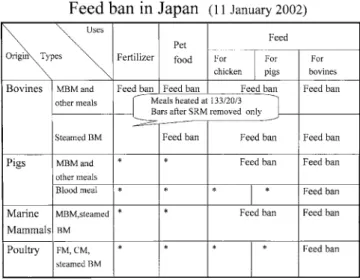
4) Ban of MBM (meat- and - bone meals) for production, sale use.
5) Prion test for fallen stocks. 100,000 cows (aged more than 24 months old)/yr. tests.
6) Transparent information and traceability.
7) New Measures
Food Safety Basic Law.
Details of Law is shown in the website of Japanese Government (http://www.fsc.go.jp/english/index.html).
8) Government Reorganization (Food Safety Commission:
FSC) (Table 2). Details of organization of FSC is shown in the same website (http://www.fsc.go.jp/english/index.
html).
SRM removal
Removal of SRMs has been mandatory since October 2001, and being carried out at all slaughterhouses in Japan, as of March 2005. SRM removal is believed to cut the infectious doses by 99.4%. Therefore, if SRMs can be removed with complete certainty, the risk of meat becoming contaminated by BSE prions can be reduced dramatically [17].
In Japan, use of cattle heads (excluding the tongue and cheek flesh), spinal cord, distal part of ileum, spinal column including dorsal root ganglion for food products is prohibited for all cattle by the law. However, it is not practical to consider that a complete SRM removal is implemented in slaughter houses because of the residual spinal cord left behind during spinal cord removal, possible contamination of dressed carcasses, and contamination of central nervous tissues by pitching. The result of surveillance concerning the removal rates of spinal cord before back-spreading in 7 Meat Hygiene Inspection Office directed by NHLW are as follows: 5 offices employing the spinal cord aspiration method indicated average 80.6 ± 17.1% (52.5~ 99.1%) and 2 offices employing the spinal cord extrusion method indicated average 75%
(72.0, 78.0%). In addition, the residual spinal cord after back- spreading was disposed of manually [28].
Absence or presence of tissues other than SRM in which
abnormal prion protein accumulates cannot be determined at
this point because of the detection limit of the infection
experiments by which SRM was identified and uncertainity
derived from incomplete understanding of mechanisms
underlying BSE infection. These ideas are supposed to be
the grounds on which the World Health Organization
recommends exclusion of any BSE-cattle tissue from the
human food chain.
Traceability
In Japan, in December 2003, based on the “Special measures law on management and transmission of information for individual recognition of cattle”, the traceability system has been made compulsory to document information, including
birth record, which allows individual recognition at the production and slaughtering stages and determination of accurate ages. This allows a separate investigation on the degree of risk of BSE infections before or after implementation of various regulation.
Table 2. Advisory committees
Food Safety Commission Expert Committee on Prions (chaired by Prof. Yoshikawa)
MAFF Advisory Committee on Food, Agriculture and Rural Policy’s Subcommittee on Prion Diseases (Chaired by Prof. Onodera)
BSE Policy Advisory Group (chaired by Prof. Kumagai)
MHLW Advisory Committee on Pharmaceutical Affairs and Food Sanitation’s TSE Group on Food Sanitation (chaired by Prof. Shinagawa)
Expert Committee on BSE Diagnosis (chaired by Prof. Shinagawa)
Advisory Committee on Pharmaceutical Affairs and Food Sanitation’s TSE Group on Pharmaceutical Affairs (chaired by Dr. Yosikura)
Organization of the Food Safety Commission
1. Academic Background of Commission Members (Seven Commission Members total, including four full-time members and three part-time members)
Masaaki Terada (Chairman) Tadao Terao (Deputy Chairman) Naoko Koizumi
Takeshi Mikami Motoko Sakamato Seiichi Honma Yasuhiko Nakamura
2. Organization of the Food Safety Commission (Expert Commission Members will total around 200) Food Safety Commission
Planning
Risk communication
Emergency Response (food accidents, etc) (Assessment team)
Chemical substance assessment group
Food additives Pesticides
Veterinary Medicines Apparatus / containers and packages
Chemical substance Contaminants, etc.
Biological assessment group
Microorganisms Virus
Natural toxins/mycotoxins, etc. Prions (BSE, etc.) Emerging food assessment group
Genetically modified organisms Newly developed foods Feed/fertilizer, etc.
3. Organization of the Secretariat (Secretariat personnel: 54)
Secretariat (Director-General, Deputy Director-General, and four divisions and one director General Affairs Division
Risk Assessment Division
Recommendation and Public Relations Division
Information and Emergency Response Division
Director for risk communication
In addition, this regulation has also been implemented at the distribution level since December 2004. Taking into account its significance to create transparency for consumer to directly obtain information of beef, securing and verification of the traceability system are deemed essential from now on.
Risk management
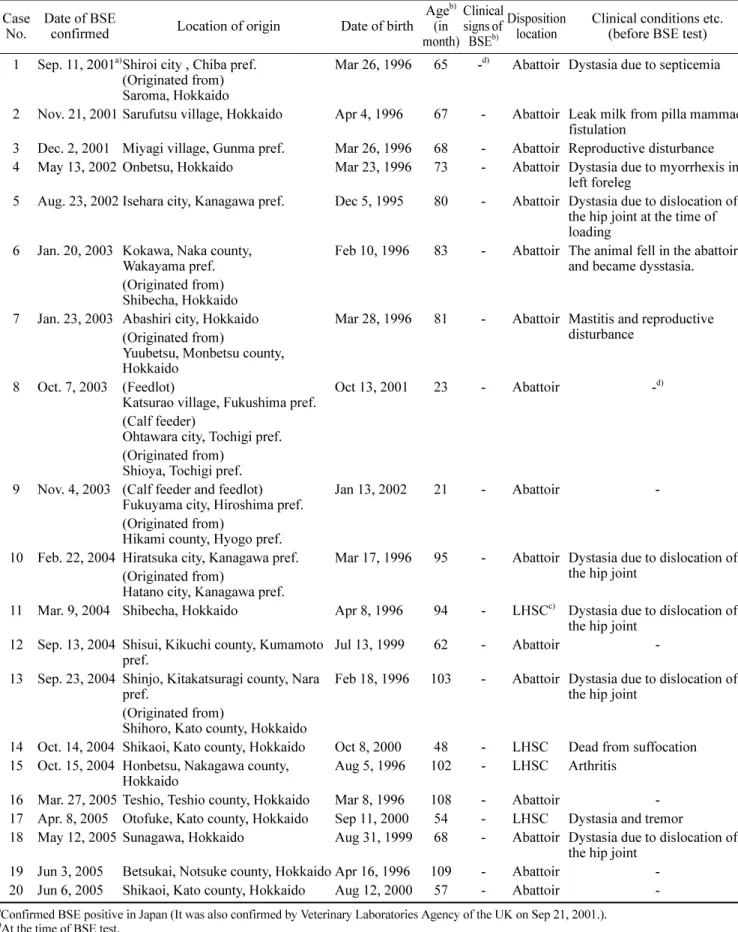
While BSE in cattle was first reported in 1986 in the United Kingdom, the first case in Japan was not detected until 2001. Since then, the Japanese Government has intensified BSE surveillance in cattle and located 19 more cases in subsequent years (Table 3).
The experience in continental Europe shows that a comprehensive strategy in combating BSE is not available on the drawing board. Measures taken to resolve BSE incidences in Japan have to be persistently assessed, systematically modified and appropriately adapted to conditions in Japan.
As the first country to have detected BSE cases in Asia, Japan was obligated to promptly implement a variety of countermeasures after encountering the first BSE cases in cattle. Of many countermeasures, the most important approach focused on the feed issue; prompt imposition of a ban on specified high-risk raw materials such as brain- and spinal cord-derived meals was quickly adopted. Apart from the feed issue, we are still continuing to incorporate additional measures to neutralize BSE in Japan.
All the 20 BSE cases that have been diagnosed up to October 2005 were dairy cows. Of these, 16 cases were located at slaughterhouses while the remaining 4 cases were fallen farm-stock. Since unregulated imports of MBM from BSE-affected countries into Japan had been practiced extensively in the 80s and early 90s, contaminated feed were likely given to animals. If infected animals had not been diagnosed then, they might be eventually terminated as feed (SRM) and could have yielded domestically infected MBM;
A raw material which is churned into homemade MBM would serve as a possible source of BSE dissemination in Japan.
The controversy in OIE recommendations of import and export of beef are the basics for conflicts within the framework of WTO/SPS (sanitary and phytosanitary agreement): if measures more stringent than the OIE recommendations are adopted, scientific arguments (risk assessment) have to be provided. While risk assessments for different countries are under evaluation, the GBR (geographical BSE risk) - assessment of the EU is currently being considered. With regard to the import bans - especially concerning beef - the risks of communication are very problematic. If Japanese beef is considered safe for consumption, it is difficult then to explain the status of American beef as being more risky than Japanese beef.
For the measures concerning consumer protection, we are considering a re-evaluation of the approach to testing young
cattle. As suggested by some Swiss scientists, we have to provide details of the limitations of the test to consumers/
retailers. Instead of beef, the brain of animals is tested with the possibility of detecting relevant BSE agents within the brain tissues, which in young animals approximates to zero.
In fact, we are currently reviewing pithing in the slaughterhouse.
Beginning in 2004, we have implemented surveillance of all fallen stock (100,000 tests for cattle over 24 months of age) to establish an overall status of BSE-infection in Japan.
The European experience has revealed that risk-bearing BSE cases harbor the infected animals (with clinical signs of BSE) in fallen stock and slaughtered adult cattle related to emergency/diseases; the probability of BSE infection in the risk-bearing population (including fallen stocks and emergency/
disease-induced slaughtered adult cattle) is in fact 20 times higher than that of the normally slaughtered adult population.
In our attempt to correlate the BSE incidence in risk-bearing populations, details of the actual fallen stock and emergency/
disease-induced slaughtered adult cattle in Japan are now being reviewed.
After the finding of a BSE case in the United States (U.S.), an Ad Hoc Subcommittee (in response to BSE in the U.S.) of the Foreign Animal and Poultry Disease Advisory Committee was formed. The said subcommittee convened in Washington D.C. under the chairmanship of Prof. U.
Kihm (Switzerland), and according to his report delivered to US government and explained in the Japanese FSC in March 2004, he recommended 5 objectives: ① reduce the risk of public health for consumer protection; ② limit recycling and amplification of BSE agents; ③ establish the level of effectiveness of measures through surveillance; ④ prevent any advertent introduction of BSE from abroad in the future; and ⑤ contribute to prevention of the epidemic on a global scale.
The proposed U.S. ban on SRM eliminates high-risk BSE tissues (i.e. SRM from cattle over 30 months of age) from food supplies to humans in accordance to the OIE standards.
However, the said subcommittee recommended that specified SRM (derived from brains and spinal cords of cattle over 12 months of age) be excluded from both the human food chain and animal feed production lines. Until the levels of BSE risk have been established, the subcommittee meanwhile concedes that exclusion of central nervous system tissues, skulls and vertebral columns from cattle over 30 months of age as well as intestines from cattle of all ages for use in human food is a temporary rational compromise.
For the purpose of facilitating overall surveillance reliability, said subcommittee recommends testing all cattle older than 30 months of age in the above-mentioned high-risk populations, besides strengthening the passive surveillance system.
Moreover, said subcommittee considers testing of all cattle
slaughtered for human consumption (performed in Japan) to
be unjustified in terms of protecting human and animal
health. However, to support the overall surveillance system
Table 3. BSE cases in Japan as of August 2005 Case
No. Date of BSE
confirmed Location of origin Date of birth Age
b)month) (in
Clinical signs of
BSE
b)Disposition
location Clinical conditions etc.
(before BSE test) 1 Sep. 11, 2001
a)Shiroi city , Chiba pref.
(Originated from) Saroma, Hokkaido
Mar 26, 1996 65 -
d)Abattoir Dystasia due to septicemia 2 Nov. 21, 2001 Sarufutsu village, Hokkaido Apr 4, 1996 67 - Abattoir Leak milk from pilla mammae
fistulation
3 Dec. 2, 2001 Miyagi village, Gunma pref. Mar 26, 1996 68 - Abattoir Reproductive disturbance 4 May 13, 2002 Onbetsu, Hokkaido Mar 23, 1996 73 - Abattoir Dystasia due to myorrhexis in
left foreleg
5 Aug. 23, 2002 Isehara city, Kanagawa pref. Dec 5, 1995 80 - Abattoir Dystasia due to dislocation of the hip joint at the time of loading
6 Jan. 20, 2003 Kokawa, Naka county,
Wakayama pref. Feb 10, 1996 83 - Abattoir The animal fell in the abattoir and became dysstasia.
(Originated from) Shibecha, Hokkaido
7 Jan. 23, 2003 Abashiri city, Hokkaido Mar 28, 1996 81 - Abattoir Mastitis and reproductive disturbance
(Originated from)
Yuubetsu, Monbetsu county, Hokkaido
8 Oct. 7, 2003 (Feedlot)
Katsurao village, Fukushima pref. Oct 13, 2001 23 - Abattoir -
d)(Calf feeder)
Ohtawara city, Tochigi pref.
(Originated from) Shioya, Tochigi pref.
9 Nov. 4, 2003 (Calf feeder and feedlot)
Fukuyama city, Hiroshima pref. Jan 13, 2002 21 - Abattoir - (Originated from)
Hikami county, Hyogo pref.
10 Feb. 22, 2004 Hiratsuka city, Kanagawa pref. Mar 17, 1996 95 - Abattoir Dystasia due to dislocation of the hip joint
(Originated from)
Hatano city, Kanagawa pref.
11 Mar. 9, 2004 Shibecha, Hokkaido Apr 8, 1996 94 - LHSC
c)Dystasia due to dislocation of the hip joint
12 Sep. 13, 2004 Shisui, Kikuchi county, Kumamoto
pref. Jul 13, 1999 62 - Abattoir -
13 Sep. 23, 2004 Shinjo, Kitakatsuragi county, Nara
pref. Feb 18, 1996 103 - Abattoir Dystasia due to dislocation of
the hip joint (Originated from)
Shihoro, Kato county, Hokkaido
14 Oct. 14, 2004 Shikaoi, Kato county, Hokkaido Oct 8, 2000 48 - LHSC Dead from suffocation 15 Oct. 15, 2004 Honbetsu, Nakagawa county,
Hokkaido Aug 5, 1996 102 - LHSC Arthritis
16 Mar. 27, 2005 Teshio, Teshio county, Hokkaido Mar 8, 1996 108 - Abattoir - 17 Apr. 8, 2005 Otofuke, Kato county, Hokkaido Sep 11, 2000 54 - LHSC Dystasia and tremor
18 May 12, 2005 Sunagawa, Hokkaido Aug 31, 1999 68 - Abattoir Dystasia due to dislocation of the hip joint
19 Jun 3, 2005 Betsukai, Notsuke county, Hokkaido Apr 16, 1996 109 - Abattoir - 20 Jun 6, 2005 Shikaoi, Kato county, Hokkaido Aug 12, 2000 57 - Abattoir -
a)
Confirmed BSE positive in Japan (It was also confirmed by Veterinary Laboratories Agency of the UK on Sep 21, 2001.).
b)
At the time of BSE test.
c)
Livestock health service center.
d)