• 검색 결과가 없습니다.

Valgus Laxity of Elbow Joint in High School Weight Lifters: Ultrasonographic Assessment

N/A
N/A
Protected

Academic year: 2021

Share "Valgus Laxity of Elbow Joint in High School Weight Lifters: Ultrasonographic Assessment"

Copied!
7
0
0

로드 중.... (전체 텍스트 보기)

전체 글

(1)

http://dx.doi.org/10.5763/kjsm.2013.31.2.85

Received: September 16, 2013 Revised: November 26, 2013 Accepted: November 26, 2013 Correspondence: Chang-Hyuk Choi

Department of Orthopaedics, Catholic University of Daegu and College of Medicine, 33 Duryugongwon-ro 17-gil, Nam-gu, Daegu 705-718, Korea

Tel: +82-53-650-4276, Fax: +82-53-650-4270, E-mail: [email protected]

Copyright ©2013 The Korean Society of Sports Medicine

CC

This is an Open Access article distributed under the terms of the Creative Commons Attribution Non-Commercial License (http://creativecommons.org/

licenses/by-nc/3.0) which permits unrestricted non-commercial use, distribution, and reproduction in any medium, provided the original work is properly cited.

고교 역도선수에서 주관절의 외반 불안정성:

초음파의 유용성

대구가톨릭대학교 의과대학 정형외과학교실

최창혁ㆍ김세식ㆍ박창민ㆍ채승범ㆍ장호진

Valgus Laxity of Elbow Joint in High School Weight Lifters:

Ultrasonographic Assessment

Chang-Hyuk Choi, Se-Sik Kim, Chang-Min Park, Seung-Bum Chae, Ho-Jin Chang Department of Orthopaedics, Catholic University of Daegu and College of Medicine, Daegu, Korea

We evaluated abnormalities in medial portion of elbow in high-school weightlifter compared with the non weightlifter using a stress radiography and ultrsonography. The experimental group(G1) was 26 high school weightlifters with an average age of 17 years old (range, 16—18 years). The control group (G2) were comprised of 25 age matched general students. Both groups received physical examination, simple and valgus stress radiography and ultrasonography on both side of elbow. Physical examination showed 26.9% (14/52 elbows) tenderness and 19.2%

(10/52 elbows) valgus laxity in G1, no tenderness and laxity in G2. There were no differences in medial joint gaps on simple radiography (G1, 3.3 mm, G2, 2.7 mm; p>0.05), but the valgus stress view showed 5.6±0.8 mm medial joint gap in G1 and 3.8±0.8 mm in G2 (p<0.001). Ultrasonography in G1, angular deformity was found in 67.3%

(36/52) and G2 all in normal (p<0.01). The horizontal distance was an average 4.9±1.23 mm for the G1 and 3.1±0.78 mm for the G2 (p<0.001). Vertical distance of the proximal portion of the ulna was average 0.58±0.94 mm for the G1 and 1.59±0.49 mm for the G2 (p<0.001). In G1, angular deformity of male was 50% (15/30 elbows) and female was 95% (21/22 elbows) (p<0.001). Change of horizontal and vertical distance were larger in female (p<0.05). In conclusion, there were increased incidence of medial elbow joint laxity in high school weightlifter, especially in female, regardless of career. Sustained valgus laxity could be prone to ulnar collateral ligament injury and should be evaluated with ultrasonography-assisted dynamic study.

Keywords: Elbow joint, High school weighlifter, Radiography, Ultrasonography

(2)

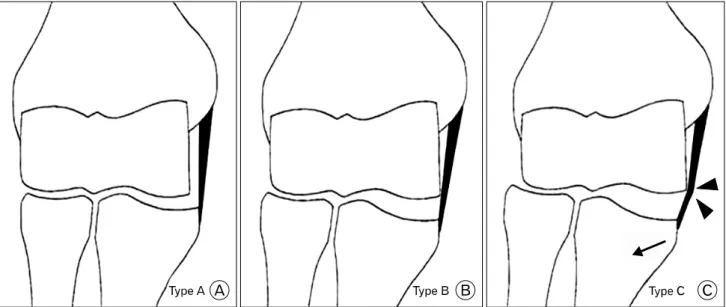
Fig. 1. Three types of angular changes of the medial collateral ligament. (A) Type A: normal stable elbow joint. (B) Type B: increased medial elbow laxity, as manifested by widening of the medial joint space and lateral shift of the proximal part of the ulna. (C) Type C: increased lateral shift of the proximal part of the ulna (arrow) causing impingement of the ulnar collateral ligament on the trochlea (arrowheads).

Introduction

It is well known that chronic valgus stress of the elbow joint often begins in sports activities (such as volleyball spike, the hockey shoot, the American football pass, the javelin throw, the tennis serve, and the baseball pitch), which can lead to ulnar medial collateral ligament injury and other elbow joint overuse injuries 1-5) . These sports have a similar exercise mechanism, which requires fast and strong elbow joint extensibility, accompanied by the valgus stress of the elbow joint and pronation of the supinated forearm 6) . Weight lifting has a similar exercise mechanism and chronic repetitive valgus-stress during exercise, abrupt resisted extension force on lifting can cause injuries at the medial side of the elbow joint. The purpose of this study was to evaluate the problems at the medial portion of the elbow joint in high-school weightlifters using a stress radiographic and ultrsonographic examination.

Methods

1. Demographics

The experimental group (G1) was 26 high school weight lifters,

15 male (right hand dominant in 12), and 11 female (right hand dominant in 9) with an average age of 17 years. Their weight was 63 kg on average (male, 68 kg; female, 60 kg), and height was 170 cm in average (male, 174 cm; female, 161 cm), and the period involved in the sport was 4 years in average. The control group (G2) was comprised of 25 volunteers without elbow problems (right-hand dominant in all) whose weight and height had been controlled; 15 were male and 10 were female, and their average age was 17 years. The average weight was 63 kg (male, 69 kg; female, 61 kg), and height was 171 cm in average (male, 175 cm; female, 160 cm). They did not have any symptoms in the elbow joint area and were not involved in any other sports activities with throwing or weight lifting. This study protocol was approved by the institutional ethics committee of our hospital.

2. Physical examination and radiographic study

After a medical history was taken for general information,

a physical examination was attempted of both elbows on each

athlete about tenderness or laxity, and simple and valgus stress

radiograph of the elbow joint were taken. Valgus stress to the

elbow was given as elbow flexed 30 o in a comfortable sitting

position.

(3)

Fig. 2. Ultrasonographic image of the elbow joint in normal and medial laxity. (A) Ultrasonography of normal elbow joint. The medial joint space is shown as a nonechoic space between the subchondral bone of the trochlea (arrowheads) and that of the coronoid process (large ar- row). The ulnar collateral ligament (UCL) is identified as a band-like structure that attaches to the medial epicondyle and the tubercular portion of the coronoid process. The superficial surface of the ligament is seen outlined by a hyperechoic straight line (small arrows). (B) Ultrasonogra- phic findings in ligament injury. The image showing type C angular changes with increased medial elbow laxity, as manifested by widening of the medial joint space (h=8.4 mm) and the lateral shift of the proximal part of the ulna (v=-1.2 mm). UCL tear is shown as a nonechoic gap be- tween torn margin of the ligament (between x and +).

h=horizontal distance of the medial joint space (with the assumption that the outline of the ulnar collateral ligament is a horizontal line), and v=vertical distance of the medial joint space.

3. Ultrasonographic study

Ultrasonographic examination was conducted by using a 7.5 Hz linear array transducer (Philips HD11 XE, Bothell, WA, USA).

For the ultrasonographic examination, the patient was positioned in the supine position, with the arm undergoing examination stretched across the bed. After the arm was 90 o in external rotation, the elbow joint bent at 70 o , and the forearm in a neutral position, gravity bearing stress was put on the forearm in order to cause tension in the medial portion of the elbow joint. The transducer was positioned on the medial portion of the elbow joint to make both the top of the medial epicondyle and the medial tubercular portion of the coronoid process appear together in the ultrasonographic image. The ulnohumeral joint between the

trochlea and the coronoid process was presented as echo-free space. The ulnar collateral ligament appeared as a hyperechoic straight-line, band shape attached to the medial tubercular portion of the coronoid process and medial epicondyle. The 3 types of angular change (Fig. 1), the gap of the elbow joint, and the lateral movement of the elbow joint under gravitation were measured (Fig. 2).

4. Statistical analysis

All statistical analyses were performed using the SPSS ver.

12.0 (SPSS Inc., Chicago, IL, USA). Chi-square test, Fischer exact test, Student’s t test, and Mann-Whitney U test were used, and a p<0.05 was considered statistically significant.

Results

1. Physical examination

Experimental group (G1) showed 14 cases of tenderness (5 cases in males, 9 cases in females). Three persons (6 cases) had tenderness in both elbow joints, among them 1 was male and 2 were female. There were 10 cases of valgus laxity (2 cases in males, 8 cases in females), and 2 females (4 cases) had valgus instability in both elbow joints. There was no instability or tenderness found in the control group (G2).

2. Radiographic examination

There were no remarkable differences in medial joint gaps on simple radiographic examination (G1, 3.3 mm; G2, 2.7 mm;

p>0.05), but the valgus stress view showed that the medial joint gap was 5.6±0.8 mm for the G1 and 3.8±0.7 mm for the G2, showing an average 1.8 mm increase (independent t test, p<0.001).

3. Ultrasonographic examination

1) Angular deformity of the elbow joint

There were significant differences between G1 and G2 in angular

deformity, with 30.8% of normal type A in G1 and 100% in

G2 (p<0.001). In G1, angular deformity of the elbow joint was

found in 69.2% of cases (36/52 cases), comprised of 33 cases

of type B (dominant arm, 20 cases; non-dominant, 13 cases)

(4)

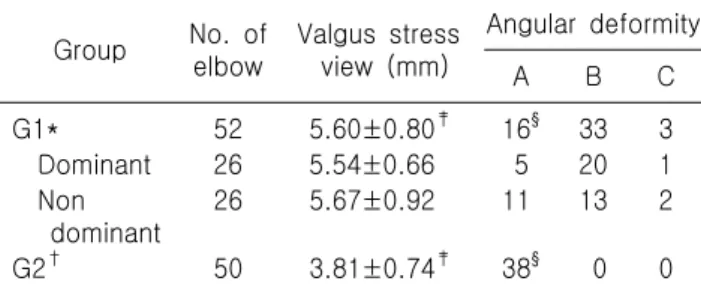
Table 1. Valgus laxity on stress radiograph and angular deformity between weight-lifter and control group

Group No. of elbow

Valgus stress view (mm)

Angular deformity

A B C

G1* 52 5.60±0.80

16

§

33 3

Dominant 26 5.54±0.66 5 20 1 Non

dominant

26 5.67±0.92 11 13 2

G2

50 3.81±0.74

38

§

0 0

*High school weightlifter;

High school general students;

Independent t test, p=0.000;

§

Dependent t test, p=0.000.

Table 2. Horizontal and vertical distances of medial elbow joint on ultrasonographic image between weight-lifter and control group

Group No. of elbow

Horizontal distance (mm)

Vertical distance (mm)

G1* 52 4.92±1.23

0.58±0.94

§

Dominant 26 5.06±1.12 0.48±0.86 Non

dominant

26 4.75±1.28 0.67±1.01

G2

50 3.11±0.78

1.59±0.49

§

*High school weightlifter;

High school general students;

Independent t test, p=0.000;

§

Dependent t test, p=0.000.

Table 3. Valgus laxity on stress radiograph and angular deformity between male and female in weight-lifter group

Gender No. of elbow

Angular deformity

A* B

C

Male 30 15 15 0

Female 22 1 18 3

*Independent t test p=0.000;

p=0.782.

Table 4. Horizontal and vertical distances of medial elbow joint on ultrasonographic image between male and female in weight-lifter group

Gender No. of elbow

Horizontal distance (mm)*

Vertical distance (mm)

Male 30 4.47±1.13 0.85±1.06

Female 22 5.40±1.22 0.41±0.82

*Independent t test, p=0.04;

p=0.042.

and 3 cases of type C (dominant arm, 1 cases; non-dominant, 2 case). There were no significant differences in valgus laxity and angular deformities between the dominant and non-dominant elbow (Table 1).

2) Horizontal and vertical distance of the elbow joint The horizontal distance (width of the medial elbow) was an average 4.9 mm (range, 3.7–6.2 mm) for the G1, and 3.1 mm (range, 2.3–3.9 mm) for the G2, showing an about 1.8 mm increase (independent t-test, p<0.001). There was no statistical difference between the dominant arm and the non-dominant arm in G1 (Table 2). Vertical distance (lateral movement) of the proximal portion of the ulna was on average 0.58 mm (range, -0.36–1.02 mm) for the G1, and 1.59 mm (range, 1.10–2.08 mm) for the G2, making it a remarkable 0.94 mm decrease (independent t-test, p<0.001) (Table 2). There was no statistically significant difference between the dominant and non-dominant arm in G1 (Table 2).

3) Male and female differences in experimental group For the angular deformity, male athletes had 15 cases of type A, 15 cases of type B, while the female athletes had 1 case of type A, 18 cases of type B, and 3 cases of type C, which revealed a remarkable disparity (p=0.001) (Table 3). In addition, 1 case of partial tear and 1 case of total tear were confirmed in female athletes, and the case of the total tear medial collateral ligament reconstruction surgery was performed.

For the ultrasonographic distances, the horizontal distance of male athletes was on average 4.47 mm (range, 3.34–5.60 mm), whereas the female athletes’ average of 5.40 mm (range, 4.18–6.62 mm) with more remarkable widening of the medial joint gap (p=0.04). For the vertical distances in the experimental group, male athletes had an average of 0.85 mm (range, -0.21–1.91 mm), while the females athletes had an average of 0.41 mm (range, -0.41–1.23 mm) showing more lateral movement (p=0.042) (Table 4).

4) Differences according to sports related period in experimental group

In G1, the sports-related career length were divided into 3

group time periods, group A (14 elbows) with one to 2 years

career, group B (20 elbows) with 3 to 4 years career, group

C (18 elbows) with over 5 years career. The horizontal distance,

(5)

Table 5. Horizontal and vertical distances of medial elbow joint on ultrasonographic image according to career

Career No. of elbow

Horizontal distance (mm)*

Vertical distance (mm)

Total 52 4.92±1.23 0.58±0.94

1−2 y 14 5.14 0.61

3−4 y 20 4.72 0.49

>5 y 18 5.0 0.61

*Independent t test, p=0.747;

p=0.865.

Table 6. Correlation between angular deformity and ultra- sonographic findings (horizontal and vertical distance)

Angular deformity

No. of elbow

Horizontal distance (mm)

Vertical distance (mm) Normal

(type A)

16 2.02±2.21* 5.09±0.83

Abnormal (type B, C)

36 5.34±1.01

0.17±0.79

§

*Mann-Whitney U test, p=0.000;

p=0.000;

p=0.000;

§

p=0.006.

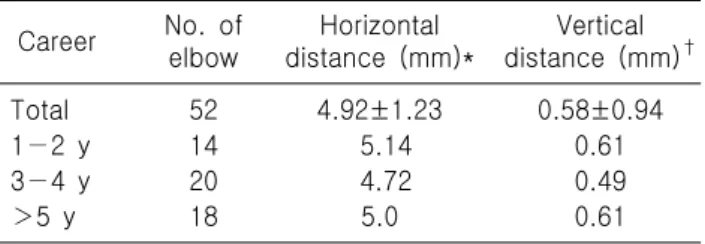
was an average 5.1 mm, 4.7 mm, and 5.0 mm, respectively (p=0.747). The vertical distance was an average 6.1 mm, 4.9 mm, and 6.1 mm, respectively (p=0.865) (Table 5).

5) Correlation between angular deformity and ultrasono- graphic parameters (horizontal and vertical distance) Angular deformity was divided into normal (type A) and the deformity-present group (type B and C), which was compared with horizontal distance and vertical distance. There was a strong correlation between angular deformity and both horizontal distance and vertical distance (Mann-Whitney U test, p<0.01) (Table 6).

Discussion

Weight lifting usually involves lifting a weight heavier than one’s own body above the head level by using fast and strong elbow joint extension with a pronated forearm. Furthermore, a wider grip position may leads to higher valgus forces on the elbow joint. In a pitching motion, the thrower receives a valgus force of about 64 N/m 3,7) and in a tennis serve, over 60 N/m of valgus force 6) ; in a cadaveric study, the maximum extensibility of the medial collateral ligament was 33 N/m 8) . Weight lifters usually lift 50 kg and up to 200 kg of barbell and chronic valgus force during exercise, which may increase medial joint laxity or risk of medial collateral ligament injuries.

Diagnostic tools for elbow injuries were consisted with simple X-ray, stress radiography, arthrography, computerized tomo- graphy, magnetic resonance imaging (MRI), and dynamic ultrasonography in addition to medical history and physical examination. According to Rijke et al. 9) , stress radiography on athletes who use a pitching motion showed a 94% sensitivity, and 100% specificity in their medial collateral ligament injuries.

However, in the case of acute medial collateral ligament injuries, the test could face difficulties due to the guarding by the patient.

Rijke et al. 9) reported that the gap of the ulnohumeral joint in

complete rupture of the ulnar collateral ligament was increased

over 5 mm more than in the control group. Ellenbecker et al. 10)

compared the laxity of the medial elbow joint of the dominant

hand and the non-dominant hand of the baseball player by stress

radiography and reported about a 5 mm difference in the dominant

(p<0.01). Lee et al. 11) reported gravity or 25 N bearing increased

valgus gap (p<0.0001) in the normal population at both extension

and 30 degrees of flexion, therefore we evaluated at only 30

degrees of flexion. Due to the slight difference in radiation bearings

between the injured and uninjured elbow joints of baseball players,

and the dominant and non-dominant arm of the normal elbow

joint, medial collateral ligament injuries in the early stages are

sometimes underestimated or misdiagnosed 1) . Thompson et al. 12)

reported that they found that 88% of athletes who had gone through

medial collateral ligament reconstruction surgery had an increase

of over 2 mm in their medial joint gap than in their healthy

joint. However, Azar et al. 13) reported that only 46% of patients

who underwent reconstruction surgery revealed a positive results

from their radiation bearings test. Arthrography could be a helpful

diagnostic tool in diagnosing acute medial collateral ligament

ruptures. However, ruptures to the articular capsule accompanied

in chronic injuries are rare, and it is hard to determine the leakage

of the contrast medium from the joint. According to Timmerman

and Andrews 14) in research that included 25 baseball players,

computed tomography scans using contrast medium revealed an

86% rate of sensitivity and 91% rate of singularity in acute and

chronic medial collateral ligament injuries. MRI could be a

diagnostic study for a medial collateral ligament 15-17) and the

surrounding soft tissue structures injuries in acute and chronic

(6)

conditions. For the usefulness of MR arthrography, Azar et al. 13) reported a 97% rate of sensitivity in diagnosing medial collateral ligament injuries.

Recently, the effectiveness of dynamic ultrasonography to confirm ulnar collateral ligament injury was reported by several authors (Sugimoto et al. 18,19) , Miller et al. 20) , and De Smet et al. 21) ). Sasaki et al. 22) reported dynamic ultrasonography for evaluating medial joint laxity and medial collateral ligament injury revealed that the medial elbow joint gap and angular deformity was more increased in the dominant arm of 30 male baseball pitchers. Nazarian et al. 23) examined the medial collateral ligament of 26 professional baseball players using dynamic ultrasonography, who had no symptoms on their elbow, and revealed both low echogenic lesions or calcification and thick bands on pitchers’

arms with much higher valgus laxity. Sasaki et al. 22) conducted the dynamic ultrasonography to the 90 o bending location of the elbow joint. However, in our study, the elbow was positioned to 70 o of flexion in a lying position and gravity bearing force was applied to the forearm. According to Callaway et al. 24) , the stability of the elbow joint is the highest when bending is lower than 20 degrees or higher than 120 degrees, and in cadaveric study, in which the medial collateral ligament was totally removed, laxity was highest when the elbow joint was bended to 70 degrees 24-26) .

There have been few studies of ulnar collateral ligament injury for weight lifters and the exact mechanism of injury was unclear.

In addition, the similarities and differences should be identified among the injury mechanisms of the weight lifting, throwing sports, and other sports activities that require pronation of the supinated forearm and place valgus force on the elbow joint.

Weight lifting needed strong muscular power for lifting, as well as valgus stability, for maintaining the barbell. During the concentric movement of the bench press, there is an initial high-power push after chest contact, immediately followed by a characteristic area of low power, the so-called “sticking region”.

The decline in power during the initial acceleration phase appears to be a factor in a failed lift attempt at the sticking point 27) . These problems could be occured in a condition of high intensity lifting or fatiguing repeated training, which could increase the risk of the elbow injuries in adolescent weight lifters.

In our study, the medial elbow joint gap of adolescent weight

lifters was higher than in the control group by an average 1.8 mm (p<0.001) under radiation bearing tests and an ultrasono- graphy study revealed 1.8 mm by the horizontal distance and vertical distance was decreased at an average 1.0 mm (p=0.000).

It means that the elbow joint of weight lifters had an increased medial laxity, when compared to the control group. In addition, angular deformity of the medial collateral ligament, among 52 cases in weight lifters, 32 cases were type B, 3 were type C, indicated a great difference to the control group who were all type A. These results could postulate that higher valgus laxity, and deformity of the medial collateral ligament of the weight lifters compared to the control group, might be prone to increase the risk of the medial elbow joint injuries. There were significant differences in angular deformity and medial joint gap between female and male athletes, with more prone to increase the risk of injuries in female group. According to the sports-related career, there was no differences between the groups of carrer years. It means that the most vulnerable period of elbow injuries in adolescent weight lifters is early time of their career. These results could be the guideline in determining intensity and duration of the training program. For the adolescent athletes, prevention of injuries is one of important issue in training and competition.

Therefore, dynamic ultrasonography study should be used for screening tests to evaluate and to follow-up study for ulnar collateral ligament injury in adolescent weight lifters. In conclusion, there was an increased incidence of medial elbow joint laxity in high school athletes that lift weights, especially in female, regardless of career. Sustained valgus laxity could be prone to ulnar collateral ligament injury and it would be evaluated with ultrasonography assisted dynamic study.

Acknowledgements

The authors thank Prof. Im-Hee Shin of the Medical Statistics Department, for her advice, guidance on statistical analysis, and Chul-Su Suk, coach of the weight-lifting department of the Daegu Physical Education High School for his support for this study.

References

1. Andrews JR, Timmerman LA. Outcome of elbow surgery in

(7)

professional baseball players. Am J Sports Med 1995;23:407-13.

2. Elliott B, Fleisig G, Nicholls R, Escamilia R. Technique effects on upper limb loading in the tennis serve. J Sci Med Sport 2003;6:76-87.

3. Fleisig GS, Andrews JR, Dillman CJ, Escamilla RF. Kinetics of baseball pitching with implications about injury mechanisms. Am J Sports Med 1995;23:233-9.

4. Hamilton CD, Glousman RE, Jobe FW, Brault J, Pink M, Perry J. Dynamic stability of the elbow: electromyographic analysis of the flexor pronator group and the extensor group in pitchers with valgus instability. J Shoulder Elbow Surg 1996;5:347-54.

5. Jobe FW, Stark H, Lombardo SJ. Reconstruction of the ulnar collateral ligament in athletes. J Bone Joint Surg Am 1986;68:1158-63.

6. Loftice J, Fleisig GS, Zheng N, Andrews JR. Biomechanics of the elbow in sports. Clin Sports Med 2004;23:519-30.

7. Werner SL, Fleisig GS, Dillman CJ, Andrews JR. Bio- mechanics of the elbow during baseball pitching. J Orthop Sports Phys Ther 1993;17:274-8.

8. Bennett JB, Tullos HS. Ligamentous and articular injuries in the athlete. In: Morrey BF, editor. The elbow and its dis- orders. Philadelphia: WB Saunders; 1985. p. 502-22.

9. Rijke AM, Goitz HT, McCue FC, Andrews JR, Berr SS.

Stress radiography of the medial elbow ligaments. Radiology 1994;191:213-6.

10. Ellenbecker TS, Mattalino AJ, Elam EA, Caplinger RA.

Medial elbow joint laxity in professional baseball pitchers. A bilateral comparison using stress radiography. Am J Sports Med 1998;26:420-4.

11. Lee GA, Katz SD, Lazarus MD. Elbow valgus stress radiography in an uninjured population. Am J Sports Med 1998;26:425-7.

12. Thompson WH, Jobe FW, Yocum LA, Pink MM. Ulnar collateral ligament reconstruction in athletes: muscle-splitting approach without transposition of the ulnar nerve. J Shoulder Elbow Surg 2001;10:152-7.

13. Azar FM, Andrews JR, Wilk KE, Groh D. Operative treatment of ulnar collateral ligament injuries of the elbow in athletes. Am J Sports Med 2000;28:16-23.

14. Timmerman LA, Andrews JR. Undersurface tear of the ulnar collateral ligament in baseball players: a newly recognized lesion. Am J Sports Med 1994;22:33-6.

15. Jobe FW, Kvitne RS. Elbow instability in the athlete. Instr

Course Lect 1991;40:17-23.

16. Mirowitz SA, London SL. Ulnar collateral ligament injury in baseball pitchers: MR imaging evaluation. Radiology 1992;185:573-6.

17. Timmerman LA, Schwartz ML, Andrews JR. Preoperative evaluation of the ulnar collateral ligament by magnetic resonance imaging and computed tomography arthrography.

Evaluation in 25 baseball players with surgical confirmation.

Am J Sports Med 1994;22:26-31.

18. Sugimoto K, Matui N, Taneda Y, Oyabu N, Nakano Y, Goto H. Ultrasonographic evaluation of the ulnar collateral liga- ment of the elbow joint. J Jpn Soc Orthop Ultrason 1994;6:

187-8.

19. Sugimoto K, Ohta S. The natural course of the MCL injury of the elbow. J Jpn Soc Orthop Ultrason 1997;9:15-9.

20. Miller TT, Adler RS, Friedman L. Sonography of injury of the ulnar collateral ligament of the elbow-initial experience.

Skeletal Radiol 2004;33:386-91.

21. De Smet AA, Winter TC, Best TM, Bernhardt DT. Dynamic sonography with valgus stress to assess elbow ulnar collateral ligament injury in baseball pitchers. Skeletal Radiol 2002;31:671-6.

22. Sasaki J, Takahara M, Ogino T, Kashiwa H, Ishigaki D, Kanauchi Y. Ultrasonographic assessment of the ulnar collateral ligament and medial elbow laxity in college baseball players. J Bone Joint Surg Am 2002;84:525-31.

23. Nazarian LN, McShane JM, Ciccotti MG, O'Kane PL, Harwood MI. Dynamic US of the anterior band of the ulnar collateral ligament of the elbow in asymptomatic major league baseball pitchers. Radiology 2003;227:149-54.

24. Callaway GH, Field LD, Deng XH, et al. Biomechanical evaluation of the medial collateral ligament of the elbow. J Bone Joint Surg Am 1997;79:1223-31.

25. Floris S, Olsen BS, Dalstra M, Sojbjerg JO, Sneppen O. The medial collateral ligament of the elbow joint: anatomy and kinematics. J Shoulder Elbow Surg 1998;7:345-51.

26. Sojbjerg JO, Ovesen J, Nielsen S. Experimental elbow instability after transection of the medial collateral ligament.

Clin Orthop Relat Res 1987;(218):186-90.

27. Drinkwater EJ, Galna B, McKenna MJ, Hunt PH, Pyne DB.

Validation of an optical encoder during free weight resistance

movements and analysis of bench press sticking point power

during fatigue. J Strength Cond Res 2007;21:510-7.

수치

Fig. 1. Three types of angular changes of the medial collateral ligament. (A) Type A: normal stable elbow joint
Fig. 2. Ultrasonographic image of the elbow joint in normal and  medial  laxity.  (A)  Ultrasonography  of  normal  elbow  joint
Table  1.  Valgus  laxity  on  stress  radiograph  and  angular  deformity  between  weight-lifter  and  control  group
Table 6. Correlation between angular deformity and ultra- ultra-sonographic  findings  (horizontal  and  vertical  distance)

참조

관련 문서

XAFS: X-ray absorption fine structure XES: X-ray emission spectroscopy XRF: X-ray fluorescence.. Use of x-rays; a probe based

Fourth, for the sub-factors of personality traits according to weight lifters’ education, while there was a high difference in neuroticism and agreeableness

The clinical outcomes were assessed by measuring the Korea shoulder society (KSS) score, Mayo elbow performance (MEP) score and the postoperative complications.

Postoperative Postoperative Postoperative Postoperative Magnetic Magnetic Magnetic Magnetic resonance resonance resonance image resonance image image image shows

This study aimed to evaluate the site and extent of injury, injury mechanism, player position, and the reinjury incidence in the hamstring by using magnetic

A,B Gradual lengthening with external fixator, C,D Lateral angulation of 4th metatarsal bone and 4th MTP joint subluxation, valgus deformity of 4th toe, E,F Corrective

the intersection of several such symmetry elements.. International Tables for X-ray Crystallography.. International Tables for X-ray Crystallography.. International Tables

radiography, X-ray generation, and the simulation of weapons effects, such as nuclear electromagnetic pulse (EMP), to packaged pulsed power for directed energy weapons