• 검색 결과가 없습니다.

The Impact of Subclinical Hypothyroidism or Thyroid Autoimmunity on Coronary Vasospasm in Patients without Associated Cardiovascular Risk Factors

N/A
N/A
Protected

Academic year: 2022

Share "The Impact of Subclinical Hypothyroidism or Thyroid Autoimmunity on Coronary Vasospasm in Patients without Associated Cardiovascular Risk Factors"

Copied!
6
0
0

로드 중.... (전체 텍스트 보기)

전체 글

(1)

Korean Circulation Journal

Introduction

Coronary artery spasm, defined as transient occlusive or suboc-

Print ISSN 1738-5520 • On-line ISSN 1738-5555

The Impact of Subclinical Hypothyroidism or Thyroid Autoimmunity on Coronary Vasospasm in Patients without Associated Cardiovascular Risk Factors

Sea-Won Lee, MD 1 , Kyoung-Im Cho, MD 2 , Hyun-Su Kim, MD 2 , Jung-Ho Heo, MD 2 , and Tae-Joon Cha, MD 2

1

Division of Cardiology, Department of Internal Medicine, Busan Veterans Hospital, Busan,

2
Division of Cardiology, Department of Internal Medicine, Kosin University College of Medicine, Busan, Korea

Background and Objectives: Subclinical hypothyroidism is associated with endothelial dysfunction and impaired coronary flow reserve.

However, the effect of subclinical hypothyroidism or thyroid autoimmunity on variant angina has yet to be determined.

Subjects and Methods: Among 385 consecutive patients without associated cardiovascular risk factors who underwent coronary angi- ography with the ergonovine provocation test (EPT), 165 had a positive EPT {EPT(+)} and 220 had a negative EPT {EPT(-)}. The relationship between coronary artery spasm and the presence of subclinical thyroid dysfunction as well as serum thyroid peroxidase autoantibody (TPO Ab) was evaluated.

Results: The proportion of patients with subclinical hypothyroidism among those who were EPT(+) was significantly higher than that in those who were EPT(-) (18% vs. 11%, p=0.001). However, there was no significant difference in the proportion of patients with subclinical hyperthyroidism between the groups. Moreover, EPT(+) patients showed significantly more positive TPO Ab (33% vs. 14%, p<0.001) than those with EPT(-). There was a positive correlation between EPT(+) and TPO positivity (r=0.226, p<0.001), subclinical hypothyroidism (r=0.112, p=0.033), and body mass index (r=0.123, p=0.018). Binary logistic regression analysis revealed that the significant predictors of EPT(+) were body mass index {adjusted odds ratio (OR)=1.042, 95% confidence interval (CI)=1.005–1.080}, presence of subclinical hypo- thyroidism (OR=3.047, 95% CI=1.083–8.572), TPO Ab titer (OR=1.028, 95% CI=1.015–1.041), and the presence of TPO Ab (OR=4.904, 95%

CI=1.544–15.567).

Conclusion: Subclinical hypothyroidism and the presence of TPO Ab are significantly associated with coronary vasospasm in patients with- out cardiovascular risk factors. (Korean Circ J 2015;45(2):125-130)

KEY WORDS: Hypothyroidism; Autoimmunity; Coronary vasopasm.

Received: August 14, 2014 Revision Received: October 7, 2014 Accepted: November 14, 2014

Correspondence: Kyoung-Im Cho, MD, Division of Cardiology, Department of Internal Medicine, Kosin University College of Medicine, 262 Gamcheon- ro, Seo-gu, Busan 602-702, Korea

Tel: 82-51-990-6105, Fax: 82-51-990-3005 E-mail: [email protected]

• The authors have no financial conflicts of interest.

This is an Open Access article distributed under the terms of the Creative Commons Attribution Non-Commercial License (http://creativecommons.

org/licenses/by-nc/3.0) which permits unrestricted non-commercial use, distribution, and reproduction in any medium, provided the original work is properly cited.

clusive vasoconstriction in large epicardial arteries, plays an impor-

tant role in variant angina (VA). Pharmacologic provocative testing

with vasomotor agents such as acetylcholine

1)

or ergonovine

2)

has

generally been used in the diagnosis of VA. Although the precise

mechanism of VA is unclear, it has been reported that one of the ma-

jor causes of VA is endothelial dysfunction of the coronary artery.

3)

Endothelial dysfunction is an important, early, and reversible fea-

ture of atherogenesis.

4)

Thyroid hormones have a direct effect on

cardiac myocytes, endothelial cells, and vascular smooth muscle

cells, resulting in hypertrophy and stiffness of the vessels.

5)6)

Previ-

ous reports have shown that overt or subclinical hypothyroidism is

associated with endothelial dysfunction,

6-8)

which might be due to

reduced nitric oxide (NO) availability.

8)

When the bioavailability of

NO is reduced, the vasoconstrictor effect prevails and coronary

blood flow does not increase, and may even decrease, despite the

(2)

increase in cardiac work expressed as the rate-pressure product. In addition, coronary flow reserve was shown to be lower in overt or subclinical hypothyroidism

9)10)

which is an important factor in VA.

3)

However, there is no consensus on the association between sub- clinical hypothyrodism and VA. There have also been reports that thyroid autoimmunity is associated with arterial stiffness.

11)12)

Fur- thermore, we previously showed that the presence of thyroid anti- body is correlated with arterial stiffness in patients with fibromy- algia.

13)

However, the effect of subclinical hypothyroidism or thyroid autoimmunity on VA has not yet been determined. Therefore, the purpose of the present study was to investigate whether subclinical hypothyroidism or thyroid autoimmunity is related to VA, as estab- lished by the ergonovine test.

Subjects and Methods

Study population

A total of 770 consecutive patients who underwent coronary an- giograms with an ergonovine provocation test (EPT) at our hospital from January 2007 to August 2013 were enrolled. Exclusion criteria were: a previous history of thyroid disease and treatment, medica- tions that could change thyroid hormone levels including amioda- rone and corticosteroids, diabetes mellitus, hypertension, stroke, high serum creatinine, known atherosclerotic disease, any rhythm other than sinus, psychiatric conditions, and pregnancy within the last two years. We also excluded patients who had significant cor- onary stenosis (≥50%) as determined from the coronary angio- gram and current smokers. Written informed consent was obtained from all patients, and the study protocol was approved by the eth- ics committee at our institution.

Blood sampling

Thyroid function was assessed by measuring levels of free thy- roxine (FT4) and thyroid stimulating hormone (TSH). FT4 (reference range 0.89–1.76 ng/dL) and TSH (reference range 0.38–4.7 μIU/mL) were measured by a chemiluminescent microparticle immunoassay (Architect-I 2000, Abbot, Ireland, UK). Subclinical hypothyroidism was defined as a TSH level >4.0 μIU/mL and a normal free thyroxine level; and subclinical hyperthyroidism was defined as a TSH level

<0.45 μIU/mL and a normal free thyroxine level. Thyroid peroxidase autoantibody (TPO Ab) was measured by a chemiluminescent im- munoassay (ADVIA centaur, Siemens, Muenchen, Germany) with a cut-off value of 60 IU/mL. A fasting laboratory analysis of blood col- lected early in the morning prior to catheterization included mea- sures of serum low density lipoprotein-cholesterol (LDL-C), high den- sity lipoprotein-cholesterol, uric acid, hemoglobin A1c, high-sensitivity C-reactive protein, and creatinine.

Echocardiography

Measurements of the thickness of the interventricular septum and posterior wall and the diameter of the left ventricular (LV) cavity were performed according to the American Society of Echocardiog- raphy (ASE) criteria. The LV mass was calculated using the corrected ASE cube formula, and the value was indexed for body surface area to obtain the LV mass index (LVMI). The relative wall thickness was measured as the ratio between the double posterior wall thickness and the LV diastolic cavity diameter at end diastole. A pulsed wave Doppler of transmitral LV inflow was performed in the apical four- chamber view, with the sample volume placed at the level of the mitral valve tips; Doppler variables were analyzed during three con- secutive beats. The following measurements of global LV diastolic function were determined: peak early (E) and late (A) diastolic mi- tral flow velocity and their ratio E/A, early (Ea) diastolic mitral annu- lar velocity, deceleration time of the E wave, and LV isovolumic re- laxation time (IVRT).

Ergonovine test for provocation of coronary spasm

Patients with normal angiography or minimal luminal narrowing (<50% stenosis) underwent the EPT. The EPT was performed with an intravenous injection of methyergometrine maleate. After a diag- nostic coronary angiography, incremental doses of ergonovine were injected intravenously (50, 100, 200 μg) over ten seconds.

2)

Two minutes after each injection, the coronary angiogram, electrocardio- gram (ECG), blood pressure and patient symptoms were assessed.

Coronary spasm was defined as near total or localized spasm (≥90%

diameter) of the focal epicardial coronary artery with signs of chest pain or ischemic ST changes according to the Guidelines for Diag- nosis and Treatment of Patients with Vasospastic Angina.

14)15)

An in- tracoronary injection of isosorbide dinitrate was performed at the completion of the ergonovine test, regardless of whether or not cor- onary spasm was confirmed. We continuously assessed the coro- nary angiogram and ECG for changes in vessel dilatation and elec- trophysiology. No patients had a previous history of myocardial in- farction, congestive heart failure, previous coronary stenting, or other serious disease. We divided the study patients into a VA group who showed definite coronary spasms induced by the ergonovine test and an atypical chest pain group who did not show typical va- soconstriction. The relationship between coronary artery spasms and the presence of subclinical thyroid dysfunction as well as serum thyroid peroxidase autoantibody (TPO Ab) were evaluated.

Statistical analysis

All data are expressed as the mean±standard deviation. Data were

analyzed using standard statistical software (Statistical Package for

the Social Sciences package version 12.0, SPSS Inc., Chicago, IL, USA).

(3)

The chi-square test or Fisher’s exact test was used to compare fre- quencies. Quantitative data were analyzed with the Mann-Whitney U test. Comparisons of all measurements were made with two- sample unpaired t-test for continuous variables, and correlations were assessed with Pearson’s correlation analysis. To identify inde- pendent contributors for VA, binary logistic regression analysis was performed. A p<0.05 was considered statistically significant.

Results

Patient characteristics

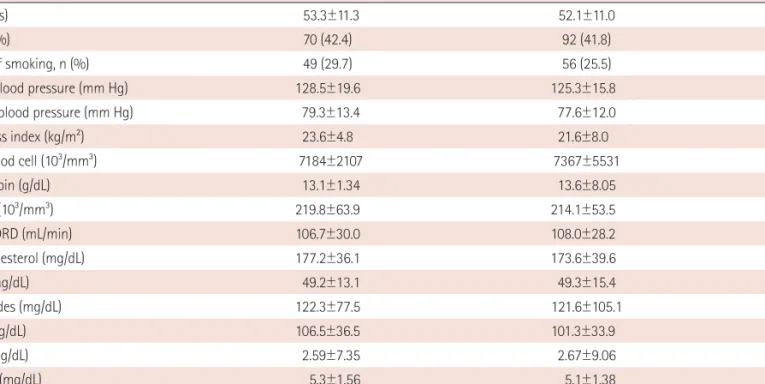
Among 385 consecutive patients, who underwent coronary an- giography with EPT without associated cardiovascular risk factors, 165 patients showed positive EPTs {EPT(+)} and 220 patients sh- owed negative EPTs {EPT(-)}. Baseline clinical characteristics are Table 1. Baseline characteristics of groups

Positive EPT (n=165) Negative EPT (n=220) p

Age (years) 53.3±11.3 52.1±11.0 0.278

Male, n (%) 70 (42.4) 92 (41.8) 0.494

History of smoking, n (%) 49 (29.7) 56 (25.5) 0.178

Systolic blood pressure (mm Hg) 128.5±19.6 125.3±15.8 0.082

Diastolic blood pressure (mm Hg) 79.3±13.4 77.6±12.0 0.210

Body mass index (kg/m

2

) 23.6±4.8 21.6±8.0 0.004

White blood cell (10

3

/mm

3

) 7184±2107 7367±5531 0.654

Hemoglobin (g/dL) 13.1±1.34 13.6±8.05 0.395

Platelets (10

3

/mm

3

) 219.8±63.9 214.1±53.5 0.363

eGFR, MDRD (mL/min) 106.7±30.0 108.0±28.2 0.655

Total cholesterol (mg/dL) 177.2±36.1 173.6±39.6 0.373

HDL-C (mg/dL) 49.2±13.1 49.3±15.4 0.955

Triglycerides (mg/dL) 122.3±77.5 121.6±105.1 0.938

LDL-C (mg/dL) 106.5±36.5 101.3±33.9 0.172

hsCRP (mg/dL) 2.59±7.35 2.67±9.06 0.925

Uric acid (mg/dL) 5.3±1.56 5.1±1.38 0.142

Fasting glucose (mg/dL) 102.9±30.0 98.6±21.9 0.177

Data are n (%) or mean±SD. EPT: ergonovine provocation test, eGFR: estimated glomerular filtration rate, MDRD: modification of diet in renal disease, HDL-C: high density lipoprotein-cholesterol, LDL-C: low density lipoprotein-cholesterol, hsCRP: high-sensitivity C-reactive protein

Table 2. Echocardiographic parameters between groups

Positive EPT (n=165) Negative EPT (n=220) p

LVEDD (mm) 45.7±4.43 45.3±5.00 0.425

LVESD (mm) 28.5±4.33 28.2±4.18 0.453

Ejection fraction (%) 67.8±8.34 67.8±7.54 0.969

IVSd (mm) 11.0±1.83 11.3±2.16 0.223

PWDd (mm) 10.1±1.80 9.9±1.62 0.439

Relative wall thickness 0.44±0.11 0.43±0.12 0.716

LV mass index (gram/m

2

) 114.8±33.6 105.3±45.8 0.019

Left atrial diameter (mm) 34.0±5.6 34.3±5.3 0.625

Aortic diameter (mm) 32.0±4.1 31.8±4.0 0.292

E velocity (cm/sec) 67.8±19.5 64.8±17.4 0.841

A velocity (cm/sec) 65.9±19.5 64.8±17.4 0.590

Deceleration time (cm/sec) 235.0±52.2 236.6±55.5 0.791

E/Ea 9.2±4.0 9.3±3.1 0.856

Data are n (%) or mean±SD. EPT: ergonovine provocation test, LVEDD: left ventricular end diastolic diameter, LVESD: left ventricular end diastolic diameter,

IVSd: diastolic interventricular septal thickness, PWDd: posterior wall thickness, LV: left ventricular, E: peak early diastolic mitral flow, A: peak late diastolic

mitral flow, Ea: peak early diastolic annular velocity

(4)

summarized in Table 1. As shown in Table 1, there was no statisti- cally significant difference between the patients with VA and con- trols with respect to demographic characteristics except for body mass index. Table 2 outlines the echocardiographic data of the study groups. All echocardiographic parameters, except LVMI, were similar between the groups; these parameters included IVRT, DT, E/

A ratio and E/E’ ratio, which are indicators of diastolic dysfunction.

The proportion of patients with subclinical hypothyroidism among those with EPT(+) was significantly higher than among those pa- tients with EPT(-) (18% vs. 11%, p=0.042) (Fig. 1). However, there was no significant difference in the proportion of subclinical hyper- thyroidism between the groups (Table 3). Moreover, TPO Ab posi- tivity was significantly more common in patients with EPT(+) than those with EPT(-) (33% vs. 14%, p<0.001). There was a significant positive correlation between EPT(+) and TPO positivity (r=0.235, p<0.001), TPO Ab titer (r=0.293, p<0.001), subclinical hypothyroid- ism (r=0.104, p=0.042), and body mass index (r=0.143, p=0.005).

Binary logistic regression analysis revealed that the significant predictors of EPT(+) were body mass index {adjusted odds ratio (OR)=1.042, 95% confidence interval (CI)=1.005–1.080, p=0.026},

presence of subclinical hypothyroidism (OR=3.047, 95% CI=1.083–

8.572, p=0.035), TPO Ab titer (OR=1.028, 95% CI=1.015–1.041, p<

0.001) and the presence of TPO Ab (OR=4.904, 95% CI=1.544–

15.567, p=0.007) (Table 4).

Discussion

Variant angina is an important cause of critical situations such as acute myocardial infarction, fatal arrhythmia, and sudden cardiac death.

16)

Therefore, it is important to predict the risk of coronary ar- tery spasms in the general population in order to reduce its associ- ated complications. One of the important mechanisms underlying VA is thought to be endothelial dysfunction of coronary arteries.

3)17)

In this study, we showed that subclinical hypothyroidism, not sub- clinical hyperthyroidism, is associated with coronary spasms as es- tablished by the ergonovine test. The presence of TPO Ab was also found to be significantly associated with increased coronary vaso- spasm in patients without cardiovascular risk factors.

Since the cardiovascular system is one of the major sites of ac- tion for thyroid hormones, it is relatively sensitive to changes in hor- monal levels.

18)

The first case of hyperthyroidism-associated angina pectoris (secondary to coronary spasm) was reported clinically in 1950 and by angiography in 1979; since then, several reports addi- tional reports have appeared.

19)

However, there is no consensus on the association between subclinical thyroid disease and VA. Sub- clinical hypothyroidism is characterized by normal serum free T4 and free T3 levels and increased serum TSH levels, which is relatively common in the general population.

20)

Although the relationship be- tween subclinical hypothyroidism and cardiovascular diseases has become a popular topic recently, there is still some controversy con- cerning the cardiovascular effect of subclinical hypothyroidism and management protocols.

20)21)

Due to its metabolic and hemodynam- ic effects, such as hyperlipidemia and hypertension, overt hypothy- roidism is associated with atherosclerosis.

19)

Subclinical hypothy- roidism may be related to endothelial dysfunction and atherogenesis in several ways. First, subclinical hypothyroidism is associated with Table 3. Thyroid function of groups

Positive EPT (n=165) Negative EPT (n=220) p

Normal TFT, n (%) 118 (71.5) 169 (76.8) 0.237

Subclinical hypothyroidism, n (%) 30 (18.2) 24 (10.9) 0.042

Subclinical hyperthyroidism, n (%) 17 (10.3) 27 (12.3) 0.548

Free T4 (pmol/L) 1.15±0.20 1.16±0.21 0.463

TSH (mlU/L) 4.31±14.1 2.15±2.04 0.026

TPO Ab titer 90.0±154.9 25.4±33.3 <0.001

Positive TPO Ab, n (%) 55 (33.3) 30 (13.6) <0.001

Data are n (%) or mean±SD. EPT: ergonovine provocation test, TFT: thyroid function test, TSH: thyroid stimulating hormone, TPO Ab: thyroid peroxidase anti- body

Fig. 1. The proportion of patients with subclinical hypothyroidism among those with positive ergonovine provocation tests was significantly higher than among those patients with negative ergonovine provocation tests.

TPO: thyroid peroxidase.

35 30 25 20 15 10 5 0

Prevalence (%)

TPO positive p<0.001

p=0.042

p=0.548

Subclinical

hypothyroidism Subclinical

hyperthyroidism

Normal

Variant angina

(5)

increased levels of LDL-C,

22)

diastolic blood pressure,

23)

and altered coagulation parameters.

24)

Second, because thyroid hormone re- ceptors have been identified in human vascular smooth muscle cells,

25)

thyroid hormone deficiency with low grade inflammation may cause endothelial dysfunction and impaired NO availability,

26)

and slow blood flow may contribute to the process.

27)

Previous stud- ies have identified impaired endothelial function in patients with subclinical hypothyroidism,

6-8)

which resulted from a reduction in NO availability and was reversed by levothyroxine supplementation.

8)

In the present study, we found a higher frequency of coronary artery spasm induced by ergonovine in patients with subclinical hypothy- roidism defined by TPO autoantibody positivity. There have also been reports regarding the impact of thyroid autoimmunity on the car- diovascular system. For example, among euthyroid women, the pres- ence of Hashimoto’s thyroiditis has been found to be positively as- sociated with arterial stiffness.

11)

Furthermore, thyroid autoimmunity has been associated with an increase in carotid atherosclerosis in obese women, independent of thyroid function, obesity, and cardio- vascular risk factors.

12)

We previously showed that the presence of TPO Ab was significantly associated with increased arterial stiffness in postmenopausal female fibromyalgia patients.

13)

Considering that increased arterial stiffness is also caused by mildly impaired thyroid function,

28)

the increased arterial stiffness associated with endothe- lial dysfunction might explain our result.

Another interesting finding in our study is that there is a signifi- cant association between body mass index and VA. Although there was no clear evidence that obesity might initiate coronary artery spasms, excess body fat may indirectly affect insulin resistance, an enhanced inflammatory state, and the plasma free insulin-like growth factor-I, which are reported to be related to coronary ar- tery spasms.

29)

Obesity itself also has been shown to be indepen-

dently associated with coronary endothelial dysfunction in patients with normal or mildly diseased coronary arteries.

30)

There are several limitations to this study. Because we used strict criteria to define a positive ergonovine angiographic study (near to- tal, localized spasm, reproducing the patient’s typical symptoms or associated with ST-segment shifts), our results are not applicable to patients with mild generalized vasoconstriction (<20% narrowing) of apparently normal coronary arteries with clinically suspected VA.

The cross-sectional study design is also a limitation in that it pre- cludes our ability to infer causal associations. Moreover, our patients were on a variety of medications, which may have had some effect on endothelial function. In addition, the weak correlation we found between the presence of subclinical hypothyroidism (r=0.104) or TPO antibody (r=0.235) will require a larger prospective study.

However, we believe the results of this study have shown a valu- able trend in VA, especially regarding the use of TPO Ab to evaluate this condition. In conclusion, we demonstrated that combined thy- roid autoimmunity is significantly associated with increased coro- nary vasospasm in patients without cardiovascular risk factors. These results support the need to re-evaluate the effects of thyroid au- toimmunity on the vasculature of VA patients without cardiovascu- lar risk factors. However, longitudinal studies that employ a large population will be needed to determine the pathophysiologic and prognostic implications of coronary vasospasm.

References

1. Yasue H, Horio Y, Nakamura N, et al. Induction of coronary artery spasm by acetylcholine in patients with variant angina: possible role of the parasympathetic nervous system in the pathogenesis of coronary ar- tery spasm. Circulation 1986;74:955-63.

2. Akasaka T, Yoshida K, Hozumi T, et al. Comparison of coronary flow re- Table 4. Binary logistic regression analysis

Ergonovine provocation test(+)

Univariate Multivariate

OR (95% CI) p OR (95% CI) p

Age 1.010 (0.992–1.029) 0.439

Female gender 1.025 (0.681–1.543) 0.615

Smoking 1.213 (0.762–1.499) 0.300

SBP 1.010 (0.999–1.022) 0.152

Total cholesterol 1.002 (0.997–1.008) 0.342

Subclinical hypothyroidism 1.347 (1.008–1.800) 0.044 3.047 (1.083–8.572) 0.035

Body mass index 1.049 (1.013–1.085) 0.007 1.042 (1.005–1.080) 0.026

TSH 1.081 (1.002–1.167) 0.045 1.114 (0.991–1.251) 0.070

TPO Ab titer 1.013 (1.008–1.019) <0.001 1.028 (1.015–1.041) <0.001

Positive TPO Ab 3.167 (1.915–5.237) <0.001 4.903 (1.544–15.567) 0.007

OR: odds ratio, CI: confidence interval, SBP: systolic blood pressure, TSH: thyroid stimulating hormone, TPO Ab: thyroid peroxidase antibody

(6)

serve between focal and diffuse vasoconstriction induced by ergono- vine in patients with vasospastic angina. Am J Cardiol 1997;80:705-10.

3. Kugiyama K, Ohgushi M, Motoyama T, et al. Nitric oxide-mediated flow-dependent dilation is impaired in coronary arteries in patients with coronary spastic angina. J Am Coll Cardiol 1997;30:920-6.

4. Selwyn AP, Kinlay S, Creager M, Libby P, Ganz P. Cell dysfunction in atherosclerosis and the ischemic manifestations of coronary artery disease. Am J Cardiol 1997;79(5A):17-23.

5. Owen PJ, Sabit R, Lazarus JH. Thyroid disease and vascular function.

Thyroid 2007;17:519-24.

6. Lekakis J, Papamichael C, Alevizaki M, et al. Flow-mediated, endotheli- um-dependent vasodilation is impaired in subjects with hypothyroid- ism, borderline hypothyroidism, and high-normal serum thyrotropin (TSH) values. Thyroid 1997;7:411-4.

7. Cikim AS, Oflaz H, Ozbey N, et al. Evaluation of endothelial function in subclinical hypothyroidism and subclinical hyperthyroidism. Thyroid 2004;14:605-9.

8. Taddei S, Caraccio N, Virdis A, et al. Impaired endothelium-dependent vasodilatation in subclinical hypothyroidism: beneficial effect of le- vothyroxine therapy. J Clin Endocrinol Metab 2003;88:3731-7.

9. Schultz M, Kistorp C, Raymond I, et al. Cardiovascular events in thyroid disease: a population based, prospective study. Horm Metab Res 2011;

43:653-9.

10. Sharma R, Sharma TK, Kaushik GG, Sharma S, Vardey SK, Sinha M. Sub- clinical hypothyroidism and its association with cardiovascular risk factors. Clin Lab 2011;57:719-24.

11. Stamatelopoulos KS, Kyrkou K, Chrysochoou E, et al. Arterial stiffness but not intima-media thickness is increased in euthyroid patients with Hashimoto’s thyroiditis: the effect of menopausal status. Thyroid 2009;

19:857-62.

12. Ciccone MM, De Pergola G, Porcelli MT, et al. Increased carotid IMT in overweight and obese women affected by Hashimoto’s thyroiditis: an adiposity and autoimmune linkage? BMC Cardiovasc Disord 2010;

10:22.

13. Cho KI, Lee JH. The impact of thyroid autoimmunity on arterial stiff- ness in postmenopausal patients with fibromyalgia. Int J Rheum Dis 2014 Jan 11 [Epub]. http://dx.doi.org/10.1111/1756-185X.12257.

14. Zaya M, Mehta PK, Merz CN. Provocative testing for coronary reac- tivity and spasm. J Am Coll Cardiol 2014;63:103-9.

15. JCS Joint Working Group. Guidelines for diagnosis and treatment of patients with vasospastic angina (coronary spastic angina) (JCS 2008):

digest version. Circ J 2010;74:1745-62.

16. Bory M, Panagides D, Desfossez L. Coronary artery spasm in myocardial infarction. Lancet 1993;342:436.

17. Yasue H, Kugiyama K. Coronary spasm: clinical features and pathogen- esis. Intern Med 1997;36:760-5.

18. Kahaly GJ. Cardiovascular and atherogenic aspects of subclinical hy- pothyroidism. Thyroid 2000;10:665-79.

19. Wei JY, Genecin A, Greene HL, Achuff SC. Coronary spasm with ven- tricular fibrillation during thyrotoxicosis: response to attaining euthy- roid state. Am J Cardiol 1979;43:335-9.

20. Cooper DS. Clinical practice. Subclinical hypothyroidism. N Engl J Med 2001;345:260-5.

21. Biondi B, Palmieri EA, Lombardi G, Fazio S. Effects of subclinical thyroid dysfunction on the heart. Ann Intern Med 2002;137:904-14.

22. Pirich C, Müllner M, Sinzinger H. Prevalence and relevance of thyroid dysfunction in 1922 cholesterol screening participants. J Clin Epidemiol 2000;53:623-9.

23. Cai Y, Ren Y, Shi J. Blood pressure levels in patients with subclinical thyroid dysfunction: a meta-analysis of cross-sectional data. Hyper- tens Res 2011;34:1098-105.

24. Cantürk Z, Cetinarslan B, Tarkun I, Cantürk NZ, Ozden M, Duman C.

Hemostatic system as a risk factor for cardiovascular disease in women with subclinical hypothyroidism. Thyroid 2003;13:971-7.

25. Mizuma H, Murakami M, Mori M. Thyroid hormone activation in hu- man vascular smooth muscle cells: expression of type II iodothyronine deiodinase. Circ Res 2001;88:313-8.

26. Taddei S, Caraccio N, Virdis A, et al. Low-grade systemic inflammation causes endothelial dysfunction in patients with Hashimoto’s thyroid- itis. J Clin Endocrinol Metab 2006;91:5076-82.

27. Obuobie K, Smith J, Evans LM, John R, Davies JS, Lazarus JH. Increased central arterial stiffness in hypothyroidism. J Clin Endocrinol Metab 2002;87:4662-6.

28. Nagasaki T, Inaba M, Kumeda Y, et al. Increased pulse wave velocity in subclinical hypothyroidism. J Clin Endocrinol Metab 2006;91:154-8.

29. Kashiwagi Y, Harada E, Mizuno Y, et al. Coronary spastic angina is as- sociated with insulin resistance-possible involvement of endothelial dysfunction. Coron Artery Dis 2013;24:559-65.

30. Al Suwaidi J, Higano ST, Holmes DR Jr, Lennon R, Lerman A. Obesity is

independently associated with coronary endothelial dysfunction in pa-

tients with normal or mildly diseased coronary arteries. J Am Coll Car-

diol 2001;37:1523-8.

수치

Table 2. Echocardiographic parameters between groups
Fig. 1. The proportion of patients with subclinical hypothyroidism among  those with positive ergonovine provocation tests was significantly higher  than among those patients with negative ergonovine provocation tests

참조

관련 문서

Orbital fibroblasts from patients with TAO expressed significantly higher level of CD44 than non-TAO cells, and the increased COX-2 expression by HA in these cells was attenuated

When com- pared to diabetic patients with no complication, patients ≥2 complication had significantly higher risk of subscale, physical functioning, role of physical health,

In our study, among five patients who underwent surgery based on AVS results of a positive CR and negative LR, there was one patient who did not achieve clinical improvement

Background: Data regarding the association between preexisting cardiovascular risk factors (CVRFs) and cardiovascular diseases (CVDs) and the outcomes of patients requiring

Impact of cardiovascular risk factors and cardiovascular diseases on outcomes in patients hospitalized with COVID-19 in Daegu Metropolitan City.. Ponikowski P, Voors AA, Anker

Also, regardless of the smoking status, the CAS group had a significantly higher incidence of recurrent angina than the non-CAS group (Fig. Most of the patients who underwent