Evaluating the effects of pentoxifylline administration on experimental pressure sores in rats by biomechanical examinations
Kobra Velaei
1, Mohammad Bayat
1*, Giti Torkman
2, Fatemealsadat Rezaie
1, Abdollah Amini
1, Mohsen Noruzian
1, Azaedh Tavassol
3, Mehernoush Bayat
41
Cell and Molecular Biology Research Center and Anatomy Department, Medical Faculty, Shahid Beheshti University of Medical Sciences, Tehran, Iran
2
Physiotherapy Department, Medical Sciences faculty, Tarbiat Modrres University, Tehran, Iran
3
Sciences Faculty, Islamic Azad University, Tehran, Iran
4
Dental Faculty, Tehran University of Medical Sciences, Tehran, Iran
This study used a biomechanical test to evaluate the effects of pentoxifylline administration on the wound healing process of an experimental pressure sore induced in rats. Under general anesthesia and sterile conditions, experimental pressure sores generated by no. 25 Halsted mosquito forceps were inflicted on 12 adult male rats. Pentoxifylline was injected intraperitoneally at a dose of 50 mg/kg daily from the day the pressure sore was generated, for a period of 20 days. At the end of 20 days, rats were sacrificed and skin samples extracted. Samples were biomechanically examined by a material testing instrument for maximum stress (N mm
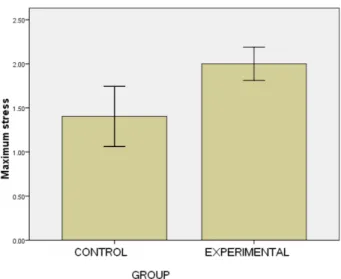
2), work up to maximum force (N), and elastic stiffness (N/mm). In the experimental group, maximum stress (2.05±0.15) and work up to maximum force (N/mm) (63.75±4.97) were significantly higher than the control group (1.3±0.27 and 43.3±14.96, P=0.002 and P=0.035, respectively). Pentoxifylline administration significantly accelerated the wound healing process in experimental rats with pressure sores, compared to that of the control group.
Key words: Experimental model of pressure sore, rat, biomechanical test, pentoxifylline
Received 27 June 2012; Revised version received 26 August 2012; Accepted 30 August 2012
Pressure sores are a major health problem currently affecting approximately three million adults [1-4].
Mostly, pressure sores occur in patients who are immobile or unable to change their body positions. In this condition the patient’s dermal tissues are at increased risk for necrosis of the skin, subcutaneous tissues, and muscles.
Pressure sores are defined as areas of skin discoloration or damage which persist following the removal of pressure and which are likely to have resulted from the effects of pressure on the tissues. Throughout history, pressure sores have previously been called decubitus ulcers, bed sores. Scientists have attempted to use these terms in order to identify and describe the
pathophysiology of wounds that result from physical stress. However, bed sore could not justify the existence of a pressure sore that occurs for any other reason, except in bed such as those pressure sores that occur in individuals who use wheelchairs. Today, pressure sore is the best description for this type of sore, as these lesions are multifactorial in nature and may occur anywhere on the body [1].
Stress, time, spasticity, infection, edema, nerve transaction, and poor nutrition are considered the main factors which lead to pressure sores or at least have a role in their development. Approximately more than 60% of pressure sores occur in hospitalized patients and these numbers are increasing. This is possibly due to the
Letter
*Corresponding author: Mohammad Bayat, Cell and Molecular Biology Research Center and Anatomy Department, Medical Faculty, Shahid Beheshti University of Medical Sciences, PO Box 19395-4719, Tehran 1985717443, Velenjak, Iran
Tel: +98-21-2243-9976; Fax: +98-21-2243-9976; E-mail: [email protected]
This is an Open Access article distributed under the terms of the Creative Commons Attribution Non-Commercial License (http://creativecommons.org/licenses/
by-nc/3.0) which permits unrestricted non-commercial use, distribution, and reproduction in any medium, provided the original work is properly cited.
hospital administrators are legally obligated to prevent patients from acquiring pressure sores and physical weaknesses. In order to achieve this goal and prevent the occurrence of pressure sores, intensive preventative measures are warranted [1]. As mentioned earlier, the primary cause of pressure sores is based on the exerted pressure and permanent forces on the patient’s dermal tissues, whereby the supply of oxygen is reduced or cut- off causing tissue necrosis [2,3].
Pressure sores remain a major challenge in the medical world [4,5]. In English hospitals, the prevalence of pressure sores has ranged from 9.6 to 11.9% among adult patients; in those who had surgery the range was 12%, whereas it was 22% in elderly patients. Statistics taken from the English population showed that the prevalence range in adults was 4.4% and in children it was 6.8%. Studies in the United States and Canada have shown that the prevalence range and incidence range vary according to environmental conditions. For example, in acute care settings, there was a prevalence of 4.7% to 29.7% [5]. A similar study in European hospitals showed an 18.1% prevalence of pressure sores [6].
According to reports by the Consultation Secretariat of the National Association of Pressure Ulcers, a prevalence range of 10% to18% was seen in general acute care units [7].
Pentoxifylline is a xanthine derivative and like other methylated xanthine derivatives, it is a competitive nonselective phosphodiesterase inhibitor [8] that raises intracellular cAMP, activates PKA, inhibits TNF-alpha [9,10] and leukotriene [11] synthesis, and reduces inflammation and innate immunity [11]. In addition, pentoxifylline improves red blood cell deformability, reduces blood viscosity and decreases the potential for platelet aggregation and thrombus formation [12].
Pentoxifylline improves blood flow through peripheral blood vessels and therefore assists with blood circulation in the arms and legs (e.g., intermittent claudication), and the brain in cases of vascular dementia.
A large volume of studies have identified the positive effects of pentoxifylline administration on skin flaps [13- 15], venous ulcers, skin ulcers in both healthy [16-19]
and diabetic mice [20], colitis, stomach ulcers, and small and large bowel anastomosis in experimental ischemic conditions [21-24].
quantitative assessment criteria, such as the effects of pentoxifylline on biomechanical factors in healing skin sores have been less considered. Factors such as metabolic, circulatory, and neurotrophic changes, in addition to complications arising from ischemia are additional factors that create pressure sores [25]. It is known that ischemia and reperfusion are the most important factors in the pathogenesis of pressure sore development [26].
Recent studies have shown the positive effects of pentoxifylline in cases of ischemic conditions [15,16, 20,21]. In a review of the literature, despite numerous reviews that have discussed and identified the influence of pentoxifylline on wound healing, no study has investigated the influence of pentoxifylline on pressure sores. Thus the present study has been designed to investigate the effects of pentoxifylline administration on healing experimental pressure sores in rats by using a biomechanical evaluating method.
Twenty adult male Wistar rats with a mean age of twelve weeks (10-14 weeks) and mean body weight of 250 grams (230-270 grams) were purchased from the Pasteur Institute of Iran. During the study, rats were maintained in individual cages in an animal house with a light-dark cycle (12 h light, 12 h dark) and access to water and food ad libitum. Animals were kept for at least two weeks in the animal house until they acclimated to their surroundings. All study procedures were approved by the Medical Ethics Committee of Shahid Beheshti University of Medical Sciences, Tehran, Iran.
In a pilot study, four degrees of pressure (low, medium, high and very high) were inflicted by using nos. 25 and 13 Halsted mosquito forceps on eight rats (two rats per degree of pressure). The rats’ skins were held between two clamps of forceps for 2 hours, after which pressure was released for about 30 min (Figure 1).
As with the main experiment, this procedure was repeated 12 times during three consecutive days for each grade.
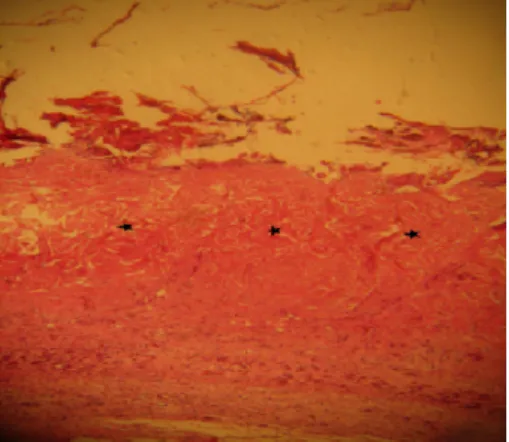
Histological studies on the samples which were taken at the end of the seventh day showed that pressure sores were created only in the skins that received very high pressure with the no. 25 forceps (Figure 2).
In the main study, twelve additional rats were
anesthetized by intramuscular injections on day 0, the
hair from the dorsal regions were shaved and cleaned
with 70% alcohol and povidine iodine. Then, under sterile conditions, the skin was raised and double-folded from the middle region. Approximately a one centimeter length of skin was held under the highest pressure grade of the no.25 Halsted mosquito forceps for 2 h (Figure 1) after which their skins were released for about 30 min to induce an experimental model of ischemia and perfusion on the skin tissue [27]. A thin sheet of aluminum (dimensions, 3×5 mm) was laid between contact sides of the skin and forceps clamps to enable equal distribution of the pressure on all parts of the skin. Ischemia (2 h) and perfusion (30 min) were applied for a period of 12 times (four periods per day) during 3 consecutive days. During those courses, the rats were anesthetized by injection of anesthetic drugs. From the beginning of the third day, rats were followed for seven days until the presence of pressure sore models were noted on their skins. At the end of the seventh day, we randomly divided the twelve rats into two groups, control and experimental. The experimental group received intraperitoneal injections of 50 mg/kg pentoxifylline [28]. Control groups received a similar volume of saline. These injections were administered daily for 20 consecutive days.
Rats were sacrificed by inhalation of chloroform at the end of day 20 and skin samples taken (5 cm of length×
5 mm of breadth) from the wound and surrounding skin area, with wounds located in the center of the samples.
Samples were placed in a piece of gas packing wound impregnated with saline solution and maintained at −20
o