* Corresponding author
Phone: +82-62-230-7518 Fax: +82-62-232-2474 E-mail: [email protected]
This is an open-access journal distributed under the terms of the Creative Commons Attribution Non-Commercial License
(http://creativecommons.org/licenses/by-nc/4.0/)
http://dx.doi.org/10.15433/ksmb.2016.8.1.001 ISSN 2383-5400 (Online)
재조합 한천 분해효소의 생산과 응용
Production and Application of Recombinant Agarase
김세원1, 홍채환2, 윤나경2, 신현재1*
Se Won Kim1, Chae-Hwan Hong2, Na Kyong Yun2, Hyun-Jae Shin1*
1조선대학교 생명화학고분자공학과, 광주광역시 동구 필문대로 309, 61452, 대한민국
2현대자동차 중앙연구소, 경기도 의왕시 철도박물관로 37, 16082, 대한민국
1Department of Biochemical and Polymer Engineering, Chosun University, Gwnagju-si 61452, Republic of Korea
2Research & Development Division, Hyundai Motor Group, Uiwang-si, Gyeonggi-do 16082, Republic of Korea
(Received 18 May 2016, Revised 2 June 2016, Accepted 3 June 2016)
Abstract The hydrolysis of biomass to fermentable sugar (saccharification) and to oligosaccharide is an essential process in biotechnology including biorefinery and biofood. Various macroalgae are commercially cultivated in several Asian countries as a useful resource for food and agar production. Agar is a major component of the cell walls of red algae that can be hydrolyzed by agarase. Agarases are classified into α-agarase (E.C. 3.2.1.158) and β-agarase (E.C. 3.2.1.81) according to the cleavage pattern and grouped in the glycoside hydrolase (GH) family (GH-16, GH-58, GH-86, GH-96, and GH-118) based on the amino acid sequences of the proteins. Agarases have been isolated from various bacteria found in seawater and marine sediments. To increase productivity of the enzyme, a research on recombinant enzymes has been done. The application of recombinant agarase can be possible in the various filed such as energy, food, cosmetics, medical and so on. This paper reviews the source, biochemical characteristics and production system of recombinant agarases for further study.
Keywords : Red Algae, Agar, Recombinant Agarase, Saccharification, Oligosaccharides, GH family
서 론
최근 에너지, 환경, 보건에 관련된 문제를 해결하 기 위한 원료물질로서 해조류에 대한 관심이 증가하 고 있다. 해조류를 구성하고 있는 다당류를 활용한 다양한 시도가 이루어지고 있다. 우선 석유계 자원 을 대체하기 위한 바이오매스 (biomass)자원으로서
해조류 (혹은 해조류 다당류)를 가수분해하여 발효 가 가능한 단당류를 생산하는 연구가 활발히 진행 중이다. 또한 해조류 다당류를 저분자화하여 제조한 올리고당은 항암 및 항균작용, 면역증강, 항비만 효 과, 항산화 작용과 같은 생리적 활성이 우수하다고 알려져 있다 [20]. 해조류 다당류 중에 대표적인 한 천 (agar)은 우뭇가사리나 꼬시래기 등의 홍조류에 서 얻어지는데, 그 자체로 식품용 콜로이드로 이용
이 가능할 뿐만 아니라 바이오매스 자원과 올리고당 의 제조에도 널리 사용되고 있다. 이때 다당류를 분 해하는 방법으로 산을 이용한 화학적 당화와 효소를 이용한 생물학적 분해(혹은 가수분해)법이 사용될 수 있다. 화학적 방법은 반응 후 분해산물이 균일하 지 않고 분해반응 조절이 쉽지 않으며 부산물이 생 성되어 정밀한 가수분해 공정 혹은 대량생산 공정에 적합하지 않다. 또한 환경오염 문제 및 반응 후 중화 작업을 거쳐야 하는 등 공정이 번거로운 단점이 있 다. 반면, 효소를 이용한 생물학적 분해법은 효소가 다당체의 특정부위를 인식하여 한천을 선택적으로 분해할 수 있어, 당화의 효율을 증대시킬 수 있을 뿐만 아니라 한천올리고당을 생산하는데 용이하게 사용할 수 있는 장점이 있다. 따라서 경제적이고 효 율적인 효소의 생산은 산업적으로 무척 중요하다.
특히 한천을 분해하는 한천 분해효소 (agarase)를 생 산하는 새로운 균주에 대한 연구 및 재조합 효소의 개발이 꾸준히 이루어지고 있다 [3]. 본 총설에서는 최근 각광받고 있는 재조합 한천분해효소의 최신 연 구동향을 정리하고 효소의 특성을 요약하여 한천을 산업적으로 이용함에 있어 도움을 주고자 한다.
한천 (agar)
홍조류의 세포벽을 구성하는 다당류는 셀룰로오 즈 (cellulose), 자일란 (xylan), 만난 (mannan), 한천 (agar) 그리고 카라기난 (carragena)등이 있다. 이 중 에서 카라기난은 진두발속 (Chondrus), 돌가사리속 (Gigartina)에서 얻어지며, 한천은 우뭇가사리속 (Gelidium), 꼬시래기속 (Gracilaria) 등에서 얻을 수 있다. 계절에 따라 홍조류가 가진 다당류의 함량은 조금씩 차이가 있지만, 평균적으로 33~35% (건물기 준) 내외이다. 이 두 다당류는 해조를 뜨거운 물 또는 뜨거운 알칼리성 수용액으로 추출하는 점질성 다당류 이다. 카라기난은 D-galactose와 3,6-anhydro-D-galactose 의 잔기에 황산기가 일부 결합한 산성 다당류로 한 천과 유사한 구조를 지니고 있다 (Fig. 1(b)). 카라기 난과 한천의 차이점은 한천의 황산기는 3~6%로 적 은 반면, 카라기난은 20~25%로 함량이 높다는 것이 다. 카라기난은 점성이 강한 반면, 한천은 응고력이 강한 특성이 있다. 반면, 카라기난은 점성이 강하다.
한천은 홍조류의 세포벽에서 추출한 피코콜로이드
(phycocolloid)로서, 상업적 유용성이 높다. 한천은 agarose (60~80%)와 agaropectin (20~40%)의 두 가지 다당류로 구성된 혼합물이다. Agar는 D-galactose와 3,6-anhydro-L-galactose (AHG)가 교차 결합된 구조 로 되어 있다 (Fig. 1(a)). 한천은 우유, 유제품, 청량 음료 등에 첨가제로 이용되며 화장품과 약품 등의 안정제로 많이 쓰이고 있다. 기타 식품용 겔화제, 안 정제, 점증제, 변색방지제, 청징제로 사용되고 있을 뿐만 아니라, 연구분야에서도 일반적인 미생물 성장 용 배지를 비롯하여 식물의 조직배양용 배지의 겔화 제로 사용된다. 최근에는 의약분야에서는 치과인상 제 등으로도 사용되기도 한다.
한천 분해효소 (agarase)와 분해산물
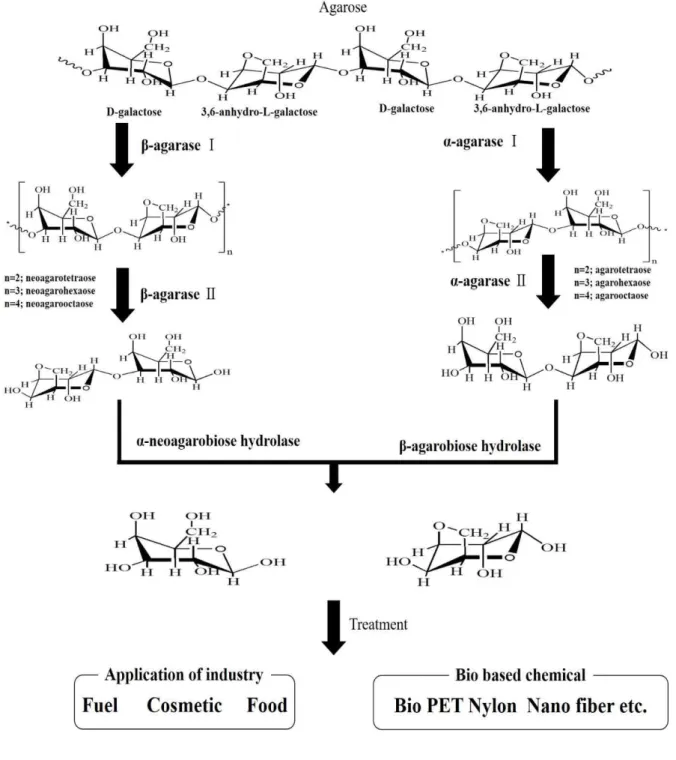
한천은 다당류의 복합체이므로 단당으로 분해하기 위해서는 다양한 형태의 효소를 필요로 한다 (Fig. 2).
Agarase는 주로 해조류에 기생 또는 공생하는 해양미 생물들에서 한천 분해 효소인 agarase를 분리하지만, 해양퇴적물, 바닷물, 심지어 토양에서도 agarase를 분 리한 연구도 있다 [2, 13]. 일반적으로 아가레이즈 (agarase)는 분해하는 위치 및 생성되는 한천올리고당 으로 α-agarase (EC 3.2.1.158)와 β-agarase (EC 3.2.1.81) 로 구분한다. 지금까지 보고 된 agarase는 대부분 β -agarases이며, β-agarases는 β-(1,4) glycosidic 결합부위 를 인식하여 neoagarooligosaccharides (NAOS)를 생성 하는 반면 (Fig. 1(d)), α-agarases는 α-(1,3) glycosidic 결 합부위에 반응하여 agarooligosaccharide (AOS)를 최종 산물로 생산한다 (Fig. 1(c)) [1]. α-agarases (EC 3.2.1.158)는 α-(1,3) glycosidic결합에 선택적으로 작용 하는 효소로서, 현재까지 알려진 바로는 Alteromonas agarlyticus GJ1B [37]와 Thalassomonas sp. JAMB-A33
[36]에서 분리되었다. 이 두 종류의 α-agarases는
glycoside hydrolase family 96 (GH-96)에 해당된다 (http://www.cazy.org/Glycoside-Hydrolases.html). 한편 β-agarases 는 β-(1,4) glycosidic 결합과 선택적으로 반응하는 효소 로서 보고된 agarase의 대부분을 차지한다. Agarase의 서열 상동성을 기준으로 분류하면 β-agarases는 다시 GH-16, GH-50, GH-86과 GH-118으로 구분 할 수 있다 (http://www.cazy.org/Glycoside-Hydrolases.html). 이 중 GH-16은 agarase 뿐만 아니라 galactosidase, glucanase, carrageenase등 다양한 효소가 이 그룹에 속해 있는 반면, GH-50, GH-86, GH-118군은 agarase만으로 이루어져 있다. 현
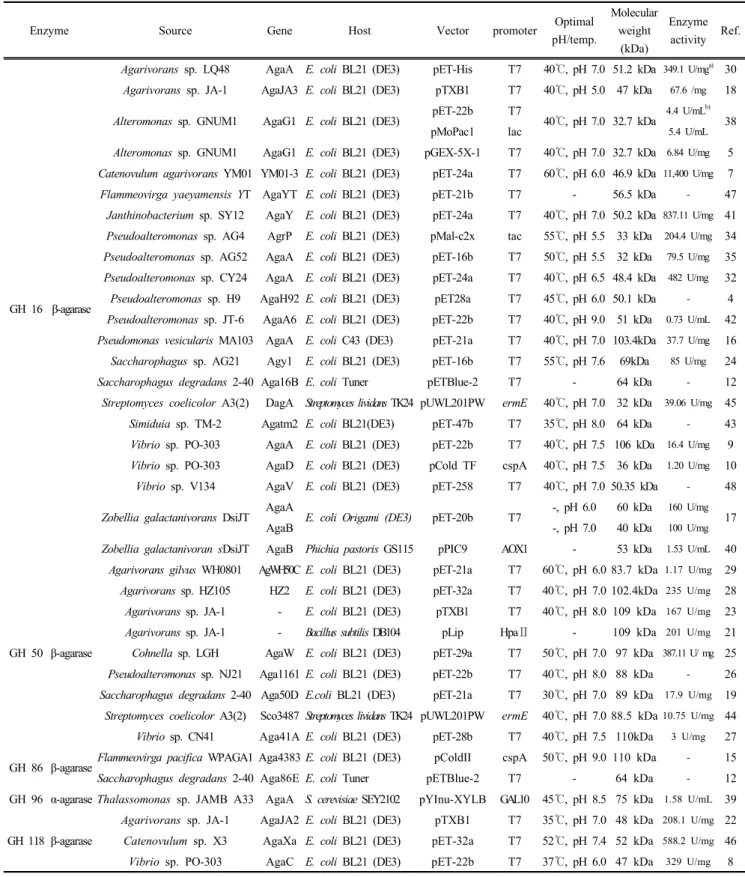
재 GH-16과 GH-50군의 β-agarases가 많이 연구되고 있 으며, 그 중 GH-16군에서의 연구가 활발히 이루어지고 있다 (Table 1).
Agarase에 의해 생성되는 최종산물들은 agarase의 범
주에 따라 달라진다. Agarase의 범주는 amino acid를 기준으로 분류한 glycoside hydrolase family (GH)로 구 분된다. α-agarase는 GH-96으로 최종산물로는 agarotetraose (DP4)가 생성되는 반면 β-agarases는 GH-16, GH-50, GH-86,
O
O H
H H
H H
H H H H
H
OH
OH OH
OH
O
O O
CH2
CH2
* O
O H
H H
H H
H H H H
H
OH
OH OH
OH
O
O O
O CH2
CH2
*
n
(A)
O
O
HO
H
2C
O SO
3O
O
O
OH CH
2OH
O
O n
O
3S
O
3S
*
*
(B)
O
O
H
H H
H H
H H H H
H
OH
OH OH
OH
O
O O
CH2
CH2
*
O
*
n
(C)
O
H H H
H H OH O
O
CH
2O
H H
H H
H OH OH
OH O O
CH
2* *
n
(D)
Figure 1. Structure of red algae main components and agarooligosaccharide (AOS) and neoagarooligosaccharides (NAOS) (A) agar, (B) Carrageenan (λ-Carrageenan), (C) agarooligosaccharide (AOS), (D) neoagarooligosaccharides (NAOS)
GH-118등 4개 군에 해당하는 것으로 보고되고 있다.
GH-16은 최종 산물로 neoagarotetraose (DP4), GH-50은 neoagarobiose (DP2), GH-86은 neoagarohexaose (DP6)와 neoagaroctaose (DP8), GH-118은 neoagarodecaose (DP10) 생성한다. 또한, 하나의 미생물에서 한 개 이상의 agarase 균주가 존재하기도 한다. Zobellia galactanivorans DsiJT 의 AgaA [17], AgaB [40] 2종의 agarase가 GH-16군 에 속하는 반면, Streptomyces coelicolor A3(2)의
DagA [45], Sco3487 [44]는 GH-16과 GH-50에 각각 1 종씩, Vibrio sp. PO-303의 AgaA [9], AgaD [10], AgaC [8]는 GH-16 2종과 GH-50 1종이 존재한다. Agarivorans sp. JA-1의 AgaJA3 [18], agarase [23], AgaJA2 [22]으로 GH-16, GH-50, GH-118에서 각 1종씩 존재하며 Saccharophagus degradans 2-40의 Aga16B [12], Aga50D [19]. Aga86E [13]는 GH-16, GH-50, GH-86에 각 1종씩 존재한다.
Figure 2. Schematic diagram of α-agarase (right) and β-agarase (left) hydrolytic pathways.
Table 1. Summary of recombinant agarases from various sources reported since 2006.
Enzyme Source Gene Host Vector promoter Optimal
pH/temp.
Molecular weight
(kDa)
Enzyme activity Ref.
GH 16 β-agarase
Agarivorans sp. LQ48 AgaA E. coli BL21 (DE3) pET-His T7 40℃, pH 7.0 51.2 kDa 349.1 U/mga) 30 Agarivorans sp. JA-1 AgaJA3 E. coli BL21 (DE3) pTXB1 T7 40℃, pH 5.0 47 kDa 67.6 /mg 18
Alteromonas sp. GNUM1 AgaG1 E. coli BL21 (DE3) pET-22b T7
40℃, pH 7.0 32.7 kDa
4.4 U/mLb)
pMoPac1 lac 5.4 U/mL 38
Alteromonas sp. GNUM1 AgaG1 E. coli BL21 (DE3) pGEX-5X-1 T7 40℃, pH 7.0 32.7 kDa 6.84 U/mg 5 Catenovulum agarivorans YM01 YM01-3 E. coli BL21 (DE3) pET-24a T7 60℃, pH 6.0 46.9 kDa 11,400 U/mg 7
Flammeovirga yaeyamensis YT AgaYT E. coli BL21 (DE3) pET-21b T7 - 56.5 kDa - 47 Janthinobacterium sp. SY12 AgaY E. coli BL21 (DE3) pET-24a T7 40℃, pH 7.0 50.2 kDa 837.11 U/mg 41 Pseudoalteromonas sp. AG4 AgrP E. coli BL21 (DE3) pMal-c2x tac 55℃, pH 5.5 33 kDa 204.4 U/mg 34 Pseudoalteromonas sp. AG52 AgaA E. coli BL21 (DE3) pET-16b T7 50℃, pH 5.5 32 kDa 79.5 U/mg 35 Pseudoalteromonas sp. CY24 AgaA E. coli BL21 (DE3) pET-24a T7 40℃, pH 6.5 48.4 kDa 482 U/mg 32 Pseudoalteromonas sp. H9 AgaH92 E. coli BL21 (DE3) pET28a T7 45℃, pH 6.0 50.1 kDa - 4 Pseudoalteromonas sp. JT-6 AgaA6 E. coli BL21 (DE3) pET-22b T7 40℃, pH 9.0 51 kDa 0.73 U/mL 42 Pseudomonas vesicularis MA103 AgaA E. coli C43 (DE3) pET-21a T7 40℃, pH 7.0 103.4kDa 37.7 U/mg 16 Saccharophagus sp. AG21 Agy1 E. coli BL21 (DE3) pET-16b T7 55℃, pH 7.6 69kDa 85 U/mg 24
Saccharophagus degradans 2-40 Aga16B E. coli Tuner pETBlue-2 T7 - 64 kDa - 12
Streptomyces coelicolor A3(2) DagA Streptomyces lividans TK24 pUWL201PW ermE 40℃, pH 7.0 32 kDa 39.06 U/mg 45 Simiduia sp. TM-2 Agatm2 E. coli BL21(DE3) pET-47b T7 35℃, pH 8.0 64 kDa - 43 Vibrio sp. PO-303 AgaA E. coli BL21 (DE3) pET-22b T7 40℃, pH 7.5 106 kDa 16.4 U/mg 9 Vibrio sp. PO-303 AgaD E. coli BL21 (DE3) pCold TF cspA 40℃, pH 7.5 36 kDa 1.20 U/mg 10
Vibrio sp. V134 AgaV E. coli BL21 (DE3) pET-258 T7 40℃, pH 7.0 50.35 kDa - 48
Zobellia galactanivorans DsiJT AgaA
E. coli Origami (DE3) pET-20b T7 -, pH 6.0 60 kDa 160 U/mg
AgaB -, pH 7.0 40 kDa 100 U/mg 17
Zobellia galactanivoran sDsiJT AgaB Phichia pastoris GS115 pPIC9 AOX1 - 53 kDa 1.53 U/mL 40
GH 50 β-agarase
Agarivorans gilvus WH0801 AgWH50C E. coli BL21 (DE3) pET-21a T7 60℃, pH 6.0 83.7 kDa 1.17 U/mg 29 Agarivorans sp. HZ105 HZ2 E. coli BL21 (DE3) pET-32a T7 40℃, pH 7.0 102.4kDa 235 U/mg 28 Agarivorans sp. JA-1 - E. coli BL21 (DE3) pTXB1 T7 40℃, pH 8.0 109 kDa 167 U/mg 23 Agarivorans sp. JA-1 - Bacillus subtilis DB104 pLip HpaⅡ - 109 kDa 201 U/mg 21 Cohnella sp. LGH AgaW E. coli BL21 (DE3) pET-29a T7 50℃, pH 7.0 97 kDa 387.11 U/ mg 25 Pseudoalteromonas sp. NJ21 Aga1161 E. coli BL21 (DE3) pET-22b T7 40℃, pH 8.0 88 kDa - 26 Saccharophagus degradans 2-40 Aga50D E.coli BL21 (DE3) pET-21a T7 30℃, pH 7.0 89 kDa 17.9 U/mg 19 Streptomyces coelicolor A3(2) Sco3487 Streptomyces lividans TK24 pUWL201PW ermE 40℃, pH 7.0 88.5 kDa10.75 U/mg 44 Vibrio sp. CN41 Aga41A E. coli BL21 (DE3) pET-28b T7 40℃, pH 7.5 110kDa 3 U/mg 27
GH 86 β-agarase Flammeovirga pacifica WPAGA1 Aga4383 E. coli BL21 (DE3) pColdII cspA 50℃, pH 9.0 110 kDa - 15
Saccharophagus degradans 2-40 Aga86E E. coli Tuner pETBlue-2 T7 - 64 kDa - 12
GH 96 α-agarase Thalassomonas sp. JAMB A33 AgaA S. cerevisiae SEY2102 pYInu-XYLB GAL10 45℃, pH 8.5 75 kDa 1.58 U/mL 39
GH 118 β-agarase
Agarivorans sp. JA-1 AgaJA2 E. coli BL21 (DE3) pTXB1 T7 35℃, pH 7.0 48 kDa 208.1 U/mg 22 Catenovulum sp. X3 AgaXa E. coli BL21 (DE3) pET-32a T7 52℃, pH 7.4 52 kDa 588.2 U/mg 46 Vibrio sp. PO-303 AgaC E. coli BL21 (DE3) pET-22b T7 37℃, pH 6.0 47 kDa 329 U/mg 8 a) amount of protein (mg)
b) enzyme solution (mL)
One unit (U) of agarase was defined as the amount of enzyme that produced 1 μmol of galactose/reducing sugar per minute under assay conditions.
재조합 한천 분해효소 (recombinant agarase)
한천 분해효소와 그 유전자는 바닷물, 해양퇴적물, 해조류 등에서 분리 정제되어 다양한 숙주에서 재조 합 효소의 형태로 발현된다. 이렇게 생산된 재조합 한천 분해효소의 효소학적, 유전학적 특성 규명에 대 한 연구가 최근 활발히 이루어지고 있다. Table 1은 최근 10년간 agarase 생산균주에서 해당 유전자를 확 보하고 이종숙주를 사용하여 대량생산하는 방법으 로 산업적으로 적용하기 위한 다양한 연구 결과를 정리한 것이다. 유전자 발현을 위한 이종숙주는 대부 분 E. coli가 사용되었고 T7 promoter를 사용하는 vec- tor에 삽입되었다. 이외의 숙주로는 Phichia pastoris GS115 [40], Streptomyces lividans TK24 [44, 45], S.
cerevisiae SEY2102 [39]가 대표적이다. 재조합 agar- ase의 분자량은 32 kDa에서 110 kDa으로 다양했다.
Pseudoalteromonas sp. AG52에서 유래한 AgaA [35]
의 분자량은 32 kDa으로 가장 작은 반면 Vibrio sp.
CN41에서 유래한 Aga41A [27]와 Flammeovirga pa- cifica WPAGA1에서 유래한 Aga4383 [15]은 110 kDa 으로 가장 큰 분자량을 나타내었다. Table 1에서 보듯 이 agarase 활성 측정은 DNS법을 기본으로 연구자마 다 조금씩 수정된 방법으로 측정되었는데, 그 결과 0.73 U/mL~5.4 U/mL과 1.20 U/mg~11,400 U/mg으로 무척 다양한 범위로 나타났다. Vibrio sp. PO-303에서 유래한 agarase는 1.20 U/mg [10], Vibrio sp. CN41에서 유래한 agarase는 3 U/mg [27]으로 낮은 활성을 보였 다. Alteromonas sp. GNUM-1에서 유래한 agarase의 경우에서 살펴보면, 도입된 vector에 따라 활성 차이 를 보이고 있다. 측정방법은 DNS법으로 동일하지만 Chi등 [5]은 agarase의 활성을 6.84 U/mg으로, Seo등 [38]은 4.4 U/mL과 5.4 U/mL으로 보고하였다. 또한, Zobellia galactanivorans DsiJT에서 유래한 AgaB의 경 우에는 사용된 이중숙주 및 측정방법에 따라 활성이 달라짐을 알 수 있었다. Ferricyanide법으로 활성을 측 정한 결과 100 U/mg [17], DNS법으로 측정한 결과 1.53 U/mL [40]로 나타났다. Catenovulum agarivorans YM01에서 유래한 agarase는 11,400 U/mg [7]으로 가 장 높은 활성을 보였다. 이는 재조합 agarase의 중간 영역에서의 활성이 200~300 U/mg인 것에 비하여 4~5배이상의 높은 활성을 보여준다.
Agarase의 최적 활성을 보인 온도는 대체적으로 비슷한 경향을 보여주고 있다. Agarose의 겔 형성온 도가 32~37℃ 인데, agarase의 최적 활성 온도는 겔 형성온도 보다 높으며 대부분은 40℃가 가장 최적 조건으로 보인다. 한편 Catenovulum agarivorans YM01 [7], Pseudoalteromonas sp. AG4 [34], Pseudoalteromonas sp. AG52 [35], Saccharophagus sp. AG21 [24], Agarivorans gilvus WH0801 [29], Flammeovirga pacifica WPAGA1 [15], Catenovulum sp. X3 [45]는 50℃이상 에서 최적 활성온도를 보이고 있다. 특히, Catenovulum agarivorans YM01과 Agarivorans gilvus WH0801유래 agarase은 60℃에서도 비교적 안정된 활성을 보이는 것으로 보고되고 있다 [7, 29]. 대부분의 agarase의 최적 활성 pH는 중성영역 이나 약 알칼리성 영역에 서 높은 활성을 보이고 있는데 이것은 해양 pH가 평균 7~8인 점을 감안하면 최적 활성 pH 역시 비슷 한 경향을 보인다고 할 수 있다. 그러나, Agarivorans sp. JA-1 [18]는 pH 5.0에서, Pseudoalteromonas sp. AG4 [34]와 Pseudoalteromonas sp. AG52 [35]는 pH 5.5에 서 다른 agarase와는 다르게 약 산성영역에서 높은 활성을 보여주고 있다.
재조합 한천 효소의 미래 전망
현재 agarase를 시약용 혹은 상업용으로 시판하고 있는 회사는 Sigma-Aldrich (cat. # A6306), Thermo Scientific (cat. # EO0461), Lonza (cat. # 58001) 등이 다. 시판 중인 agarase는 에서 유래한 β-agarase Ⅰ과 β-agarase Ⅱ를 사용한 것으로 최종 분해산물로는 neoagarotetraose (DP 4), neoagarobiose (DP 2)를 생산 하는 GH-16군과 GH-50에 속한다 [30]. 대부분의 재 조합 연구가 E. coli에서만 이루어지고 있으며, 다른 이종숙주를 사용하는 예가 드물다. E. coli에서 재조 합 단백질을 생산 할 경우 native상태로 접히지 못한 단백질들이 축적되어 내포체 (Inclusion body)로 형 성될 수 있는 등의 문제점도 발생할 수 있다. 각각의 이종숙주 발현시스템의 특징을 이용한 발현시스템 을 구축하게 되면 대량의 재조합 agarase를 생산할 수 있을 뿐만 아니라, 높은 활성을 얻을 수도 있을 것이다. 따라서 재조합 agarase의 발현 시스템은 각 각의 agarase의 활성 및 생성량을 고려해서 적절한
발현시스템을 사용해야 한다. 현재 재조합 한천 효 소는 대부분 E. coli 발현시스템으로 생산되고 있다.
그러나 추후 재조합 한천 효소의 사용용도에 따른 다양한 발현 시스템 구축이 필요 할 것으로 판단된 다. 예를 들어 재조합 한천 효소를 이용하여 식품 혹은 의약용 한천 올리고당을 생산하기 위해서는 인 체에 안전하게 사용할 수 있는 Lactic acid bacteria (LAB)와 Saccharomyces cerevisiae를 이용한 발현시 스템을 활용하는 것이 유리할 것이다. LAB는 일반 적으로 안전하며, 배양하기 쉬운 것으로 알려져 있으며, 식품 공정에서 사용하기에는 적절한 것 으로 알려져 있다 [14]. LAB 중 대표적인 것은 Lactobacillus sp.이다. 또한 S. cerevisiae는 유전자의 전사와 번역 후 수식이 이루어지는 진핵 숙주로서 식품과 의약용 단백질을 생산하는데 고려할 수 있다 [31]. 재조합 효소의 생산성만을 따지자면, Pichia
pastoris를 활용한 발현 시스템으로 고려할 수 있다.
P. pastoris는 단세포로 조작 및 배양하기 쉬우며, 원 핵생물인 bacteria에서 쉽게 불활성형(inclusion body) 형태로 발현되는 것을 방지하며, 고등 진핵세포인 동물세포를 이용하는 것과 유사한 발현량을 얻을 수 있다 [6]. 이러한 upstream 연구뿐만 아니라 재조합 한천 분해 효소를 대량 배양하는 배양 및 배양기 제 작 기술을 개발하고 해조 다당류를 해조류로부터 효 과적으로 추출하는 등의 downstream 연구가 지속적 으로 진행된다면, 바이오 에너지 생산뿐만 아니라 고부가가치를 가진 해조 다당류인 한천올리고당 생 산에도 효과적일 것으로 판단된다.
감사의 글
본 연구는 현대자동차 그룹 ㈜현대엔지비의 지원 (2015-2016) 에 의하여 이루어졌으며, 이에 감사의 말씀을 드립니다.
References
1. Araki C. 1959. Seaweed polysaccharides. In: Wolfrom ML (ed) Carbohydrate chemistry of substances of biological interest. Pergamon, London, pp 15–30.
2. Araki, T., Hayakawa, M., Lu, Z., Karita, S. and Morishita, T.
1998. Purification and characterization of agarases from a marine bacterium, Vibrio sp. PO-303. J. Mar. Biotechnol.
6, 260-265.
3. Chi, W. J., Chang, Y. K. and Hong, S. K. 2012. Agar degradation by microorganisms and agar-degrading enzymes.
Appl. Microbiol. Biotechnol. 94, 917-930.
4. Chi, W. J., Lee, C. R., Dugerjonjuu, S., Park, J. S., Kang, D. K.
and Hong, S. K. 2015. Biochemical characterization of a novel iron-dependent GH16 β-agarase, AgaH92, from an agarolytic bacterium Pseudoalteromonas sp. H9. FEMS Microbiol. Lett. 362(7), fnv035.
5. Chi, W. J., Park, da. Y., Seo, Y. B., Chang, Y. K., Lee, S. Y. and Hong, S. K. 2014. Cloning, expression, and biochemical characterization of a novel GH16 β-agarase AgaG1 from Alteromonas sp. GNUM-1. Appl. Microbiol.
Biotechnol. 98(10), 4545-4555.
6. Cregg, J. M., Cereghino, J. L., Shi, J. and Higgins, D. R.
2000. Recombinant Protein Expression in Pichia pastoris.
Mol. Biotechnol. 6(1), 23-52.
7. Cui, F., Dong, S, Shi, X., Zhao, X. and Zhang, X. H.
2014. Overexpression and characterization of a novel the rmostable β-agarase YM01-3, from marine bacterium Catenovulum agarivorans YM01(T). Mar. Drugs. 12(5), 2731-2747.
8. Dong, J., Hashikawa, S., Konishi, T., Tamaru, Y. and Araki, T. 2006. Cloning of the novel gene encoding beta-agarase C from a marine bacterium, Vibrio sp. strain PO-303, and characterization of the gene product. Appl.
Environ. Microbiol. 72(9), 6399-6401.
9. Dong, J., Tamaru, Y. and Arakia T. 2007. A unique beta-agarase, AgaA, from a marine bacterium, Vibrio sp.
strain PO-303. Appl. Microbiol. Biotechnol. 74(6), 1248- 1255.
10. Dong, J., Tamaru, Y. and Araki, T. 2007. Molecular cloning, expression, and characterization of a beta-agarasegene, agaD, from a marine bacterium, Vibrio sp. strain PO-303.
Biosci. Biotechnol. Biochem. 71(1), 38-46.
11. Duckworth, M. and Yaphe, W. 1971. The structure of agar:
Part I. Fractionation of a complex mixture of polysaccharides.
Carbohydr. Res. 16, 189-197.
12. Ekborg, N. A., Taylor, L. E., Longmire, A. G., Henrissat, B., Weiner, R. M. and Hutcheson, S.W. 2006. Genomic and proteomic analyses of the agarolytic system expressed by Saccharophagus degradans2-40. Appl. Environ. Microbiol.
72(5), 3396-3405.
13. Fu, X. and Kim, S. 2010. Agarases: review of major sources, categories, purification method, enzyme characteristics and application. Mar. Drugs. 8, 200-218.
14. Gosalbes, M. J., Esteban, C. D., Galán, J. L. and Pérez-Martínez, G. 2000. Integrative food-grade expression system based on the lactose regulon of Lactobacillus casei. Appl. Environ.
Microbiol. 66(11), 4822-4828.
15. Hou, Y., Chen, X., Chan, Z and Zeng, R. 2015. Expression and characterization of a thermostable and pH-stable β-agarase encoded by a new gene from Flammeovirga pacifica WPAGA1. Process Biochem. 50, 1068-1075.
16. Hsu, P. H., Wei, C. H., Lu, W. J., Shen, F., Pan, C.L.
and Lin, H. T. 2015. Extracellular production of a novel endo-β-agarase AgaA from Pseudomonas vesicularis MA103 that cleaves agarose into neoagarotetraose and neoagarohexaose. Int. J. Mol. Sci. 16(3), 5590-5603.
17. Jam, M., Flament, D., Allouch, J., Potin, P., Thion, L., Kloareg, B., Czjzek, M., Helbert, W., Michel, G. and Barbeyron, T. 2005. The endo-beta-agarases AgaA and AgaB from the marine bacterium Zobellia galactanivorans:
two paralogue enzymes with different molecular organizations and catalytic behaviours. Biochem. J. 385, 703-713.
18. Jeon, M. J., Kim, A. R., Lee, D. G. and Lee, S. H. 2012.
Cloning, Expression, and Characterization of a Novel GH-16 β-Agarase from Agarivorans sp. JA-1. Kor. J. Life Science.
22(11), 1545-1551.
19. Kim, H. T., Lee, S., Lee, D., Kim, H. S., Bang, W. G., Kim, K. H. and Choi, I. G. 2010. Overexpression and molecular characterization of Aga50D from Saccharophagus degradans2-40: an exo-type beta-agarase producing neoagarobiose. Appl. Microbiol. Biotechnol. 86(1), 227-34.
20. Kobayashi, R., Takisada, M., Suzuki, T., Kirimura, K.
and Usami, S. 1997. Neoagarobiose as a novel moisturizer with whitening effect. Biosci. Biotechnol. Biochem. 61, 162-163.
21. Lee, D. G., Jang, M. K., Lee, O. H., Kim, N. Y., Ju, S. A.
and Lee, S. H. 2008. Over-production of a glycoside hydrolase family 50 β-agarase from Agarivorans sp. JA-1 in Bacillus subtilis and the whitening effect of its product.
Biotechnol. Lett. 30, 911-918.
22. Lee, D. G., Jeon, M. J. and Lee, S. H. 2012. Cloning, expression, and characterization of a glycoside hydrolase family118 beta-agarase from Agarivorans sp. JA-1. J.
Microbiol. Biotechnol. 22(12), 1692-1697.
23. Lee, D. G., Park, G. T., Kim, N. Y., Lee, E. J., Jang, M. K., Shin, Y. G., Park, G. S., Kim, T. M., Lee, J.
H., Lee, J. H., Kim, S. J. and Lee, S. H. 2006. Cloning, expression, and characterization of a glycoside hydrolase family 50 beta-agarase from a marine Agarivoransisolate.
Biotechnol. Lett. 28(23), 1925-1932.
24. Lee, Y., Oh, C., De, Zoysa M., Kim, H., Wickramaarachc hi, W. D., Whang, I., Kang, D. H., and Lee, J. 2013.
Molecular cloning, overexpression, and enzymatic characterization of glycosyl hydrolase family16 β-Agarase from marine bacterium Saccharophagus sp. AG21 in Escherichia coli. J. Microbiol. Biotechnol. 23(7), 913-922.
25. Li, G., Sun, M., Wu, J., Ye, M., Ge, X., Wei, W., Li, H. and Hu, F. 2015. Identification and biochemical characterization of a novel endo-type β-agarase AgaW from Cohnella sp. strain L GH. Appl. Microbiol. Biotechnol.
99(23), 10019-10029.
26. Li, J. and Sha, Y. 2015. Expression and enzymatic characterization of a cold-adapted β-agarase from Antarctic bacterium Pseudoalteromonas sp. NJ21. Chinese J. Oceanol. Limnol. 33(2), 319-327.
27. Liao, L., Xu, X. W., Jiang, X. W., Cao, Y., Yi, N., Huo, Y. Y., Wu, Y. H., Zhu, X. F., Zhang, X. Q. and Wu, M. 2011. Cloning, expression, and characterization of a new beta-agarase from Vibrio sp. strain CN41. Appl.
Environ. Microbiol. 77(19), 7077-7079.
28. Lin, B., Lu, G., Zheng, Y., Xie, W., Li, S. and Hu, Z.
2012. Gene cloning, expression and characterization of a neoagarotetraose-producing β-agarase from the marine bacterium Agarivorans sp. HZ105. World J. Microbiol.
Biotechnol. 28(4), 1691-1697.
29. Liu, N., Mao, X., Yang, M., Mu, B. and Wei, D. 2014.
Genecloning, expression and characterisation of a new β-agarase, AgWH50C, producing neoagarobiose from A
garivorans gilvus WH0801. World J. Microbiol. Biotechnol.
30(6), 1691-1698.
30. Long, M., Yu, Z. and Xu, X. 2010. A novel beta-agarase with high pH stability from marine Agarivorans sp. LQ48.
Mar. Biotechnol. 12(1), 62-69.
31. Lopes, T. S., Klootwijk, J., Veenstra, A. E., van der Aar, P. C., van Heerikhuizen, H., Raúe, H. A. and Planta, R. J.
1989. High-copy-number integration into the ribosomal DNA of Saccharomyces cerevisiae: a new vector for high-level expression. Gene. 79(2), 199-206.
32. Lu, X., Chu, Y., Wu, Q., Gu, Y., Han, F. and Yu, W.
2009. Cloning, expression and characterization of a new agarase-encoding gene from marine Pseudoalteromonas sp. Biotechnol Lett. 31(10), 1565-1570.
33. Morrice, L. M., McLean, M. W., Long, W. F. and Williamson, F. B. 1983. Beta-agarases I and II from Pseudomonas atlantica. Substrate specificities. Eur. J.
Biochem. 137(1-2), 149-154.
34. Oh, C., Nikapitiya, C., Lee, Y., Whang, I., Kim, S. J., Kang, D. H. and Lee, J. 2010. Cloning, purification and biochemical characterization of beta agarase from the marine bacterium Pseudoalteromonas sp. AG4. J. Ind.
Microbiol. Biotechnol. 37(5), 483-494.
35. Oh. C., Nikapitiya, C., Lee, Y., Whang, I., Kang, D.
H., Heo, S. J., Choi, Y. U. and Lee, J. 2010. Molecular cloning, characterization and enzymatic properties of a novel beta-agarase from a marine isolate Psudoalteromonas SP. AG52. Braz. J. Microbiol. 41(4), 876-889.
36. Ohta, Y., Hatada, Y., Miyazaki, M., Nogi, Y., Ito, S.
and Horikoshi, K. 2005. Purification and characterization of a novel α-agarase from a Thalassomonas sp. Curr.
Microbiol. 50, 212–216.
37. Potin, P., Richard, C., Rochas, C. and Kloareg, B. 1993.
Purification and characterization of the α-agarase from Alteromonas agarlyticus (Cataldi) comb. nov., strain GJ1B.
Eur. J. Biochem. 214, 599–607.
38. Seo, Y. B., Lu, Y., Chi, W. J., Park, H. R., Jeong, K. J., Hong. S. K. and Chna. Y. K. 2014. Heterologous expression of a newly screened β-agarase from Alteromonas sp. GNUM1 in Escherichia coli and its application for agarose degradation.
Process Biochem. 49, 430-436.
39. Seok, J. H., Kim, H. S., Hatada, Y., Nam, S. W. and Kim, Y. H. 2012. Construction of an expression system
for the secretory production of recombinant α-agarase in yeast. Biotechnol. Lett. 34(6), 1041-1049.
40. Seok, J. H., Park, H. G., Lee, S. H., Nam, S. W., Jeon, S. J., Kim, J. H. and Kim Y. H. 2010. High level secretory expression of recombinant β-agarase from Zobellia galactanivorans in Pichia pastoris. Kor. J. Microbiol.
Biotechnol. 38(1), 40-45.
41. Shi, Y. L., Lu, X. Z. and Yu W. G. A. 2008. A new β-agarase from marine bacterium Janthinobacterium sp.
SY12. World J. Microbiol. Biotechnol. 24, 2659–2664.
42. Tao, X., Jing, W., Kim, K. S., Yu, A. and Lee, Y. C.
2008. Cloning, expression and characterization of β-agarase gene from a marine bacterium, Pseudoalteromonas sp.
JT-6. Kor. J. Life Science. 18(5), 625-630.
43. Tawara, M., Sakatoku, A., Tiodjio, R. E., Tanaka, D.
and Nakamura, S. 2015. Cloning and characterization of a novel agarase from a newly isolated bacterium Simiduia sp. strain TM-2 able to degrade various seaweeds. Appl.
Biochem. Biotechnol. 177(3), 610-623.
44. Temuujin, U., Chi, W. J., Chang, Y. K. and Hong, S.
K. 2012. Identification and biochemical characterization of Sco3487 from Streptomyces coelicolor A3(2), an exo- and endo-type β-agarase-producing neoagarobiose. J.
Bacteriol. 194(1), 142-149.
45. Temuujin, U., Chi, W. J., Lee, S. Y., Chang, Y. K. and Hong, S. K.2011. Overexpression and biochemical chara cterization of DagA from Streptomyces coelicolor A3(2):
an endo-type β-agarase producing neoagarotetraose and neoagarohexaose. Appl. Microbiol. Biotechnol. 92(4), 74 9-759.
46. Xie, W., Lin, B., Zhou, Z., Lu, G., Lun, J., Xia, C., Li, S. and Hu, Z. 2013. Characterization of a novel β-agarase from an agar-degrading bacterium Catenovulum sp. X3.
Appl. Microbiol. Biotechnol. 97(11), 4907-4915.
47. Yang, J. I., Chen, L. C., Shih, Y. Y., Hsieh, C., Chen, C. Y., Chen, W. M. and Chen, C. C. 2011. Cloning and characterization of β-agarase AgaYT from Flammeovirgayae yamensisstrain YT. J. Bacteriol. 112(3), 225-232.
48. Zhang, W. W. and Sun, L. 2007. Cloning, characterization, and molecular application of a beta-agarase gene from Vibrio sp. strain V134. Appl. Environ. Microbiol. 73(9), 2825-2831.