• 검색 결과가 없습니다.

A Study on the Isodose Distribution in a Vascular Characterization Room

N/A
N/A
Protected

Academic year: 2021

Share "A Study on the Isodose Distribution in a Vascular Characterization Room"

Copied!
5
0
0

로드 중.... (전체 텍스트 보기)

전체 글

(1)

◈ Original Article ◈

A Study on the Isodose Distribution in a Vascular Characterization Room

Young Choi

1

ㆍByung Sam Kang

2

ㆍJung Whan Min

2

1Department of Customer Service, LISTEM Corporationㆍ

2Department of Radiological Technology, Shingu University

2)

Abstract

As applications of radiation grow wider from use in the early detection of lesions and preventive diagnosis purposes to the treatment of diseases, the possibilities for patients and working professionals to be exposed to radiation are becoming greater than ever. This can not only directly bring about an increase in patient’s individual radiation exposure, but also brings about an increase in the annual radiation dose of working professionals. Therefore, research and countermeasures to reduce radiation dosage are required. In this study, space dosimetry has been divided into two separate measuments with an understanding of the increasing number of angiography procedures: front perspective and side perspective. According to the results of the isodose curve, a way to minimize radiation exposure in working professionals has been suggested. This was made possible by workers through awareness of suitable working positions.

Key Words : Radiation dose, Angiography, Isodose curve, Radiation exposure in working

Ⅰ. Introduction

As applications of radiation grow wider from use in the early detection of lesions and preventive diagnosis purposes to the treatment of diseases, the possibilities for patients and working professionals to be exposed to radiation are becoming greater than ever.

1

This can not only directly bring about an increase in patient’s individual radiation exposure, but also brings about an increase in the annual radiation dose of working professionals. Therefore, research and

Received January 10, 2011/ 1st Revised February 15, 2011/

Accepted for Publication February 25, 2011.

Corresponding Author: Byung Sam Kang

Department of Radiological Technology, Shingu University (462-743) 657, Gwangmyeong-ro, seongnam-si, Gyeonggi-do, Republic of Korea

Tel: 031) 740-1522 Fax: 031) 740-1589 E-mail: [email protected]
countermeasures to reduce radiation dosage are required. In this study, space dosimetry has been divided into two separate measurements with an understanding of the increasing number of angiography procedures: front perspective and side perspective. According to the results of the isodose curve, a way to minimize radiation exposure in working professionals has been suggested. This was made possible by workers through awareness of suitable working positions.

Ⅱ. Subject and Method

The measurement device was the Phillips Allura

Xper FD 20. Using an abdominal tissue equivalent

phantom in Figure 1 perspective conditions were

set in automatic mode and at 80 kVp 24 mAs in

the front perspective, while in the side perspec-

tive, at 84 kVp 55 mAs. For dose measurement,

(2)

Fig. 1. Abdominal tissue equivalent phantom Fig. 2. Survey meter & Reader

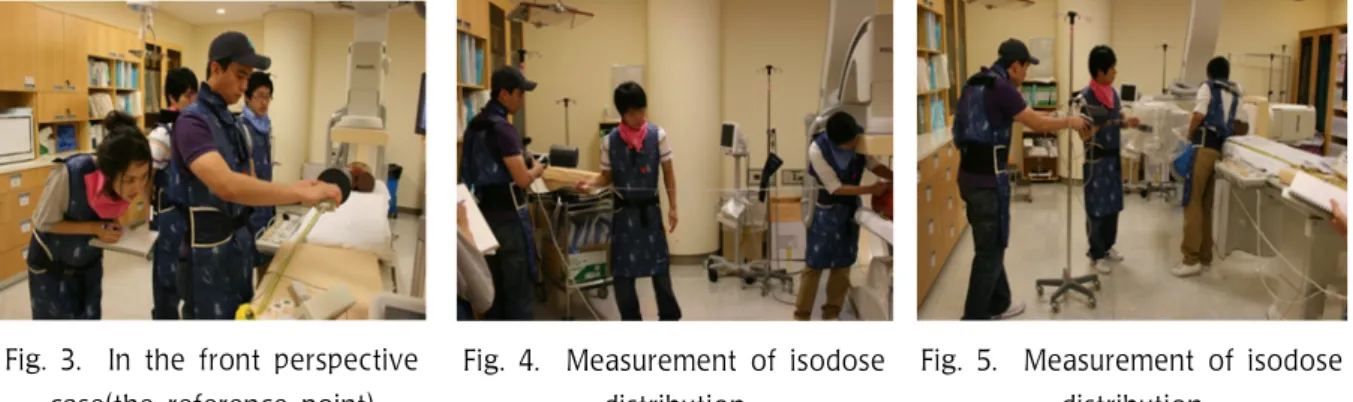
Fig. 3. In the front perspective case(the reference point)

Fig. 4. Measurement of isodose distribution

Fig. 5. Measurement of isodose distribution

the survey meter(model 20 x 4 1800) in Figure 2 was used and for the reader; radiation monitor controller model 2026 was used.

In the front perspective case, measurement device setup was carried out under the general conditions of the process: 80 cm height, 100 cm SID, and 42 cm scan field. Positions for dose measurement were set at 30, 60, 90, 120, 150, 180 cm from the center of penetration to the operation table as shown in Figure 3. For each position, 5 measurements were performed and averaged to determine the dose. The measurement position of the survey meter was set at 125 cm which is the average height of the operant’s chest.

In order to find the safest position from the rise and fall of the dose by angle variation and

from the scattered rays, 5 distance measurements for each angle of 30, 60, 90, 120, 150˚ with a 30˚

step from the operation table (the reference point) having the same dose as the reference point were performed as shown in Figure 4, 5. Measured distances have been averaged and isodose curves have been plotted for the coordinates with coordinates with the same dose as the reference point using the Auto CAD 2008 program. Under the assumption that the dose for 210˚~330˚ is similar to that of 30˚~150˚, the isodose curves were drawn using a dose distribution of 30˚∼150˚.

5 distance measurements for each angle of 30, 60, 90, 120, 150, 180, 210, 240, 270, 300, 330˚

with a 30˚ step from the operation table having

the same dose as the reference point were

performed. Measured distances were averaged and

(3)

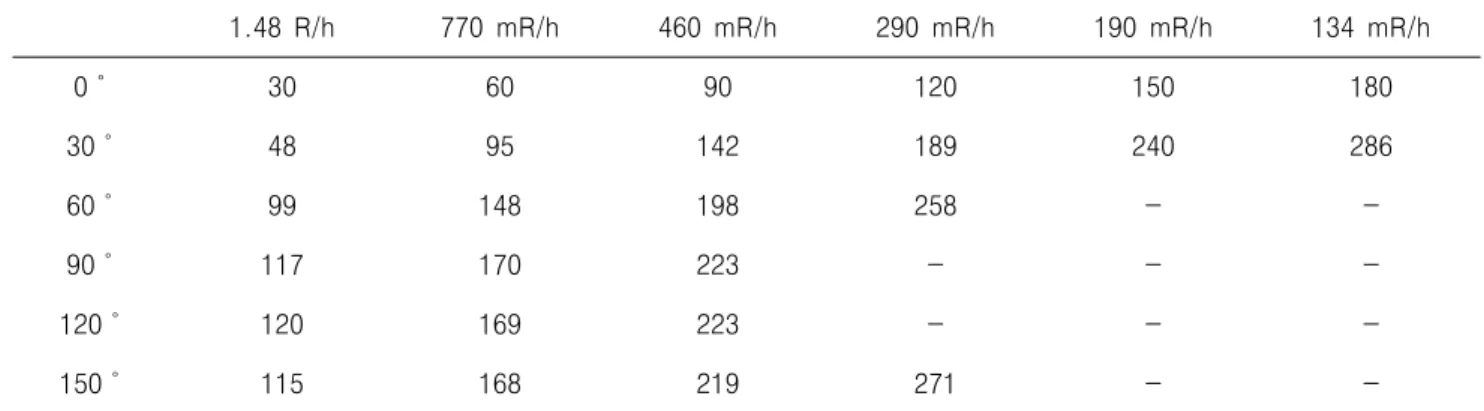
1.48 R/h 770 mR/h 460 mR/h 290 mR/h 190 mR/h 134 mR/h

0˚ 30 60 90 120 150 180

30˚ 48 95 142 189 240 286

60˚ 99 148 198 258 - -

90˚ 117 170 223 - - -

120˚ 120 169 223 - - -

150˚ 115 168 219 271 - -

Table 1. Isodose distribution of front (unit : cm)

Fig. 6. Isodose curve of front Fig. 7. Isodose curve of lateral

isodose curves plotted for the coordinates with the same dose as the reference point using the Auto CAD 2008 program.

Ⅲ. Result

From Table 1 and Figure 6, it can be seen that the dose is lowest at 0˚ which is at the position of the operation table, regardless of the direction of the perspective, and that the dose increases at 30˚~150˚ compared with 0˚. The results also showed that the dose dramatically increased at 30˚

~60˚ and that the dose was highest at the 90˚~

150˚ range. Measurement of distance at 60˚~150˚

was sometimes not possible because of structural effect of the location. The dose was lower than the 90˚~150˚ range which is the operant’s position.

However, the value appeared higher than the dose of at reference point 0˚.

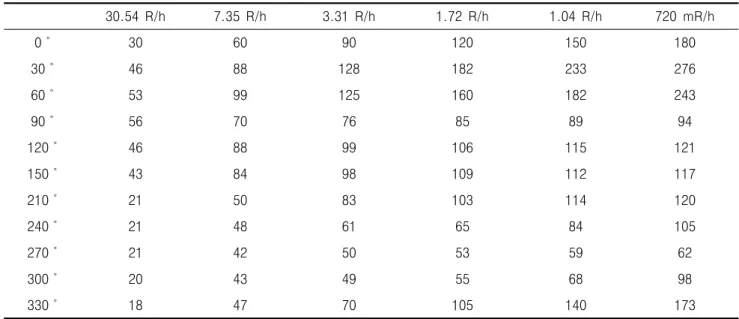
From Table 2 and Figure 7, it can be seen that

the dose is lowest at the rear of the equipment

among the perspective directions. This was

because the scattered rays were blocked by the

equipment structure. Among the isodose curves,

the left side of the center point refers to the

direction of the X-ray tube and the right side of

the center point refers to the direction of the

detector. t can be seen that among the directions

(4)

30.54 R/h 7.35 R/h 3.31 R/h 1.72 R/h 1.04 R/h 720 mR/h

0˚ 30 60 90 120 150 180

30˚ 46 88 128 182 233 276

60˚ 53 99 125 160 182 243

90˚ 56 70 76 85 89 94

120˚ 46 88 99 106 115 121

150˚ 43 84 98 109 112 117

210˚ 21 50 83 103 114 120

240˚ 21 48 61 65 84 105

270˚ 21 42 50 53 59 62

300˚ 20 43 49 55 68 98

330˚ 18 47 70 105 140 173

Table 2. Isodose distribution of lateral (unit : cm)

for the X-ray tube, the dose is highest at a distance without any interference. The highest dose in a 30˚~60˚ direction means that there are lots of scattered rays near the subject. The dose lower at 300˚ and 330˚ than at 60˚ and 30˚ is because of the difference in the dose that has been absorbed when penetrating the The dose lower at 300˚ and 330˚ than at 60˚ and 30˚ is because of the difference in the dose that has been absorbed when penetrating the abdominal tissue equivalent phantom. In most cases, the dose on the right side which is the direction of the detector appeared lower.

Ⅳ. Discussion

In a vascular characterization room, not only patients, but also medical workers are subject to a radiation dose. However, the risk is hardly recognized. In particular, if the equipment is not designed for interventional radiology, the dose to medical workers can be equally high. Some countries limit the number of processes because of accumulation of radiation doses in the hands, eyes and thyroid glands of the operant in interventional radiology.

2

The effects of radiation

exposure in the human body are largely cate- gorized into two areas: the effect in somatic cells and in genetic inheritance. Effects in somatic cells include leukemia, lymphoma, skin cancer, lung cancer, bone marrow cancer and cataracts.

The cataracts require special attention by working professionals in a radioactive environment and the onset of cataracts is known to be most likely due to radiation exposure of greater than 2 Gy with different latent periods.

3

Genetic effects can be caused by exposure of the genital organs whose effect is not directly seen in the generation exposed; rather, the next generation has to suffer. This, therefore can cause more severe problems.

4~7

Medical radiation exposure always has a certain possibility to have impact in working profe- ssionals and interventional procedures involve long term radiation exposure, and therefore minimal exposure in line with the medical benefit should be allowed. As practical countermeasures, lead skirts should be worn, shields should be utilized and the best position for equipment and worker should be chosen in order to minimize exposure.

8~10

If the beam is horizontal or close to the

(5)

horizontal line, the operant needs to be standing at the image intensifier tube side and if the beam is vertical or close to the vertical line, X-ray tube should be placed underneath the patient. In the results of the measurements, there were some findings from the isodose distribution drawn for the effect of the scattered rays generated during the front and side perspectives. First, it was found that the dose dramatically increased at 30˚

∼60˚ and that the dose was highest in the 90˚~

150˚ range for the front perspective. The position where the dose was lowest was the operation table.

Second, it was found that for the front perspective, the dose was highest at 30˚~60˚ and that the dose generally appeared lower in the direction of the detector. Working professionals should try and minimize exposure by positioning themselves at suitable locations based on the results from the isodose distribution

Ⅴ. Conclusion

Workers in a vascular characterization room should be aware that during an operation with a front perspective, positioning themselves in the 0˚

~60˚ range is the best way to minimize exposure.

On the other hand, for the side perspective, they need to be positioned in the 270˚~330˚ range as the dose is highest in the 0˚~60˚ range. Working professionals should always bear the isodose distribution diagram in mind and wear protective gear with lead equivalent to over 0.5 mmPb so that they minimize radiation exposure.

References

1. Ahn BS, Lee KE, Seon JR. A study on the exposure and free space scattered dose in radiography. Journal of Korean Society of radiological technology 1998; 21: 26-30.

2. ICRP Publication 85. Avoidance of radiation injuries from medical interventional proce- dures. 2000; 7-29.

3. Merriam GR, Focht EF. A Clinical study of radiation cataracts and the relation ship to dose. Am J Roentgenol Radium Ther Nucl Med 1997; 77: 759-85.

4. Russell WL. Studies in mammalian radiation genetics. Nucleonics 1962; 23: 53-6.

5. Waggener RG, Levy LB, Zanca P. Spectra of Scattered Diagnostic X-rays from an Alderson Phantom. Health Phys 1973; 24: 59-70.

6. Dong KR, Lee SJ, Kweon DC, Goo EH, Jung JE, Lee KS. Actual Condition of Quality Control of X-ray Imaging System in Primary Care Institution: focused on Gwangju Metropo- litan City. Journal of Radiation Protection 2010; 35: 34-42.

7. Schreiner-Karoussou A. Review of image quality standards to control digital X-ray systems. Radiat Prot Dosimetry 2005; 117:

23-5.

8. Stanton L, Lightfood MA, Mann S. A Penet- rometer for field kV calibration of diagnostic X-ray machine. Radiology 1966; 87: 87-98.

9. Dong KR, Kweon DC, Chung WK, Goo EH, Kevin D, Choe CH. Study on the angular dependence of personal exposure dosimeter – Focus on thermoluminescent dosimeter and photoluminescent dosimeter. Annals of Nuclear Energy 2011; 38: 383-8.

10. Ko YE, Park SH, Choi B, Kim HS, Noh YJ,

Comparison of skin dose measurement using

glass dosimeter and diode for breast cancer

patients. Korean J Med Phys 2008; 19: 9-13.

수치

Fig.  4.    Measurement  of  isodose  distribution
Fig.  6.    Isodose  curve  of  front Fig.  7.    Isodose  curve  of  lateral
Table  2.    Isodose  distribution  of  lateral                                                                                                                            (unit  :  cm)

참조

관련 문서

The purpose of the study is to provide basic data for the management of individual exposure and the monitoring of natural radiation dose using D-Shuttle

Materials and Methods: In order to evaluate the difference between mobile calibrations and exposure radiation dose, the glass dosimetry and Rando Phantom were used for 11

thickness of the subject for lower radiation dose of patients, is used in most of PET/CT scans. It is reported as lowering 20~40% approximate radiation dose measured in

Working period, according to domain-specific average annual dose of radiation dose from 10 to 14 in oral and maxillofacial radiology practitioners as high as 1.01~3.00 mSv

The awareness and attitude of medical radi- ation exposure Patient Medical Radiation Shielding, Graduate School of Public Health, Kyungpook National University, Master's

While patient dose monitoring and management should be used to decrease and optimize overall radiation dose, it should not be used to assess individual cancer risk.. One must

Dose distibution based on experiment, to reduce radiation exposure to patients result from reduction of scatter ray as we control field size of radiation and

However, a statistically significant increase has hardly been described with exposure to low dose radiation (<100 mSv). In addition, with respect to the data on