• 검색 결과가 없습니다.

Comparison between transumbilical and transvaginal morcellation of a large uterus during single-port-access total laparoscopic hysterectomy

N/A
N/A
Protected

Academic year: 2022

Share "Comparison between transumbilical and transvaginal morcellation of a large uterus during single-port-access total laparoscopic hysterectomy"

Copied!
8
0
0

로드 중.... (전체 텍스트 보기)

전체 글

(1)

https://doi.org/10.5468/ogs.2020.63.3.379 pISSN 2287-8572 · eISSN 2287-8580

Introduction

Since laparoscopic hysterectomy was first performed [1], a series of studies have shown the superiority of laparoscopic hysterectomy over open hysterectomy in terms of better view of the surgical field, low volume of blood loss, faster recov- ery, and decreased wound complications [2]. Furthermore, to maximize the advantages of laparoscopic surgery and reduce the incision size and number of trocars [3], single-port lapa- roscopy was carried out.

Comparison between transumbilical and transvaginal morcellation of a large uterus during single-port-access total laparoscopic hysterectomy

Seung Ju Oh, MD

1

, Seo Young Lee, MD

1

, Woo Yong Kim, MD

2

, Jieun Kang, MD

1

, Kyoung-Hee Han, MD

1

, San-Hui Lee, MD

1,3

, Ji Sun Park, MD

1

Department of Obstetrics and Gynecology,

1

Yonsei University Wonju College of Medicine, Wonju;

2

Kangbuk Samsung Hospital, Sungkyunkwan University School of Medicine, Seoul;

3

National Health Insurance Service Ilsan Hospital, Goyang, Korea

Objective

To compare the perioperative outcomes of transumbilical morcellation (TUM) and transvaginal morcellation (TVM) of a large uterus (≥500 g) during single-port-access total laparoscopic hysterectomy (SPA-TLH).

Methods

A total of 57 patients who underwent SPA-TLH for a large uterine myoma and/or adenomyosis (uterine weight ≥500 g) between March 2013 and July 2017 were included. For specimen retrieval, TUM was performed for 30 patients and TVM for 27 patients.

Results

Perioperative outcomes, including total operative time, tissue extraction time, extension of skin incision length, estimated volume of blood loss, changes in postoperative hemoglobin level, length of postoperative hospital stay, postoperative pain, and uterine weight, were compared between the 2 groups. No significant differences were observed in the baseline characteristics except for a history of cesarean section (TUM vs. TVM: 83.3% vs.

14.8%, P=0.002) and history of vaginal delivery (TUM vs. TVM: 6.7% vs. 88.8%, P=0.001). The total operative time, tissue extraction time, extension of skin incision length, estimated volume of blood loss, changes in postoperative hemoglobin level, length of postoperative hospital stay, and postoperative pain did not significantly differ between the two groups. The uterine weight was significantly higher for patients who underwent TUM than for those who had TVM (median [range]: 735 g [520–1,380 g] vs. 622 g [514–975 g]; P=0.042).

Conclusion

TUM during SPA-TLH is a feasible technique for extracting large uteri weighing ≥500 g. This procedure is suitable for patients without a history of vaginal delivery or a narrow vaginal cavity.

Keyword: Adenomyosis; Hysterectomy; Laparoscopy; Minimally invasive surgical procedures; Myoma

Received: 2019.07.16. Revised: 2019.10.28. Accepted: 2019.11.07.

Corresponding author: Ji Sun Park, MD

Department of Obstetrics and Gynecology, Yonsei University Wonju College of Medicine, 20 Ilsan-ro, Wonju 26426, Korea E-mail: [email protected]

https://orcid.org/0000-0001-9522-0046

Articles published in Obstet Gynecol Sci are open-access, distributed under the terms of the Creative Commons Attribution Non-Commercial License (http://creativecommons.

org/licenses/by-nc/3.0/) which permits unrestricted non-commercial use, distribution, and reproduction in any medium, provided the original work is properly cited.

Copyright © 2020 Korean Society of Obstetrics and Gynecology

(2)

After single-port-access total laparoscopic hysterectomy (SPA-TLH) was first performed in 1991 [4], the universaliza- tion of single-port laparoscopy has been slow. However, single-port laparoscopy has been more commonly used in the gynecologic field after the latest developments in lapa- roscopic instrumentation and the accumulation of surgical experience [5].

In SPA-TLH, specimen retrieval is one of the most critical factors affecting operative time, and the length of the pro- cedure is positively correlated with uterine weight [6]. Efforts have been made to reduce specimen retrieval time in SPA- TLH, which include performing procedures, such as intra- abdominal morcellation, transvaginal morcellation (TVM), and combined laparoscopic morcellation and TVM [7,8].

Specimen retrieval during umbilicus and manual morcellation of a large specimen in a gynecological laparoscopic opera- tion is considered feasible and safe [9]. Furthermore, in some cases, the transumbilical morcellation (TUM) of a large uterus had a shorter operative time [10].

The current study aimed to compare the surgical outcomes between TUM and TVM for retrieving a large uterus (≥500 g) during SPA-TLH.

Materials and methods

This retrospective study included all patients who under- went SPA-TLH between March 2013 and July 2017 at two institutions (National Health Insurance Service Ilsan Hospital, Goyang; Wonju Severance Christian Hospital, Wonju). Dur- ing the study period, 386 patients underwent SPA-TLH for benign diseases, and a single surgeon performed all proce- dures. Among the patients, those with uterine weights over 500 g based on the pathology report were selected. Thus, 57 patients were included in this study. The data of 30 and 27 patients who underwent SPA-TLH with TUM and TVM, respectively, for tissue extraction were compared. All patients underwent transvaginal and/or transabdominal ultrasonogra- phy within 30 days before surgery, during which the size of the uterus was assessed and recorded. If the diagnosis and evaluation of the uterine mass via ultrasonographic exami- nation were not sufficient, additional abdominopelvic com- puted tomography scan or magnetic resonance imaging was performed.

The following patients met the inclusion criteria of this

study: women with a benign gynecological disease, such as uterine myoma and adenomyosis, who underwent total lap- aroscopic hysterectomy, had a uterus weighing ≥500 g were classified as American Society of Anesthesiologists class I and II, and were aged under 60 years.

Due to a high risk of undergoing complex surgical proce- dures, such as adhesiolysis or resection of severe endome- triosis, patients with more than 4 previous abdominopelvic surgeries via laparotomy or those with clinical evidence of deep infiltrating endometriosis were excluded from the study.

Moreover, patients diagnosed with malignancy via pathologi- cal examinations were excluded.

TUM or TVM was performed based on manual pelvic exam- ination. Patients with a narrow vagina (<2 finger breadths) were subjected to specimen retrieval via TUM [11].

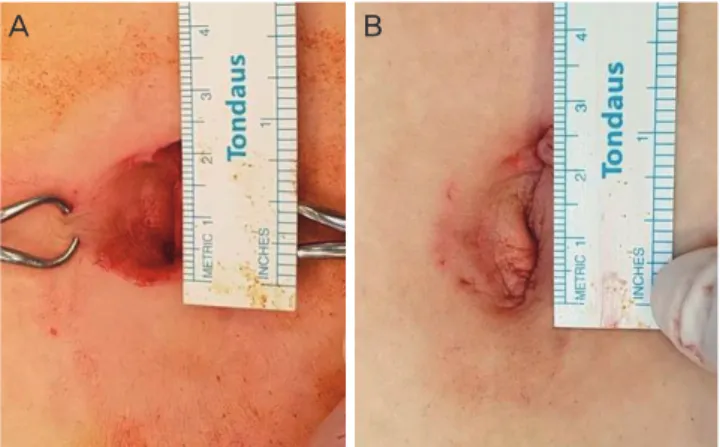
A specific type was designed to retrospectively collect data about the characteristics of the patients, intraoperative de- tails, surgical outcomes, and perioperative complications. The total operative time was defined as the time from skin inci- sion to skin closure. The tissue extraction time was defined as the time spent on tissue extraction. The data were collected from the electronic medical records. In the anesthesiology unit, the estimated volume of blood loss was calculated as the difference between the total amount of suction and ir- rigation plus the difference between total gauze weight before and after surgery. To determine the extent of skin incision before and after surgery, the length of the skin inci- sion was measured before inserting the single-port channel system and after skin closure (Fig. 1).

Changes in hemoglobin level was defined as the difference

Fig. 1. Umbilicus wound (A) before starting laparoscopy, (B) after the end of operation.

A B

(3)

between preoperative hemoglobin level and hemoglobin level on postoperative day 1. Patients were discharged from the hospital after the return of bowel activity and a success- ful ambulation and if fever was not observed after surgery and narcotic analgesics were no longer required. Length of hospital stay was defined as the time from the operative day to the day of discharge. Several assessors who were not as- sociated with the investigators performed postoperative pain assessments with a visual analog scale 12, 24, and 48 hours after surgery. The scale was presented as a 10-cm line with the verbal descriptors “no pain” and “pain as bad as it could be” as the final outcome [12]. All intraoperative and postop- erative complications arising within 30 days of surgery were recorded. All patients were scheduled for follow-up examina- tions at 1 week and 1 month after surgery.

1. Surgical technique

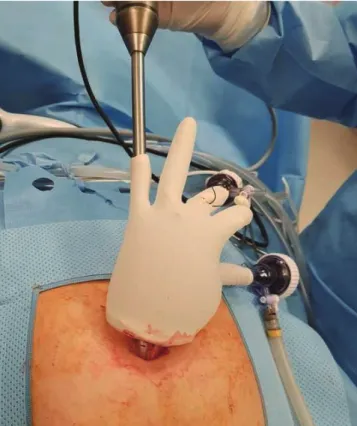
A single surgeon performed all surgeries at the two institu- tions. A single-port channel system with surgical glove and Alexis wound protectors/retractors (Applied Medical, Rancho Santa Margarita, CA, USA) was inserted through the umbili- Fig. 2. Single-port channel system.

Fig. 3. Tissue extraction through umbilicus.

(4)

cus (Fig. 2). Hysterectomy was performed with conventional straight laparoscopic instruments and advanced bipolar instruments, such as LigaSure™ (Covidien, Dublin, Ireland) and THUNDERBEAT (Olympus Medical, Tokyo, Japan). In both TVM and TUM cases, the uterus was placed in an endo- pouch (Lap Bag™ metal type; Meditech Infrared, Seoul, Ko- rea) before morcellation.

In TVM cases, tissue extraction was performed before vault closure. After placing the right-angle retractors at the 12 and 6 o’clock positions to retract the anterior and posterior vagi- nal walls and to protect the urethra, urinary bladder, and rec- tum, the uterine cervix was grasped with towel clips or Lahey clamps for pulling. Starting from the cervix, the uterus was circumferentially incised with scalpels or with Mayo scissors.

In TUM cases, the edge of the endo-pouch was elevated via an umbilical incision, and the specimen was visualized.

The uterus was held and pulled with towel clips or Lahey clamps while it was circumferentially incised with a scalpel.

The specimen was extracted in small fragments (Fig. 3).

The vaginal cuff was closed, and the peritoneum, fascia,

and subcutaneous tissue were then estimated and closed layer by layer using 2-0 Polysorb sutures (Covidien). Rein- forced skin closures (Steri-Strip™; 3M Health Care, St. Paul, MN, USA) were used to close the incision.

2. Statistical analysis

All statistical analyses were performed using the Statisti- cal Package for the Social Sciences software version 23.0 (SPSS Inc., Chicago, IL, USA). Data were presented as means±standard deviations or medians (ranges) for continu- ous variables and frequencies (percentages) for categorical variables. The baseline clinical characteristics and study out- comes were compared between the two groups using the χ

2

test or Fisher’s exact tests for categorical variables and the student’s t-test or Mann-Whitney U test for continuous vari- ables accordingly. A P-value <0.05 was considered statisti- cally significant.

Table 1. Baseline characteristics (n=57)

TUM (n=30) TVM (n=27) P-value

Age (yr) 45.2±5.8 46.8±7.2 0.892

Body mass index (kg/m

2

) 24.2±4.2 24.9±4.1 0.341

Parity >0.986

Nulliparous 2 (6.7) 1 (3.7)

Parous 28 (93.3) 26 (96.3)

History of cesarean section 25 (83.3) 4 (14.8) 0.002

1 11 1

2 13 3

≥3 1 0

History of vaginal delivery 2 (6.7) 24 (88.8) 0.001

Hysterectomy indication

Myoma 10 (33.3) 7 (25.9)

Adenomyosis 3 (10.0) 2 (7.4)

Myoma and adenomyosis 16 (53.3) 16 (59.2)

Combined with cervical lesion 1 (3.4) 2 (7.5)

Surgical procedure 0.812

Hysterectomy alone 22 (72.8) 18 (66.7)

Hysterectomy with adnexal surgery

a)

8 (27.2) 9 (33.3)

Data are presented as mean±standard deviation or number (%).

TUM, transumbilical morcellation; TVM, transvaginal morcellation.

a)
Adnexal surgery includes ovarian cystectomy, salpingo-oophorectomy, and salpingectomy.

(5)

Results

Between March 2013 and July 2017, 386 patients under- went SPA-TLH. In total, 329 patients were excluded from the study according to the exclusion criteria. Meanwhile, 57 pa- tients were enrolled, and 30 and 27 patients underwent SPA- TLH with TUM and TVM, respectively, for tissue extraction.

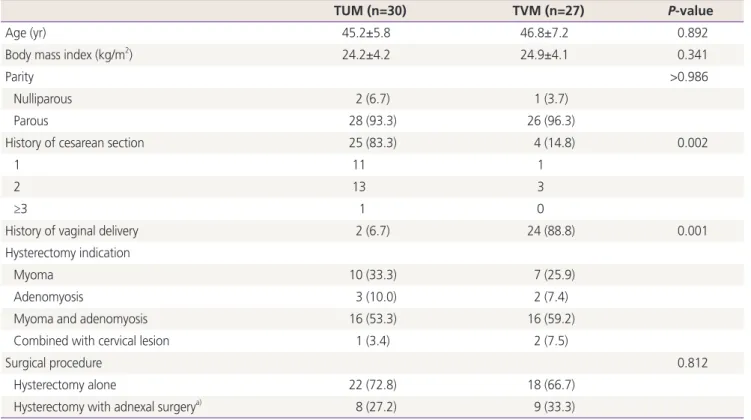
The baseline characteristics, except for a history of cesarean section and vaginal delivery, were similar between the TUM and TVM groups (Table 1). In the TUM group, 25 patients (83.3%) had a history of cesarean section. In the TVM group, four patients (14.8%) had a history of cesarean section (P=0.002). Moreover, only 2 patients (6.7%) had a history of vaginal delivery in the TUM group, and 24 (88.8%) had a history of vaginal delivery in the TVM group (P=0.001). In the TUM group, 22 patients underwent hysterectomy alone, and 8 had hysterectomy with adnexal surgery. Moreover, in the TVM group, 18 patients underwent hysterectomy, and 9 had hysterectomy with adnexal surgery.

The perioperative outcomes between the two study groups are depicted in Table 2. The mean total operative time was

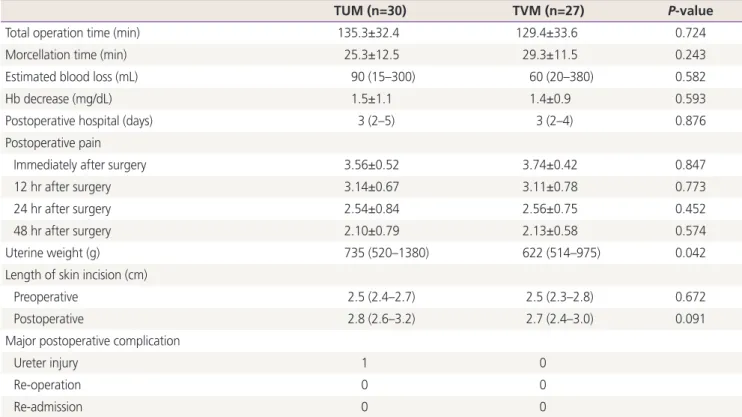
135.3 min in the TUM group and 129.4 min in the TVM group (P=0.724). The mean total operative time was shorter in the TVM group than in the TUM group. However, the result was not significantly different. The mean tissue extrac- tion time was 25.3±12.5 minutes in the TUM group and 29.3±11.5 minutes in the TVM group (P=0.243). The mean tissue extraction time was shorter in the TUM group than in the TVM group. However, no significant difference was ob- served. The extension of umbilical skin incision was noted in both groups. In the TUM group, the umbilical incision length was extended from 2.5 to 2.8 cm. Moreover, in the TVM group, the umbilical incision length was extended from 2.5 to 2.7 cm. No statistically significant difference was observed in both preoperative and postoperative skin incision lengths (P=0.672, P=0.091). In addition, the amount of blood loss, decrease in hemoglobin level, length of postoperative hos- pital stay (days), and postoperative pain between the two groups did not significantly differ.

The weight of the uterus was significantly different be- tween the two study groups (P=0.042). The median uterine weight of the TUM group was 735 g, ranging from 520 to

Table 2. Perioperative outcomes (n=57)

TUM (n=30) TVM (n=27) P-value

Total operation time (min) 135.3±32.4 129.4±33.6 0.724

Morcellation time (min) 25.3±12.5 29.3±11.5 0.243

Estimated blood loss (mL) 90 (15–300) 60 (20–380) 0.582

Hb decrease (mg/dL) 1.5±1.1 1.4±0.9 0.593

Postoperative hospital (days) 3 (2–5) 3 (2–4) 0.876

Postoperative pain

Immediately after surgery 3.56±0.52 3.74±0.42 0.847

12 hr after surgery 3.14±0.67 3.11±0.78 0.773

24 hr after surgery 2.54±0.84 2.56±0.75 0.452

48 hr after surgery 2.10±0.79 2.13±0.58 0.574

Uterine weight (g) 735 (520–1380) 622 (514–975) 0.042

Length of skin incision (cm)

Preoperative 2.5 (2.4–2.7) 2.5 (2.3–2.8) 0.672

Postoperative 2.8 (2.6–3.2) 2.7 (2.4–3.0) 0.091

Major postoperative complication

Ureter injury 1 0

Re-operation 0 0

Re-admission 0 0

Data are presented as mean±standard deviation or median (range).

TUM, transumbilical morcellation; TVM, transvaginal morcellation; Hb, hemoglobin.

(6)

1,380 g. The median uterine weight in the TVM group was 622 g, ranging from 514 to 975 g.

No surgery was converted to multi-port laparoscopy or laparotomy. In the TUM group, 1 patient presented with intraoperative ureter injury. Primary repair of the ureter and retrograde pyelography-guided ureter stent insertion were conducted. The ureter stent was removed 3 months after the operation, and no further treatment was required.

Discussion

No difference was observed in total operative time, tissue extraction time, or estimated amount of blood loss between the two study groups. Furthermore, postoperative decrease in hemoglobin level, length of hospital admission, and post- operative pain did not significantly differ. Uterine weight was significantly different between the two study groups (TUM:

735 g [520–1,380 g], TVM: 622 g [514–975 g]; P=0.042).

However, no significant difference was observed in tissue ex- traction time between TUM and TVM (25.3 vs. 29.3 minutes;

P=0.243). Thus, a larger specimen can be retrieved using the TUM procedure within the same duration.

In total, 24 patients (88.8%) in the TVM group and two patients (6.7%) in the TUM group had a history of vaginal delivery (P=0.001). The repeated stretching of vaginal tis- sues, such as that during vaginal delivery, leads to decreased collagenase in these tissues and enlargement of the vaginal cavity [13]. In patients with an enlarged vaginal cavity, TVM is a more competitive procedure. However, in patients with a history of cesarean section but without vaginal delivery, the vaginal cavity is relatively narrow, and TUM is more effective for specimen extraction.

According to a previous study, adhesiolysis of the posterior uterus, time to colpotomy completion, uterine extraction time, and uterine weight are the predictors of total operative time in performing SPA-TLH. Additionally, a positive correla- tion was observed between uterine weight and extraction time [6]. To reduce the overall operative time, the specimen extraction time must be decreased.

Several technical attempts have been made in removing a large uterus using procedures, including intra-abdominal morcellation with a power morcellator, mini-laparotomy, TVM, and TUM [7,8,10]. Intra-abdominal morcellation with a laparoscopic power morcellator was widely performed

before the release of the November 2014 Food and Drug Administration safety communication statement about the risk of using morcellators for uterine fibroid morcellation due to the risk of specimen spillage and tumor dissemination [14]. In addition to the risk of specimen spillage, laparoscopic morcellation has been associated with bowel or vessel injury caused by the morcellator blade as well as prolonged opera- tive time [10,15].

Transvaginal specimen extraction is generally performed using bisection, morcellation, wedge resection, and vaginal myomectomy. However, this procedure is challenging to per- form, and the total operative time is higher in patients with a narrow vaginal cavity and obesity [16]. During transvaginal tissue extraction, injury in the vaginal wall, vaginal stump, bladder, and ureter may occur [17].

Transumbilical tissue extraction was first performed to re- move huge pelvic masses, including ovarian masses. Recently, transumbilical tissue extraction in laparoscopic hysterectomy was found to be safe and effective. In addition, as TUM is performed with the specimen in an endoscopic bag, the risk of bowel injury, vessel injury, and tumor dissemination is reduced [18]. Moreover, our study showed the feasibility of TUM, without complications and extension of operative time.

In 2008, Ghezzi et al. [9] have reported that the transum- bilical approach was feasible for adnexal masses. Further- more, in 2012, they showed that the use of the vaginal ap- proach in colpotomy might be more effective for the removal of adnexal masses [19]. However, the results of these studies differ from those of the current study because the target was an adnexal mass. This type of mass can be easily resected via a small incision because it is rarely firm. However, the uterus with total hysterectomy is solid and greater in size on which the procedure was performed were different in nature. A solid and larger uterus is more difficult to remove via the vaginal cavity and particularly through a narrow vaginal cav- ity.

A recent study has compared TVM and TUM during multi- port laparoscopic hysterectomy, and results showed no differ- ence between the 2 morcellation methods. Between January 2010 and December 2014, patients with a uterus weighing

≥500 g were included in the study, and all manual morcella-

tion procedures were performed in an endoscopic bag. The

abdominal approach was used in 58.7% of the patients and

the vaginal approach in 41.3%. Results showed no gross

spillage, rupture of the endoscopic bag, or other complica-

(7)

tions correlated to the morcellation procedure [18].

Our study performed single-port-access laparoscopy, and no difference was observed between the TUM and TVM groups in terms of extension of the skin incision. Previous studies have shown that postoperative pain after laparoscopy significantly decreases with the reduction in incision size [20].

Therefore, in this study, no difference was observed in post- operative pain between the two groups because the umbili- cal incision sizes were similar. In addition to reducing postop- erative pain, smaller umbilical incision sizes are beneficial in terms of cosmetic aspects.

An objective guideline for selecting morcellation method is not available. Thus, this might have caused selection bias as the selection of procedure was not blinded or randomized.

Moreover, since this was a retrospective study with a small sample size, a randomized prospective analysis should be performed to increase the power of the study. In this study, all patients were Koreans, and they had a relatively low BMI.

Therefore, there is a limitation for the generalization and application of the results. In addition, there might be errors in the measurement of skin incisions. To evaluate the exact extension, the length of the incision in the fascia before and after the operation must be compared. The stability of the tissue extraction method and the use of an endo-pouch has not been well established. Thus, further prospective studies must be conducted.

Future large-scale prospective randomized controlled trials about specimen extraction methods may provide more reli- able results and objective guidelines for selecting the morcel- lation method.

In conclusion, when performing SPA-TLH in a patient with a large uterus, TUM is considered safe and effective. In par- ticular, in patients with a narrow vaginal cavity, TUM may be a more suitable procedure for specimen retrieval.

Acknowledgements

This work was supported by the Yonsei University Wonju Campus Future-Leading Research Initiative of 2018 (2018- 62-0040) and by the Basic Science Research Program through the National Research Foundation of Korea (NRF) funded by the Ministry of Education, Science and Technology (NRF-2017R1D1A3B03032983).

Conflict of interest

No potential conflict of interest relevant to this article was reported.

Ethical approval

The study was approved by the Institutional Review Board of Wonju Severance Christian Hospital (IRB No. CR318116) and performed in accordance with the principles of the Declara- tion of Helsinki. Written informed consents were obtained.

Patient consent

The patients provided written informed consent for the pub- lication and the use of their images.

References

1. Reich H, DeCarpio J, McGlynn F. Laparoscopic hysterec- tomy. J Gynecol Surg 1989;5:213-6.

2. Wu MP, Lee CL. The trends of minimally invasive surgery for benign gynecologic lesions, 1997–2007 in Taiwan.

Gynecol Minim Invasive Ther. 2012;1:3-8.

3. Choi YS, Park JN, Oh YS, Sin KS, Choi J, Eun DS. Single- port vs. conventional multi-port access laparoscopy- assisted vaginal hysterectomy: comparison of surgical outcomes and complications. Eur J Obstet Gynecol Re- prod Biol 2013;169:366-9.

4. Pelosi MA, Pelosi MA 3rd. Laparoscopic hysterectomy with bilateral salpingo-oophorectomy using a single um- bilical puncture. N J Med 1991;88:721-6.

5. Jackson T, Einarsson J. Single-port gynecologic surgery.

Rev Obstet Gynecol 2010;3:133-9.

6. Jeung IC, Lee YS, Song MJ, Park EK. Laparoendoscopic single-site total laparoscopic hysterectomy: clinical factors that affect operative times and techniques to overcome difficulties. J Minim Invasive Gynecol 2017;24:617-25.

7. O’Shea RT, Cook JR, Seman EI. Total laparoscopic hyster- ectomy: a new option for removal of the large myoma- tous uterus. Aust N Z J Obstet Gynaecol 2002;42:282-4.

8. Chen SY, Chang DY, Sheu BC, Torng PL, Huang SC, Hsu

(8)

WC, et al. Laparoscopic-assisted vaginal hysterectomy with in situ morcellation for large uteri. J Minim Invasive Gynecol 2008;15:559-65.

9. Ghezzi F, Cromi A, Uccella S, Siesto G, Bergamini V, Bo- lis P. Transumbilical surgical specimen retrieval: a viable refinement of laparoscopic surgery for pelvic masses.

BJOG 2008;115:1316-20.

10. Serur E, Lakhi N. Laparoscopic hysterectomy with manu- al morcellation of the uterus: an original technique that permits the safe and quick removal of a large uterus.

Am J Obstet Gynecol 2011;204:566.e1-2.

11. Kovac SR. Route of hysterectomy: an evidence-based approach. Clin Obstet Gynecol 2014;57:58-71.

12. Hawker GA, Mian S, Kendzerska T, French M. Measures of adult pain: Visual Analog Scale for Pain (VAS Pain), Numeric Rating Scale for Pain (NRS Pain), McGill Pain Questionnaire (MPQ), Short-Form McGill Pain Question- naire (SF-MPQ), Chronic Pain Grade Scale (CPGS), Short Form-36 Bodily Pain Scale (SF-36 BPS), and Measure of Intermittent and Constant Osteoarthritis Pain (ICOAP).

Arthritis Care Res (Hoboken) 2011;63 Suppl 11:S240-52.

13. Zong W, Jallah ZC, Stein SE, Abramowitch SD, Moalli PA. Repetitive mechanical stretch increases extracellular collagenase activity in vaginal fibroblasts. Female Pelvic Med Reconstr Surg 2010;16:257-62.

14. U.S. Food and Drug Administration. Recommended

labeling statements [Internet]. Silver Spring (MD): Food and Drug Administration; 2014 [cited 2014 Nov 24].

Available from: https://www.fda.gov/downloads/medi- caldevices/safety/alertsandnotices/ucm424444.pdf.

15. Kho RM. In the aftermath of the storm called power morcellation. J Minim Invasive Gynecol 2016;23:847-8.

16. Wu KY, Lertvikool S, Huang KG, Su H, Yen CF, Lee CL.

Laparoscopic hysterectomies for large uteri. Taiwan J Obstet Gynecol 2011;50:411-4.

17. Wang H, Li P, Li X, Gao L, Lu C, Zhao J, et al. To- tal laparoscopic hysterectomy in patients with large uteri: comparison of uterine removal by transvaginal and uterine morcellation approaches. BioMed Res Int 2016;2016:8784601.

18. Serur E, Zambrano N, Brown K, Clemetson E, Lakhi N.

Extracorporeal manual morcellation of very large uteri within an enclosed endoscopic bag: our 5-year experi- ence. J Minim Invasive Gynecol 2016;23:903-8.

19. Ghezzi F, Cromi A, Uccella S, Bogani G, Serati M, Bolis P. Transumbilical versus transvaginal retrieval of surgical specimens at laparoscopy: a randomized trial. Am J Ob- stet Gynecol 2012;207:112.e1-6.

20. Acton JN, Salfinger SG, Tan J, Cohen PA. Outcomes of

total laparoscopic hysterectomy using a 5-mm versus

10-mm laparoscope: a randomized control trial. J Minim

Invasive Gynecol 2016;23:101-6.

수치

Fig. 1. Umbilicus wound (A) before starting laparoscopy, (B) after  the end of operation.
Fig. 3. Tissue extraction through umbilicus.
Table 1. Baseline characteristics (n=57)
Table 2. Perioperative outcomes (n=57)

참조

관련 문서

Changes in blood components decreased in total cholesterol, low density lipoprotein cholesterol, and triglyceride and increased in high density

In SDE extraction, a total of 117, 115 and 120 volatile compounds were detected in Aster yomena, Aster tataricus and Chrysanthemum zawadskii, individually, whereas their total

Comparison of the proportion of permanent teeth extraction according to oral disease by tooth type in the upper jaw ··· 21... Comparison of the proportion of permanent

Patient had laparoscopic surgery on the adnexal tumor and excised tissue was removed through Douglas pouch incision by single surgeon.. Results: The mean age

To assess the clinical usefulness of performing Q-PCR in practice as a diagnostic technique, we compared blindly the Q-PCR results using blood samples of the

Maximum seismic moment and magnitude as functions of total volume of injected fluid from the start of injection until the time of the largest induced earthquake (Zang et

• The reset time and the derivative time should increase as the ratio of time delay to dominant time constant increases. • The ratio between derivative time and reset time

-Cost of carriers and immobilization -Changes in properties(selectivity) -Mass transfer limitations.. -Activity