Korean Circulation Journal
Temporal Trends of Hospitalized Patients with Heart Failure in Korea
Jong-Chan Youn, MD, Seongwoo Han, MD, and Kyu-Hyung Ryu, MD
Division of Cardiology, Dongtan Sacred Heart Hospital, Hallym University College of Medicine, Hwaseong, Korea
Heart failure (HF) is an important cardiovascular disease because of its increasing prevalence, significant morbidity, high mortality and rapidly expanding health care costs. The number of HF patients is increasing worldwide and Korea is no exception. Temporal trends of four representative Korean hospitalized HF registries–the Hallym HF study, the Korean Multicenter HF study, the Korean Heart Failure (KorHF) registry and the Korean Acute Heart Failure (KorAHF) registry showed mild survival improvement reflecting overall HF patient care development in Korea despite the increased severity of enrolled patients with higher incidence of multiple comorbidities. Moreover, device therapies such as implantable cardioverter defibrillator and cardiac resynchronization therapy and definitive treatment such as heart transplantation have been increasing in Korea as well. To prevent HF burden increase, it is essential to set up long term effective prevention strategies for better control of ischemic heart disease, hypertension and diabetes, which might be risk factors for HF development. Moreover, proper HF guidelines, performance measures, and performance improvement programs might be necessary to limit HF burden as well. (Korean Circ J 2017;47(1):16-24)
KEY WORDS: Heart failure; Hospitalization; Trends; Korea.
Introduction
Heart failure (HF) is a clinical syndrome characterized by typical symptoms and signs caused by structural and/or functional cardiac abnormalities.
1)HF is an important cardiovascular disease due to its increasing prevalence, significant morbidity, high mortality and rapidly expanding health care costs. An HF diagnosis has previously been described as more ‘malignant’ than cancer, given the comparatively low 5-year survival rates.
2)3)In 1991, 5-year mortality from HF was 11% higher than the corresponding rates for gastrointestinal cancers. A systematic review found comparative 5-year age-adjusted and gender-adjusted survival rates for cancer,
stroke, and HF to be generally similar, with observed improvements in survival for all three diseases over the past decade.
3)4)The prevalence of HF is approximately 1–2% in the adult population in developed countries, rising to ≥10% among people
>70 years of age.
1)On the basis of data from the National Health and Nutrition Examination Survey (NHANES) 2009–2012, about 5.7 million (2.2%) people over the age of 20 years have HF and more than 550000 people are newly diagnosed with HF every year in the USA.
5)By 2030, the prevalence of HF will increase 46%, resulting in more than 8 million people, and total medical costs for HF patients are expected to increase from $20.9 billion to $53.1 billion.
5)6)In Japan, it is estimated that 1.0 million individuals have HF, and the number of Japanese outpatients with left ventricular (LV) dysfunction is predicted to gradually increase from 979000 in 2005 to 1.3 million by 2030.
7)In Korea, the prevalence of HF increased approximately two times from 0.75% in 2002 to 1.53%
in 2013, and is expected to increase by 2-fold again, from 1.60%
in 2015 to 3.35% in 2040, when more than 1.7 million Koreans are expected to have HF.
8)9)Korean hospitalized heart failure registry
Despite the survival improvement in chronic HF, following the introduction of disease-modifying treatments in the 1990s, Received: December 5, 2016
Revised: December 8, 2016 Accepted: December 15, 2016
Correspondence: Seongwoo Han, MD, Division of Cardiology, Dongtan Sacred Heart Hospital, Hallym University College of Medicine, Keunjaebong-gil 7, Hwaseong 18450, Korea
Tel: 82-31-8086-2530, Fax: 82-31-8086-2559 E-mail: [email protected]
• The authors have no financial conflicts of interest.
This is an Open Access article distributed under the terms of the Creative Commons Attribution Non-Commercial License (http://creativecommons.
org/licenses/by-nc/3.0) which permits unrestricted non-commercial use, distribution, and reproduction in any medium, provided the original work is properly cited.
Print ISSN 1738-5520 • On-line ISSN 1738-5555
hospitalization for acute heart failure (AHF) continues to increase in many countries.
10-14)AHF refers to rapid HF onset or worsening of symptoms and/or signs. This is a life-threatening medical condition requiring urgent evaluation and treatment, typically leading to hospital admission.
1)Estimates of the clinical characteristics, treatment, prognosis and temporal trends of HF hospitalization are central to our understanding of health-care utilization and to efforts to improve patient care and reduce health care costs. Therefore we aimed to investigate the temporal trends of four representative Korean hospitalized HF registries–the Hallym HF study, the Korean Multicenter HF study, the KorHF registry and the KorAHF registry.
The Hallym HF study registry was a single university medical center, 4 affiliated hospital-based, retrospective cohort study of Korean hospitalized HF patients, between January 1987 and December 1997 (n=1657).
15)The Korean Multicenter HF study registry was a nationwide, prospective, observational, multicenter registry from 9 university hospitals for hospitalized Korean HF patients, between January 1998 and August 2003 (n=1759).
16)The KorHF registry was a nationwide, prospective, observational, multicenter registry from 24 academic hospitals for hospitalized Korean patients with AHF, between June 2004 and April 2009 (n=3200).
17)The KorAHF registry was also a nationwide, prospective, observational, multicenter cohort registry from 10 tertiary university hospitals for hospitalized Korean patients with AHF between March 2011 and March 2014 (n=5625).
18)Concomitant with the progress of these four Korean HF registries, the cornerstone of the Korean Society of Heart Failure (KSHF) has been laid firmly with various publications.
15-31)Since 2003, KSHF has been Korea’s leading academic organization dedicated to the study of heart failure. KSHF has promoted all aspects of research into heart failure, offered education for health- care professionals, and provided forums where the expertise and experiences in heart failure research and treatment could be shared through periodical conferences, congresses, and symposiums.
In this review article we aimed to evaluate temporal trends seen in the four representative Korean HF registries, and focused on patient population characteristics, clinical status on admission, in-hospital management and clinical outcome. Because long term prognosis from the KorAHF registry are not available yet, we analyzed the KorAHF registry data from published interim analysis results (n=2066).
18)We also briefly review the temporal trend for device therapies in Korea such as implantable cardioverter defibrillators (ICD) and cardiac resynchronization therapy (CRT) as well as definitive treatment such as heart transplantation.
As shown in Table 1, the recent Korean HF registry patients were older, and had a higher incidence of comorbidities including hypertension, diabetes, atrial fibrillation and stroke compared with previous Korean HF registry populations. Ischemic etiology
was associated with a higher proportion of hospitalized HF patients, while hypertension as an HF etiology showed wide variation between different registries. Patients with more severe symptoms were enrolled in the recent registry and more patients underwent echocardiography during the index admission period.
While the mean value of hemoglobin, serum sodium and creatinine were comparable between the KorHF and KorAHF registries, the proportion of patients with anemia, hyponatremia and azotemia increased (data not shown). Regarding in-hospital management, more frequent use of intravenous diuretics, inotropes, vasodilators, mechanical ventilation and renal replacement therapy were noted in the recent period, reflecting increased HF severity in the patient population. The prescription rate for beta-blockers at discharge was lower in the KorAHF registry while that for angiotensin converting enzyme inhibitor (ACEi)/angiotensin receptor blocker (ARB) was higher. Despite increased HF severity in enrolled patients, the recent registry showed mild improvement of in-hospital mortality indicating the overall development of hospitalized HF patient care in Korea.
Age
One of the outstanding findings in the comparisons between the four Korean hospitalized HF registries is the rapidly increasing mean age of the patient population (Fig. 1). HF is one of the major causes of death and hospitalization for elderly patients. The Korean National Health Insurance Service (NHIS) sample cohort data showed that the prevalence of HF was 12.6% in subjects aged 80 years or older, while it was 1.0% and 5.5% in those aged 40- 59 years and 60-79 years, respectively. The prevalence of HF in subjects aged 80 years or older was approximately 8-fold higher than the overall prevalence of HF (1.53%).
8)Age is an important prognostic factor in the Hallym HF registry, the Korean Multicenter HF study registry and KorHF registry as well.
15-17)The KorAHF registry also showed that old age (≥70 years) was an independent predictor of post-discharge mortality.
18)Data from other countries revealed that the overall number of hospitalizations for heart failure has increased, particularly in the aged population.
11)13)With the aging of the general population, the epidemiologic burden of HF might increase substantially.
Comorbidities
Temporal trends in hospitalized HF patient comorbidities showed
increasing prevalence of hypertension and diabetes (Fig. 2). The Korean
NHIS sample cohort data revealed that hypertension and diabetes were common in HF patients. The prevalence of hypertension as a comorbidity in hospitalized HF patients remained high, while diabetes was markedly increasing in 2013 compared to 2003 (hypertension 46.2%, and diabetes 33.4% in 2003; hypertension 43.6%, and
diabetes 49.1% in 2013, respectively).
8)Data from Western Australia also revealed that hypertension and diabetes were the predominant comorbidities associated with HF and the prevalence of risk factors for HF, including hypertension, diabetes, renal failure, and atrial fibrillation, increased between 1990 and 2005, which along with Table 1. Comparison of four Korean hospitalized HF registry
Hallym HF study
(n=1657) Korean multicenter HF study
(n=1759) KorHF
(n=3200) KorAHF
(n=2066) Time period January 1987–December 1997 January 1998–August 2003 June 2004–April 2009 March 2011–May 2012
No. of participating hospitals 4 9 24 10
Demographics
Male (%) 43.2 52.9 50 55
Age (year) 63.7 ± 13.4 64.1 ± 14.3 67.6 ± 14.3 69 ± 14
Hypertension (%) 40.4 30.2 46.5 59
Diabetes mellitus (%) 19.9 25.6 30.5 36
Atrial fibrillation (%) 9.2 27.5 22.4 27
Stroke (%) 9.5 8.6 18.9 15
Etiology (%)
Ischemic 29.3 32.3 52.3 38
Hypertensive 26.7 16.5 36.7 6
Cardiomyopathy 25.5 22.7 26.5 21
Idiopathic dilated 15.3 14.9 23.3 15
Valvular 17.2 13.5 12.7 13
In-hospital management (%)
Intravenous inotropes - - 35.8 40.0
IABP - - 3.3 3.9
Mechanical ventilation - - 7.1 14.0
Hemodialysis - - 4.1 4.5
CRRT - - 4.3
ECMO/PCPS - - 2.5
Medication at discharge (%)
Beta-blocker - - 58.6 44.0
ACEi/ARB 65.1 (ACEi only) - 53.7 65.0
Aldosterone antagonist - - 53.1 40.4
Digitalis 52.0 - 13.9 -
Total mean medical cost
(x 10
3KRW) - - 6658 7700
Admission duration (day) 11.3±12.2 - 9* 8*
In-hospital mortality (%) 5.8 (1 month mortality) - 6.4 5.2 (excluding HTx)
6-month cumulative survival (%) 87.4 90.5 - 90.8
1-year cumulative survival (%) 82.0 80.1 85.0 -
*Expressed as median duration. HF: heart failure, KorHF: Korean heart failure, KorAHF: Korean acute heart failure, IABP: intraaortic balloon pump, CRRT:
continuous renal replacement therapy, ECMO: extracorporeal membrane oxygenation, PCPS: percutaneous cardiopulmonary support, ACEi: angiotensin
converting enzyme-inhibitor, ARB: angiotensin receptor blocker, KRW: Korean won, HTx: heart transplantation
aging population demographics provided a note of caution with respect to future population trends for HF.
11)Heart failure etiologies
Ischemic etiology is responsible for a high proportion of hospitalized HF cases, suggesting the need for better control of ischemic heart disease in order to reduce HF hospitalization (Fig. 3). The number of ischemic heart disease patients has increased due to the accelerated westernization of lifestyle in Korean people, and the number of survivors of an acute coronary syndrome has dramatically increased due to the development of interventional and medical progress in the general cardiovascular treatment. Recently, similar trends showing ischemia as the chief cause of HF were observed in
Asia, including China and Japan.
7)8)Cardiomyopathy and valvular heart disease etiologies underlying HF hospitalization showed consistent proportions during different time periods, while hypertension as an HF etiology showed wide variation between different registries. Hypertension as an HF etiology was significantly lower in the KorAHF registry compared to the other registries. This may result from different initial evaluation protocols in the KorAHF registry or the limited number of participating tertiary hospitals with higher rates of hypertension awareness, diagnosis and control.
18)It is sometimes difficult to differentiate whether hypertension is merely an accompanying disease or an HF hospitalization etiology. It is necessary to more clearly define ‘hypertensive heart failure’ in which uncontrolled hypertension at clinical presentation might result in decompensation in the absence of other identifiable causes.
Clinical outcomes and prognostic factors
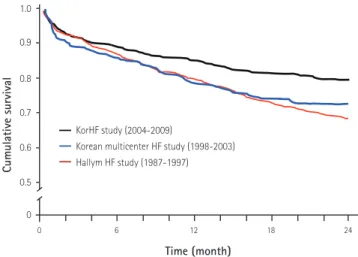
Even though the time point for survival analysis showed variation between the different registries, clinical outcomes showed mild improvement despite the increased HF severity in enrolled patients, reflecting the overall development of HF patient care in Korea (Fig. 4). In-hospital mortality was 5-8%, which is comparable to other registries. The cumulative Kaplan-Meier estimates for survival using 3 available previous registry data sets showed modest improvement in long term survival (Fig. 5). For the proper analysis of long term clinical outcomes, more detailed analysis such as propensity score matching might be necessary. However, it is common that temporal trends in clinical outcomes show mild or limited improvement irrespective of medical and surgical care
63.7 64.1
67.6 70 69.0
68
66
64
62
60
Hallym HF study (1987-1997)
Korean multicenter HF study (1998-2003)
KorHF registry (2004-2009)
KorAHF registry (2011-2012)
Age (year)
70 60
50
40
30 20
10
0 Hallym HF study (1987-1997)
Korean multicenter HF study (1998-2003)
KorHF registry (2004-2009)
KorAHF registry (2011-2012) 40.4
19.9
30.2 25.6
46.5
30.5
59.0
36.0 Hypertension (%) Diabetes (%)
Percentage (%)
60
50
40
30 20
10
0
Hallym HF study
(1987-1997) Korean multicenter HF study
(1998-2003) KorHF registry
(2004-2009) KorAHF registry (2011-2012) 29.3 26.725.5
17.2 32.3
16.5 22.7
13.5 52.3
36.7
26.5
12.7 38.0
6.0 21.0
13.0 Ischemic (%) Hypertensive (%) Cardiomyopathy (%) Valvular (%)
Percentage (%)
Fig. 1. Temporal trends of mean age in four Korean hospitalized HF registry.
HF: Heart failure, KorHF: Korean heart failure, KorAHF: Korean acute heart failure.
Fig. 2. Temporal trends of comorbidities in four Korean hospitalized HF registry. HF: heart failure, KorHF: Korean heart failure, KorAHF: Korean acute heart failure.
Fig. 3. Temporal trends of etiologies in four Korean hospitalized HF
registry. HF: heart failure, KorHF: Korean heart failure, KorAHF: Korean
acute heart failure.
development for HF, because of the increased HF severity seen in enrolled patients.
32)33)Independent prognostic factors from the four representative Korean hospitalized HF registries are summarized in Table 2.
Hyponatremia was an independent predictor of poor prognosis in the Hallym HF registry, the KorHF registry, the KorAHF registry and other Asian hospitalized HF registries.
15)17)18)34)35)Data from the KorHF registry revealed that hyponatremia at admission was associated with higher all-cause mortality, irrespective of whether hyponatremia improved during hospitalization.
20)A multivariate regression analysis of the KorAHF registry data also showed that hyponatremia at admission was an independent predictor of in- hospital mortality and post-discharge mortality.
18)Anemia is a well-known prognostic factor in patients with HF and is commonly observed in hospitalized HF patients. The KorHF registry showed that anemia on admission was an independent predictor for all- cause mortality in hospitalized HF patients.
17)Renal dysfunction is
one of the most important findings during hospitalization and a prognostic factor for hospitalized HF patients. The KorHF registry revealed that renal dysfunction was associated with poor clinical outcomes.
17)A multivariate regression analysis of KorAHF registry data also showed that renal dysfunction at admission was one of the most important prognostic factors for in-hospital mortality and post-discharge mortality.
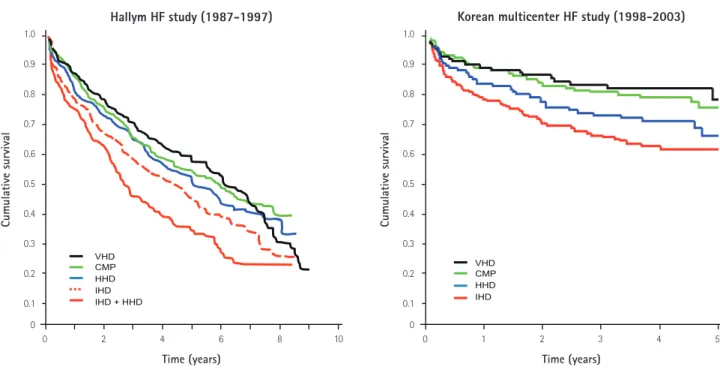
18)The cumulative survival curves for HF etiologies are shown in Fig. 6. The Hallym HF study revealed that HF caused by ischemic heart disease was associated with the poorest cumulative survival of 80.5% at 6 months, 30.2% at 5 years and 18.4% at 10 years, while HF caused by hypertensive heart disease predicted better survival with 90.8% at 6 months, 53.8% at 5 years and 31.1% at 10 years.
15)These patterns were consistent with a subsequent Korean multicenter HF study as well. HF caused by ischemic heart disease showed the poorest cumulative survival with 79.4% at 6 months, 70.2% at 1 year and 59.7% at 2 years, while HF caused by valvular
100 90 80 70 60 50 40 30 20 10
0 Hallym HF study (1987-1997)
Korean multicenter HF study (1998-2003)
KorHF registry (2004-2009)
KorAHF registry (2011-2012) Discharge survival (%) 6-month survival (%) 1-year survival (%) 2-year survival (%)
94.2 87.4 82
90.5 80.1 76.4
93.6 85 79
94.8 90.8
survival rate (%)
1.0
0.9
0.8
0.7
0.6
0.5
0
0 6 12 18
KorHF study (2004-2009)
Korean multicenter HF study (1998-2003) Hallym HF study (1987-1997)
Time (month)
Cumulative survival
24
Fig. 4. Temporal trends of clinical outcome in four Korean hospitalized HF registry. HF: heart failure, KorHF: Korean heart failure, KorAHF: Korean acute heart failure.
Fig. 5. Cumulative Kaplan-Meier estimates of survival according to different time periods in three Korean hospitalized HF registry. KorHF:
Korean heart failure, HF: heart failure.
Table 2. Independent predictors of clinical outcome in four Korean hospitalized HF registry Hallym HF study
(n=1657) Korean multicenter
HF study (n=1759) KorHF
(n=3200) KorAHF
(n=2066)
Hyponatremia Previous MI Old age Old age
Diabetes Diabetes Hyponatremia Hyponatremia
Stroke Stroke Previous HF Renal dysfunction
Smoking Anemia HF aggravation due
to renal failure
Interruption of ACE inhibitors High NT-proBNP
Beta-blocker at discharge
HF: heart failure, KorHF: Korean heart failure, KorAHF: Korean acute heart failure, MI: myocardial infarction, ACE: angiotensin converting enzyme, NT-proB-
NP: N-terminal prohormone of brain natriuretic peptide
heart disease was associated with better survival with 92.6% at 6 months, 91.0% at 1 year and 89.2% at 2 years followed by HF caused by cardiomyopathy and hypertensive heart disease
16). However, long term survival of valvular heart disease patients in the Hallym HF study revealed a poor prognosis 7-9 years after index admission requiring close attention to these patients. HF etiology can be highly variable and many patients will have several comorbid pathologies that result in HF hospitalization. Identification of these diverse pathologies should be part of the diagnostic workup, as they may offer specific therapeutic opportunities.
1)In-hospital management
More frequent use of intravenous diuretics, inotropes, vasodilators, mechanical ventilation and renal replacement therapy in the recent time period might result from the fact that patients with more severe symptoms and multiple comorbidities were enrolled in the recent registry. The advance of more active interventional treatment such as mechanical ventilation, renal replacement therapy and percutaneous cardiopulmonary support (PCPS) may be related to the improved in-hospital mortality in AHF patients. PCPS have been actively engaged in the acute care of patients with cardiogenic shock and are associated with clinical outcome improvement in Korea.
36)Guideline directed medical therapy and performance measures
are important issues in the management of hospitalized HF patients.
Interruption of ACEi treatment was an independent prognostic factor in the Hallym HF registry, while beta-blocker prescription at discharge showed better clinical outcomes in the KorHF registry.
When 1527 patients from the KorHF registry with left ventricular systolic dysfunction who survived hospitalization were evaluated, multivariate analysis revealed that adherence to ACE inhibitor treatment or ARB use at discharge were significantly associated with mortality and readmission at 60 days, and adherence to beta- blockers at discharge with mortality at 1 year.
22)Implantable cardioverter defibrillators and cardiac resynchronization therapy in Korea
In Korea, device therapy for HF patients such as ICD and CRT has been underutilized because of cultural proscriptions, low HF awareness of patients and strict insurance coverage criteria.
However, device therapy has recently increased steadily as shown in Fig. 7. To get real world data regarding the risks and benefits of device therapy for HF, and to clarify unmet needs for device therapy in Korean HF patients, it is necessary to establish a prospective nationwide HF device therapy registry near in the future.
5 3
2 1
10 0.1
0.3 0.4 0.5 0.6 0.7 0.8 0.9 1.0
0 0
Time (years)
Cumulative survival
0.2
8 6
4 2
0.1 0.3 0.4 0.5 0.6 0.7 0.8 0.9 1.0
0 0
Time (years)
Cumulative survival
0.2
4
VHDCMP HHD IHD IHD + HHD
VHD CMP HHD IHD