Safety of One-Day Admission Transradial Coronary Intervention
Hye Lim Oh, MD, Hyeon-Cheol Gwon, MD, Seon Mee Lee, MD, Yong Hoon Kim, MD, Il Seok Cheon, MD, Woo Jung Cheon, MD, Jin Ho Choi, MD, Sang-Chol Lee, MD, Ji Dong Sung, MD, June Soo Kim, MD, Eun Seok Jeon, MD, Duk Kyung Kim, MD, Sang Hoon Lee, MD, Kyung Pyo Hong, MD, Jeong Euy Park, MD and Jung Don Seo, MD Cardiac and Vascular Center, Sungkyunkwan University School of Medicine, Samsung Medical Center, Seoul, Korea ABSTRACT
Background:Recent advances of percutaneous coronary intervention (PCI) and transradial coronary interven- tion (TRI) have made it possible to reduce the local complication rate and the time until a return to ambulation.
The aim of this study is to assess the safety and the patient satisfaction of the TRI-based one-day admission program for PCI. Methods:Total 230 consecutive patients underwent TRI on the day of admission, according to pre-determined inclusion criteria, from May 2001 to October 2003. The subjects were examined for clinical and angiographic characteristics. The patients having a same-day discharge were telephone-interviewed one day and seven days after discharge to assess late complications and the patients’ satisfaction. Results:The mean age of the subjects was 59±9 years and 77.4% were male patients. 169 (73.4%) had stable angina and 37 (16.1%) had unstable angina. Stents were implanted in 178 cases (69.3%). Of the 230 patients who underwent TRI, 206 patients (89.6%) could discharge on the same day after the procedure. The procedure was successful in 98.5%. The average hospital stay for them was 9.4±1.4 hours. Two subjects reported hematoma near the puncture site within 24 hours after discharge, and one reported this problem 7 days after discharge. During the follow-up, there were no cases reporting chest pain needing rehospitalization or such complications as subacute vessel closure. No deaths, myocardial infarctions or revascularization were noted during the follow-up period. The majority of the patients (n=197, 95.6%) were satisfied with the same-day admission and discharge. Conclusions:Same- day admission and discharge after TRI seems to be safe as well as satisfactory for not low-risk patients. (Korean Circulation J 2004; 34 (7):647-654)
KEY WORDS:Coronary disease;Angioplasty;Radial artery.
Introduction
Because of its invasiveness and risk of potential com- plications, diagnostic coronary angiography or per- cutaneous coronary intervention (PCI) are commonly performed as inpatient procedures. However, with imp- roved equipment technology and the accumulation of
experiences, diagnostic coronary angiography is incre- asingly performed on an outpatient basis in many car- diovascular centers.1) However, PCI has still been per- formed as an inpatient procedure, with the average lengths of stay ranging from 2-3 days in the majority of cases.
The two major reasons for keeping the patient under clinical observation is the risk of subacute closure of the target vessel after discharge and immobilization to reduce the risk of puncture site-related bleeding complications if the procedure was performed via a transfemoral approach.
Recent advances in equipment technology, such as the advent of coronary stent and enhanced clinical exp- ertise, have reduced the acute complications after the Received:March 4, 2004
Accepted:May 14, 2004
Correspondence:Hyeon-Cheol Gwon, MD,Cardiac and Vasc- ular Center, Sungkyunkwan University School of Medicine, Sam- sung Medical Center, 50 Ilwon-dong, Gangnam-gu, Seoul 135-710, Korea
Tel:82-2-3410-3418, Fax:82-2-3410-3849 E-mail:[email protected]
procedure.2) Also, the development of a procedure via a transradial approach3) and vascular closure devices that achieve early ambulation have contributed to the dec- reased length of hospital stay. In recent studies in other countries, the feasibility of same-day discharge has been demonstrated, not only after transradial PCI,4-6) but also after transfemoral PCI.7-9) Such trends are accelerating due to the introduction of vascular closure devices.10-12) Particularly, transradial coronary intervention (TRI) is considered as the most suitable for a same-day discharge procedure because of the advantages that compression hemostasis can be performed easily, puncture site comp- lications rarely occur and its indication widens with the accumulation of operator experience of performing TRI.
However, a same-day discharge PCI remains to be re- ported in Korea. Thus, the feasibility of a same-day disc- harge and its safety on patients undergoing transradial coronary intervention (TRI) on an outpatient basis were prospectively investigated.
Methods
Patient selection
The study population was comprised of all patients diagnosed with coronary artery disease that had under- gone transradial coronary intervention on the day of admission, under the same-day admission and discharge program, between May 2001 and October 2003, at the cardiac and vascular center of Samsung Medical Center.
Although the following patients are included in the study, they were not discharged on the same day: cardiogenic shocks during or after the procedure, systemic or distal embolization, severe complications related to the pro- cedure, such as cardiac arrest, left main PCI, medical history of myocardial infarction within one week, pre- sence of intracoronary thrombus or severe coronary artery dissection, left ventricular ejection fraction lower than 30% and a serum creatinine greater than 2.0 mg/dL.
Periprocedural medication
All patients were treated with 100-300 mg aspirin and
75 mg clopidogrel daily for 3-5 days prior to the proce- dure. Before or immediately after the procedure, a loading dose of 300 mg clopidogrel was administered to patients not previously treated with clopidogrel on the several days prior to the procedure. Patients without contraindi- cations were maintained on clopidogrel 75 mg/day for one month and aspirin indefinitely. Immediately prior to the procedure, the administration of heparin was adjusted to 100 U/Kg and the activated clotting time (ACT) maintained between 300 and 350 seconds.
Procedural protocol
TRI was performed with the use of 5-7 French gui- ding catheters through the right or left radial artery. Im- mediately after the procedure, the arterial sheath was removed in the catheterization laboratory and a pressure dressing applied at the radial puncture site. After 4 hours, the pressure dressing was removed and the presence or absence of a radial artery pulse, bleeding and hematomas were assessed. If the patient was in a stable condition, without chest pain and electrocardiographic change dur- ing a postprocedural observation period, they were disc- harged 2 hours later on the same day.
Study method
The clinical, angiographic and procedural characteris- tics, and the procedural success rate were assessed on the study patients. Lesions were characterized accor- ding to the American College of Cardiology/American Heart Association (ACC/AHA) classification system.
Successful PCI was defined as a residual diameter ste- nosis < 30% after balloon angioplasty or stent implanta- tion, with TIMI 3 flow and the patient in a stable condition, and without acute myocardial infarction, the need for emergency coronary artery bypass graft surgery (CABG) or death.
To assess late complications and patient satisfaction, structured follow-up telephone interviews were performed 24 hours and 7 days after discharge. The occurrence of chest pain, a puncture site complication (pain, bleeding and hematoma) and readmission status were evaluated.
In addition, the satisfaction of same-day discharge and the preference between same-day discharge and treat- ment as an inpatient were assessed.
Statistical analysis
All data are presented as the mean±SD. Statistical analysis was performed by Student’s t- or Chi-squared tests using SPSS for 11.0. p<0.05 was considered as statistically significant.
Results
Clinical characteristic
During the study period, a total 230 patients (257 le- sions) underwent transradial coronary intervention (TRI) on the day of admission. There were 178 male and 52 female cases (77.4 and 22.6%, respectively), with a mean age of 59±9 years. The clinical diagnoses of the study population were stable angina, which was most preva- lent, unstable angina, silent ischemia, and mixed angina
in 169 (73.4%), 37 (16.1%), 19 (8.3%) and 5 (2.2%) cases, respectively. 43 (18.7%), 80 (34.8%) and 6 (2.6%) cases had prior myocardial infarction, PCI and CABG, respec- tively. The left ventricular ejection fraction, as evaluated by echocardiogram, was 59±9% (Table 1).
Angiographic characteristic
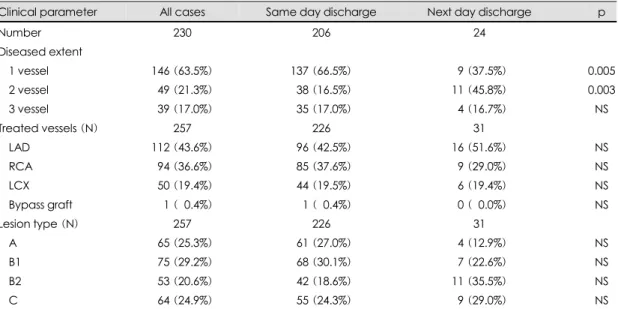
With regard to the number of diseased vessel, there were 146 (63.5%), 49 (21.3%) and 39 (17.0%) cases of a single vessel disease, two vessel disease and three vessel disease, respectively. The vessels that underwent TRI (n=257) were as follows: the left anterior descending artery, the right coronary artery, the left circumflex artery and the bypass graft vessel in112 (43.6%), 94 (36.6%), 50 (19.4%) and 1 (0.4%) cases, respectively. The lesion type according to the ACC/AHA classification was as follows:Types A, B1, B2 and C lesions in 65 (25.3%), 75 (29.2%), 53 (20.6%) and 64 (24.9%) cases, respec- tively (Table 2).
Table 1. Clinical characteristics
Clinical parameter All cases Same day discharge Next day discharge p
Number 230 206 (89.6%) 24 (10.4%) NS
Age (years) 59±9 59±9 59±7 NS
Male sex 178 (77.4%) 163 (79.1%) 15 (62.5%) NS
Hypertension 113 (49.1%) 102 (49.5%) 11 (45.8%) NS Diabetes mellitus 054 (23.5%) 046 (22.3%) 08 (33.3%) NS CVA history 010 (04.3%) 009 (04.4%) 01 (04.2%) NS Hypercholesterolemia 042 (18.3%) 039 (18.9%) 03 (12.5%) NS Family history 010 (04.3%) 009 (04.4%) 01 (04.2%) NS
Smoking 066 (28.7%) 060 (29.1%) 06 (25.0%) NS
Previous MI 043 (18.7%) 040 (19.4%) 03 (12.5%) NS Previous PCI 080 (34.8%) 080 (38.8%) 00 (00.0%) 0.001
Previous CABG 006 (02.6%) 005 (02.4%) 01 (04.2%) NS Ejection fraction (%) 59±9 60±11 57±8 NS Clinical diagnosis
Stable angina 169 (73.4%) 152 (73.8%) 17 (70.8%) NS Unstable angina 037 (16.1%) 033 (16.0%) 04 (16.7%) NS Silent ischemia 019 (08.3%) 017 (08.3%) 02 (08.3%) NS Mixed angina 005 (02.2%) 004 (01.9%) 01 (04.2%) NS Values are presented as numbers (relative percentages) or mean±SD. CVA: cerebrovascular accident, MI: myo-
cardial infarction, PCI: percutaneous coronary intervention, CABG: coronary artery bypass graft
Procedural characteristic
The TRI was performed on 257 lesions in 230 patients.
A multivessel procedure was performed in 24 cases (10.4%). As the lesion treatment, stent implantation was performed in 178 cases (69.3%), with 190 stents used. In 55 cases (21.4%), only balloon angioplasty was perfor- med. Angioplasty using a cutting balloon was performed on 24 cases (9.3%). The guiding catheters used in TRI were as follows:6 French, which was most common, 5 French and 7 French in 118 (51.3%), 101 (43.9%) and 11 (4.8%), respectively (Table 3).
Same day discharge
Of the 230 patients that underwent TRI on the day of admission, 24 (10.4%) were unable to be discharged on the same day. The reasons for failure of same-day dis- charge were that clinicians or patients did not want to be discharged for the reason unrelated to the result of pro- cedure, complications related to the procedure, a high risk procedure, such as a bifurcation lesion, the develo- pment of new thrombus after stent deployment and the development of ventricular tachycardia requiring elec- trical cardioversion during procedure, in 9, 9, 3, 2 and 1 cases, respectively.
Of the 206 patients successfully discharged on the same day, the intervention failed in 3 cases (1.5%), 2 due to the failure of guidewire passage in the completely occluded artery and 1 that showed 75% residual stenosis after the balloon angioplasty for a completely occluded artery. In 12 cases (5.8%), complications related to the procedure occurred. Of these, there was 10 (4.9%) cases of coronary artery dissection and 1 case each of side branch occlu- sion and dissection of the sinus valsalva, respectively (Table 3).
Of the 24 patients who were unable to be discharged on the same day, only 1 case (4.2%) was due to failure of the procedure because of type B dissection and 50%
residual stenosis after balloon angioplasty for the ostial lesion on the diagnonal branch of the left anterior des- cending artery. In 9 cases (37.5%), complications related to the procedure occurred; coronary artery dissection, side branch occlusion and left anterior descending artery perforation in 5 (20.8%), 3 (12.5%) and 1 (4.2%) cases, respectively (Table 3).
The mean hospital stay and average discharge time of the same-day discharge patients were 9.4±1.4 hours and 17.1±1.3 o’clock, respectively.
Table 2. Angiographic characteristics
Clinical parameter All cases Same day discharge Next day discharge p
Number 230 206 24
Diseased extent
1 vessel 146 (63.5%) 137 (66.5%) 09 (37.5%) 0.005 2 vessel 049 (21.3%) 038 (16.5%) 11 (45.8%) 0.003
3 vessel 039 (17.0%) 035 (17.0%) 04 (16.7%) NS
Treated vessels (N) 257 226 31
LAD 112 (43.6%) 096 (42.5%) 16 (51.6%) NS
RCA 094 (36.6%) 085 (37.6%) 09 (29.0%) NS
LCX 050 (19.4%) 044 (19.5%) 06 (19.4%) NS
Bypass graft 001 (00.4%) 001 (00.4%) 00 (00.0%) NS
Lesion type (N) 257 226 31
A 065 (25.3%) 061 (27.0%) 04 (12.9%) NS
B1 075 (29.2%) 068 (30.1%) 07 (22.6%) NS
B2 053 (20.6%) 042 (18.6%) 11 (35.5%) NS
C 064 (24.9%) 055 (24.3%) 09 (29.0%) NS
LAD: left anterior descending artery, RCA: right coronary artery, LCX: left circumflex artery
Follow-up
Within 24 hours of the same-day discharge, a hema- toma at the puncture site occurred in 2 cases (1.0%) bet- ween 24 hours and 7 days in 1 (0.5%). The bleeding at the puncture site within 24 hours after discharge occurred in 2 cases (1.0%). The amount of bleeding was small, equivalent to a sheet of gauze, and did not require addi- tional treatment. The development of chest pain within 24 hours and between 1 and 7 days of discharge occurred in 11 (5.3%) and 23 (11.2%) cases, respectively. How- ever, no severe chest pain requiring repeat coronary angiography or readmission developed. During the follow- up period, complications such as subacute thrombosis and major cardiac events, such as myocardial infarction, requiring repeat PCI or CABG, did not occur, and there were no deaths (Table 4).
In the survey for the patients’ satisfaction of same- day discharge, 197 of 206 cases (95.6%) were satis- fied and preferred same-day discharge to treatment as an inpatient. Of the 9 dissatisfied cases, the were 3 males and 6 females, with a mean age of 58±7 years. Their reason for dissatisfaction was psychological anxiety (Table 4).
Discussion
With the expanding indication for PCI in the treat- ment of symptomatic coronary artery diseases the pro- portion of its use is gradually increasing, and PCI has generally been performed as an inpatient procedure.
One of major reasons for performing PCI as an inpatient procedure is the risk of occlusion of the target vessel after discharge. Prior to the general use of stents, depen- Table 3. Procedural characteristics
All cases Same day discharge Next day discharge p
Case number 230 206 24
Multivessel procedure 024 (10.4%) 017 (08.3%) 07 (29.2%) NS Procedural success rate 226 (98.3%) 203 (98.5%) 23 (95.8%) NS Procedural complication 021 (09.1%) 012 (05.8%) 09 (37.5%) 0.0001
Used guiding catheter
5 French 101 (43.9%) 092 (44.7%) 09 (37.5%) NS 6 French 118 (51.3%) 107 (51.9%) 11 (45.8%) NS 7 French 011 (04.8%) 007 (03.4%) 04 (16.7%) 0.004
Lesion number 257 226 31
Stent implantation 178 (69.3%) 155 (68.6%) 23 (74.2%) NS Balloon dilatation 055 (21.4%) 048 (21.2%) 07 (22.6%) NS Cutting balloon 024 (09.3%) 023 (10.2%) 01 (03.2%) NS Type A dissection 008 (03.1%) 007 (03.1%) 01 (03.2%) 0.005 Type B dissection 007 (02.7%) 003 (01.3%) 04 (12.9%) 0.002 Side branch occlusion 004 (01.6%) 001 (00.4%) 03 (09.7%) 0.006
Table 4. Local wound complications and patient sa- tisfaction after same-day discharge
After 24 hour After 7 days Puncture site
complication
Pain 036 (17.5%) 015 (07.3%) Hematoma 002 (01.0%) 001 (00.5%) Bleeding 002 (01.0%) 000
Death 000 000
Myocardial infarction 000 000 Repeat PCI or CABG 000 000 Readmission 000 000 Satisfied with same-day
discharge 197 (95.6%) 197 (95.6%) PCI: percutaneous coronary intervention, CABG: cor- onary artery bypass graft
ding on the number of related risk factors present with a vessel occlusion, the incidence of acute vessel closure has been reported to be 2-25%.13-17) The major cause has been reported as coronary artery dissection, which frequently occurs with in minutes or a few hours after the procedure.16) However, stenting, although initially intro- duced as a treatment for acute vessel closure, is now widely practiced electively, making acute vessel closure a rare complication. Now, a subacute stent thrombosis is the more prevalent postprocedural thrombotic compli- cation. The predictors of the risk of stent thrombosis include multiple stents, smaller vessel, pre-intervention thrombosis, suboptimal stent expansion, residual diss- ection and slow flow, etc., which are mainly related with suboptimal PCI result.18)19) If an optimal result after sten- ting is achieved, the risk may be decreased. In addition, the administration of new anti-platelet agents, such as ticlopidine or clopidogrel, has been reported to reduce the incidence of subacute thrombosis to less than 2%.20)
Ziakas, et al.6) reported in a retrospective study of same- day discharge on 943 patients, that subacute vessel clo- sure occurred in only 0.6% of patients, but it did not occur during the first 24 hours after discharge, and re- ported same-day discharge as safe and feasible in certain patients with low-risk for postdischarge complications.
Similarly, in our study, the development of subacute thrombosis within 7 days of the same-day discharge was not detected. Thus, in the same-day discharge patients, the risk due to subacute vessel occlusion after the pro- cedure would not be increased if the angiographic result after the procedure was optimal and the condition of the patient stable.
Another important reason for hospitalization is that the procedure requires prolonged immobilization to reduce the risk of puncture site-related bleeding com- plications, particularly in the cases of a transfemoral approach. The reported incidence of puncture site comp- lications after the procedure varies from 1.5 to 18%, which has been reported to be associated with the level of anticoagulation, the sheath size and sheath dwell time.21) However, the advantages of the transradial app-
roach is that the distal radial artery has a superficial course, lies isolated from major veins or nerves and is easy to compress; thus, bleeding complications are ext- remely rare, and even if occlusion of the radial artery occurs after the cannulation procedure, the functional impairment due to the ischemia in hand is extremely rare due to the presence of the collateral blood supply from the ulnar artery. A recent randomized comparison study has shown that major entry site complications were encountered in 2.0% of cases in a transfemoral group, but in none of the transradial group, and the procedural and clinical outcomes of PCI were similar for both groups.22) Hence, with transradial coronary intervention (TRI), the advantages are that same-day discharge is feasible as major vascular complications are rare and the restriction of activity is limited; consequently, the pro- cedure allows busy contemporary individuals to return to work earlier and shortens the hospital stay, resulting in reduced medical costs.
Kiemeneij, et al.4) reported the safety of same-day discharge on 100 patients who underwent the Palmaz- Schatz stent implantation through the transradial app- roach between 1994 and 1995. Although, the results are currently difficult to apply, as a proportion of the pa- tients were receiving anticoagulation with Coumadin, the study suggested the potential of PCI on an outpatient basis without complications. Subsequently, Slagboom, et al.5) compared the outcome of 159 patients who under- went the transradial PCI using 6 French guiding cathe- ters, and divided the patients into two groups, the same- day discharge group and the 24-hour clinical group, based on a set of clinical and angiographic parameters, and predictive indicators of adverse clinical events dur- ing the first 24 hour. The data demonstrated that 106 patients (66%) were considered suitable for same-day discharge without cardiac and vascular complications, which has shown very encouraging results in term of the safety of same-day discharge. In this study, 56% of treated lesions were type A, and stents were used in only 40% of patients, with none undergoing a multivessel procedure. However, our study included relatively high
risk patients with unstable angina (n=33, 16.0%) and types B2 and C lesions (n=97, 42.9%), and patients that underwent a multivessel procedure (n=17, 8.3%), with 68.6% of patients underwent stent implantation. There- fore, the significance of our results is in the demons- tration of the potential for successful same-day discharge on a larger number and variety of patients, without increased risk of major cardiac events or puncture site complications.
On the other hand, in other countries same-day disc- harge has been reported to be safe, not only in the proce- dure via transradial approach, but also in the procedure via transfemoral approach, and the degree of patient satisfaction is high,6)9)23) with the additional advantage of cost reduction.10)23) In our study, 95.6% of patients preferred the same-day discharge procedure, which indi- cates the high patient satisfaction rate. Under current conditions, with the prevalence for coronary stents, high- pressure stent deployment24) and the development of powerful anti-platelet agents,25)26) the incidence of sub- acute thrombosis is rare, less than 1%. Even in high risk patients, same-day discharge can be carried out safely if an optimal final result after PCI is achieved. Particularly in the transradial PCI, as puncture site complications are extremely rare and early ambulation is feasible, same- day discharge is expected to raise the satisfaction of pa- tients and reduce medical costs.
This study is a prospective registry on the outcome of patients that underwent TRI on the day of admission under the planned same day admission and discharge program. Therefore, clinical or angiographic parameters for predicting same-day discharge could not be accu- rately defined. However, in those treated as inpatients, significantly more multivessel diseases were detected and a significantly larger guiding catheter used. Hence, for the accurate assessment of the safety and patient selec- tion for same-day discharge, larger scaled randomized multi-center trials are required to compare with the inpa- tient population. In addition, as the large majority of do- mestic cardiovascular centers perform the procedure via the transfemoral approach, further study is required to
assess the outcome of same-day discharge after trans- femoral PCI.
In conclusion, it is consider that for patients with a stable condition and minimal complications after the procedure, the same-day admission and discharge TRI reduces the hospital stay, possibly increases patient sa- tisfaction and may prevail in the field of interventional cardiology in Korea.
REFERENCES
1) Block PC, Ockene I, Goldberg RJ, Butterly J, Block EH, Degon C, et al. A prospective randomized trial of outpatient versus inpatient cardiac catheterization. N Engl J med 1988;319:1251-5.
2) Roubin GS, Cannon AD, Agrawal SK, Macander PJ, Dean LS, Baxley WA, et al. Intracoronary stenting for acute and threatened closure complicating percutaneous transluminal coronary angioplasty. Circulation 1992;85:916-27.
3) Kiemeneij F, Laarman GJ, de Melker E. Transradial artery coronary angioplasty. Am Heart J 1995;129:1-7.
4) Kiemeneij F, Laarman GJ, Slagboom T, van der Wieken R.
Outpatient coronary stent implantation. J Am Coll Cardiol 1997;29:323-7.
5) Slagboom T, Kiemeneij F, Laarman GJ, van der Wieken R, Odekerken D. Actual outpatient PTCA. Catheter Cardiovasc Interv 2001;53:204-8.
6) Ziakas AA, Klinke BP, Mildenberger CR, Fretz DE, Williams EM, Kinloch FR, et al. Safety of same-day-discharge radial percutaneous coronary intervention: a retrospective study.
Am Heart J 2003;146:699-704.
7) Koch KT, Piek JJ, de Winter RJ, Mulder K, David GK, Lie KI. Early ambulation after coronary angioplasty and sten- ting with six French guiding catheters and low-dose heparin.
Am J Cardiol 1997;80:1084-6.
8) Koch KT, Piek JJ, de Winter RJ, Mulder K, Schotborgh CE, Tijssen JG, et al. Two hour ambulation after coronary an- gioplasty and stenting with 6 F guiding catheters and low dose heparin. Heart 1999;81:53-6.
9) Knopf WD, Cohen-Bernstein C, Ryan J, Heselov K, Yar- brough N, Steahr G. Outpatient PTCA with same day dis- charge is safe and produces high patient satisfaction level. J Invasive Cardiol 1999;11:290-5.
10) Wilentz JR, Mishkel G, McDermott D, Ravi K, Fox JT, Rei- mers CD. Outpatient coronary stenting using the femoral approach with vascular sealing. J Invasive Cardiol 1999;
11:709-17.
11) Carere RG, Webb JG, Buller CE, Wilson M, Rahman T, Spinelli J, et al. Suture closure of femoral arterial puncture sites after coronary angioplasty followed by same-day disc- harge. Am Heart J 2000;139:52-8.
12) Dalby M, Davies J, Rakhit R, Mayet J, Foale R, Davies DW.
Feasibility and safety of day-case transfemoral coronary stenting. Catheter Cardiovasc Interv 2003;60:18-24.
13) Detre KM, Holmes DR Jr, Holubkov R, Kelsy S, Cowley
MJ, Bourassa MG, et al. Incidence and consequences of periprocedural occlusion. Circulation 1990;82:739-50.
14) Simpfendorfer C, Belardi J, Bellamy G, Galan K, Franco I, Hollman J. Frequency, management and follow-up of pati- ents with acute coronary occlusions after percutaneous tran- sluminal coronary angioplasty. Am J Cardiol 1987;59:267-9.
15) de Feyter PJ, van den Brand M, Laarman GJ, van Domburg R, Serruys PW, Suryapranata H, et al. Acute coronary artery occlusion during and after percutaneous transluminal coro- nary angioplasty: frequency, prediction, clinical course, ma- nagement and follow up. Circulation 1991;83:927-36.
16) Lincoff AM, Popma JJ, Ellis SG, Hacker JA, Topol EJ.
Abrupt vessel closure complicating coronary angioplsty:
clinical, angiographic and therapeutic profile. J Am Coll Cardiol 1992;19:926-35.
17) de Feyter PJ, de Jaegere PP, Serruys PW. Incidence, pre- dictors and management of acute coronary occlusion after coronary angioplasty. Am Heart J 1994;127:643-51.
18) Mak KH, Belli G, Ellis SG, Moliterno DJ. Subacute stent thrombosis: evolving issues and current concepts. J Am Coll Cardiol 1996;27:494-503.
19) Moussa I, di Mario C, Reimers B, Akiyama T, Tobis J, Co- lombo A. Subacute stent thrombosis in the era of intrava- scular ultrasound-guided coronary stenting without antica- gulation: frequency, predictors, and clinical outcome. J Am Coll Cardiol 1997;29:6-12.
20) Moussa I, Oetgen M, Roubin G, Colombo A, Wang X, Iyer S, et al. Effectiveness of clopidogrel and aspirin versus ticlopidine and aspirin in preventing stent thrombosis after
coronary stent implantation. Circulation 1999;99:2364-6.
21) Popma JJ, Satler LF, Pichard AD, Kent KM, Campbell A, Chuang YC, et al. Vascular complications after balloon and new device angioplasty. Circulation 1993;88:1569-78.
22) Kiemeneij F, Laarman GJ, Odekerken D, Slagboom T, van der Wieken R. A randomized comparison of percutaneous transluminal coronary angioplasty by the radial, brachial and femoral approaches: the access study. J Am Coll Cardiol 1997;29:1269-75.
23) Khatri S, Webb JG, Carere RG, Amis A, Woolcott J, Chugh S, et al. Safety and cost benefit of same-day discharge after percutaneous coronary intervention. Am J Cardiol 2002;90:
425-7.
24) Nakamura S, Hall P, Gaglione A, Tiecco F, di Maggio M, Maiello L, et al. High pressure assisted coronary stent im- plantation accomplished without intravascular ultrasound guidance and subsequent anticoagulation. J Am Coll Cardiol 1997;29:21-7.
25) Karrillon GJ, Morice MC, Benveniste E, Bunouf P, Aubry P, Cattan S, et al. Intracoronary stent implantation without ultrasound guidance and with replacement of convetional anticoagulation by antiplatelet therapy: 30-day clinical out- come of the French Multicenter Registry. Circulation 1996;
94:1519-27.
26) Colombo A, Hall P, Nakamura S, Almagor Y, Maiello L, Martini G, et al. Intracoronary stenting without anticoagu- lation accomplished with intravascular ultrasound guid- ance. Circulation 1995; 91:1676-88.