Estimating Wildfire Fuel Load of Coarse Woody Debris using National Forest Inventory Data in South Korea
Choi, Suwon
*, Lee, Jongyeol
**, Han, Seung Hyun
**, Kim, Seongjun
**and Son, Yowhan
*,**†*
Dept. of Climate Environment, Graduate School of Life and Environmental Sciences, Korea University, Seoul 136-713, Korea
**
Dept. of Environmental Science and Ecological Engineering, Graduate School, Korea University, Seoul 136 – 713, Korea
ABSTRACT
This study presents an estimate of on-site surface fuel loadings composed of coarse woody debris (CWD) using 5
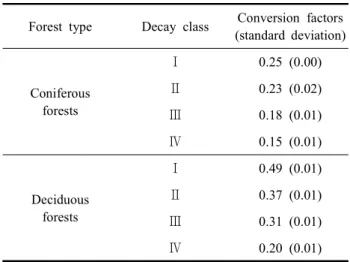
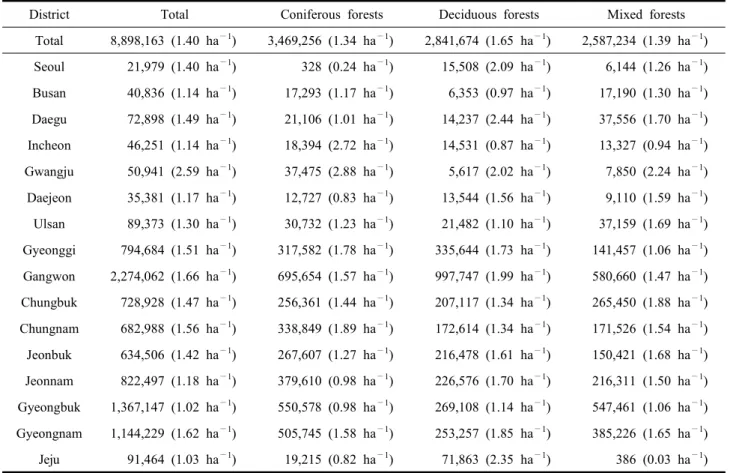
thNational Forest Inventory (NFI) data in South Korea. We classified CWD data into forest type, region and decay class, and used conversion factors by decay class and tonne of oil equivalent developed in the country. In 2010, the total wildfire fuel load of CWD was estimated as 8.9 million TOE; those of coniferous, deciduous and mixed forests were 3.5 million TOE, 2.8 million TOE and 2.6 million TOE, respectively. Gangwon Province had the highest wildfire fuel load of CWD (2.3 million TOE), whereas Seoul exhibited the lowest wildfire fuel load of CWD (0.02 million TOE).
Wildfire fuel loads of CWD were estimated as 2.9 million TOE, 1.9 million TOE, 2.4 million TOE and 1.7 million TOE for decay classes I, II, III and IV, respectively. The total wildfire fuel load of CWD corresponded to the calorific value of 8.2 million tons crude oil, 2.46% of that of living trees. Proportionate to the growing stock, total wildfire fuel load of CWD was in a broad distinction by region, while its TOE ha
-1was not. This implies that there is no need to establish different guidelines by region for management of CWD. The results of this work provide a baseline study for scientific policy guidelines on preventing wildfires by proposing CWD as wildfire fuel load.
Key Words: Wildfire, Coarse Woody Debris, Forest Fuel, National Forest Inventory
†