Kor. J. Pharmacogn.
41(3) : 174∼ 179 (2010)
174
신나무 수피로부터 Gallotannin 화합물의 항산화 활성 및 함량분석
최선은·박관희·오명환·장준혜·진혜영1·김성식1·이민원* 중앙대학교 약학대학, 1국립수목원
Antioxidative Activities and Quantitative Determination of Gallotannins from Barks of Acer ginnala Maxim.
Sun Eun Choi, Kwan Hee Park, Myoeng Hwan Oh, Jun Hye Jang, Hye Young Jin1, Sung Sik Kim1 and Min Won Lee*
College of Pharmacy, Chung-Ang University, Seoul 156-756, Korea
1Korea National Arboretum, Pocheon-City 487-821, Korea
Abstract − Activity guided isolation of 80% acetone extract from the barks of Acer ginnala Maxim. yielded five gallotannins [6-galloyl-1,5-anhydroglucitol (ginnalin B) (1), acertannin (3,6-digalloyl-1,5-anhydroglucitol) (2), methyl gallate (3), acertannin (2,6-digalloyl-1,5-anhydroglucitol) (4) and gallic acid (5)]. All of these isolated compounds from Acer ginnala(1-5) were firstly isolated from Acer ginnala Maxim. And contents of compounds from barks of Acer ginnala (Comp. 1: 0.73±0.002%, Comp.
2: 0.48±0.001%, Comp. 3: 0.66±0.002%, Comp. 4: 1.05±0.002% and Comp. 5: 0.29±0.001%) were evaluated by HPLC anal- ysis. And, in order to evaluate anti-oxidative activities on Comp. 1-5 isolated from Acer ginnala, DPPH radical scavenging activity was measured in vitro. All of these isolated compounds from Acer ginnala exhibited potent DPPH radical scavenging activities.
Key words − Acer ginnala Maxim., gallotannin, DPPH, HPLC
신나무(Acer ginnala Maxim.)는 단풍나무과 단풍나무속 식물로서 우리나라 전국 각지의 해발 1,500 m 이하의 산기 슭 양지바른 떨기나무 숲에서 흔히 잘 자라며, 낙엽소교목 또는 관목으로 식물체의 높이 2~8 m이다. 나무껍질은 밋밋 하거나 거칠며 얕게 세로로 터지고 회갈색을 나타낸다. 잎 은 대생하며 난상 타원형이고 가장자리에 톱니모양을 하고 있다. 꽃은 5월에 가지끝에서 복산방화서를 이루고 잡성꽃 또는 자웅동주이다. 꽃잎은 연한 황백색이다. 열매는 9월에 짙은 갈색으로 성숙한다. 신나무를 민간 또는 한방에서는 안 질에 약으로 쓰거나 상처 치유 및 지사제로 이용되어 왔다.1-3) 신나무(Acer ginnala Maxim.) 성분연구로는 잎과 줄기로 부터 flavonoid 류 (quercetin, quercitrin, isoquercitrin, rutin, quercetin-3-O-α-L-rhamnopyranosyl-2''-O-gallate etc.), tannin 류 (acertannin, polygagallin, ginnalin B,C, gallic acid, ethyl gallate, methyl gallate, gallicin etc.), saponin (ilexoside
O,K) 등이 보고되었다.4-9) 신나무(Acer ginnala Maxim.) 추 출물 혹은 그로부터 분리된 화합물이 강력한 항산화 활성 과 항균활성 및 항암효과도 있는 것으로 알려져 있다.10-11)
이에 본 연구에서는 신나무(Acer ginnala Maxim.)수피로 부터 항산화 효과를 기반으로 한 activity guided isolation 을 실시하여 5종의 gallotannin을 분리하였고 이들 화합물들 의 항산화 활성을 평가하고 HPLC를 이용하여 함량을 분석 하였다.
재료 및 방법
실험 재료 − 신나무 (Acer ginnala Maxim.)는 2009년 8월 경기도 포천시에 위치한 국립수목원에서 제공받아 식물학 적 감정한 후 사용하였으며, 표준품은 중앙대학교 약학대학 생약학 연구실에 보관하고 있다 (AGM2009-08).
기기 및 시약 −1H 및 13C-NMR spectra는 Gemini 2000 (300 MHz, 75 MHz)와 VNS (Varian, Palo Alto, CA, USA) (600 MHz, 125 MHz)로 측정하였고, Low resolution fast
*교신저자(E-mail):[email protected] (Tel): +82-2-820-5602
atom bombardment mass spectrum (LRFAB-MS)는 JMSAX505WA (JEOL, Tokyo, Japan)을 사용하였다. High pressure liquid chromatography(HPLC)는 Waters 600 system (USA)을 이용하였으며, 세부적으로는 Pump : Waters 600 pump, Controller : Waters 600 controller, Detector : Waters 112 UV/VIS (280 nm), Column : Kromasil C18 HPLC column (Varian C18-HL, 5µm, 250 × 4.6 mm), Data system : Autochro-Win 3.0 plus (Young-lin Co., Korea)을 각각 이용하였다. Column chromatography 용 충진제는 Sephadex LH-20 (10-25µm, GE Healthcare Bio-Science AB, Uppsala, Sweden), ODS-B gel (40-60µm, Daiso, Osaka, Japan)을 사용하였으며, Thin layer chromatography (TLC) plate는 pre-coated silica gel 60 F254 plate (Merck, Darmstadt, Germany)를 사용하였다. 항산화활성 측정용 시 약인 DPPH (1,1-diphenyl-2-picrylhydrazyl), L-ascorbic acid 는 Sigma Aldrich(Milw., WI, USA)에서 구입하였고, 99.5%
ethanol은 Merck (Darmstadt, Germany) 에서 구입하여 사용 하였다. 흡광도는 ELISA reader (TECAN, Salzburg, Austria) 를 사용하여 측정하였다.
추출 및 분리 − 신나무 수피 5.5 kg을 절단한 후 80%
acetone으로 실온에서 3회 추출하여 여과하였다. 그 추출액 을 감압 농축한 후(387.87g) H2O에 현탁하여 여과한 후 (142.87 g) Sephadex LH-20 컬럼 크로마토그래피를 이용하 였다. 용매는 H2O-MeOH을 0%-100%까지 농도를 높였으 며 TLC를 실시하여 8개의 분획 (Fr.1, Fr.2, Fr.3, Fr.4, Fr.5, Fr.6, Fr.7, Fr.8)으로 나누었다. Fr.3 (4.60 g)으로부터 DaiSogel ODS-B with middle pressure liquid chromatography (MPLC) (H2O-MeOH, 0%-100%), (H2O-MeOH, 10%-80%)을 통해서 gallic acid (1.74 g)을 얻었다. 또한, Fr.4 (13.86 g 중 12.87 g) 로부터는 Sephadex LH-20 (H2O-MeOH, 0%-100%), MCI- gel CHP20P (H2O-MeOH, 10%-80%)를 통해서 ginnalin B (10.72 g)를 얻었다. 그리고 Fr.6 (5.54 g)으로부터는 DaiSogel ODS-B with MPLC (H2O-MeOH, 20%-100%)를 통해서 methyl gallate(3.49 g)를 얻었다. Fr.7(14 g)은 DaiSogel ODS-B with MPLC (H2O-MeOH, 20%-100%, 30%-100%, 10%-80%), Sephadex LH-20 (MeOH, 50%)를 통해서 3,6- digalloyl-1,5-anhydroglucitol (acertannin) (7.74 g)을 얻었다.
Fr.8 (13.45 g 중 12.45 g)에 대해서 YMC ODS gel (MeOH, 50%), DaiSogel ODS-B with MPLC (H2O-MeOH, 20%- 100%)를 통하여 2,6-digalloyl-1,5-anhydroglucitol (acertannin) (11.24 g)과 3,6-digalloyl-1,5-anhydroglucitol (ace- rtannin) (0.15 g)을 각각 얻었다.
Ginnalin B (1)
white amorphous powder, [α]D: + 30.8o (c=0.005, acetone), Negative FAB MS m/z: 315 [M-H]-, 1H-NMR (600 MHz,
DMSO-d6+D2O) : δ 3.03 (1H, t, J = 10.8 Hz, H-1), 3.15
~3.11 (2H, m, H-3,4), 3.31~3.25 (2H, m, H-5,2), 3.72 (1H, H-1), 4.14 (1H, dd, J = 12.0, 6.0 Hz, H-6b), 4.40 (1H, dd, J = 12.0, 1.8 Hz, H-6a), 6.93 (2H, s, galloyl-H),
13C-NMR (125 MHz, DMSO-d6+D2O) : δ 64.3 (C-6), 69.8 (C-1), 69.9 (C-2), 70.3 (C-4), 78.2 (C-3), 78.6 (C-5), 108.9 (C-2',6'), 119.8 (C-1'), 138.6 (C-4'), 145.7 (C-3',5'), 166.2 (C-7')
3,6-digalloyl-1,5-anhydroglucitol (Acertannin) (2) white amorphous powder, [α]D: + 45o (c=0.005, acetone), Negative FAB MS m/z: 467 [M-H]-, 1H-NMR (600 MHz, DMSO-d6+D2O) : δ 3.21 (1H, t, J = 10.8 Hz, H-1), 3.40 (1H, t, H-4), 3.47 (1H, m, H-5), 3.56 (1H, m, H-2), 3.84 (1H, dd, J = 11.4, 5.4 Hz, H-1), 4.22 (1H, dd, J = 12.0, 5.4 Hz, H-6b), 4.41 (1H, d, J = 12.0 Hz, H-6a), 4.93 (1H, t, J = 9.0 Hz, H-3), 6.94, 6.95 (each 2H, s, galloyl- H), 13C-NMR (125 MHz, DMSO-d6+D2O) : δ 63.9 (C-6), 68.2 (C-2), 68.4 (C-1), 69.9 (C-4), 78.6 (C-5), 79.5 (C-3), 109.0, 109.1 (C-2',6',2'',6''), 119.7, 120.5 (C-1',1''), 138.3, 138.7 (C-4',4''), 145.6, 145.7 (C-3',5',3'',5''), 166.2, 166.0 (C-7',7'')
Methyl gallate (3)
gray amorphous powder, [α]D: - 3.4o (c=0.005, acetone), DIP EI MS : m/z 183 [M]+, 1H-NMR (600 MHz, DMSO- d6+D2O) : δ 6.91 (2H, s, H-2,6), 3.71 (3H, s, -OCH3),
13C-NMR (125 MHz, DMSO-d6+D2O) : δ 52.0 (-OCH3), 108.8 (C-2,6), 119.7 (C-1), 138.7 (C-4), 145.8 (C-3,5), 166.8 (C-7)
2,6-digalloyl-1,5-anhydroglucitol (Acertannin) (4) white amorphous powder, [α]D: + 27.6o (c=0.005, acetone), Negative FAB MS : m/z 467 [M-H]-, 1H-NMR (600 MHz, DMSO-d6+D2O) : δ 3.24 (1H, t, J = 10.8 Hz, H-1), 3.32 (1H, t, J = 9 Hz, H-3), 3.45 (2H, m, H-3,5), 3.91 (1H, dd, J = 10.8, 5.4 Hz, H-1), 4.21 (1H, dd, J = 12.0, 5.4 Hz, H-6b), 4.44 (1H, br d, J = 10.2 Hz, H-6a), 4.72 (1H, m, H-2), 6.95 (2H × 2, s, galloyl-H), 13C-NMR (125 MHz, DMSO-d6+D2O) : δ 64.0 (C-6), 66.5 (C-1), 70.6 (C-4), 72.0 (C-2), 75.1 (C-3), 75.7 (C-5), 109.0, 109.2 (C-2',6',2'',6''), 119.6, 119.7 (C-1',1''), 138.8 (C-4',4''), 145.8 (C-3',5',3'',5''), 166.9, 166.2 (C-7',7'')
Gallic acid (5)
gray amorphous powder, [α]D: - 3.2o (c=0.005, acetone),
DIP EI MS : m/z 170 [M]+, 1H-NMR (600 MHz, DMSO- d6+D2O) : δ 6.96 (2H, s, galloyl-H)
함량분석 − 신나무 수피를 건조하여 가루로 분쇄하고 2 g 을 취하여 80% MeOH 50 ml로 2~3시간씩 3회 가온 추출 하여 이를 합한 후 여과하여 농축하고 그 농축액을 정확히 50 ml (80% MeOH)에 녹여 미지 검액 으로 하였다.
신나무의 수피로부터 분리, 정제한 표품인 6-galloyl-1,5- anhydroglucitol (ginnalin B) (1), 3,6-digalloyl-1,5-anhy- droglucitol (acertannin) (2), methyl gallate (3), 2,6-digalloyl- 1,5-anhydroglucitol (acertannin) (4), gallic acid (5)을 각각 1 mg을 정확히 취해 80% MeOH를 가하여 전체량이 1 ml 가 되도록 하여 stock solution (1000 ppm)을 조제하였다.
이 stock solution을 희석하여 125, 250, 500, 1000 ppm 농 도의 표준용액을 조제하였다. 각 표준용액을 200 µl 씩 취 하여 5가지 표품들이 균일하게 섞인 표준용액으로 하여 5 개 화합물이 동시에 잘 분리되는 HPLC chromatogram을 얻 었고, 여기서 얻은 농도에 따른 peak area을 바탕으로 검량 선을 작성하였다. 또한 실험의 재현성을 위해 반복실험을 통해서 표준용액과 신나무 수피 추출물 미지검액의 retention time의 평균과 표준오차를 구하였다.
표품의 분석조건을 아래와 같이 설정한 다음, 이 분석조 건에 따라 각각의 시료중 표품의 정량을 실시하였다.
- mobile phase : Gradient solvent system - Solvent A (1% Acetic acid-H2O), Solvent B (1% Acetic acid- CH3CN)
- temperature : room temp.
- flow rate : 1.0 ml/min - wavelength : 280 nm
- column : Kromasil C18 HPLC column (5µm, 250×4.6mm) 항산화활성측정
프리 래디칼 소거작용의 측정 (Free radical scavenging assay)− Hatano et al. 의 방법에 의하여12) 실시하였다. 즉 시료를 각 농도별로 조제한 용액 100 µl (control : 99.5%
ethanol) 에 0.1 mM DPPH 용액 (99.5% ethanol) 1.9 ml을 가한다. 각 시료는 5가지 농도로 조제하였다. Vortex mixer 로 10초간 진탕한 후 37oC에서 30분 동안 incubation 시킨 다. 이후 spectrophotometer를 이용하여 492 nm에서 흡광도 를 측정하였다. 양성 대조약물로는 L-ascorbic acid를 5가지
농도로 조제하여 측정하였다. 각 시료의 항산화작용은 IC50 치 (DPPH 래디칼 형성을 50%로 억제하는 데 필요한 농도) 로 나타내었다.
결과 및 고찰
신나무 수피의 항산화 활성 성분 규명을 위하여 수피를 80% acetone으로 추출하고 Sephadex LH-20 column chromatography를 실시하여 sub-fraction 1~8으로 분획하였 다. 항산화 효능 평가를 위하여 Free radical scavenging assay에서 positive control인 L-ascorbic acid와 비교하여 강 력한 활성을 나타낸 sub-fraction 3~8 (Table II) 을 대상으 로 Sephadex LH-20와 ODS-B gel column chromatography 및 MPLC system을 반복 실시하고, 일부 분획은 재결정 유 도를 통해서 최종 5종의 gallotannin 화합물을 분리하였다.
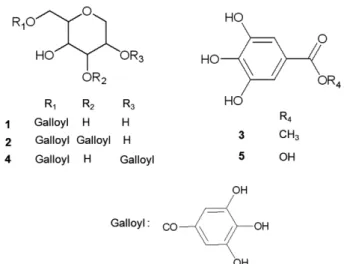
화합물 1~5는 TLC plate상에서 10%-H2SO4 및 FeCl3 용 액에 의한 발색과 1H, 13C-NMR, MS spectrum data를 기존 문헌과 비교하여 각각 일치함을 확인하여 각각 6-galloyl- 1,5-anhydroglucitol (ginnalin B) (1), 3,6-digalloyl-1,5- anhydroglucitol (acertannin) (2), methyl gallate (3), 2,6- digalloyl-1,5-anhydroglucitol (acertannin) (4), gallic acid (5)로 최종 동정 하였다.4-11)
Gallotannin은 일반적으로 유기산이나 당을 모핵으로 galloyl기가 ester 결합해 있는 가수분해성 탄닌으로 알려져 있다. 한편, 본 신나무 수피의 gallotannin은 glucose가 아 닌 1,5-anhydroglucitol에 galloyl기 가 결합한 점이 특이하 다. 또한 gallotannin은 항균, 항암, 항염 활성 등이 알려졌 으며, 특히 강력한 항산화 활성을 나타내는 것으로 알려져 있다.
따라서 본 연구에서는 우선 신나무 수피의 galloyl glucitol 화합물(1-5)의 항산화 활성을 평가하기 위하여 DPPH 법을 이용한 free radical scavenging activity assay를 실시하였고 Table II. Extract and fraction barks of Acer ginnala Maxim.
on DPPH radical scavenging activity IC50 values Extract and
sub-fractions
DPPH radical scavenging activity (µg/ml)
Extract 13.52±1.66
Fr. 1 100>
Fr. 2 80.89±4.78
Fr. 3 21.79±1.59
Fr. 4 17.74±0.30
Fr. 5 17.88±0.49
Fr. 6 15.77±0.11
Fr. 7 14.04±0.13
Fr. 8 13.92±0.18
L-ascorbic acid 16.78±0.11 Table I. HPLC method of solvent system
0 min 10 min 18 min 25 min Solvent A
(1% Acetic acid-H2O) 100 85 65 65 Solvent B
(1% Acetic acid-CH3CN) 0 15 35 35
천연소재로써의 주요한 조건인 함유량을 알기 위하여 HPLC 를 이용한 함량평가를 실시하였다.
분리된 5개 화합물에 대해서도 추출물 및 분획물에 적용 한 방법과 동일한 방법인 free radical scavenging assay를 실 시하여 항산화 활성을 측정한 결과 모든 화합물이 positive control인 L-ascorbic acid와 비교하여 강력한 활성을 나타냈 으며, 특히 화합물 2와 4는 L-ascorbic acid에 비하여 약 2~4 배 이상의 높은 활성을 나타내었다 (Table II). 이렇게 강력 한 항산화 활성을 나타낸 화합물의 함량을 HPLC 를 이용 하여 정량 분석은 다음과 같이 실시하였다.
본 실험에서는 C18 역상 column을 사용하여, 전개 분리되 는 최적용매조건을 찾기 위하여 이동상으로 1% Acetic acid- H2O와 1% Acetic acid-Acetonitrile을 여러 가지 혼합비율로 혼합하여 그 분리능을 측정 검토한 결과, 용매조건은 1%
Acetic acid-H2O : 1% Acetic acid-Acetonitrile = 100 : 0
의 조성에서 시작하여 25분후 1% Acetic acid-H2O : 1%
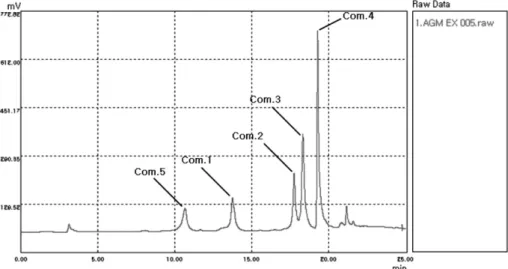
Acetic acid-Acetonitrile = 65 : 35인 gradient mode에서 분 석이 잘 되었으며, 파장은 280 nm에서 최대 흡수파장을 나 타내었다. 이러한 조건에서 화합물 1~5가 균일하게 섞인 표 준용액 20 µl씩 취하여 5개 화합물이 동시에 잘 분리되는 HPLC chromatogram을 얻었고 (Fig. 2-4), 여기서 얻은 peak area와 농도의 관계로부터 검량선을 작성한 결과 25-200 ppm 의 농도범위에서 회귀 직선방정식은 화합물 1~5 각각 y=24.952x-195.94, y=36.751x+21.891, y=51.338x-110.3, y=47.214x-487.4, y=46.121x-214.46 이고, R-square값이 각 Table III. Compounds levels of Acer ginnala Maxim. on
DPPH radical scavenging activity IC50 values
Compounds DPPH radical scavenging activity (µM/ml)
1 20.10±1.24
2 10.19±0.28
3 29.25±0.48
4 5.96±0.49
5 27.03±1.40
L-ascorbic acid 28.37±0.40
Fig. 1. The structures of compounds 1-5 from barks of Acer ginnala Maxim.
Fig. 2. HPLC chromatogram of Comp.1~5. Sample 1 = Comp. 1~5 mixture 1000 ppm (each 200 ppm×5), Sample 2 = Comp. 1~5 mixture 500 ppm (each 100 ppm×5), Sample 3 = Comp. 1~5 mixture 250 ppm (each 50 ppm×5), Sample 4 = Comp. 1~5 mixture 125 ppm (each 25ppm×5).
HPLC analysis conditions : Kromasil C18 HPLC column 5um, 250×4.6 mm, mobile phase-gradient solvent system-Solvent A (1%
Acetic acid-H2O), Solvent B (1% Acetic acid-CH3CN).
각 0.991, 0.9999, 1, 0.9969, 0.9996 로서 1.0에 일치 혹은 근접하여 그 직선성이 인정되었다 (Fig. 5).
또한 표품 1~5 의 retention time과 미지검액중의 1~5의 retention time이 거의 동일함을 확인할 수 있었다 (Table IV).
HPLC분석에 의한 미지검액의 chromatogram으로부터 신 나무 수피에서 분리된 gallotannin 1~5의 표준용액 검량선 에 의하여 함량을 결정하였으며 매우 높은 함유량을 확인 할 수 있었다 (Fig. 5, Table V).
Fig. 3. HPLC chromatogram of extract of Acer ginnala Maxim. Sample 1 = extract of Acer ginnala Maxim. 1000 ppm.
HPLC analysis conditions : Kromasil C18 HPLC column 5µm, 250×4.6 mm, mobile phase-gradient solvent system-Solvent A (1%
Acetic acid-H2O), Solvent B (1% Acetic acid-CH3CN).
Fig. 4. HPLC chromatogram of Comp.1~5. Sample 1 = Comp. 1~5 mixture 1000 ppm (each 200 ppm×5), Sample 2 = Comp. 1~5 mixture 500 ppm (each 100 ppm×5), Sample 3 = Comp. 1~5 mixture 250 ppm (each 50 ppm×5), Sample 4 = Comp. 1~5 mixture 125 ppm (each 25 ppm×5), Sample 5 = extract of Acer ginnala Maxim. 1000 ppm.
HPLC analysis conditions : Kromasil C18 HPLC column 5µm, 250×4.6 mm, mobile phase-gradient solvent system-Solvent A (1%
Acetic acid-H2O), Solvent B (1% Acetic acid-CH3CN).
Table IV. Retention time of compounds 1~5 from barks of Acer ginnala Maxim.
Retention time (min)
Comp. 1 Comp. 2 Comp. 3 Comp. 4 Comp. 5
Standard 13.75±0.03 17.73±0.05 18.29±0.04 19.27±0.05 10.63±0.05 Extract 13.74±0.03 17.72±0.04 18.29±0.04 19.26±0.04 10.63±0.05
결 론
신나무 수피의 항산화 활성 성분을 밝히기 위하여 80%
acetone 추출물 및 분획물의 항산화 효능을 검색하였다. Free radical scavenging assay에 의한 항산화 활성의 측정에서 강 력한 활성을 나타낸 분획을 각종 컬럼 크로마토그래피에 적 용하여 5종의 화합물을 분리하였고 이화학적 성상 및 기기 분석적 방법으로 그 구조를 규명하였다. 분리된 화합물은 gallotannin인 6-galloyl-1,5-anhydroglucitol (ginnalin B) (1), 3,6-digalloyl-1,5-anhydroglucitol (acertannin) (2), methyl gallate (3), 2,6-digalloyl-1,5-anhydroglucitol (acertannin) (4), gallic acid (5) 로 확인 동정 하였다.
Free radical scavenging assay에 의한 분리된 화합물의 항 산화 활성 검색 결과, 모든 화합물이 매우 우수한 활성을 보 였으며, 특히 화합물 2와 4에서 높은 활성을 보였다.
강력한 천연 항산화제로 평가되는 gallotannin인 6-galloyl- 1,5-anhydroglucitol (ginnalin B) (1), 3,6-digalloyl-1,5- anhydroglucitol (acertannin) (2), methyl gallate (3), 2,6- digalloyl-1,5-anhydroglucitol (acertannin) (4), gallic acid (5) 의 신나무 수피중의 함량을 검토할 목적으로 HPLC를
이용하여 연구하였으며 화합물 1~5의 함량이 매우 높은 것 을 알 수 있었다 (Table IV).
사 사
본 연구는 보건복지가족부 보건의료연구개발사업의 지원 에 의하여 이루어졌으며 이에 감사드립니다(A091121).
인용문헌
1.김태정 (2008) 한국의 야생화와 자원식물(3권), 202-203.
서울대학교출판부, 서울
2.임록재 (1999) 조선약용식물지(1권), 249. 한국문화사, 평양 3.우원식, 한병운, 서대연, 서영배, 지형준, 장일무 (1996) 한
국의 천연물과학 연구, 9-374, 서울대학교출판부, 서울 4. Woo. L. K. (1962) The chemical structure of acertannin.
Yakhak Hoeji 6: 11-16.
5. Bock, K., LaCour, N., F, Jensen., S, R. and Nielsen, B. J.
(1980) The structure of acertannin. Phytochemistry 19: 2033.
6. Han, K. D. (1962) Structural study on new tannin, polyg- agallin, from Acer ginnala Max. Yakhak Hoeji 6: 1-4.
7. Song, C. Q., Zhang, N., Xu, R. S., Song, G. Q., Sheng, Y. and Hong, S. H. (1982) Studies on the antibacterial constituents of the leaves of Acer ginnala Maxim (II. Isolation and iden- tification of ginnalin B, ginnalin C and other six compounds).
Acta. Chimica. Sinica 40: 1142-1147.
8. Park, W. Y. (1996) Phenolic compounds from Acer ginnala Maxim. Kor. J. Pharmacogn. 27: 212-218.
9. Son, Y. K. and Han, Y. N. (2002) Isolation of tritnerpenoid saponins from the stems of Acer ginnala Maxim. Kor. J.
Pharmacogn. 33: 301-304.
10. Hong, S. H., Song, C. Q., Sheng, Y., Zhang, F. J. and Xu, R.
S. (1982) Studies on the antibacterial constituents of the leaves of Acer ginnala Maxim. Chem. Nat. Prod., Proc. Sino- Am. Sym. 244-247.
11. Choi, Y. H., Han, S. S., Lee, H. O. and Baek, S. H. (2005) Biological activity of bioactive components from Acer gin- nala Max. Bull. Korean Chem. Soc. 26: 1450-1452.
12. Hatano, T., Edamatsu, R., Hiramatsu, M., Mori, A., Fujita, Y., Yasuhara, T., Yoshida, T. and Okuda, T. (1989), Effects of the interaction of tannins with co-existing substances. VI. Effects of tannins and ralated polyphenols on superoxide anion rad- ical, and on 1,1-diphenyl-2-picrylhydrazyl radical, Chem.
Pharm. Bull. 37: 2016-2021.
(2010. 7. 16 접수; 2010. 7. 23 심사; 2010. 8. 16 게재확정) Fig. 5. Calibration curve and equation of Comp. 1~5.
comp.1 : y = 24.952x - 195.94, R2 = 0.991 / comp.2 : y = 36.751x + 21.891, R2 = 0.9999 / comp.3 : y = 51.338x - 110.3, R2 = 1 / comp.4 : y = 47.214x - 487.4, R2 = 0.9969 / comp.5 : y = 46.121x - 214.46, R2 = 0.9996
Table V. Contents of compounds 1~5 in barks of Acer ginnala Maxim.
Compounds Contents (%) RSD(%)
1 0.73±0.002 0.27
2 0.48±0.001 0.20
3 0.66±0.002 0.30
4 1.05±0.002 0.19
5 0.29±0.001 0.34