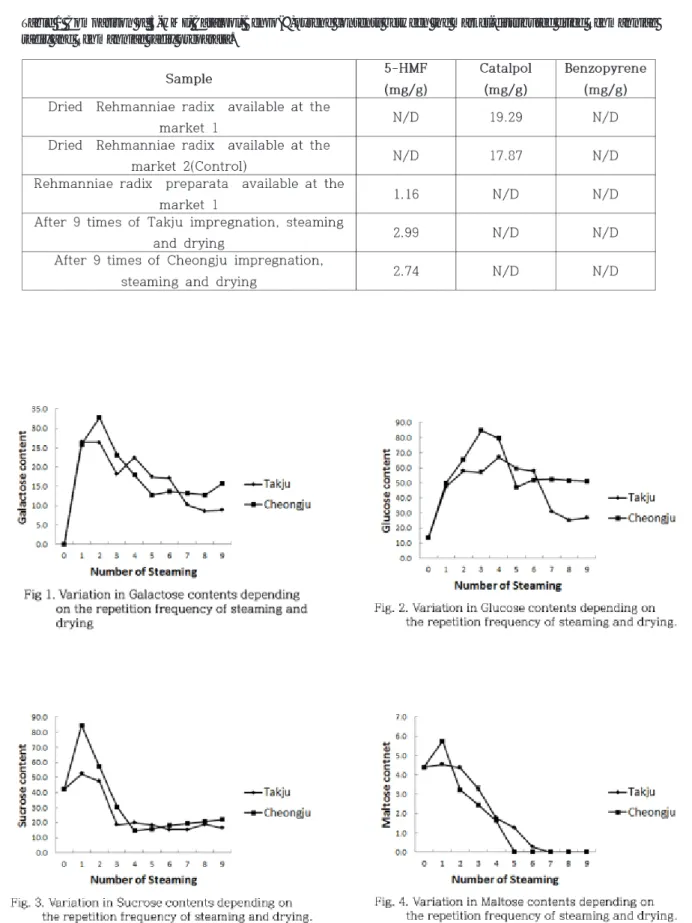
Variation of main components according to the number of steaming and drying of Rehmanniae radix preparata
Ui Joung Youn 1 , Bon-Seok Gu 2,3 , Kyung Hee Kim 1,3 , Chulgyu Ha 4 and In Chan Jung 3*
Abstract
Contents of compounds in Rehmanniae Radix change depending on the number of steaming and drying and the drying method. In this study, as an impregnation method for dried Rehmanniae Radix, takju impregna- tion and cheongju impregnation were carried out and steaming and drying were repeated for 9 times. The changes of 5-HMF and catalpol contents were analyzed according to the number of repetition times to investi- gate which stage of steaming and drying is preferable.
Also, total nitrogen, crude fat, ash, and crude fiber were measured to analyze changes in general components.
5-HMF was not detected in dried Rehmanniae Radix. As a result of repetitive steaming and drying, the content of 5-HMF increased only slightly from 1 to 4-times steam- ing and drying but increased significantly from 5-times.
The catalpol in dried Rehmanniae Radix was not detect- ed after 5 times of steaming and drying. Sucrose, malt- ose, and glucose were included in dried Rehmanniae Radix before steaming and drying. However, after the process in both Takju impregnation and Cheongju im- pregnation, galactose and fructose tended to decrease after production and sucrose and glucose tended to
decrease after the increase. In this study condition, 6-times and more steaming and drying were appro- priate process which met the content criteria (not less than 0.1%) of the Korean Pharmacopoeia (8th edition) for 5-HMF, an index component for quality control of Rehmanniae Radix Preparata.
1. Introduction
The botanical names of Scrophulariaceae include Rehmannia glutinosa Libosch, Rehmannia glutinosa Libosch var. purpurea Makino, Rehmannia, glutinosa Libosch var. hueichingensis(Chao et Schih), Hsiao, etc[1-2]. Rehmanniae radix is a perennial plant and the length of its aerial part is approximately 20-30cm.
The length of roots is about 30cm. The part right be- low where sclerophyll comes out is thin but becomes thicker and thicker as it goes down, but it gets thinner again near the end. Its diverse varieties have different shades including lemon yellow, dark yellow, and red yellow. The outer part of the cross-section is creamy- white, while the inside is ivory-white. In South Korea, the domestic growing method for Rehmanniae radix changed from native species to clone selection in 1999.
The domestic variety of Rehmanniae radix has many thick roots and has a high content of active ingredients and a high processing yield into Rehmanniae radix preparata. The major ingredients of Rehmanniae radix include β-sitosterol, mannitol, catalpol, stimastenol, camphesterol, rehmannin, alkaloids, fatty acid, glu-
Original article
Key Words
catalpol, Rehmanniae Radix, impregnation method, 5-HMF.
This is an Open-Access article distributed under the terms of the Creative Commons Attribution Non-Commercial License (http://creativecommons.org/licenses/by-nc/4.0/) which permits unrestricted noncommercial use, distribution, and reproduction in any medium, provided the original work is properly cited.
This paper meets the requirements of KS X ISO 9706, ISO 9706-1994 and ANSI/NISO Z39.48-1992 (Permanence of Paper).
*
Corresponding Author
In Chan Jung: Department of Chemistry, Hanseo University, Hanseo 1 Ro, Seosan, 31962 Republic of Korea
Tel: +82 42 660 1331, Fax: +82 42 688 6878, E-mail: [email protected]
ⓒ 2018 Korean Pharmacopuncture Institute http://www.journal.ac Received: May 3, 2018 Reviewed: June 4, 2018 Accepted: June 12, 2018
1
Division of life Sciences, Korea Polar Research Institute, Inchon, Republic of Korea
2
Agricultural Corporation Aram Limited, Seosan, Republic of Korea
3
Department of Chemistry, Hanseo University, Seosan, Republic of Korea
4