41(9), 1220~1225(2012)
곤달비( Ligularia stenocephala ) 잎 분획물의 항산화활성 평가
김경희1․김나영2․김성환2․한인애1․육홍선1†
1
충남대학교 식품영양학과
2
중부대학교 식품영양학과
Study on Antioxidant Effects of Fractional Extracts from Ligularia stenocephala Leaves
Kyoung-Hee Kim1, Na-Young Kim2, Sung-Hwan Kim2, In-Ae Han1, and Hong-Sun Yook1†
1Dept. Of Food and Nutrition, Chungnam National University, Daejeon 305-764, Korea
2Dept. of Food and Nutrition, Jungbu University, Chungnam 312-702, Korea
Abstract
Ligularia stenocephala leaves were subjected to extraction by using several solvents with different polarities, which were then investigated for their antioxidant and antimicrobial activities. Extraction yield of ethanol extract of Ligularia stenocephala was 21.36%. The water fraction showed the highest extraction yield of 60.35%, followed by the n-butanol, n-hexane, and ethyl acetate fractions. Total polyphenolic content was the highest (254.00 mg/g GAE) in the ethyl acetate fraction of Ligularia stenocephala extract. The ethyl acetate fraction had IC
50values of 0.28 mg/mL for DPPH radical scavenging, and 96.67±0.09% for ABTS radical scavenging activity.
Further, FRAP value was significantly higher in the ethyl acetate fraction. The ethyl acetate fraction showed antimicrobial activities against B. cereus, and the diameter of the zone of inhibition was 10.2 mm at 5 mg/disc.
These results suggest that the ethyl acetate fraction of Ligularia stenocephala possesses the antimicrobial activ- ities against B. cereus, and its high antioxidant activity could be applicable to food additives and as a natural cosmetic ingredient.
Key words: Ligularia stenocephala leaves, antioxidant, antimicrobial
†
Corresponding author. E-mail: [email protected]
†
Phone: 82-42-821-6840, Fax: 82-42-821-8887
서 론
최근 들어 생체 내에서 노화를 억제시키거나, 동맥경화증, 염증, 퇴행성질환 및 암을 예방하는데 천연 항산화제가 매우 효과적인 것으로 보고되어 있어 천연식물체의 항산화 작용 에 관한 연구 등이 많이 이루어지고 있다. 특히 천연식물 소 재 중 국내에서 자생되거나 재배되는 산채 및 나물류는 인체 에 미치는 독성 및 돌연변이성 영향이 거의 없는 반면, 항산 화, 항염, 항암, 혈전용해능 등의 다양한 활성이 있어 이를 이 용하기 위한 연구가 많이 진행되고 있다.
곤달비(
Ligularia stenocephala)는 쌍떡잎식물 초롱꽃목 국화과의 여러해살이풀로서 한국(전라남도), 일본, 타이완, 중국 등지에 분포하며, 깊은 산의 습지에서 자란다. 한국의 고랭지에서 자생하고 특히 대관령에서 산채로 이용되고 있 기 때문에 이 지역의 농가에서 주로 재배하고 있다. 주로 어 린잎을 나물로 섭취하며 한방에서는 전초 혹은 뿌리를 보익, 진정 및 부인병 등에 약으로 사용한다고 한다(1,2).
곤달비는 곰취와 더불어 쌈, 나물, 장아찌, 김치 등으로 다
양하게 식용되고 있으며, 곤달비에서 분리 보고되어진 물질 로는 1β,6α-dihydroxy-5(15)-eudesmene, phthalic acid di- Bu ester, N-phenyl-2-naphthylamine, neophytadiene, va- nillin, triterpenoid 유도체, 4-hydroxyacetophenone, chloro- genic acid, caffeic acid 등이 있으며(3), 곤달비에 관한 연구 로는 곤달비 추출물의 간 기능 효과(4), 항산화(3), 멜라닌 생성 저해(3), 주름개선(5), 항당뇨 효과(1) 등이 보고되어져 있고 가공식품 개발과 관련된 연구로는 곤달비 분말 첨가 식빵에 관한 연구(6) 등이 보고되어져 있다.
하지만 이러한 곤달비의 다양한 효능은 주로 식용이 많이
이루어지고 있는 어린잎에 관한 연구가 대부분으로 어린잎
에서 좀 더 자란 곤달비 잎에 관한 연구는 거의 없는 실정이
다. 따라서 본 연구에서는 곤달비의 주 채취시기인 5월초가
아닌 어린잎에서 좀 더 자란 6월에 채취된 곤달비 잎을 대상
으로 항산화 효과 및 항균활성을 평가하여 곤달비의 응용
범위를 넓힐 수 있는 기초자료로 제공하여 식품가공 및 화장
품 등의 산업에 대해 적용할 수 있도록 하고자 한다.
Ligularia stenocephala leaves
↓ ― Extraction with 80% ethanol 80% Ethanol extracts
↓ ― n -Hexane/H
2O
n -Hexane fraction Aqueous phase
↓ ― Ethyl acetate
Ethyl acetate fraction Aqueous phase
↓ ― n -Butanol
n -Butanol fraction Aqueous phase Fig. 1. Procedure for the extraction and fractions of Ligularia stenocephala leaves by various solvents.
재료 및 방법
재료
실험에 사용된 곤달비(
Ligularia stenocephala)는 2008년 6월에 강원도농업기술원 특화작물시험장으로부터 제공받 아 일주일간 음건하였고 마쇄하여 분말로 만든 후 각종 항산 화 및 항균활성 분석을 실시하였다.
용매별 추출물 제조
건조된 곤달비는 시료 200 g당 15배량(w/v)의 80% 에탄 올로 24시간 동안 3회 추출한 다음, 추출액은 여과지 (Whatman No.4, Maidstone, England)로 여과하였다. 여액 을 40
oC 수욕상에서 rotary vacuum evaporator(EYELA A-1000S, Tokyo Rikakikai Co., Tokyo, Japan)로 용매를 제 거하고 감압․농축한 후 동결 건조하여 4
oC 이하로 냉장보관 하면서 실험에 사용하였다. 80% 에탄올 추출물을 Fig. 1과 같이 separating funnel에 의한 용매별 분획으로
n-hexane, ethyl acetate 및
n-butanol로 연속 추출한 후 각 분획물을 rotary vacuum evaporator로 감압․농축한 후 동결 건조시 켜 수율을 계산하였다.
총 폴리페놀 함량
폴리페놀 화합물 함량은 페놀성 물질인 phosphomolybdic acid와 반응하여 청색을 나타내는 원리를 이용한 Folin- Denis 방법(7)을 이용하여 측정하였다. 1 mg/mL 농도로 methanol에 용해시킨 시료액 0.2 mL와 Folin-Ciocalteu's phenol reagent(Sigma, St. Louis, MO, USA) 0.2 mL를 첨가 하여 혼합한 후 3분간 실온에서 반응시킨 뒤, 10% sodium carbonate(Na
2CO
3) 용액 3 mL를 가하여 암실에서 1시간 동 안 방치하여 상등액을 765 nm에서 흡광도를 측정하였다.
Gallic acid(Sigma)를 이용하여 표준곡선을 작성한 후 이 검 량곡선으로부터 시료 중의 총 폴리페놀 함량을 구하였다.
DPPH radical 소거능 측정
항산화 활성은 1,1-diphenyl-2-picrylhydrazyl(DPPH)을 이용하여 시료의 라디칼 소거효과(radical scavenging ef- fect)를 측정하는 Blois법(8)을 활용하였다. 각 분획물을 농 도별(0.1, 0.3, 0.5, 0.7, 1.0 mg/mL)로 제조한 시료와 0.2 mM DPPH를 1:1로 가하여 vortex mixing 후 실온에서 15분간 반응시킨 후 분광광도계를 이용하여 517 nm에서 흡광도를 측정하여 DPPH의 환원에 의한 흡광도 감소를 결정하였다.
이때 IC
50(mg/mL)은 추출물을 첨가하지 않은 대조군의 값 을 50% 감소시키는 추출물의 농도를 나타냈으며, 기존의 항산화제인 ascorbic acid를 대조구로 사용하여 비교하였다.
ABTS radical scavenging activity 측정
2,2'-Azino-bis(3-ethylbenzothiazoline-6-sulphonic acid)(ABTS) radical scavenging activity의 측정은 Pelle- grin 등(9)의 방법에 의해 측정하였다. 즉, 7 mM ABTS와 140 mM K
2S
2O
8을 5 mL:88 μL로 섞어 어두운 곳에 14~16 시간 방치시킨 후, 이를 absolute ethanol과 1:88 비율로 섞어 734 nm에서 대조구의 흡광도 값이 0.7±0.002가 되도록 조 절한 ABTS solution을 사용하였다. 0.5 mg/mL 농도로 제조 한 시료 50 μL와 solution 1 mL를 30초 동안 섞은 후 2.5분간 incubation하여 734 nm에서 흡광도를 측정하여 아래의 식에 의해 저해율을 계산하였다.
Radical scavenging
activity (%) = ( 1- 반응구의 흡광도 대조구의 흡광도 ) × 100
FRAP(ferric-reducing antioxidant potential) 측정
FRAP 측정 방법은 Benzie와 Strain(10) 방법을 참고하여 측정하였다. FRAP reagent는 25 mL acetate buffer(300 mM, pH 3.6)를 37
oC에서 가온한 후, 40 mM HCl에 용해한 10 mM 2,4,6-tris(2-pyridyl)-s-triazine(TPTZ) 5 mL와 20 mM ferric sulfate(FeSO
4) 2.5 mL를 가하여 제조하였다. 제 조된 0.9 mL FRAP reagent에 1 mg/mL의 농도로 용해시킨 산채류 각각의 분획물 0.03 mL와 증류수 0.09 mL를 넣은 다음 37
oC에서 10분간 반응시킨 후, 593 nm에서 Spec- trophotometer(Shimadzu UV-1800, Shimadzu Co., Kyoto, Japan)를 이용하여 흡광도를 측정하였다. Blank는 시료 대신 methanol을 넣어 측정하였다. Ascorbic acid를 1 mg/mL 농 도로 제조하여 대조군으로 사용하였고, 0.125, 0.25, 0.5, 1, 2.5 및 5 mM의 농도로 반복하여 작성한 FeSO
4의 검량식에 대입하여 환산하였다.
Disc diffusion assay에 의한 항균활성 측정
시험균주: 항균력 조사에 사용된 균주는
Bacillus cereus(
B. cereus) KCTC 1012,
Bacillus subtilis(
B. subtilis)
KCTC 1022,
Staphylococcus aureus(
S. aureus) KCTC 3881
과 같은 Gram 양성 세균과
Escherichia coli(
E. coli) KCTC
2441,
Salmonella enterica(
S. enterica) KCTC 1925,
Pseu-Table 1. List of strains used for antimicrobial experiments
Strains Media Temp. (
oC)
Gram positive bacteria Bacillus cereus Bacillus subtilis Staphylococcus aureus
NA
1)/NB
2)NA/NB NA/NB
30 30 30 Gram negative bacteria Escherichia coli
Salmonella enterica Pseudomonas aeruginosa
NA/NB NA/NB NA/NB
30 37 37
1)
NA: Nutrition agar (Difco, Franklin Lakes, NJ, USA).
2)NB: Nutrition broth (Difco).
Table 2. Yield of each fractions extracted from Ligularia stenocephala leaves
Fraction Yield (%, w/w)
80% ethanol
1)21.36
Fractions of 80% ethanol extract
2)n -Hexane
Ethyl acetate n -Butanol Water
11.83 20.41 7.41 60.35
1)
Yield (%)=weight of solid extract/ weight of dry sample×
2)
100. Yield (%)=weight of solid fraction/ weight of 80% ethanol extract×100.
Table 3. Total polyphenol contents of various solvent frac- tions from 80% ethanol extract of Ligularia stenocephala leaves
Solvent Polyphenol contents (mg/g GAE
1)) 80% ethanol
n -Hexane Ethyl acetate n- Butanol Water
188.41±0.49
2)c3)143.91±0.09
d254.00±0.16
a197.10±0.09
b127.03±0.16
e1)
GAE: gallic acid equivalents.
2)
Values are mean±SD (n=3).
3)
Values with different letter within a same column (a-e) differ significant (p<0.05).
domonas aeruginosa
(
P. aeruginosa) KCTC 1636과 같은 Gram 음성 세균으로 총 6종을 한국생명공학연구원에서 분 양받아 사용하였다(Table 1).
추출물 및 용매 분획별 항균성 검색: 각 추출물의 항균활 성은 각 균주를 대상으로 disc diffusion assay로 측정하였다.
항균시험용 평판배지는 계대 배양된 각 균주를 멸균 면봉을 이용하여 100 μL씩 도말하여 준비하였고, 시료를 disc당 1.0, 5.0 mg이 되도록 paper disc(8 mm)에 천천히 흡수시킨 뒤 건조과정을 거쳐 용매를 휘발시킨 후 평판배지 위에 밀착시 킨 상태로 30~37
oC에서 24시간 배양한 후 disc 주변에 생성 된 저해환(clear zone, mm)을 측정하여 항균활성을 비교하 였다. 대조군으로 ampicillin(10 μg/disc)을 사용하였다.
통계처리
모든 실험은 3회 이상 반복 실시하였으며, 얻어진 결과들 은 SPSS 17.0(Statistical Package for Social, SPSS Inc., Chicago, IL, USA) software를 이용하여 유의적 차이가 있 는 항목에 대해서 Duncan's multiple range test로 p<0.05 수준에서 유의차 검정을 실시하였다.
결과 및 고찰
80% 에탄올 추출물 및 용매별 분획물 수율
곤달비 잎의 항산화 효과를 검토하기 위해 자연 건조하여 마쇄한 시료를 80% 에탄올로 추출하여 감압농축 후 고형분 함량의 추출수율은 21.36%였다. 80% 에탄올 추출물에 대하 여 용매별로 분획한 후 추출수율(dry basis, %)을 계산한 결과는 Table 2와 같다. 곤달비잎 80% 에탄올 추출물의 용 매별 분획물의 추출수율은 water(60.35%)>
n-butanol(20.41
%)>
n-hexane(11.83%)> ethyl acetate(7.41%)로 water 분 획물에서 가장 높은 수율을 나타내었고, ethyl acetate 분획 물에서 가장 낮은 수율을 나타내었다. 산뽕나무 잎(11)과 참 나물(12), 고려엉겅퀴(13)의 경우도 water 분획물이 가장 높 은 수율을 나타내었다.
총 폴리페놀 함량
식품 유래 기능성물질의 대표적인 성분중의 하나로서 폴 리페놀계 물질들은 한 분자 내에 2개 이상의 phenolic hy- droxyl(-OH)기를 가진 방향족 화합물들을 총칭하며, 식물 체에 특수한 색깔을 부여하고 산화-환원반응에서 기질로 작
용하며, 충치 예방, 고혈압 억제, 항에이즈, 항산화, 항암 등 의 다양한 생리활성을 가진다(14). 일반적으로 식물 성분의 항산화 활성은 페놀성 화합물이 원인물질로 관련되어 있는 것으로 알려져 있어 gallic acid를 표준용액으로 하여 작성한 표준곡선으로부터 곤달비의 총 폴리페놀 함량을 조사하여 Table 3에 나타내었다.
곤달비의 총 폴리페놀 함량은 ethyl acetate 분획물에서 254.00±0.16 mg/g으로 가장 높게 나타났고,
n-butanol 197.10
± 0.09, 80% ethanol 188.41±0.49,
n-hexane 143.91±0.09,
water 분획물 127.03±0.16 mg/g의 순으로 나타나 페놀화합
물이 주로 ethyl acetate 분획물에 다량 존재함을 확인할 수
있었다. Lee 등(15)의 연구에서 울릉도산 산채류의 80% 메
탄올 추출물의 섬고사리 잎 120.69, 물엉겅퀴 잎 130.22, 눈개
승마 잎 66.48 μg/mg의 총 폴리페놀 함량을 나타내었다는
보고와 Choi 등(16)의 국내 시판되는 일부 다류의 경우 폴리
페놀 함량이 홍차(101.51 μg/mg), 인삼차(28.30 μg/mg), 녹
Table 4. DPPH radical scavenging activity and ABTS radical scavenging activity of various solvent fractions from 80%
ethanol extract of Ligularia stenocephala leaves Solvent DPPH radical
scavenging activity (mg/mL)
1)ABTS radical scavenging activity
(%)
4)80% ethanol
n -Hexane Ethyl acetate n -Butanol Water
0.67±0.02
2)c3)0.97±0.01
b0.28±0.01
e0.54±0.01
d1.80±0.01
a94.16±2.66
a37.06±1.57
b96.67±0.15
a95.87±0.35
a25.51±1.90
cAscorbic acid 0.03±0.00 99.42±0.15
1)
Amount required for 50% reduction of hydrogen donating activity.
2)
Values are mean±SD (n=3).
3)
Values with different letter within a same column (a-e) differ significant (p<0.05).
4)
% of ABTS radical scavenging activity/ 0.5 mg/mL of various solvent fractions from 80% ethanol extract of Ligularia sten- ocephala leaves.
Table 5. FRAP (ferric reducing antioxidant potential) value of various solvent fractions from 80% ethanol extract of Ligularia stenocephala leaves
Solvent FRAP value (mM)
3)80% ethanol n -Hexane Ethyl acetate n- Butanol Water
2.07±0.02
1)b2)1.25±0.02
c2.70±0.03
a2.19±0.04
b0.78±0.02
dAscorbic acid 9.09±0.24
1)
Values are mean±SD (n=3).
2)
Values with different letter within a same column (a-d) differ significant (p<0.05).
3)
FRAP value (mM)/ 1 mg/mL of various solvent fractions from 80% ethanol extract of Ligularia stenocephala leaves.
차(94.90 μg/mg)로 보고한 것과 비교할 때 곤달비는 비교적 많은 폴리페놀 함량을 가지는 것으로 나타났다.
DPPH radical 및 ABTS radical 소거활성
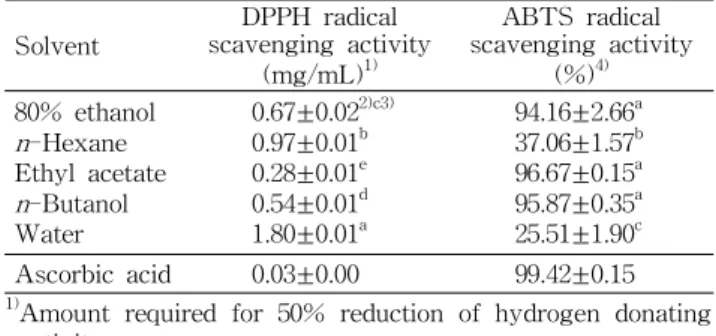
기존에 잘 알려진 항산화제인 ascorbic acid를 양성 대조 군으로 하여 곤달비 추출물 분획별 라디칼 소거활성에 대한 결과는 Table 4와 같다. DPPH radical 소거활성은 검체 농도 에 따른 항산화 활성 변화 곡선으로부터 산화를 50% 억제시 키는 농도인 IC
50으로 나타내었다. 곤달비의 DPPH radical 소거활성은 ethyl acetate 분획물에서 0.28±0.01 mg/mL로 높은 활성을 나타내었고, water 분획물은 가장 낮은 활성을 나타내었다. 이러한 결과는 곤달비의 총 폴리페놀 함량이 ethyl acetate,
n-butanol, 80% ethanol,
n-hexane, water 분 획물 순으로 나타난 것과 마찬가지로 DPPH radical 소거활 성 또한 ethyl acetate 분획물에서 높고 water 분획물에서 가장 낮은 활성을 나타내, 각 추출물이 함유하고 있는 총 페놀 화합물의 함량이 증가하면 항산화 활성도 증가한다는 Seo 등(17)의 보고와 유사한 경향을 나타내었다. Roh 등(3) 은 99.8% methanol 추출물의 ethyl acetate 분획물에서 곤달 비의 잎과 줄기의 IC
50값이 10.512 μg/mL, 31.377 μg/mL로 나타났다고 보고하였는데, 이러한 결과는 본 연구의 곤달비 에탄올 추출물의 ethyl acetate 분획물에서의 결과보다 높은 수치이며 이러한 항산화 활성의 차이는 곤달비 잎의 채취장 소, 채취 시기 및 추출방법에 따른 차이 때문인 것으로 사료 된다.
곤달비의 분획별 ABTS 라디칼 소거활성을 0.5 mg/mL 농도에서 평가한 결과, ABTS 라디칼 소거활성은 ethyl acetate 분획물과
n-butanol 분획물, 80% ethanol 추출물이 유의적인 차이를 보이지 않았으나 ethyl acetate 분획물에서 96.67±0.15%로 가장 높은 활성을 나타내었으며
n-hexane 분획물, water 분획물 순으로 활성을 나타내었다. 이러한 각 분획별 활성은 DPPH radical 소거능과는 다소 다른 경향을
보였는데 이는 자유 라디칼인 DPPH와 양이온 라디칼인 ABTS 라디칼의 차이로 인해 이들과 결합하는 페놀물질의 종류가 다름에 따라 라디칼의 제거능력이 차이를 나타내었 기 때문인 것으로 여겨진다(18). Choi 등(19)은 산수유, 복분 자, 음양곽, 우슬, 현삼, 지황 등 14종의 생약 추출물이 50 mg/mL 농도에서 90% 이상의 ABTS radical 소거능을 나타 내었다고 보고하였으며 이러한 결과와 비교할 때, 곤달비 추출물의 활성이 우수함을 확인할 수 있었다.
FRAP 활성
곤달비 추출물의 분획별 FRAP value의 결과는 Table 5에 나타내었다. Ethyl acetate 분획물에서 2.70±0.03 mM로 가 장 높은 FRAP value를 나타내었으며, 이어서
n-butanol 분 획물 2.19±0.04, 80% ethanol 추출물 2.07±0.02,
n-hexane 분획 1.25±0.02, water 분획물 0.78±0.02 mM 순으로 FRAP value를 나타내었으며, 80% ethanol 추출물과
n-butanol 분 획물은 유의적인 차이를 보이지 않았다. 각 분획별 FRAP 활 성은 DPPH radical 소거 활성 및 총 페놀함량 증가와 비슷한 경향을 나타내어, 각 추출물이 함유하고 있는 총 페놀 화합 물의 함량이 증가하면 항산화 활성도 증가한다는 Seo 등 (17)과 Lee 등(20)의 보고와 유사한 결과를 나타내었다. Li 등(21)은 천연물에 존재하는 페놀성 화합물이 존재할 때 매 우 높은 FRAP를 보인다고 보고하고 있으며 Kang 등(22)은 전자공여능이 phenolics acid와 flavonoid 및 기타 phenol성 물질에 대한 항산화작용의 지표로서, 이 물질들은 환원력이 큰 것일수록 전자공여능이 높다고 보고하고 있다.
Disc diffusion assay에 의한 항균활성
곤달비 추출물에 대한 항균활성을
B. cereus,
B. subtilis,
S. aureus와 같은 3종의 Gram 양성 세균과
E. coli,
S. enter- ica,
P. aeruginosa와 같은 3종의 Gram 음성 세균으로 구성
된 총 6종의 세균에 대하여 disc 확산법으로 실시한 결과를
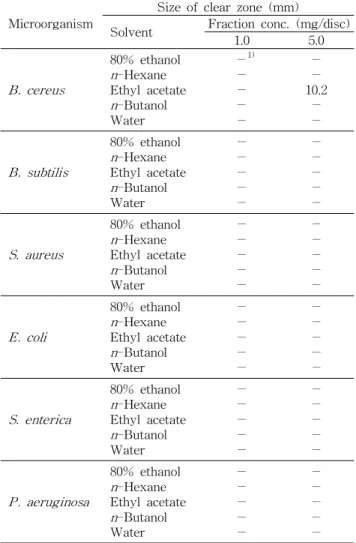
Table 6에 나타내었다. 곤달비 ethyl acetate 분획물은 5.0
mg/disc 농도에서
B. cereus에 대해 생육저해환이 10.2 mm
로 활성을 나타내었으나, 80% ethanol 추출물과 나머지 분
획물에서는 항균활성을 보이지 않았다. 국내산 자생 허브의
Table 6. Antibacterial activities of various solvent fractions from 80% ethanol extract of Ligularia stenocephala leaves
Microorganism Size of clear zone (mm)
Solvent Fraction conc. (mg/disc)
1.0 5.0
B. cereus
80% ethanol n -Hexane Ethyl acetate n -Butanol Water
-
1)- -
- -
- - 10.2
- -
B. subtilis
80% ethanol n -Hexane Ethyl acetate n -Butanol Water
- -
- -
-
- -
- -
- S. aureus
80% ethanol n -Hexane Ethyl acetate n -Butanol Water
- -
- -
-
- -
- -
- E. coli
80% ethanol n -Hexane Ethyl acetate n -Butanol Water
- -
- -
-
- -
- -
- S. enterica
80% ethanol n -Hexane Ethyl acetate n -Butanol Water
- -
- -
-
- -
- -
- P. aeruginosa
80% ethanol n -Hexane Ethyl acetate n -Butanol Water
- -
-
- -
- -
-
- -
1)
Not detected.
정유성분으로 항균실험을 한 결과 참나물은
P. aeruginosa에 효과가 있었다는 보고(23)와 냉이 에탄올 추출물(6.0 mg/
disc)은
B. cereus(20.0 mm),
S. aureus(17.0 mm),
E. coli(14.0 mm)와 같은 항균활성을 나타내었다는 보고(24)와 비 교할 때 곤달비 추출물은
B. cereus,
B. subtilis,
S. aureus및
E. coli,
S. enterica,
P. aetruginosa균주에 대해 항균력 이 거의 없거나 미약한 것으로 확인되어 곤달비를 이용한 가공식품 및 화장품 제조에 있어 저장 혹은 유통기간 연장을 위한 다른 물리화학적 처리가 필요할 것으로 여겨진다.
요 약
본 연구는 곤달비(
Ligularia stenocephala)의 생리 효능을 체계적으로 밝히기 위한 기초 자료를 얻고자 80% 에탄올 추출물과 순차적 분획물에 대하여 항산화 및 항균 효과를 검증하였다. 곤달비 에탄올 추출물의 추출수율은 21.36%이 었으며, 이에 대하여 용매별로 분획한 수율은 water 분획물 이 60.35%로 가장 높았으며,
n-butanol,
n-hexane, ethyl
acetate 순이었다. 곤달비 추출물 및 분획물의 총 폴리페놀 함량은 ethyl acetate 분획물에서 254.00 mg/g으로 가장 높 게 나타났다. DPPH radical 소거활성을 측정한 결과, 곤달비 ethyl acetate 분획물에서 IC
50값이 0.28 mg/mL로 높은 활 성을 나타내었다. 0.5 mg/mL 농도에서의 ABTS 라디칼 소 거활성은 ethyl acetate 분획물에서 96.67%의 활성을 보였 다. FRAP 활성 역시 1 mg/mL 농도에서 ethyl acetate 분획 물이 2.70 mM의 가장 높은 활성을 나타내었다. 항균활성은
B. cereus균주에 대해 ethyl acetate 분획물 5 mg/disc에서 10.2 mm의 저해환을 나타내었다. 이상의 결과에서 곤달비 의 추출물 및 분획물 중 ethyl acetate 분획물의 경우 높은 항산화 활성과 약간의 항균활성을 나타내었으며 천연물소 재로서 식품첨가물 및 화장품 원료로의 가능성이 있는 것으 로 사료된다.
문 헌