Evaluation of Nitrogen Mineralization in Soil Polluted by Zinc and Cadmium
Buddhi Charana Walpola, K.K.I.U. Arunakumara1, and Min-Ho Yoon2*
Department of Soil Science, Faculty of Agriculture, University of Ruhuna, Mapalana, Kamburupitiya, Sri Lanka
1Department of Crop Science, Faculty of Agriculture, University of Ruhuna, Mapalana, Kamburupitiya, Sri Lanka
2Department of Bio-Environmental Chemistry, College of Agriculture and Life Sciences, Chungnam National University, Daejeon, 305-764, Korea
Soil microbial functions are considered to be effective in assessing the severity of heavy metal pollution.
Therefore, this study was carried out to examine the effect of heavy metals on nitrogen mineralization by measuring the releasing pattern of inorganic nitrogen (NH4+-N and NO3--N) in a soil treated with heavy metals. A factorial combination of two heavy metals (Zn and Cd) treated with three concentrations (50, 100 and 150 µmol g-1 soils) was used in a laboratory incubation. Nitrogen mineralization was determined at 3, 7, 14, 21, 28, 42 and 56 days after the treatments replicated four times. Soil sample free from heavy metals was served as the control. The amount of nitrogen mineralization from heavy metal treated soils was found to be decreased at an increasing rate during the first 21 days of incubation. However, as the incubation progressed, nitrogen mineralization was found to be decreased at decreasing rates. Furthermore, during this period, nitrogen mineralization in Cd treated soils was significantly lower (P≤0.05) than that of the control. Soils treated with Cd at the concentration of 150 µmol g-1 showed the lowest N mineralization throughout the incubation. Nitrogen mineralization in Zn treated soils (50 µmol g-1) was found to be higher than the other heavy metal treated soils. On the base of present findings, nitrogen mineralization of soil could be considered as a viable assessment of the degree of heavy metal pollution.
Key words: Heavy metals, Incubation, Nitrogen mineralization
Received : July 13. 2011 Accepted : July 29. 2011
*Corresponding author : Phone: +82428216733 E-mail: [email protected]
Introduction
Heavy metal contamination of soil through anthropogenic activities is a serious environmental issue all over the world.
Mining, smelting of metalliferous ores and metal scraps, electroplating, application of fertilizer and pesticides, sludge dumping and generation of municipal waste have been identified as the principal sources of soil contami- nation by heavy metals (Kebir and Bouhadjera, 2011). The soil microbial population is under tremendous pressure due to these toxic substances (Chaudhary et al., 1996).
Soil microorganisms are among the first to experience the negative impacts of pollutants, thus their population and diversity can be used as an index to assess the degree of pollution in the environment (Ultra et al., 2005). Many reports indicate that heavy metals interfere with the biochemistry of diverse group of microorganisms isolated
from their natural environments (Sani et al., 2003; Utgikar et al., 2004). The availability of metals is primarily determined by metals binding to: (1) Clay minerals, leading to a significant decrease in the water soluble and exchangeable varieties of heavy metals (Usman et al., 2005); or (2) metals binding to either Fe/Mn oxides or carbonate complexes (Reddy et al., 2010). Tolerance to toxic metals is strongly correlated to the concentrations of the metals as reported by Ogilvie and Grant (2008) for Cu. Soil microorganisms can however become adapted to the effects of heavy metals if toxic elements have been present in the soil for long periods of time (Chander and Joergensen, 2008).
Heavy metals at elevated concentrations are known have direct impacts on soil fertility as they could alter soil microbial population and their associated activities.
The magnitude of the microbial diversity makes it difficult to study the whole spectrum of population. However, certain important functional groups such as ammonifying, nitrifying, nitrogen fixing, cellulytic and lignolytic micro- organisms have often been investigated. Zinc (Zn) and
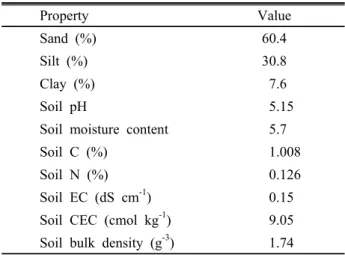
Table 1. Physicochemical properties of soil.
Property Value
Sand (%) 60.4
Silt (%) 30.8
Clay (%) 7.6
Soil pH 5.15
Soil moisture content 5.7
Soil C (%) 1.008
Soil N (%) 0.126
Soil EC (dS cm-1) 0.15
Soil CEC (cmol kg-1) 9.05
Soil bulk density (g-3) 1.74 Cadmium (Cd) are naturally found in small amounts in
soils. Cadmium acts as a potentially toxic metal in soil environment by unknown biological function. Zinc as a micronutrient is an essential element to maintain metabolic functions of living organisms. However, at elevated concentrations, both essential and nonessential elements may have a potential risk to terrestrial environments.
Typical Cd and Zn contents of uncontaminated soils are less than 0.5 and 10-80 mg kg-1 soil, respectively (Scheffer and Schachtschabel, 2002). However, intensified anthro- pogenic activities, such as mining, application of sewage sludge, industrial waste disposal and agricultural activities lead to elevate Zn and Cd concentration in soils. Under this background, the present study was undertaken to study the effect of heavy metals on microbial activity as measured by nitrogen mineralization of soil.
Materials and Methods
Experimental Area and Soil The experiment was conducted at the Faculty of Agriculture, University of Ruhuna, Sri Lanka. According to the agro-ecological classification (Panabokke, 1980), the region of investigation comes under agro-ecological region WL2 (low country wet zone). The soil used in this study belongs to Red Yellow Podzolic great soil group and is classified as Hapludults according to the USDA soil taxonomy (Mapa et al., 1999). The climate of the area is tropical monsoonal (Panabokke, 1980), with a warm wet period (April to June) and a relatively dry period (January to March).
The area receives an annual rainfall of around 2,500 mm.
The distribution of rain is bi-model. Annual mean air temperature of the area is 22 - 30℃ and the relative humidity is about 80 %.
Soil Sampling Soil samples were collected randomly from several selected locations at the research farm of Faculty of Agriculture, University of Ruhuna, Sri Lanka.
After removing the surface litter, soil samples were taken from 0 - 15 cm depth by using an auger. They were then mixed thoroughly in order to make a composite sample. Physico-chemical characteristics of the soil were determined using standard methods (Table 1).
Treatments Sub samples of 50 g of homogeneously mixed air dried soil were placed in glass bottles. Bottles were watered to adjust the moisture content to 50% of
the field capacity (dry basis) and maintained by daily monitoring and adding water when necessary. Bottles were then kept in dark for two weeks prior to addition of treatments. After two-week pre-incubation period, the glass bottles were opened and 50 µmol, 100 µmol, 150 µmol of CdCl2 and ZnCl2, were added separately and mixed thoroughly with the soil. Soil samples without being treated with heavy metals were used as control.
The treated soil samples along with the controls were incubated in the dark at room temperature (25 ± 1℃).
Constant moisture content of the soil was maintained throughout the incubation period.
Nitrogen Mineralization Nitrogen mineralization was determined in terms of inorganic N (NH4+-N and NO3--N) at 3, 7, 14, 21, 28, 42 and 56 days after incubation. Samples containing 10 g soil were extracted using 30 mL of 2 M KCl and the extracts were used in determining NH4+-N and NO3--N. The NH4+-N content was determined utilizing Berthelot reaction (Searle, 1984) and the NO3--N by sodium salicylate yellow color method (Bremner, 1982) using a spectrophotometer (UV 160) at 640 nm and 410 nm, respectively. Simultaneously, soil moisture content was measured gravimetrically in same intervals. Water holding capacity was maintained at the rate of 50% and four replicates were followed.
Statistical Analysis Data generated were analyzed as a completely randomized design with four replicates at 95 % confidence interval, using analysis of variance (ANOVA) of SAS software (SAS Institute, 1989) DMS at P≤0.05 was used to compare and separate.
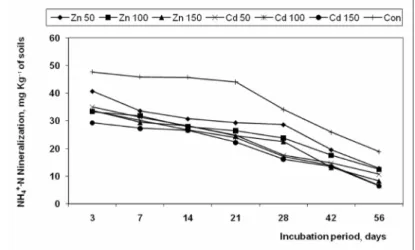
Fig. 1. NH4+
-N mineralization of the soil treated with different heavy metals. Values given here are the means (n = 4) ± SD.
Fig. 2. NO3-
-N mineralization of the soil treated with different heavy metals. Values given here are the means (n = 4) ± SD.
Results and Discussion
The periodical changes in NH4+-N and NO3--N miner- alization of soils amended by heavy metals, Cd and Zn, are depicted in figure 1 and 2, respectively. As illustrated in figure 1 and 2, both NH4+-N and NO3--N mineralization showed a similar pattern throughout the incubation. The amount of nitrogen mineralization from the tested heavy metal treated soils was found to be decreased at an increasing rate during the first 21 days followed by decreasing rates as incubation progressed. A possible reason for the initial decrease in nitrogen mineralization at an increasing rate of may be due to the toxicity of the heavy metal. It is further indicated from the results that a considerable period of time is needed for the adaptation of microorganisms. Soils treated with Zn at the concentration of 50 µmol g-1 showed relatively higher nitrogen minera- lization than the other treatments, whereas Cd at the concentration of 150 µmol g-1 exhibited the lowest nitrogen
mineralization throughout the incubation. Microorganisms differ in their sensitivity to metal toxicity and elevated metal exposure will result in immediate death of cells due to disruption of essential functions, and to more gradual changes in population sizes due to changes in viability or competitive ability.
At the beginning of the incubation, NH4+-N minera- lization of Zn treated soils were 40.7, 33.3 and 33.1 mg kg-1 soil respectively for the concentrations of 50, 100 and 150 µmol g-1 of soil. The corresponding figures at the end of the incubation period (after 56 days) were just 12.8, 12.5 and 8.2 mg kg-1 soil for the respective treatments. In the case of Cd treated soils, lower NH4+-N mineralization was recorded both at the beginning (35, 33.6 and 29.3 mg kg-1 soil) and the end (10.7, 6.6 and 6.4 mg kg-1 soil) of the incubation for the treatments of 50,100 and 150 µmol g-1, respectively.
According to the results, the lowest and the highest inhibitory effect of NH4+-N mineralization in heavy metal
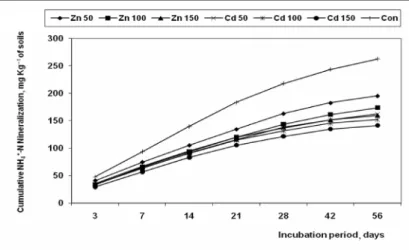
Fig. 3. Cumulative NH4+
-N mineralization of the soil treated with different heavy metals. Values given here are the means (n = 4) ± SD.
Fig. 4. Cumulative NO3-
-N mineralization of the soil treated with different heavy metals. Values given here are the means (n = 4) ± SD.
treated soils was recorded from the soils treated with Cd at 150 µmol g-1 and Zn at 50 µmol g-1 (Fig. 3), respectively.
As the incubation progressed, gradual decline in NH4+-N mineralization was observed in all the treatments including the control. Though the highest rate of NH4+-N minera- lization was recorded from the control, no significant differences (P≤0.05) were found among the treatments during the initial period of incubation. However, after 21 days of incubation, the rate of NH4+-N mineralization in Cd treated soils (150 µmol g-1) was significantly (P≤
0.05) lower than the other treatments.
The initial figures of NO3--N mineralization in Zn treated soils were 45.1, 38.5 and 37.5 mg kg-1 soil, respectively for the treatments of 50,100 and 150 µmol g-1 of soil. At the end of the incubation (after 56 days) the respective values were found to be changed to 15.3, 14.2 and 10.4 mg kg-1 soil. The respective values for the Cd applied soils were 36.9, 35.7 and 27.4 mg kg-1 soil for the treatments of 50, 100 and 150 µmol g-1 at the beginning of the incubation
and 11.1, 11.1 and 10.8 mg g-1 soil for respective treatments at the end of the incubation. Similar to NH4+-N minera- lization Cd with 150 µmol g-1 amended soil showed the highest NH4+-N mineralization inhibitory effect and the Zn with 50 µmol g-1 amended soil showed the lowest NO3--N mineralization inhibitory effect through out the incubation period (Fig. 4). Similar to NH4+-N mineralization there was no significant difference (P≤0.05) among treatments at the beginning of the incubation. However, after 21 days of incubation, Cd (150 µmol g-1) treated samples showed the significant difference (P≤0.05) until the end of the incubation.
Important factors which influence microbe-metal inter- actions in soil include pH, the quantity and quality of clay minerals as well as other complex interaction involving the metal ions and other inorganic constituents (Nwuche and Ugoji, 2008). Net nitrogen mineralization under field conditions was reported to be inhibited by the heavy metals, thus it seems to be a sensitive indicator of metal
pollution (Inubushi et al., 2000; Stuczynski et al., 2003;
Hinijosa et al., 2004). This was further confirmed by Min Lio (2005), who studied soil microbial parameters of a soil polluted with heavy metals and reported an increased ED50 (Ecological dosage) over time for different heavy metals. However the results from laboratory experiments are less clear, since nitrogen mineralization has been shown to be stimulated, inhibited or unchanged due to heavy metal pollution (Stuczynski et al., 2003). Due to contradictory results which have been produced by different investigations, sound conclusion is not yet to make. In fact, the inconsistent results might be due to different experimental procedures and variability in soil properties and or organic nitrogen concentration. However, present findings are also in agreement with Yao et al., (2000) who suggested that nitrogen mineralization can be used as possible indicators of soil environmental quality in toxicity assays.
Conclusion
The apparent results showed that the microbial process of nitrogen mineralization was inhibited to varied extents by the tested metals and the nitrogen mineralization of the soil has been altered by addition of Zn and Cd. Especially, Cd was shown to display higher inhibitory effect on nitrogen mineralization than Zn. This could therefore suggested that the metals of concern to soil microorganisms and their concentrations are the decisive factors determining the degree of inhibition. The impact of heavy metals on nitrogen mineralization is likely to be related to tolerance and adaptation of the microbial community to the concen- tration and type of pollutants. Therefore, nitrogen minera- lization can be considered as a potential indicator of heavy metal pollution of soil environment.
Acknowledgements
The authors acknowledge the technical assistance given by the staff members of the Department of Soil Science, Faculty of Agriculture, University of Ruhuna, Sri lanka.
References
Bremner, J.M. and C.S. Mulvaney. 1982. Total nitrogen. In. A.L.
Page (ed.) Methods of Soil Analysis. Part 2. Chemical and
Microbiological Methods. 2nd Edition. Am. Soc. Agron. 1149-178.
Chander, K. and R.G. Joergensen. 2008. Decomposition of Zn- rich Arabidopsis halleri litter in low and high metal soil in the presence and absence of EDTA. Water Air Soil Pollut.
195-204.
Chaudhary, A.M., S.P. MacGrath, B.P. Knight, D.L. Johnson, and K.C. Jones. 1996. Toxicity of organic compounds to the indigenous population of R. leguminosorum bv. trifolii in soil.
Soil Biol. Biochem. 28:1483-1487.
Hinojosa, M.B., R. Garcia-Ruiz, B. Vinegla, and J.A. Carreira. 2004.
Microbiological rates and enzyme activities as indicators of functionality in soils affected by the Aznalcollar toxic spill.
Soil Biol. Biochem. 36:1637-1644.
Inbushi, K., S. Goyal, K. Sakamoto, Y. Wada, K. Yamakawa, and T. Arai. 2000. Influences of application of sewage sludge compost on N2O production in soils. Chemosh-Global chang Sci. 2:329-334.
Kebir, T. and K. Bouhadjera. 2011. Heavy metal concentrations in agricultural soils and accumulation in plants growing near of dumpsite of ghazaouet (west of algeria) In. J. of Current Res. 2:042-049.
Mapa, R.B., S. Somssiri, and S. Nagarajah. 1999. Soils of the wet zone of Sri Lanka. Soil Sci. Soc. S.L. Sri Lanka. 23-92.
Min, L., L. Yun-kuo, Z. Xiao-min, and H. Chang-yong. 2005.
Toxicity of cadmium to soil microbial biomass and its activity:
Effect of incubation time on Cd ecological dose in a paddy soil.
J. Zhejiang Univ. Sci. B. 6:324-330.
Nwuche, C.O. and E.O. Ugoji. 2008. Effects of heavy metal pollution on the soil microbial activity. Int. J. Environ. Sci.
Tech. 5:409-414.
Ogilvie, L.A. and A. Grant. 2008. Linking pollution induced community tolerance (PICT) and microbial community structure in chronically metal polluted estuarine sediments. Mar. Environ. Res. 65:187-198.
Panabokke, C.R. 1980. Handbook of the soils of Sri Lanka. J. soil Sci. Soc. 2:83-85.
Reddy, K.R., S. Danda, Y. Yukselen-Aksoy, and A.Z. Al-Hamdan.
2010. Sequestration of heavy metals in soils from two polluted industrial sites: implications for remediation. Land Contam. Reclam.
18:13-23.
Sani, R.K., B.M. Peyton, and M. Jadhyala. 2003. Toxicity of lead in aqueous medium to Desulfovibrio desulfuricans G20.
Environ. Toxicol. 22:252-260.
SAS Institute. 1988. SAS/STAT user’s guide, Release 6.03. SAS Institute, Cary, North Carolina, USA.
Scheffer, F. and P. Schachtschabel. 2002. Lehrbuch der Bodenkunde.
Auflage, vol. 15. Spektrum Akademischer Verlag, Heidelberg, Berlin.
Searle, P.L. 1984. The Berthelot or indophenol reaction and its use in the analytical chemistry of nitrogen: a review, Analyst 109:549-568.
Stuczynski, T.I., G.W. McCarty, and G. Siebielec. 2003. Response of soil microbiological activities to Cd, Pb and Zn amendments.
J. Environ. Qual. 32:1346-1355.
Ultra, Jr V.U., A. Yano, K. Iwasaki, S. Tanaka, Y.M. Kang, and K. Sakurai. 2005. Influence of chelating agent addition on copper distribution and microbial activity in soil and copper
uptake by brown mustard (Brassica juncea). Soil Sci. Plant Nutr. 51:193-202.
Usman, A., Y. Kuzyakov, and K. Stahr. 2005. Effect of clay minerals on immobilization of heavy metals and microbial activity in a sewage sludge-contaminated soil. J. Soils Sediments 5:245-252.
Utgikar, V.P., N. Chaudhary, A. Koeniger, H.H. Tabak, J.R. Haines, and R. Govind. 2004. Toxicity of metals and metal mixtures:
Analysis of concentration and time dependence for zinc and copper. Water Res. 38:3651-3658.
Yao, H.Y., Z.L. He, M.J. Wilson, and C.D. Campbell. 2000.
Microbial biomass and community structure in a sequence of soils with increasing fertility and changing land use. Microb.
Ecol. 40:223-237.