Copyrightⓒ 2011, The Korean Academy of Oral Biology
7
Journal of Oral Biology
Antimicrobial Effects of Ursolic Acid against Mutans Streptococci Isolated from Koreans
Min Jung Kim1†, Chun Sung Kim1†, Jae-Yoon Park2†, Yun Kyong Lim1, Soon-Nang Park 1, Sug-Joon Ahn3, Dong-Chun Jin4, Tae Hyung Kim5, and Joong-Ki Kook1*
1Department of Oral Biochemistry and Oral Biology Research Institute, School of Dentistry,Chosun University, Gwangju 501-759, Korea
2Department of Biochemistry and Molecular Biology, Medical School, Chosun University, Gwangju 501-759, Korea
3Dental Research Institute and Department of Orthodontics, College of Dentistry, Seoul National University, Seoul, 110-749, Korea
4Department of Veterinary Medicine, College of Agriculture, Yanbian University, Jilin Province, China
5Department of Restorative Sciences, Herman Ostrow School of Dentistry, University of Southern California, Los Angeles, CA 90089, USA
(received December 13, 2010 ; revised January 28, 2011 ; accepted February 11, 2011)
Ursolic acid is a triterpenoid compound present in many plants. This study examined the antimicrobial activity of ursolic acid against mutans streptococci (MS) isolated from the Korean population. The antimicrobial activity was evaluated by the minimum inhibitory concentration (MIC) and time kill curves of MS. The cytotoxicity of ursolic acid against KB cells was tested using an MTT assay. The MIC90 values of ursolic acid for Streptococcus mutans and Streptococcus sobrinus isolated from the Korean population were 2µg/ml and 4 µg/ml, respectively. Ursolic acid had a bactericidal effect on S. mutans ATCC 25175T and S.
sobrinus ATCC 33478T at > 2× MIC (4 µg/ml) and 4 × MIC (8µg/ml), respectively. Ursolic acid had no cytotoxic effect on KB cells at concentrations at which it exerted antimicrobial effects. The results suggest that ursolic acid can be used in the development of oral hygiene products for the prevention of dental caries.
Key words: antimicrobial effect, Streptococcus mutans, Streptococcus sobrinus, ursolic acid.
Introduction
The low pH of the organic acids produced by the carbohydrate metabolism of bacteria in dental plaque causes dental caries, resulting in demineralization of the dental hard tissue. Among the oral bacteria, mutans streptococci (MS) have been identified as the major causative bacteria of dental caries (Loeshe, 1986). MS are composed of seven species according to 16S rRNA gene sequence analysis (Kawamura et al., 1995). Of them, Streptococcus mutans and Streptococcus sobrinus are isolated mainly from humans and are strongly associated with human dental caries (Loeshe, 1986).
Fluorides and chlorhexidine are effective compounds for the prevention of dental caries and are the major component of oral hygiene products, such as toothpaste, gargling solutions and dental floss (Emilson, 1994; Schaeken et al., 1991).
However, the intake of fluoride compound might cause abdominal pain and its excessive intake produces side effects, such as mottled teeth (Spencer & Do, 2008). According to these side effects, Koreans have generally rejected water fluoridation. The excessive use of chlorhexidine, which is used as an oral gargling solution, can also cause the discoloration of teeth (Tredwin et al., 2005).
Recently, multiple tests have been performed to determine the effective chemicals from many plants that have been used as antimicrobial agents in the Korean population for a long time to overcome the side effects of chemical compounds, such as fluoride and chlorhexidine. It was reported that ursolic acid (3β-hydroxy-urs-12-en-28-oic acid), which is a derivative of
*Corresponding author: Dr. Joong-Ki Kook, Department of Oral Biochemistry, School of Dentistry, Chosun University, 375 Seosuk- Dong, Dong-Gu, Gwangju 501-759, Korea
Tel.: +82-62-230-6877, Fax.: +82-62-224-3706 E-mail: [email protected]
†Contributed equally
triterpenoid saponins (Liu, 1995), has a higher degree of the anti-bacterial activity against pathogenic bacterial strains, such as Staphylococcus aureus, Pseudomonas aeruginosa and Enterococcus faecalis (Fontanay et al., 2008). Ursolic acid can suppress dental plaque formation by inhibiting the glucosyl- transferase activity of S. mutans OMZ 176 (Kozai et al., 1987).
In general, the antimicrobial tests for the screening of anti- caries agents are performed by measuring the minimum bactericidal concentration (MBC) and/or minimum inhibitory concentration (MIC) against the type of strains or few wild type strains of MS. According to previous studies, the MIC of a water-extract of green tea on the clinical strains of MS isolated from Korean population was different from that of the type strains of MS (Lim et al., 2003; Lee et al., 2003). These results suggest that the appropriate concentration of anti- caries agents in oral hygiene products, such as gargling solution or toothpastes, should be determined from clinical isolates obtained from the Korean population. The purpose of this study was to determine the antimicrobial activity and optimal ursolic acid concentration using 40 clinical strains of S. mutans and 15 clinical strains of S. sobrinus isolated from the Korean population for the development of oral hygiene products containing ursolic acid for Koreans.
Materials and Methods
Bacterial strains and growth conditions
The S. mutans ATCC 25175T and S. sobrinus ATCC 33478T were purchased from the American Type Culture Collection (ATCC, Manassas, VA, USA). The clinical strains of S. mutans (KCOM 1088, KCOM 1091, KCOM 1092, KCOM 1095, KCOM 1097, KCOM 1111, KCOM 1112, KCOM 1113, KCOM 1116, KCOM 1117, KCOM 1118, KCOM 1123, KCOM 1124, KCOM 1126, KCOM 1127, KCOM 1128, KCOM 2762, KCOM 1136, KCOM 1137, KCOM 1139, KCOM 1142, KCOM 1143, KCOM 1145, KCOM 1146, KCOM 1197, KCOM 1200, KCOM 1201, KCOM 1202, KCOM 1203, KCOM 1207, KCOM 1208, KCOM 1209, KCOM 1212, KCOM 1214, KCOM 1217, KCOM 1219, KCOM 1226) and S. sobrinus (KCOM 1061, KCOM 1150, KCOM 1151, KCOM 1152, KCOM 1153, KCOM 1157, KCOM 1158, KCOM 1159, KCOM 1185, KCOM 1191, KCOM 1193, KCOM 1196, KCOM 1221, KCOM 1228, KCOM 1218) were obtained from the Korean Collection for Oral Microbiolgy (KCOM, Gwangju, Korea). All strains were cultured in Todd Hewitt broth or on agar plates (Difco, Lab., Detroit, MI. USA) in a 37oC incubator in air containing 10%
CO2.
Determination of the minimum inhibitory concentration (MIC)
The MIC was performed by a microdilution assay according to the NCCLS standard (NCCLS, 2000). The bacterial strains were cultured in TH broth at 37oC in an incubator for 24
hours and then added to a 96-well plate to a final concen- tration of 1× 10⁶CFU/ml. The ursolic acid (Sigma, St. Louis, MO, USA) solutions were added to each well to a final concentration of 1, 2, 4, 8, and 16µg/ml. At this time, ursolic acid was dissolved in dimethyl sulfoxide (DMSO; Sigma).
The final concentration of DMSO in each well was 1%. The 1% DMSO in the medium and medium only group was used as the double negative groups. The ampicillin (concentration of 100µg/ml) was used as a positive control. After 24 hr incubation under the appropriate conditions, the lowest concentration of ursolic acid that inhibited visible growth was considered to be the MIC.
Time- kill assay
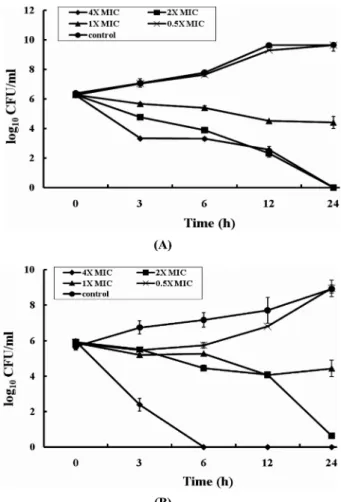
The bactericidal activity was also evaluated from the time- kill curves on the type strains of S. mutans (ATCC 25175T) and S. sobrinus (ATCC 33478T). The time-kill curves were assessed at the following ursolic acid concentrations: 0.5× MIC, 1× MIC, 2 × MIC, and 4 × MIC. The control curve was obtained in a culture medium for each strain. The bacteria were inoculated in a TH broth and incubated overnight in a 37oC incubator. The liquid media containing ursolic acid at the above mentioned concentrations were inoculated with 1× 10⁶CFU/ml of an overnight culture and incubated in a 37oC incubator. At 0, 3, 6, 12, and 24 hrs after inoculating bacteria, each bacterial culture solution was diluted 100- or 10,000-folds and plated onto a TH agar plate. The agar plate was incubated in a 37oC incubator for 24 h and the bacterial colonies were counted.
KB cells culture
KB cells, an oral epithelial carcinoma cell line, were obtained from the ATCC. The KB cells were grown in MEM medium (Gibco) supplemented with 10% heat-inactivated fetal bovine serum (PAA Laboratories, Etobicoke, Ontario, Canada), 100 U/ml penicillin and 100µg/ml streptomycin (Gibco) at 37oC in a humidified atmosphere containing 5%
CO2. MTT assay
A MTT (3-(4,5-Dimethylthiazol-2-yl)-2,5-diphenyltetrazolium bromide, a tetrazole) assay was performed to test the cytotoxicity of ursolic acid on KB cells. The 80% confluent NHGF cell monolayers in the 24-well plates were incubated with 32, 16, 8, 4, and 2µg/ml of ursolic acid and 1% DMSO as a control in growth medium at 37oC in humidified air containing 5% CO2 for 24 h. The medium in each well was changed to a new culture medium with a 10% MTT solution (Sigma, USA) and cultured for 3 h in under same culture conditions. Isopropanol (Sigma, USA) was placed in each well at a volume of 300µl to dissolve the formazan crystals.
The culture plate was well shaken. The sample was aliquoted on a 96-well plate at a volume of 200µl. The absorbance was measured at a wavelength of 595 nm. At this time, the experimental and control groups were assigned three wells
each. This procedure was repeated individually three times.
In the experimental group and the control group, all the experimental results were expressed as mean ± SD (SD:
standard deviation).
Results
MIC measurements were performed to determine if ursolic acid has an anti-bacterial effect on the type strains of MS (S.
mutans ATCC 25175T and S. sobrinus ATCC 33478T). The MIC value of ursolic acid was 2µg/ml for both S. mutans ATCC 25175T and S. sobrinus ATCC 33478T (Table 1). To determine the appropriate concentration of ursolic acid as an anti-carious agent, the MIC50 and MIC90 were measured with 40 and 15 clinical strains of S. mutans and S. sobrinus isolated from the oral cavity of Koreans (Table 2).
Time-kill kinetic studies were performed to determine if the activity of ursonic acid was bactericidal or bacteriostatic.
Ursonic acid exhibited bactericidal activity against S. mutans Table 1. Minimum inhibitory concentration of ursolic acid against
the clinical isolates of mutans streptococci from Koreans Species & strains MIC
(µg/ml) Species & strains MIC (µg/ml) S. mutans ATCC125175T 2 S. mutans KCOM 1200 2 S. mutans KCOM2 1054 2 S. mutans KCOM 1201 2 S. mutans KCOM 1085 2 S. mutans KCOM 1202 2 S. mutans KCOM 1087 2 S. mutans KCOM 1203 2 S. mutans KCOM 1087 2 S. mutans KCOM 1207 2 S. mutans KCOM 1091 2 S. mutans KCOM 1207 2 S. mutans KCOM 1092 2 S. mutans KCOM 1209 2 S. mutans KCOM 1095 2 S. mutans KCOM 1212 2 S. mutans KCOM 1097 2 S. mutans KCOM 1214 2 S. mutans KCOM 1111 2 S. mutans KCOM 1217 2 S. mutans KCOM 1112 2 S. mutans KCOM 1219 4 S. mutans KCOM 1113 2 S. mutans KCOM 1226 2 S. mutans KCOM 1116 2 S. sobrinus ATCC 33478T 2 S. mutans KCOM 1117 2 S. sobrinus KCOM 1061 2 S. mutans KCOM 1118 2 S. sobrinus KCOM 1150 2 S. mutans KCOM 1123 2 S. sobrinus KCOM 1151 2 S. mutans KCOM 1124 2 S. sobrinus KCOM 1152 2 S. mutans KCOM 1126 2 S. sobrinus KCOM 1153 2 S. mutans KCOM 1127 2 S. sobrinus KCOM 1157 2 S. mutans KCOM 1128 2 S. sobrinus KCOM 1158 2 S. mutans KCOM 2762 2 S. sobrinus KCOM 1159 2 S. mutans KCOM 1136 2 S. sobrinus KCOM 1185 4 S. mutans KCOM 1137 2 S. sobrinus KCOM 1191 2 S. mutans KCOM 1139 2 S. sobrinus KCOM 1193 4 S. mutans KCOM 1142 2 S. sobrinus KCOM 1196 4 S. mutans KCOM 1143 2 S. sobrinus KCOM 1221 2 S. mutans KCOM 1145 2 S. sobrinus KCOM 1228 2 S. mutans KCOM 1146 2 S. sobrinus KCOM 1218 2 S. mutans KCOM 1197 2
ATCC, America Type Culture Collection; KCOM, Korean Col- lection for Oral Microbiolgoy
Table 2. Inhibitory effect of ursolic acid against mutans strepto- cocci isolated from Koreans
Species (n=59) Concentration of ursolic acid (µg/ml) MIC50 MIC90 MIC100
S. mutans (n=40) 2 2 4
S. sobrinus (n=15) 2 4 4
Total (n=55) 2 2 4
MIC50, MIC90, and MIC100 minimal inhibitory concentration re- quired to inhibit the growth of 50, 90 and 100% of mutans strep- tococci, respectively
Fig. 1. Time kill curves of ursolic acid on (A) S. mutans ATCC 25175T and (B) S. sobrinus ATCC 33478T at different ursolic acid concentrations.
ATCC 25175T and S. sobrinus ATCC 33478T when added to the culture medium at concentrations higher than 4× MIC and 2× MIC, respectively, for 24 h (Fig 1).
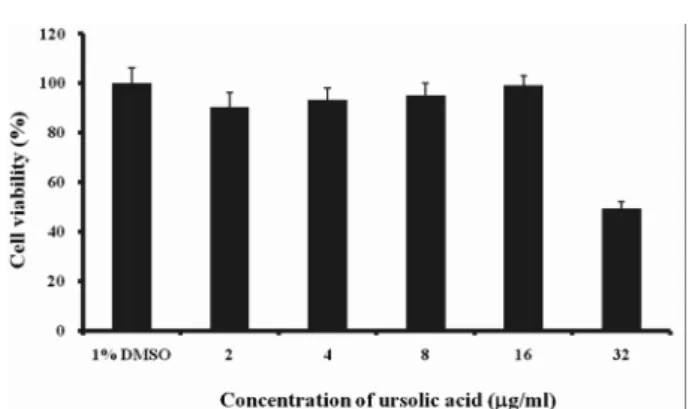
This study examined whether ursolic acid has a cytotoxic effect on KB cells at the concentration at which ursolic acid has a bactericidal effect on the MS using a MTT assay. The data showed that ursolic acid up to 16µg/ml (8 × MIC) had no cytotoxic effect on KB cells (Fig 4).
Discussion
The MIC50 value of ursolic acid against the clinical strains of MS was the same as that of the type strains of them. The MIC90 value against the clinical isolates of S. sobrinus was 2 times higher than that for the type strains of S. sobrinus (ATCC 33478T). Twenty percent of the clinical strains of S. sobrinus had a higher MIC value than the type strain (ATCC 33478T).
However, the MIC90 value for all clinical strains of MS was the same as that of the type strains of S. mutans and S.
sobrinus. The result of the time kill assay suggest that > 8µg/
ml of ursolic acid can be used as an antimicrobial agent to prevent dental caries.
Ursolic acid had no cytotoxic effect on the normal human oral keratinocytes and human gingival fibroblast cells upto 16µg/ml ursolic acid (data not shown). The cytotoxicity tests for the chemicals or natural extracts on the human cells were performed in vitro. Human oral tissue cells in vivo could be more resistant to the chemicals than those under in vitro conditions because the oral tissue cells in vivo can be supplied with nutrients continuously by blood and have a better repair mechanism than those under in vitro conditions. Considering these factors, an ursolic acid concentration > 16µg/ml can be used in vivo for the prevention of dental caries. However, the optimal concentration of ursolic acid should be determined by further clinical studies. Nevertheless, these results suggest that ursolic acid can be useful in the development of anticaries agents for humans.
According to previous studies, the MIC values of the clinical strains for the crude natural extract had a broad range
(Lim et al., 2003; Lee et al., 2003). However, in this study, the range of MIC values of ursolic acid on the clinical isolates of MS was relatively narrow, from 2 to 4µg/ml. The reason for this is unclear but it appears that the susceptibility of MS vary according to crude natural extracts and clinical isolates.
Therefore, the antibacterial effects of a single compound on the clinical isolates of MS may be not need to be tested.
In conclusion, ursolic acid at < 16µg/ml had a bactericidal effect on MS without toxicity to oral tissue cells. Accordingly, ursolic acid can be used for the development of oral hygiene products, such as toothpaste, oral gargling solutions and dental floss.
Acknowledgments
This study was supported by a grant from the Korea Healthcare technology R&D Project, Ministry for Health, Welfare & Family Affairs, Republic of Korea (A091074).
References
Emilson CG. Potential efficacy of chlorhexidine against mutans streptococci and human dental caries. J Dent Res.
1994;73:682-91.
Fontanay S, Grare M, Mayer J, Finance C, Duval RE. Ursolic, oleanolic and betulinic acids: antibacterial spectra and selectivity indexes. J Ethnopharmacol. 2008;120: 272-6.
Kawamura Y, Hou XG., Sultana F, Liu S, Yamamoto H, Ezaki T.
Determination of 16S rRNA sequences of Streptococcus mitis and Streptococcus gordonii and phylogenetic relationships among members of the genus Streptococcus. Int J Syst Bacteriol. 1995;45:406-8.
Kozai K, Miyake Y, Kohda H, Kametaka, S, Yamasaki K, Suginaka H, Nagasaka N. Inhibition of glucosyltransferase from Streptococcus mutans by oleanolic acid and ursolic acid. Caries Res. 1987;21:104-8.
Lee ES, Ahn TY, Yoon J-J, Kook JK, Lee BR, Kim DK.
Restraint effect on leaf-extract from Camellia sinensis and seed-extract from Casia tora against periodontopathogens. J Korean Acad Dent Health. 2003;27:569-79.
Lim SH, Seo JS, Yoon YJ, Kim KW, Yoo SO, Kim HS, Kook JK, Lee BR, Cha JH, Park JY. Effect of leaf-extract from Camellia sinensis and seed-extract from Casia tora on viability of mutans streptococci isolated from the interface between orthodontic brackets and tooth surfaces. Korea J Orthod. 2003;33:381-9.
Liu J. Pharmacology of oleanolic acid and ursolic acid. J.
Ethnopharmacol. 1995;49:57-68.
Loeshe WJ. Role of Streptococcus mutans in human dental decay. Microbiol Rev. 1986;50:353-80.
National Committee for Clinical Laboratory Standards. Methods for dilution antimicrobial susceptibility tests for bacteria that grow aerobically: approved standard M7-A5. NCCLS, Wayne, PA, USA. 2000.
Fig. 2. Cytotoxicity of ursolic acid on KB cells.
Schaeken MJ, Keltjens HM, Van Der Hoeven JS. Effects of fluoride and chlorhexidine on the microflora of dental root surfaces and progression of root-surface caries. J Dent Res.
1991;70:150-3.
Spencer AJ, Do LG. Changing risk factors for fluorosis among
South Australian children. Community Dent Oral Epidemiol.
2008;36:210-8.
Tredwin C, Scully C, Bagan-Sebastian J. Drug-induced disorders of teeth. J Dent Res. 2005;84:596-602.