DOI http://dx.doi.org/10.14770/jgsk.2020.56.5.555
‡Corresponding author: +82-33-250-8473, E-mail: [email protected]
자연방사선과 인공방사선으로 조사된 석영의 선형변조 광 자극 냉광 빠른 성분의 연대측정과 관련된 광 자극 냉광 특성 연구
김명진
1
․홍덕균2,‡
1(주)라드피온 고고과학연구소
2강원대학교 물리학과
요 약
자연방사선과 인공방사선에 의해 유도된 석영의 각각에 대한 선형변조 광 자극 냉광 빠른 성분들의 비교 연 구가 수행되었다. 우선적으로 측정된 선형변조 광 자극 냉광 신호를 수학적 방법으로 피크 분리하였으며 분리 된 성분들과 관련된 물리적 정보를 얻었다. 분리된 성분 중 빠른 성분들의 자연방사선과 인공방사선의 상대적 면적 비교를 통한 실험에서 석영 시료들은 세 그룹으로 구분되었다. 그룹 A는 상대적 면적 비가 1 값에 가깝게 주어졌으며 그룹 B 와 C 시료들은 1 보다 크거나 작은 값을 보였다. 재현 방사선을 통한 민감도 변화 실험 결과, 연속적인 재현 방사선에 대한 자연방사선과 인공방사선의 빠른 성분들의 상대적 면적 비도 앞의 결과와 같은 시료 그룹을 형성하였다. 결과로서 얻어진 자연방사선과 인공방사선의 빠른 성분들에 대한 민감도 변화는 선형 변조 광 자극 냉광 빠른 성분을 이용하여 얻은 자연축적선량 결정에 영향을 주었음을 보였다.
주요어: 자연/인공방사선, 선형변조 광 자극 냉광, 빠른 성분, 민감도 변화, 자연축적선량
Myung-Jin Kim and Duk-Geun Hong, 2020, OSL properties for the fast component of quartz LM-OSL com- paring natural and artificial irradiation relevant to dating. Journal of the Geological Society of Korea.
v. 56, no. 5, p. 555-560
ABSTRACT: A comparative investigation for the fast component of quartz LM-OSL between a natural and an
artificial dose was carried out. Using a mathematical peak deconvolution, the LM-OSL signal was separated and the related physical information was obtained. Three different luminescence groups were observed among the quartz samples in a comparison of the ratios of relative areas for fast components of a natural dose and an artificial dose. The ratios in group A were close to a value of unity, while those in group B and group C showed lower and higher values than unity, respectively. The relative ratios of sensitivity change for the fast component areas during each regenerative measurement were also classified for the above three groups. In addition, it was known that the sensitivity changes of each of the fast components from the natural and the artificial dose influenced the equivalent doses evaluated from the SAR method using the LM-OSL fast component.Key words: natural and artificial radiation, LM-OSL, fast component, sensitivity change, equivalent dose (Myung-Jin Kim, Archaeological Science Institute, RADPION Inc., Daejeon 34013, Republic of Korea; Duk-Geun Hong, Dept. of Physics, Kangwon National University, Chuncheon 24341, Republic of Korea)
1. INTRODUCTION
It is well known that optically stimulated lu- minescence (OSL) from quartz is composed of the sum of three or four components with differ- ent rates of charge loss and that each component corresponds to various physical characteristics.
The components are described as fast, medium, and slow on the basis of the relative decay rates (Smith and Rhodes, 1994; Huntley et al., 1996; Bailey et al., 1997). The fast component is considered to originate from a trap corresponding to the 325℃
TL peak (Smith et al., 1986; Wintle and Murray,
1997). In optical dating, this has been of interest,
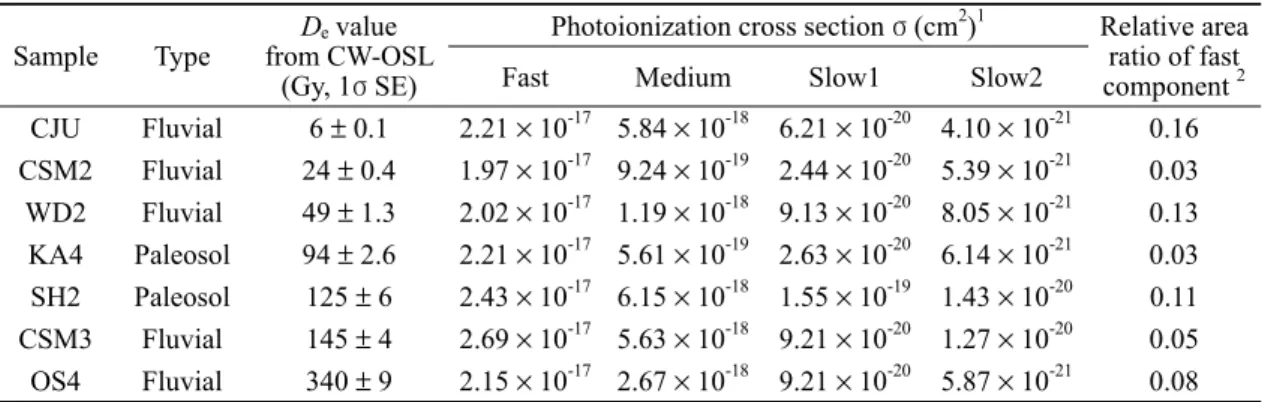
Sample Type D e value from CW-OSL
(Gy, 1σ SE)
Photoionization cross section σ (cm 2 ) 1 Relative area ratio of fast component 2
Fast Medium Slow1 Slow2
CJU Fluvial 6 ± 0.1 2.21 × 10 -17 5.84 × 10 -18 6.21 × 10 -20 4.10 × 10 -21 0.16 CSM2 Fluvial 24 ± 0.4 1.97 × 10 -17 9.24 × 10 -19 2.44 × 10 -20 5.39 × 10 -21 0.03 WD2 Fluvial 49 ± 1.3 2.02 × 10 -17 1.19 × 10 -18 9.13 × 10 -20 8.05 × 10 -21 0.13 KA4 Paleosol 94 ± 2.6 2.21 × 10 -17 5.61 × 10 -19 2.63 × 10 -20 6.14 × 10 -21 0.03 SH2 Paleosol 125 ± 6 2.43 × 10 -17 6.15 × 10 -18 1.55 × 10 -19 1.43 × 10 -20 0.11 CSM3 Fluvial 145 ± 4 2.69 × 10 -17 5.63 × 10 -18 9.21 × 10 -20 1.27 × 10 -20 0.05 OS4 Fluvial 340 ± 9 2.15 × 10 -17 2.67 × 10 -18 9.21 × 10 -20 5.87 × 10 -21 0.08 1. The photoionization cross section is the mean value from three aliquots in each case.
2. The relative contributions of the fast component to the total LM-OSL signal are also indicated.
Table 1. Photoionization cross sections obtained from peak deconvolution of natural LM-OSL.
because of a fast bleaching characteristic, high signal-to-noise ratio, and sufficient stability to be used for quaternary dating.
The estimation of equivalent dose (D e ) is usually carried out by using a single aliquot regenerative dose (SAR) method with constant power stimulation to obtain a continuous-wave OSL (CW-OSL) sig- nal (Murray and Wintle, 2000). The integration of the decay curve after subtraction of a back- ground signal is applied for the first few seconds to select the fast component. However, such an isolation process cannot completely remove the medium and slow components. The existence of these components in the initial part of the CW-OSL signal may distort the D e determination in the SAR method.
Peak-shaped linear modulation OSL (LM-OSL) is obtained by linearly increasing stimulation from zero. Peak deconvolution of the LM-OSL signal is a useful technique to extract only the fast com- ponent from other overlapping components ac- cording to each photoionization cross section (Bulur et al., 2000). Especially, comparison of the D e val- ue from the LM-OSL fast component with that from CW-OSL by using the SAR method has been widely investigated (e.g., Choi et al., 2003; Tsukamoto et al., 2003; Li and Li, 2006). The physical charac- teristics and sensitivity changes of the LM-OSL fast component have also been examined (e.g., Jain
et al., 2003; Singarayer and Bailey, 2004; Moska and Murray, 2006). Despite these various stud- ies, there have been no attempts to understand how the sensitivity of the fast component is af- fected by differences between natural and artifi- cial irradiation.
In this study, we first calculated the physical information from each LM-OSL component by using peak deconvolution. Then, we preliminarily investigated the luminescence characteristics of the LM-OSL fast component between the natural dose and the artificial dose for several quartz samples with a wide range of equivalent dose. We also compared the D e values obtained from the standard SAR method with those obtained only from the fast component separated from the LM-OSL.
2. SAMPLES AND EXPERIMENTAL DETAILS
Seven well-bleached samples from archaeological
excavation sites in central Korea were used in
this study. Samples of CJU, CSM2, WD2, CSM3,
and OS4 were taken from fluvial deposits at the
sites, and KA4 and SH2 were taken from paleo-
sols (Table 1). Coarse grains of quartz (125~250 μ
m) were extracted by routine chemical treatment
with 10% HCl, 10% H 2 O 2 and 1 hour of concentrated
HF treatment. The purity of the resulting quartz
against feldspar contamination was tested by in-
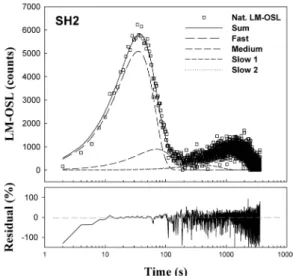
Fig. 1. An example of LM-OSL peak deconvolution ac- cording to magnitude of photoionization cross section for sample SH2.
frared stimulated OSL measurement.
Quartz OSL measurements were performed by using an automated TL/OSL reader (Riso TL-DA-15) installed at the central laboratory of Kangwon National University and the Chungcheong Cultural Properties Research Institute, which was equipped with op- tical excitation units based on blue LED (470 ± 30 nm) arrays delivering about 50 mW/cm 2 passing through GG-420 filters. The luminescence was measured through a 7.5 mm thick U340 filter in front of a bialkali PM tube. At room temper- ature, all laboratory irradiations were carried out by using a calibrated 90 Sr/ 90 Y beta source, whose dose rate was 125 mGy/s at the sample position.
Before the LM-OSL measurement, D e values using CW-OSL were previously determined, for future comparison, by using the conventional SAR method (Table 1). All CW-OSL measurements were made at 125℃, followed by 260℃ preheating for 10 s to remove unstable signals. Samples received a total of 40 s stimulation and the CW-OSL signal of the initial 0.5 s stimulation was used for mak- ing the dose response curve.
3. RESULTS AND DISCUSSION
3.1 Deconvolution of LM-OSL curves
LM-OSL measurements were made to sepa- rate the several overlapping components. All natural quartz samples were preheated to 260℃
for 10 s. LM-OSL signals were recorded at 125℃
by linearly increasing the stimulation LED pow- er from 0 to 50 mW/cm 2 over 3600 s. Three blank aliquots were measured under the same conditions, to subtract background signals and electrical noise.
LM-OSL curves were analyzed by assuming a linear combination of four first-order kinetics:
∑
∑ ⎟⎟
⎠
⎜⎜ ⎞
⎝
⎛ −
⎟ ⎠
⎜ ⎞
⎝
= ⎛
= T
t b T b t n t L t
L
i i i iexp 2 )
( ) (
2
0
(1)
where n 0 is the initial trap population, b is the detrapping probability proportional to the pho- toionization cross section σ and T is the total measurement time (Bulur et al., 2000). The de- convolutions were performed by using commer- cial software SigmaPlot TM , which employs the Marquardt-Levenberg algorithm for non-linear fitting. The representative LM-OSL curve and each component from sample SH2 are shown in Fig. 1. Residuals were also calculated, to judge the reliability of the fitting results (Residual = 100*(I exp -I decon )/I exp ). The resultant values of pho- toionization cross section for each component are summarized in Table 1. These are consistent with the result by Jain et al. (2003). The relative contributions of the fast component to the total LM-OSL signal are also indicated.
3.2 Relative area ratio for LM-OSL components between natural and artificial dose
We divided each quartz sample into two parts
for comparison of the ratio of relative area be-
tween natural and artificial dose. One was di-
rectly used for natural LM-OSL measurement,
and the other was bleached under sunlight for
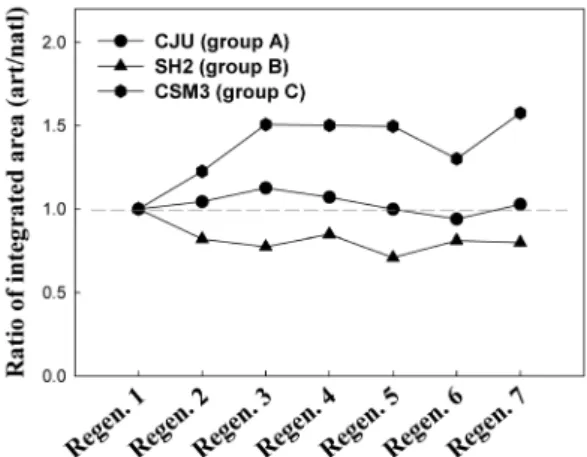
Fig. 3. Relative ratios of sensitivity change due to bleaching for LM-OSL fast component areas for sam- ples CJU (group A), SH2 (group B), and CSM3 (group C).
Fig. 2. Comparison of relative area ratios for four LM-OSL components between natural and artificial dose. Three different luminescence groups for the fast components were observed among seven quartz samples.
six hours before measurement. Then, the artifi- cial beta dose was irradiated to each sun-bleach- ed sample. LM-OSL measurements from the nat- ural and the artificial dose were made under the same conditions as for the above measurements by using three aliquots in each case and then the CW-OSL responses to a 5 Gy test dose were meas- ured to normalize the mass difference between aliquots and to correct any sensitivity change due to bleaching.
Based on the values of photoionization cross section (Table 1), LM-OSL curves were separated for four first-order components. Comparisons of the relative area ratios of the components be- tween natural and artificial dose are shown in Fig. 2. Apart from the medium and slow compo- nents, three different luminescence groups for the fast component were observed among the quartz samples. The ratios in group A were close to a value of unity, while those in group B and group C showed lower and higher values than unity, respectively.
3.3 Comparison of sensitivity change due to bleaching for the fast component areas Three representative samples were selected
from the different luminescence groups in Fig. 2:
group A is CJU, group B is SH2, and group C is CSM3, because the amount of other quartz samples was not sufficient to make any further measurement.
For the natural-dose part of each sample, seven regenerative LM-OSL measurements with the same beta dose irradiation were firstly performed to investigate the sensitivity change due to bleach- ing for the LM-OSL fast component area. All areas were normalized to the area of the first LM-OSL measurement. For the corresponding artificial-dose parts, the regenerative LM-OSL measurements and normalization were carried out in the same way. The relative ratio of sensitivity change due to bleaching for the fast component area was ob- tained by dividing the area change for the artifi- cial dose by that for the natural dose.
Fig. 3 shows the relative ratios of sensitivity
change due to bleaching, measured by LM-OSL
fast component areas, for samples CJU, SH2, and
CSM3, obtained by using the mean values ob-
tained from three aliquots in each case. From the
repeated LM-OSL measurements, the relative ra-
tios of sensitivity change due to bleaching from
the fast component areas for the natural dose
and the artificial dose were also classified into
three groups, showing a similar tendency to that
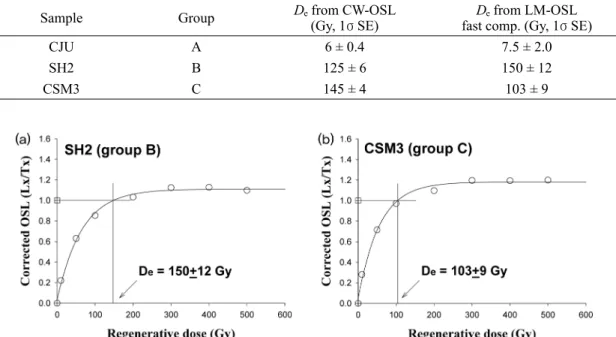
Sample Group D e from CW-OSL
(Gy, 1σ SE) D e from LM-OSL
fast comp. (Gy, 1σ SE)
CJU A 6 ± 0.4 7.5 ± 2.0
SH2 B 125 ± 6 150 ± 12
CSM3 C 145 ± 4 103 ± 9
Table 2. Equivalent doses resulting from CW-OSL and fast component of the LM-OSL using SAR method.
Fig. 4. Examples of determination of equivalent dose by using the SAR method applied to the LM-OSL fast compo- nent: sample SH2 (a), and sample CSM3 (b).
of group A, group B, and group C in Fig. 2.
3.4 Comparison of De values obtained between CW-OSL and the LM-OSL fast component In order to examine how the D e value is af- fected by the sensitivity change of the fast com- ponent from natural and artificial irradiation, the SAR method using the LM-OSL fast component was applied to quartz samples CJU (group A), SH2 (group B), and CSM3 (group C), of which the D e values were previously measured by the CW-OSL SAR method. LM-OSL measurements were made at 125℃, followed by 260℃ preheat- ing for 10 s to remove unstable signals. The sen- sitivity change of the fast component was corrected by using the CW-OSL intensity derived from the initial 0.5 s integration.
On comparing the D e values obtained by CW-OSL with those found by using the fast component of LM-OSL, consistent result was obtained for the sample CJU (group A) only, which showed that the ratio of sensitivity change for the LM-OSL
fast component was close to a value of unity.
However, the ratio of sensitivity change for the LM-OSL fast component for the sample SH2 (group B) was less than unity, which made the regeneration curve for the fast component gen- tler than that for CW-OSL and consequently re- sulted in a larger equivalent dose when using the fast component (Fig. 4a). In contrast to the sample SH2, the ratio of sensitivity change for the LM-OSL fast component for the sample CSM3 (group C) was greater than unity, which caused a steeper regeneration curve for the fast component than for CW-OSL and consequently resulted in a smaller equivalent dose when using the fast component (Fig. 4b). For D e determi- nation, data was fitted by a single exponential saturating function expressed by y = a*(1- exp(-x/b)).
4. SUMMARY
With the use of several quartz samples, a com-
parative study on the fast component of quartz
LM-OSL separated using peak deconvolution between a natural and an artificial dose was undertaken. From this study, we found that:
First, in the comparison of the relative area ra- tios for the fast component in the LM-OSL meas- urements for the natural and the artificial dose, three different luminescence groups were ob- served among the quartz samples. The ratios in group A were close to a value of unity, while those in group B and group C showed lower and higher values than unity, respectively.
Second, the relative ratios of sensitivity change due to bleaching for the fast component areas for the natural dose and the artificial dose were also classified into three groups, showing a similar tendency to that for the above three groups.
Third, on comparing the equivalent dose from CW-OSL with those obtained from the fast com- ponent of LM-OSL, consistent results were ob- tained for the sample of group A only.
However, further study with more quartz samples should not be excluded.
REFERENCES
Bailey, R.M., Smith, B.W. and Rhodes, E.J., 1997, Partial bleaching and the decay form characteristics of quartz OSL. Radiation Measurements, 27, 123-136.
Bulur, E., Botter-Jensen, L. and Murray, A.S., 2000, Optically stimulated luminescence from quartz meas- ured using the linear modulation technique. Radiation Measurements, 32, 407-411.
Choi, J.H., Murray, A.S., Cheong, C.S., Hong, D.G. and Chang, H.W., 2003, The resolution of stratigraphic in- consistency in the luminescence ages of marine terrace sediments from Korea. Quaternary Science Review, 22,
1201-1206.
Huntley, D.J., Short, M.A. and Dunphy, K., 1996, Deep traps in quartz and their use for optical dating. Canadian Journal of Physics, 74, 81-91.
Jain, M., Murray, A.S. and Botter-Jensen, L., 2003, Characterisation of blue-light stimulated luminescence components in different quartz samples: implications for dose measurement. Radiation Measurements, 37, 441-449.
Li, S.-H. and Li, B., 2006, Dose measurement using the fast component of LM-OSL signals from quartz. Radiation Measurements, 41, 534-541.
Moska, P. and Murray, A.S., 2006, Stability of the quartz fast-component in insensitive samples. Radiation Measurements, 41, 878-885.
Murray, A.S. and Wintle, A.G., 2000, Luminescence dating of quartz using an improved single aliquot regenerative dose protocol. Radiation Measurements, 32, 57-73.
Singarayer, J.S. and Bailey, R.M., 2004, Component-re- solved bleaching spectra of quartz optically stimulated luminescence: preliminary results and implications for dating. Radiation Measurements, 38, 111-118.
Smith, B.W., Aitken, M.J., Rhodes, E.J., Robinson, P. and Geldard, D.M., 1986, Optical dating: methodological aspects. Radiation Protection Dosimetry, 17, 229-233.
Smith, B.W. and Rhodes, E.J., 1994, Charge movements in quartz and their relevance to optical dating. Radiation Measurements, 23, 329-333.
Tsukamoto, S., Rink, W.J. and Watanuki, T., 2003, OSL of tephric loess and volcanic quartz in Japan and an alter- native procedure for estimating De from a fast OSL component. Radiation Measurements, 37, 459-465.
Wintle, A.G. and Murray, A.S., 1997, The relationship be- tween quartz thermoluminescence, photo-transferred thermoluminescence, and optically stimulated luminescence.
Radiation Measurements, 27, 611-624.