Optimization Mixture Ratio of Petasites japonicus, Luffa cylindrica and Houttuynia cordata to Develop a Functional Drink by Mixture Design
Hae-Jin Jeong
1, Kyoung-Pil Lee
3, Hun-Sik Chung
1, Dong-Seop Kim
1, Han-Soo Kim
1, Young-Whan Choi
2, Dong-Soon Im
3, Jong-Hwan Seong
1and Young-Guen Lee
1*
1Department of Food Science and Technology, College of Natural Resources & Life Science, Pusan National University, Miryang 627-706, Korea
2Department of Horticultural Bioscience, College of Natural Resources & Life Science, Pusan National University, Miryang 627-706, Korea
3Molecular Inflammation Research Center for Aging Intervention (MIRCA) and College of Pharmacy, Pusan National University, Busan 609-735, Korea
Received December 2, 2014 /Revised March 11, 2015 /Accepted March 18, 2015
This study was performed to determine the optimal ratio of Petasites japonicus, Luffa cylindrica, and Houttuynia cordata, all of which are supposed to have anti-respiratory disease effects, such as against rhinitis. The experiment incorporated a mixture design and included 12 experimental points with cen- ter replicates for three different independent variables (Petasites japonicus 30~70%; Luffa cylindrica 10~30%; and Houttuynia cordata 10~30%). Based on this design, the mixture was extracted in hot water at 121°C for 45 min and anti-allergy and anti-microbial activities were observed. The response surface and trace plot described for the anti-allergy activity showed Petasites japonicas was a relatively im- portant factor. The correlation coefficient (R
2) value 82.10% for the inhibition effect of degranulation was analyzed by the regression equation. The analysis of variance showed the model fit was statisti- cally significant (p<0.05). The optimal ratio of the mixture was Petasites japonicus 0.75%, Luffa cylindrica 0.11%, and Houttuynia cordata 0.14%. The anti-microbial activity for each extraction of the mixture was valid on gram-positive, such as Staphylococcus aureus (KCCM 40881) and Staphylococcus epidermidis (KCCM 35494), while it was less effective on gram-negative, such as Escherichia coli (KCCM 11234) and Pseudomonas aeruginosa (KCCM 11328).
Key words :
Houttuynia cordata, Luffa cylindrical, mixture design, optimization, Petasites japonicas
*Corresponding author
*Tel : +82-55-350-5354, Fax : +82-55-350-5359
*E-mail : [email protected]
This is an Open-Access article distributed under the terms of the Creative Commons Attribution Non-Commercial License (http://creativecommons.org/licenses/by-nc/3.0) which permits unrestricted non-commercial use, distribution, and reproduction in any medium, provided the original work is properly cited.
Journal of Life Science 2015 Vol. 25. No. 3. 329~335 DOI : http://dx.doi.org/10.5352/JLS.2015.25.3.329
서 론
빠른 경제성장과 도시화로 인한 환경오염이 심각하고 그와 동시에 호흡기계 질병 발생이 급격하게 증가하고 있다. 건강 보험심사평가원이 최근 5년간(2009~2013년)의 건강보험 및 의료급여 심사결정자료를 이용하여 분석한 결과, 비염인 경우 진료인원은 2009년 약 549만명에서 2013년 627만명으로 5년 간 약 78만명(14.2%)이 증가하였으며, 총 진료비 또한 2009년 1,616억원에서 2013년 1,995억원으로 5년간 약 380억원(23.5%) 이 증가하였다[2, 14, 24].
비염, 축농증, 천식 등과 같은 호흡기계 질병은 알레르기성 또는 세균감염에 의해 야기되고 대표적인 균 종은 Staphylococ- cus aureus, Staphylococcus epidermidis, Pseudomonas aeruginosa, Streptococcus spp. 등이 있다[20].
최근 2000년 이후로 웰빙 시대가 도래되는 만큼 건강에 대 한 관심과 건강기능 식품에 대한 소비가 급격하게 증가하고 있다. 자연계에 존재하는 천연물의 유용성분에 대한 영양적 측면과 약리적 측면에 대해 그 효능을 밝히려는 연구가 활발 히 진행 되고 있으며 그에 따른 높은 부가가치를 가진 식품 소재 개발이 주목 받고 있다[7, 11].
머위(Petasites japonicas)는 중국 및 우리나라 등 아시아 지역 에서, 햇볕이 잘 드는 곳에서 잘 자라는 국화과에 속하는 다년 생 초본 식물이다[21]. 머위는 오래 전부터 진해, 진정, 천식, 이뇨 및 풍한 등에 효능이 있는 것으로 알려져 민간요법으로 많이 사용되어 온[6] Petasites 종으로서, petasin류와 bakke- nolide류 등의 sesquiterpenoid를 비롯한 여러 가지 생리활성 물질을 가지고 있어 혈압 강화 효과 및 anti-allergy activity 효과가 있는 것으로 보고되었다[8, 18, 23].
수세미(Luffa cylindrical) 는 박과 식물로 덩굴성 1년생 초본
이고 일본과 중국에서 유래 되었으며 따뜻하고 습한 지역에서
잘 자란다. 수세미는 saponin, coumaric acid, α-spinasterol 및
luteolin 등의 기능성분을 가지고 있어 한방에서는 지혈, 이뇨,
소종, 치통, 혈행부전 등에 이용된 기록이 있고, 최근에는 감
기, 알레르기 비염 및 변비 등에 좋고 피를 맑게 하는 청혈
작용을 한다고 알려져 있다[4, 5, 12].
Table 1. Experimental design of mixtures for finding the optimal mixture ratio
No Run Pseudo component Actual component (g)
A B C A B C
4 3 8 6 12
9 2 10
1 7 11
5 1 2 3 4 5 6 7 8 9 10 11 12
0.750 0.000 0.500 0.500 0.500 0.250 0.500 0.625 0.750 0.625 0.500 0.500
0.250 0.500 0.125 0.250 0.250 0.375 0.000 0.250 0.000 0.125 0.375 0.500
0.000 0.500 0.375 0.250 0.250 0.375 0.500 0.125 0.250 0.250 0.125 0.000
70 33 56.65 56.65 56.65 43.3 56.65
63.3 70 63.3 56.65 56.65
20 33 15 20 20 25 10 20 10 15 25 30
10 33 25 20 20 25 30 15 20 20 15 10 A : Petasites japonicus B:Luffa cylindrica C:Houttuynia cordata Pseudo component=
Fig. 1. Plot of a modified distance design in the mixture region.
어성초(Houttuynia cordata)는 삼백초과에 속하는 다년생 초 본으로써 음습한 곳에 자라는 식물로서 잎과 줄기에서 독특한 냄새, 즉 생선비린내가 난다. 이 냄새로 인해 어성초라 불리며 약모밀, 취영단, 십약이라고도 불리어지고 있다[25]. 어성초에 는 quercitrin, kaempferol, aristolactam, decanyl acetalde- hyde 및 capryl aldehyde 등의 다양한 생리활성 물질이 함유 되어 있으며, 이들 성분은 약리학적으로 anti-allergy activity 증 작용, anti-microbial activity, 항암작용 뿐만 아니라 기관지 염, 이뇨, 폐염 및 만성비염 등에 효능이 있는 것으로 알려져 있다[3]. 또한 최근 연구에서는 어성초의 열수 추출물이 항백 혈성효과, 항암효과 그리고 항산화 효과 등이 있다고 보고된 [9,17,22] 바 있다.
본 연구는 앞선 연구에서 비염, 천식 등의 호흡계 질환에 효능 있는 것으로 알려져 있는 머위, 수세미 그리고 어성초를 이용한 혼합물의 최적혼합비율을 찾기 위하여, 비염에 연관된 균과 세포를 통한 anti-allergy activity 및 anti-microbial activ- ity를 종속변수로 한 반응표면분석을 실행하므로써 식품학적 측면과 약리학적 측면에서 고부가가치가 있는 건강기능음료 를 개발하는 기초자료를 얻고자 하였다.
재료 및 방법
실험 재료
머위 잎은 전라북도 장수군에서 2013년 수확한 것을 생머위 로 구입하였고, 수세미는 경상북도 경주에서 그리고 어성초는 경상남도 진주에서 채취한 것을 건조 된 상태로 구입하여 사 용하였다.
혼합 비율의 최적화를 위한 실험 디자인
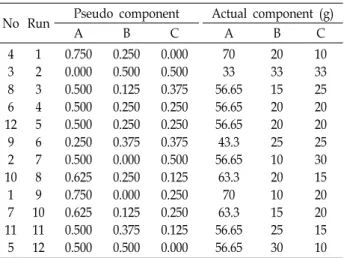
MINITAB 17 (Minitab Inc, state college, USA) 을 이용하여 혼합 최적 비율을 알기 위해 혼합물 설계하였다. 머위, 수세미, 어성초의 각 혼합 비율을 Table 1와 같다. 머위, 수세미, 어성초 의 최소 및 최대 범위는 머위 30~70%, 수세미 10~30% 그리고 어성초 10~30%으로 하였고, 실험은 중심에 반복점을 더 하여 총 12개의 설계점(Fig. 1)으로 수행하였다. 모든 실험 순서 (RUN)는 오차를 줄이기 위해 무작위로 실행하였다.
추출 제조
머위 잎, 수세미 그리고 어성초는 40℃에서 건조(DE/ULE 400, Memmert, Nuremberg, Germany)한 후 사용하였다. 모 든 시료들은 분쇄기(HMF-3100S, Hanil Electric Co., Seoul, Korea)를 이용해서 마쇄하여 사용하였다. 설계된 조건(Table 1)을 바탕으로 원료의 비율대로 합하여(각 설계점의 총 원료량 합 = 100 g) 중탕추출기(Dongnam Co., Daejeon, Korea)를 이 용하여 121℃에서 45분간 증류수 500 ml 와 함께 열수 추출을 하였다. 이어 추출물은 Whatman NO.2를 사용하여 1차 여과 를 한 후 Whatman GF/F 90 mm로 감압여과를 2차로 하였다.
Cell 배양
Rat RBL-2H3 cell을 American Type Culture Collection (ATCC, Manassas, VA)에서 분양 받았으며 5% CO
2incubator (Forma-3110, forma scientific Inc., Ohio, USA)에서 37℃에 배양하였다. 그리고 RBL-2H3 세포를 열에 불활성화된 10%
(v/v) fetal bovine serum(FBS), 100 units/ml penicillin, 50 μg/ml streptomycin, 2 mM glutamine 그리고 1 mM sodium pyruvate를 포함한 Dulbeco's Modified Eagle's Medium (DMEM) 에 현탁 시켜 사용하였다[10].
Anti-allergy activity 측정
혼합 추출물의 anti-allergy activity 효과는 이전에 Dear-
man의 연구를 바탕으로 RBL-2H3 세포로부터 β-hexosamini-
dase의 방출 억제 효과를 측정하였다[10]. RBL-2H3 cell (2×10
5cells/well)을 24 well plate에 접종하고, cell에 dinitrophenyl-
Table 2. Inhibition effect of the mixtures on degranulation
No Run Pseudo component Actual component (g) Inhibition effect on
degranulation2
A1 B C A B C
4 3 8 6 12
9 2 10
1 7 11
5
1 2 3 4 5 6 7 8 9 10 11 12
0.750 0.000 0.500 0.500 0.500 0.250 0.500 0.625 0.750 0.625 0.500 0.500
0.250 0.500 0.125 0.250 0.250 0.375 0.000 0.250 0.000 0.125 0.375 0.500
0.000 0.500 0.375 0.250 0.250 0.375 0.500 0.125 0.250 0.250 0.125 0.000
70 33 56.65 56.65 56.65 43.3 56.65
63.3 70 63.3 56.65 56.65
20 33 15 20 20 25 10 20 10 15 25 30
10 33 25 20 20 25 30 15 20 20 15 10
11.8369 11.9231 10.1701 11.0478 11.7054 10.5217 8.4174 11.8369 11.4423 11.1793 12.2315 4.9978
1A: Petasites japonicus B:Luffa cylindrica C: Houttuynia cordata.
2Inhibition effects are expressed as the remained number from that control value (16.77) minus β-hexosaminidase release rate (%).
immunoglobulin E (DNP-IgE, 0.5 μg/ml)를 처리하여 5%
CO
2incubator에서 37℃에서 12시간 배양 하였다. 각 well의 세포들을 PIPES buffer (pH 7.2; 25 mM PIPES, 110 mM NaCl, 5 mM KCl, 5.6 mM glucose, 0.4 mM MgCl2, 0.1% BSA and 1 mM CaCl
2)로 DNP-IgE를 제거하기 위해 2회 수세하였다.
그런 후 각 well에 PIPES buffer 500 μl와 각 추출물 10 μl씩 로딩 후 5% CO
2incubator에서 37℃로 60분간 반응시켰다.
이 때 각 추출물은 PIPES buffer로 20배 희석한 것을 사용하였 다. 또 각 well에 degranulation 시키기 위해 10 mg/ml의 hu- man dinitrophenyl serum albumin (DNP-HSA, A6661 Sigma, St. Louis, MO) 300 μl를 반응 시킨 후 1시간 20분 동안 37℃에서 배양하였다. 각 well의 상층액 50 μl를 96-well plate 에 옮겼고, 0.1 M sodium citrate buffer에 1 mM p-nitro- phenyl-N-acetyl-β-D-glucosaminide (N9376, Sigma,St.Louis) 과 0.5% Triton X-100를 반응시킨 50 μl를 37℃에서 1시간 동안 반응시켰다. 마지막으로 0.05 M sodium carbonate buffer (pH 10.0; 0.05 M Na₂CO
3/0.05 M NaHCO
3) 250 μl를 반응시킨 후 microplate reader를 이용하여 410 nm에서 흡광도를 측정 하여 β-hexosaminidase 방출량을 나타내었다. Degranulation (%)는 총 β-hexosaminidase activity 에 대한 방출된 β -hexosaminidase의 비율로 계산하였다.
사용 균주 및 배지
미생물은 한국미생물보존센터(KCCM, Seoul, South-Korea) 에서 총 4개의 미생물을 분양 받았다. 그람양성균인 Stapylo- coccus aureus (KCCM 40881), Stapylococcus epidermidis (KCCM 35494)과 그람음성균인 Escherichia coli (KCCM 11234), Pseudo- monas aeruginosa (KCCM 11328)이다. 각 미생물들의 배지는 Tripticase Soy Broth/Trapticase Soy Agar (TSB/TSA, Difco, USA)에서 배양하였고, anti-microbial activity은 Mueller Hinton
Agar (MHA, Difco, USA)에서 측정하였다.
Anti-microbial activity 측정
anti-microbial activity 검색을 위하여 well diffusion meth- od법[19]을 변형하여 실험하였다. 각 균주를 TSB 배지에서 2 회 계대 배양하여 사용하였으며 균의 활성은 UV spectropho- tometer (Optizen POP, Mecasys co., Daejeon, Ltd, Korea)를 이용하여 650 nm에서 optical density (O.D) 값 0.4가 되게 맞 춘 후 사용하였다. MHA 배지에 soft agar (0.8% agar)를 이용 하였고, pour-plate 방법에 따라 배지가 분주 된 배양 접시에 균일하게 섞은 후 실온에서 응고 시켜 pasteur pipette을 이용 하여 직경 6 mm의 well을 만들어 각각의 well에 추출물 70 μl과 negative control로 ether (99%, Junsei, Japan)을 주입하였 다. 그런 후, 37℃에서 24시간 배양하면서 저해환의 생성 유무 및 직경의 크기를 확인 하였다. 각 추출물 350 ml에 99% ether 를 사용하여 분액 깔때기로 3번 추출한 후 감압농축을 하여 3 ml로 정용한 후 사용하였다.
통계 분석
모든 설계점에서 랜덤으로 3반복 실시하였고, Degranula- tion와 anti-microbial activity 값의 통계 처리는 MINITAB 17 (Minitab Inc., State College, PA, USA)을 이용하여 mean±
standard deviation (n=3)으로 나타내었다. Degranulation은 평균 값을 바탕으로 혼합물 설계와의 관계를 회귀분석을 하였 고, 최적 혼합 설계점을 구축하였다.
결과 및 고찰
Anti-allergy activity
혼합비율에 따른 각 추출물을 20배 희석하여 RBL-2H3 cell
Fig. 2. Response surface on the inhibition effect on degra- nulation.
Fig. 3. Contour map of the inhibition effect on degranulation.
Table 3. Regression analysis of the inhibition effect on degranulation
Response F P R2 (%) Equation on terms of pseudo component
Regression analysis Linear
Quadratic A*B A*C B*C
5.50 11.64 8.85 1.91 0.00 20.23
0.030 0.009 0.013 0.217 0.966 0.004
82.10 Y1 = 14.98A-14.63B+1,03C+23.22AB-0.76AC+74.12BC
A : Petasites japonicus, B : Luffa cylindrical, C : Houttuynia cordata
Fig. 4. Trace plot of the inhibition effect on degranulation.
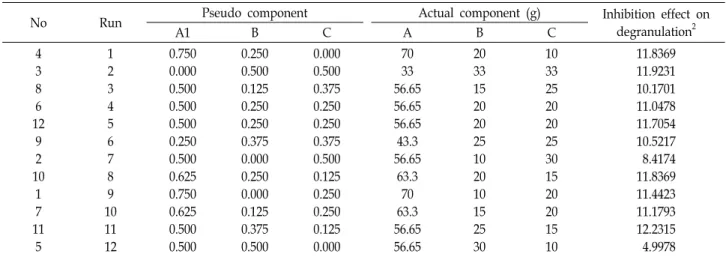
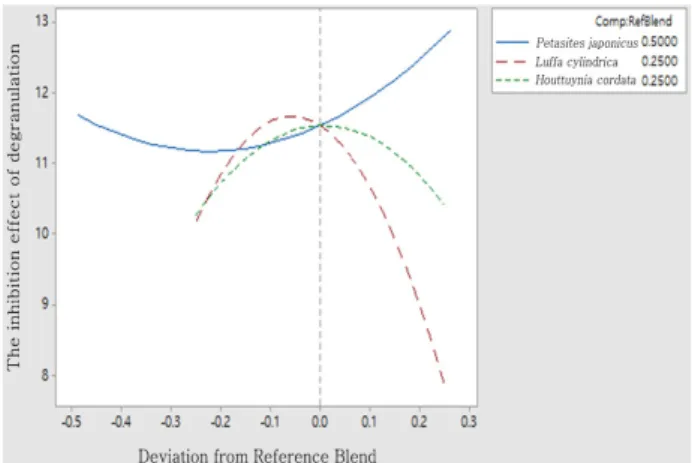
에 대한 anti-allergy activity 실험의 결과는 다음 Table 2와 같다. Table 2에 나타낸 값은 control 값인 16.77에서 각 추출물 의 β-hexosaminidase 값(%)을 뺀 값을 바탕으로 혼합물 설계 와의 관계를 분석하였다. Response surface와 trace plot (Fig.
2-3)를 보면 머위가 가장 큰 영향을 주었고, 수세미는 다소 약 한 영향을 미친다는 양상을 알 수 있다. 다중회귀분석의 결과 는 Table 3에 나타내었는데 degranulation의 저해에 대한 상관 계수 값은 82.10%이며, 전체 회귀분석의 결과는 p값 0.030 (p<0.05)으로 유의성이 있다고 할 수 있다. 뿐만 아니라 1차회 귀방정식에서는 p값이 0.009(p<0.05), 2차회귀방정식에서는 0.013(p<0.05) 으로 유의성 있는 것으로 나타났다. 그 모델식은 다음과 같다; Y=14.98A-14.63B+1,03C+23.22AB-0.76AC+
74.12BC.
최종적으로 최적의 혼합 설계점은 머위 0.75%, 수세미 0.14
%, 어성초 0.11% 의 비율이라는 것을 알 수 있었다(Fig. 4-5).
또한, 혼합 설계점의 대부분에서 anti-allergy activity 효과가 우수한 결과를 보이므로 알레르기성 호흡기계 질환에 대한 효과도 좋을 것으로 전망된다. 이전 연구에서 머위는 RBL- 2H3 cell에 대한 degranulation의 저해 활성 뿐만 아니라 염증 물질인 inducible nitric oxide synthase (iNOS) 와 Cycloox- ygenase 2 (COX-2)을 저해하는 항염 활성도 좋다는 결과가 있었으며[16, 19], 어성초 또한 degranulation의 저해 효과와 NF-κB의 항원 유도 활성화와 Reactive Oxygen Species (ROS) 의 생산을 억제한다는 결과가 보고된 바 있다[13].
Anti-microbial activity
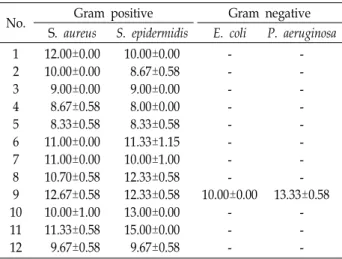
Anti-microbial activity의 결과는 Table 4와 같다. 전반적으
로 모든 추출물에서 큰 차이를 보이진 않지만 대체적으로 모
든 추출물은 negative control인 ether과 비교하여 그람양성균
인 S. aureus와 S. epidermidis에서 anti-microbial activity이 유
효한 것으로 나타났다. S. aureus는 No. 9 추출물에서 12.67
mm로 가장 크게 저해환이 나타났으며 그 다음 No. 1 추출물
에서 12.00 mm, No. 11 추출물 11.33 mm의 순으로 활성이
작게 나타났다. S. epidermidis는 No. 11 추출물에서 15.00 mm
로 가장 큰 저해환이 나타났고 No. 8 추출물과 No. 9 추출물에
Fig. 5. The optimal ratio of mixture design.
Table 4. Anti-microbial activity on the mixtures (unit=mm)
No. Gram positive Gram negative
S. aureus S. epidermidis E. coli P. aeruginosa 1
2 3 4 5 6 7 8 9 10 11 12
12.00±0.00 10.00±0.00 9.00±0.00 8.67±0.58 8.33±0.58 11.00±0.00 11.00±0.00 10.70±0.58 12.67±0.58 10.00±1.00 11.33±0.58 9.67±0.58
10.00±0.00 8.67±0.58 9.00±0.00 8.00±0.00 8.33±0.58 11.33±1.15 10.00±1.00 12.33±0.58 12.33±0.58 13.00±0.00 15.00±0.00 9.67±0.58
- - - - - - - - 10.00±0.00
- - -
- - - - - - - - 13.33±0.58
- - -
서 12.33 mm로 비슷한 활성을 나타냈다. 반면에 그람음성균 인 E.coli와 P. aeruginosa 에서는 No. 9 추출물에서 E .coli는 10.00 mm와 P. aeruginosa는 13.33 mm로 가장 뚜렷했으며 다 른 추출물에서는 미미한 결과가 나타났다. 따라서 anti-micro- bial activity이 전체적으로 뚜렷하게 나타난 추출물은 No. 9이 며, 각각 균에 대해 최대 활성을 나타내는 추출물은 다르지만 전반적으로 머위의 함유가 많이 되어 있는 추출물에서 an- ti-microbial activity이 강한 것으로 알 수 있다(Fig. 6). 비염, 천식 등 호흡계 질환은 중국의 황사 문제 뿐만 아니라 현대사 회에서 대기오염과 관련하여 환경성 질환이 문제시되고 있으 며 특히 소아·청소년기 유병률이 뚜렷이 증가되고 있다[1, 15], 특히 Nenad Pandak et al의 연구에서 만성비염, 축농증 등의 환자들의 부비강에 대부분 Staphylococcus epidermidis, Staphy- lococcus aureus, Klebsiella spp. 그리고 Streptococci 등의 병원성 미생물을 발견한 것으로 보고[20] 하였다. 따라서 머위, 수세미 그리고 어성초의 혼합 추출물이 호흡기계 질환에 관련된 an- ti-allergy activity와 anti-microbial activity에 대한 효과 있는 것으로 보아 향후 고부가가치 기능성 음료의 개발 가치가 있 는 것으로 사료된다.
Fig. 6. Anti-microbial activity of extract No.9 (S. aureus, S.
epidermidis, E. coli, P. aeruginosa).
감사의 글
본 연구는 농림수산식품부의 농림수산식품개발사업의 연 구비로 수행되었음에 감사드립니다.
References
1. Asher, M. I., Montefort, S., Bjorksten, B., Lai, C. K., Strachan, D. P., Weiland, S. K., Williams, H. and the ISAAC Phase Three Study Group. 2006. Worldwide time trends in the prevalence of symptoms of asthma, allergic rhinoconjuncti- vitis, and eczema in childhood; ISAAC phases one and three repeat multicountry cross-sectional surveys. Lancet 368, 733-743.
2. Bernstein, J. A. 2004. Health effects of air pollution. J. Allergy Clin. Immunol. 114, 1116-1126.
3. Cha, J. Y., Jeon, B. S., Park, J. W., Moon, J. C. and Cho,
Y. S. 2004. Effect of fermented compositions containing Inonotus obliquus with Houttuynia cordata on growth of hu- man AGS gastric and HCT-15 colon cancer cells. J. Kor. Soc Appl. Biol. Chem. 47, 202-207.
4. Cha, S. Y., Jang, J. Y., Lee, Y. H., Lee, G. O., Lee, H. J., Hwang, K. T., Kim, Y. J., Jun, W. J. and Lee, J. M. 2010.
lipolytic effect of methanol extracts from Luffacylindrica in mature 3T3-L1 adipocytes. J. Kor. Soc. Food Sci. Nutr. 39:
813-819.
5. Chang, K. W., Moon, C. S., Lee, H. D., Lee, C. J. and Lee, V. C. 1991. Determination of the effective components in the various parts of Luffa cylindrica (L.) Roemer and develop- ment to remove the flesh from its fruit; (Ⅰ) Determination of chemical components in the vareious parts of Luffa cylin- drica (L.) Roemer by GC and GC/MS. J. Kor. Agric. Chem.
Soc. 34, 366-372.
6. Cho, B. S., Lee, J. J., Ha, J. O. and Lee, M. Y. 2006. Physico- chemical composition of Petasites japonicus S. et Z. Max. Kor.
J. Food Preserv. 13, 661-667.
7. Cho, S. Y., Han, Y. B. and Shin, K. H. 2001. Screening for antioxidant activity of edible plants. J. Kor. Soc .Food Sci.
Nutr. 30, 133-137.
8. Choi, O. B. 2002. Anti-allergic effects of Petasites japonicum.
Kor. J. Food. Nutr. 15, 382-385.
9. Chung, C. K., Ham, S. S., Lee, S. Y., Oh, D. H., Choi, S.
Y., Kang, I. J. and Nam, S. M. 1999. Effects of Houttuynia cordata ethanol extracts on serum lipids and antioxidant en- zymes in rats fed high fat diet. J. Kor. Soc. Food Sci. Nutr.
28, 205-211.
10. Dearman, R. J., Skinner, R. A., Deakin, N., Shaw, D. and Kimber, I. 2005. Evaluation of an in vitro method for the measurement of specific IgE antibody responses; the rat ba- sophilic leukemia (RBL) cell assay. Toxicology 206, 195-205.
11. Eliott, M. Jr. 1996. Biological properties of plant flavonoids:
and overview. J. Pharmacogn. 34, 344-348.
12. Haemmerle, G., Lass, A., Zimmermann, R., Gorkiewicz, G., Meyer, C., Rozman, J., Heldmaier, G., Maier, R., Theussel, C., Eder, S., Kratky, D., Wagner, E. F., Klingenspor, M., Hoefler, G. and Zechner, R. 2006. Defective lipolysis and altered energy metabolism in mice lacking adipose trigly- ceride lipase. Science 312, 734-737.
13. Han, E. H., Park, J. H., Kim, J. Y., Jeong, H. G. 2009.
Houttuynia cordata water extract suppresses anaphylactic reaction and IgE-mediated allergic response by inhibiting multiple steps of FceRI signaling in mast cells. Food. Chem.
Toxicol. 47, 1659-1666.
14. HIRA (Health Insurance Review & Assessment Service).
http://www.hira.or.kr
15. Jee, H. M., Kim, K. W., Kim, C. S., Sohn, M. H., Shin, D.
C. and Kim, K. E. 2009. Prevalence of asthma, rhinitis and eczema in korean children using the international study of asthma and allergies in childhood (ISAAC) questionnaires.
Pediatr. Allergy Respir. Dise. 19, 165-172.
16. Kim, J. H., Kim, Y. M., Chung, H. S., Choi, Y. W., Lee, K.
P., Im, D. S., Lee, Y. G. 2014. Optimization of Extraction Conditions for Bakkenolide B from the Leaves of Petasites japonicus by Using Response Surface Methodology. J. Life Sci. 24, 167-172.
17. Kim, S. K., Ryu, S. Y., Choi, S. U. and Kim, Y. S. 2001.
Cytotoxic alkaloids from Houttuynia cordata. Arch. Pharm.
Res. 24, 518-521.
18. Lee, K. P., Kang, S., Park, S. J. Choi, Y. W., Lee, Y. G. and Im, D. S. 2013. Anti-allergic and anti-inflammatory effects of bakkenolide B isolated from Petasites japonicus leaves. J.
Ethnopharmcol. 148, 890-894.
19. Nathan, P., Law, E. J., Murphy, D. F. and MacMillan, B.
C. 1978. A laboratory method for selection of topical anti- microbial agents to treat infected burn wounds. Burns 4, 177-187
20. Pandak, N., Pajic-penavic, L. and et al. 2011. Bacterial colo- nization or infection in chronic sinusitis. Wien. Klin.
Wochenschr. 123, 710-713.
21. Oh, S. H., Yang, Y. H., Kwan, O. Y. and Kim, M. R. 2006.
Effects of diet with added Butterbur (Petasites japonicus Maxim) on the plasma lipid profiles and antioxidant index of mice. J. East Asian Soc. Dietary Life 16, 399-407.
22. Song, J. H., Kim, M. J., Kwon, H. D. and Park, I. H. 2003.
Antimicrobial activity of fractional extracts from Houttuynia Cordara root. J. Kor. Soc. Food Sci. Nutr. 32, 1053-1058.
23. Wang, G. J., Shum, A. Y., Lin, Y. L., Liao, J. F., Wu, X. C., Ren, J. and Chen, C. F. 2001. Calcium channel blockade in vasscular smooth muscle cell is major hypotensive mecha- nism of S-petasin, a hypotensive sesquiterpene from Petasites formosanus. J. Pharmacol. Exp. Ther. 297, 240-246.
24. World Health Organization (WHO). 2003. Health aspects of air pollution with articulate matter, ozone and nitrogen dioxide, pp. 7-56, Report on a WHO working Group, EUR/03/
5042688, Bonn, Germany.
25. Yoo, J. and Song, D. S. 2004. The Houttuynia cordata drink's fatigue-relieving effect on athletes and general population.
J. Kor. Sport Res. 15, 1345-1356.
초록:혼합물 실험계획법에 의한 머위 및 부원료의 혼합비율 최적화
정해진
1․이경필
3․정헌식
1․김동섭
1․김한수
1․최영환
2․임동순
3․성종환
1․이영근
1*
(1부산대학교 식품공학과, 2부산대학교 원예생명과학과, 3부산대학교 약학과)