공동주택의 분별해체 시험시공을 통한 건설폐기물 발생량 비교 분석
김효진1·강인석2·김창학*
1한국토지주택공사 주택도시연구원·2경상대학교 공학연구원 토목공학과
A Comparative Analysis on Generated Construction Waste Quantities in a Case Study for Deconstruction of an Apartment
Kim, Hyojin
1, Kang, Leenseok
2, Kim, Changhak
*1Urban and Environment research division, Land and Housing Institute, LH
2Department of Civil Engineering, Engineering Research Institute, Gyeongsang National University
Abstract : Deconstruction of the building must be applied firstly in order to improve recycling and reuse of construction wastes. In this study have done a case study for deconstruction of an apartment. All construction waste(CW) which will be generated during deconstruction was examined in each part of the building. Because drawing did not exist in most of the old building, we drew up floor plans of buildings. After analyzing these drawings, estimated quantities of CW. It was measured working time of labor and equipments for deconstruction and general demolition on each building of the apartment. In addition, it was proposed in the volume and weight per unit after analyzing detailed measurement of CW which was generated in the process of deconstruction and traditional demolition. It suggested recovery rate at a site, volume and weight conversion factors, and waste basic unit per area that based on the results of comparative analysis on the amount of CW which is calculated from drawing and generated at a site. These factors will be used fundamental materials for estimating quantities and treatment cost of CW, and scheduling of works.
Keywords : Deconstruction, Demolition, Construction Waste, Basic Unit
* Corresponding author: Kim, Changhak, Department of Civil Engineering, Gyeongnam National University of Science and Technology, Jinju 660-758, Gyeongnam, Korea
E-mail: [email protected]
Received August 26, 2014: revised October 10, 2014 accepted October 13, 2014
1. 서론
1.1 연구의 배경 및 목적
1.1.1 연구의 배경
국내 폐기물의 발생량은 2012년 기준 총 382천 톤/일 이 발생하고 있으며, 이중 건설폐기물은 49%인 186천 톤/일 이 발생하여 가장 높은 비율을 차지하고 있다. 또한 건설폐 기물 1일 발생량 186천 톤 중 45.3%가 서울, 경기, 경북 지 역에서 발행하고 있다(KWA). 이는 인구점유율이 높은 지 역으로 건축수요가 많은 곳에서 건설폐기물의 발생량 또한 많이 발생하고 있는 것을 알 수 있다. 건설폐기물의 발생량 기준으로 보면 해체공사에서 약 95%, 신축공사에서 약 5%
가 발생(Park and Song 2012) 하고 있으므로 건설폐기물
의 증가를 저감하기 위해서는 해체시 혼합폐기물의 발생을
줄일 수 있는 방법을 연구하는 것이 매우 중요함을 알 수 있
다. 그러나 국내의 공동주택 해체 현장 대부분은 별도의 분
별해체는 시행하지 않고, 기존 구조물을 선 해체한 후 철근
및 금속 등과 같은 유가성 금속만을 분리선별 하는 전통적
해체방법을 시행함으로서 혼합폐기물이 다량 혼합되어 배
출되고 이 때문에 건설폐기물의 재활용률이 매우 낮다. 따
라서 건설폐기물의 재활용율과 품질을 높이기 위해서는 분
별해체가 더욱 활성화되어야 한다. 그러나 분별해체를 하는
경우 해체 단가의 상승이 이루어지게 됨으로 이를 시행하지
못하고 있다. 분별해체와 일반해체의 공사비용 분석결과 분
별해체비용이 일반해체비용보다 약 25% 높게 산출되었으나
폐기물 처리 비용은 약 17% 감소하여 분별해체 비용이 단
지 5.8% 높게 나타나는 것으로 분석되었다(Park and Song
2012). 따라서 분별해체 폐기물의 재활용률을 높일 수 있는
해체기술의 개발과 재활용기술을 개발하면 이러한 차이는
충분히 극복할 수 있을 것으로 사료된다. 따라서 건설폐기
물의 재활용률을 높이기 위해서는 반드시 분별해체가 선행
되어야 하고, 이를 지원하기 위한 관련법규와 기준이 잘 정 비되어야 할 것이다. 그러나 국내의 경우 분별해체를 위한 물량산정방법, 생산성분석, 품기준 등의 기준이 부족하여 작업계획 수립 및 견적 등을 위한 관련 지침이 없는 실정이 다. 따라서 본 연구는 근래 활발히 이루어지고 있는 공동주 택의 해체시 분별해체 계획과 물량산정에 필요한 해체폐기 물의 종류별 발생량 산정기준 마련을 위한 기초자료를 제공 하는 그 목적이 있다.
1.2 연구의 범위 및 방법
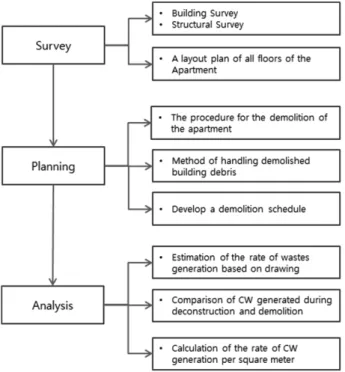
본 연구는 공동주택 재건축 현장을 대상으로 분별해체공사 및 일반해체공사의 비교분석을 실시하기 위해 시험시공을 실 시한다. 시험시공절차는 Fig. 1과 같이 사전조사를 실시하여 분별해체 대상 및 부위별 발생 폐기물의 종류를 조사하고, 조 적 및 콘크리트류의 발생량을 정확히 예측하기 위해 공동주 택을 정밀 실사하여 도면을 작성하였다. 현장 실측조사는 건 물 내·외부 조사 및 내장재 등을 조사하고 필요하면 추가 도 면을 작성한다. 현장조사 결과를 토대로 해체공사를 실시하 기 위해 작업 공정표를 작성하고 투입인원, 장비, 해체방법 등을 실사하고 기록한다. 분별해체의 결과를 분석하기 위해 분별해체와 일반해체를 동별로 실시하여, 건설페기물의 발생 량을 실측하고 도면에서 예측된 발생량과의 비교, 분별해체 와 일반해체에서 발생되는 건설페기물 발생량 비교, 투입 노 무 및 작업시간 비교, 단위면적당 투입 해체시간 및 인원 등 을 산정·비교 하여 제시한다.
Fig. 1. Research Procedure
2. 국내·외 연구동향 2.1 국내연구동향
국내의 건축물을 대상으로 한 해체공사 관련 연구가 최근 에 국토교통부의 지원으로 활발히 이루어지고 있으며, 그 결 과의 일환으로 해체공사시 분별해체가 의무화되어 건물내부 에 있는 폐기물을 우선 제거하여 건설폐기물과 혼합되지 아 니하도록 하는 법률이 제정되었다(건폐법 5조, 6조). 그러나 이렇듯 법적 기준은 설정되어 있지만 현장에서 이의 적용을 위한 계량화된 기본 자료가 미비하여, 그 적용이 잘 이루어지 지 못하고 있다.
HRI(2009)는 분별해체를 위한 적정 공사비를 산정하기 위 한 기준을 제시하기 위하여 시설물별 건설폐기물 발생량을 조사하여 품산정을 위한 분별해체 품을 제안하였다. 그러나 발생원단위의 제안이 분별해체 재료별 세부제안이 아니라 건 설폐기물 발생량을 5종으로 구분하여 제안하였다.
Park and Song(2012)은 건축물의 분별해체 제도 도입을 위해 일반해체와 분별해체 적용시 해체공사비용을 비교분 석하여 분별해체 도입이 타당하다는 결론을 제시하였으며, Park et al.(2013)연구에서는 건축물의 분별해체 제도 도입 을 위한 적용대상 건축물의 범위를 총면적과 용도별로 구분 하여 도입할 것을 제안하였다. Lee et al.(2009)는 상업용 건 물을 대상으로 건축물 내장재의 분별해체와 일반해체시 투입 인원 및 시간, 부위별 폐기물 발생량 등을 실사하여 제시하였 다. Kim et al.(2008)연구에서는 공동주택 일반해체 현장의 사례분석을 실시하여 폐기물 발생량을 비교분석 하였고, 해 체공사비산정 및 폐기물관리를 위한 전산시스템의 제안 관 련된 연구(Cha et al. 2014, Kim et al. 2014, Kim and Kim 2011, Kim 2012), 리모데링 철거공사 기간산출방안(Woo et al. 2013)등의 연구가 실시되었다.
그러나 이들의 공통적 문제점은 해체 현장의 실사시 발생 페기물별 상세 원단위 및 체적증가, 중량환산 등의 계수가 발 표되지 않아 건설페기물의 운반량 산정 등의 산정 예측에 어 려움이 있다.
2.2 국외연구
국외 연구사례를 살펴보면 유럽을 포함한 선진외국에서는 분별해체에 대한 연구가 활발히 이루어지고 있고, 해체산업 계에서 또한 일반화되어 널리 활용되고 있다.
일본의 경우 2002년 262개의 분별해체구조물에 현장 실험 을 실시하여 구조별, 용도별로 조사하고 통계 처리하여 관련 자료들을 제시하였고(KWA 2004), 건설폐기물에 대한 재활 용에 관한 법률이 제정(2000년 2월)되어 건설폐기물의 재활 용률을 99%까지 높이기 위한 노력을 지속해오고 있다.
유럽은 우리와 같이 건축물을 전면해체 한 후 신축하기 보
다는 리모델링이 선호되고 있고, 전면해체의 경우 엄격히 제 안하고 있으므로 분별해체가 활용되고 있다(MICT 2004).
미국은 해체폐기물의 환경, 사회 및 경제에 미치는 효과를 최소화기 위해 Green Demolition이라는 개념을 도입하기 위 한 연구를 진행하고 이를 활성화하기 위한 방안으로해체공사 의 조사, 계획, 해체방법, CW처리방법 등에 점수를 부여하여 일정점수를 획득하면 자격 증명서를 발급하는 방안을 제안하 였다(Brad G 2003). 이후 Green Demolition분야에 대한 후 속연구가 활발히 진해되고 있다.
3. 시험시공 3.1 일반현황
공동주택의 재건축 현장에서 분별해체에 대한 시험시공 을 실시하고, 분별해체 전 과정에 대한 정밀실사를 실시한다 (MCT 2004, MLTM 2012). 실사현장 대상 공동주택의 경우 4층, 56.1m
2, 32세대로 구성되었으며, 2개동은 분별해체, 1 개동은 기존 해체방법을 실시하여 시공성, 경제성, 현장 발생 재의 성상별 회수율, 체적환산율, 원단위 기준을 제시한다.
시험시공 대상 현황과 해체방법은 Table 1과 Table 2와 같다.
Table 1. General Information for field measurement
General Information Building Information
Location Oo Apartments, Geoje City Floor Space 4 floor56.27m2
Survey Methods
Deconstruction, Detailed Examinations, Two Building
Completed
Year before 1980 Traditional Demolition, Detailed
Examinations, One Building
A Number
Of House 32
Traditional Demolition, General Examinations, Eight Building
Total
Space(M2) 1,771.9
Table 2. Field measurement methods for demolition works
Deconstruction Traditional demolition Apartment Building A Apartment
Building B
Apartment Building C
Interior Labor
Structure, crusher(1.0m3) Structure
Waterproof and protective layer
demolition, breaker(0.7m3) Structure, crusher(1.0m3) Structure, crusher (1.0m3)
Fig. 2. Floor Plan
3.2 현장실측조사
분별해체 시험시공 대상 아파트에 대한 도면의 부재로 현 장실측을 실시하여 도면을 작성하였다. 이 도면은 해체공사 를 실시하기 전 도면분석을 통해 부위별 면적을 계산하여 건 설페기물 별 발생량을 예측하는 자료로 활용하였다. 예측된 발생량은 해체현장에서 발생된 자료와 비교분석을 실시하게 된다. 현장실측 결과로 판단할 수 없는 부위에 대해서는 해당 해체건물과 유사한 설계도면을 참고하였다. 사전조사에 의한 건물 외부 및 내부의 실측 조사활동에 대한 현황은 Fig. 3과 같다.
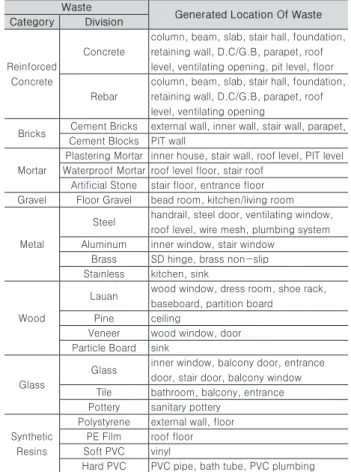
분별해체를 실시하기 전 발생 가능한 건설페기물의 종류의 대분류와 중분류로 구분하고 발생부위를 조사하였으며, 종류 별 조사부위는 Table 3과 같다.
Table 3. Generated location of demolition waste Waste
Generated Location Of Waste Category Division
Reinforced Concrete
Concrete
column, beam, slab, stair hall, foundation, retaining wall, D.C/G.B, parapet, roof level, ventilating opening, pit level, floor
Rebar
column, beam, slab, stair hall, foundation, retaining wall, D.C/G.B, parapet, roof level, ventilating opening
Bricks Cement Bricks external wall, inner wall, stair wall, parapet, Cement Blocks PIT wall
Mortar
Plastering Mortar inner house, stair wall, roof level, PIT level Waterproof Mortar roof level floor, stair roof
Artificial Stone stair floor, entrance floor Gravel Floor Gravel bead room, kitchen/living room
Metal
Steel handrail, steel door, ventilating window, roof level, wire mesh, plumbing system Aluminum inner window, stair window
Brass SD hinge, brass non-slip Stainless kitchen, sink
Wood
Lauan wood window, dress room, shoe rack, baseboard, partition board
Pine ceiling
Veneer wood window, door Particle Board sink
Glass
Glass inner window, balcony door, entrance door, stair door, balcony window Tile bathroom, balcony, entrance Pottery sanitary pottery
Synthetic Resins
Polystyrene external wall, floor PE Film roof floor Soft PVC vinyl
Hard PVC PVC pipe, bath tube, PVC plumbing
3.3 해체공사 작업공정
시험시공은 분별해체와 기존해체 방법으로 구분하여 작업
공정을 분석하고 그 작업공정도에 따라 시험시공을 실시하였
다. 공동주택에 적합한 분별해체 작업은 Fig. 3과 같이 수행
하고, 본 현장의 시험시공 절차는 Fig. 4와 같다. 분별해체의
작업공정은 먼저 내장재는 인력시공에 의하여 수지, 전등, 모
노륨, 창문, 창문유리, 천정, 철재류, 목재류, 스치로품의 내 장재를 분리해체 및 반출하고, 본 구조물은 작업은 조적류와 콘크리트류로 구분하여 해체를 실시하였다. 조적류는 옥상모 르타르, 조적조, 정리 작업으로 구분하였고, 철근콘크리트류 는 지상층, 지하층, 기초층으로 구분하고 압쇄, 소할, 정리로 구분하여 실측하였다.
기존철거방법은 내장재는 알루미늄 및 황동 논슬립만 인력 철거하고 본구조물은 조적류의 구분 없이 지상층, 지하층으 로만 구분하여 해체를 실시하였다.
(a) Apartment Survey (b) Survey of Housing Units
(c) Basement Survey (d) Measure
Fig. 3. Site Survey for Deconstruction
Fig. 4. Deconstruction Procedures for a Case Study
4. 시험시공 성과분석
4.1 도면분석에 의한 해체수량 산출
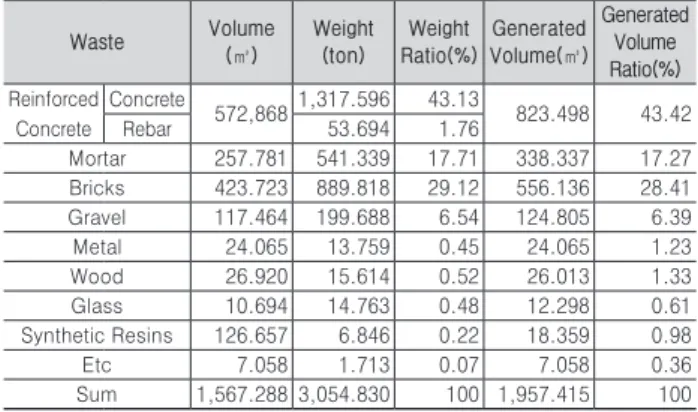
현장에서 실측자료를 근거로 작성된 도면들을 통해서 분별 해체가 시행된 대상 건물에 대한 도면을 분석하여 해체수량 을 산출하였다. 이러한 폐기물 별로 종합 정리하면 Table 4 와 같다. 좀 더 세분화하여 부위별 세부 산출결과의 일부는 Table 5와 같고, 이의 종합결과는 Table 6과 같다.
Table 4. Estimated waste quantities from drawings
Waste Volume
(㎥)
Weight (ton)
Weight Ratio(%)
Generated Volume(㎥)
Generated Volume Ratio(%)
ReinforcedConcrete Concrete
572,8681,317.596 43.13
823.498 43.42
Rebar 53.694 1.76
Mortar 257.781 541.339 17.71 338.337 17.27 Bricks 423.723 889.818 29.12 556.136 28.41 Gravel 117.464 199.688 6.54 124.805 6.39
Metal 24.065 13.759 0.45 24.065 1.23
Wood 26.920 15.614 0.52 26.013 1.33
Glass 10.694 14.763 0.48 12.298 0.61
Synthetic Resins 126.657 6.846 0.22 18.359 0.98
Etc 7.058 1.713 0.07 7.058 0.36
Sum 1,567.288 3,054.830 100 1,957.415 100
Table 5. Estimated waste quantities from each parts of building(A~I) A. concrete
(2,300kg/m3)
Parts Volume Weight
㎥ kg ton
Column 61.887 142,340 142.340
Beam 96.884 222,833 222.833
Slab 232.394 534,506 534.506
Stair Hall 46.644 107,281 107.281
Foundation 46.377 106,667 106.667
Retaining Wall 40.096 92,221 92.221
D.C / G.B 18.401 42,322 42.322
Parapet Etc 27.717 63,749 63.749
Sum 572,868 1,317,596 1,317.596
B. Rebar
Parts Volume Weight
㎥ kg ton
Column - 9,985 9.985
Beam - 16,668 16.668
Foundation - 2,198 2.198
Slab - 17,591 17.591
Stair Hall - 3,502 3.502
D.C / G.B - 882 0.882
External Wall - 2,869 2.869
Sum - 53,694 53.694
C. Bricks
(2,100kg/m3)
Division Quantity Volume Weight
EA ㎥ kg ton
1~4 Floor Cement Bricks 252,271 246.009 516,618 516.618
Mortar - 63.068 132,442 132.442
Stair Cement Bricks 74,581 72.729 152,731 152.731
Mortar - 24.595 51,650 51.650
Parapet Cement Bricks 8,032 7.832 16,448 16.448
Mortar - 2.008 4,217 4.217
Pit Wall Cement Bricks 991 6.682 14,032 14.032
Mortar - 0.800 1,680 1.680
Sum 423.723 889,819 889.819
D. metal
Division Volume Weight
㎥ kg ton
Steel 0.840 10,838 10.838
Aluminum 0.933 2,518 2.518
Brass 0.027 235 0.235
Stainless 0.034 264 0.264
Sum 1.834 13,855 13.855
E. Wood
(580kg/m3)
Division Volume Weight
㎥ kg ton
Lauan 18.508 10,735 10.735
Pine 1.191 691 0.691
Veneer 2.480 1,438 1.438
Particle Board 4.741 2,750 2.750
Sum 26.920 15,614 15.614
Table 6. The summary of detailed quantities on each parts of building
Waste Unit Weight
(Kg/㎥)
Quantities
Category Division Volume(㎥) Weight(Ton)
Reinforced Concrete
Concrete 2,300
572,868 1,317.596
Rebar 53.694
Mortar
Plastering Mortar 2,100 244.403 513.246 Waterproof Mortar 2,100 4.244 8.912
Artificial Stone 2,100 9.134 19.181
Masonry
Cement Bricks 2,100 326.570 685.797
Cement Blocks 2,100 6.682 14.032
Masonry Mortar 2,100 90.471 189.989 Gravel Floor Gravel 1,700 117.464 199.688
Metal
Steel 7.850 0.840 10.838
Aluminum 2,700 0.898 2.422
Brass 8.600 0.027 0.235
Stainless 7.800 0.034 0.264
Wood
Lauan 580 18.508 10.735
Pine 580 1.191 0.691
Veneer 580 2.480 1.438
Particle Board 580 4.741 2.750
Glass
Glass 2,500 1.527 3.51
Tile 2,100 4.551 9.557
Pottery 4.617 1.696
Synthetic Resins
Polystyrene 20 101.539 2.032
PE Film 920 0.024 0.022
Soft PVC 1,300 2.610 3.393
Hard PVC 1.400 17.696 0.569
PVC Pipe 4.788 0.830
Etc Fluorescent
Light/Bulb 7.058 1.713
4.2 현장 발생폐기물의 종류 및 성상 분석
4.2.1 발생 폐기물의 단위중량 산정
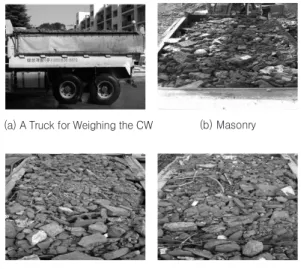
해체에 의해서 발생된 건설페기물의 종류에 따라 부피의 변화에 따라 단위 중량의 변화가 있게 되고 이것은 운반량 및 운반비 등에 영향을 미치게 되므로 현장에서 실제 발생된 잔 재의 유형별 단위중량에 대한 기준정립은 매우 중요하다. 본 연구에서는 내장재별 단위중량 산출을 위한 체적의 측정은 계량을 위한 운반차량의 적재함에 내장재 종류별 적재높이를 고려해서 현장에서 직접 측정하였다. 따라서 Table 7은 현장 에서 실제 발생된 내장재의 현장 단위중량이라고 할 수 있다.
조적재의 단위중량은 소형장비에 의해 분리해체가 실시된 후 15톤 덤프트럭을 이용하여 체적과 중량을 측정하는 방식 으로 측정하였다.
(a) A Truck for Weighing the CW (b) Masonry
(c) Deconstructed Concrete (d) Traditional Demolished Concrete Fig. 5. Weight and Volume Measure of demolished Concrete
Table 7. Unit weight of generated waste after deconstruction
Division (t/m
3)
Structure
Masonry Block, Mortar, Cement Brick 1.135
Deconstruction Concrete 1.425
General Demolition Concrete 1.381
Interior
Synthetic Resins
Polystyrene 0.035
Linoleum 0.977
Glass Fibber 0.125 Light Fluorescent Light/Bulb 0.015 Steel Steel Door, Hand Rail 0.230
Brass Non Slip 0.237
Nonferrous Metal Chassis 0.068
Stainless Sink 0.051
Wood Door, Window 0.238
Glass Window Glass 0.138
4.2.2 실제발생률을 고려한 현장 회수율
분별해체 시험시공 시에 발생된 잔재별 발생량과 도면분석
에 의한 사전 예측한 수량의 차이를 고려한 현장에서의 잔재
종류별 회수율은 Table 8과 같다. 회수율은 ‘실제 발생량/예
측물량’을 백분율로 나타낸 값을 말한다. 회수율의 차이는 도
면 분석 시 폐콘크리트와 철근 등에서 과소평가 된 요소가 있
고, 분별해체를 시행해도 현장에서 100% 회수가 불가능한데
서 그 원인을 찾을 수 있다. 내장재만의 실제 현장에서의 회
수율은 62% 정도의 값을 나타내고 있다. 따라서 실제 현장에
서 도면을 기준하여 예측한 물량에는 많은 오차가 발생할 수
있음을 의미한다.
Table 8. Collect rate of generated waste after deconstruction
Division Collect Rate (%)
Concrete 108
Rebar 124
Metals
Steel 56
Aluminum 61
Brass 128
Stainless 63
Wood Lauan, Pine 110
Glass
Glass 80
Tile 0
Sanitary Pottery 95
Synthetic Resins
Polystyrene 14
Polyethylene 0
Soft PVC 29
Hard PVC 98
PVC Pipe 0
Etc Fluorescent Light/Bulb 69
Sum 107
4.2.3 체적 및 중량환산계수
도면분석에서 예측한 물량과 현장에서 실제 발생한 물량을 비교분석하는 것은 해체현장에서 발생하는 물량을 예측하는 데 매우 중요한 요소이다. 따라서 본 연구에서는 현장의 실제 발생량과 도면발생량을 비교 분석하여 체적 및 중량환산계수 를 Table 9와 같이 제안하였다. 이는 공사비견적에 매우 중요 한 요소로서 추후 검증 등의 연구를 통해 표준품셈 등 공사비 견적기준에 반드시 반영되어야 할 요소이다.
Table 9. Suggestion of conversion factor for calculating volume and weight of waste
Division
Volume Conversion
Factor
Weight Conversion
Factor
Synthetic Resins
Linoleum 2.966 0.286
Polystyrene 0.182 0.141
Glass Fiber 2.578 1.396
Light Fluorescent Light/Bulb 5.452 0.553 Steel Steel Door, Hand Rail 2.940 0.545
Brass Brass Non Slip 1.567 0.898
Nonferrous Metal Aluminum Chassis 2.129 0.607
Stainless Sink 1.329 0.625
Wood Door, Window, Sink,
Mopboard 4.616 1.097
Glass Window 1.855 0.801
Concrete
Reinforced Concrete 1.697
1.073
Mortar 1.551
Masonry 1.549
Gravel 1.254
Tile 2.065
Average(Concrete) 1.623
4.2.4 현장발생 잔재의 원단위 비교
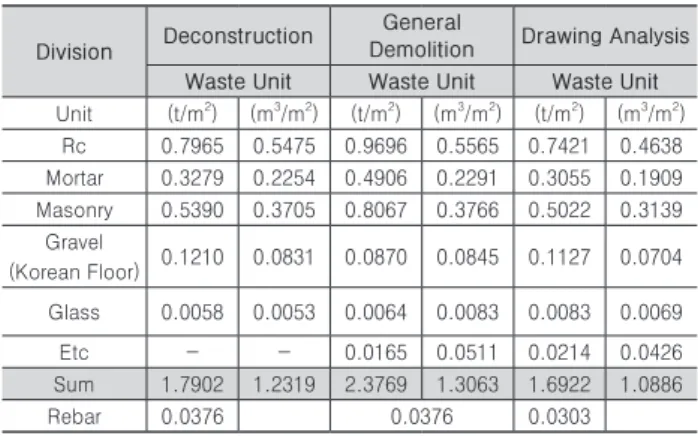
분별해체 및 일반해체 시험시공 결과, 현장 발생잔재는 크 게 9개 정도의 성상으로 발생되었다. 이러한 성상별 원단위 는 Table 10에 제안하였다. Table 10에서 부피기준의 원단 위는 분별해체 시에 발생되는 반출차량의 실제 적재한 높이
를 측정한 것을 기초로 산출하였다. 즉, 실제의 내장재 적재 방법에 따라서 계산된 체적이며, 원단위 산출 시에 사용된 면적은 시험시공대상 건물 1개동의 면적(16.75평×32세대
=1,771.90m
2)이다. 또한 분별해체와 일반해체 의 폐콘크리트 류의 현장발생 성상별 원단위의 비교결과는 Table 11에 제안 하였다. 체적 및 중량에 대한 원단위 기준은 ‘해체이후 발생 량(m
3, 톤)/건물 연면적(m
2)’으로 계산하였으며, 폐콘크리트 류의 성상별(철근콘크리트, 모르터, 조적류) 체적은 현장발생 폐콘크리트류의 총중량에 도면산출한 잔재의 구성비를 곱하 여 재산정한 결과이다. 분별해체가 실시된 동의 유리 및 자기 류는 타일에 대한 값이고, 기존의 해체방식으로 철거된 동의 기타류에는 금속류(철근제외), 목재류, 합성수지류, 형광등 등이 포함되어 있는 것으로 볼 수 있다.
Table 10. Comparison analysis of construction waste unit generated at site
Division Items
Generated At Site (T/M
2)
Drawing Analysis
(T/M
2)
Generated At Site (M
3/M
2)
Drawing Analysis (Per M
2)
Synthetic Resins
Polystyrene 0.0005 0.0019 0.0044 0.0059
0.7366 0.4976
m
2Linoleum 0.0002 0.0011 0.0083 0.2080 m
2Glass Fibber 0.0002 0.0001 0.0050 0.5483 m Light
Fluorescent Light/Bulb 0.0000
0.0003 0.0001
0.0018 0.1738
0.2224 EA
Socket 0.0001 0.0035 0.2709 EA
Steel
Steel Door
0.0034 0.0062 0.0190
0.0166 0.0098
place
Steel Hand Rail 0.0007 kg
Steel Pipe 0.0121 m
Brass Alloter
0.0002 0.0002 0.0007 0.0181
0.0100 kg
Brass Non Slip 0.0018 m
Nonferrous Metal
Aluminum
Chassis 0.0008 0.0014 0.0123 0.0370 place
Stainless Sink 0.0001 0.0001 0.0018 0.0181 m
Wood
Baseboard
0.0097 0.0088 0.0702
0.1976
0.2782 place
Door/Frame 0.0722 m
2Rack 0.0715 EA
Window 0.1264 kg
Window Frame 1.3335 m
2Ceiling 0.1283 m
2Sink 0.0181 EA
Glass Window Glass
0.0016 0.0020 0.0016 0.0016 EA
Crush Glass
Table 11. Comparison analysis of waste concrete unit generated at site
Division Deconstruction General
Demolition Drawing Analysis Waste Unit Waste Unit Waste Unit
Unit (t/m2) (m3/m2) (t/m2) (m3/m2) (t/m2) (m3/m2)Rc 0.7965 0.5475 0.9696 0.5565 0.7421 0.4638 Mortar 0.3279 0.2254 0.4906 0.2291 0.3055 0.1909 Masonry 0.5390 0.3705 0.8067 0.3766 0.5022 0.3139
Gravel
(Korean Floor) 0.1210 0.0831 0.0870 0.0845 0.1127 0.0704 Glass 0.0058 0.0053 0.0064 0.0083 0.0083 0.0069
Etc - - 0.0165 0.0511 0.0214 0.0426
Sum 1.7902 1.2319 2.3769 1.3063 1.6922 1.0886
Rebar 0.0376 0.0376 0.0303
5. 결론
최근 국내에서도 건설폐기물 관련 정책들이 고품질 순환 골재의 생산을 유도하기 위한 시스템으로 전환하려는 노력에 따라 그러한 정책을 준수하기 위해서는 분별해체 시스템으로 의 자연스러운 전환이 불가피하게 되어 가고 있다. 이에 따라 기존의 관습적인 해체시스템의 전환에 따른 부작용을 줄이기 위해 분별해체 공정절차의 정립, 적정 시공방법 및 시방기준, 공사비 산출기준, 현장에서 분별해체로 발생되는 잔재의 성 상별 원단위 산출기준 등의 기준 마련이 시급하게 되어 감에 따라 본 연구에서는 시험시공을 통해 이와 관련된 유의한 자 료를 제시하였다.
1. 기존 연구에서 제안된 원단위는 도면분석을 통하여 산출 된 종류별 수량을 바닥면적으로 나누어 제시한 이론적인 원 단위 이였다. 따라서 실제 현장에서 발생하는 건설폐기물을 예측하는 데는 어려움이 있다. 따라서 본 연구에서는 실제 현 장발생 성상별 원단위를 현장에서 실측하여 제시하였다.
2. 이렇게 제시된 현장발생 폐기물들은 구조물을 해체하기 전과 대비하여 해체 후에는 체적이 변화하고 이에 따라 단위 중량도 달라진다. 따라서 현장에서 발생된 잔재의 유형별 단 위중량에 대한 기준을 제시하였다. 분별해체 콘크리트류의 단위 적재 중량은 1.425t/m
3으로 설계 콘크리트 단위중량의 41%에 불과하였다.
3. 이것을 바탕으로 실제 현장에서 발생되는 건설페기물의 정확한 중량이나 체적의 환산에 필요한 계수를 제안하였으 며, 또한 현장에서 잔재별 회수율을 제시함으로서 건설페기 물 운반비 및 처리비 등의 산정기준에 활용될 수 있는 기준을 제시하였다.
감사의 글
본 연구는 2006년 06 건설핵심 B04 지원사업과 2013년 경 남과학기술대학교 기성회연구 지원에 의하여 이루어진 것으 로 본 연구를 가능케한 건설교통부와 경남과학기술대학교의 연구지원에 감사드립니다.
References