• 검색 결과가 없습니다.

Optimization of submerged culture conditions for roridin E production from the poisonous mushroom Podostroma cornu-damae

N/A
N/A
Protected

Academic year: 2021

Share "Optimization of submerged culture conditions for roridin E production from the poisonous mushroom Podostroma cornu-damae"

Copied!
7
0
0

로드 중.... (전체 텍스트 보기)

전체 글

(1)

81 This is an Open-Access article distributed under the terms of the Creative Commons Attribution Non-Commercial License (http://

creativecommons.org/licenses/by-nc/3.0) which permits unrestricted non-commercial use, distribution, and reproduction in any medium, provided the original work is properly cited.

J. Mushrooms 2021 June, 19(2): 81-87 http://dx.doi.org/10.14480/JM.2021.19.2.81 Print ISSN 1738-0294, Online ISSN 2288-8853

© The Korean Society of Mushroom Science

Dong Hwan Lee(Graduate student), Si Young Ha(Complete a doctorate), Ji Young Jung(Research professor), and Jae-Kyung Yang(Professor)

*Corresponding author E-mail : [email protected] Tel : +82-55-772-1862 Received May 20, 2021 Revised June 21, 2021 Accepted June 24, 2021

Optimization of submerged culture conditions for roridin E production from the poisonous mushroom Podostroma cornu- damae

Dong Hwan Lee, Si Young Ha, Ji Young Jung, and Jae-Kyung Yang*

Division of Environmental Forest Science and Institute of Agriculture & Life Science, Gyeongsang National University, Jinju 52828, Republic of Korea

ABSTRACT:

Roridin E, produced by Podostroma cornu-damae, is a mycotoxin with anticancer activity. To increase the content of roridin E, submerged culture conditions were optimized using response surface methodology. Three factors, namely, medium initial pH, incubation time and agitation speed were optimized using a Box–Behnken design. The optimum submerged culture conditions to increase the content of roridin E included a medium with an initial pH of 4.0, an incubation time of 12.90 days, and an agitation speed of 63.03 rpm. The roridin E content in the submerged culture, under the aforementioned conditions, was 40.26 mg/L. The findings of this study can help lower the current price of roridin E and promote its related research.

KEYWORDS:
Podostroma cornu-damae, Poisonous mushroom, Response surface methodology, Roridin E, Submerged culture conditions

INTRODUCTION

Mushrooms have long been consumed in oriental countries because of their unique aroma, texture, and various pharmacological properties (Wasser, 2010). More than 14000 mushroom species are known worldwide, and, at present, approximately 7000 species can be consumed and about 10 species are cultivated on an industrial scale. It has been reported that approximately 2000 mushroom species have medicinal properties. Of these, poisonous mushrooms are less than 1%; however, their

presence cannot be ignored as they can be dangerous and lethal (Miles and Chang, 2004). Therefore, studies on the biological activity, structure, biosynthetic pathway, and action mechanism of the toxic compounds present in poisonous mushrooms have been conducted (Sharma et al., 2018; Jo et al., 2014; Zhu et al., 2020).

Podostroma cornu-damae belongs to the Hypocreaceae family and produces a deadly poison called trichothecene.

Since this mushroom is indistinguishable from the young fruiting bodies of reishi mushrooms or cordyceps, which are known as healthy foods, accidental poisoning by ingestion have been frequently reported (Park et al., 2016; Yang et al., 2013; Yu et al., 2013). In P. cornu- damae, substances such as roridin E, satratoxin H, 5 12- episatratoxin H, roridin L-2, and trichoverritone are present.

Recently, it was reported that roridin E has a more potent activity in breast cancer cells than doxorubicin, an existing therapeutic substance (Lee et al., 2018). It also has a potential as an antimalarial agent (Zhang et al., 2002).

However, roridin E is very expensive substance (selling for $245 for 1 mg, Biovision, Inc.), and therefore, an optimization study is required to increase the concentration of roridin E extracted from P. cornu-damae mycelia.

The response surface methodology (RSM) was used to

optimize the liquid culture conditions. It is one of the most

(2)

popular optimization techniques, which greatly reduces the number of experiments required and provides a set of mathematical equations for process optimization (Cui and Yuan., 2011; Wu et al., 2017).

The Box–Behnken design (BBD), consisting of central and middle points on the edges of the cube circumscribed on the sphere, has been widely used to optimize the RSM. The BBD produces a statistical model with fewer design points than that of a central composite design (Ferreira et al., 2007). Muthukumar et al. (2003) utilized BBD for optimization 6 variables.

In this study, we aimed to optimize the submerged culture conditions (medium, incubation time, medium initial pH, and agitation speed) by using the RSM, to increase the content of roridin E extracted from P. cornu- damae.

MATERIALS AND METHODS

Reagents and standards

The Roridin E standard was purchased from BioVision, Inc. (California, USA). Potato dextrose agar (PDA), potato dextrose broth (PDB), and yeast extract were purchased from BD (New Jersey, USA). Glucose was purchased from Sigma-Aldrich Co. (Darmstadt, Germany). Mushroom complete medium (MCM) broth was purchased from MB cells (Seoul, South Korea). KH

2

PO

4

was purchased from Junsei Chemical Co. (Tokyo, Japan). MgSO

4

·7H

2

O was purchased from Samchun (Seoul, South Korea). KCl, FeSO

4

·7H

2

O, ZnSO

4

·7H

2

O, CuSO

4

·5H

2

O, HCl, and NaOH were purchased from Daejung Chemicals &

Metals Co. (Gyeonggi-do, South Korea).

Microorganism

P. cornu-damae was obtained from the BCRC (FU31130, Bioresource Collection and Research Center, Hsinchu, Taiwan). The stock cultures were maintained on PDA plates, and the plates were incubated at 25

o

C for 30 days and stored at 4

o

C for use as subcultures every two months.

P. cornu-damae was initially grown on PDA medium at 25

o

C, and the mycelia were harvested after 30 days for further experiments.

Culture media

Czapek mineral salts broth (CZB) medium (Jackson et al., 1991) (glucose 30 g/L; yeast extract 2.8 g/L; KH

2

PO

4

1 g/L;

MgSO

4

·7H

2

O 0.5 g/L; KCl 0.5 g/L; FeSO

4

·7H

2

O 0.01 g/L;

ZnSO

4

·7H

2

O 0.01 g/L; CuSO

4

·5H

2

O 0.005 g/L). MCM

broth (glucose 20 g/L; peptone 2 g/L; yeast extract 2 g/

L; MgSO

4

·7H

2

O 0.5 g/L; KH

2

PO

4

0.46 g/L; K

2

HPO

4

1 g/L). PDB medium (glucose 20 g/L; potato extract 4 g/

L). Yeast extract MgSO

4

·7H

2

O KH

2

PO

4

(YMK) medium (glucose 20 g/L; yeast extract 5 g/L; MgSO

4

·7H

2

O 1 g/L;

KH

2

PO

4

2 g/L).

Submerged Culture

Submerged culture using liquid medium has the advantage of not only being able to control the seed amount to some extent but also greatly shortens the cultivation period of the mycelia (Stamets, 1993). Three mycelial agar disks (5 mm) were obtained using a sterilized cork borer and transferred to 100 mL Erlenmeyer flasks containing 50 mL of media. The incubation time was 15 days with intervals of 3 days in between (3, 6, 9, 12, and 15 days). The initial pH of the medium was adjusted using 1N HCl and 1N NaOH (pH 2.0, 4.0, 6.0, 8.0, 10.0, and 12.0). The mycelia were cultivated at 24

o

C in a shaking incubator (SI-900R, JEIO TECH, Daejeon, South Korea), and the agitation speeds were set at 0, 50, 100, and 150 rpm.

Determination of mycelial dry weight

The samples collected from the shake flasks were centrifuged at 6000×g for 15 min, and the supernatant was filtered through a pre-weighed No. 2 Whatman filter paper (Whatman plc, Maidstone, UK). The centrifuged mycelia were washed with distilled water and collected by filtration through the Whatman filter paper. The dry weights of the mycelia were measured after oven drying at 60

o

C for 48 h to a constant dry weight.

Determination of roridin E

Mycelia (whole cultured) were extracted overnight with 90% MeOH (30 mL). The MeOH phase was filtered and mixed with distilled water (30 mL). And aqueous phase was evaporated in vacuo to obtain the water layer. The water layer was extracted with ethyl acetate (30 mL ×3). A culture broth (30 mL) of P. cornu-damae was extracted with ethyl acetate (30 mL ×3), and the ethyl acetate layers were filtered using a 0.2 μm syringe filter (16534k, Sartorius, Göttingen, Germany).

To measure roridin E, an HPLC system (YL9100 plus, YOUNG IN Chromass, Gyeonggi-do, South Korea) was equipped with an Eclipse plus C18 column (5 μm, 4.6 × 250 mm, Agilent Technologies, Inc., California, USA).

Samples were eluted with gradients of 25% to 100%

(3)

acetonitrile in water for 30 min as the mobile phase. The injection volume was 10 μL and the flow rate was 2 mL/

min. The eluent was detected using a UV/visible detector at 260 nm and quantified using the external calibration based on the UV signal response by 0.0625-1 μg/mL of roridin E.

Experimental design by the RSM

A three-level BBD in the RSM was employed in the present study, and the optimal conditions were determined using minimal set of experiments, compared with other designs (Dong et al., 2009). The BBD has been applied to optimize culture conditions for submerged cultivation of mushrooms (Jing et al., 2018); in this study also, BBD was used to optimize the roridin E (Y) of P.

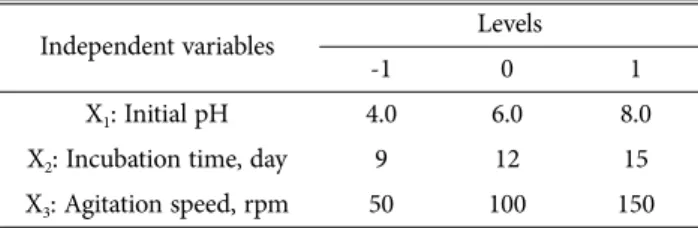
cornu-damae. The three factors chosen for this study (Table 1) were initial pH (pH, X

1

), incubation time (days, X

2

), and agitation speed (rpm, X

3

) with three levels of each factor, namely high (coded as 1), middle (coded as 0), and low (coded as -1). For a three-factor, three-level design, 17 experimental trials were conducted.

The BBD results were fitted to a second-order polynomial equation (Eq. (1)) using a multiple regression technique,

(1)

where Y is the predicted response (roridin E yield in this study, mg/L), β0, βi, βii, and βij are constant coefficients, and x

i

and x

ij

are the coded independent variables or factors. Design-Expert software (Version 13, Stat-Ease, Inc., Minnesota, USA) was used for regression analysis of the experimental data and responses.

Statistical analysis

Data are presented as mean ± standard deviation (n = 3).

Statistical analyses of the results were performed at a 5%

significance level using Statistical Analysis System (SAS) software (SAS Institute, Inc., North Carolina, USA).

Differences between the means of individual groups were

assessed using SAS with Duncan's multiple-range test.

RESULTS AND DISCUSSION

Effect of various media on mycelial dry weight and roridin E production

It has been reported that an acidic pH and appropriate media components are favorable for the growth of mycelia and for the production of metabolites in many of the ascomycetes and basidiomycetes members (Osińska-Jaroszuk et al., 2015). The effects of liquid media on the mycelium dry weight and roridin E content of P. cornu-damae are depicted in Fig. 1. When cultured for 15 days, the dry weight of mycelium in each medium was 6.55 ± 0.64 g/L, 5.89 ± 0.39 g/L, 6.02 ± 1.15 g/L, 6.39 ± 0.46 g/L, and for CZB, MCM, PDB and YMK media, respectively.

Y = β 0 + Σ i 1 4 = β i x i + Σ i 1 4 = β ii x i 2 + Σ i 1 3 = Σ i j 4 < β ij x i x ij Table 1. Code of three factor, Box–Behnken experimental design

Independent variables Levels

-1 0 1

X

1

: Initial pH 4.0 6.0 8.0

X

2

: Incubation time, day 9 12 15

X

3

: Agitation speed, rpm 50 100 150

Fig. 1. The effects of various media on the mycelial dry weight and roridin E content in the submerged cultures of P.

cornu-damae. A: mycelial dry weight; B: roridin E content;

and C: roridin E presence in PDB medium. Each value is expressed as mean±SE (n = 3). Different letters on the top of the line represent statistically significant at 5% probability level. CZB, Czapek mineral salts broth medium; MCM, mushroom complete medium; PDB, potato dextrose broth;

YMK, yeast extract MgSO

4

·7H

2

O KH

2

PO

4

.

(4)

There was no significant difference in the mycelial dry weight between the groups, although the content of roridin E was different. After 15 days, the maximum roridin E content was observed in PDB media (42.14 ± 5.63 mg/L) followed by CZB (32.75±6.11 mg/L), MCM (15.59±5.24 mg/L), and YMK (14.98±1.99 mg/L). The roridin E content in the extracellular and intracellular form in P. cornu-damae cultivated in PDB medium was also determined. It was observed that the roridin E content in the extracellular form (42.14±5.63 mg/L) was 1.6 times higher than that in the intracellular form (27.16±0.37 mg/L).

Therefore, the PDB medium displaying the highest roridin E content of P. cornu-damae was selected for further experiments.

One-factor-at-a-time experiment

Effect of incubation time on roridin E production To evaluate the production of roridin E we optimized the culture condition using PDB medium. The culture was performed for 15 days at intervals of 3 days at 100 rpm and incubated at 24

o

C. It was found that the content of roridin E increased as the incubation time increased. The highest content was observed on day 15 (40.33±6.29 mg/

L), although there was no significant difference as compared to the content on day 12 (37.45±5.61 mg/L).

This tendency was similar to the result of maintaining a constant after increasing the content of metabolites as the incubation time increased (Adnan et al., 2017). Therefore, for efficiency, it was determined that a culture time of 12 days was most suitable for the culture of P. cornu-damae.

Effect of initial pH on roridin E production

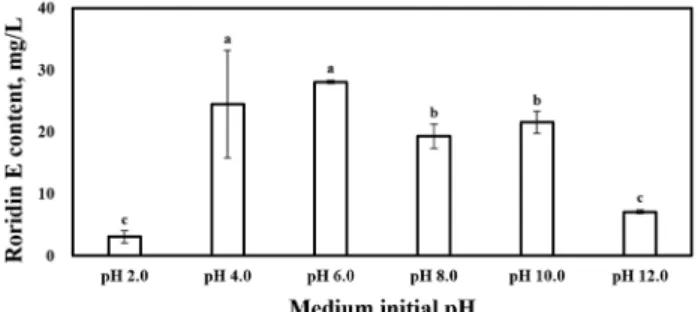
Fig. 3 depicts the concentration of roridin E in P. cornu- damae at different initial pH values. The initial pH of the

medium was set to pH 2.0–pH 12.0. Culturing was performed at 100 rpm and 24 °C using PDB medium for 12 days. Firstly, it was observed that roridin E content was very low under the extreme conditions of pH 2.0 (3.08±

0.99 mg/L) and pH 12.0 (7.12±0.3 mg/L). The highest content of roridin E was observed in the mildly acidic conditions, including pH 4.0 (24.48±8.70 mg/L) and pH 6.0 (28.07±0.29 mg/L). Among these, the content of roridin E was the highest at pH 6.0, although there was no significant difference between the two. These results were consistent with reports of increased metabolite production in several mushrooms when the initial pH was mildly acidic (Meng et al., 2016; Osińska-Jaroszuk et al., 2015)

Effect of agitation speed on roridin E production To compare the content of roridin E based on the agitation speed during the submerged culture, culturing was performed at 0, 50, 100, and 150 rpm (Fig. 4). It was observed that an agitation speed of 100 rpm (38.45±2.15 mg/L) was most suitable for producing

Fig. 2. The effects of incubation time on roridin E content by P. cornu-damae in submerged culture. Each value is expressed as mean±SE (n = 3). Different letters on the top of the line represent statistically significant at 5% probability level.

Fig. 3. The effects of medium initial pH on roridin E content by P. cornu-damae in submerged culture. Each value is expressed as mean ± SE (n = 3). Different letters on the top of the line represent statistically significant at 5%

probability level.

Fig. 4. The effects of agitation speed on roridin E content by

P. cornu-damae in submerged culture. Each value is

expressed as mean±SE (n = 3). Different letters on the top of

the line represent statistically significant at 5% probability

level.

(5)

roridin E from P. cornu-damae. This could be due to the difference in air saturation caused by agitation in the submerged culture of mushrooms (Asadi et al., 2021).

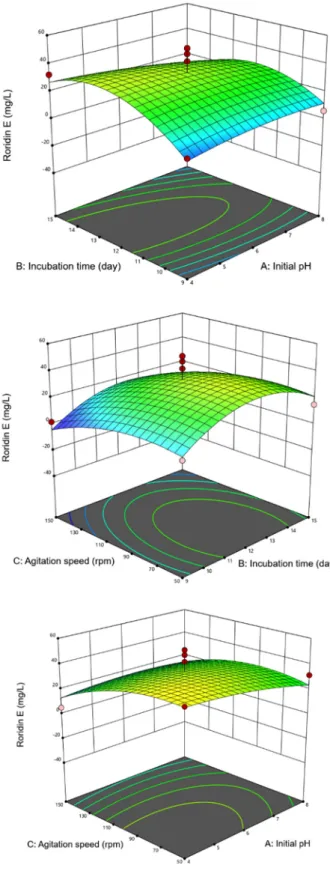
Optimization of roridin E production by the RSM The conventional variation of the one-factor-at-a-time approach of optimization is not only time-consuming but also costly. Therefore, an experimental design using the RSM is much more efficient. To achieve the desired target (i.e., highest roridin E content), optimization was performed by applying the BBD to predict the optimal levels of the independent variables (initial pH, incubation time, and agitation speed). The response surface plots for the BBD are depicted in Fig. 5 together with the observed experimental data (Table 2). A second-order polynomial model (Eq. (2)):

Roridin E content, mg/L = − 345.31204 + 15.26432 X

1

+ 53.84132 X

2

+ 0.306343 X

3

− 0.972611X

1

X

2

+ 0.039587 X

2

X

3

− 0.002831 X

1

X

3

− 0.797459 X

12

1.92938 X

22

− 0.003396X

32

Statistical analysis of the BBD data revealed that the order of the three factors affecting roridin E production Table 2. Result of three factor, Box–Behnken experimental

design Run

Independent variables (coded)

Independent variables (actual)

Roridin E content, mg/L

X

1

X

2

X

3

X

1

X

2

X

3

Y

1 -1 -1 0 4.0 9 100 13.58±9.05

2 1 -1 0 8.0 9 100 7.06±1.36

3 -1 1 0 4.0 15 100 29.90±4.23

4 1 1 0 8.0 15 100 5.84±1.79

5 -1 0 -1 4.0 12 50 31.55±12.63

6 1 0 -1 8.0 12 50 36.65±9.17

7 -1 0 1 4.0 12 150 6.32±1.58

8 1 0 1 8.0 12 150 11.88±3.50

9 0 -1 -1 6.0 9 50 11.51±3.61

10 0 1 -1 6.0 15 50 19.99±8.58

11 0 -1 1 6.0 9 150 3.74±3.25

12 0 1 1 6.0 15 150 16.19±18.31

13 0 0 0 6.0 12 100 41.82±6.28

14 0 0 0 6.0 12 100 47.09±5.41

15 0 0 0 6.0 12 100 17.07±7.07

16 0 0 0 6.0 12 100 51.02±8.29

17 0 0 0 6.0 12 100 12.54±8.97

X

1

: Initial pH; X

2

: Incubation time, day; X

3

: Agitation speed, rpm.

Fig. 5. Regression analysis of the Box–Behnken design

experiments.

(6)

in the submerged cultures of P. cornu-damae was agitation speed > incubation time > initial pH. The optimal conditions, as per Eq. (2), included an initial pH of 4.0, an incubation time of 12.90 days, and an agitation speed of 63.03 rpm (Fig. 5). This model predicted a maximum roridin E yield of 40.26 mg/L.

Roridin E is a trichothecene belonging to the macrocyclic sesquiterpenes. Trichothecenes are found in Myrothecium roridum, M. verrucaria, Stachybotrys chartarum, Cylindrocarpon sp., Verticimonosporium diffractum, Cryptomola acutispora, Phomopsis leptostromiformis, and Cercophora (Jarvis and Wang, 1999). Trichothecene is a highly toxic substance (Rocha et al., 2005); therefore, limited studies are performed on increasing its content.

However, due to the strong anticancer activity of roridin E, further research is required to increase its content. To our knowledge, no studies have been conducted to control the increase the roridin E content of P. cornu- damae. In this study, in the predicted roridin E content (40.26 mg/L) of P. cornu-damae was higher than that reported in P. cornu-damae cultured by stationary culture by Saikawa et al. (2001) (22.1 mg/L). They were cultured for 3 weeks by stationary culture. In addition, Bean et al.

(1984) reported a higher content than that reported for M.

roridum (less than 5 mg/L). The findings of this study will help lower the price of roridin E and promote related research.

ACKNOWLEDGEMENTS

This study was carried out with the support of R&D Program for Forest Science Technology (Project No.

“2020253A00-2021-0001”) provided by Korea Forest Service (Korea Forestry Promotion Institute).

REFERENCES

Adnan M, Ashraf SA, Khan S, Alshammari E, Awadelkareem AM. 2017. Effect of pH, temperature and incubation time on cordycepin production from Cordyceps militaris using solid- state fermentation on various substrates. CyTA-Journal of food

15: 617-621.

Asadi F, Barshan-Tashnizi M, Hatamian-Zarmi A, Davoodi- Dehaghani F, Ebrahimi-Hosseinzadeh B. 2021. Enhancement of exopolysaccharide production from Ganoderma lucidum using a novel submerged volatile co-culture system. Fungal Biology 125: 25-31.

Bean GA, Fernando T, Jarvis BB, Bruton B. 1984. The isolation and identification of trichothecene metabolites from a plant pathogenic strain of Myrothecium roridum. Journal of natural products 47: 727-729.

Cui JD, Yuan LQ. 2011. Optimization of culture conditions on mycelial grown in submerged culture of Cordyceps militaris.

International Journal of Food Engineering 7.

Ferreira SC, Bruns RE, Ferreira HS, Matos GD, David JM, Brandão GC, Da Silva EGP, Portugal LA, Dos Reis PS, Souza AS, Dos Santos WNL. 2007. Box-Behnken design: an alternative for the optimization of analytical methods.

Analytica chimica acta 597: 179-186.

Gonmori K, Fujita H, Yokoyama K, Watanabe K, Suzuki O. 2011.

Mushroom toxins: a forensic toxicological review. Forensic Toxicology 29: 85-94.

Jackson AM, Whipps JM, Lynch JM. 1991. Nutritional studies of four fungi with disease biocontrol potential. Enzyme and microbial technology 13: 456-461.

Jarvis BB, Wang S. 1999. Stereochemistry of the roridins.

Diastereomers of roridin E. Journal of natural products 62:

1284-1289.

Jo WS, Hossain MA, Park SC. 2014. Toxicological profiles of poisonous, edible, and medicinal mushrooms. Mycobiology 42: 215-220.

Lee SR, Seok S, Ryoo R, Choi SU, Kim KH. 2018. Macrocyclic trichothecene mycotoxins from a deadly poisonous mushroom, Podostroma cornu-damae. Journal of natural products 82: 122- 128.

Meng F, Xing G, Li Y, Song J, Wang Y, Meng Q, Lu J, Zhou Y, Wang D, Teng L. 2016. The optimization of Marasmius androsaceus submerged fermentation conditions in five-liter fermentor. Saudi journal of biological sciences 23: S99-S105.

Miles PG, Chang ST. 2004. Mushrooms: cultivation, nutritional value, medicinal effect, and environmental impact. CRC press.

USA. 5.

Muthukumar M, Mohan D, Rajendran M. 2003. Optimization of mix proportions of mineral aggregates using Box Behnken design of experiments. Cement and Concrete Composites 25:

751-758.

Osińska-Jaroszuk M, Jarosz-Wilkołazka A, Jaroszuk-Ściseł J, Szałapata K, Nowak A, Jaszek M, Ozimek E, Majewska M. 2015.

Extracellular polysaccharides from Ascomycota and Basidiomycota:

production conditions, biochemical characteristics, and biological properties. World Journal of Microbiology and Biotechnology 31:

1823-1844.

Park JS, Min JH, Kim H, Lee SW, Kang JH, An JY. 2016. Four cases of successful treatment after Podostroma cornu-damae intoxication. Hong Kong journal of emergency medicine 23:

55-59.

Rocha O, Ansari K, Doohan FM. 2005. Effects of trichothecene mycotoxins on eukaryotic cells: a review. Food additives and contaminants 22: 369-378.

Saikawa Y, Okamoto H, Inui T, Makabe M, Okuno T, Suda T, Hashimoto K, Nakata M. 2001. Toxic principles of a poisonous Table 3. Results of the verified experiment

Initial pH

Incubation time, day

Agitation speed,

rpm

Roridin E, mg/L Optimal culture

condition 4.0 12.90 63.03 40.26

(7)

mushroom Podostroma cornu-damae. Tetrahedron 57: 8277-8281.

Sharma D, Singh VP, Singh NK. 2018. A review on phytochemistry and pharmacology of medicinal as well as poisonous mushrooms. Mini Reviews in Medicinal Chemistry 18: 1095- 1109.

Si J, Meng G, Wu Y, Ma HF, Cui BK, Dai YC. 2019. Medium composition optimization, structural characterization, and antioxidant activity of exopolysaccharides from the medicinal mushroom Ganoderma lingzhi. International Journal of Biological Macromolecules 124: 1186-1196.

Stamets P. 1993. Growing gourmet and medicinal mushrooms. Ten Speed Press. USA. 146.

Wu L, Qiu L, Zhang H, Sun J, Hu X, Wang B. 2017. Optimization for the Production of Deoxynivalenol and Zearalenone by Fusarium graminearum Using Response Surface Methodology.

Toxins 9: 57.

Wasser SP. 2010. Medicinal mushroom science: history, current status, future trends, and unsolved problems. International

Journal of Medicinal Mushrooms 12.

Yang JN, Kang JH, Kang YS, Seok SJ, Kim WK. 2013. A case of Podostroma cornu-damae intoxication similar to drug hypersensitivity syndrome. Korean Journal of Medicine 85:

223-228.

Yu HM, Kim J, Kang S, An S, Lim CH, Lee HG, Lee KR. 2013.

Mushroom poisoning by Podostroma cornu-damae: a case report and review of the literature. Journal of the Korean Society of Emergency Medicine 24: 469-472.

Zhang H, Qiu S, Tamez P, Tan GT, Aydogmus Z, Hung NV, Choung NM, Angerhofer C, Soejarto DD, Pezzuto JM, Fong HH. 2002. Antimalarial agents from plants II. Decursivine, a new antimalarial indole alkaloid from Rhaphidophora decursiva. Pharmaceutical Biology 40: 221-224.

Zhu M, Cen Y, Ye W, Li S, Zhang W. 2020. Recent Advances on

Macrocyclic Trichothecenes, Their Bioactivities and

Biosynthetic Pathway. Toxins 12: 417.

수치

Fig. 1. The effects of various media on the mycelial dry weight and roridin E content in the submerged cultures of P.
Fig. 3 depicts the concentration of roridin E in P. cornu- cornu-damae at different initial pH values
Fig. 5. Regression analysis of the Box–Behnken design experiments.

참조

관련 문서

Optimal conditions for production of CMCase such as concentrations of carbon and nitrogen sources, initial pH of medium and temperature were inves- tigated using

Optimal conditions for production of CMCase such as concentrations of carbon sources and nitrogen sources, initial pH of medium, and temperature, were