• 검색 결과가 없습니다.

Optimization Using 33 Full-Factorial Design for Crude Biosurfactant Activity from Bacillus pumilus IJ-1 in Submerged Fermentation

N/A
N/A
Protected

Academic year: 2021

Share "Optimization Using 33 Full-Factorial Design for Crude Biosurfactant Activity from Bacillus pumilus IJ-1 in Submerged Fermentation"

Copied!
9
0
0

로드 중.... (전체 텍스트 보기)

전체 글

(1)

Optimization Using 3 3 Full-Factorial Design for Crude Biosurfactant Activity from Bacillus pumilus IJ-1 in Submerged Fermentation

Byung Soo Kim

1

and Ji Yeon Kim

2

*

1

Department of Statistics, Institute of Statistical Information,

2

Department of Liberal Arts, Inje University, Gimhae 50834, Republic of Korea

Received: August 5, 2019 / Revised: October 22, 2019 / Accepted: November 29, 2019

Introduction

Biosurfactants are extracellular surface-active amphi- philic biomolecules derived mainly from microorganisms [1]. These biomolecules can be classified into different groups on the basis of the species of biosurfactant- producing microorganisms and the characteristic of their chemical structure [2]. Biosurfactants effectively decrease surface tension or interfacial tension in aque- ous solutions or hydrocarbon mixtures [2] and serve as highly efficient emulsifiers [3, 4]. The numerous advantages of biosurfactants over chemically synthe- sized surfactants include lessened toxicity, enhanced biodegradability, better environmental compatibility, producing capacity from renewable and cheaper sub-

strates, greater foaming properties, better stability at extreme conditions of temperatures, pH and salinity, and ecological acceptability [1, 3, 5]. For these reasons, biosurfactants have potential applications to the food processing, cosmetics, pharmaceuticals and oil recovery industries. Moreover, biosurfactants are used in the bioremediation for oil spills and removal of residual oil in storage tanks [3, 5, 6].

However, the low yields and high costs associated with biosurfactant production severely restrict their large- scale use [7]. One of the approaches to compensate for the aforementioned limitations involves the determina- tion of optimal production medium and culture condi- tions to maximize biosurfactant productivity [5]. In this regard, the control of biosurfactant production is strongly influenced by temperature and medium pH, salinity, and composition [8].

Statistical approaches have been applied to optimize cultural conditions in biotechnological processes.

This study aimed to optimize the culture conditions to improve the crude biosurfactant activity of Bacillus pumilus IJ-1, using a 3

3

full-factorial design of response surface methodology (RSM). It was found that sub- merged fermentation of B. pumilus improved the activity of the crude biosurfactant. The factors selected for optimization were NaCl concentration, temperature, and tryptone concentration. Response surface analysis revealed that the fitted quadratic model was statistically significant and produced an adequate R

2

value (0.9898) and a low probability value (<0.0001). The optimum level for each factor was found to be 0.567% (w/v) NaCl, 21.851 ℃ and 0.765% (w/v) tryptone, respectively. Crude biosurfactant activity was found to be most affected by tryptone concentration; then temperature, and finally NaCl concentration. Our results may potentially facilitate large-scale biosurfactant production from B. pumilus IJ-1.

Keywords: 3

3

full-factorial design, Bacillus pumilus IJ-1, biosurfactant, optimization, response surface methodology, surface tension reduction ratio

*Corresponding author

Tel: +82-55-320-3737, Fax: +82-55-337-1301 E-mail: [email protected]

© 2020, The Korean Society for Microbiology and Biotechnology

(2)

Response surface methodology (RSM) is the most extensively used method for culture medium optimiza- tion. The RSM is more effective than the classical ‘one- factor-at-a-time’ method because it helps assess the given factors simultaneously with fewer observations, thus saving time, labor, and cost [9, 10]. This is a statis- tics-based technique which helps to design appropriate experiments, building mathematical models, evaluating the effect of factors and establishing optimal conditions [11, 12]. The RSM has been successfully employed in various areas of biotechnology to optimize bacterial growth media and culture conditions [13 −17].

Despite its availability, there are comparatively fewer reports showing its utilized instances in optimization of biosurfactant production [18 −20]. Statistical experimen- tal designing is essential for optimizing culture condi- tions. The factorial design is one of the best tools to analyze the effect of relevant factors and their potential interactions. Multiple regression analysis formulated equations that adequately indicate the influence of interdependent factors on selected responses. Experi- ment through the factorial design and the RSM are commonly conducted in optimization of culture condi- tions [21, 22].

We previously stated the consequence of medium com- position and culture conditions on crude biosurfactant activity from Bacillus pumilus IJ-1, using an established method [23]. According to a literature survey, this paper is another report to elucidate optimization of culture con- ditions for crude biosurfactant activity from B. pumilus, using RSM at a flask level.

Materials and Methods

Microorganism

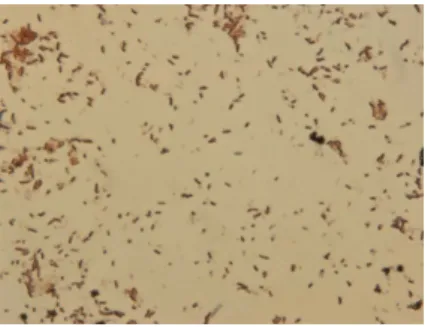
In this study, the bacterial strain B. pumilus IJ-1 was used for crude biosurfactant activity (Fig. 1). The strain was previously isolated from contaminated crude oil col- lected in Taean, Korea and characterized in our labo- ratory [24]. It has been entitled by the Culture Center of Microorganisms (KCCM), Korea (Accession no.

KCCM11319P).

Media

The bacterial cells were cultured on Luria-Bertani (LB) agar containing (w/v) 1.0% NaCl (Promega, USA),

1.0% tryptone (Acumedia, USA), 0.5% yeast extract (BioShop, USA) and 1.5% agar (Junsei, Japan), pH 7.0.

For inoculum preparation, a mineral salt medium (A- medium) was used involving the following components (w/v): 0.3% KNO

3

, 0.22% Na

2

HPO

4

, 0.06% MgSO

4

, 0.014% KH

2

PO

4

, 0.004% CaCl

2

, 0.002% FeSO

4

, 0.001%

NaCl and 0.1 ml of a trace element solution, pH 7.0. The trace element solution consisted of (g/l): 2.32 g ZnSO

4

· 7H

2

O, 1.78 g MnSO

4

· 4H

2

O, 1 g CuSO

4

· 5H

2

O, 1 g ethylenediaminetetraacetic acid, 0.56 g H

3

BO

3

, 0.42 g CoCl

2

· 6H

2

O and 0.39 g Na

2

MoO

4

· 2H

2

O [25]. Culture media used for crude biosurfactant activity experiments consisted of tryptone and NaCl in accordance with that formulated by Park and Kim [23]. By using 1 N NaOH solution, the initial pH of the media was adjusted to 9.0.

Preparation of crude biosurfactant

For seed culture, a bacterial colony was transferred to 5 ml of A-medium. Seed culture was conditioned at 35 ℃, and 14 −16 h of shaking incubation (200 rpm, OD

600

= 0.8 −0.9). Then, 1 ml of the bacterial culture suspensions was inoculated in 1-L Erlenmeyer flasks containing 100 ml of crude biosurfactant production medium. Culti- vations containing tryptone and NaCl at various concen- trations were performed at temperatures ranging from 15 to 25 ℃ (intervals of 5℃) with agitation (200 rpm) for 72 h. Each experiment was carried out in triplicate.

Culture broth was centrifuged at 9,300 × g and 4℃ for 15 min to eliminate bacterial cells. Subsequently, the remaining cell-free broth was filtered through a 0.22-µm pore-size membrane (Minisart, Sartorius Stedium Biotech GmbH, Germany). The filtered sample served as the source of the crude biosurfactant and was used for surface tension determination.

Fig. 1. Phase-contrast microscopic observation of Bacillus

pumilus IJ-1 (Magnification: ×1,000).

(3)

Surface tension determination

Reducing the surface tension of the bacterial growth medium, the effects of biosurfactants can be indirectly measured by determining surface tension [26, 27]. The surface tension was determined on the crude biosurfac- tants with a Surface Tension Analyser DST-60 digital surface tensiometer (Surface Electro Optics, Korea), using the Du Nouy ring method at 20 ℃ [28]. To validate these measurements, calibration used distilled water (ST = 71.5 dyne/cm ± 0.5) before obtaining sample mea- surements. Each nutrient source required an uninocu- lated control flask to measure the initial surface tension.

To enhance accuracy, each measurement resulted from three separate experiments, and the surface tension of the sample was expressed into the mean value in each measurement.

Validation of the experimental design of 3

3

full-factorial design

The critical optimal conditions via single-factor-at-a- time experiments were previously reported [23]. NaCl, tryptone, and culture temperature were determined as major factors affecting significant crude biosurfactant activity. Based on previous studies, appropriate models were devised to analyze factor interactions. For its validity, the parameter range was selected in accor- dance with the previous report [23]. Experiments were based on 3

3

full-factorial design: NaCl (0, 0.5, 1.0%, w/v), tryptone (0, 0.5, 1.0%, w/v), and temperature (15, 20, 25 ℃) by B. pumilus IJ-1 inoculated with 1% (w/v) seed culture at pH 9.0 in shaking incubator (200 rpm) for 72 h.

The specified codes and the range of the parameters were enlisted in Table 1. Each factor of the design was assessed at 3 different levels from low (-1), to medium (0), and to high (+1). In developing the regression equa- tion, the test factor was encoded as follows:

where the i-th test factor X

i

is the dimensionless coded value, is the real one, is the real one at the center point, and is the range, so that X

i

is –1 ≤ X

i

≤ 1.

The design was comprised of 29 experimental trials including 27 for factorial design, and 2 for replication of the central points (Table 2). The reduction ratio of surface tension (%) was considered response values (Y).

All experiments were conducted in triplicate on different days and the mean value from the three experiments has been presented. As the initial value differed in run types, its difference from final value was calculated [5].

In Table 2, reduction ratio (%) is calculated as:

Reduction ratio of surface tension =

(initial tension – final tension)/initial tension × 100

Determination of optimal conditions by RSM

RSM was required to ascertain the interactive effects of three factors at three levels. The consequent data was then subjected to multiple regression analysis on the basis of the empirical model. After completing the exper- iments, the relationship between the independent fac- tors and their responses was fitted to the following predictive second-order polynomial equation:

(1)

where Y

i

is the predicted response, subscripts i and j take values from 1 to k of the number of factors, β

0

is a constant, β

i

's are the linear coefficients, β

ii

's are the qua- dratic ones, β

ij

's are the cross-product ones, and X

i

and X

j

are the coded dimensionless values of these factors in Table 1.

The optimal values of the experimental conditions X

i

x

i

– x

i0

x

i

/2 --- Δ

=

x

i

x

i0

x

i

Δ

Y

i

= β

0

+ Σ

i 1k=

β

i

X

i

+ Σ

i jk<

Σ β

ij

X

i

X

j

+ Σ

i 1k=

β

ii

X

i2

Table 1. Range of the parameters used for modeling and the specified codes for each parameter.

Independent factors

Symbols Coded values and the corresponding values of parameters

Uncoded Coded -1 0 1

NaCl (w/v) x

1

X

1

0 0.5 1

Temperature ( ℃) x

2

X

2

15 20 25

Tryptone (w/v) x

3

X

3

0 0.5 1

(4)

resulted from solving the regression equation and ana- lyzing the response-surface contour plots. The responses to each run were subjected to multiple regression analy- sis with the help of SAS 9.2 software (SAS Institute, USA) to obtain the coefficients of the polynomial equa- tion. The model was statistically validated via the analy- sis of variance (ANOVA) provided in the same software.

The equation was then expressed in the form of a three- dimensional response surface and their respective con- tour plots, using the software. These plots were used to elucidate the interaction among different factors and to

predict optimal conditions.

Results and Discussion

Optimization of crude biosurfactant activity using 3

3

full- factorial design and RSM

We have studied the relationship between response (surface tension reduction ratio) and three independent factors (NaCl, temperature, and tryptone), using a 3

3

full-factorial design and RSM. The design and results of the 3

3

full-factorial design experiments are presented in Table 2. Experimental 3

3

full-factorial design and the response of reduction ratios of the surface tension.

Trial number

Factor 1:

NaCl (w/v)

Factor 2:

Temperature ( ℃ )

Factor 3:

Tryptone (w/v)

Response

Reduction ratio of surface tension (%) Experimental value Predicted value

1 0 15 0 1.370 0.595

2 0 15 0.5 46.543 45.136

3 0 15 1 42.983 45.283

4 0 20 0 1.107 3.973

5 0 20 0.5 49.113 49.197

6 0 20 1 50.550 50.027

7 0 25 0 4.077 1.979

8 0 25 0.5 47.093 47.887

9 0 25 1 50.640 49.400

10 0.5 15 0 5.433 2.144

11 0.5 15 0.5 45.707 46.897

12 0.5 15 1 48.653 47.256

13 0.5 20 0 2.683 5.743

14 0.5 20 0.5 51.667 51.180

15 0.5 20 0.5 51.430 51.180

16 0.5 20 0.5 51.427 51.180

17 0.5 20 1 52.630 52.222

18 0.5 25 0 2.977 3.971

19 0.5 25 0.5 50.740 50.091

20 0.5 25 1 50.333 51.817

21 1 15 0 1.207 0.256

22 1 15 0.5 40.140 45.222

23 1 15 1 46.547 45.793

24 1 20 0 2.483 4.077

25 1 20 0.5 53.533 49.726

26 1 20 1 52.860 50.981

27 1 25 0 3.927 2.526

28 1 25 0.5 49.160 48.859

29 1 25 1 48.380 50.797

(5)

Table 2. For the data, we fitted the second-order polyno- mial equation (1) and obtained ANOVA table and the parameter estimates by SAS 9.2.

The results of ANOVA in the quadratic model illus- trated in Table 3; the equation could adequately be employed to describe crude biosurfactant activity under various operating conditions. It came up with an F-value of 832.37 with an extremely low p-value (<0.0001).

These results implied that it was highly significant for the response variables assessed herein (Table 3). The R

2

was 0.9898, and the coefficient of variation (CV) was rel- atively low (6.68%), indicating a good precision and reli- ability [29]. These estimators revealed that the model was acceptable by the statistical point-of-view to predict the response in the considered factor range.

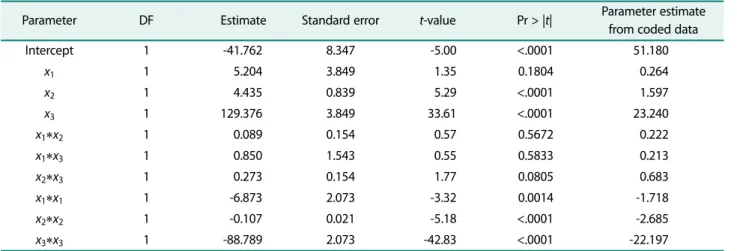
The t-values and the corresponding p-values were cal- culated from the Student’s t distribution, along with the parameter estimates (Table 4). The following quadratic equation was formulated for the uncoded data:

Reduction ratio (%) = −41.762 + 5.204x

1

+ 4.435x

2

+ 129.376x

3

+ 0.089x

1

x

2

+ 0.850x

1

x

3

+ 0.273x

2

x

3

− 6.873 − 0.107 − 88.789 (2)

where reduction ratio (%) is about the surface tension (dyne/cm), and x

1

, x

2

and x

3

are uncoded values corre- sponding to the NaCl concentration (%, w/v), temperature ( ℃), and tryptone concentration (%, w/v), respectively.

For the coded data this equation was obtained:

Reduction ratio (%) = 51.180 + 0.264X

1

+ 1.597X

2

+ 23.240X

3

+ 0.222X

1

X

2

+ 0.213X

1

X

3

+ 0.683X

2

X

3

− 1.718 − 2.685 − 22.197 (3)

The p-value was for assessing the significance of each of the coefficients, subsequently necessary to understand the pattern of the mutual interactions among factors [30]. The smaller p, the more significant the correspond- ing coefficient.

x

12

x

22

x

32

X

12

X

22

X

32

Table 3. Analysis of variance (ANOVA) for the response surface quadratic model.

Source Degree of freedom (DF) Sum of squares Mean square F-value Prob > F

Model 9 40135 4459.444 832.37 <0.0001

Linear 3 29306 9768.667 1823.35 <0.0001

Quadratic 3 10809 3603.000 672.49 <0.0001

Crossproduct 3 20 6.667 1.26 0.2951

Total error 77 413 5.357

Lack of fit 17 319 18.765 12.04 <0.0001

Pure error 60 94 1.559

Corrected total 86 40547

R

2

0.9898

Table 4. Least-squares fit and parameter estimates.

Parameter DF Estimate Standard error t-value Pr > |t| Parameter estimate

from coded data

Intercept 1 -41.762 8.347 -5.00 <.0001 51.180

x

1

1 5.204 3.849 1.35 0.1804 0.264

x

2

1 4.435 0.839 5.29 <.0001 1.597

x

3

1 129.376 3.849 33.61 <.0001 23.240

x

1

* x

2

1 0.089 0.154 0.57 0.5672 0.222

x

1

* x

3

1 0.850 1.543 0.55 0.5833 0.213

x

2

* x

3

1 0.273 0.154 1.77 0.0805 0.683

x

1

* x

1

1 -6.873 2.073 -3.32 0.0014 -1.718

x

2

* x

2

1 -0.107 0.021 -5.18 <.0001 -2.685

x

3

* x

3

1 -88.789 2.073 -42.83 <.0001 -22.197

(6)

The sum of squares was partitioned to assess the effect of individual factors (Table 5). Each factor was subjected to a joint test on all the parameters. For exam- ple, the test for x

1

examines the null hypothesis that x

1

and x

1

x

i

's (i =1, 2, 3) are all zero. Crude biosurfactant activity was most prominently affected by tryptone (p- value < 0.0001), followed by temperature (p-value <

0.0001), and NaCl (p-value = 0.0207).

The actual and predicted plot indicated that experi- mental values were distributed proximal to the straight line (Fig. 2), indicating that actual values were highly similar to the predicted ones (R

2

= 0.9898). Thus, equa- tion (2) was a suitable model for predicting the crude bio- surfactant activity efficiency under the aforementioned experimental conditions.

The three-dimensional response surfaces and their respective contour plots are the graphical representa- tions of equation (2) (Fig. 3). Each plot shows the effect of two independent factors varies within the given range, while the other factor is fixed at its center point level.

This visualization allowed for the associations among the levels of each factor and the response and interactive types between factors.

Fig. 3(A) illustrates the effects of NaCl concentration and temperature on crude biosurfactant activity at a

definite tryptone concentration of 0.5% (w/v). Tempera- ture had a slightly greater effect on crude biosurfactant activity than NaCl concentration. The maximum surface tension reduction ratio was achieved at 0.55% (w/v) NaCl at 21.5 ℃.

Fig. 3(B) shows the effect of the interaction between NaCl and tryptone concentrations on crude biosurfac- tant activity at 20 ℃. Tryptone concentration had a more significant effect than that of NaCl. The maximal pro- duction was achieved at 0.55% (w/v) NaCl and 0.76%

(w/v) tryptone.

The combined effects of temperature and tryptone con- centration are illustrated in Fig. 3(C) with NaCl concen- tration fixed at 0.5% (w/v). The strain contributed to the maximal production with 0.76% (w/v) tryptone supple- mentation at 21.8 ℃. Crude biosurfactant activity was shown to be less affected by NaCl concentration than by the other factors. Higher concentrations of tryptone and medium temperature increased the surface tension reduction ratio. As observed in Fig. 3, tryptone concen- tration had a definite effect on crude biosurfactant activ- ity. These results verified the predicted model.

Table 6 includes experimental values along with pre- dicted values in both factors of culture conditions and reduction ratio of surface tension. A comparison of these values pointed to some reasonable concurrence. In the former factor, predicted values were x

1

= 0.567, x

2

= 21.851, and x

3

= 0.765. The corresponding value in the latter was 57.649%. The concurrence between the two values supported the model.

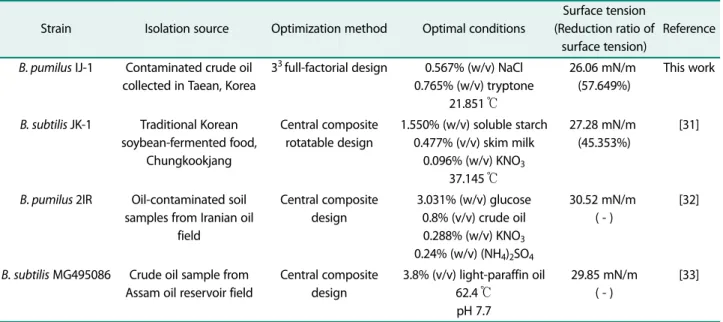
The important features of the current statistical approach to optimize the biosurfactant production using Bacillus sp. in shake-flask fermentation is shown in Table 7 [31 −33]. To our knowledge, very few studies have reported the optimization of biosurfactant produc- tion from Bacillus pumilus. Recently, medium compo- nents for biosurfactant production by B. pumilus 2IR were investigated [32]. The central composite design (CCD) performed by Fooladi et al. [32] revealed that glu- Table 5. Sum of squares partitioned by the factors.

Factor DF Sum of Squares Mean Square F -value Pr > F

x

1

(NaCl) 4 66.058075 16.514519 3.08 0.0207

x

2

(Temperature) 4 300.119598 75.029899 14.00 <.0001

x

3

(Tryptone) 4 39010 9752.598149 1820.37 <.0001

Fig. 2. Experimental vs. predicted reduction ratio of surface

tension.

(7)

cose, crude oil, KNO

3

, and (NH

4

)

2

SO

4

most significantly influenced biosurfactant production by B. pumilus 2IR.

The present results indicate that crude biosurfactant activity by B. pumilus IJ-1 depended on tryptone con- centration, temperature, and NaCl concentration.

Statistical approaches facilitate the formulation of bio-

surfactant production media and may be crucial to

enhance productivity [34]. This study attempted to opti-

mize culture conditions for crude biosurfactant activity

by B. pumilus IJ-1. Using a combination of a 3

3

full-fac-

torial design and RSM, we determined the optimal oper-

ating conditions for large-scale biosurfactant production

Fig. 3. Two and three dimensional contour plots for the reduction ratio of surface tension. RSM plots were induced the data

in Table 2. Inputs were 29 experimental runs under the conditions by the 3

3

full-factorial design. (A) On function of NaCl concen-

tration and temperature. (B) On function of NaCl and tryptone concentrations. (C) On function of temperature and tryptone con-

centration.

(8)

by B. pumilus IJ-1. Therefore, further research is required to optimize the biosurfactant yield in special- ized bioreactors.

Acknowledgments

This work was supported by a grant from Research year of Inje Uni- versity in 2016.

Conflict of Interest

The authors have no financial conflicts of interest to declare.

References

1. Desai JD, Banat IM. 1997. Microbial production of surfactants and their commercial potential. Microbiol. Mol. Biol. Rev. 61: 47-64.

2. Van Hamme JD, Singh A, Ward OP. 2006. Physiological aspects.

Part 1 in a series of papers devoted to surfactants in microbiol-

ogy and biotechnology. Biotechnol. Adv. 24: 604-620.

3. Banat IM, Makkar RS, Cameotra SS. 2000. Potential commercial applications of microbial surfactants. Appl. Microbiol. Biotechnol.

53: 495-508.

4. Toledo FL, Gonzalez-Lopez J, Calvo C. 2008. Production of bio- emulsifier by Bacillus subtilis, Alcaligenes faecalis and Enterobacter species in liquid culture. Bioresour. Technol. 99: 8470-8475.

5. Mukherjee S, Das P, Sen R. 2006. Towards commercial production of microbial surfactants. Trends Biotechnol. 24: 509-515.

6. Christofi N, Ivshina IB. 2002. Microbial surfactants and their use in field studies of soil remediation. J. Appl. Microbiol. 93: 915-929.

7. Mukherjee S, Das P, Sivapathasekaran C, Sen R. 2008. Enhanced production of biosurfactant by a marine bacterium on statistical screening of nutritional parameters. Biochem. Eng. J. 42: 254-260.

8. Abouseoud M, Maachi R, Amrane A, Boudergua S, Nabi A. 2008.

Evaluation of different carbon and nitrogen sources in produc- tion of biosurfactant by Pseudomonas fluorescens. Desalination 223: 143-151.

9. Liyana-Pathirana C, Shahidi F. 2005. Optimization of extraction of phenolic compounds from wheat using response surface meth- odology. Food Chem. 93: 47-56.

Table 6. Predicted values vs. experimental values for maximal crude biosurfactant activity.

Factor Culture conditions Reduction ratio of surface tension (%)

Experimental value Predicted value Experimental value Predicted value

x

1

(w/v, %) 1 0.567

x

2

( ℃) 20 21.851 53.88% 57.649%

x

3

(w/v, %) 0.5 0.765

Table 7. Comparison of the current studies on Bacillus sp. shake-flask fermentation regarding optimization of biosurfactant production.

Strain Isolation source Optimization method Optimal conditions

Surface tension (Reduction ratio of

surface tension)

Reference

B. pumilus IJ-1 Contaminated crude oil collected in Taean, Korea

3

3

full-factorial design 0.567% (w/v) NaCl 0.765% (w/v) tryptone

21.851 ℃

26.06 mN/m (57.649%)

This work

B. subtilis JK-1 Traditional Korean soybean-fermented food,

Chungkookjang

Central composite rotatable design

1.550% (w/v) soluble starch 0.477% (v/v) skim milk

0.096% (w/v) KNO

3

37.145 ℃

27.28 mN/m (45.353%)

[31]

B. pumilus 2IR Oil-contaminated soil samples from Iranian oil

field

Central composite design

3.031% (w/v) glucose 0.8% (v/v) crude oil 0.288% (w/v) KNO

3

0.24% (w/v) (NH

4

)

2

SO

4

30.52 mN/m ( - )

[32]

B. subtilis MG495086 Crude oil sample from Assam oil reservoir field

Central composite design

3.8% (v/v) light-paraffin oil 62.4 ℃

pH 7.7

29.85 mN/m ( - )

[33]

(9)

10. Montgomery D. 2005. Design and Analysis of Experiments, pp. 478-553. (8th ed). John Wiley and Sons, USA.

11. Kalil SJ, Maugeri F, Rodrigues MI. 2000. Response surface analysis and simulation as a tool for bioprocess design and optimization.

Process Biochem. 35: 539-550.

12. Myers RH, Montgomery DC. 2002. Response surface methodol- ogy: process and product optimization using designed experi- ments, (2nd ed). John Wiley & Sons, USA.

13. Chauhan AK, Survase SA, Kishenkumar J, Annapure US. 2009.

Medium optimization by orthogonal array and response surface methodology for cholesterol oxidase production by Streptomy- ces lavendulae NCIM2499. J. Gen. Appl. Microbiol. 55: 171-180.

14. Dutta JR, Dutta PK, Banerjee R. 2004. Optimization of culture parameters for extracellular protease production from a newly isolated Pseudomonas sp. using response surface and artificial neural network models. Process Biochem. 39: 2193-2198.

15. Oskouie SFG, Tabandeh F, Yakhchali B, Eftekhar F. 2008. Response surface optimization of medium composition for alkaline prote- ase production by Bacillus clausii. Biochem. Eng. J. 39: 37-42.

16. Singh RS, Singh H, Saini GK. 2009. Response surface optimization of the critical medium components for pullulan production by Aureobasidium pullulans FB-1. Appl. Biochem. Biotechnol. 152: 42-53.

17. Xiong YH, Liu JZ, Song HY, Ji LN. 2004. Enhanced production of extracellular ribonuclease from Aspergillus niger by optimization of culture conditions using response surface methodology.

Biochem. Eng. J. 21: 27-32.

18. Mutalik SR, Vaidya BK, Joshi RM, Desai KM, Nene SN. 2008. Use of response surface optimization for the production of biosurfac- tant from Rhodococcus spp. MTCC2574. Bioresour. Technol. 99:

7875-7880.

19. Najafi AR, Rahimpour MR, Jahanmiri AH, Roostaazad R, Arabian D, Ghobadi Z. 2010. Enhancing biosurfactant production from an indigenous strain of Bacillus mycoides by optimizing the growth conditions using a response surface methodology. Chem. Eng. J.

163: 188-194.

20. Rodrigues L, Teixeira J, Oliveira R, van der Mei HC. 2006. Response surface optimization of the medium components for the pro- duction of biosurfactants by probiotic bacteria. Process Biochem.

41: 1-10.

21. Chen HC. 1996. Optimizing the concentrations of carbon, nitro- gen and phosphorous in a citric acid fermentation with response surface method. Food Biotechnol. 10: 13-27.

22. Rao PV, Jayaraman K, Lakshmanan CM. 1993. Production of

lipase by Candida rugosa in solid state fermentation. 2: Medium optimization and effect of aeration. Process Biochem. 28: 391-395.

23. Park EJ, Kim JY. 2015. Characteristics of culture conditions for the production of biosurfactant by Bacillus pumilus IJ-1. J. Appl. Biol.

Chem. 58: 81-88.

24. Kim JY. 2014. Isolation and characterization of a biosurfactant- producing bacterium Bacillus pumilus IJ-1 from contaminated crude oil collected in Taean, Korea. J. Korean Soc. Appl. Biol. Chem.

57: 5-14.

25. Hur SH, Yang JS, Hong JH. 2002. Production of biosurfactant using Bacillus spp.. J. Korean Soc. Food Sci. Nutr. 31: 389-393.

26. Carrillo PG, Mardaraz C, Pitta-Alvarez SI, Giulietti AM. 1996. Isola- tion and selection of biosurfactant-producing bacteria. World J.

Microbiol. Biotechnol. 12: 82-84.

27. Lang S. 2002. Biological amphiphiles (microbial biosurfactants).

Curr. Opin. Colloid Interface Sci. 7: 12-20.

28. Zajic JE, Seffens W. 1984. Biosurfactants. CRC Crit. Rev. Biotechnol.

1: 87-107.

29. Box GEP, Wilson KB. 1951. On the experimental attainment of optimum conditions. J. Royal Statist. Soc. Ser. B 13: 1-45.

30. Ren X, Yu D, Han S, Feng Y. 2006. Optimization of recombinant hyperthermophilic esterase production from agricultural waste using response surface methodology. Bioresour. Technol. 97:

2345-2349.

31. Kim BS, Kim JY. 2013. Optimization of culture conditions for the production of biosurfactant by Bacillus subtilis JK-1 using response surface methodology. J. Korean Soc. Appl. Biol. Chem.

56: 279-287.

32. Fooladi T, Moazami N, Abdeshahian P, Kadier A, Ghojavand H, Wan Yusoff WM, et al. 2016. Characterization, production and optimization of lipopeptide biosurfactant by new strain Bacillus pumilus 2IR isolated from an Iranian oil field. J. Pet. Sci. Eng. 145:

510-519.

33. Datta P, Tiwari P, Pandey LM. 2018. Isolation and characterization of biosurfactant producing and oil degrading Bacillus subtilis MG495086 from formation water of Assam oil reservoir and its suitability for enhanced oil recovery. Bioresour. Technol. 270: 439- 448.

34. Kiran GS, Anto Thomas T, Selvin J, Sabarathnam B, Lipton AP.

2010. Optimization and characterization of a new lipopeptide

biosurfactant produced by marine Brevibacterium aureum

MSA13 in solid state culture. Bioresour. Technol. 101: 2389-2396.

수치

Fig.  1.  Phase-contrast  microscopic observation of  Bacillus pumilus IJ-1 (Magnification: ×1,000)
Table 1. Range of the parameters used for modeling and the specified codes for each parameter.
Table 4. Least-squares fit and parameter estimates.
Table 6 includes experimental values along with pre- pre-dicted values in both factors of culture conditions and reduction ratio of surface tension
+2

참조

관련 문서