Isolation and Identification of Lipolytic Enzyme Producing Pseudomonas sp.
OME and Optimization of Cultural Conditions
G. Satheesh kumar
1,2*, T. Kiran Reddy
2, B. Madhavi
2, P. Charan Teja
2, M. Subhosh Chandra
3and Yong Lark Choi
3*
1
Department of Microbiology, Acharya Nagarjuna University, Nagarjuna nagar 522-510, Guntur, India
2
Department of Virology, Sri Venkateswara University, Tirupati 517-502, India
3
Department of Biotechnology, College of Natural Resources and Life Science, Dong-a University 840, Hadan-Dong, Saha-gu, Busan 604-714, Korea Received February 16, 2010 /Accepted April 15, 2010
Lipolytic enzyme-producing bacteria were isolated from edible oil mill effluents on tributyrin agar medium. The shake-flask-scale studies yielded a promising isolate and it was identified as Pseudomonas sp. An OME using various microbiological observations such as cultural, microscopic, and biochemical tests was undertaken and confirmed using PIBWIN bacterial identification software. Lipolytic enzyme production was screened with oils such as sunflower, caster, coconut, tributyrin, and olive. Amongst these, olive oil showed an increased lipase production 6.1 U/ml. In view of the highest lipolytic en- zyme production with olive oil, further optimizations were carried out using olive oil as a carbon source. Lipolytic enzyme production was optimized by a conventional ‘one variable at a time’ ap- proach and the significant factors were further analyzed statistically using response surface method- ology (RSM). The effect of physical factors such as incubation time, temperature, initial medium pH, and nutritional factors such as concentration of olive oil and yeast extract were examined for lipase production. Lipolytic enzyme secretion was strongly affected by three variables (incubation time, con- centration of yeast extract and olive oil). Therefore, the interaction of these three factors was further optimized using response surface methodology. The optimized conditions of lipase production using response surface methodology yielded a maximum of 9.62 U/ml with optimum conditions for in- cubation, yeast extract and olive oil concentrations were found to be 48 hr, 0.3 g. and 0.9 ml. respectively.
Key words : Oil mill effluents (OME), isolation, lipolytic enzyme, identification, Pseudomonas sp. OME, RSM, optimization
*Corresponding author Phone: +91-970-104-2538 E-mail: [email protected]
Phone: +82-51-200-7585; Fax: +82-51-200-6536 E-mail: [email protected]
Introduction
Historically, the selection of microorganisms that produce exoenzymes has been empirical, starting with samples from very diverse environmental sources. Lipases are ubiquitous in nature and are produced by various plants, animals and microorganisms. Lipases of microbial origin, mainly bacte- rial and fungal, represent the most widely used class of en- zymes in biotechnological applications and organic chemistry.
Microbial lipases have been the subject of many important studies because of their availability and the large number of reactions they catalyze. Lipases (E.C. 3.1.1.3) are enzymes that are primarily responsible for the hydrolysis of acylglycerides. The industrial importance is the hydrolysis of vegetable oils, such as olive oil or coconut oil, to produce
fatty acids and glycerol, both of which find widespread ap-
plications, especially in soaps and detergents, others such
as in cosmetics, pharmaceuticals, food, organic synthesis,
dairy, fat and oil modification [1,8,15,17,22]. Most research
has concentrated on extracellular lipases that are produced
by many different microbial species. Although a number of
lipase-producing bacterial sources are available, only a few
are commercially exploited as wild or recombinant strains
[9,18]. The potent isolates of the genus belonging to
Achromobacter, Alcaligenes, Arthrobacter, Bacillus, Burkholderia,
Chromobacterium and Pseudomonas are most extensively used
for lipase porudction [9]. Of these, the lipases from
Pseudomonas bacteria are widely used for a variety of bio-
technological applications [2,9,19]. The synthesis and secre-
tion of lipases by bacteria is influenced by a variety of envi-
ronmental factors like ions, carbon sources, or presence of
non-metabolizable polysaccharides. The secretion pathway
is known for Pseudomonas lipases with P. aeruginosa lipase
using a two-step mechanism and P. fluorescens lipase using
a one-step mechanism [9]. Optimization of cultivation con- ditions is expected to improve the enzyme production. In order to attain higher enzyme titres, a number of factors need to be optimized, including a suitable organism and the process [10,12]. The optimization of physical and nutritional factors for submerged and solid state enzyme production is an important problem in the development of economically feasible bioprocesses. Combinatorial interactions of medium components with the production of the desired enzyme are numerous and the optimum processes may be developed using an effective experimental design procedure. RSM which is a collection of statistical techniques for designing experiments, building models, evaluating the effects of fac- tors and searching for the optimum conditions, has success- fully been used in the optimization of bioprocesses [4,5,6,11,20,26]. The goal of present study is to achieve a high level of lipolytic enzyme lipase production by newly isolated promising Pseudomonas sp. OME by optimization of physical and nutritional factors using a statistical experimental design.
Materials and Methods
Screening and selection of high lipase producing bacterial isolate
Lipolytic bacteria were isolated from oil mill effluents around Tirupati, India. The ability to produce extracellular lipase was determined by culturing the bacterial isolates on tributyrin agar medium at 37
oC for 24-48 hr [13]. A total of 9 bacterial colonies were selected (designated as OME i.e.
oil mill effluent I to IX) and tested for enzyme production in shake-flask-scale studies.
Fermentation
The liquid broth (yeast extract 2.5 g/l, K
2HPO
41.0 g/l, MgSO
4.7H
2O 0.05 g/l) was amended with olive oil (1%, v/v) and the final pH adjusted to 7.0. The 50 ml liquid broth me- dium was prepared in 250 ml Erlenmeyer flask and autoclaved at 121
oC for 15 min. The 5 hr old cultures (0.2 OD
600 nm) in- oculated at 5% (v/v) and the flasks were incubated at 30
oC for 48 hr with 120 rpm in an orbital shaking incubator.
Measurement of bacterial growth and assay of lipase activity
The bacterial growth in the fermented broth medium was determined using a spectrophotometer at 600 nm. The lipase
activity in the fermented broth medium was measured by centrifugation of fermented culture at 10,000 rpm for 15 min at 4
oC and the crude centrifugal supernatant was used as enzyme source. Determination of lipase activity was done by the titrimetric method [14,16]. The emulsion of olive oil (10%, v/v) was prepared in arabic gum (5%) in sodium phosphate buffer (0.1 mol/l pH 7.0). The assay mixture con- tained 2 ml of emulsified olive oil as substrate and appropri- ately diluted enzyme in phosphate buffer (0.1 M, pH 7.0) at 50°C for 30 min and the enzyme activity was stopped immediately by incubating into boiling water bath for 3 min.
Phenolpthalein indicator added to the hydrolyzed mixture and titrated against 0.05 M NaOH solution. One unit of li- pase activity was defined as 1.0 µmol of fatty acid liberated per min.
Statistical analysis
Data presented are the averages of three replicates. The statistical analysis for standard deviation was carried out us- ing Instat+v3.33 and SPSS 10.0 soft-ware packages.
Identification of bacterial isolate
Amongst the primary isolates, the promising one selected by plate assay and shake flask culture was used for identification. The selected promising bacterial culture used for preliminary microbiological studies such as cultural, mi- croscopic and biochemical observations.
Optimization of lipase production by ‘one variable at a time’
The factors were studied by modifying the medium com-
position according to the conditions and factors, which were
studied. The effect of different oils such as sun flower, caster,
coconut, tributyrin and olive on lipase production was
screened in shake-flask-scale culture studies by supplement-
ing oils at 1% to the liquid medium and the enzyme ex-
traction and assay carried out as described above. The effect
of different physical and nutritional factors for lipase pro-
duction by Pseudomonas sp. OME was investigated by cultur-
ing in liquid broth supplemented with 1% olive oil at 30
oC
under shaking condition, during cultivation lipase activity
was monitored. The effect of incubation period on lipase
production was observed at regular 12 hr interval, over a
period of 72 hr. In the view of maximum lipase production
with olive oil at 48 hr of incubation, further optimizations
were carried out at this point. The effect of incubation tem-
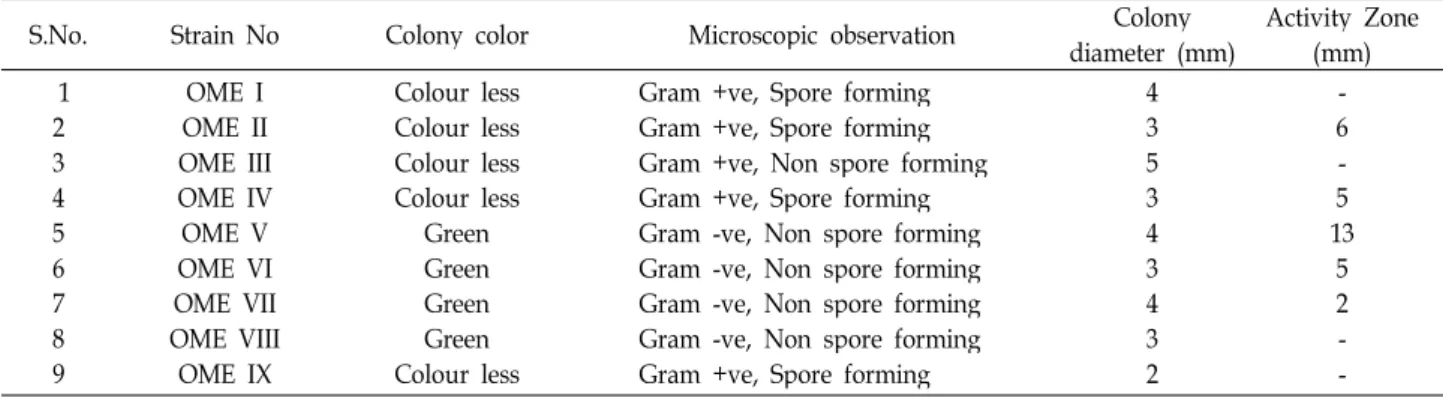
Table 1. The colony, microscopic and plate assay characteristics of selected bacterial isolates for lipase production
S.No. Strain No Colony color Microscopic observation Colony
diameter (mm) Activity Zone (mm) 1
2 3 4 5 6 7 8 9
OME I OME II OME III OME IV OME V OME VI OME VII OME VIII OME IX
Colour less Colour less Colour less Colour less
Green Green Green Green Colour less
Gram +ve, Spore forming Gram +ve, Spore forming Gram +ve, Non spore forming Gram +ve, Spore forming Gram -ve, Non spore forming Gram -ve, Non spore forming Gram -ve, Non spore forming Gram -ve, Non spore forming Gram +ve, Spore forming
4 3 5 3 4 3 4 3 2
- 6 - 5 13 5
2 - - perature from 30-50
oC and the effect of initial medium pH
was determined by preparing the Luria broth medium in buffer solution (0.1 M) from 4-8. The effect nutritional factors such as concentration of olive oil (0.3-1.6) and yeast extract (0.1-0.5) on lipase production was screened.
Experimental design using RSM
The significant factors influencing lipase production from
‘one variable at a time’ method was further optimized by RSM. Three factors selected from ‘one variable at a time’
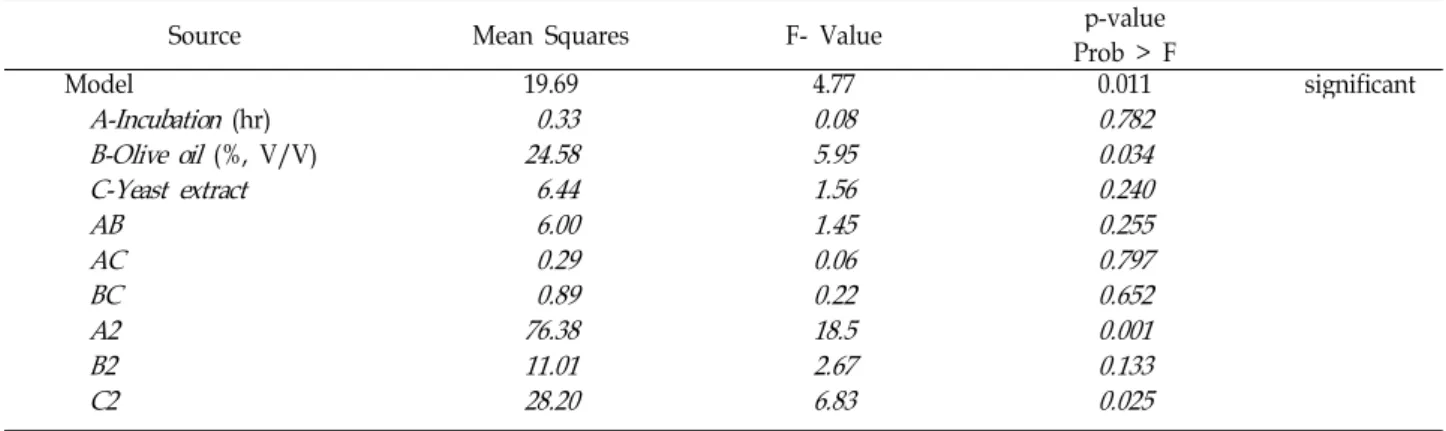
approach, were further optimized and used in designing the experiment: Incubation time (A), Olive oil (B) and Yeast ex- tract concentration (C). The ranges of the variables inves- tigated in this study are given in Table 4. A central compo- site quadratic design containing 20 experiments (20 runs) was generated using Design-Exeper
®software (7.1.6 ver- sion), lipase production was taken as an independent varia- ble or response.
The results of RSM were used to fit a second order plynominal equation (1) as it represents the behaviour of response [12].
Y=β
o+β
1A+β
2B+β
3C+β
1β
1A
2+β
2β
2B
2+β
3β
3C
2+β
1β
2AB+β
1β
3AC+β
2β
3BC (1) Y=response variable, β
o=intercept, β
1,β
2,β
3,=linear coeeficients, β
1β
1, β
2β
2, β
3β
3=Suqared coeeficients, β
1
β
2, β
1β
3, β
2β
3=interaction coeficients, and A, B, C, A
2, B
2, C
2, AB, AC, BC=level of independent variables.
Results and Discussion
Screening, selection and identification of potent bacterial isolate
The bacterial isolates used in this study were isolated from oil mill effluent samples. The bacterial cultures were
grown on tributyrin agar medium 24-48 hr at 30
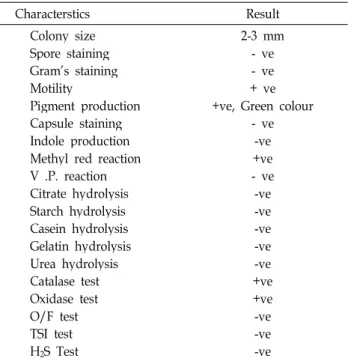
oC and the formation of clear hydrolysis zone gave an indication of lip- olytic enzyme producing cultures (Fig. 1). Amongst 9 iso- lates selected and they were designated as OME (oil mill effluent) I to OME IX. The cultural, microscopic and plate assay characteristics of lipolytic enzyme producing bacterial isolates were given in Table 1. The flask scale culture studies resulted one of the promising bacterial isolate (OME V) with lipase production 5.6 U/ml and it was used for further stud- ies (Fig. 2). The selected bacterial isolate was identified by cultural, microscopic and biochemical tests as Pseudomonas sp. OME using PIBWIN (Probabilistic Identification of Bacteria for Windows) bacterial identification software with identification score 64%, the results of these observations are given in Table 2 [3].
Optimized conditions by ‘One variable at time method’
The results of lipase production and bacterial growth with
Fig. 1. Screening of lipase production by selected bacterial
isolates using tributyrin agar plate assay method.
0.00 1.00 2.00 3.00 4.00 5.00 6.00
OME I
OME II
OME III
OME IV
OME V
OME VI
OME VII
OME VIII
OME IX Bacterial isolates
Lipase activity
0 0.5 1 1.5 2 2.5 3 3.5 4
bacterial growth
Lipase production (U/ml) bacterial growth (OD at 600nm)
Fig. 2. Screening and selection of promising isolate for lipase production by flask scale culture. OME, Oil mill effluent.
Table 2. Macroscopic and microscopic and certain biochemical tests performed to promising bacterial isolate
Characterstics Result
Colony size Spore staining Gram’s staining Motility
Pigment production Capsule staining Indole production Methyl red reaction V .P. reaction Citrate hydrolysis Starch hydrolysis Casein hydrolysis Gelatin hydrolysis Urea hydrolysis Catalase test Oxidase test O/F test TSI test H
2S Test
2-3 mm - ve - ve +ve, Green colour + ve
- ve -ve +ve - ve -ve -ve -ve -ve -ve +ve +ve -ve -ve -ve
different oils such as sunfloweroil, castor oil, coconut oil, tributyrin oil and olive oil by Pseudomonas sp. OME shown in Fig 3. High yield of lipase found with olive oil, th ideal substrate for inducing the enzyme production by Pseudomonas sp. OME. The effect of physical factors such as incubation time, temperature and initial medium pH on lipolytic en- zyme production was shown in Table 3. The enzyme pro- duction was increased with incubation time from 12-48 hrand further increase decreased the enzyme activity. The optimum incubation temperature and initial medium pH for enzyme production was found to be at 30
oC and pH 7 re-
0 1 2 3 4 5 6 7
sunflower oil
Caster oil Coconut oil
Tributyrin oil
Olive oil Bacterial isolates
Lipase activity
0 0.5 1 1.5 2 2.5 3 3.5 4
Bacterial growth