Optimization of gibberellic acid production by Methylobacterium oryzae CBMB20
Md. Ashaduzzaman Siddikee, Muhammad Hamayun1, Gwang-Hyun Han, and Tong-min Sa*
Dept. of Agricultural Chemistry, Chungbuk National University, Cheongju, Chungbuk, 361-763, Korea
1Dept. of Botany, Abdul Wali Khan University, Pakistan
Gibberellic acid (GA3) is used in many industries and constitutes the primary gibberellins produced by fungi and bacteria. However, there is no information on GA3 production by Methylobacterium oryzae CBMB20, a novel plant growth promoting bacterium. We investigated the favorable carbon (C) and nitrogen (N) sources and ratios and cultural conditions, such as incubation temperature, pH of the culture medium, and incubation period for the maximum production of GA3 by Methylobacterium oryzae CBMB20. Maximum GA3 production was observed in ammonium mineral salt (AMS) broth supplemented with Na-succinate and NH4Cl as C and N sources, respectively. The maximum GA3 production was found at the C/N ratio of 5:0.4 g L-1. The highest GA3 production was obtained when the bacterial culture was incubated at 30oC for 96 h at pH 7.
Key words: Methylobacterium oryzae, Gibberellic acid, Cultural parameter, Na-succinate, Ammonium chloride
Received : August 7. 2010 Accepted : August 13. 2010
*Corresponding author : Phone: +82432612561 E-mail: [email protected]
Introduction
Soil bacteria generally known as plant growth promoting rhizobacteria (PGPR) can promote plant growth directly or indirectly via various mechanisms. Among the growth promoting mechanisms the production and release of stimulatory metabolites such as auxin, cytokinin (Timmusk et al., 1999 Madhaiyan et al., 2006a) and GAs (Joo et al., 2009 Kang et al., 2009) are very important. Gibberellins (GAs) are plant growth hormones which influence a wide range of developmental processes including stem elongation, seed germination and dormancy, sex expression and flowering and fruit sets and development in a range of plant species (Sponsel, 2003). Gibberellic acid is also an important biotechnological product and it is widely used in the cosmetic sector and beer industry. Although GAs are considered as typical secondary metabolites in microorganisms, until now their physiological roles are not known. Until recently, 136 GAs have been identified in 128 plant species, 28 GAs in 18 different fungi species and only four GAs (GA1, GA3, GA4 and GA20) in 12 different bacterial species (Hamayun et al., 2009).
Gibberellins have been unequivocally identified in
cultures of Azospirillum lipoferum (Piccoli et al., 1996), Azospirillum brasilense (Janzen et al., 1992), Acetobacter diazotrophicus and Herbaspirillum seropedicaea (Bastian et al., 1998), Acinetobacter calcoaceticus (Kang et al., 2009) and Burkholderia sp. (Joo et al., 2009). Several observations led to suggest that these GA-producing microorganisms might induce or promote growth of the host plants by secreting these hormones in the rhizosphere (Bastian et al., 1998; Joo et al., 2009 Kang et al., 2009).
Methylobacterium is a group of strictly aerobic, facultative methylotrophic, Gram-negative and rod shaped bacteria able to grow on one-carbon compounds and a wide-range of multi-carbon growth substrates (Green and Bousifield, 1982). Moreover, Methylobacterium has a range of reported properties including nitrogen fixation (Jourand et al., 2004), IAA and cytokinin production (Omer et al., 2004), phosphorus solubilization, regulation of ethylene level in plant root by ACC deaminase (Madhaiyan et al., 2006a) and stimulation of resistance against pathogens (Madhaiyan et al., 2006b). However, GA production capacity for any member of the genus Methylobacterium has not been reported yet. In addition, production of GAs is considerably influenced by C and N sources, C/N ratio as well as other cultural conditions such as pH, temperature, and incubation time (Kahlon et al., 1986).
In this study, GA3 production by the plant growth
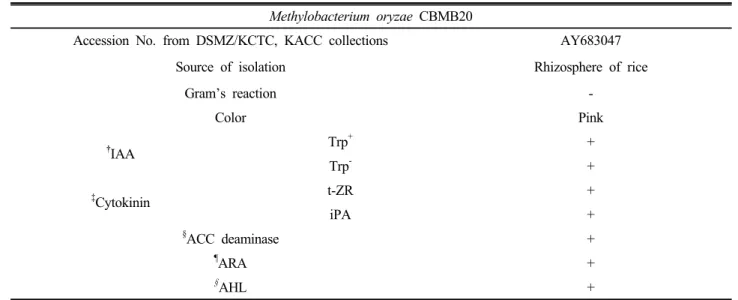
Table 1. Summary of plant growth promoting traits of Methylobacterium oryzae CBMB20.
Methylobacterium oryzae CBMB20
Accession No. from DSMZ/KCTC, KACC collections AY683047
Source of isolation Rhizosphere of rice
Gram’s reaction -
Color Pink
†IAA Trp+ +
Trp- +
‡Cytokinin t-ZR +
iPA +
§ACC deaminase +
¶ARA +
§AHL +
† IAA (Indole acetic acid) production with (Trp+) or without (Trp-) tryptophane supplementation.
‡ t-ZR (trans-Zeatin riboside), iPA (Iso pentenyl adenosine) are deferent form of cytokinin.
§ ACC (1-amino-cyclopropane-1-carboxylic acid) deaminase enzyme.
¶ ARA (Acetylene reduction activity) Ability to fixed atmospheric N2.
§ AHL (Acyl-Homoserine Lactone) a quorum-sensing signaling molecule.
Ref: Madhaiyan et al. (2006a) and Poonguzhali et al. (2007).
promoting Methylobacterium oryzae CBMB20 and optimum culture conditions for a large scale production of GA3 were investigated.
Materials and Methods
Bacterial strain and culture conditions M. oryzae CBMB20 was procured from the Plant Nutrition and Fertilizer Laboratory of the Department of Agricultural Chemistry, Chungbuk National University, South Korea.
The culture was maintained on standard AMS medium at 30°C in incubator with monthly transfer. Various traits of M. oryzae CBMB20 are presented in Table 1. AMS broth was prepared and pH adjusted to 6.8-7.0 then 50 mL was transferred in 250 mL flasks to grow bacteria. Before inoculation of bacteria (1:50 mL), growth medium was autoclaved at 121°C for 15 min. The inoculated flasks were incubated under standard conditions for 3-5 days, and bacterial growth was monitored throughout the experiment by reading absorbance at 600 nm.
Extraction of GA3 To extract and quantify the GA3
produced by Methylobacterium, culture broth was centrifuged at 10,000 rpm for 15 min at 4°C. The pellet was discarded and the pH of the supernatant was adjusted to 2.5 with 2 N
HCl. GA3 were extracted using liquid-liquid (ethyl acetate/
NaHCO3) extraction method following Cho et al. (1979).
GA3 was extracted two times from the supernatant with ethyl acetate (Volume 1:10) and the upper ethyl acetate fraction that contains the free GA3 was collected. To remove impurities, the ethyl acetate fraction was partitioned two times with 1 M NaHCO3 (Volume 1:1) and the upper fractions were collected. The pH of the NaHCO3 fraction was adjusted to 2.0. The NaHCO3 solution with the free GA3 was partitioned two times using ethyl acetate (Volume 1:10) and the upper fraction was collected. All the ethyl acetate fractions were composited together and dried using rotary evaporator and the residue was dissolved in 4 mL absolute methanol and filtered through Whatman No. 42 filter paper. The quantity of extracted GA3 in absolute methanol was determined by comparing the absorbance of GA3 dissolved in absolute methanol i.e. using standard curve of GA3. The efficiency of recovery using this procedure was estimated to be 92% on the basis of samples in which 1 mg of GA3 was added to AMS broth and extracted following the above described procedure.
Effects of C and N sources on growth and GA3 production To determine the effects of different C and N sources on growth of M. oryzae CBMB20 and GA3 production, M. oryzae CBMB20 was grown in the AMS broth
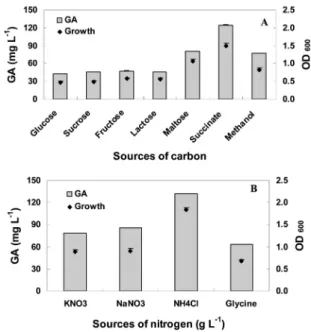
Fig. 1. Growth of Methylobacterium oryzae CBMB20 and GA3 production in different carbon (A) and nitrogen (B) sources. OD600 stands for optical density at 600 nm.
Fig. 2. Growth of Methylobacterium oryzae CBMB20 and GA3 production at different concentrations of Na-succinate (A) and NH4Cl (B). OD600 stands for optical density at 600 nm.
supplemented with one of these C (Na-succinate, methanol, glucose, maltose, sucrose, fructose, and lactose) and N sources (KNO3, NH4Cl, NaNO3 and glycine). Maximum GA3 production was observed in the growth medium supplemented with Na-succinate and NH4Cl. Each of these C and N sources was added to AMS broth at the concentration of 5 g L-1 for C and 0.2 to 1.0 g L-1 for N.
Culture flasks were incubated under optimum growth conditions. After incubation, bacterial growth and the amount of GA3 production were estimated following the above mentioned procedures.
Determination of C/N ratio for optimum growth and GA3 production Two experiments were set to determine the optimum C/N ratio on bacterial growth and GA3
production. In the first set, NH4Cl was added to nutrient broth between 0.2 to 1.0 g L-1 concentrations range. The C source was kept at fixed concentration. In the second set, the concentration of N was kept constant and Na-succinate was added in the concentration range of 2.0 to 8.0 g L-1 into the growth medium.
Optimization of incubation period, temperature and pH for bacterial growth and GA3 production To determine the optimum duration of incubation, temperature and pH, M. oryzae CBMB20 was inoculated into AMS broth, and the culture was incubated at different incubation period (12, 24, 36, 48, 72, 96 and 120 h at 30 ± 2°C), temperature (15, 20, 25, 30, 35 and 40°C for 96 h) and pH (6.0, 6.5, 6.8, 7.0 and 7.5) on a rotary shaker (150 rpm). After incubation, bacterial growth and the amount of GA3 production were estimated following the above mentioned procedures.
Statistical analyses All data were subjected to analysis of variance and testing of means by Duncan’s multiple range test (DMRT) at P<0.01 using the SAS package version 9.1. (SAS Institute Inc., Cary, NC, USA).
Results and Discussion
The effects of different C sources and different concentrations of Na-succinate on the growth and production of GA3 by M. oryzae CBMB20 are presented in Fig. 1A and 2A. The addition of Na-succinate to the medium increased GA3 production up to 124.5 mg L-1 and bacterial growth up to 1.49 OD600, whereas the lowest bacterial growth and GA3 production were found in the
glucose and sucrose supplemented medium (Fig. 1A).
Maltose and methanol on the other hand are considerable C sources only for bacterial reproduction. However, Na- succinate is appropriate both for bacterial growth and GA3
production. Comparing the effect of the concentration of Na-succinate in the growth medium, the highest GA3
production was found at 5 g L-1 but maximum bacterial growth was obtained at 7 g L-1 Na-succinate (Fig. 2A).
Fig. 3. Growth of Methylobacterium oryzae CBMB20 and GA3 production at different incubation periods (A), temperatures (B) and pH (C). OD600 stands for optical density at 600 nm.
However, GA3 production decreased when Na-succinate concentration was above 6 g L-1 and the bacterial growth also started to decrease. Bacterial growth increased with increased Na-succinate concentration but GA3 production in the culture decreased. This reduced GA3 production may be due to the higher amount of C which facilitate primary metabolism of bacteria and enhance growth and multiplication. Escamilla et al. (2000) also found that growth and production of GA3 continues when sufficient C substrate is available for Gibberella fujikuroi. Demain (1998) reported that secondary metabolism is brought on by exhaustion of a nutrient, biosynthesis or addition of an inducer, and/or by a growth rate decrease. These events generate signals which affect a cascade of regulatory events resulting in chemical differentiation i.e., primary to secondary metabolism.
The effects of various N sources and their concentration on the bacterial growth and GA3 production are presented in Fig. 1B and 2B. The highest bacterial growth and GA3
production were found with the addition of NH4Cl to the culture medium, and the lowest GA3 production and bacterial growth were obtained in the glycine amended medium (Fig. 2B). Shukla et al. (2003) also found that N source plays a very significant role in gibberellic acid production.
NH4Cl was found to be suitable for maximum growth of M. oryzae CBMB20 and facilitate faster growth which rapidly shifted to the secondary metabolism. In other words, NH4Cl encourages stationary phase and starts GA3
production because it is a typical secondary metabolite in microorganisms. Upon exhaustion of N sources, exponential growth of microorganisms ceases and secondary metabolism is triggered (Escamilla et al., 2000).
Optimum concentration of NH4Cl for GA3 production was found to be 0.4 g L-1 whereas maximum bacterial growth was obtained at concentration of 0.7 g L-1 (Fig. 2B). Giordano et al. (1999) reported that in the biosynthesis of N-free compounds, GAs are inhibited by high amounts of N in the culture medium. The TOR kinase, responsible for regulating nutrient mediated growth signaling to control cell growth, has recently been implicated in the biosynthesis of GAs by Fusarium fujikuroi and was found to be involved in the N regulation of secondary metabolism and repression of the expression of GA biosynthetic gene in N sufficient conditions (Teichert et al., 2006).
To optimize C/N ratio for maximum bacterial growth and GA3 production, two experiments were performed.
The production of GA3 was found highest in the AMS broth containing 5 g L-1 Na-succinate (Fig. 2A) and 0.4 g L-1 NH4Cl (Fig. 2B). The limitation of N in the culture medium and the use of the optimal concentration of C source could increase the GA3 production. Escamilla et al.
(2000) reported that C/N ratio is the most important factor in improving the growth of microorganisms. Production of GAs starts when N is depleted and continues when sufficient C substrate is available for Gibberella fujikuroi (Escamilla et al., 2000).
The effects of different incubation periods, temperature and pH on growth and biosynthesis of GA3 are presented in Fig. 3 (A, B and C). GA3 production started to increase at 12 h of incubation and reached a maximum level after 94 h (Fig. 3A), and a decline of GA3 production was observed at 120 h of incubation. Bacterial growth and GA3
production persistently increased up to 72 h then growth stabilized but GA3 production still increased. At this point, secondary metabolism may be triggered due to nutrient limitation. After 96 h of incubation, growth as well as GA3
productions started to decrease rapidly. This is due to
product inhibition, chemical decomposition and, perhaps, bio-degradation of the product by the culture (Hollmann et al., 1995). Hollmann et al. (1995) reported that GA3
production stops and/or the concentration decreases sharply in Gibberella fujikuroi after 200 h. Similar to Escamilla et al. (2000) report on fungi, this studies showed maximum GA3 production at the lag phase of growth.
Various incubation temperatures and pH showed a diverse effect on bacterial growth and GA3 biosynthesis.
Bacterial growth and GA3 production increased with increasing temperature. The maximum GA3 production and bacterial growth was detected at 30°C and both started to decrease at 35°C (Fig. 3B). Previous studies found the maximum GA3 production at 30 ± 2°C (Zamanian et al., 1987). Escamilla et al. (2000) reported that temperature can affect the production of gibberellic acid in Gibberella fujikuroi and the activity of the GA3 is lost at high temperature. The maximum bacterial growth and GA3
production were obtained at pH 7.0, while lower GA3
production and bacterial growth were obtained both at pH 6.0 and 7.5 (Fig. 3C).
All parameters studied in this study showed significant (P ≤ 0.01) effects on the growth of M. oryzae CBMB20 and GA3 production. Moreover, though each treatment showed less deviation from mean value of each parameter, value of CV confirmed that each treatment of all parameter has considerable impact on growth and GA3 production (statistical inference has not shown).
In conclusion, GA3 production by M. oryzae CBMB20 was highly dependent on the source of C and N, C/N ratio, and other cultural parameters. Based on the data obtained, the GA3 production was maximum at 96 h of incubation at pH 7 at 30°C using Na-succinate and NH4Cl as C and N source, respectively. Currently, GA3 is largely produced by submerged fermentation of the fungus Gibberella fujikuroi (Santos et al., 2003) for 12 to 18 days of incubation. In addition, Kumar and Lonsane (1988) obtained GA3 yield of 79 mg L-1 using non-conventional bio-reactor and immobilized mycelia of G. fujikuroi. In comparison to G.
fujikuroi, Methylobacterium sp. may offer better options for GA production because it needs shorter incubation period and simple cultural conditions. These results suggest that Methylobacterium sp. can be used as a potential bacterial source to obtain high yields of GA3. Moreover, Methylobacterium sp. could be a potential alternative of commercial GA3 in agriculture by applying it as a plant growth promoting inoculant.
Acknowledgments
We thank Eleazar M. Escamilla S. for critical reading of this manuscript and giving constructive comments. This work was supported by the research grant of Chungbuk National University in 2010.
References
Bastian, F., A. Cohen, P. Piccoli, V. Luna, R. Baraldi, and R. Bottini. 1998. Production of indole-3-acetic acid and gibberellins A1 and A3 by Acetobacter diazotrophicus and Herbaspirillum seropedicae in chemically-defined culture media. Plant Growth Regul. 24:7-11.
Cho, K.Y., A. Sakurai, and Y. Kamiya. 1979. Effects of the new plant growth retardants of quaternary ammonium iodides on gibberellin biosynthesis in Gibberella fujikuroi.
Plant Cell Physiol. 20:25-81.
Demain, A.L. 1998. Induction of microbial secondary metabolism.
Int. J. Microbiol. 1:259-264.
Escamilla, E.M.S., L. Dendooven, I.P. Magana, R.S. Parra, and M. De la Torre. 2000. Optimization of gibberellic acid production by immobilized Gibberella fujikuroi mycelium in fluidized bioreactors. J. Biotechnol. 76;, 147-155.
Giordano, W., J. Avalos, O.E. Cerda, and C. Domenech.
1999. Nitrogen availability and production of bikaverin and gibberellins in Gibberella fujikuroi. FEMS Lett. 173:389-393.
Green, P.N., and I.J. Bousifield. 1982. A taxonomic study of some Gram-negative facultatively methylotrophic bacteria.
J. Gen. Microbiol. 128:623-638.
Hamayun, M., A.K. Sumera, M.A. Khan, A.L. Khan, S.M.
Kang, S.K. Kim, G.J. Joo, and I.J. Lee. 2009. Gibberellin production by pure cultures of a new of Aspergillus fumigatus.
World J. Microbiol. Biotechnol. 25:1785-1792.
Hollmann, D., J. Switalski, S. Geipel, and U. Onken. 1995.
Extractive fermentation of gibberellic acid by Gibberella fujikuroi. J. Ferment. Bioeng. 79:594-600.
Janzen, R., S. Rood, J. Dormar, and W. McGill. 1992.
Azospirillum brasilense produces gibberellins in pure culture and chemically-medium and in co-culture on straw. Soil Biol. Biochem. 24:1061-1064.
Joo, G.J., S.M. Kang, M. Humayun, S.K. Kim, C.I. Na, D.H. Shin, and I.J. Lee. 2009. Burkholderia sp. KCTC 11096BP as newly isolated gibberellin producing bacterium.
J. Microbiol. 47:167-171.
Jourand, P., E. Giraud, G. Bena, A. Sy, A. Willems, M. Gillis, B. Dreyfus, and P. de Lajudie. 2004. Methylobacterium nodulans sp. nov., for a group of aerobic, facultatively methylotrophic, legume root-nodule forming and nitrogen- fixing bacteria. Int. J. Syst. Evol. Microbiol. 54:2269-2273.
지베렐린산 생산을 위한
Methylobacterium oryzae
CBMB20의 최적 배양조건 확립Md. Ashaduzzaman Siddikee·Muhammad Hamayun1·한광현·사동민*
충북대학교 농업생명환경대학 농화학과, 1파키스탄 압둘왈리칸대학교 식물학과
지베렐린산은 곰팡이 및 세균으로부터 생산되는 주요 식물생장촉진물질이며 다양한 산업에서 이용되고 있다. 본 연구는 Methylobacterium oryzae CBMB20을 이용하여 GA3를 생산하기 위해 탄소원 및 질소원을 선발하였으며, 선발된 탄소원 및 질소원의 최적 농도와 최적 비율을 조사하였다. 탄소원으로는 Na-succinate가 methanol, glucose, maltose, sucrose, fructose, lactose에 비해 가장 우수하였으며, 질소원으로는 NH4Cl가 NO3, NaNO3, glycine 등에 비해 우수하였다. 배양액에서 Na- succinate와 NH4Cl를 각각 5 및 0.4 g L-1 농도 비율로 사용하였을 때 GA3의 생산량이 가장 높았다. 또한 ammonium mineral salt 배지의 pH를 7로 유지하고 30℃의 조건으로 96시간 배양하였을 때 GA3의 생산이 최대로 나타나는 것을 확인 하였다.
Kahlon, S.S. and S. Malhotra. 1986. Production of gibberellic acid by fungal mycelium immobilized in sodium alginate.
Enzyme Microbe. Technol. 8:613-616.
Kang, S.M., G.J. Joo, M. Hamayun, C.I. Na, D.H. Shin, H.Y. Kim, J.K. Hong, and I.J. Lee. 2009. Gibberellin production and phosphate solubilization by newly isolated of Acinetobacter calcoaceticus and its effect on plant growth.
Biotechnol Lett. 31:277-281.
Kumar, P.K.R. and B.K. Lonsane. 1988. Immobilized growing cells of Gibberella fujikuroi P-3 for production of gibberellic acid and pigment in batch and semi-continuous cultures.
Appl. Microbiol. Biotechnol. 28:537-542.
Madhaiyan, M., S. Poonguzhali, J.H. Ryu, and T.M. Sa.
2006a. Regulation of ethylene levels in canola (Brassica campestris) by 1-aminocyclopropane-1-carboxylate deaminase- containing Methylobacterium fujisawaense. Planta 224:
268-278.
Madhaiyan, M., B.V.S. Reddy, R. Anandham, M. Senthilkumar, S. Poonguzhali, S.P. Sundaram, and T.M. Sa. 2006b. Plant growth promoting Methylobacterium sp. induces defense responses in groundnut (Arachis hypogaea L.) compared to rot pathogens. Curr. Microbiol. 53:270-276.
Omer, Z.S., R. Tombolini, A. Broberg, and B. Gerhardson.
2004. Indole-3-acetic acid production by pink-pigmented facultative methylotrophic bacteria. Plant Growth Regul.
43:93-96.
Piccoli, P., O. Masciarelli, and R. Bottini. 1996. Metabolism of 17, 17 [2H2]-Gibberellins A4, A9, and A20 by Azospirillum lipoferum in chemically-defined culture medium. Symbiosis 21:167-178.
Poonguzhali, S., M. Madhaiyan, and T.M. Sa. 2007. Production of Acyl-Homoserine Lactone Quorum-sensingsignals is wide- spread in Gram-Negative Methylobacterium. J. Microbiol.
Biotechnol. 17:226-233.
Santos, M.G.E., M.C.M. Couto, and H.L.S. Rebelo. 2003.
Ion-selective electrodes based on metalloporphyrins for gibberellic acid determination in agricultural products. Anal.
Bioanal. Chem. 375:511-516.
Shukla, R., A.K. Srivastava, and S. Chand. 2003. Bioprocess strategies and recovery processes in gibberellic acid fermentation. Biotechnol. Biproc. Eng. 8:269-278.
Sponsel, V.M. 2003. Gibberellins. p. 29-40. In H.L. Henry and A.W. Norman (eds.) Encyclopedia of Hormones, Vol. 2. Academic Press, London, UK.
Teichert, S., M. Wottawa, B. Schonig, and B. Tudzynski.
2006. Role of the Fusarium fujikuroi TOR kinase in nitrogen regulation and secondary metabolism. Eukaryotic Cell. 5:1807-819.
Timmusk, S., B. Nicander, U. Granhall, and E. Tillberg.
1999. Cytokinin production by Paenibacillus polymyxa. Soil Biol. Biochem. 31:1847-1852.
Zamanian, M. and R.J. Mason. 1987. Benzene dioxygenase in P. putida. Biochem. J. 244:611-616.