*These authors contributed equally to this paper Y. J. Jung* ・ K. K. Kang
Institute of Genetic Engineering, Hankyong National University, Ansung, 456-749, Korea
H. J. Lee* ・ Y. G. Cho
Department of Crop Science, Chungbuk National University, Cheongju, 361-763, Korea
J. S. Choi
National Institute of Horticultural & Herbal Science, Suwon, 440-746, Korea
I. S. Nou
Department of Horticulture, Sunchon National University, Suncheon, 540-742, Korea
K. K. Kang ( )
Department of Horticulture, Hankyong National University, Ansung, 456-749, Korea
e-mail: [email protected]
Isolation and functional characterization of BrUGT gene encoding a UDP-glycosyltransferase from Chinese cabbage (Brassica rapa)
Yu Jin Jung ・ Hye Jung Lee ・ Jang Sun Choi ・ Yong Gu Cho ・ Ill Sup Nou ・ Kwon Kyoo Kang
Received: 20 September 2012 / Accepted: 23 September 2012
ⓒKorean Society for Plant Biotechnology
Abstract Glycosyltransferases are enzymes (EC 2.4) that
catalyze the transfer of monosaccharide moieties from activated nucleotide sugar to a glycosyl acceptor molecule which can be a carbohydrate, glycoside, oligosaccharide, or a poly- saccharide. In this study, a UDP-glucosyltransferase cDNA was isolated from Brassica rapa using a rapid amplification of cDNA ends (RACE) and subsequently named BrUGT. It has a full-length cDNA of 1,236 bp with 119 bp 5′-un- translated region (UTR), a complete ORF of 834 bp encoding a polypeptide of 277 amino acids (31.19 kDa) and a 3′-UTR of 283 bp. BLASTX analysis hits a catalytic domain of Glycos_transf_1 super family (cl12012) that belongs to the Glycosyltransferases group 1 with tetratricopeptide (TPR) regions located between 165 to 350 bp. Expression analysis showed high mRNA transcripts in pistil, followed by petal, seed and calyx of flower. Moreover, expression analysis of BrUGT in Chinese cabbage seedlings under stresses of cold, salt, PEG, H
2O
2, drought and ABA showed elevated mRNA transcript. Furthermore, when BrUGT gene was transformed into rice using pUbi-1 promoter, overexpression was evident
among the T
1plants. This study provides insights into the function of BrUGT in plants.
Keywords Glycosyltransferase, stresses, Chinese cabbage,
overexpression
Introduction
Plants synthesize a large variety of natural products, known as secondary metabolites, which play important roles in plant defense against microorganisms and herbivores (Wink 1999; Dixon 2001). Plant secondary metabolite UDP-dependent glycosyltransferases (UGTs) catalyze the transfer of a car- bohydrate from an activated donor sugar onto small mole- cule acceptors by the formation of a glycosidic bond (Mackenzie et al. 1998; Li et al. 2001). Glycosylation changes the stability and/or solubility of the aglyca, and even create a higher diversity due to differential and multiple conjugations. These reactions are an important feature of the biosynthesis of many secondary metabolites and in many cases of the regu- lation of the activity of signaling molecules and defense compounds.
It has been reported that Arabidopsis thaliana contains 120 UGTs (Li et al. 2001; Paquette et al. 2003). Several UGTs using different groups of substrates in A. thaliana have been characterized in vitro but substrates of most UGTs still remain unknown (Bowles et al. 2005). Similarly, rice has more UGTs than A. thaliana but their functional charac- terization is currently under way to elucidate their functional importance (Ko et al. 2006). The UGT superfamily in higher plants is thought to encode enzymes that glycosylate a broad array of aglycones, including plant hormones, all major classes of plant secondary metabolites, and xenobiotics such as herbicides (Vogt and Jones 2000). Indeed, many studies have shown that glucose regulates expression of a broad range of genes involved in primary metabolism, signal
DOI:http://dx.doi.org/10.5010/JPB.2012.39.3.212Research Article
transduction, and metabolite transport (Mita 1995; Price et al 2004; Thibaud et al. 2004). Overexpression of UDP glucosyltransferase increases glucose tolerance in A. thaliana (Yan et al 2010). Further, analysis of UGT expression in Arabidopsis defense-signaling mutants revealed that their induction was methyl jasmonate independent, but partially salicylic acid dependent. T-DNA tagged mutants (ugt73b3 and ugt73b5) exhibited decreased resistance to P. syringae pv tomato-AvrRpm1 (Langlois-Meurinne et al. 2005). These results emphasize the importance of plant secondary metab- olite UGTs in plant-pathogen interactions and provide foun- dation for future understanding of the exact role of UGTs during the hypersensitive response.
In addition to the stress and defense roles of UGT, it also involves in the flavonol glycoside biosynthesis in vivo, and metabolite profiling of the knock-out mutants of UGT73C6 and UGT78D1 showed no accumulation of quercetin and kaempferol glycosides in leaf and floral tissues (Wang 2009;
Jones et al. 2003). UGT74F2 glucosylates anthranilate (Quiel and Bender 2003) and salicylic acid in vivo (Dean and Delaney 2008), and UGT75C1 is a functional anthocyanin 5-O-glucosyltransferase (Tohge et al. 2005). In Medicago truncatula, UGT71G1 was identified to be involved in saponin biosynthesis, and an integrated transcript and metabolite profiling showed that methyl jasmonate treatment resulted in induction of UGT71G1 in cell cultures and also induced accumulation of triterpene glycosides (Achnine et al. 2005).
Medicago UGT72L1 is involved in the production of epicatechin 3'-O-glucoside in the seed coat as a key step in proanthocyanidin biosynthesis (Pang et al. 2008). Fur- thermore, UGTs also play important roles in detoxification of xenobiotics and regulating activity of plant hormones (Bowles et al. 2006). For example, Arabidopsis UGT73C5 glucosylates steroid hormone brassinosteroids and reduces their bioactivity (Poppenberger et al. 2005). Arabidopsis UGT72B1 is involved in xenobiotic metabolism (Brazier- Hicks et al. 2007).
Plant UGTs have attracted extensive research interest due to their key roles in glycosylation and physiological functions in plants as well as their potential application in biotechnology. In recent years, significant progress has been achieved in structural studies of plant UGTs, advancing our understanding of the UGT mediated glycosylation mechanism and directed the UGT engineering from altering glycosylation patterns to producing bioactive glycosides. It will be essential to integrate data from in vitro and in vivo studies in many crops to gain more complete picture of the potential biological and molecular roles of UGT in plants.
In this study, we reported the molecular characterization of
a full-length cDNA of BrUGT gene cloned from Chinese cabbage (Brassica rapa) and its response to abiotic stresses.
Material and method Plant materials
Chinese cabbage (Brassica rapa var. ‘sosongche’) plants were grown in the greenhouse at Hankyong National Uni- versity, Anseong, Korea. Different parts of the plant, i.e.
young leaves, stems, seeds, flower buds, flower stalks, pistils, stamens, petals, calyx of flowers and roots (branched side roots) from 2-month-old nursery grown plants were used as plant materials.
Stress treatments
Two-month-old potted mature plants of Brassica rapa var.
sosongche were subjected to different stress conditions in the following manner. Seedlings at the 5-6 leaf stage were placed in 15% PEG 6000 solution and drought condition to induce drought. For other treatments, seedlings at the 5-6 leaf stage were treated with 100 μM ABA, 250 mM NaCl, 4℃ cold, 3% H
2O
2by spraying and/or irrigation.
Samples were collected at 0, 0.25, 0.5, 1, 2, 4, 8 and 24 h and immediately stored at -80℃.
RNA isolation and real-time PCR
Total RNA from leaf tissue was extracted as described by
Lee et al. (2012) with some modifications. The relative
purity and concentration of extracted RNA was estimated
using NanoDrop-1000 spectrophotometer, and stored at
-80℃ freezer. Total RNAs were cleaned using DNaseI, and
the first-strand cDNA synthesis was performed by reverse
transcription of mRNA using Oligo (dT)
20primer and
SuperScript TMⅢ Reverse Transcriptase. For RT-PCR analysis,
the gene specific primers were: BrUGT Fw1 : 5’-GTGG
AGAGTCTTGTCGGAGA-3’ and BrUGT Rv1 : 5’-GACC
GGTTTGAGATTGAATG-3’. The PCR amplification pro-
gram consisted of an initial step at 94℃ for 5 min followed
by 30 cycles of 94℃ for 1 min, 58℃ for 1 min, 72℃ for
2 min, and a final step at 72℃ for 10 min. Actin primers
were used as a loading control and also used as an internal
control for normalization of RT-PCR reaction. For the
quantitative RT-PCR, the gene specific primers were : BrUGT
Fw2 : 5’-CACAGCATCATATCTCCAAA-3’ and BrUGT Rv2 :
5’-TATAGAGCGTGGATGGTTTT-3’. The cDNA samples
were diluted to 10 ng/μl. Triplicate quantitative assays were performed using 5 μl of each cDNA dilution with the SYBR Green Master mix and the CFX connect real-time system (Biorad, USA). The relative quantification method (∆∆Ct) was used to evaluate quantitative variation be- tween the replicates. The amplification of actin as an internal control to normalize all data was used.
DNA Extraction and PCR Analysis
Genomic DNA was extracted as described by Abdula et al. (2011) with some modifications. Point two gram (0.2 g) of ground powder of fresh rice leaf tissue was placed in 2 ml microcentrifuge tube, and 900 μl of 65℃ pre- heated extraction buffer (pH7.8-8.0) was added. After in- cubation in water bath at 65℃ for 30 min, 700 μl of phenol:chloroform:isoamyl alcohol (25:24:1) was added into the tube and mixed for 10 min, and centrifugation was carried out at 13,000 rpm for 10 min. The upper phase was transferred into a new 2 ml tube and equal volume of chloroform:isoamyl alcohol (24:1) was added and mixed for 10 min. The mixed samples were centrifuged at 13,000 rpm for 10 min and the upper phase was transferred into a new 1.5 ml tube containing 4 μl of 10 mg/ml RNase1.
After incubation at 37℃ for 30 min, 0.7 volume of pre- cooled isopropanol was added and mixed by vortexing, and centrifuged at 13,000 rpm at 4℃ for 15 min. The super- natant was discarded and 1 ml of 70% ethanol was applied to wash the DNA pellet and centrifuged at 13,000 rpm for 5 min. DNA pellet was air-dried and suspended in 50 μl of 0.5 M TE buffer. The relative purity and concentration of extracted DNA was estimated using NanoDrop-1000 (NanoDrop Technologies, Inc. USA). PCR analysis was performed using HPT-Fw (5’-ATGAAAAAGCCTGAACT CACCGC-3’) and HPT-Rv (5’-CTATTTCTTTGCCCTCG GACGA-3’) primers to check the introgression of hygro- mycinphosphotransferase gene (hpt), and BrUGT Fw1 and Rv1 primers to check the introduction of the full-length cDNA of BrUGT gene.
Vector Constructs and Rice Transformation
The BrUGT full length cDNA was ligated into the pBig_
sfiI vector (TaKaRa, Shiga, Japan). The recombinant vector with BrUGT has been constructed under the control of pUbi-1 promoter and NOS terminator and transformed using Agrobacterium tumefaciens-mediated transformation method (Lee et al. 2011). Agrobacterium strain EHA105 harboring binary Ti plasmid pFLCIII containing the full-length cDNA
of BrUGT gene was cultured on AB medium containing 50 mg/L kanamycin sulfate solidified with 1.5% agar for 3 days at 28℃ in the dark. Agrobacterium culture was scraped from the plates and suspended in AAM medium to yield an OD
600of approximately 0.3. Pre-cultured seeds were immersed in the Agrobacterium suspension by gently inverting the tube for 1.5 min, blotted dry with a sterilized filter paper to remove excess bacteria. The seeds were trans- ferred onto a sterilized filter paper that had been moistened with 0.5 ml of AAM medium placed on 2N6-AS medium solidified with 0.4% gelrite. After 3 days of co-cultivation at 25℃ in the dark, seeds were washed five times in sterilized water and then washed once in sterilized water containing 500 mg/L carbenicillin to remove Agrobacterium.
The seeds were rapidly blotted dry on a sterilized filter paper and cultured on N6D medium containing 50 mg/L hygromycin and 400 mg/L carbenicillin under continuous light at 32℃ for 2 weeks. Proliferating calli arising from the scutellum were transferred to SF medium. Plantlets arising from the calli were transferred to RF medium to induce roots.
Results
Characterization of BrUGT gene
Analysis of the Brassica rapa UDP-glucosyltransferase (BrUGT) showed a full-length cDNA of 1,236 bp with 119 bp 5′-untranslated region (UTR), a complete open reading frame (ORF) of 834 bp encoding a polypeptide of 277 amino acids (31.19 kDa) and a 3′-UTR of 283 bp. BLASTX analysis of the deduced amino acid sequences showed a glycosyltransferase_GTB_type superfamily located in the N-terminal region (Fig. 1). The members of this family share a common GTB topology, one of the two protein topologies observed for nucleotide-sugar-dependent glycosyltransferases.
Moreover, BrUGT showed 83% amino acid identity to Arabidopsis lyrata (Accession No. XP 002879117), and Arabidopsis thaliana (Accession No. AAM 61749), 66%
to Ricinus communis (Accession No. XP 002523692), and 59% in Dianthus carypophyllus (Accession No. BAF 75888).
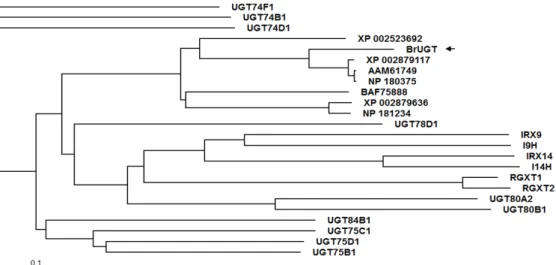
Furthermore, phylogenetic tree analysis using the deduced amino acid of BrUGT showed close divergence to Arabidopsis lyrata and Arabidopsis thaliana (Fig. 2). This result is not surprising since Chinese cabbage belong to the Brassicaceae (Cruciferae) family which includes both the A. lyrata and A. thaliana (Abe et al. 2011).
To investigate the expression of BrUGT, quantitative
Fig. 2 A rooted neighbour-joined tree comparing the phylogenetic sequence relationship of the BrUGT gene domains Fig. 1 Nucleotide and deduced amino acid sequence of the
full-length cDNA of BrUGT gene
Fig. 3 Quantitative reverse transcription-polymerase chain reaction (RT-PCR) analysis of BrUGT was conducted in various tissues collected from Brassica rapa. Actin transcripts served as a positive control and were detected in all tissues
RT-PCR analysis was conducted in different parts of Chinese cabbage. mRNA transcript of BrUGT gene was detected in 10 different tissues (seed, pitil, stamen, flower bud, petal, caly of flower, flower stalk, leaf, stem and root) with highest levels in pistil and petal but no or barely detectable in stamen, bud, stem and root indicating that BrUGT is tissue-specific and may function on different tissues (Fig. 3).
Response to abiotic stresses
To characterize the expression patterns of BrUGT gene in
Chinese cabbage at the molecular level, we quantitatively
measured the expression of mRNA transcript on Chinese
cabbage plants after abiotic stress treatments of cold (4℃),
250 mM NaCl, 15% PEG6000, 3% H
2O
2, 100 μM ABA
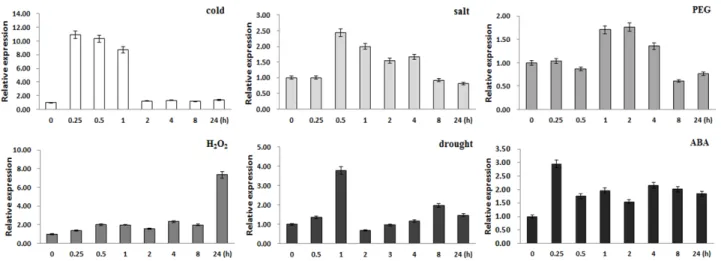
and drought (Fig. 4). Using a 4-week-old seedling, the mRNA
transcript of BrUGT gene was elevated in all stresses at
different onset of expression. For the cold stress, expression
was noticed as early as 15 min and relatively constant until
1 hr, whereas in the salinity stress, expression was observed
from 0.5~8 hr after NaCl imposition. Furthermore, in PEG,
mRNA expression was elevated from 1~4 hr after treatment,
whereas 24 hr in the hydrogen peroxide stress. For drought
stress, no trend was observed in the expression, whereas,
mRNA expression in the ABA treatment was variable. The
results on abiotic stress mRNA expression were variable
Fig. 4 Quantitative RT-PCR analysis after application of different stresses. Expression of BrUGT in the Chinese cabbage seedlings under 4℃ cold, 250 mM NaCl, 15% PEG6000, 3% H2O2, drought and 100 μM ABA. Actin transcripts served as a positive control and were detected in wild type plant
Fig. 5 Development of transgenic rice overexpressing BrUGT gene. (A) Schematic diagram of the binary Ti plasmid pFLCIII containing the UGT full length cDNA from Brassica rapa. pBigs vector consisted by using two different SfiI sites [SfiI(A) and SfiI(B)]. P35S, CaMV 35S promoter; pUbi-1, maize ubiquitin-1 promoter; Tg7 and Tnos, polyadenylation signals from gene 7 and nopaline synthase (nos) gene in the T-DNA, respectively; hpt, hygromycin resistance gene; LB, left border; RB, right border (B) Transgenic plants (C) Expression analysis of pBigs::BrUGT in rice. PCR amplification of transgenic rice lines (D) RT-PCR analysis of transgenic rice. The amplification products were separated using a 1.5% agarose gel. Lane M; DNA 100 bp ladder, Lane WT;
PCR generated from the DNA or cDNA template of the wild type plant, Lane 1~5; independent transgenic lines
indicating that the gene may act differently in each of the stresses (Fig. 4).
Rice Transformation
To determine the expression of BrUGT gene in rice, we directly inoculated Agrobacterium containing a BrUGT gene under the control of ubiquitin-promoter and Tnos terminator in the pBigs vector into the pre-soaked seeds in N6D
media for 24 hours (Fig. 5A). To confirm its integration
into the rice (Fig. 5B), genomic PCR analysis was
conducted. As shown in Figure 5C, the DNA amplification
was clearly detected whereas no band was seen in the wild
type. Further investigation of mRNA showed an overex-
pression in all independent transgenic plants (Fig. 5D). The
magnitude of mRNA expression, however, differs from
each independent rice lines. Further analysis of BrUGT
function is currently undertaken in rice plants.
Discussion
Glycosyltransferases (GT) (EC 2.4.x.y) catalyzes the transfer of sugars to a wide range of acceptor molecules (Ross et al. 2001) and might have an important role in plant defense and stress tolerance (Vogt and Jones 2000). Although these enzymes have been studied intensively for many years, to date only a handful of plant GTs have been characterized and mostly from Arabidopsis. So far, our study demon- strated for the first time to report on the characterization of GT in Chinese cabbage (Brassica rapa). Like GT in Arabidopsis, BrUGT shares a common GTB topology, one of the two protein topologies observed for nucleotide-sugar- dependent glycosyltransferases. GTB proteins have distinct N- and C- terminal domains each containing a typical Rossmann fold. BrUGT is closely related to Arabidopsis thaliana and Arabidopsis lyrata (Fig. 2). The substrate profile, catalytic properties, and tissue distribution in plants has been studied but limited describing their mechanism and function.
Despite intensive research efforts aimed at resolving the roles and mechanisms of GTs in plant defense and stress tolerance, little is known regarding the functions of GT expression profiling in plant responses to abiotic stress.
Analysis of mutants and overexpressing lines of GTs pro- vides a useful tool to reveal their functions both at the physiological and molecular level. Thus, we investigated the BrUGT by overexpression with pUbi-1 promoter (Fig.
5A). The variation in the expression level may be due to the position effects of Agrobacterium transformation which transferred genes anywhere in the somatic cells. Moreover, BrUGT is highly expressed in pistil (Fig. 3) indicating that it is a pistil tissue specific gene. Recently, many studies have demonstrated that the expression pattern of GTs can be affected by various biotic and abiotic stresses, including sucrose, ABA, GA, PEG8000, ethylene, NAA, NaCl, wounds, and cold temperatures (Wu et al. 2007; Xu et al. 2002;
Korobczak et al. 2005). As seen in Figure 5, over- expression of BrUGT gene was confirmed in rice. Further analysis, however, showed different expression level in the mRNA in each of the selected transgenic rice.
In our study, we found that the expression of BrUGT was induced by these stresses at the molecular level (Fig.
4). However, the expression level varies considerably in different stresses indicating that BrUGT may function dif- ferently in these stresses. Further studies on the mechanism and function would be necessary. In summary, the over- expression of BrGUT might have an influence on the abiotic stress tolerance in rice. Further functional analysis would be conducted. This study, however, provide insights into
the function of BrUGT in plants.
Acknowledgements
This work was supported by a grant from the Next-Generation BioGreen 21 Program (Plant Molecular Breeding Center No.
PJ008129), Rural Development Administration, Republic of Korea.
References
Abdula SE, Lee HJ, Melgar RJ, Sun M, Kang KK, Cho YG (2011) Isolation and characterization of Bradh1 gene encoding alcohol dehydrogenase from Chinese cabbage (Brassica rapa).
J Plant Biotechnol 38:77-86
Abe H, Narusaka Y, Sasaki I, Hatakeyama K, Shin S, Narusaka N, Fukami-Kobayashi K, Matsumoto S, Kobayashi M (2011) Development of full-length cDNAs from Chinese cabbage (Brassica rapa Subsp. pekinensis) and identification of marker genes for defense response. DNA Research 18:277-289 Achnine L, Huhman DV, Farag MA, Sumner LW, Blount JW,
Dixon RA (2005) Genomics-based selection and functional characterization of triterpene glycosyltransferases from the model legume Medicago truncatula. Plant J 41:875-887 Bowles D, Lim EK, Poppenberger B, Vaistij FE (2006) Glyco-
syltransferases of lipophilic small molecules. Annu Rev Plant Biol 57:567-597
Bowles D, Lsayenkova J, Lim EK, Poppenberger B (2005) Glycosyltransferases: managers of small molecules. Curr Opin Plant Biol 8:254-263
Brazier-Hicks M, Offen WA, Gershater MC, Revett TJ, Lim EK, Bowles DJ, Davies GJ, Edwards R (2007) Charac- terization and engineering of the bifunctional N- and O- glucosyltransferase involved in xenobiotic metabolism in plants. Proc Natl Acad Sci USA 104:20238-20243 Dean JV, Delaney SP (2008) Metabolism of salicylic acid in
wild-type, ugt74f1 and ugt74f2 glucosyltransferase mutants of Arabidopsis thaliana. Physiol Plant 132:417-425 Dixon RA (2001) Natural products and disease resistance. Nature
411:843-847
Jones P, Messner B, Nakajima J, Schaffner AR, Saito K (2003) UGT73C6 and UGT78D1, glycosyltransferases involved in flavonol glycoside biosynthesis in Arabidopsis thaliana. J Biol Chem 278:43910-43918
Ko JH, Kim BG, Hur HG, Lim Y, Ahn JH (2006) Molecular cloning, expression and characterization of a glycosyl- transferase from rice. Plant Cell Rep 25:141-146 Korobczak A, Aksamit A, Lukaszewicz M, Lorenc K, Rorat T,
and Szopa J (2005) The potato glucosyltransferase gene promoter is environmentally regulated. Plant Sci 168:339- 348
Langlois-Meurinne M, Gachon CMM, Saindrenan P (2005)
Pathogenresponsive expression of glycosyltransferase genes UGT73B3 and UGT73B5 is necessary for resistance to Psedomonas syringae pv. tomato in Arabidopsis. Plant Physiol 139:1890-1901
Lee HJ, Abdula SE, Jee MG, Jang DW, Cho YG (2011) High- efficiency and Rapid Agrobacterium-mediated genetic trans- formation method using germinating rice seeds. J Plant Biotechnol 38:251-257
Lee HJ, Abdula SE, Cho YG (2012) Overexpression of OsMLD encoding MYB-like DNA binding domain increases tolerance to salt stress in rice (Oryza sativa L.). Kor J Breed Sci 44:100-109
Li Y, Baldauf S, Lim EK, Bowles DJ (2001) Phylogenetic analysis of the UDP-glycosyltransferase multigene family of Arabidopsis thaliana. J Biol Chem 276:4338-4343 Mackenzie LF, Wang Q, Warren RAJ, Withers SG (1998)
Glycosynthases: Mutant glycosidases for oligosaccharide synthesis. J Am Chem Soc 120:5583-5584
Mita S, Suzukifujii K, Nakamura K (1995) Sugar inducible expression of a gene for beta-amylase in Arabidopsis thaliana. Plant Physiol 107:895-904
Pang Y, Peel GJ, Sharma SB, Tang Y, Dixon RA (2008) A transcript profiling approach reveals an epicatechin-specific glucosyltransferaseexpressed in the seed coat of Medicago truncatula. Proc Natl Acad Sci USA 105:14210-14215 Paquette S, Moller BL, Bak S (2003) On the origin of family
1 glycosyltransferases. Phytochemistry 62:399-413 Poppenberger B, Fujioka S, Soeno K, George GL, Vaistij FE,
Hiranuma S, Seto H, Takatsuto S, Adam G, Yoshida S, Bowles D (2005) The UGT73C5 of Arabidopsis thaliana glucosylates brassinosteroids. Proc Natl Acad Sci USA 102:15253-15258
Price J, Laxmi A, St. Martin SK, Jang JC (2004) Global tran- scription profiling reveals multiple sugar signal transduction mechanisms in Arabidopsis. Plant Cell 16:2128-2150 Ross J, Li Y, Lim EK, Bowles DJ (2001) Higher plant
glycosyltransferases. Genome Biology 2:reviews3004.1-3004.6 Quiel JA, Bender J (2003) Glucose conjugation of anthranilate
by the Arabidopsis UGT74F2 glucosyltransferase is required for tryptophan mutant blue fluorescence. J Biol Chem 278:
6275-6281
Thibaud MC, Gineste S, Nussaume L, Robaglia C (2004) Sucrose increases pathogenesis related PR 2 gene expression in Arabidopsis thaliana through an SA dependent but NPR1 independent signaling pathway. Plant Physiol Biochem 42:
81-88
Tohge T, Nishiyama Y, Hirai MY, Yano M, Nakajima J, Awazuhara M, Inoue E, Takahashi H, Goodenowe DB, Kitayama M, Noji M, Yamazaki M, Saito K (2005) Func- tional genomics by integrated analysis of metabolome and transcriptome of Arabidopsis plants over-expressing an MYB transcription factor. Plant J 42:218-235
Vogt T, Jones P (2000) Glycosyltransferases in plant natural product synthesis: characterization of a supergene family.
Trends Plant Sci 5:380-386
Wang X (2009) Structure, mechanism and engineering of plant natural product glycosyltransferases. FEBS Letters 583:3303- 3309
Wink M (1999) Functions of plant secondary metabolites and their exploitation in biotechnology. Annual Plant Reviews, Sheffield Academic Press, Sheffield, UK
Wu AM, Lv SY, and Liu JY (2007) Functional analysis of a cotton glucuronosyltransferase promoter in transgenic tobaccos.
Cell Res 17:174-183
Xu ZJ, Nakajima M, Suzuki Y, and Yamaguchi I (2002) Cloning and characterization of the abscisic acid specific glucosyltransferase gene from Adzuki Bean seedlings. Plant Physiol 129:1285-1295
Yan JP, He H, Zhang JJ, Liu Z, Wang JM, Li XF, Yang Y (2010) Overexpression of UDP glucosyltransferase 71C5 increases glucose tolerance in Arabidopsis thaliana. Russ J Plant Physiol 57:875-881