Y.-J. Jung, K.-K. Kang 한경대학교 유전공학연구소
(Institute of Genetic Engineering, Hankyong National University, Ansung 456-749, Korea)
Y.-G. Cho
충북대학교 식물자원학과
(Department of Crop Science, Chungbuk National University, Cheongju, Korea)
K.-K. Kang ( ) 한경대학교 원예학과
(Department of Horticulture, Hankyong National University, Ansung, 456-749, Korea)
e-mail: [email protected]
배추 유래 phytocystatin 유전자, Brcpi1의 분리 및 발현특성 분석
정유진 ・ 조용구 ・ 강권규
Isolation and characterization of Brcpi1 gene encoding phytocystatin from chinese cabbage (Brassica rapa L.) seedlings
Yu-Jin Jung ・ Yong-Gu Cho ・ Kwon-Kyoo Kang
Received: 3 December 2009 / Accepted: 21 December 2009
ⓒKorean Society for Plant Biotechnology
Abstract A cDNA clone encoding phytocystatin was isola- ted from Brassica rapa seedlings, through rapid amplification of cDNA ends (RACE). This gene (name as Brcpi1; GenBank accession no.: EF079953) had a total length of 881 bp with an open reading frame of 609 bp, and encoded predicted poly- peptide of 203 amino acid (aa) residues including a putative N-terminal signal peptide. Other relevant regions found its sequence included the G and PW conserved aa motifs, and the consensus LARFAV sequence for phytocystatins and the reactive site QVVAG. The BrCPI1 protein shared 95, 94, 81, 80 and 78% identity with other CPI proterins isolated from Brassica oleracea (BoCPI-1), Arabidopsis thaliana (AtCY SB), Glycine max (GmCPI), Oryza sativa (OsCYS-2) and Zea may (ZmCPI) at amino acid level, respectively. Southern blot analysis showed that Brcpi1 was a low copy gene. Expression pattern analysis revealed that Brcpi1 was a tissue-specific expressing gene during reproductive growth and strongly expressed at mature seedling stages. Furthermore, overexpre- ssion of Brcpi1 in transgenic Arabidopsis was enhanced
tolerance to salt and cold stresses. Meanwhile the juvenile seedling of Brcpi1 transgenic plants was not affected by vari- ous concentrations ABA in MS medium. Taken together, the results showed that Brcpi1 functioned as a cysteine protease inhibitor and it exhibited a protective agent against diverse types of abiotic stress, which induced this gene in a tissue- and stress-specific manner.
서 론
동 식물체 내의 생리대사 특히 생체방어와 관련된 다 양한 생리반응들은 단백질 분해과정을 통해 특정단백질 이 활성화 되는 방식으로 진행된다. Cysteine protease 저 해제는 세포 내부 또는 외부로부터 cysteine protease에 의 한 비우호적인 단백질 분해 활성으로부터 세포를 보호하 며, 침략자에 대한 생물학적 방어 체계로서 중요한 역할 을 담당한다 (Sajid and McKerrow 2002). 지금까지 cysteine protease 저해제는 cathepsin B, H, L, S와 papain등으로 thiol 기를 갖는 cysteine 계열 단백질분해효소 작용을 저해하 는 단백질로 동식물에 널리 분포하고 그 종류와 특성이 다양하다 (Arai et al. 2002). 식물유래 cysteine protease 저 해제는 약 30개 정도 알려져 있으며, 12내지 16 kDa의 크 기로 Q × V × G의 활성 부위 및 이황화 결합이 되지 않 은 상태로 존재하며 계란 유래의 동물 cystein protease 저 해제와 매우 높은 상동성을 갖는다 (Shuy et al. 2004). 염 기배열에 따라 식물유래 cystein protease 저해제는 phytocy- statin의 용어로 새로운 subfamily 분류되고 있다. 이들 단 백질은 식물의 생장과 발육과정에서 상이한 발현 양상을 보이며, 생물학적 및 비생물학적 스트레스에 민감하게 반응하는 것으로 알려져 있다 (Massonneau et al 2005). 식 DOI:10.5010/JPB.2009.36.4.407
Research Article
물세포내에서 이들 단백질의 역할은 세포자살 (Programed cell death) 과정에서 사용하기 위해 비축한 생물학적 활 성을 갖는 cysteine protease작용이 억제함으로써 세포를 보호 할 뿐만 아니라 종자발아 및 유묘생장속도를 조절 한다 (Solomon et al. 1999, Hong et al. 2007). 또한 외부로부 터 침입한 바이러스 (Gutierrez et al. 1999), 진균 (Soaris et al. 2002), 선충류 (Samac et al. 2003) 및 딱정벌레 (Haq et al. 2004) 등으로부터 식물을 보호하기위한 방어기작은 cy- steine protease이 세포 복제 및 소화기관 (gut)에서 소화효 소로서 중요한 역할을 하고 있기 때문에 inhibitor가 매우 중요한 면역 요인으로 작용한다. 특히 비생물학적 스트 레스 반응에서의 cysteine protease inhibitor는 cold shock 및 암흑상태에서 자란 보리의 생체조직에서 mRNA 축적이 높게 나타났으며 (Massonneau et al 2005), 추위, 염분 및 고온 스트레스 처리한 밤나무의 뿌리 및 잎에서 발현량 이 높게 나타났다 (Pernas et al. 2000). 또한 phytocystatin은 식품산업의 보조제로 사용하고 있으며, 생물공학기술에 적용하고 있다 (Jiang et al. 2002; Douglas et al. 2004). 브로 컬리, 양배추, 케일 등이 포함한 Brassica 속 식물들은 자 가불화합성 연구의 모델식물로 알려져 있다. 그러나 아 시아에서 매우 중요한 채소작물 중 하나인 배추 (Brasssica rapa L.)에서 방어기작에 관한 연구는 전무한 상태이다.
본 연구에서는 배추 유묘로부터 phytocystatin 유전자 Brcpi 1의 분리, 발현분석 및 형질전환실험을 통한 유전 자의 기능을 구명하고자한다.
재료 및 방법 식물재료
배추 (Brassica rapa L. ssp. pekinensis) 종자를 유리 온실 에서 12℃ 이하의 저온을 일정기간 유지하여 화아분화를 유도하였다. 개화 전에 뿌리, 줄기, 잎, 주두, 꽃잎, 수술, 꽃받침, 화경 등을 분리하여 액체질소에 넣어 동결한 후, -80℃ 냉동고에 보관하여 RNA 추출 재료로 이용하였다.
또한 발아 초기의 식물 재료를 얻기 위해, 배추 종자를 여과지상에서 25℃ 암 상태에서 발아시킨 후, 1, 2, 4, 8, 10일의 유묘를 각각 채취하여 액체질소에 넣어 동결한 후, -80℃ 냉동고에 보관하여 total RNA를 분리하였다.
Total RNA 분리
배추유묘 0.1 g을 측정하여 미리 차갑게 준비해 놓은 막자사발과 막대를 이용하여 액체질소로 마쇄하였다. 마 쇄한 조직은 1 ml의 TRIzol-reagent가 담긴 1.5 ml 원심분 리용 튜브에 넣어 섞어주고, 핵단백질체가 완전히 분리
되도록 상온에 15분간 두었다. 1 ml TRIzol-reagent에 대해 0.2 ml chloroform을 넣어 15초 동안 vortex하고, 상온에서 5분간 방치한 후 11,000 rpm으로 4℃에서 15분간 원심분 리 하여 상등액을 새 튜브로 옮겼다. 상층은 0.5 ml의 iso- propanol과 0.25 ml의 high salt precipitation solution (0.8 M sodium citrate/1.2 M NaCl)을 넣어 잘 섞어주고 상온에서 10분간 방치하여 RNA를 침전시켰다. 이렇게 추출한 산물 을 11,000 rpm으로 4℃에서 10분간 원심분리 하여 상등액 을 버리고 RNA 침전물에 1 ml의 75% ethanol을 넣고 11,000 rpm으로 4℃에서 5분 동안 원심분리 했다. 그 다음 상등 액을 제거하고 RNA 침전을 진공상태에서 5-10분간 건조 시켰다. 마지막으로 50-100 µl의 DEPC 처리된 멸균수에 녹여 spectrophotometer로 RNA양을 정량하여 사용하였다.
Brcpi1 유전자 분리 및 염기서열 분석
Total RNA는 RNase H-Reverse Transcriptase (Gibco BRL, Rockville, MD, USA) protocol에 따라 수행하였으며, first strand cDNA는 5 µg total RNA로부터 합성하였다. 합성된 cDNA 2 µl를 주형으로 10× PCR buffer (200 mM Tris-HCl pH 8.4, 500 mM KCl) 5 µl와 50 mM MgCl2 1.5 µl, 10mM dNTP mix 1 µl, Taq DNA polymerase (5 units/µl) 0.4µl, for- ward primer (10µM), reverse primer (10 µM)를 각각 1µl씩 첨가하고 멸균수 38.1 µl로 최종 부피 50 µl를 만든 후 PCR 을 실시하였다. 이때 사용한 primer는 NCBI database로부터 얻어진 정보로부터 (5'-GAACTTGGAAGGTACTG-3'), (5'- AGTTTTGCGCTTCAGGCA-3')를 합성하여 사용하였다. PCR 반응은 94℃에서 4분간 pre-denaturation 시킨 후, 94℃에서 1분간 denaturation, 55℃에서 1분간 annealing, 72℃에서 2 분간 extension과정을 35cycles로 하였으며, 마지막으로 7 2℃에서 10분간 extension을 실시하였다. PCR 산물은 1.5%
agarose gel상에 영동한 후, ethidium bromide로 염색하여 band를 확인하였다. 증폭산물은 pGEM T-Easy vector (Pro- mega)에 cloning하여 염기서열을 조사하였고, 유전자간 상동성 비교는 BLAST분석에 의하여 실시하였다. Full len- gth cDNA을 분리하기 위하여 얻어진 단편의 염기서열을 토대로 RACE용 primer를 합성하여 TAKARA사에서 시판 하고 있는 5' RACE 및 3' RACE kit를 이용하여 미지의 영 역을 증폭하였다. 각각의 RACE 방법으로 얻어진 산물을 염기서열을 조사였다. 또한 유전자간의 계통수 유연관계 는 MEGA version 3.0 프로그램 (Kumar et al. 2001)을 이용 하였다.
Southern blot 분석
Brcpi1 유전자의 소송체 게놈에서 copy를 알아보기 위 하여 소송체 잎으로부터 genomic DNA 분리는 CTAB 방
Fig. 1 Nucleotide and deduced amino acid sequences of a Brcpi1 gene encoding phytocystatin in B. rapa plant
법 (Sambrook et al. 2001)에 따라 수행하였다. 분리한 DNA (20 µg)를 BamHI, EcoRI, HindIII와 Pst I으로 각각 소화하 여 0.8% agarose gel 에 전기영동한 후, Hybond N 나이론 membrane (Amersham)에 전이시켰다. Southern blot을 위한 Probe 및 detection 과정은 DIG labelling and detection system (Roche)를 사용하여 회사에서 제공한 매뉴얼에 따라 수 행하였다.
Brcpi1 유전자 도입 형질전환 애기장대 육성
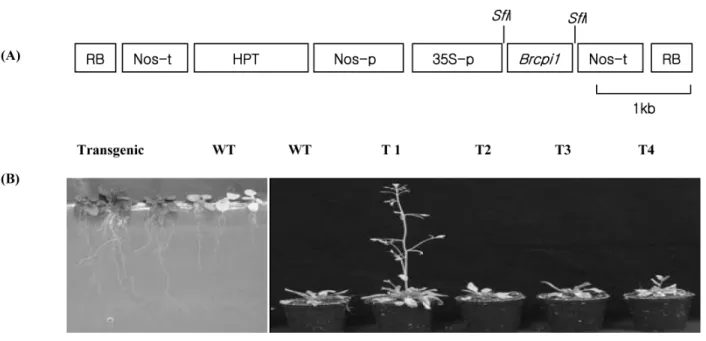
형질전환을 위한 식물 발현벡터는 pBIG vector (TAKA RA)에 SfiI 처리한 후, Brcpi1 유전자 말단에 SfiI 제한효소 site를 primer에 의해 PCR합성하여 얻어진 단편과 ligation 하여 구축하였다 (Fig. 5A). 따라서 Brcpi1 유전자는 35S promoter의 지배 하에 발현되며, 선발 marker 유전자로 hy- gromycin 저항성유전자 (HPT)를 포함하고 있다. 애기장대 의 형질전환은 Brcpi1 유전자가 삽입된 Agrobacterium을 이용하여 Steven 등 (1998)이 보고한 스프레이 방법에 의 해 수행하였다. 얻어진 T1종자를 hygromycin 이 포함된 MS배지에서 정상적으로 생육한 식물체를 선발하여 T2 세대를 육성하였다.
Abiotic stress 처리에 따른 유전자 발현 분석
Brcpi1 유전자의 비생물학적 스트레스에서 반응을 알 아보기 위해 형질전환 애기장대에 스트레스 처리 후, 얻 어진 조직에서 유전자의 발현 양상을 RT-PCR 분석에 의 해 조사하였다. 스트레스의 종류는 100 mM ABA, drought, osmotic (15% PEG6000, 250 mM NaCl, 4℃ cold 등으로 하 였다. 처리방법은 종자 발아 후, 14일된 육묘을 이용하여 Yosida 양액 (Yosida et al. 1976)에서 온도 25℃, 상대습도 70~75% 조건의 생장상에서 처리하여 시간대별로 식물 조직의 잎과 뿌리를 채취하였다. Total RNA 추출과 RT- PCR분석은 인트론 바이오사에서 시판하고 있는 plant RNA extraction kit과 one-step RT-PCR kit를 각각 사용하였다. 각 각의 유전자 특이적으로 증폭할 수 있는 Primer들은 유전 자의 3'-UTR부위 중심으로 BCM Program (Baylor college of Medicine HGSC))을 이용하여 GC함량 비율 등을 고려 하여 선정하였다. Primer합성은 Takara사에 의뢰하여 제 작하였다. Real-time qPCR은 BIO-RAD iQ5 real-time PCR system (BIO-RAD, USA)을 사용하여 Huang 등 (2008)이 기 술한 방법에 의해 수행하였다. Brcpi1 유전자의 qRT-PCR 을 위해서, 2 µg의 Total RNA을 이용하여 역전사효소 (Pro- mega)에 의해 cDNA를 합성하여 이용하였다. 유전자의 상대적 발현량을 위해 reference 유전자로 actin을 사용하 여 Ct 방법으로 계산하였다.
결과 및 고찰
Brcpi1 유전자의 분리 및 구조분석
배추 유래 phytocystatin 유전자를 분리하기 위해 NCBI data 분석을 통해 primer Br1 (5'-CAGGAGGTTGTTCATG CTAA-3')과 Br2 (5'-AGTTTTGCGCTTCAGGCA-3')를 합성 하였다. 이들 두 primer을 사용하여 RT-PCR 분석한 결과 171 bp 단편을 얻었으며, 애기장대 유래 AtCYSB 유전자와 상동성이 98 % 이었다. 따라서 RT-PCR에서 얻어진 단편 은 배추 유래의 phytocystatin 라고 생각되어진다. 따라서 이 단편의 염기서열을 이용하여 RACE 방법을 통해 full- length을 얻은 결과 3‘ RACE에서 575 bp cDNA 단편을 5' RACE에서 531 bp의 단편을 얻었다. 또한 3' RACE 얻어진 단편에는 17개 A tail이 존재하며, 209개의 염기가 UTR (untranslated region)으로 존재하며, 처음 분리한 단편과 125개 염기가 중복되었다. 5‘ RACE 얻어진 단편에서 처 음 분리한 단편과 62 bp가 중복되었다. 따라서 분리한 유 전자는 881 bp 크기로서 Brcpi1으로 명명하고, NCBI(http://
www.ncbi.nlm.nih.gov/)에 GeneBank EF079953로 등록하였 다. Brcpi1 유전자의 구조 분석은 DNA star 프로그램 (코 아바이오)에 의해 분석한 결과 개시코돈은 63번째 염기, 종지코돈은 673번째 염기에 존재하였고, 그 후에 poly A 가 존재하는 full-length cDNA이었다 (Fig. 1). 따라서 Brcpi1 유전자는 609개의 염기로 구성하는 ORF영역으로 203개 의 아미노산으로 이루어졌으며, 15.5 kDa의 크기로 pI=4.6 을 예측할 수 있었다.
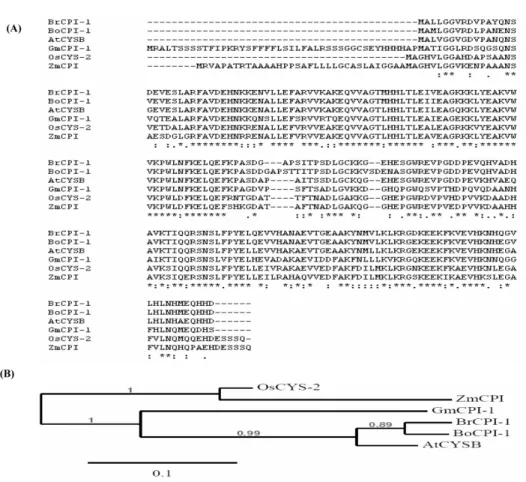
Fig. 2 Multiple alignment of deduced amino acid sequences of Brcpi1 with other phytocystatin proteins and phylogenetic tree analysis.
A, Alignment of deduced amino acid sequences of phytocystatin genes (AtCYSB (NM112084), BoCPI-1 (AY065838), GmCPI (D31700), OsCYS-2 (AP001073), ZmCPI (EU961198). Putative signal peptide and active site domain are shaded. B, phylogenetic tree of phytocystatin genes by Clustal W. The number next to the nodes give bootstrap values from 100 replicates
아미노산 alignment와 phylogenetic tree 분석
Brcpi1 유전자와 GenBank에 보고된 식물 유래의 phy- tocystatin 유전자들 간의 계통수를 구축하기위해 아미노 산 배열을 나열하였다 (Fig. 2A). 아미노산 레벨수준에서 BrCPI 단백질은 Brassica oleracea (BoCPI-1), Arabidopsis thaliana (AtCYSB), Glycine max (GmCPI), Oryza sativa (Os CYS-2) 및 Zea may (ZmCPI)와의 상동성이 각각 95, 94, 81, 80 및 78 % 를 보였다. BrCPI1 단백질은 Q × V × G motif 가 존재하고 있으며, 이들 배열은 cysteine protease inhibitor 에 특이적으로 보이고 있다. BrCPI1 단백질을 구성하는 아미노산은 disulfide 결합을 형성하는 것으로 모든 papain 계의 유전자에서 보고되었다 (Rawlingsand 1994; Trysellius et al. 1997; Pernas et al. 1998). 또한 C 말단 영역에는 2개 의 매우 유사한 보존영역이 존재하며 이들 영역은 토마 토, 사탕수수, 키위, Arabidopsis 등 에서도 잘 알려져 있다 (Belenghi et al. 2003; Diop et al. 2004; Gianotti et al. 2006;
Jacinto et al. 1998; ).
Brcpi1 유전자의 계통수 작성은 6개의 유전자들을 이용 하여 neighbor-joining 방법으로 구축한 결과 총 7개의 단 백질에서 3개의 그룹으로 나눌 수 있었다 (Fig. 2B). 각각
의 group에 해당되는 유전자들의 생리적 기능에 대한 정 보는 거의 없기 때문에 BrCPI1 단백질의 기능을 예측 할 수 없으나, 3개 그룹의 유전자간 기능적으로 분리되어 있 을 가능성을 시사하고 있다. 따라서 본 실험에서 분리된 BrCPI1은 애기장대 및 양배추유래의 phytocystatin과 같은 cluster를 형성하고 있기 때문에 이들 유전자와 거의 유사 한 기능을 가지고 있을 것으로 예측된다.
Brcpi1 유전자의 copy 수와 발현분석
소송체 게놈 상에서 Brcpi1 유전자의 copy 수를 알아보 기 위해, 배추 잎으로부터 분리한 genomic DNA 20 µg를 BamHI, EcoRI, HindIII와 Pst I으로 각각 절단하였다.
Southern blot 분석은 Brcpi1 유전자의 3' UTR 영역 특정 염기서열부위를 probe로 하였다. 그 결과 HindIII로 절단 한 lane를 제외한 나머지 3개의 lane 에서 단일 밴드를 보 였다 (Fig. 3). 이는 Brcpi1 유전자가 배추 게놈에 낮은 copy 수의 유전자임을 시사한다. 지금까지 Brassica 속에서 phy- tocystatin 유전자는 7-8개정도 알려져 있다 (Hong et al.
2008). 이들 유전자간에 높은 상동성을 보였는데, Sou- thern blot 분석에서 낮은 copy를 보였다, 이는 Brcpi1 유전
Fig. 3 Southern blot analysis with Brcpi1 in B. rapa plant. The 3' region specific to Brcpi1 gene was used as a probe. Re- striction enzymes used were as follows; M: molecular marker, B: BamHI, E: EcoRI, H: HindIII, P: Pst I
Fig. 4 Analysis of Brcpi1 gene expression in organs of the B.
rapa plants. A: Roots, B: stems, C: young leaves, D: mature leaves, E: stigmas, F: stamens, G: petals, H: Calyx, I: flower stalks
Fig. 5 Vector construction and transformation. A, Ti-plasmid vector construction for overexpression of Brcpi1 gene. Nos-p; nos gene promoter, Nos-t; nos gene terminator, HPT; hygromycin phosphotransferase gene, 35S-p; Cauliflower mosaic virus 35S-promoter, LB;
left border, RB; right border. B, Arabidopsis plants transformed with pBIG vector containing Brcpi1 gene. Left photo. transgenic plant on the selection medium, right photo; phenotypes of transgenic plants. WT; non transgenic plants T1, T2, T3, and T4; transgenic plants
자의 3' UTR 영역 특정 염기서열부위를 probe사용하였기 때문에 배추 게놈 내에 Brcpi1 만이 특이적으로 hybridiza- tion 되었기 때문으로 생각된다. 또한 Brcpi1 유전자의 발 현 분석은 뿌리, 줄기, 어린잎, 성숙한 잎, 주두, 꽃잎, 수 술, 꽃받침, 화경 등 9개 조직을 이용하여 RT-PCR분석을 수행하였다 (Fig. 4). Brcpi1 유전자의 기관별 발현양은 수 술이 가장 높게 나타났으며, 꽃받침, 주두 및 꽃잎 등의 기관에서 뿌리 및 잎보다 높은 경향을 보인 것으로 미루 어 볼 때 기관 특이적으로 발현하고 있음을 시사한다.
형질전환 애기장대를 이용한 Brcpi1 유전자의 기능분석
Brcpi1 유전자의 기능을 분석하고자 사용한 식물 발현 벡터는 pBig vector로 Brcpi1는 35S promoter의 조절지배 하에 발현하도록 구축하였다. 형질전환은 애기장대를 생 장시킨 후, 개화전에 Agrobacterium을 스프레이로 화아기 관에 촉촉하게 감염시킨 후, 종자를 채취하였다. 얻어진 T1종자를 hygromycin이 포함된 MS배지에서 30개의 형질 전환체 중 정상적으로 생육한 10개 식물체를 선발하여 T2 세대를 육성하였다 (Fig. 5B). 형질전환 식물체들에서 도입 유전자의 확인은 Brcpi1 및 HPT 유전자를 이용하여 PCR 분석으로 확인하였다. 그리고 유전자의 도입이 확인된 개 체를 이용하여 RT-PCR 분석을 통해 Brcpi1 유전자의 발현
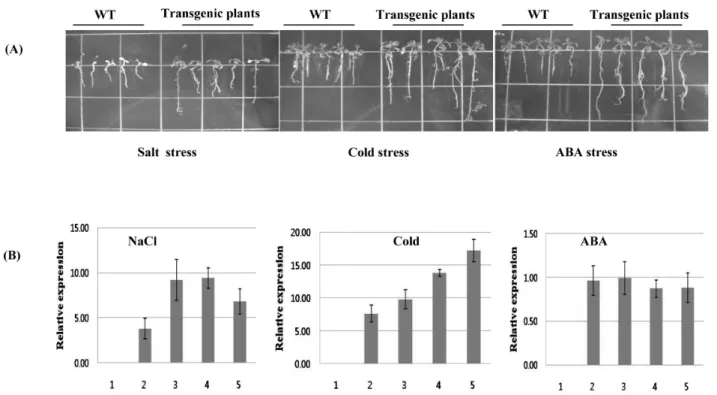
Fig. 6 Growth pattern and gene expression pattern in transgenic plants. A, growth pattern under salt, cold and ABA stress of transgenic plants containing Brcpi1 gene. B, real-time qRT-PCR analysis of Brcpi1 gene under salt, cold and ABA stress. Relative expression level of were measured in wild type (lane 1), transgenic plant (non stress) (lane 2) and transgenic plants under each stress condition (lane 3, 4, 5). Amount of cDNAs were calibrated using the actin gene (GenBank no. FJ969844) as a reference. Data presented are means and standard deviation of three independent replicated experiments
을 확인하였다 (결과 미제시). 정상생장조건에서 WT과 transgenic plants 간의 phenotype을 비교한 결과 형질전환 체가 생장 속도 및 개화시기가 빠른 게 나타났다. 식물생 장에 영향을 주는 생장조절물질 중 ABA 처리 후 Brcpi1 유전자의 발현 정도를 살펴본 결과 ABA 처리한 형질전 환체에서 ABA를 처리하지 않은 형질전환체와 거의 유사 한 발현량을 보였다 (Fig. 6B). 또한 환경 스트레스stress변 화에 따른 Brcpi1유전자의 발현 양상을 알아보기 위해 250 mM NaCl 및 저온 (4℃)을 처리하여 지상부의 발현량을 분 석한 결과 Brcpi1 유전자의 발현은 250 mM NaCl 및 저온 (4℃)을 처리한 형질전환체에서 처리하지 않은 형질전환 체에 비해 높게 나타났다 (Fig. 6B). 또한 250 mM NaCl 및 저온 (4℃) 및 ABA 처리에 따른 형질전환체의 생육은 형 질전환하지 않은 대조구에 비해 뿌리 및 지상부의 생육 이 양호하였다 (Fig. 6A). 통상 염해 스트레스는 NaCl에서 유래되어지는 Na+와 Cl- 이온 농도가 원인이 되어 세포 내에 Ca2+ 이온의 증가를 초래하게 되고, 순간적으로 변 화된 세포질내의 Ca2+ 이온농도는 second messager로서 작 용하여, 세포의 스트레스에 대한 신호전달체계를 활성화 하고 세포내의 염해 스트레스 적응에 관여하는 K+ 이온 의 유입과 K+/Na+ 관계를 조절된다. 이런 측면에서 Brcpi1 유전자는 세포내의 염해 스트레스를 적응하여 생육의 증 가 및 유전자의 발현이 높게 나타난 것으로 사료된다. 따 라서 Brcpi1 유전자는 비생물학적 스트레스 반응에 넓은
스펙트럼을 갖고 있는 식물 생장과 발육에 중요하게 관 여하고 있음을 시사한다.
적 요
식물 유래 cystein protease 저해제는 phytocystatin 으로 분류되어, 식물의 생장과 발육과정상에서 상이한 발현 양 상을 보이고 있다. 본 연구에서는 배추 유묘로부터 phy- tocystatin 유전자를 분리하여 Brcpi1 (GenBank accession no.: EF079953)으로 명명하고, 분자적 특성 및 기능 분석 을 수행하였다. Brcpi1 유전자는 전장이 881 bp이고, ORF가 609 bp으로 203개의 아미노산으로 구성되었다. BrCPI1 단 백질은 아미노산 motif로써 G와 PW 및 LARFAV가 있고, 식물 유래 phytocystatin 활성부위인 QVVAG가 잘 보존되 었다. 또한 BrCPI 단백질은 Brassica oleracea (BoCPI-1), Arabidopsis thaliana (AtCYSB), Glycine max (GmCPI), Oryza sativa (OsCYS-2) 및 Zea may (ZmCPI)와의 아미노산 서열 에서 각각 95, 94, 81, 80 및 78 %의 상동성을를 보였다.
Brcpi1 유전자의 계통수를 분석한 결과 기존에 알려진 6 개의 단백질에서 3개의 group으로 나눌 수 있으며, 애기 장대 및 양배추와 같은 cluster을 보였다. 또한 Southern blot 분석한 결과 Brcpi1 유전자는 배추 게놈에 낮은 copy 수로 존재하였다. 기관별 Brcpi1 유전자의 발현양상은 수
술이 가장 높게 나타났으며, 꽃받침, 주두 및 꽃잎 등의 순으로 나타났다. Brcpi1 유전자의 기능을 알아보기 위 해, 형질전환 애기장대를 이용하여 염, 저온 및 ABA 처 리에 따른 도입 유전자의 발현양상을 살펴본 결과 고염 및 저온 하에서 뿌리의 생장이 대조 구에 비해 크게 나타 났으며, 유전자의 발현에서도 강하게 나타났다. 그러나 ABA처리에서는 큰 변화를 볼 수 없었다. 따라서 본 연구 에서 분리한 Brcpi1 유전자는 염 및 저온에 민감하게 반 응하며, 조직 및 기관 특이적으로 기능하여 다양한 환경 stress에 저항할 수 있는 방어기작을 갖고 있는 것으로 예 측된다.
사 사
본 연구는 농촌진흥청 바이오그린 21사업 (과제번호:
200705010)과 농림기술개발사업 (과제번호:204068-3)의 일환으로 수행되었다.
인용문헌
Arai S, Matsumoto I, Emori Y, Abe K (2002) Plant seed cystatins and their target enzymes of endogenous and exogenous origin, J. Agr. Food Chem. 50:6612-6617.
Belenghi B, Acconcia F. Trovato M, Perazzolli M, Bocedi A, Polti- celli F, Ascenzi P, Delledonne M (2003) AtCYSI, a cystatin from Arabidopsis thaliana suppresses hypersensitive cell death, Eur. J. Biochem. 270:2593-2604.
Chen W.-Q, Swart W.J (2001) Genetic variation among Fusarium oxysporum isolates associated with root rot of Amaranthus hy- bridus in South Africa, Plant Dis. 85:1076-1080.
Diop N.N, Kidrič M, Repellin A, Gariel M, d'Arcy-Lameta A, Pham Thi A.T, uily-Fodil Y (2004) A multicystatin is induced by dro- ught-stress in cowpea (Vigna unguiculata (L) Walp.) leaves, FEBS Lett. 577:545-550.
Felton GW, Korth KL (2000) Trade-offs between pathogen and her- bivore resistance, Curr. Opin. Plant Biol. 3:309-314.
Gianotti A, Rios WM. Soares-Costa A, Nogaroto V, Carmona AK, Oliva MLV, Andrade S, Henrique-Silva F (2006) Recombinant expression, purification, and functional analysis of two novel cystatins from sugarcane (Saccharum officinarum), Protein.
Expres. Purif. 47:483-489.
Gutiérrez-Campos R, Torres-Acosta JA, Saucedo-Arias LJ, Gómez- Lim MA (1999) The use of cysteine proteinase inhibitors to engineer resistance against potyviruses in transgenic tobacco plants, Nature Biotechnol. 17:1223-1226.
Haq SK, Atif SM, Kham RH (2004) Protein proteinase inhibitor genes in combat against insects, pests, and pathogens: natural and engineered phytoprotection, Arch. Biochem. Biophys. 431:
145-159.
Hulo N, Bairoch A, Bulliard V, Cerutti L, De Castro E, Langendijk- Genevaux P.S, Pagni M, Sigrist C.J (2006) The PROSITE data- base, Nucleic Acids Res. 34:D227-D230.
Hong JK, Hwang JE, Chung WS, Lee KO, Choi YJ, Gal SW, Park BS, Lim CO (2007) Expression of a Chinese cabbage cysteine proteinase inhibitor, BrCYS1, retards seed germination and plant growth in transgenic tobacco plant, Plant Sci 172:556-563
Huang J, Wang MM, Jiang Y, Wang QH, Huang X, Zhang HS (2008) Stress repressive expression of rice SRZ1 and characterization of plant SRZ gene family, Plant Sci. 174:227-235.
Hwang JE, Hong JK, Je JH, Lee KO, Kim DY, Lee SY, Lim CO (2009) Regulation of seed germination and seedling growth by an Arabidopsis phytocystatin isoform, AtCYS6, Plant Cell Rep 28:1623-1632
Jacinto T, Fernandes KVS, Machado OLT, Siquiera-Junior CL (19 98) Leaves of transgenic tomato plants overexpressing prosy- stemin, accumulate high levels of cystatin, Plant Sci. 138:25- 42.
Jiang ST, Tzeng SS, Wu WT, Chen GH (2002) Enhanced expression of chicken cystatin as a thiorredoxin fusion form in Escherichia coli AD494 (DE3)pLysS and its effect on the prevention of su- rimi gel softening, J. Agr. Food Chem. 50:3731-3737.
Joshi C.P, Zhou H, Huang X, Chiang V.L (1997) Context sequences of translation initiation codon in plants, Plant Mol. Biol. 35:
993- 1001.
Kuroda M, Kiyosaki T, Matsumoto I, Misaka T, Arai S, Abe K (2001) Molecular cloning, characterization and expression of wheat cystatins, Biosci. Biotechnol. Biochem. 65:22-28.
Kumar S, Tamura K, Jakobsen IB, Nei M (2001) MEGAR2: Mole- cular evolutionary genetic analysis software, Arizona state Uni- versity, Tempe, Arizona, USA, 2001
Lim CO, Lee SI, Cheng WS, Park SH, Hwang I, Cho M.J (1996) Characterization of a cDNA encoding a cysteine proteinase inhibitor from Chinese cabbage (Brassica campestris L. ssp.
Pekinensis) flower buds, Plant Mol. Biol. 30:373-379.
Martínez M, Zamira A, Gambardella M, Echaide M, Carbonero P, Díaz I (2005) The strawberry gene Cyf1 encodes a phytocystatin with antifungal properties, J. Exp. Bot. 56:1821-1829.
Massonneau A, Condamine P, Wisniewski J.P, Zivy M, Rogowsky P.M (2005) Maize cystatins respond to developmental cues, cold stress and drought, Biochim. biophys. Acta 1729:186-199.
Misaka T, Kuroda M, Iwabuchi K, Abe K, Arai S (1996) Soyacys- tatin, a novel cysteine proteinase inhibitor in soybean, is distinct in protein structure and gene organization from other cystatins of animal and plant origin, Eur. J. Biochem. 240:609-614.
Pernas M, Sánchez-Monge R, Salcedo G (2000) Biotic and abiotic stress can induce cystatin expression in chestnut, FEBS Lett.
467:206-210.
Samac DA, Smigocki AC (2003) Expression of oryzacystatin I and II in alfalfa increases resistance to the root-lesion nematode, Phytopathology 93:799-804.
Sambrook J, Russel DW (2001) Molecular Cloning: A Laboratory Manual (third ed.), Cold Spring Harbor Laboratory Press, New York
Sánchez M.C, Osada S, Teliz D, Espitia E, Rendón G (1990) Etiolo- gía e incidencia de la mancha negra del tallo en Amaranthus sp. y otras enfermedades, Rev. Mex. Phytopatol .8: 102-106.
Shyu DJH, Chou WN, Yiu TJ, Lin CPC, Tzen JTC (2004) Cloning, functional expression and characterization of cystatin in sesame seeds, J. Agr. Food Chem.52 :1350-1356.
Soares-Costa A, Beltramini L.M, Thiemann O.H, Henrique-Silva F (2002) A sugarcane cystatin: recombinant expression, purifi- cation, and antifungal activity, Biochem. Biophys Res. Commun.
296:1194-1199.
Solomon M, Belenghi B, Delledonne M, Levine A (1999) The in- volvement of cysteine protease and protease inhibitor genes in programmed cell death in plants, Plant Cell 11:431–444.
Sugarawa H, Shibuya K, Yoshioka T, Hashiba T, Satoh S (2002) Is a cystein proteinase inhibitor involved in the regulation of petal wilting in senescing carnation (Dianthus cariophyllus L.) flo- wers?, J. Exp. Bot. 53:407-413.
Steven JC, Andrew FB (1998) A simplified method for Agrobacte- rium-mediated transformation of Arabidopsis thaliana The Plant J. 16:753-743
Turk B, Turk V, Turk D (1997) Structural and functional aspects of papain-like cysteine proteinases and their protein inhibitors, Biol. Chem. 378:141-150.
Yang AH, Yeh KW (2005) Molecular cloning, recombinant gene expression, and antifungal activity of cystatin from taro (Colo- casia esculenta cv. Kaosiung ) Planta 221:493-501.