Korean J Environ Agric (2011) Online ISSN: 2233-4173
Vol. 30, No. 2, pp. 125-131 DOI : 10.5338/KJEA.2011.30.2.125 Print ISSN: 1225-3537
Effects of Waste Nutrient Solution on Growth of Chinese Cabbage ( Brassica campestris L.) in Korea
Bongsu Choi,
1,2Sang Soo Lee
1**and Yong Sik Ok
1*1Department of Biological Environment, College of Agriculture and Life Sciences, Kangwon National University
2Crop Environment Research Division, National Institute of Crop Science
Received: 1 June 2011 / Accepted: 21 June 2011
ⓒThe Korean Society of Environmental Agriculture
*교신저자(Corresponding author):
Tel: +82-33-250-6443 Fax: +82-33-241-6640 E‐mail: [email protected]
**공동교신저자(Co-corresponding author):
Tel: +82-33-250-7214 Fax: +82-33-254-3835 E‐mail: [email protected]
125
Abstract
BACKGROUND: Reuse of waste nutrient solution for the cultivation of crops could lead to considerable conservation of water resources, plant nutrients, and water quality. There- fore, this study was conducted to evaluate the potential for reducing the use of chemical fertilizer in Chinese cabbage cultivation via the reuse of waste nutrient solution as an alternative irrigation resource.
METHODS AND RESULTS: The nutrients supplied in the waste nutrient solution consisted of 1474.5, 1285.1, 991.6, and 872.6 mg/L for K
+, NO
3-, Ca
2+and SO
42-, respectively.
At 56 days after transplanting (DAT), the leaf length of Chinese cabbage plants irrigated with the waste nutrient solution treatment was significantly higher than that of plants irrigated using a conventional groundwater treat- ment. Additionally, the leaf width, fresh weight and dry weight of the plants irrigated with the waste nutrient solution were similar or greater than that of plants irrigated with a conventional treatment. Furthermore, the growth of plants treated with the waste nutrient solution +25%
fertilizer was the highest among all tested treatments.
CONCLUSION(s): These results indicate that the waste nutrient solution can be used as an alternate water resource
for crop cultivation. In addition, it can contribute to reduce the fertilizer and to obtain the higher crop yield of Chinese cabbage.
Key Words: Climate change, Hydroponics, Nutrient solu- tion, Water reuse, Water shortage
Introduction
The supply of water is essential for the survival of all living organisms. However, regional water resour- ces and future water supply are at risk worldwide due to climate change and population growth. Water shortage severely impacts socio-economic conditions as well as food security. Indeed, the yields of crop production and water supply are positively correlated (Zhou and Tol, 2005).
The maintenance of a reliable water supply is generally difficult because of seasonal and geographical variations. The mean annual precipitation in Korea was 1,274 mm in 2000, which is approximately 1.3 greater than the world's mean of 973 mm (Jin et al ., 2005). In Korea, the summer monsoon brings abun- dant moisture from the ocean and approximately 75%
of the annual rainfall in Korea occurs from June through August; however, the occurrence of drought has recently increased in response to climate change.
During drought season it is necessary to either reduce water consumption or increase the water supply using alternative resources. Numerous studies have
Open Access
Research Article
pH EC OM† Av. P2O5 K+ Ca2+ Mg2+
(1:5 soil:water) (g/kg) (mg/kg) (cmolc/kg)
Soil 6.9 0.2 20 364 1.13 4.0 1.3
Optimum Range 6.0-6.5 0.0-2.0 25-35 350-450 0.65-0.80 5.0-6.0 1.5-2.0
† organic matter
Table 1. Chemical properties of soil used in a pot experiment
been recently published regarding the occurrence of water shortage in response to climate change or its detrimental effects. Most of these studies have pro- posed the approaches for conserving the limited re- sources of available water by reusing reclaimed waste- water in agriculture purposes (Cooper, 1991; Kang et al ., 2007; Kim et al ., 2009). However, regulations of water quality for using reclaimed water are very strict due to concerns of human health against pathogenic organisms and crop quality (Stanghellini and Rasmu- ssen, 1994; Ehret et al ., 2001).
Consequently, innovative approaches are required to identify socio-economically acceptable solutions that can overcome water shortage worldwide. One possible alternative may be the reuse of nutrient solution drained from hydroponic cultures. Hydroponic systems are commonly designed as open or closed systems. In open systems, the nutrient solution is discharged into the surrounding environments after crop cultivation.
Jensen and Collins (1985) insisted that the discharged solution can be recycled for irrigation purposes without secondary environmental pollutions.
Hydroponic systems utilize a soil-less nutrient as an aqueous form. Recently, hydroponic plant-grow systems have been intensively investigated because it is well suited for increasing horticultural plant pro- duction. Therefore, the demand of hydroponic sys- tems has been dramatically increased in the last few decades as economic and environmental aspects (Nel- son, 1998; Göhler and Molitor, 2002).
The open hydroponic systems pose a serious environ- mental risk because the nutrient solution is drained from the bed into the surrounding agroecosystem without any purification process (Yang et al ., 2005).
Conversely, in closed hydroponic systems, these nutri- ents are recycled and approximately 30% of water can be saved (van Os, 1999). Although closed hydroponic systems showed the higher efficiency of nutrient availability, the initial investment cost is much higher than open hydroponic systems (Seo, 1999). It is also difficult to estimate the amount of water drained
from closed hydroponic systems because many factors including crops types, growth stages and meteoro- logical conditions can be involved. With these reasons, the open hydroponic systems are more common in Korea than closed systems (Seo, 1999). In addition, drained nutrient solution from open hydroponic sys- tems is categorized as industrial wastewaters accord- ing to the current Water Quality Conservation Act of Korea (WQCAK). It is important to develop technology to address the environmental risk associated with nutrient solution drained from hydroponic culture.
Reuse of waste nutrient solution from open hydro- ponic systems, especially in agriculture, can contribute to the conservation of water resources, recycling of nutrients and prevention of surface water pollution.
Furthermore, the reuse of waste nutrient solution is advantageous because the drained water contains signi- ficant amounts of nutrients essential for plant growth such as NO
3-and PO
4-. This study was conducted to evaluate the potential for the reduction of chemical fertilizer applied during the cultivation season of Chinese cabbage by reusing waste nutrient solution as an alternative irrigation resource.
Materials and Methods
Collection of waste nutrient solution
Waste nutrient solution drained from open hydro- ponic systems was collected from a commercial farm.
The effluent was collected from hydroponic culture of tomato using coconut coir dust as an organic media.
At sampling, the tomato plants were in the early stage of harvest, while Chinese cabbage plants were in the middle of cultivation stage.
Soil preparation
The physicochemical properties of soil were deter- mined by the Korean Standard Methods (Rural De- velopment Administration, 2000), and are shown in Table 1. The soil pH and EC were measured (1:5 soil:
water) using a pH meter and an EC meter (Orion 3-Star,
Na+ NH4+
K+ Mg2+ Ca2+ F- Cl- NO3-
PO4-
SO42-
(mg/pot)
105.2 33.9 1474.5 403.7 991.6 746.6 154.8 1285.1 304.8 872.6
Table 2. Total amount of nutrients supplied by the waste nutrient solution
Thermo Scientific, USA), respectively. The exchangeable
cations were analyzed using the 1 N ammonium acetate method, while organic matter was measured using the Walkley-Black method, and the available P
2O
5was measured using the Lancaster method. The pH and EC were 6.9 and 0.2 dS/m, respectively, while the organic matter and available P
2O
5were 20 g/kg and 364 mg/kg, respectively. The exchangeable forms of Ca
2+, Mg
2+and K
+were 1.1, 4.0 and 1.3 cmolc/kg, respectively. With the exception for the available forms of K
+and P
2O
5, all values ranged in lower than the optimum cultivation standard of Chinese cabbage in Korea (Rural Development Administration, 1999).
Chemical fertilizer was applied at rates of 220 kg/
ha N and 130 kg/ha P following to the fertilizer re- commendation of the Rural Development Administra- tion, Korea in 1999. Chemical N fertilizer was applied 2 times at a ratio of 80:140 kg/ha basal to additional fertilizer, while PO
4-was applied entirely as a basal fertilizer. No potassium was applied because there was already a sufficient level in the soil. The sources of N and P were applied urea and fused super phos- phate, respectively.
Crop cultivation
Chinese cabbage ( Brassica campestris L.) was grown in Wagner pots (1/5000 a) with soil. During irrigation treatment with the waste nutrient solution, commer- cial fertilizers of N and PO
4-at rates of 100, 75, 50, 25 and 0% indicating recommendation levels for Chinese cabbage cultivation were added. Groundwater was also used as a control. At 30 days after sowing, the Chinese cabbage plants were transplanted to the pots and then grown in a rain shelter (plastic greenhouse), the Gangwondo Agricultural Research and Extension Service.
Chinese cabbage plants were sampled at 26 and 56 days after transplanting (DAT). When the plants were sampled, leaf number, length and width were mea- sured. The SPAD values (SPAD-502, Minolta, Co. Ltd., Japan) were also measured at the center of the leaf blade next to the primary vein to determine the N status of the plant. The waste nutrient solution as
irrigation water was diluted with groundwater at a ratio of 2:1 and this aqueous solution was applied rotationally to Chinese cabbage plants. Treatments of waste nutrient solution and groundwater were supplied twenty times during 56 DAT and the total amount was also calculated. When transplanting the Chinese cabbage plants, the irrigation water consisted of 200 mL of waste nutrient solution due to the small size of the plants. As increasing the plant biomass, the amount of irrigation water increased by 500 to 700 mL after 30 and 60 days from transplantation.
Analysis of water and plants
The concentrations of Na
+, K
+, NH
4+, Mg
2+, Ca
2+, Cl
-, NO
3-, PO
4-and SO
42-in the waste nutrient solution were determined using an ion chromatograph (IC) (DX-120, DIONEX, Sunnyvale, CA). Harvested Chinese cabbage plants were oven-dried for 48 h at 70°C, and weighted. The total N, P and cations were also mea- sured. The total N was analyzed by the Kjeldahl method using a Kjeltec 2400 Auto Analyzer (Foss Tecator, Sweden). Total PO
4-was analyzed using a UV Spectrophotometer (UVIKON XS, Secomam, France), and cations such as Ca
2+, Mg
2+, K
+, and Na
+were analyzed by an inductively coupled plasma (ICP) spec- trometry (GBC Integra XL, GBS, Australia).
Statistics
Differences among treatment groups were evaluated by one-way ANOVA using Tukey’s the least signi- ficant difference (LSD) in the SAS program (SAS institute, ver. 9.2, 2003). Significance level of 95% was considered.
Results and Discussion
Qualification of waste nutrient solution
The total amounts of each plant-essential nutrient, including Na
+, K
+, NH
4+, Mg
2+, Ca
2+, Cl
-, NO
3-, PO
4-and SO
42-, in waste nutrient solution are shown in Table 2. This table indicated that the nutrient su- pplied in the greatest abundance was K
+(1474.5 mg/L), followed by NO
3-(1285.1 mg/L), Ca
2+(991.6 mg/L)
Water resources
Fertilizer Levels
Leaf number
Leaf length
(cm)
Leaf width
(cm)
SPAD
Fresh weight (g/plant)
Dry weight (g/plant)
GW† 100% 14.6 n.s.§ 18.2 n.s. 10.7 b 39.1 a 53.4 b 5.5 b
WNS‡
100% 14.8 n.s. 18.2 n.s. 11.6 ab 40.0 a 60.8 ab 6.5 a
75% 15.8 n.s. 18.5 n.s. 12.3 a 38.8 a 66.4 a 6.5 a
50% 15.0 n.s. 18.7 n.s. 12.3 a 39.1 a 63.0 ab 6.1 ab
25% 16.0 n.s. 19.4 n.s. 11.7 ab 37.1 ab 68.0 a 6.9 a
0% 15.4 n.s. 19.2 n.s. 12.2 a 34.8 b 63.4 ab 6.3 ab
† groundwater
‡ waste nutrient solution
§ not significant
Table 4. Growth parameters of Chinese cabbage plants at 26 days after transplanting (DAT). The same letter belong with each mean value is not significantly different at a 0.05 significance level
and SO
42-(872.6 mg/L).
Nutrients in a hydroponic system are directly su- pplied to the root; therefore, the application of appro- priate nutrients has a direct effect on the growth of crops (Both et al ., 1999). The nutrients that remain in the drained nutrient solution after plant uptake are influenced by various factors, such as the growth stages of the crops and meteorological conditions.
Nitrogen is one of the most important nutrients to crop growth, and N in the form of NH
4+or NO
3-is often discharged in higher amounts than other nutri- ents. However, in this study, the NO
3-content of the drained nutrient solution was higher than the NH4+
content. Mehrer and Mohr (1989) reported that high levels of NH
4+are toxic to plants, but that a high mixture ratio of NO
3-and NH
4+can promote plant growth when compared to the use of 100% NO
3-. Conversely, nutrient solution drained from an open hydroponic system can cause environmental pollution if it is discharged directly into the surrounding environ- ments (van Os, 1999; Isozaki, 2004).
During the plant cultivation period, the mean pH and EC values in waste nutrient solution were 5.53 and 2.15 dS/m, respectively, while the those values in the groundwater were 6.53 and 0.26 dS/m, respec-
Table 3. pH and EC values of waste nutrient solution and groundwater used for irrigation
pH EC
(dS/m)
GW† WNS‡ GW WNS
Detected range 6.0-7.0 4.4-6.0 0.20-0.37 1.73-3.50 Mean 6.5±0.4 5.5±0.5 0.26±0.08 2.15±0.67
† groundwater
‡ waste nutrient solution
tively (Table 3). Additionally, the pH of the waste nutrient solution increased as the growth of tomatoes increases, although it was low during the vegetable stage of the plants (data not shown). An increase in the cultivation period caused a vigorous uptake of anions, which led to an increase in the pH of the drained solution (Schwarz, 1995). The values of EC in the irrigated waste nutrient solution were maintained at 1.8 to 2.1. After the harvesting stage of the tomato plants, the EC values increased dramatically by 3.50, which likely occurred because of the high levels of nutrients in the nutrient solution. From a study of Kang et al . (1996), an increase in EC led to a redu- ction in the germination and growth of lettuce. Addi- tionally, the germination rate of seedlings treated with nutrient solutions having an EC of 2 dS/m was 86.7%.
These findings indicate that it should be diluted with another water resource, such as groundwater or rain- water, if the EC value of the drained nutrient solution being used for irrigation is high.
Growth of Chinese cabbage
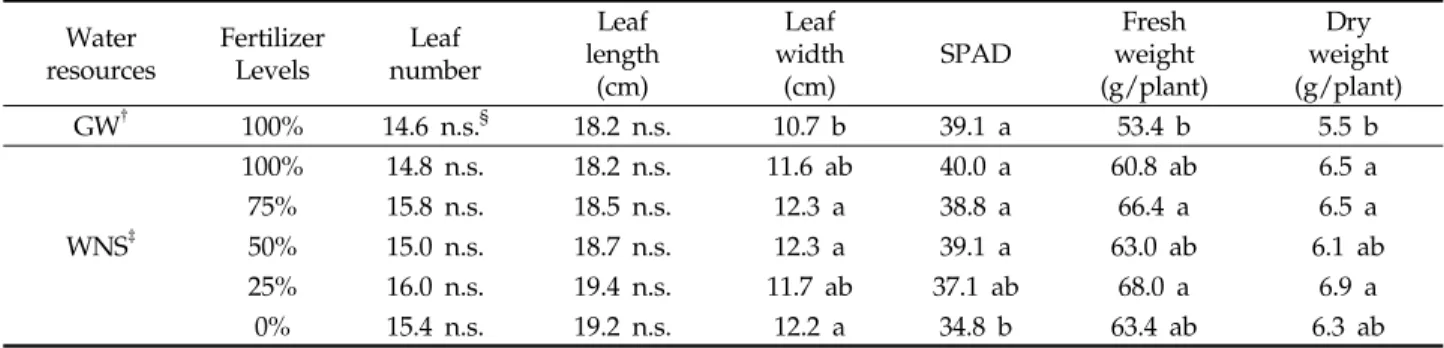
At 26 DAT, the number and length of leaves on
the Chinese cabbage plants treated with conventional
groundwater and waste nutrient solution with different
fertilizer treatments showed no difference. In addition,
the width of leaves, fresh weight and dry weight
were similar or higher in groups irrigated with waste
nutrient solution compared to those of conventional
treatment. However, the SPAD values of plants receiv-
ing the waste nutrient solution with no fertilizer were
lower than those of the groundwater treatment. The
yield of Chinese cabbage plants based on the fresh
and dry weight was not different among tested plants
that were irrigated with waste nutrient solution con-
Water resources
Fertilizer levels
Leaf number
Leaf length
(cm)
Leaf width
(cm)
SPAD
Fresh weight (g/plant)
Dry weight (g/plant)
GW† 100% 34.2 c 21.4 b 12.6 b 48.4 n.s.§ 269 n.s. 41.9 ab
WNS‡
100% 36.8 abc 23.4 a 13.7 ab 48.8 n.s. 286 n.s. 43.3 ab
75% 35.8 bc 24.5 a 14.6 a 45.7 n.s. 273 n.s. 42.3 ab
50% 40.0 a 24.2 a 13.7 ab 41.8 n.s. 286 n.s. 44.3 ab
25% 39.0 ab 23.3 a 14.1 a 47.1 n.s. 319 n.s. 46.2 a
0% 34.8 c 22.6 a 13.4 ab 46.7 n.s. 304 n.s. 40.4 b
† groundwater
‡ waste nutrient solution
§ not significant
Table 5. Growth parameters of Chinese cabbage plants at 56 days after transplanting (DAT). The same letter belong with each mean value is not significantly different at a 0.05 significance level
taining various amounts of fertilizers.
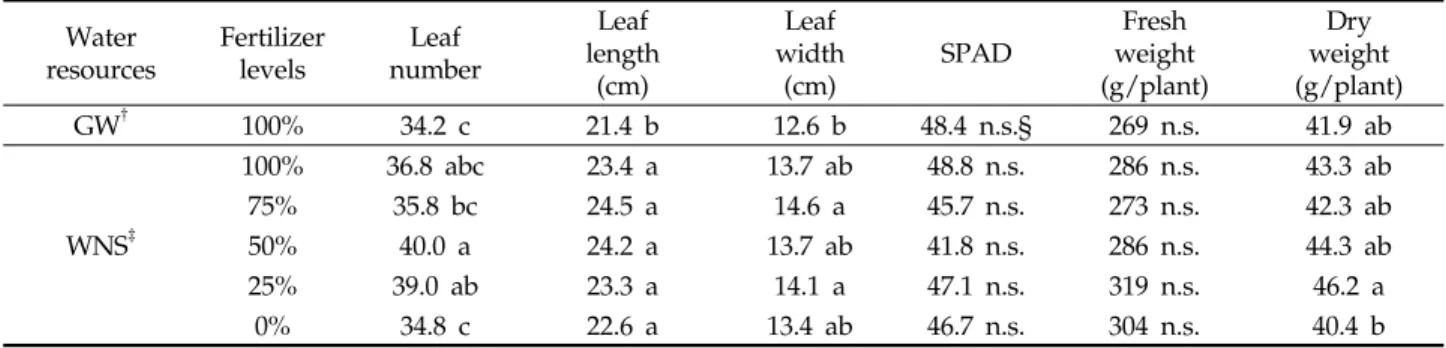
The fresh weight of Chinese cabbage plants irri- gated with groundwater increased by approximately five times from 26 to 56 DAT. At 56 DAT, the growth of Chinese cabbage plants with irrigations of conven- tional groundwater and waste nutrient solution was generally similar (Table. 5). However, the leave length of Chinese cabbage plants irrigated with waste nutrient solution was significantly higher than that of plants irrigated with the conventional groundwater. The growth parameters of Chinese cabbage plants, such as leaf width, fresh weight and dry weight, with irriga- tion of waste nutrient solution was similar or greater than that of plants with irrigation of the conventional groundwater. Specifically, the growth of plants that were irrigated with waste nutrient solution and 25%
of the recommended nutrient levels was the highest;
although the growth of plants in all groups received the fertilizer was not different significantly. At 26 DAT, there were no differences among treatments with res- pect to the growth of the Chinese cabbage plants;
however, plant growth at 56 DAT was generally pro- moted with the waste nutrient solution groups com- pared to with the groundwater. These findings indi- cate that the continuous supply of nutrients from the waste nutrient solution enhances the growth of the Chinese cabbage plants.
The dry weight of cabbage plants received fertili- zers at the 25% level and waste nutrient solution was similar to that of plants received the conventional groundwater. No significant differences were observed in the fresh weight of cabbage plants among all tested treatment groups. Park et al . (2005) reported that combined treatment with chemical fertilizer (70%) and waste nutrient solution (30%) promoted the crop
Fig. 1. Percentage of dry matter of Chinese cabbage plants at 26 and 58 days after transplanting (DAT) on waste nutrient solution applied. Legend indicates percentage of the recommended fertilizer applied. Groundwater was used as a control. The same letter belong with each mean value and the abbreviation of n.s. are not significantly different at a 0.05 significance level