• 검색 결과가 없습니다.

Mediating Effects of Attentional Control in the Relationship Between Neuroticism and

N/A
N/A
Protected

Academic year: 2021

Share "Mediating Effects of Attentional Control in the Relationship Between Neuroticism and "

Copied!
9
0
0

로드 중.... (전체 텍스트 보기)

전체 글

(1)

Mediating Effects of Attentional Control in the Relationship Between Neuroticism and

Repetitive Negative Thinking

Eun-Jung Cha Myoug-Ho Hyun

Department of Psychology, Chung-Ang University, Seoul, Korea

Depression and anxiety symptoms frequently co-occur. Research suggests that a common shared symptom — repetitive neg- ative thinking (RNT) — is a vulnerability factor that develops and prolongs symptoms of affective disorders. A dispositional factor that increases RNT is neuroticism. The mental noise hypothesis of neuroticism suggests that its volatile and reactive nature causes attentional control deficits. As theories of RNT, specifically regarding rumination and worry, indicate such defi- cits as underlying causes, it is hypothesized that the deficits may mediate the relationship between neuroticism and RNT. This study investigated whether attentional focusing and shifting mediates the relationship between neuroticism and RNT (worry and rumination). Results showed mediational effects of focusing on rumination, while the results on worry were not signifi- cant. Neuroticism has been discussed as a temperamental risk factor that increases vulnerability to psychopathology. Future research should employ longitudinal designs and behavioral measures to overcome this study’s limitations.

Keywords: neuroticism, attentional control, repetitive negative thinking, worry, rumination

Introduction

According to reports on the high comorbidity of depressive and anxiety disorders, depression and anxiety are frequently co-oc- curing conditions. A longitudinal study has showed that around 75% of patients with depressive disorder also suffered from co- morbid anxiety disorder, and 81% of patients with anxiety disor- ders also experienced depressive disorder (Lamers et al., 2011).

Furthermore, Essau (2003) has reported that approximately 72%

of adolescents with depression had comorbid anxiety disorder.

These reports suggest that the high prevalence of comorbid de- pressive and anxiety disorders is a serious issue that requires fur-

ther investigation, as it is likely to become chronic (Penninx et al., 2011).

To investigate why depressive and anxiety symptoms co-occur, it is essential to examine shared symptoms such as repetitive nega- tive thinking (RNT). RNT is defined as a cognitive symptom characterized by: 1) repetitiveness, 2) being relatively difficult to control, and 3) containing negative content (Ehring & Watkins, 2008). In depressive and anxiety disorders, two common types of RNT are worry and rumination. Worry is defined as “a chain of thoughts and images, negatively affect laden and relatively uncon- trollable” (Borkovec & Newman, 1998). Rumination is defined as

“thinking perseveratively about one’s feelings” (Nolen-Hoeksema, Wisco, & Lyubomirsky, 2008). Transdiagnostic accounts of RNT suggest that RNT is a vulnerability factor to various affective dis- orders (McEvoy, Watson, Watkins, & Nathan, 2013). For example, levels of rumination and worry prospectively predict increased depression and anxiety symptoms (Segerstrom, Tsao, Alden, &

Craske, 2000; Kocovski, Endler, Rector, & Flett, 2005). Further-

eISSN 2733-4538

Correspondence to Myoung-Ho Hyun, Department of Psychology, Chung- Ang University, 84 Heukseok-ro, Dongjak-gu, Seoul, Korea; E-mail: hyunmh@

cau.ac.kr

Received Mar 29, 2021; Revised May 06, 2021; Accepted May 07, 2021

This research was supported by the Chung-Ang University Research Scholarship Grants in 2019.

(2)

more, levels of rumination and worry are not significantly differ- ent across patients with affective disorders (McEvoy et al., 2013).

Thus, rumination and worry are vulnerability factors to the devel- opment and maintenance of affective disorders. This emphasizes the importance of investigating the dispositional factors that in- crease the likelihood of an individual developing RNT, such as neuroticism (Segerstrom et al., 2000).

Neuroticism is defined as a personality trait that predisposes an individual to experience negative emotions. Consequently, a high- ly neurotic individual may display increased reactivity to stressful events and exhibit associated traits such as decreased self-esteem, guilt, anger, or embarrassment (Costa & McCrae, 1980; Costa Jr &

McCrae, 1987). Previous studies have showed that increased levels of neuroticism are associated with increased levels of rumination and worry (De Bruin, Rassin, & Muris, 2007; Muris, Roelofs, Ras- sin, Franken, & Mayer, 2005). This suggests that, since neurotic in- dividuals are prone to experiencing negative affect, they may em- ploy dysfunctional emotion regulation strategies, such as RNT.

Since neuroticism and RNT are associated with increased vulner- ability to psychopathology, it can be inferred that neuroticism leads to psychopathology via RNT. In fact, previous research has indicated that RNT mediates the effect of neuroticism on depres- sive and anxiety symptoms (Muris et al., 2005).

Neurotic individuals may be more likely to choose dysfunction- al regulation strategies in response to stressful situations because the reactive and volatile nature of neuroticism acts as “mental noise” to negatively affect attentional control abilities (Robinson &

Tamir, 2005; Bredemeier, Berenbaum, Most, & Simons, 2011). For example, neuroticism is related to increased levels of reaction time variability and committing cognitive failures (Robinson & Tamir, 2005; Flehmig, Steinborn, Langner, & Westhoff, 2007; Neupert, Mroczek, & Spiro, 2008). Since RNT is characterized as persevera- tive and intrusive, it follows that attentional control deficiency would increase a person’s vulnerability to experiencing RNT.

Hirsch and Mathews (2012) suggest that pathological worry arises due to several reasons, including decreased attentional con- trol. That is, worry may arise from failure to exert control over in- trusive negative thought contents entered as stimuli-driven, bot- tom-up process. This has been supported empirically through ex- perimental procedures such as the flanker test (Fox, Dutton, Yates,

Georgiou, & Mouchliantis, 2015). Similarly, a theory on rumina- tion suggests that ruminators lack the ability to inhibit negative thought contents (Cohen, Daches, Mor, & Henik, 2014). These theories on rumination and worry demonstrate that attentional control deficiency underlies RNT. Combined with the mental noise hypothesis of neuroticism, it can be suggested that atten- tional control deficiency may mediate the relationship between neuroticism and RNT. The current study thus aims to test a medi- ational model where attentional control is a mediator between the predictor variable (neuroticism) and the outcome variables (worry and rumination). This would elucidate the association between neuroticism and RNT.

Recently, studies employing Attentional Control Scale (Derry- berry & Reed, 2002; ACS), a self-report scale to measure attention- al control abilities have been increasing (e.g. Mills et al., 2016;

Armstrong, Zald, & Olatunji, 2011). ACS and its subscales, focus- ing (remaining focused on a current task) and shifting (shifting attention rapidly between multiple tasks) have been shown to be successfully linked to corresponding behavioral measures, such as Attention Network Task and switch-trials in an anti-saccade task (Reinholdt-Dunne, Mogg, & Bradley, 2013; Judah, Grant, Mills, &

Lechner, 2014).

Self-report studies that employed ACS showed that focusing

and are differentially related to rumination and worry. Previous

research shows that, while focusing relates to RNT, shifting does

not (Mills et al., 2016; Armstrong et al., 2011). As attentional focus-

ing is significantly related to behavioral inhibition (i.e., preventing

distractions), it can be suggested theoretically that the intrusive

nature of rumination and worry would adversely affect an indi-

vidual with low focusing ability (Mills et al., 2016; Armstrong et

al., 2011; Reinholdt-Dunne et al., 2013). Therefore, the current

study also aims to determine whether there are different indirect

effects of focusing and shifting. Previous research investigating

demonstrated that focusing significantly mediated the longitudi-

nal prediction of worry on General Anxiety Disorder symptoms,

and rumination on depression symptoms. However, results re-

garding shifting were non-significant (Mills et al., 2016). There-

fore, it is hypothesized that focusing would mediate the effect of

neuroticism on rumination and worry.

(3)

Method

Procedure

Participants were recruited online to complete online surveys via Google Form. All participants were rewarded with a small incen- tive for participating, and few participants were randomly selected to receive e-vouchers. All participants were given instructions and an overview of the study and were informed of their right to with- draw. To begin the survey, participants were required to grant in- formed consent to participate. The entire procedure was approved by the Institutional Review Board (Approval No. 1041078-202011- HRSB-327-01) and complied with the Declaration of Helsinki.

Participants

A total of 161 Korean participants (112 females) were recruited.

Given that the appropriate sample size for 80% power and medi- um effect size was 116 (Fritz & MacKinnon, 2007), the sample size of 161 was thus deemed appropriate for mediation analysis. All participants were required to be 18 years or above to participate.

Participants’ age ranged from 20 to 69 years (M=31.83, SD =8.40).

Measures

The International Personality Item Pool, Neuroticism Subscale (IPIP-NEO-120; Johnson, 2014)

The IPIP-NEO-120 is a self-report scale used to measure the Big Five personality traits. Originally a 300-item inventory developed by Goldberg et al. (2006), the 120-item shortened IPIP-NEO-120 was developed and validated by Johnson (2014). The current study used the neuroticism subscale consisting of 24 items rated on a 4-point Likert scale ranging from 1 to 4. A Korean version trans- lated and validated by Jahng (2018) was used. The neuroticism subscale showed good internal consistency in the original study by Johnson (2014) and by Jahng (2018), with values α=.90 and α=.81, respectively. The internal consistency demonstrated in the current study was good, α=.89.

Attentional Control Scale (ACS; Derryberry & Reed, 2002; Yoon, Kim, & Choi, 2007)

The ACS is a self-report scale used to measure attentional control.

It is a 20-item scale developed and validated by Derryberry and

Reed (2002). Responses are rated on a 4-point Likert scale ranging from 1 to 4. A Korean version translated and validated by Yoon et al. (2007) was used. The ACS showed good internal consistency in both studies, with values α=.88 and α=.84, respectively. The in- ternal consistency demonstrated in the current study was accept- able, α=.78. Attentional focusing and shifting are two subscales of ACS, containing 12 items and 8 items, respectively.

Rumination Reflection Scale (RRS; Nolen-Hoeksema & Morrow, 1991; S. J. Kim, Kim, & Yun, 2010)

The RRS is a self-report scale originally developed by Nolen- Hoeksema and Morrow (1991) to measure ruminative responses.

A Korean translated and validated version (Kim et al., 2010) was used in the current study. The RRS is a 22-item scale rated on a 4-point Likert scale ranging from 1 to 4. The internal consistency reported by Nolen-Hoeksema and Morrow (1991) and Kim et al.

(2010) were both good, with values α=.89 and α=.89, respectively.

The internal consistency in the current study was good, α=.93.

Pennsylvania State Worry Questionnaire (PSWQ; Meyer, Miller, Metzger, & Borkovec, 1990; Kim & Min, 1998)

The PSWQ is a self-report scale developed by Meyer et al. (1990) used to measure levels of worry. A Korean version translated and validated by J. W. Kim and Min (1998) was used in the current study. The PSWQ is a 16-item scale rated on a 5-point Likert scale ranging from 1 to 5. The internal consistency reported by Meyer et al. (1990) and J. W. Kim and Min (1998) were both good, with val- ues α=.93 and α=.92, respectively. The internal consistency dem- onstrated in the current study was also good, α=.87.

Data Analysis

Data screening revealed no missing data or outliers. Data analyses were conducted using IBM SPSS version 25.0 and PROCESS Macro 3.4.1 developed by Hayes (2018). Pearson’s correlations were calcu- lated for neuroticism, attentional control, focusing, shifting, worry, and rumination. Mediational analyses were conducted to investi- gate: (1) focusing as a mediator between neuroticism and rumina- tion; (2) shifting as a mediator between neuroticism and rumina- tion; (3) focusing as a mediator between neuroticism and worry;

and (4) shifting as a mediator between neuroticism and worry.

(4)

Results

Descriptive Statistics

The descriptive statistics are shown in Table 1. More than half of the participants were female (69.6%), and majority were attending or have attended universities (63%). The mean total ACS score was 41 (SD =7.17), which is substantially lower than the score reported by the Korean ACS validation study (Yoon et al., 2007; M=52.56, SD =8.39). This is likely attributable to the overall mean age and age range of the participants in the current sample (M=31.8,

SD =8.40) being older than that of Yoon et al. (2007) (M=22.89, SD=2.64). The RRS and PSWQ scores (M=46.2, SD=11.8; M=44.1, SD =11.2, respectively) reported in the current study are compa- rable to their Korean validation studies (Kim et al., 2010; J. W. Kim

& Min, 1998).

Correlations

The correlation results are shown in Table 2. Neuroticism was sig- nificantly negatively correlated with attentional control, r(159)=

-.54 (p<.01), attentional focusing, r(159)=-.43, (p<.01), and at- tentional shifting, r(159)=-.51 (p<.01). Neuroticism was signifi- cantly positively correlated with rumination, r(159)=.31 (p<.01), and worry, r(159)=.25 (p<.01). Attentional control was significant- ly negatively correlated with rumination, r(159)=-.35, (p<.01) and worry, r(159)=-.18 (p=.02). Both focusing and shifting were sig- nificantly correlated with rumination, with coefficients r(159)=

-.34 (p<.01) and r(159)=-.245 (p<.01), but only shifting was sig- nificantly correlated with worry, r(159)=-.16, p=.04. Finally, rumi- nation was significantly positively correlated with worry, r(159)=

.18, p=.02.

Mediational Analyses

Before mediation analyses, all assumptions were checked (lineari- ty, normality, homoscedasticity, and independence; Kane & Ash- baugh, 2017). T-tests and one-way ANOVAs were performed to examine any significant differences across demographic variables (age, sex, education, and marriage status). The analyses revealed a significant difference of worry according to sex, such that females worried more than males, t(159)=-2.97, p<.01. This is consistent with previous research (Robichaud, Dugas, & Conway, 2003). A

Table 1. Descriptive Statistics of the Sample

Variable Value

Sex %

Male 30.4

Female 69.6

Age (yr)

M 31.8

SD 8.40

Education

High school or lower 13 (8%)

College 20 (12%)

University 101 (63%)

Postgraduate 27 (17%)

Marriage status

Single or not married 125 (78%)

Married 33 (21%)

Separated or widowed 3 (2%)

Neuroticism

M 16.7

SD 5.16

ACS (total)

M 41.0

SD 7.17

ACS (focusing)

M 24.0

SD 4.95

ACS (shifting)

M 16.9

SD 3.47

RRS

M 46.2

SD 11.8

PSWQ

M 44.1

SD 11.2

ACS =Attentional Control Scale; RRS =Ruminative Response Scale;

PSWQ=Pennsylvania State Worry Questionnaire.

Table 2. Pearson Correlations Between Neuroticism, ACS and Their Subscales, RRS, and PSWQ

Variable 1 2 3 4 5

1 Neuroticism -.43** -.51** .31** .25**

2 ACS (focus) -.43** .43** -.34** -.15

3 ACS (shift) -.51** .43** -.25** -.16*

4 RRS .31** -.34** -.25** .18*

5 PSWQ .25** -.15 .16* .18*

ACS =Attentional Control Scale; RRS =Ruminative Response Scale;

PSWQ=Pennsylvania State Worry Questionnaire.

*p<.05 (2-tailed). **p<.01 (2-tailed).

(5)

one-way ANOVA revealed a significant effect of education status on neuroticism, F(3, 157)=2.94 (p=.04) and rumination, F(3, 157)=

4.21 (p<.01). That is, neuroticism and rumination were lower among those with lower education status. Therefore, sex and education status were entered as covariates in the following mediational analyses.

PROCESS Model 4 (Hayes, 2018) was used as for separate analy- ses with outcome variables set as rumination and worry. Parallel mediational analyses with two mediators (focusing and shifting) were tested. The indirect effect was tested using 95% confidence interval and 5000 bootstrap samples for percentile bootstrapping.

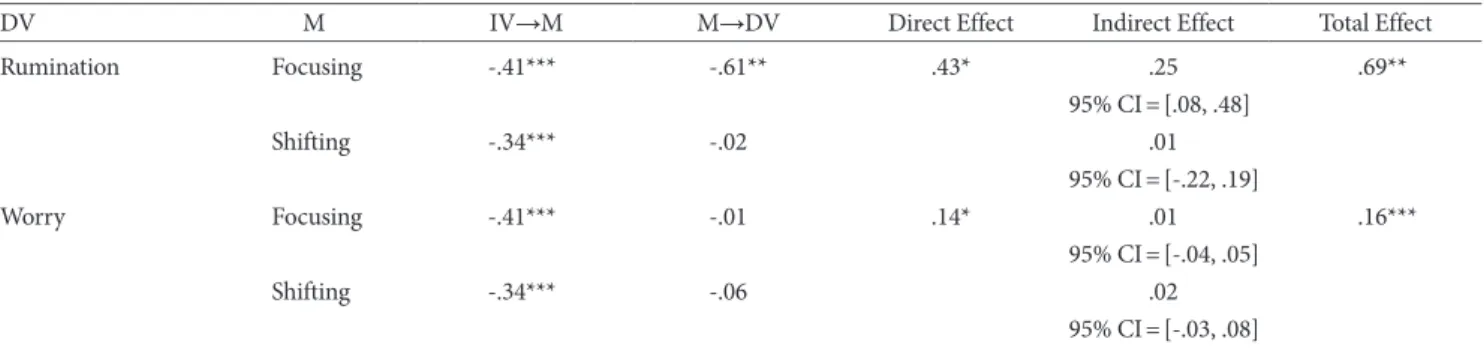
The main results are outlined in Figures 1 and 2. Table 3 shows the results of the mediational analyses.

Consistent with previous research, neuroticism positively pre- dicted rumination, c

1

= .69 (p<.01). and worry, c

2

= .16 (p<.001).

With rumination as an outcome variable, focusing mediated the relationship between neuroticism and rumination (Figure 1).

This result supported the hypothesis. The significant indirect ef- fect of focusing was .25 (95% bootstrap CI=[.08, .48]). Figure 1 il- lustrates that the positive value indicates the negative relationship between neuroticism and attentional focus, a

11

= -.41 (p<.001), and consequent negative relationship between attentional focus and rumination, b

11

= -.61 (p<.01).

In model 2, worry was set as the outcome variable (Figure 2).

Attentional focusing and shifting did not significantly mediate the effect of neuroticism on worry, as the bootstrapped confidence in- tervals did not straddle 0 (Table 3). However, neuroticism signifi- cantly predicted worry even after focusing and shifting were con- trolled for, c’

2

= .14, p=.02. This suggested that another variable may explain the relationship between neuroticism and worry.

Table 3. Results of the Mediational Analyses

DV M IV→M M→DV Direct Effect Indirect Effect Total Effect

Rumination Focusing -.41*** -.61** .43* .25 .69**

95% CI=[.08, .48]

Shifting -.34*** -.02 .01

95% CI=[-.22, .19]

Worry Focusing -.41*** -.01 .14* .01 .16***

95% CI=[-.04, .05]

Shifting -.34*** -.06 .02

95% CI=[-.03, .08]

DV=Dependent Variable; M=Mediator; IV=Independent Variable; CI=Confidence Interval. All confidence intervals indicate bootstrapped lower and upper limit confidence intervals.

*p<.05. **p<.01. ***p<.001.

Figure 1. Mediation model with rumination as the outcome variable. Figure 2. Mediation model with worry as the outcome variable .

(6)

Discussion

The current study aimed to investigate whether attentional focus- ing and shifting mediated the effect of neuroticism on RNT, spe- cifically rumination and worry. Considering previous research (Armstrong et al., 2011; Mills et al., 2016), we hypothesized that fo- cusing would mediate the effects on rumination and worry. The results were supported for rumination, but not worry, as neither focusing nor shifting indirectly affected the relationship between neuroticism and worry.

The results of rumination as an outcome variable showed that neuroticism predicted increased rumination, and that attentional focusing mediated this relationship. Contrarily, while neuroticism significantly predicted a decrease in attentional shifting, shifting did not predict rumination. While the null result regarding shift- ing is in line with results from Mills et al. (2016), it contradicts the significant results from using behavioral measures of shifting in predicting rumination (De Lissnyder, Koster, & De Raedt, 2012).

One explanation why the inconsistent results occurred may be at- tributed to the presence of emotional information in the latter study, where shifting from emotional information may have caused greater attentional influences. Therefore, future studies may investigate whether effects of shifting are limited to the in- volvement of emotional stimuli.

The indirect effect of focusing was of substantial size (.25), indi- cating that deficits in attentional focusing may play a significant role in the relationship between neuroticism and rumination. As attentional focusing is significantly correlated with behavioral in- hibition (Judah et al., 2014), the present results support the evi- dence that lack of inhibition may be a vulnerability factor to RNT and, consequently, psychopathology (Mills et al., 2016). Further- more, the significant indirect effect suggests that this lack of inhi- bition abilities may be partially explained by neuroticism, rein- forcing the mental noise hypothesis (Robinson & Tamir, 2005).

Regarding worry, no significant indirect effects of attentional focusing and shifting emerged. This is consistent with the results from Armstrong et al. (2011) obtained from the non-clinical con- trol group. However, focusing significantly predicted worry among patients with general anxiety disorder (GAD), and was also a sig- nificant mediator between worry and GAD symptoms (Armstrong

et al., 2011; Mills et al., 2016). The difference in results may be at- tributed to the clinical status of participants. In studies indicating significant roles of attentional focusing, participants comprised those with a clinical anxiety disorder, or the variable being mea- sured was psychopathology symptoms. This suggests that while attentional control may not impact worry in the general popula- tion, it may influence pathological levels of worry in vulnerable individuals. One theory on pathological worry hypothesize that vulnerable individuals possess pre-existing patterns of thinking and emotional processing biases of threat stimuli, which strength- en mere intrusions into episodes of pathological worry (Hirsch &

Mathews, 2012). As the current study investigated worry in non- clinical participants, such habitual thinking patterns and process- ing biases may not be present to significant levels of pathological worry.

However, whether worry is normal or pathological is not neces- sarily dichotomous. Previous findings have shown that worry is a continuous spectrum; thus, factors that may contribute to varia- tions in worry should be investigated (Ruscio, Borkovec, & Ruscio, 2001). This indicates that deficits in attentional focusing may in- crease levels of worry toward pathological levels. In fact, a recent nine-year longitudinal study revealed that impairments in inhibi- tion predicted the onset of GAD nine years later (Zainal & New- man, 2018). Combined with the current results, neuroticism can be proposed as an underlying causal vulnerability factor for path- ological worry. To further investigate this, a longitudinal study with neuroticism as a predictor variable may be useful.

Another reason why attentional focusing and shifting were not significant mediators of worry may be attributed to participants’

judgement on what constitutes as worry. For example, a content analysis on worry episodes revealed that 48% of worry contents were categorized as a problem-solving process (Szabó & Lovibond, 2002). This suggests a possibility where those who attributed their worry as a productive problem-solving process may have under- mined true levels of worry.

The results of the current study highlight the significance of

neuroticism as a personality trait vulnerability factor for the po-

tential development of psychopathology. Furthermore, there is ev-

idence for the genetic basis of neuroticism (Okbay et al., 2016). If

neuroticism is a core factor of psychopathology as well as their risk

(7)

factors such as attentional control deficits, then neuroticism must be emphasized as a potential treatment target, rather than its con- sequent symptoms. For example, a randomized control trial im- plemented an intervention targeting anxiety risk factors in chil- dren, such as behavioral inhibition, a temperament factor that sig- nificantly relates to neuroticism (Vreeke & Muris, 2012). The re- sults were encouraging, as the intervention decreased the severity of anxiety disorders (Rapee, Kennedy, Ingram, Edwards, & Swee- ney, 2010). Additional research should determine effective ways to decrease levels of neuroticism.

In addition, the current study results show that rumination and worry are differentially affected by attentional focusing and shift- ing. While transdiagnostic accounts of RNT suggest that RNT acts as a common vulnerability factor to psychopathology, the current results suggest that their processes may differ in the con- text of attentional control. However, previous studies investigating differences between worry and rumination have investigated the issue mainly in terms of their cognitive content (e.g., Szabó & Lo- vibond, 2002). Therefore, future research should investigate how different types of RNT may arise due to different forms of atten- tional control deficits.

Finally, combined with previous studies investigating the rela- tionship between neuroticism, psychopathology, RNT, and atten- tional control (Muris et al., 2005; Mills et al., 2016; Reinholdt- Dunne et al., 2013; Segerstrom et al., 2000), the results of the cur- rent study contribute to a holistic view on how the variables relate to each other. Muris et al. (2005) demonstrated that RNT mediates the effect of neuroticism on psychopathology. The current results show that attentional focusing acts as a mediator in the path from neuroticism to RNT. The results from Mills et al. (2016) indicate that attentional focusing influences the effect of various types of RNT on psychopathology. Combined with the current results, it can be suggested that attentional control may act as a common mediator influencing different paths from how vulnerability fac- tor (neuroticism) may develop and manifest into psychopathology (e.g., depression, anxiety). Therefore, our understanding in their relationship may benefit from future studies investigating the role of attentional control deficits within the developmental trajectory from neuroticism to psychopathology.

The interpretation of the present results is limited due to its

cross-sectional study design. Since we sought to investigate the mechanism by which neuroticism predicts psychopathology symptoms, a longitudinal design where the outcome variables are measured at subsequent time points may be more suitable. Anoth- er limitation is the use of self-report measures of attentional con- trol. The ACS may reflect personal beliefs on the individual’s at- tentional control ability (Quigley, Wright, Dobson, & Sears, 2017).

To resolve this issue, future studies may employ behavioral mea- sures of attentional control. Finally, the number of females exceed- ed that of male participants. This may have affected the results for worry, as research indicates that females tend to worry more than males (Robichaud et al., 2003).

In conclusion, the current study investigated whether attention- al focusing and shifting indirectly affected the relationship be- tween neuroticism and RNT, namely, rumination and worry. The results indicated that only attentional focusing indirectly affected neuroticism and rumination. Neither attentional focusing nor shifting indirectly affected neuroticism and worry. The results highlight the importance of neuroticism as a temperamental risk factor to the development of psychopathology.

Author contributions statement

EJC, graduate student and research assistant at Chung-Ang Uni- versity, conceptualized the research, collected and analyzed the data, and wrote the original draft of the manuscript. MHH, profes- sor at Chung-Ang University, served as the principal investigator of the research grant, supervised the research process, and re- viewed and edited the writing. All authors provided critical feed- back, participated in revision of the manuscript, and approved the final submission.

References

Armstrong, T., Zald, D. H., & Olatunji, B. O. (2011). Attentional control in OCD and GAD: Specificity and associations with core cognitive symptoms. Behaviour Research and Therapy, 49, 756- 762. Retrieved from https://doi.org/10.1016/j.brat.2011.08.003 Borkovec, T. D., & Newman, M. G. (1998). Worry and generalized

anxiety disorder. Comprehensive Clinical Psychology, 6, 439-459.

Bredemeier, K., Berenbaum, H., Most, S. B., & Simons, D. J. (2011).

Links between neuroticism, emotional distress, and disengaging

attention: Evidence from a single-target RSVP task. Cognition &

(8)

Emotion, 25, 1510-1519. Retrieved from https://doi.org/10.1080/

02699931.2010.549460

Cohen, N., Daches, S., Mor, N., & Henik, A. (2014). Inhibition of negative content—a shared process in rumination and reapprais- al. Frontiers in Psychology, 5, 622. Retrieved from https://doi.org/

10.3389/fpsyg.2014.00622

Costa, P. T., & McCrae, R. R. (1980). Influence of extraversion and neuroticism on subjective well-being: Happy and unhappy peo- ple. Journal of Personality and Social Psychology, 38, 668-678. Re- trieved from https://doi.org/10.1037/0022-3514.38.4.668 Costa Jr, P. T., & McCrae, R. R. (1987). Neuroticism, somatic com-

plaints, and disease: Is the bark worse than the bite? Journal of Personality, 55, 299-316. Retrieved from https://doi.org/10.1111/

j.1467-6494.1987.tb00438.x

De Bruin, G. O., Rassin, E., & Muris, P. (2007). The prediction of worry in non-clinical individuals: The role of intolerance of un- certainty, meta-worry, and neuroticism. Journal of Psychopathol- ogy and Behavioral Assessment, 29, 93-100. Retrieved from https://

doi.org/10.1007/s10862-006-9029-6

Derryberry, D., & Reed, M. A. (2002). Anxiety-related attentional biases and their regulation by attentional control. Journal of Ab- normal Psychology, 111, 225-236. Retrieved from https://doi.org/

10.1037/0021-843X.111.2.225

Ehring, T., & Watkins, E. R. (2008). Repetitive Negative Thinking as a Transdiagnostic Process. International Journal of Cognitive Therapy, 1, 192-205. Retrieved from https://doi.org/10.1521/ijct.

2008.1.3.192

Essau, C. A. (2003). Comorbidity of anxiety disorders in adolescents.

Depression and Anxiety, 18, 1-6. Retrieved from https://doi.org/

10.1002/da.10107

Flehmig, H. C., Steinborn, M., Langner, R., & Westhoff, K. (2007).

Neuroticism and the mental noise hypothesis: Relationships to lapses of attention and slips of action in everyday life. Psychology Science, 49, 343-360.

Fox, E., Dutton, K., Yates, A., Georgiou, G. A., & Mouchlianitis, E.

(2015). Attentional control and suppressing negative thought in- trusions in pathological worry. Clinical Psychological Science, 3, 593-606. Retrieved from https://doi.org/10.1177/2167702615575878 Fritz, M. S., & MacKinnon, D. P. (2007). Required sample size to

detect the mediated effect. Psychological Science, 18, 233-239. Re- trieved from https://doi.org/10.1111/j.1467-9280.2007.01882.x Goldberg, L. R., Johnson, J. A., Eber, H. W., Hogan, R., Ashton, M.

C., Cloninger, C. R., & Gough, H. G. (2006). The international personality item pool and the future of public-domain personal- ity measures. Journal of Research in Personality, 40, 84-96. Re- trieved from https://doi.org/10.1016/j.jrp.2005.08.007

Hayes, A. F. (2018). Introduction to mediation, moderation, and conditional process analysis (2nd Ed.). New York: The Guilford Press.

Hirsch, C. R., & Mathews, A. (2012). A cognitive model of patho- logical worry. Behaviour Research and Therapy, 50, 636-646. Re- trieved from https://doi.org/10.1016/j.brat.2012.06.007

Jahng, S. (2018). Development and validation of the Korean version of IPIP-NEO-300 scale and the brief version of IPIP-NEO scale.

[Unpublished Manuscript]. Sungkyunkwan University, Seoul, Korea.

Johnson, J. A. (2014). Measuring thirty facets of the Five Factor Model with a 120-item public domain inventory: Development of the IPIP-NEO-120. Journal of Research in Personality, 51, 78- 89. Retrieved from https://doi.org/10.1016/j.jrp.2014.05.003 Judah, M. R., Grant, D. M., Mills, A. C., & Lechner, W. V. (2014).

Factor structure and validation of the attentional control scale.

Cognition & Emotion, 28, 433-451. Retrieved from https://doi.or g/10.1080/02699931.2013.835254

Kane, L., & Ashbaugh, A. R. (2017). Simple and parallel mediation:

A tutorial exploring anxiety sensitivity, sensation seeking, and gender. The Quantitative Methods for Psychology, 13, 148-165.

Retrieved from https://doi.org/10.20982/tqmp.13.3.p148 Kim, J. W., & Min, B. B. (1998). Intolerance of uncertainty and

problem orientation in worry. Korean Psychological Association Academic Conference Archives, 1998, 83-92.

Kim, S. J., Kim, J. H., & Youn, S. C. (2010). Validation of the Korean- Ruminative Response Scale(K-RRS). Korean Journal of Clinical Psychology, 29, 1-19. Retrieved from https://doi.org/10.15842/

kjcp.2010.29.1.001

Kocovski, N. L., Endler, N. S., Rector, N. A., & Flett, G. L. (2005).

Ruminative coping and post-event processing in social anxiety.

Behaviour Research and Therapy, 43, 971-984. Retrieved from https://doi.org/10.1016/j.brat.2004.06.015

Lamers, F., Van Oppen, P., Comijs, H. C., Smit, J. H., Spinhoven, P., Van Balkom, A. J. L. M., Nolen, W. A., Zitman, F. G., Beekman, A. T. F., & Penninx, B. W. J. H. (2011). Comorbidity patterns of anxiety and depressive disorders in a large cohort study. The Jour- nal of Clinical Psychiatry, 72, 341-348. Retrieved from https://doi.

org/10.4088/JCP.10m06176blu

McEvoy, P. M., Watson, H., Watkins, E. R., & Nathan, P. (2013). The relationship between worry, rumination, and comorbidity: Evi- dence for repetitive negative thinking as a transdiagnostic con- struct. Journal of Affective Disorders, 151, 313-320. Retrieved from https://doi.org/10.1016/j.jad.2013.06.014

Meyer, T. J., Miller, M. L., Metzger, R. L., & Borkovec, T. D. (1990).

Development and validation of the penn state worry question- naire. Behaviour Research and Therapy, 28, 487-495. Retrieved from https://doi.org/10.1016/0005-7967(90)90135-6

Mills, A. C., Grant, D. M., Judah, M. R., White, E. J., Taylor, D. L., &

Frosio, K. E. (2016). Trait attentional control influences the rela-

tionship between repetitive negative thinking and psychopathol-

ogy symptoms. Psychiatry Research, 238, 277-283. Retrieved from

(9)

https://doi.org/10.1016/j.psychres.2016.02.055

Muris, P., Roelofs, J., Rassin, E., Franken, I., & Mayer, B. (2005). Me- diating effects of rumination and worry on the links between neuroticism, anxiety and depression. Personality and Individual Differences, 39, 1105-1111. Retrieved from https://doi.org/10.1016/

j.paid.2005.04.005

Neupert, S. D., Mroczek, D. K., & Spiro, A. (2008). Neuroticism moderates the daily relation between stressors and memory fail- ures. Psychology and Aging, 23, 287-296. Retrieved from https://

doi.org/10.1037/0882-7974.23.2.287

Nolen-Hoeksema, S., & Morrow, J. (1991). A prospective study of depression and posttraumatic stress symptoms after a natural disaster: The 1989 Loma Prieta earthquake. Journal of Personali- ty and Social Psychology, 61, 115-121. Retrieved from https://doi.

org/10.1037/0022-3514.61.1.115

Nolen-Hoeksema, S., Wisco, B. E., & Lyubomirsky, S. (2008). Re- thinking rumination. Perspectives on Psychological Science, 3, 400- 424. Retrieved from https://doi.org/10.1111/j.1745-6924.2008.

00088.x

Okbay, A., Baselmans, B. M., De Neve, J. E., Turley, P., Nivard, M.

G., Fontana, M. A., . . . Rich, S. S. (2016). Genetic variants associ- ated with subjective well-being, depressive symptoms, and neu- roticism identified through genome-wide analyses. Nature Ge- netics, 48, 624-633. Retrieved from https://doi.org/10.1038/ng.

3552

Penninx, B. W., Nolen, W. A., Lamers, F., Zitman, F. G., Smit, J. H., Spinhoven, P., . . . Beekman, A. T. (2011). Two-year course of de- pressive and anxiety disorders: results from the Netherlands Study of Depression and Anxiety (NESDA). Journal of Affective Disor- ders, 133, 76-85. Retrieved from https://doi.org/10.1016/j.jad.

2011.03.027

Quigley, L., Wright, C. A., Dobson, K. S., & Sears, C. R. (2017).

Measuring attentional control ability or beliefs? Evaluation of the factor structure and convergent validity of the attentional control scale. Journal of Psychopathology and Behavioral Assessment, 39, 742-754. Retrieved from https://doi.org/10.1007/s10862-017- 9617-7

Rapee, R. M., Kennedy, S. J., Ingram, M., Edwards, S. L., & Sweeney, L. (2010). Altering the trajectory of anxiety in at-risk young chil- dren. American Journal of Psychiatry, 167, 1518-1525. Retrieved

from https://doi.org/10.1176/appi.ajp.2010.09111619

Reinholdt-Dunne, M. L., Mogg, K., & Bradley, B. P. (2013). Atten- tion control: Relationships between self-report and behavioural measures, and symptoms of anxiety and depression. Cognition &

Emotion, 27, 430-440. Retrieved from https://doi.org/10.1080/02 699931.2012.715081

Robichaud, M., Dugas, M. J., & Conway, M. (2003). Gender differ- ences in worry and associated cognitive-behavioral variables. Jour- nal of Anxiety Disorders, 17, 501-516. Retrieved from https://doi.

org/10.1016/S0887-6185(02)00237-2

Robinson, M. D., & Tamir, M. (2005). Neuroticism as mental noise:

A relation between neuroticism and reaction time standard de- viations. Journal of Personality and Social Psychology, 89, 107-114.

Retrieved from https://doi.org/10.1037/0022-3514.89.1.107 Ruscio, A. M., Borkovec, T. D., & Ruscio, J. (2001). A taxometric

investigation of the latent structure of worry. Journal of Abnor- mal Psychology, 110, 413-422. Retrieved from https://doi.org/10.

1037/0021-843X.110.3.413

Segerstrom, S. C., Tsao, J. C., Alden, L. E., & Craske, M. G. (2000).

Worry and rumination: Repetitive thought as a concomitant and predictor of negative mood. Cognitive Therapy and Research, 24, 671-688. Retrieved from https://doi.org/10.1023/A:1005587311498 Szabó, M., & Lovibond, P. F. (2002). The cognitive content of natu- rally occurring worry episodes. Cognitive Therapy and Research, 26, 167-177. Retrieved from https://doi.org/10.1023/A:10145- 65602111

Vreeke, L. J., & Muris, P. (2012). Relations between behavioral inhi- bition, big five personality factors, and anxiety disorder symp- toms in non-clinical and clinically anxious children. Child Psy- chiatry & Human Development, 43, 884-894. Retrieved from https://doi.org/10.1007/s10578-012-0302-5

Yoon, S. A., Kim, H. T., & Choi, J. S. (2007). Reliability and Validity of an Attentional Control Questionnaire. The Korean Journal of Clinical Psychology, 26, 185-199. Retrieved from https://doi.org/

10.15842/kjcp.2007.26.1.011

Zainal, N. H., & Newman, M. G. (2018). Executive function and

other cognitive deficits are distal risk factors of generalized anxi-

ety disorder 9 years later. Psychological Medicine, 48, 20-45. Re-

trieved from https://doi.org/10.1017/S0033291717003579

수치

Table 2. Pearson Correlations Between Neuroticism, ACS and Their  Subscales, RRS, and PSWQ Variable 1 2 3 4 5 1 Neuroticism -.43** -.51** .31** .25** 2 ACS (focus) -.43** .43** -.34** -.15 3 ACS (shift) -.51** .43** -.25** -.16* 4 RRS .31** -.34** -.25** .
Figure 1. Mediation model with rumination as the outcome variable. Figure 2. Mediation model with worry as the outcome variable .

참조

관련 문서

Therefore, this study aims to investigate the relationship between explicit grammar instruction and English speaking of lower-grade students in third-grade

To address the research question, it's attempted to see if there were any significant gaps in peer relationship between an experimental group and a

The purpose of this study is to examine the relationship between the social support and mental health of university taekwondo athletes, and clearly clas sify

In addition, a correlation analysis was conducted to examine the relationship between generality 5 factors (neuroticism, extroversion, openness, agreeableness,

Objectives: This study aimed to investigate the relationship between job stress and turnover intention of employed opticians and to investigate the mediating effect of burnout

The purpose of this study is to verify whether The mediating effects of planned happenstance skills on the relationship between perceived social support

The purpose of this study is to analyze the relationship between dance performances, which is a part of social contribution activities of local governments,

Purpose: The aim of this study is to identify the relationship between knowledge and awareness of radiation department students and their intent in