J Korean Acad Community Health Nurs (지역사회간호학회지) https://doi.org/10.12799/jkachn.2021.32.3.292
Associated Factors of Depression and Suicidal Behaviors among Korean Adolescents: Web-based Survey of the Korea Youth Risk Behavior in
2015~2017
Choi, Hyun-A1 · Yang Hyejin2
1Assistant Professor, Department of Nursing, Sunlin University, Pohang
2Assistant Professor, College of Nursing Science, Konyang University, Daejeon, Korea
Purpose: Suicide among adolescents is a serious problem worldwide, and especially, the suicide rate of teenagers is increasing rapidly in South Korea. This study was conducted to investigate the factors affecting the respective suicidal behavior in terms of home-environment characteristics, health behavior characteristics, and psychological health characteristics in Korean adolescents. Methods: The data of the Web-based Survey of the Youth Risk Behavior from 2015 to 2017 collected by the Korea Centers for Disease Control and Prevention (KCDC) was analyzed using multivariable logistic regression analysis. Results: The influential factors by depression and suicidal behavior (suicidal ideation (SI), suicidal plan (SP), and suicidal attempt (SA)) were female(adjusted odds ratios [aOR], 1.45, 1.69, 1.30, 2.19), age (aOR 1.03, 0.98, 0.97, 0.90), no family members (aOR 1.21, 1.36, 2.11, 2.32), living with only the father (aOR 1.05, 1.06, 1.07, 1.11), high economic status (aOR 1.15, 1.22, 1.34, 1.46), residence in relatives’ home (aOR 1.6, 1.36, 2.34, 1.97), drinking experience (aOR 1.35, 1.47, 1.57, 1.76), smoking experience (aOR 1.28, 1.30, 1.31, 1.94), hospital treatment experience due to violence (aOR 2.18, 3.33, 6.24, 8.40), bad health status (aOR 1.23, 1.48, 2.00, 2.15), unhappiness (aOR 2.49, 6.14, 6.72, 8.89), and a lot of stress (aOR 6.05, 10.40, 4.86, 5.52). Conclusion:
The suicidal behavior risk screening and prevention program for adolescents should be developed considering the subjective happiness and hospital treatment experience status due to violence that affects suicidal behavior.
Key Words: Adolescent; Depression; Suicidal ideation; Suicide attempted
주요어: 청소년, 우울, 자살생각, 자살계획, 자살시도
Corresponding author: Yang, HyejinCollege of Nursing Science, Konyang University, 158 Gwangeodong-ro, Seo-gu, Daejeon 35365, Korea.
Tel: +82-42-600-8582, Fax: +82-42-600-8555, E-mail: [email protected]
Received: Mar 12, 2021 / Revised: Jul 5, 2021 / Accepted: Jul 6, 2021
This is an open access article distributed under the terms of the Creative Commons Attribution Non-Commercial License (http://creativecommons.org/licenses/
by-nc/3.0), which permits unrestricted non-commercial use, distribution, and reproduction in any medium, provided the original work is properly cited.
INTRODUCTION
Adolescence is a transitional period when one grows in- to an adult through the fastest physical, emotional, and in- tellectual change, acquires various knowledge, skills, abil- ities, and attitudes, and experiences stress and confusion while performing development tasks given to him or her [1]. Due to conflict, stress, disappointment, and frustration arising in relation to development tasks, some youths at- tempt problem behaviors, such as drug use, misdemeanor, school violence, runaway, and suicide [2]. Among them, adolescent suicide emerges as a serious problem, and it arouses social interest [3].
According to the '2020 Suicide Prevention White Paper'
data, Korea's teenage suicide rate was 4.2-4.9 per 100,000 people by 2017, but it was 5.8 in 2018, the highest rate of in- crease (22.1%) compared to other age groups, which is 1.7 times higher than the average rate of suicide among teen- agers in Organization for Economic Cooperation and De- velopment (OECD) countries 3.4. In addition, intentional self-harm and suicide ranked first among the top 10 causes of death, accounting for 35.7% of the total causes of death, 2.5 times the number of malignant neoplasms in the sec- ond place. Given the socio-economic losses caused by ju- venile suicide and the occurrence of secondary mental ill- ness [4], the severity is very high, and preventive inter- vention is urgently needed.
Suicide is the end to life for oneself, and suicidal behav-
ior is a series of process concepts that include suicidal ide- ation (SI), suicidal plan (SP), suicidal attempt (SA), and suicide death [5], and is a multidimensional action deter- mined by the interaction of various factors, not a disability or diagnosis name [6]. Not everyone who thinks of SP or SA, but it is common for those who think of or plan it to have a high risk of dying from suicide [7,8]. In addition, it is reported in many previous studies that depression, which is the most powerful predictor of suicide [9], medi- ates the relationship between suicide risk factors and ado- lescent suicide and is a direct influential factor on SI [10].
Also, depression as an illness factors on adolescents sui- cide explains suicidal behavior [11-13].
However, previous studies on the suicide of adoles- cents in South Korea focused mainly on SI, because there are limits of collecting study subjects [14]. There are stud- ies related to SA, however, they focus mainly on frag- mentary results to identify risk factors, and those that ap- proach the suicide as a series of stages of suicidal ideation, SP, and SA, including depression are very insufficient.
Moreover, as adolescents are emotionally unstable and immature, when they are faced with pain which they can't handle, they often attempt suicide without planning in ad- vance as part of escape from reality rather than seek help from outside [15], and since the suicide can't receive an im- mediate treatment intervention after the situation occurs, identifying the factors affecting each stage of suicidal be- havior, including depression, will be important data for adolescent suicide prevention and early intervention.
According to previous studies, it is reported that the suicide of adolescent is caused by the Home environment related factors, such as gender, low self-esteem, sexual vi- olence experience, life stress, misdemeanor experience of drinking, smoking, and drugs, relationship with parents, lack of family support, family economic level, parental di- vorce, and school violence and by various complex factors related to health behavior and mental health [9,10]. When analyzing suicidal behavior, it is also essential to analyze considering not only a single problem behavior, but also the complex factors and stepwise dimension including Home environment related characteristics, health behav- iors and mental health characteristics, and to make mul- ti-dimensional intervention such as the preparation of pre- ventive measures accordingly.
Therefore, by analyzing the Korea Youth Risk Behavior Web-based Survey (KYRBS) of three years from 2015 to 2017, and by grasping which factor of Home environment related characteristics, health behaviors, and mental health characteristics has a greater impact on the stages of depres- sion, SI, SP, and SA, this study was intended to be used for
the basic data for the high-risk group screening and sui- cide prevention programs for adolescent suicide preven- tion.
METHODS
1. Design of StudyThis study is a cross-sectional survey study conducted to identify the factors affecting the suicidal behavior of Korean adolescents using the KYRBS data.
2. Subjects of Study
Of the KYRBS conducted annually by the Ministry of Education and the KCDC, three-year data from 2015 to 2017 was used, and since the raw data was open to the public, it was used after it was officially approved for use through the KYRBS website. The subjects of this study were the 11th (2015), 12th (2016), and 13th (2017) KYRBS.
The KYRBS was designed to represent middle and high school students nationwide using the stratified sample collection method, and students with a long absence, chil- dren with disabilities, and students with literacy dis- abilities were excluded from the sample students. From 2015 to 2017, the total number of populations in the KYRBS was 70,362, 67,983, and 64,991, respectively, with 68,043, 65,528, and 62,276 actual participants, respectively, and 188,959 people were selected as the final subjects in this study.
3. Study Tools
Independent and dependent variables were selected through a literature review on adolescent suicide [16,17].
1) Home environment related characteristics
The Home environment related characteristics of the subjects included gender, age, family members, parents' cohabitation, parents' education level, parents' Korean na- tionality status, socio-economic status, and residence type.
2) Health Behavior characteristics
Health behavior characteristics included drinking expe- rience, smoking experience, and treatment experience due to violence. For drinking, the question whether they had drunk more than one glass of alcohol so far, for smoking, that whether they had smoked at least one or two ciga- rettes so far, and for treatment experience due to violence, that whether they had been treated at a hospital due to vio-
lence (physical assault, intimidation, bullying, etc.) by friends, seniors, and adults in the last 12 months were used.
3) Mental health characteristics
Mental health characteristics included subjective health cognition, subjective happiness, and stress cognition. Sub- jective health cognition, which is subjective health status that one feels, was reclassified into being healthy (very healthy, healthy), moderate, and bad (not healthy, very unhealthy). Subjective happiness, which is the subjective happiness status that one feels, was reclassified into hap- piness (very happy, happy), moderate, and unhappiness (somewhat unhappy, very unhappy). Stress cognition, a degree that one normally feels, was reclassified into feel- ing a lot (feeling so much, feeling a lot), feeling a little, and no feeling (no feeling very much, no feeling at all).
4) Dependent variables
(1) Depression: If one answered 'yes' to the question, 'Have you ever felt sad or desperate enough to stop your daily life for two weeks in the last 12 months?' has been a depression
(2) Suicidal behaviors
Suicidal ideation (SI): If one answered 'yes' to the ques- tion, 'Have you ever seriously considered suicide in the last 12 months?' has been a suicidal ideation.
Suicidal plan (SP): If one answered 'yes' to the ques- tion, 'Have you ever made any specific plans to com- mit suicide in the last 12 months?' has been a suicidal plan.
Suicidal attempt (SA): If one answered 'yes' to the question, 'Have you ever committed suicide in the last 12 months?' has been a suicidal attempt.
4. Statistical Analysis
Of the KYRBS conducted annually by the Ministry of Education and the KCDC, three-year data from 2015 to 2017 was used, and since the raw data was open to the public, it was used after it was officially approved for use through the KYRBS website. The data was integrated ac- cording to the raw data analysis guidelines, and the com- plex sample design elements were designated and ana- lyzed using the IBM SPSS statistics for windows (Version 24.0; Armonk, NY, USA) program. The results of data ana- lysis of this study presented the results of correcting the weight variables. Descriptive statistical analysis was used for the Home environment related characteristics, health
behaviors, and mental health characteristics of the sub- jects, and they were presented as frequency that did not re- flect the weights and as percentage that reflected the weights. Rao-Scott x2 test and t-test was used for testing the difference between Home environment related charac- teristics, health behavior, and mental health character- istics according to suicidal behavior, and multiple logistic regression was performed to identify the factors affecting suicidal behavior.
5. Ethics Statement
This study was conducted with the approval of the Bio- ethics Review Committee of Konyang University (IRB No.
KYU-2018-169-01).
RESULTS
1. The Home Environment Related Characteristics, Health Behavior and Mental Health Characteristics of the Subjects
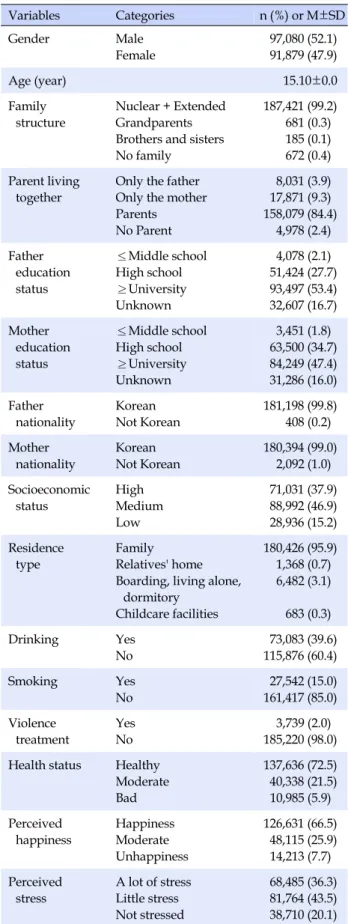
The Home environment related characteristics, health behavior and mental health characteristics of the subjects are as shown in Table 1. For gender, men were 52.1%, and women were 47.9%. For family structure type, healthy fam- ily type was 99.2%, which accounted for the largest por- tion, and for residence type, 84.4% lived with their parents.
For parent education, college graduates were the highest with 53.4% and 47.4%, respectively. For the economic sta- tus, the ratio of average was 46.9%, which was the highest.
For health behavior characteristics, 39.6% had drinking experience, 15.0% had smoking experience, and 2.0% had hospital treatment experience due to violence. In subjec- tive health cognition of mental health characteristics, 5.9%
responded that they were not healthy, and 7.7% respon- ded that they were not happy. 36.3% responded that they felt a lot of stress.
2. Relationship between Home Environment Related Characteristics, Health Behavior, Mental Health Characteristics and Suicidal Behavior
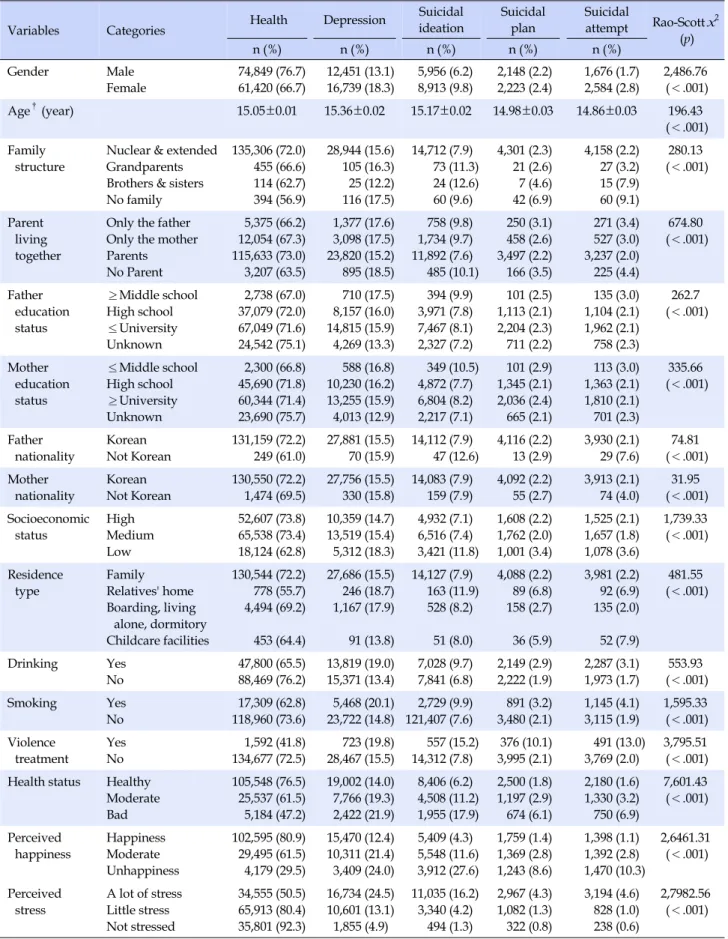
Relationship between Home environment related char- acteristics, health behavior, mental health characteristics and suicidal behavior is as shown in Table 2. Examining the prevalence of the suicidal behavior of adolescents, de- pression was 15.5%, SI rate 7.9%, SP rate 2.3%, and SA rate 2.3%. In Home environment related characteristics, gen- der, age, family structure, parents' cohabitation status, pa-
Table 1. General Characteristics of Subjects (N=188,959) (Weighted N=3,090,634)
Variables Categories n (%) or M±SD
Gender Male
Female
97,080 (52.1) 91,879 (47.9)
Age (year) 15.10±0.0
Family structure
Nuclear + Extended Grandparents Brothers and sisters No family
187,421 (99.2) 681 (0.3) 185 (0.1) 672 (0.4) Parent living
together
Only the father Only the mother Parents No Parent
8,031 (3.9) 17,871 (9.3) 158,079 (84.4)
4,978 (2.4) Father
education status
≤Middle school High school
≥University Unknown
4,078 (2.1) 51,424 (27.7) 93,497 (53.4) 32,607 (16.7) Mother
education status
≤Middle school High school
≥University Unknown
3,451 (1.8) 63,500 (34.7) 84,249 (47.4) 31,286 (16.0) Father
nationality
Korean Not Korean
181,198 (99.8) 408 (0.2) Mother
nationality
Korean Not Korean
180,394 (99.0) 2,092 (1.0) Socioeconomic
status
High Medium Low
71,031 (37.9) 88,992 (46.9) 28,936 (15.2) Residence
type
Family Relatives' home Boarding, living alone,
dormitory Childcare facilities
180,426 (95.9) 1,368 (0.7) 6,482 (3.1)
683 (0.3)
Drinking Yes
No
73,083 (39.6) 115,876 (60.4)
Smoking Yes
No
27,542 (15.0) 161,417 (85.0) Violence
treatment
Yes No
3,739 (2.0) 185,220 (98.0) Health status Healthy
Moderate Bad
137,636 (72.5) 40,338 (21.5) 10,985 (5.9) Perceived
happiness
Happiness Moderate Unhappiness
126,631 (66.5) 48,115 (25.9) 14,213 (7.7) Perceived
stress
A lot of stress Little stress Not stressed
68,485 (36.3) 81,764 (43.5) 38,710 (20.1)
rents' education, parents' Korean nationality status, eco- nomic status, and residence type were statistically sig- nificant in depression, SI, SP, and SA. In health behavior characteristics, drinking experience, smoking experience, and hospital treatment experience due to violence were statistically significant in depression, SI, SP, and SA. In mental health characteristics, subjective health status, sub- jective happiness, and stress cognition were statistically significant in depression, SI, SP, and SA.
3. Factors Affecting Suicidal Behavior
The relevant factors affecting suicidal behavior are as shown in Table 3. In gender of the Home environment re- lated characteristics, female students showed a higher risk of depression, SI, SP, and SA than male students, and among them, the risk of suicidal attempt was 2.19 times higher than that of SA of male students. In the family structure, students in a broken family type with no parents or only siblings showed a gradual increase in the risk of depression, SI, SP, and SA, compared to those in the heal- thy family type consisting of a couple and children. Among them, the risk of SA of students with no parents was high- est at 2.32 times, and that of SA in a family structure con- sisting of only siblings was 1.90 times higher. In parent co- habitation status, the risk of depression, SI, SP, and SA (aOR, 1.11; 95% confidence interval [CI], 0.96~1.28) got gradually higher in the case of living with only the father, compared to the case of living with parents. In addition, it was found that the risk of SA increased by 1.14 times in the case of living with only the mother as well. In the socio- economic status, those who replied, 'High' or 'Low' showed a gradual higher risk of depression, SI, SP, and SA (aOR, 1.46, 95% CI, 1.35~1.57; aOR, 1.28, 95% CI, 1.17~1.40), com- pared to those who replied, 'Average'. In residence type, the risk of depression, SI, and SP (aOR, 2.34; 95% CI, 1.81~
3.04) got higher in the case of living in a relative's house, compared to the case of living with family members, how- ever, the risk of SA (aOR, 1.97; 95% CI, 1.49~2.61) got lower.
In addition, in the case of living in a childcare facility and in a boarding house, living alone, or in a dormitory, it was found that there were some similarities or lower risks, compared to the case of living with family members. In the health behavior characteristics, those who had drinking experience showed a gradual increase in the risk of de- pression, SI, SP, and SA (aOR, 1.76; 95% CI, 1.63~1.89), compared to those who had none. Those who had smok- ing experience showed a gradual increase in the risk of de- pression, SI, SP, and SA (aOR, 1.94; 95% CI, 1.77~2.11), compared to those who had none. Those who had hospital
Table 2. Factors Affecting Health and Suicidal Behavior (N=188,959) (Weighted N=3,090,634)
Variables Categories Health Depression Suicidal
ideation
Suicidal plan
Suicidal
attempt Rao-Scott x2
n (%) n (%) n (%) n (%) n (%) (p)
Gender Male
Female
74,849 (76.7) 61,420 (66.7)
12,451 (13.1) 16,739 (18.3)
5,956 (6.2) 8,913 (9.8)
2,148 (2.2) 2,223 (2.4)
1,676 (1.7) 2,584 (2.8)
2,486.76 (<.001)
Age†(year) 15.05±0.01 15.36±0.02 15.17±0.02 14.98±0.03 14.86±0.03 196.43
(<.001) Family
structure
Nuclear & extended Grandparents Brothers & sisters No family
135,306 (72.0) 455 (66.6) 114 (62.7) 394 (56.9)
28,944 (15.6) 105 (16.3) 25 (12.2) 116 (17.5)
14,712 (7.9) 73 (11.3) 24 (12.6) 60 (9.6)
4,301 (2.3) 21 (2.6) 7 (4.6) 42 (6.9)
4,158 (2.2) 27 (3.2) 15 (7.9) 60 (9.1)
280.13 (<.001)
Parent living together
Only the father Only the mother Parents No Parent
5,375 (66.2) 12,054 (67.3) 115,633 (73.0) 3,207 (63.5)
1,377 (17.6) 3,098 (17.5) 23,820 (15.2) 895 (18.5)
758 (9.8) 1,734 (9.7) 11,892 (7.6) 485 (10.1)
250 (3.1) 458 (2.6) 3,497 (2.2) 166 (3.5)
271 (3.4) 527 (3.0) 3,237 (2.0) 225 (4.4)
674.80 (<.001)
Father education status
≥Middle school High school
≤University Unknown
2,738 (67.0) 37,079 (72.0) 67,049 (71.6) 24,542 (75.1)
710 (17.5) 8,157 (16.0) 14,815 (15.9) 4,269 (13.3)
394 (9.9) 3,971 (7.8) 7,467 (8.1) 2,327 (7.2)
101 (2.5) 1,113 (2.1) 2,204 (2.3) 711 (2.2)
135 (3.0) 1,104 (2.1) 1,962 (2.1) 758 (2.3)
262.7 (<.001)
Mother education status
≤Middle school High school
≥University Unknown
2,300 (66.8) 45,690 (71.8) 60,344 (71.4) 23,690 (75.7)
588 (16.8) 10,230 (16.2) 13,255 (15.9) 4,013 (12.9)
349 (10.5) 4,872 (7.7) 6,804 (8.2) 2,217 (7.1)
101 (2.9) 1,345 (2.1) 2,036 (2.4) 665 (2.1)
113 (3.0) 1,363 (2.1) 1,810 (2.1) 701 (2.3)
335.66 (<.001)
Father nationality
Korean Not Korean
131,159 (72.2) 249 (61.0)
27,881 (15.5) 70 (15.9)
14,112 (7.9) 47 (12.6)
4,116 (2.2) 13 (2.9)
3,930 (2.1) 29 (7.6)
74.81 (<.001) Mother
nationality
Korean Not Korean
130,550 (72.2) 1,474 (69.5)
27,756 (15.5) 330 (15.8)
14,083 (7.9) 159 (7.9)
4,092 (2.2) 55 (2.7)
3,913 (2.1) 74 (4.0)
31.95 (<.001) Socioeconomic
status
High Medium Low
52,607 (73.8) 65,538 (73.4) 18,124 (62.8)
10,359 (14.7) 13,519 (15.4) 5,312 (18.3)
4,932 (7.1) 6,516 (7.4) 3,421 (11.8)
1,608 (2.2) 1,762 (2.0) 1,001 (3.4)
1,525 (2.1) 1,657 (1.8) 1,078 (3.6)
1,739.33 (<.001)
Residence type
Family Relatives' home Boarding, living
alone, dormitory Childcare facilities
130,544 (72.2) 778 (55.7) 4,494 (69.2)
453 (64.4)
27,686 (15.5) 246 (18.7) 1,167 (17.9)
91 (13.8)
14,127 (7.9) 163 (11.9) 528 (8.2)
51 (8.0)
4,088 (2.2) 89 (6.8) 158 (2.7)
36 (5.9)
3,981 (2.2) 92 (6.9) 135 (2.0)
52 (7.9)
481.55 (<.001)
Drinking Yes
No
47,800 (65.5) 88,469 (76.2)
13,819 (19.0) 15,371 (13.4)
7,028 (9.7) 7,841 (6.8)
2,149 (2.9) 2,222 (1.9)
2,287 (3.1) 1,973 (1.7)
553.93 (<.001)
Smoking Yes
No
17,309 (62.8) 118,960 (73.6)
5,468 (20.1) 23,722 (14.8)
2,729 (9.9) 121,407 (7.6)
891 (3.2) 3,480 (2.1)
1,145 (4.1) 3,115 (1.9)
1,595.33 (<.001) Violence
treatment
Yes No
1,592 (41.8) 134,677 (72.5)
723 (19.8) 28,467 (15.5)
557 (15.2) 14,312 (7.8)
376 (10.1) 3,995 (2.1)
491 (13.0) 3,769 (2.0)
3,795.51 (<.001) Health status Healthy
Moderate Bad
105,548 (76.5) 25,537 (61.5) 5,184 (47.2)
19,002 (14.0) 7,766 (19.3) 2,422 (21.9)
8,406 (6.2) 4,508 (11.2) 1,955 (17.9)
2,500 (1.8) 1,197 (2.9) 674 (6.1)
2,180 (1.6) 1,330 (3.2) 750 (6.9)
7,601.43 (<.001)
Perceived happiness
Happiness Moderate Unhappiness
102,595 (80.9) 29,495 (61.5) 4,179 (29.5)
15,470 (12.4) 10,311 (21.4) 3,409 (24.0)
5,409 (4.3) 5,548 (11.6) 3,912 (27.6)
1,759 (1.4) 1,369 (2.8) 1,243 (8.6)
1,398 (1.1) 1,392 (2.8) 1,470 (10.3)
2,6461.31 (<.001)
Perceived stress
A lot of stress Little stress Not stressed
34,555 (50.5) 65,913 (80.4) 35,801 (92.3)
16,734 (24.5) 10,601 (13.1) 1,855 (4.9)
11,035 (16.2) 3,340 (4.2)
494 (1.3)
2,967 (4.3) 1,082 (1.3) 322 (0.8)
3,194 (4.6) 828 (1.0) 238 (0.6)
2,7982.56 (<.001)
†t -test.
Table 3. Factors Affecting the Suicidal Behavior(N=188,959)(Weighted N=3,090,634) VariablesCategories DepressionSuicidal ideationSuicidal plan Suicidal attempt aOR(95%CI)paOR(95%CI)paOR(95%CI)paOR(95%CI)p GenderMale Female1 1.45(1.39~1.50)<.0011 1.69(1.60~1.78)<.0011 1.30(1.19~1.42)<.0011 2.19(1.99~2.41)<.001 Age(year)1.03(1.02~1.05)<.0010.98(0.96~0.99).0230.97(0.93~0.99).0450.90(0.87~0.94)<.001 Family structureNuclear & Extended Grandparents Brothers & sisters No family 1 0.94(0.74~1.21) 0.67(0.41~1.10) 1.21(0.94~1.57)
.648 .114 .136
1 1.38(1.02~1.87) 1.34(0.82~2.19) 1.36(0.98~1.89)
.038 .241 .062
1 1.12(0.65~1.95) 1.35(0.52~3.48) 2.11(1.38~3.24)
.677 .540 .001
1 1.09(0.66~1.80) 1.90(0.99~3.64) 2.32(1.50~3.58)
.729 .053 <.001 Parent living togetherParents Only the father Only the mother No parents
1 1.05(0.98~1.12) 1.06(1.01~1.11) 1.07(0.97~1.19)
.178 .010 .174
1 1.06(0.97~1.15) 1.07(1.01~1.14) 0.95(0.83~1.09)
.194 .023 .475
1 1.07(0.94~1.23) 0.98(0.89~1.09) 0.76(0.59~0.98)
.314 .771 .032
1 1.11(0.96~1.28) 1.14(1.03~1.27) 0.87(0.69~1.10)
.159 .010 .248 Socioeconomic statusHigh Medium Low
1.15(1.11~1.19) 1 1.06(1.02~1.10)
<.001 .003
1.22(1.17~1.28) 1 1.22(1.16~1.28)
<.001 <.001
1.34(1.24~1.44) 1 1.31(1.20~1.43)
<.001 <.001
1.46(1.35~1.57) 1 1.28(1.17~1.40)
<.001 <.001 Residence typeFamily Childcare facilities Boarding, living alone, dormitory Relatives' home
1 0.79(0.61~1.02) 1.02(0.95~1.10) 1.16(0.99~1.37)
.071 .565 .071
1 0.81(0.57~1.15) 1.04(0.94~1.16) 1.36(1.11~1.68)
.242 .452 .004
1 1.45(0.97~2.15) 1.33(1.11~1.58) 2.34(1.81~3.04)
.068 .002 <.001
1 1.42(0.97~2.08) 1.02(0.83~1.24) 1.97(1.49~2.61)
.074 .868 <.001 DrinkingYes No1.35(1.31~1.39) 1<.0011.47(1.41~1.53) 1<.0011.57(1.47~1.69) 1<.0011.76(1.63~1.89) 1<.001 SmokingYes No1.28(1.23~1.33) 1<.0011.30(1.23~1.38) 1<.0011.31(1.19~1.44) 1<.0011.94(1.77~2.11) 1<.001 Violence treatmentYes No2.18(1.98~2.40) 1<.0013.33(2.99~3.72) 1<.0016.24(5.48~7.11) 1<.0018.40(7.38~9.56) 1<.001 Health statusHealthy Moderate Bad
1 1.10(1.06~1.14) 1.23(1.16~1.30)<.001 <.001 1 1.14(1.09~1.19) 1.48(1.39~1.59)<.001 <.001 1 1.15(1.06~1.24) 2.00(1.81~2.21)<.001 <.001 1 1.28(1.19~1.38) 2.15(1.94~2.37)<.001 <.001 Perceived happinessHappiness Moderate Unhappiness
1 1.43(1.39~1.48) 2.49(2.36~2.62)<.001 <.001 1 1.94(1.86~2.02) 6.14(5.79~6.51)<.001 <.001 1 1.68(1.54~1.83) 6.72(6.11~7.40)<.001 <.001
1 1.92(1.77~2.09) 8.89(8.08~9.77)<.001 <.001 Perceived stressNot stressed A lot of stress Little stress
1 6.05(5.74~6.38) 2.59(2.46~2.73)<.001 <.001 1 10.40(9.46~11.44) 2.82(2.56~3.10)<.001 <.001 1 4.86(4.26~5.53) 1.62(1.42~1.85)<.001 <.001 1 5.52(4.78~6.37) 1.55(1.34~1.80)<.001 <.001 F=186.554, p<.001 aOR=adjusted odds ratio; CI=confidence interval.
treatment experience due to violence showed a gradual in- crease in the risk of depression, SI, SP, and SA (aOR, 8.40;
95% CI, 7.38~9.56).
In mental health characteristics, those who replied that their subjective health status was bad showed a gradual increase in the risk of depression, SI, SP, and SA (aOR, 2.15; 95% CI, 1.94~2.37), compared to those who replied that their subjective health was good. Those who replied that they were unhappy in their subjective happiness showed a gradual increase in the risk of depression, SI, SP, and SA (aOR, 8.89; 95% CI, 8.08~9.77), compared to those who replied they were happy. In stress cognition, those who replied that they received a lot of stress showed a gradual increase in the risk of depression and SI (aOR, 10.40; 95% CI, 9.46~11.44), however, a decrease in the risk of SP (aOR, 4.86; 95% CI, 4.26~5.53) and SA (aOR, 5.52;
95%CI, 4.78~6.37), compared to those who replied that they did not receive stress.
As a result of calculating the F-value to verify the model fit, it was verified to be statistically significant (F=186.554, p<.001).
DISCUSSION
Adolescence is a period when adolescents become an adult physically, mentally, and socially, and suffer from identity confusion due to conflicts and wandering accord- ing to the surrounding location.
As a result of this study, in the gender of the Home envi- ronment related characteristics, female students showed the gradual increase in the risk as they passed through the stages of depression, SI, SP, and SA, compared to male stu- dents. Among them, female students showed the risk of suicidal attempt of 2.19 times higher than that of the SA of male students, which supports the results of previous studies [3,8,14,15]
Male and female students have different physical and psychological development levels and different ways of coping with problems, and female students value inter- personal relationships and attachment to others, so when they are faced with a crisis in a relationship with a mean- ingful person, they are more likely to commit suicide than male students [18]. In particular, it is reported that female students have chronically a higher level of depression dur- ing adolescence than male students, and that the level does not decrease even when they are in late adolescence [18], so when developing programs related to suicide pre- vention, it is necessary to prepare differentiated early in- tervention methods by gender. In this study in family structure, the students in a broken family without parents
or with only siblings showed a gradual increase in the risk of the stages of depression, SI, SP, and SA, compared to those in the healthy family structure consisting of a couple and children, as they passed through the stages. In partic- ular, the risk of SA of students without parents increased by 2.32 times, which was similar to the results of previous studies [19]. In the case of a child head of household, it is thought that the risk of suicide gets higher due to econom- ic difficulties and the loss of the parent support system [20,21].
In addition, in the case of a grandson's family, the risk of SI increased by 1.38 times than nuclear family and ex- tended family that indicating that SI are possible due to the poor family environment, but it is believed that they cannot even SP or SA. However, since there are studies that adolescents in their grandchildren's families increa- sed susceptibility to suicide due to the disconnection of communication due to generation gaps rather than sup- port from their grandparents and the dual stress problem of caring for the family [19], and that the suicide has noth- ing to do with family structure [22], it is thought that fol- low-up studies are needed.
In the case of living with parents, those who lived with the mother showed an increase in the risk of depression by 1.06 times, the risk of SI by 1.07 times and SA by 1.14 times, respectively, compared to the case of living with parents.
However, the risk of SP of living without parents was low- er than the risk of SP of living with parents.The risk of de- pression, SI and SA could have no significant when it com- pared to the case of living with parents. It is thought that since the children of single-parent families experience the psychological and emotional problems which require emo- tional handling, such as sadness or deloss due to the ab- sence of one parent, problems adapting to changes in life, and problems, such as overweight of the role of the parent that should act as a parent [23], the risk of suicidal behav- ior might increase. In the future, it is considered that re- search will be needed to compare the risk of suicidal be- havior by subdividing a single parent family type into a divorced family, a bereaved family, a single mother, and a single father family.
In the economic status, the students who responded 'High' or 'Low' showed a gradual increase in the risk of the stages of the depression, SI, and SP, compared to those who answered 'Average', however, those who answered 'Low' showed a decrease in the risk of the stage of SP, and those who answered 'High' showed an increase in the risk of SA by 1.46 times. The result of this study was different from the results of previous studies that the lower the eco- nomic level, the higher the risk of suicide [24,25], however,
it was similar to the result of study of Lee et al [8], that the risk of suicide is higher in the order of the upper, lower, and middle classes. In the study of Park and Jang [26], in the case of depression and SI, a higher distribution was shown in a low socio-economic group, and in the case of stress, the rate of experience of children in a generation with a high socio-economic level was higher than that of those in other groups, which indicates that the economic status cannot be interpreted merely from a material point of view. That is, since parents' high economic level im- poses excessive expectations on adolescents, and adoles- cents' mental health can be threatened due to inherent con- flicts between parents and children [26], it is necessary to analyze the factors affecting suicidal behavior in depth for teenagers with high economic level.
In residence type, those who lived in a relative's house showed an increase in the risk of the stages of SI, and SP by 1.36 times, and 2.34 times respectively, compared to those who lived with family members, however, they showed a little decrease in the risk of the stage of SA by 1.97 times. In the case of living in childcare facilities is no significant dif- ference compared to those who lived with family mem- bers. The reason why the case of living in a children's fa- cility showed no significant difference from the case of liv- ing with a family is thought to be that it is possible to re- ceive the attention and care of facility officials, and that there is no need to nunchi. This result was similar to the re- sults of previous studies that SI rate was higher in rela- tives' homes than childcare facilities [27], and was differ- ent from the study result of Kim et al. [28], that the risk of the SP and SA of the students who resided in childcare fa- cilities increased the most by 3.23 times and 3.36 times.
However, this result is in line with the results of existing studies that the risk of suicidal behavior increases, com- pared to the case of living with someone other than family members or in an unstable environment. Recently, the number of students who do not live with their parents due to the unemployment or divorce of parents has increased, and due to that, the dysfunction of the family, which is un- stable and lacks emotional support, is thought to affect the suicide of adolescents. Therefore, it is necessary to pay special attention and care to them.
Among health behavior characteristics, drinking expe- rience, smoking experience and hospital treatment status due to violence emerged as the influential factors of suici- dal behavior, and the risk increased as the stages of de- pression, SI, SP, and SA progressed. Drinking and smok- ing experience emerged as the risk factors of depression, SI, SP, and SA, which was similar to the results of previous studies [29,30]. Drinking and smoking, which are typical
health behavior problems among adolescents, are known to be caused by a heavy burden on grade, stress due to worry about going to school, and interpersonal problems [26]. In particular, in this study, it was indicated that smoking had a greater impact on SA, which is the result similar to previous studies that reported that smoking had a significant effect on the SI, SP, and SA of adolescents [31,32]. There were the results of previous studies that in the education environment focused on entrance exams, stressful adolescents sometimes often smoke to relieve tension or maintain relationships with their peers, which can lead to other misdemeanors [29]. Alcohol and tobacco are known as a gateway to all drugs [26], so it is necessary to prevent access to these drugs early, and to provide ad- equate education and active preventive measures. In addi- tion, it is necessary to select and manage students with high frequency of smoking and drinking as a high-risk group, and to find and manage the suicidal behaviors of them early on.
In particular, adolescents who experienced hospital treatment due to violence damage showed a significant in- crease in the risk as the process of depression SI, SP, and SA proceeded, compared to those who had none, which turned out to be a major risk factor of suicidal behavior.
This was similar to the results of previous studies that sui- cidal behavior could be caused by the damage of school vi- olence [30-32]. Adolescents, the victims of violence, may show psychological problems, internalized symptoms, and externalized problem behaviors due to experience of school violence, and among them, it is thought that de- pression, psychological problem, may emerge. Consider- ing depression as a predisposing factor in SI, special atten- tion and care should be paid to the adolescents who have been victimized by violence. It was indicated that among the mental health characteristics, subjective health status, subjective happiness, and stress cognition were the influ- ential factors of suicidal behavior. In subjective health sta- tus, the students who thought they were unhealthy showed a gradual increase in the risk as they passed through the stages of depression, SI, SP, and SA. This result is similar to the results of previous studies that the risk of suicide in- creases if the recognition of one's health status is not heal- thy [8]. In subjective happiness, the students who thought they did not feel happy showed a gradual increase in risk as they passed through the stages of depression, SI, SP, and SA. Among them, the risk of suicidal attempt increa- sed by 8.89 times, which was identified as a major variable affecting suicidal behavior. Therefore, it is thought that the happiness perceived by adolescents can be an important intervention to reduce suicidal behavior. In stress cogni-
tion, in the case of high stress, the risk of SI was the highest at 10.40 times, and, it showed a decrease of 4.86 times in SP, and 5.52 times in SA, however, it was still high. It was similar to the results of previous studies that stress caused by various factors such as study, friendship, and family environment increases the risk of suicide [33]. Adolescents with high stress have a high degree of aggression, feel sui- cidal impulse, and often choose suicide as a means of ex- treme expression of stress [34]. The need for stress man- agement and intervention is also urgent, and mental health variables should be examined as important predictors of suicide behavior
In conclusion, it was indicated that the suicidal behav- ior of adolescents is a combination of Home environment related characteristics, health behavior, and mental health characteristics. Among them, preventive approach to school and domestic violence is important to prevent suicide, and multidimensional interventions to prevent suicide will be needed, since mental health-related factors have a great influence on suicide.
The limitations of this study are as follows. First, as this study is a cross-sectional survey using the KYRBS, there are limitations in explaining various factors affecting the suicidal behavior of Korean adolescents. Second, as the questions about suicidal behavior are sensitive, there are limitations that they may not have been honestly answered.
Third, as the questions about depression, SI, SP, and SA are dichotomous (yes, or no), there are limitations in grasp- ing the degree of severity of suicidal behavior.
However, this study is significant in that it integrates and analyzes the 2015-2017 KYRBS data to identify wheth- er or not the Home environment related characteristics, health behavior and mental health characteristics affect the depression, SI, SP, and SA of adolescents, lowers the suicide rate of adolescents by finding the risk factors of suicidal behavior in advance and grasping the factors pos- sible to correct, and presents as basic data for the develop- ment of a suicide prevention program for adolescents.
CONCLUSION
This study was conducted to provide basic data for the development of suicidal behavior prevention program by identifying the risk factors of the depression, SI, SP, and SA of adolescents using the KYRBS in three years from 2015 to 2017.
As a result of study, the Home environment related cha- racteristics (gender, family structure, parents' cohabitation, socio-economic status, and residence type), health behav- ior characteristics (smoking experience, drinking experi-
ence, and hospital treatment experience due to violence), and mental health characteristics (subjective health status, subjective happiness, and stress cognition) have an effect on the depression, SI, SP, and SA of Korean adolescents.
Through this study, it was identified that suicidal behav- ior is caused by a combination of health behaviors and mental health characteristics, as well as Home environ- ment related characteristics. In particular, it could be known that subjective happiness and hospital treatment experience status due to violence had a significant impact on suicidal behavior.
Based on the results of this study, it is suggested as follows. First, this study was conducted on the adolescents from 1st grade of middle school to 3rd grade of high school, and didn't include those outside school. Those who are outside school are considered to have additional risk factors in addition to health behaviors and mental health characteristics, and therefore, further studies are needed to identify the factors affecting suicidal behavior.
Second, it is thought that studies are needed to subdivide the family structure and compare the risk of suicidal beha- vior. Third, the studies that analyze the factors affecting suicidal behavior in depth are needed for adolescents with a high economic level. Fourth, it is necessary to have fol- low-up research from an ecological perspective, including the factors affecting suicidal behavior as a second study of data using three-year complex sample data.
REFERENCES
1. Koo SS, Jung OH, Jang SH. The relationships of ego-identity, social support and mental health of adolescents. The Journal of the Korea Contents Association. 2011;11(9):225-237.
https://doi.org/10.5392/JKCA.2011.11.9.225
2. Chung HK, Ahn OH, Kim KH. Predicting factors on youth sui- cide impulse. Korean Journal of Youth Studies. 2003;10(2):
107-126.
3. Shin HJ, Chung IJ, Lee SA, Lee HY, Park JY. Factor affecting depression, suicidal ideation, suicide plans and suicide at- tempts in adolescence. Journal of School Social Work. 2014;27:
25-50.
4. Ministry of Health Welfare & Korea Suicide Prevention Center.
2020 White book. first ed. Seoul: Korea Suicide Prevention Center; 2020. 279 p.
5. Maris RRM. Suicide and neuropsychiatric adverse effects of SSRI medications: methodological issues. Paper presented at:
Scientific Symposium; 2002 October 4; Marriott Hotel. Phila- delphia.
6. Silverman, MM, Berman AL, Sanddal ND, O'Carroll PW, Joi- ner Jr TE. Rebuilding the tower of Babel: A revised nomencla-
ture for the study of suicide and suicidal behaviors Part 1:
Background, rationale, and methodology. Suicide and Life- Threatening Behavior. 2007;37(3):248-263.
https://doi.org/10.1521/suli.2007.37.3.248
7. Neeleman, J, de Graaf R, Vollebergh W. The suicidal process:
Prospective comparison between early and later stages. Jour- nal of Affective Disorders. 2004:82(1):43-52.
https://doi.org/10.1016/j.jad.2003.09.005
8. Lee HS, Kim YH, Kim SH. Influencing factors on suicidal be- havior among adolescents: Using 10th (2014) Korea youth risk behavior web-based survey. The Korean Society of Living En- vironmental System. 2015;22:827-838.
9. Kim HJ. Effect Factors of Adolescences' Suicide risk. Journal of the Korean Society of Child Welfare. 2008;27:69-93.
10. Kim HS. Correlation between personality, family dynamic en- vironment and suicidal attempt among Korean adolescents population. Journal of Korean Academy of Nursing. 2002;32(2):
231-242.
11. Kim R, Kwon H, Lee YH, Yook KH, Song J, Song MA, et al.
Risky behavior subtypes and suicide attempts in adolescents with depression. Journal of the Korean Academy of Child and Adolescent Psychiatry. 2015;26(3):149-158.
https://doi.org/10.5765/jkacap.2015.26.3.149
12. Kim JJ. Analysis of the structural relationship among stress, parent-adolescent communication, depression and suicidal be- havior of adolescent. [dissertation]. [Busan]: Dong-A Univer- sity; 2012. 95 p.
13. Isometsä E. Suicidal behaviour in mood disorders—Who, when, and why?. The Canadian Journal of Psychiatry. 2014;59(3):
120-130. https://doi.org/10.1177/070674371405900303 14. Nam YO. The factors affecting adolescents' suicide ideation
and suicide attempts. Korean Journal of Youth Studies. 2013;
20(11):283-304.
15. Shin YM, Chung YK, Lim KY, Lee YM, Oh EY, Cho SM.
Childhood predictors of deliberate self-harm behavior and suicide ideation in Korean adolescents: A prospective pop- ulation-based follow-up study. Journal of Korean Medicals Science. 2009;24(2):215-222.
https://doi.org/10.3346/jkms.2009.24.2.215
16. Kim D. A meta-analysis on variables related to suicide attempt among Korean adolescents. [master's thesis]. [Seoul]: Ewha Womans University; 2016. 134 p.
17. Moon DK, Kim YH. A meta-regression analysis on related trig- gering variables of adolescents suicidal ideation. Korea Jour- nal of Counseling. 2011;12(3):945-964.
https://10.15703/kjc.12.3.201106.945
18. Kim SW. The heterogeneous developmental trajectories of adolescent depression and their predictors focusing on gender differences. Studies on Korean Youth. 2010;21(1):171-192 19. Kim HS, Park WJ, Park GR, Kim MH. Interpersonal relation-
ships and suicide probability among Korean adolescents. Jour- nal of Korean Academy of Psychiatric and Mental Health Nurs- ing. 2012;21(1):11-20.
20. Brooks-Gunn J, Duncan GJ. The effects of poverty on children.
The Future of Children. 1997;7(2):55-71.
21. Bradley RH, Whiteside ML. Children in poverty. In RT. Am- merman and M. Hersen (Eds), Handbook of Prevention and Treatment with Children and Adolescents: Intervention in the real world context. John Wiley and Sons; 1997. p. 13-58.
22. Kim BY, Lee CS. A meta-analysis of variables related to suici- dal ideation in adolescents. Journal of Korean Academy Nurs- ing. 2009;39(5):651-661.
https://doi.org/10.4040/jkan.2009.39.5.651
23. Nam HJ, Yoon HS, Lee TY, Shin CY, Lee DH. An understand- ing adolescents' development and adaption in single parent families: A review of the literature. The Korean Journal of Wo- man Psychology. 2013;18(1):129-168.
https://doi.org/10.18205/kpa.2013.18.1.007
24. Hong YS. Prevalence of adolescent suicidal behaviors and ef- fects of risk factors. Korean Journal of Clinical Social Work.
2004;1(1):191-209.
25. Park GY, Che YR, Kim BR. The analysis of risk factors influenc- ing adolescent suicidal ideation in a multicultural family - based on the 2012 Korean Youth Health Risk Behavior on-line survey. The Korean Journal of Health Service Management.
2013;7(1):155-165.
https://doi.org/10.12811/kshsm.2013.7.1.155
26. Park DH, Jang SN. Influence of parental socioeconomic status on stress, depression and suicidal ideation among Korean ado- lescents. Journal of the Korea Academia-Industrial coopera- tion Society. 2013;14(6):2667-2676.
https:// doi.org/10.5762/KAIS.2013.14.6.2667
27. Choi JH, Jeon JA. Adolescents' mental health and its relation- ship with health behaviors. Health and Social Welfare Review.
2017;245:72-83.
28. Kim MK, Cho KW. Factors affecting health risk behaviors, sui- cidal ideation, suicidal plans and suicidal attempts in adoles- cents. Korean Journal of Health Education and Promotion.
2019;36(3):61-71.
https://doi.org/10.14367/kjhep.2019.36.3.61
29. Park EO. The influencing factors on suicide attempt among adolescents in South Korea. Journal of Korean Academy Nurs- ing. 2008;38(3):465-473.
30. Lee GY. Factors influencing attempted suicide among adoles- cents in Korea. Journal of the Korea Academia-Industrial co- operation Society. 2015;16(5):3139-3147.
https://doi.org/10.5762/KAIS.2015.16.5.3139
31. Scherrer JF, Grant JD, Agrawal A, Madden PA, Fu Q, Jacob T, et al. Suicidal behavior, smoking and familial vulnerability.
Nicotine & Tobacco Research. 2012;14(4):415-424.
32. Riala K, Taanila A, Hakko H, Rasanen P. Longitudinal smok- ing habits as risk factors for early-onset and repetitive suicide attempts: The northern Finland 1966 birth cohort study. Annals of Epidemiology. 2009;19(5):329-335.
33. Kim JJ, Cho GP. The effect of stress and stress-coping on ado- lescents' suicidal ideation and plans. Korea Journal of Coun-
seling. 2011;12(1):301-314.
https://doi.org/10.15703/kjc.12.1.201103.301
34. Park JS, Moon JW. Factors affecting suicidal ideation of the middle and high school students in Korea. Health and Social Science. 2010;27(27):105-131.