A Voltage-Lift DC-DC Converter with Large Conversion Ratio
Ho-Yeon Kim
*, Eun-A Moon
**, Yong-Mi Lee
*, Youn-ok Choi
***★Abstract
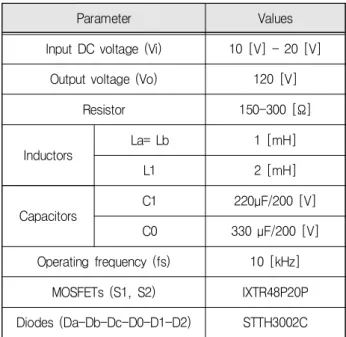
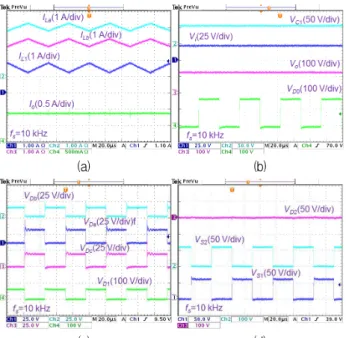
A extension of the high boost voltage-lift DC-DC converter with large conversion ratio has been proposed in this paper. The proposed extension is combined the switched-inductor cell (SL-cell) and modular voltage cell (MV-cell). The proposed structure can achieve the large voltage conversion without high duty-cycle and the low voltage of the components. Moreover, the PID controller for novel SL-MV voltage-lift DC-DC converter also introduces. This technique a good-performance output voltage can kept constant with an good transient performance when the output load is suddenly changed. In order to prove the theoretical analysis, the experimental setup has been built for the DC load of 150[Ω] and 300[Ω]. In addition, the transient of output voltage has been tested to determine the controller. Experimental results validate the effectiveness of the theoretical analysis proving the satisfactory converter performance.
Key words:tranformerless converter; high-voltage gain; switched-inductor; voltage-lift; duty ratio
* Dept. of Electrical Engineering, College of Korea Polytechnies
** Dept. of Electrical Engineering, Chosun College of Science & Technology
*** Dept. of Electrical Engineering, Chosun University
★ Corresponding author
E-mail:[email protected], Tel:+82-62-230-7175
※ Acknowledgment
This study was supported by research fund from Chosun University, 2017 Manuscript received Sep. 2, 2019; revised Oct. 25, 2019; accepted Nov. 15, 2019.
This is an Open-Access article distributed under the terms of the Creative Commons Attribution Non-Commercial License (http://creativecommons.org/licenses/by-nc/3.0) which permits unrestricted non-commercial use, distribution, and reproduction in any medium, provided the original work is properly cited.
Ⅰ. Introduction
Nowadays, energy from renewable sources such as wind power, photovoltaic power, and fuel cells has become the best solution to generate clean electric energy. However, the demerit characteristics of these energies is the low-output voltage and instability. Thus, a DC-DC converters [1-2] with a high boost voltage conversion is used to boost the low output voltage of the clean energy to high voltage. Fig. 1 indicates a block diagram of the power-conversion system. A high gain DC-DC converter is used to boost a low voltage into a high voltage dc bus.
DC-DC Converter with High
Gain Low DC
Voltage
High Bus DC Voltage Fig. 1. Block diagram of power-conversion system.
Various DC-DC converter topologies have been
researched and obtained a high-voltage gain in
both isolated and non-isolated topologies. For the
isolated DC-DC converter topologies [3-6], to
boost low input voltage into high output voltage, a
high frequency transformer is used. As a result,
the cost, weight and volume of converter circuit
are significantly risen. Furthermore, the leakage
304
inductances can be caused a voltage spike on switches. Due to the transformer losses, leakage inductance and large volume/weight of the converter, the transformer-based topologies is difficult to obtain a high efficiency and low cost like non- isolated topologies. For conventional non-isolated DC-DC converters, an extremely high duty cycle is required to obtain a high voltage gain. Recently, many high boost DC-DC converters have been proposed in [7-20] to obtain a high voltage gain without using high duty cycle. In the high boost converters with non-isolated structure can obtain the high voltage gain; some techniques were proposed and used such as cascaded technique [10], switched-inductor technique [11], switched- capacitor techniques [12], interleaved [13]-[14], and voltage-lift [15-16] techniques have been introduced.
In switched-capacitor technique [8], by combining several switches and capacitors with minimum inductor achieving a higher output voltage can be achieved. The voltage-lift DC-DC converter and it’s extension have been proposed in [21], which can increase the voltage gain. However, it is just verified with the simulation.
This paper presents the novel SL-MV voltage- lift DC-DC converter with PID controller was determined with the voltage gain ratio will be improved and using the small duty cycle. Moreover, the PID controller with the experimental has been shown.
L
aS
2D
aC
1C
0V
iD
cL
bS
1D
bD
1D
2D
0R L
1SL cell MV-Boost Stage
Fig. 2. Voltage-lift high boost DC-DC converter in [21].
Ⅱ. Novel Voltage-lift DC-DC Converter
Fig. 2 shows the voltage-lift DC-DC converter in [21]. It consists of one SL cell
, and
, two power switches
, modular voltage boost stage
and
, one diode
, one capacitors
. Fig. 3 shows the key waveforms of the voltage-lift converter operating in the CCM.
La S2
Da C1
C0
Vi
Dc
Lb
S1
Db
D1
D2
D0
R L1
La S2
Da C1
C0
Vi
Dc
Lb
S1
Db
D1
D2
D0
R L1
(a)
(b)
Fig. 3. Operating modes of the suggested converter: (a) state 1 and (b) state 2.
1. Derivation of novel voltage-lift DC-DC converter
Fig. 4 represents the operating state of the suggested converter. When
is turned “ON”
with DT. The
diodes are ON, while the
diode is OFF. The
diode is forward-biased and
is OFF. We have
1
1 1
.
La Lb
a b i
L
C o
di di
L L V
dt dt
L di V V
dt
ì = =
ïï í
ï = -
ïî
(1)
When
is switched “OFF” and
is switched
“ON”; the
diode is OFF while the
diode is ON. We have
(2)
The voltage gain of the converter is given
( )
1 ,
1 G D
D D
= +
- (3)
2. Derivation of novel voltage-lift DC-DC converter
The novel voltage-lift DC-DC is shown in Fig.
4. It can be extended to produce a higher voltage conversion ratio by cascading more SL and MV cells, and the structure is shown in Fig. 5. It will be composed of SL-cell with one inductor and three diodes, and MV-cells with one inductor, one capacitor and two diodes.
Lb1
S2
C1
C0
Vi
S1 D1
D2
D0
R L1
SL cell 2 La
Da1
Dc1
Db1
SL cell 1 Db2 Dc2
Da2 Lb2
Dcn
Dbn
Dan Lbn
SL cell n
Fig. 4. Novel voltage-lift DC-DC converter with with n SL-cells.
Lb1
S2
C1
C0
Vi
S1 D1
D2
D0
R L1
La
Da1
Dc1
Db1
Dc2
Db2
Da2 Lb2
Dcn
Dbn
Dan Lbn
(a)
Lb1
S2
C1
C0
Vi
S1 D1
D2
D0
R L1
La
Da1
Dc1
Db1
Dc2
Db2
Da2 Lb2
Dcn
Dbn
Dan Lbn
(b)
Fig. 5. Operating modes of the novel voltage-lift DC-DC converter with n SL-cells: (a)
is ON,
is OFF and (b)
is OFF,
is ON.
In the operating analysis,
is ON and
is
OFF,
and
are OFF. The diodes
in SL- ells are OFF, diodes
and
are ON. In this case,
and
are in series connection.
When
is OFF and
is ON,
and
are ON. The diodes
in SL-cells are ON, diodes
and
are OFF. In this case,
and
are in parallel connection. The voltage gain of the novel voltage-lift DC-DC converter with n SL-cells is given
( )
1
o
1
iV nD V D D
= +
- (4)
Fig. 6. Voltage gain comparison when n = 1, 2, 3, 4.
3. The novel voltage-lift DC-DC converter with SL-MV cells
The voltage gain of the suggested converter can be improved by adding m-SL cells and m-stages. The switched-inductor cell can connect in series with nth times the voltage stress of diodes in SL-cell are decreased. Furthermore, the stage
can connect in series where the voltage gain can increase with n times compared to the voltage gain of the basic converter.
S2
C0
S1
D0
R Vi
La
SL Cell
m SL Cell 2 SL Cell
1
Stage 1
Stage 2
Stage m
Fig. 7. Novel voltage-lift DC-DC converter with with SL-MV
cells.
Fig. 8. Voltage gain comparison when m = 1, 2, 3, 4.
Ⅲ. Control algorithm for novel voltage-lift DC-DC converter with SL-MV cells
Figure 9 demonstrates the block diagram controlled boost type DC-DC converter and the scheme of digital control circuit. In here, the power circuit of the DC-DC converter are included switches, diodes, inductors and capacitors. The output current and voltage is read by voltage and current sensor circuits. These analog signals are thrown the analog to digital block of the digital signal processor to convert the analog signal to the digital signal. Moreover, the pulse width modulation signal will be generated by the PWM generator of the digital signal processor with the switching frequency
. The switching frequency of the switching devices in power circuit will operate in the frequency of
. The control calculation is updated by each sampling point.
Vdc R
Novel Voltage-Lift Converter with with
SL-MV cells Gate Drivers
fs
PID ADC PWM Generator
Digital Signal Processor
Voltage &
Current sensors
Vo, Io
(a)
Vo Vref
S1
S2
PID
LimiterIref
PID
Io
01 T
D
![Fig. 2 shows the voltage-lift DC-DC converter in [21]. It consists of one SL cell , and](https://thumb-ap.123doks.com/thumbv2/123dokinfo/5623395.499604/2.892.105.426.887.1025/fig-shows-voltage-lift-dc-converter-consists-cell.webp)