ABSTRACT
Hotel consumers tend to rely on online reviews to reduce the risk to hotel products when they book hotel rooms because hotel products are high-risk products due to their intangibility. However, the development of ICT has caused information load, and it is an important issue to be perceived as useful information to consumer because a large amount of information complicates the decision making process of consumers. Drawn from Heuristic-Systematic Model(HSM), the present study explored the role of heuristic and systematic cues composing an online review influencing consumers’ perception of hotel online reviews. More specifically, this study identified reviewers’ identity, level of the reviewer, review star ratings, and attached hotel photo as heuristic cue, while review length, cognitive level of review and negativity in review as systematic cues. The binary logistic regression was adopted for analysis. This study found that only systematic cues of online review were found to affect the usefulness of it. Moreover, we preceded further study examining the moderating effect of seasonality in the relationships between systematic cues and usefulness.
Keywords: Online hotel review, Usefulness of online review, Heuristic-systematic model, TripAdvisor
1)This work was supported by the Ministry of Education of the Republic of Korea and the National Research Foundation of Korea (NRF-2016S1A3A2925146).
논문접수일: 2018년 7월 12일; 1차 수정: 2018년 8월 23일; 게재확정일: 2018년 8월 31일 2)제1저자 ([email protected])
3)제2저자 ([email protected]) 4)교신저자 ([email protected]) 5) 제4저자([email protected])
Which is More Important in Useful Online Review?
Heuristic-Systematic Model Perspective
1유용한 온라인 리뷰에서 어느 것이 더 중요한가? 휴리스틱-체계적 모델 관점
정 희 정 (Hee Chung Chung) 이 현 애 (Hyunae Lee) 정 남 호 (Namho Chung) 구 철 모 (Chulmo Koo)
경희대학교 대학원 호텔경영학과2
경희대학교 대학원 호텔경영학과3
경희대학교 호텔경영학과4
경희대학교 컨벤션경영학과5
1. Introduction
Since hotel product, the service product, is an experienced goods which the consumer cannot experience before purchasing(Ert et al. 2016), consumers who purchase the service product tend to collect information about the product they want to buy in order to reduce such uncertainty(Jacoby et al. 1994). Furthermore, advanced information a nd c om mu n ic at ion te ch nolog ie s have enhanced this consumer behavior. That is, these technologies allow consumers to share their experience easily and freely(Koo et al. 2016;
Chung et al. 2016). Under this trend, various online review platforms have emerged, and a number of hotel consumers rely on online review platforms because these platforms allow consumers to socially interact with other people and exchange information(Racherla and Friske 2012). For example, TripAdvisor made a profit of $4 billion in 2012 and many experts expected that sales will increase yearly. Additionally, many consumers acquire travel information through TripAdvisor and spend 200 minutes a month on this platform for traveling plan(NEWSPIM 2012). Moreover, Ady and Quadri-Felitti(2015) explored the influence of online review and found that online reviews play a decisive role when making a booking decision for both business and leisure travelers.
However, even though online reviews are useful in consumers’ decision making, a considerable volume of information could make consumers’
decision making process complicated(Zhang et al. 2016). Therefore, in consumers’ standpoint,
distinguishing useful information among a large amount of information is a critical issue in online reviews platforms(Liu and Park 2015). In this vein, a number of researchers(e.g., Baek et al. 2012;
Huang et al. 2015; Kuan et al. 2015; Liu and Park 2015) have investigated attributes affecting the usefulness of online review. However, the findings do not show the same results. Thus, even though numerous studies have been conducted on online reviews, it is still necessary to continue research on the attributes affecting the usefulness of online reviews.
Meanwhile, consumers can be involved in dual - process when processing different information composing an online review(Eagly and Chaiken 1993). In other words, consumers can judge the usefulness of online reviews based on the various cues that constitute an online review.
This information processing of consumer can be explained by HSM, which posits that people could process information in heuristic and systematic processing. Therefore, the purpose of the present study is to identify heuristic and systematic cues that constitute an online review from the viewpoint of HSM, and examines how such cues affect consumers’ perception of the usefulness of online reviews
2. Theoretical Background
2.1 Online Hotel Review
The role of online review can be explained from the point of view of uncertainty reduction theory
and social identity theory(Kusumasondjaja et al.
2012). Uncertainty reduction theory delineate that individuals seek to obtain reliable information to reduce uncertainty(Jacoby et al. 1994), and social identity theory suggests that individuals tend to communicate with people who share a similar social identity or value in order to reduce uncertainty(Tajfel and Turner 1979). This behavior also occurs in consumers who purchase intangible hotel products and has been strengthened recently with the advent of various online review platforms. Online reviews are based on previous experiences of consumers(Mudambi and Schuff 2010) and provide useful information for potential consumers to purchase the same or similar products. Especially, due to products of hotel and tourism intangibility, the usefulness of online review is regarded as a more significant factor(Lin et al. 2009). Moreover, credibility of online reviews based on quality of products or service is a salient concept because consumers are able to infer their quality(Liu and Park 2015). Therefore, online reviews have an impact on consumers’
decision making, and usefulness of online review indicates that consumers perceive specific review would be useful and helpful(Schuckert et al.
2015). This usefulness of online review not only help finding useful information between different types of information, but giving confidence in consumer’s decision making(Sussman and Siegal 2003). Recently, there is a function on a lot of online review platforms that consumers can vote useful online review. This function gives value to specific information among various information in
platforms(Mudambi and Schuff 2010).
In this context, several researchers have investigated useful online review. Although lots of studies have been conducted to determine the attributes of the usefulness of online review, the findings are inconsistent. For example, in the study of Beak et al.(2012), reviewer’s real name was not precedent variable for usefulness of online review, but it was found to have a significant influence in the study of Liu and Park(2015). Additionally, the results of impact attribute corresponding to the reviewer’s expertise also show different results in both studies: Beak et al.(2012) found that reviewer ranking has a significant effect on the helpfulness of online review, whereas reviewer’s expertise, have no significant effect on the usefulness of online review in Liu and Park(2015)’s study. The study of Huang et al.(2015) also showed that the attributes related to the reviewer(i.e., reviewer experience and reviewer impact) did not affect the usefulness of the online review. Thus, online review is still important topic.
2.2 Heuristic-Systematic Model
When consumers process information, they process based on the characteristics of the clue.
HSM is a theory derived from dual-process theory that explains this information processing of consumers. Elaboration Likelihood Model(ELM) is also a theory applied by many researchers to explain dual-process, but this study selected HSM based on several reasons. This study chose HSM for several reasons. According to Zhang and Watts(2008), first, Since ELM was specifically
designed persuasive message, HSM is employed broader validity-seeking contexts than ELM.
Second, HSM explains that dual-process can arise simultaneously and influence each other rather than trade-off. HSM suggests two different modes of information processing(Chaiken 1980). Heuristic process is less requiring effort and more efficient due to use easily perceived cues. Therefore, when consumers engage in heuristic process, they rely on more available information such as non-text cues or identity of source. Whereas, systematic process allows consumers to evaluate, elaborate, and construe message content. This systematic process is based on reaction of message argument quality and it is related to strength of persuasive and validity. These two modes of information processing can have a complementary effect in various contexts(Chaiken and Ledgerwood 2012).
Zhang and Watts(2008) explained that individuals’
knowledge adoption in online community by using HSM. Zhang et al.(2010) also adopted HSM to explain the role of online review on consumer decision making. In this vein, several researchers have investigated factors influencing on usefulness of online review in hospitality context through HSM. More specifically, Yang et al.(2017) examined the comparative salience of online reviews’
heuristic attributes in review helpfulness and found that reviewer helpful vote and review rating attributes are the most salient attributes in hotel context. Li, et al.(2018) also explored the effect of the heuristic factors on online recommendations of best places to visit in an online travel community and found that recommender’s identity, reputation,
number of places recommended, helpfulness rating, and length of recommendation have a positive impact on recommendation popularity.
However, although these studies identified factors which impact on the online review usefulness, they were focused on heuristic cue. Thus, the present study attempt to investigate the factors affecting online review usefulness by considering not only heuristic cue but also systematic cue.
3. Theoretical Framework and Hypotheses Development
The aim of the present study is to determine attributes influencing on usefulness of online review from HSM perspective. When consumers visit an online review website, they judge the usefulness of online review based on the various attributes composing the online review. These attributes can be categorized into heuristic and systematic cue. Since heuristic cue which are information processed through the heuristic process require relatively less cognitive effort, information that can be intuitively judged corresponds to a heuristic cues. In this context, some researchers(e.g., Baek et al. 2012; Huang et al. 2015; Liu and Park 2015; Yang et al. 2017) have considered reviewer’s identity, level, review star rating, and attached photo as heuristic cue. On the other hand, systematic cue is information that is based on elaborated judgement, and consumers are more cognitive efforts than processing heuristic cues in judging the usefulness of the
online review. In this vein, several studies(e.
g., Baek et al. 2012; Zhang et al. 2014) have considered argument quality as systematic cue. Meanwhile, discussion of review length(or word count) is different for each researcher.
More specifically, Yang et al.(2017) considered review length as a heuristic cue because it can be recognized intuitively on the website screen, whereas Baek et al.(2012) insisted word count as a central route(which is similar to systematic process) from ELM perspective. Additionally, in
the study of Mudambi and Schuff(2010), the word count was used as a measurement to grasp how elaborated the information about the review was.
In this study, review length can be intuitively judged on the website screen, but it is applied as a measurement of information elaboration in judging the usefulness of the online review. Thus, we also considered review length as systematic cue rather than heuristic cue. Taking into consideration these previous studies, we propose the research model of this study in Fig. 1.
Real name
Real photo Level of reviewer Review star ratings
Attached hotel photo
Review length
Negativity
Heuristic cuesSystematic cues
Review usefulness H1
H2 H3 H4 H5
H6 H7 H8 Cognitive level
in review
Figure 1. Proposed research model
3.1 Heuristic Cues 3.1.1 Reviewer’s identity
Online identity can be defined as “a social identity that an individual establishes in online communities and/or website”(Liu and Park 2015, p.142). Consumers who search information in online circumstance may perceive more uncertainty that offline environment because they cannot acquire enough social cues about source(Tidwell and Walther 2002). Thus, the source identity plays role that reduce consumers’ uncertainty(Tidwell and Walther 2002). Additionally, Sussman and Siegal(2003) asserted that source identity enhance credibility of information, consequently, the information is recognized as useful(Kusumasondjaja et al. 2012).
Therefore, the following hypotheses are proposed:
H1: Reviewer’s real name has a positive effect on the usefulness of their reviews.
H2: Reviewer’s real photo has a positive effect on the usefulness of their reviews.
3.1.2 Level of Reviewer
Level of reviewer refers to the number of level allocated by his previous activities. That is, the more reviews that a reviewer have posted, the higher his or her level. This level of reviewer can influence others’ perception, for example, a reviewer who has level 4 can be perceived as more expert than another who has a lower level than 4.
Thus, if the reviewer’s level is higher, this signifies that the reviewer is considered as expertise.
Gilly et al.(1998) argued that consumers tend to pay attention to expert’s opinion when making
decisions(Liu and Park 2015). In online context, consumers cannot attain enough reviewer’
s social background(Liu and Park 2015), so that they depend on reviewer’s past behaviors(e.
g. the number of reviews written)(Weiss et al.
2008). In this vein, Willemsen et al.(2011) found out the positive relationship between expertise message and the perceived usefulness of a review.
Therefore, the following hypothesis is proposed:
H3: Level of reviewer has a positive effect on the usefulness of their reviews.
3.1.3 Review Star Ratings
Review star ratings are the number of stars assigning by reviewers and these ratings indicate the evaluation of a product or service used(Liu and Park 2015). Review star ratings are helpful cue for consumers because they can infer the quality of products or service by using these ratings. According to Wei et al.(2013), it was found that consumers tend to perceive lower star rating as more useful than higher one. Therefore, we proposed the following hypothesis:
H4: Review star ratings have a negative effect on the usefulness of their reviews.
3.1.4 Attached Hotel Photo
Vivid information is more appealing and more likely to be remembered than non-vivid information(Sundar and Kalyanaraman 2004).
According to Jin et al.(2013), review inserted in photos and videos have a higher abundance than text-based review. That is, review embedded in multimedia is perceived to be more useful.
Therefore, the following hypothesis is proposed:
H5: Attached hotel photo has a positive effect on the usefulness of their reviews
3.2 Systematic Cues 3.2.1 Review Length
Review length is related to content richness.
Chevalier and Mayzlin(2006) explained that review length implies reviewer’s involvement and they found that the amount of information in reviews has a positive influence on overall sales of the related product(Racherla and Friske 2012). In a similar vein, Mudambi and Schuff(2010) found that the longer a review’s length is, the more detailed information for the product or service it contains.
Therefore, the following hypothesis is proposed:
H6: Review length has a positive effect on the usefulness of their reviews.
3.2.2 Cognitive Level of Review
The review may include both aspects of affective and cognitive message. Affective message contains feelings and emotions toward a product or service, whereas cognitive message contain beliefs about the attributes of a product or service(Fabrigar and Petty 1999). Byun and Jang(2015) stated that cognitive message contains more credible and accurate information than the affective message because it is objective. That is, if a reviewer provides concrete and cognitive message, the review can be more compelling(Pera et al. 2016).
Therefore, the following hypothesis is proposed:
H7: Cognitive level of review has a positive effect on the usefulness of their reviews.
3.2.3 Negativity in review
Kanouse(1984) argued that consumers are inclined to have negative bias, thus they pay more attention to negative message than positive message(Baek et al. 2012). In other words, consumers tend to think that negative reviews are more reliable and more persuasive than positive reviews, even if they are reviews of the same product(Ito, Larsen et al. 1998; Lee et al. 2008).
In addition, consumers pay more attention to negative information than positive information when they purchase a high involvement product(Chevalier and Mayzlin 2006). In this vein, Willemsen et al.(2011) found that negativity has a positive impact on the usefulness of the online review. Particularly, negative bias has stronger persuasion when consumers make a high involvement decision(Martin and Marshall 1997). Since hotel products are considered as high involvement products, consumers may have negative bias when making hotel booking decision.
Therefore, the following hypothesis is proposed:
H8: Negativity in review has a positive effect on the usefulness of their reviews.
4. Methods
4.1 Hotel Selection
Tripadvisor is one of the predominant online review platform where millions of travelers post and read travel-related reviews, compare hotel prices and book(Tripadvisor 2016). By using this platform, we collected online reviews posted for
hotels in Seoul, capital of South Korea(hereafter Korea). Seoul is ranked in 9th on Global Top 20 top destination cities by international overnight visitors(Hedrick-Wong and Choong 2015), having a considerable number of tourism attractions from cultural heritage to shopping malls and 233 hotels including 24 super deluxe hotel(Seoul Statistics, 2016). According to the Korea Tourism Knowledge and Information Systems, 80.4 % of visitors from Korea were found to visit Seoul(International Visitor Survey 2014). In order to minimize biased issues resulted from hotel classification and different geological and strategical positions of hotels, we selected 3-stars hotel and 5-stars hotel which are local and contemporary hotels located in Myung-dong, Seoul. Moreover, in order to raise the quality of data, we truncated the range of hotels to Top 10 hotels listed in Seoul on TripAdvisor. As a result, Lotte Hotel Seoul and Metro Hotel were chosen as representatives of 3-stars and 5-stars hotels, respectively. All of the online review about these hotels posted during a whole year of 2015 were collected in order to minimize biased issues resulted from seasonality. After eliminating 58 reviews which conceal reviewers’ information, a total number of 287 reviews was used(184 reviews for 5-stars hotel and 103 reviews for 3-stars hotel).
4.2 Data Collection and Analysis
The data were collected manually by researchers since heuristic cues and dependent variables including real photo, real name, attached hotel photo and review usefulness were binary variables to be measured as ‘1’ if a reviewer discloses his/
her own photo, own name, hotel photo and receive usefulness score, and ‘0’ otherwise(Figure 2). Real photo was coded as 1 or 0, a reviewer’s photo can be clearly identified as his or her own face, or not.
Systematic cues including review length, cognitive level of review and negativity in a review were calculated with LIWC(Linguistic Inquiry and Words Count) 2015 program. This program can classify a text into 80 word categories including linguistic categories(e.g. personal pronouns, verbs, tenses, etc.) and psychological categories(e.g. cognitive, perceptual, social, etc.) (Pennebaker, Booth, and Francis 2007). For instance, words such as ‘know’,
‘consider’ were classified as cognitive words,
‘happy’ and ‘nice’ as affective ones, and ‘hurt’,
‘ugly’ as negative ones. This program calculated the proportions of cognitive, affective, and negative words in each review. After comparing the proportions of cognitive and affective words, if a percentage of affective words is greater than that of cognitive words, Cognitive level of review was coded as ‘0’(low level of cognitive review) and ‘1’
otherwise(high level of cognitive review). Degree of negativity was measured by a proportion of negative words in a review. The dependent variable(review usefulness) is a dichotomous variable measured as ‘1’ or ‘0’ whether a review receive ‘thanks reviewer’ or not, therefore, this study adopted binary logistic regression. Binary logistic regression was employed due to its’ ability of permitting that independent variables are measured by different measurement scales from dependent variables(Adam and Adongo 2016). The review usefulness can be described as follows:
RU=β0+β1*rea lname+β2 *rea lphoto+β 3*levelofreviewer+β4*starratings+β5*hotelphoto+
β6*reviewlength+β7*cognitivelevelofreview+β 8*negativityinreview
Where RU represents review usefulness and β0 represents constant.
5. Results
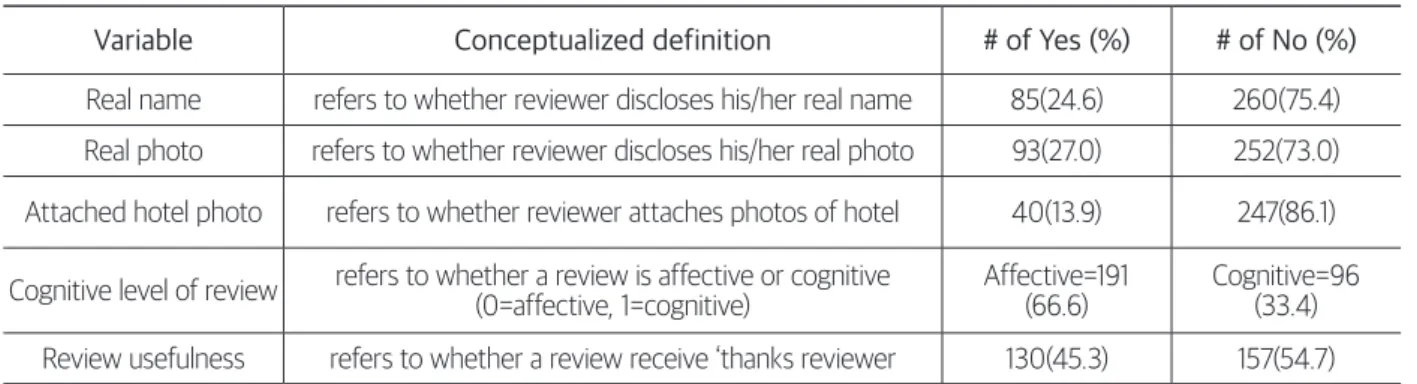
5.1 Descriptive Analysis of the Variable As shown in Table 1, it was found that most of the reviewers are reluctant to provide their actual information. Only a few reviewers exposed their real name(n=85, 24.6%), real photo(n=93, 27.0%) and hotel photos they had took(n=40, 13.9%),
which indicates a low level of identity disclosure.
In addition, the average of level of reviewers was 3.37(S.D=1.95), with an average of review star rating was 4.54(S.D=0.67). With regard of systematic cues of the reviews, an average of review length(log) was 2.07(S.D=0.29). More than half of the reviews were found to be affective(n=191, 66.6%), which indicates that hotel customers tends to post an affective review than cognitive review.
An average of Negativity in review was 4.07(S.
D=4.00), which indicates a proportion of negative words in each review was relatively lower than expected. Finally, less than half of the reviews received usefulness score(N=130, 45.3%), whereas the other reviews have no usefulness score(N= 157, 54.7%).
Figure 2. Information of the variables in online review
In order to assess multicollinearity, we calculated variance inflation factor(VIF) and tolerance values of each independent variable(see Table 3). Generally, it is required that tolerance surpass 0.1 and VIF is lower than 4(O’brien, 2007).
The tolerance values are ranged from 0.752(Review length) to 0.961(Real name), and the VIF values are ranged from 1.041(Real name and Real photo) to 1.330(Review length). Therefore, it was found that there is little concern of multicollinearity between independent variables.
5.2 Result of Main Hypotheses
The overall model fit of our binary logistic regression was assessed by Likelihood Ratio Test, Hosmer and Lemeshow’s Chi-square, Cox and Snell’s R2 and Nagelkerke’s R2(Djekic and Loebbecke 2007). First, initial -2 log likelihood
value for the constant-only model(395.323) was reduced to 353.301 in research model, an improvement of 42.022 and this change was significant(Chi-square=42.021, df=8, p<0.001).
Second, the significance probability value of Hosmer and Lemeshow’s Chi-square is 4.451 is much greater than the significance level of 0.05, thus, a regression model was found to be acceptable. Additionally, Cox and Snell’s R2 was 0.136, Nagelkerke’s R2 was 0.182 and predictor power was 68.6%.
The results showed that only systematic cues have influences on review usefulness(Table 3). To be more specific, the review length was found to positively influence review usefulness(Wals=13.608, p<0.001). Moreover, cognitive level of review was found to have an impact on the review usefulness(Wals=7.319, p<0.01), cognitive reviews Table 1. Explanation and descriptive statistics for the nominal variable
Variable Conceptualized definition # of Yes (%) # of No (%)
Real name refers to whether reviewer discloses his/her real name 85(24.6) 260(75.4) Real photo refers to whether reviewer discloses his/her real photo 93(27.0) 252(73.0) Attached hotel photo refers to whether reviewer attaches photos of hotel 40(13.9) 247(86.1)
Cognitive level of review refers to whether a review is affective or cognitive (0=affective, 1=cognitive)
Affective=191 (66.6)
Cognitive=96 (33.4) Review usefulness refers to whether a review receive ‘thanks reviewer 130(45.3) 157(54.7)
Table 2. Explanation and descriptive statistics for the ordinal variable
Variable Conceptualized definition Min Max Mean Median S.D
Level of reviewer refers to reviewer’s level in TripAdvisor 0 6 3.37 4 1.95 Review star ratings refers to the ratings that reviewer evaluates about hotel 1 5 4.54 5 0.67 Review length (log) refers to how many words in each review 1.45 2.89 2.07 2.03 0.29 Negativity in review refers to percentage of negative words in each review 0.00 32.14 4.07 3.55 4.00
are 2.407 times as likely to get usefulness vote than affective review(Exp(B) = 2.407). Thus, it means that the more cognitive words used in a review, the higher a possibility of being perceived as useful. Finally, Negativity in review has a negative effect on review usefulness(Wals=16.867, p<0.001), one more negative word in a review is 0.841 times as likely to get usefulness vote(Exp(B)
= 0.841). Thus, this means that the less negative words are used in a review, the higher a possibility of being perceived as useful is. Therefore, hypotheses H6 to H8 were supported while hypotheses H1 to H5 were not.
6. Discussion and Conclusion
With heuristic cues, consumers can easily judge whether an online review is useful or not. Thus, if consumers employ heuristic process, they tend to access the review’s usefulness with peripheral
cues(i.e. reviewer’s real photo and real name, level of reviewer, etc.)(Chaiken 1980). On the other hand, when consumers are involved in systematic process, they make an effort to acquire abundant information related hotel product(Chaiken 1980).
The results show that heuristic cues were not validated as significant antecedents of review usefulness. This indicates that when assessing the review usefulness, readers tend to put a bigger emphasis on review’s message-relevant contents than simple information embedded in a review.
That is, since hotel products are experience product, consumers try to acquire information in order to reduce their risk(Kassinis and Soteriou 2015; Zeithaml 1988). This result is similar with Liu and Park(2015)’s result that qualitative components of review were validated as the strongest predictors of review usefulness.
The second result is the negative impact of review negativity on review usefulness, which are contrary to the results of previous studies which Table 3. Results of logistic regression (main hypotheses)
Hypotheses B S.E. Wals P Exp(B) Results
Systematic
H1 Real name .231 .312 .548 .459 1.260 Rejected
H2 Real photo .034 .303 .012 .911 1.034 Rejected
H3 Level of reviewer -.043 .070 .373 .542 .958 Rejected
H4 Review star ratings -.166 .195 .721 .396 .847 Rejected
H5 Attached hotel photo -.650 .390 2.771 .096 .522 Rejected
Heuristic H6 Review length 1.920 .520 13.608 .000*** 6.819 Supported
H7 Cognitive level of review .878 .325 7.319 .007** 2.407 Supported
H8 Negativity in review -.173 .042 16.867 .000*** .841 Supported
Likelihood ratio tests: Chi-square=45.693(df=8, p<.001), Model fitting criteria: -2Log likelihood=349.630 Pseudo R-square: Cox and Snell R²=.147, Nagelkerke R²=.197
Hosmer and Lemeshow test: Chi-square=6.266 (df=8, p=.618), Classification accuracy=61.8%
* p<.05, ** p<.01, *** p<.001
showed the positive impact of review negativity on review usefulness(e.g. Baek et al. 2012;
Willemsen et al. 2011). This might be because that previous studies selected tangible search goods(e.
g., espresso machine, running shoes, book and so on) which can be assessed more objectively and neutrally than intangible experience ones such as hotel service. Due to the inherent characteristics of service, heterogeneity, its’ quality tends to be assessed by customer’s subjective judgement. With this result, we can infer that online hotel review readers can recognize the heterogeneity of hotel service and try to objectively assess online review without reviewer’s characteristics and subjective and negative assessment.
Based on these results, the present study offers theoretical and practical implications. As a theoretical implication, systematic cues of online hotel review were found to be critical. Since heuristic cues are easy to collect and analyze, a considerable number of previous studies have put emphasis on these cues. However, in order to deeply and completely understand the factors influencing review usefulness, it is needed to investigate review’s qualitative factors(Liu and Park 2015). In this vein, the results of this study, emphasizing the importance of systematic cues, are meaningful. Second, with real online review data, this study could provide more precise results.
Numerous previous studies tend to use limited data collected from experiment- or scenario-based survey, inducing some problems such as social desirability, common method bias and makes it hard to generalize results. On the other hand, this
study can be relatively free from these problems by manually collecting real online review and analyzing the words composing a review. Further, this study offers valuable insights to online marketers of hotels. First, since it was found that long and cognitive review is regarded as a useful online review, online review platform managers should put this review up a notice in a conspicuous place. For example, they are suggested to reviewers who have written more than a certain number of letters(e.g. 200 words) with some reward(e.g. level- up). Second, our finding shows that less negative review has an impact on usefulness of online review, therefore, hotel marketers should focus on this review for their manage. They are suggested to give their customers the opportunity to voice their dissatisfaction directly to the hotels in order to prevent the spread of negative e-WOM.
However, there are also limitations that further studies should address. First, it is hard to generalize the results since online review posted for hotels located in only one city(Seoul) by using one website(TripAdvisor) as an exemplary, although we selected two hotels with different grades in order to minimize biases caused by differences between hotel grades. Therefore, if a future study collects online review posted for numerous hotels in numerous cities and online review platforms, they can obtain more precise results. Second, we ignored the relationships between review hotel usefulness and customer’
s behavior such as room reservation or word- of-mouth. Therefore, we suggest that future studies expand the research scope to online hotel
review readers’ behavior in order to provide more practical implication to hotel industry. Third, since the review length is the only ratio variable of the regressor, it has potential to make the results odd.
Accordingly, future researches need to transform this variable into Likert one using quartiles statistics. Finally, consumers can narrow down the number of reviews to look at when they are involved in funnel process(Sirakaya and Woodside 2005). Consequently, further researches are required to examine consumers’ decision making process for selecting online reviews.
References
[국내 문헌]
1. 구철모, 유문정, 전유희, 이지민, 정남호 2016. “관 광경험에서의 스마트폰 활용 행태와 사용자 임파 워먼트와의 관계에 관한 연구: 중국인을 대상으 로,” 지식경영연구 (17:1), pp. 155-174.
2. 정남호, 엄태휘, 구철모 2016. “인스타그램에서 사 회적 관계 형성을 위한 사진 공유에 영향을 미치는 요인에 관한 연구,” 지식경영연구 (17:4), pp. 129- 145.
[국외 문헌]
1. Adam, I., and Adongo, C. A. 2016. “Do backpackers suf fer crime? Empirica l investigation of crime perpetrated against backpackers in Ghana,” Journal of Hospitality and Tourism Management (27), pp. 60-67.
2. Ady, M., and Quadri-Felitti, D. 2015.
“Consumer research identif ies how to present travel review content for more bookings,” Retrieved May 2016, from:
ht t p://web c ache . go og leu s erc ontent . com/search?q=cache:5HvAssYaJSoJ:old hotelier.tistory.com/attachment/cfile26.
u f % 4 0 2 3 6 8 C 8 3 4 5 6 F 9 3 C 3 E 0 8 3 5 7 8 . pdf+&cd=4&hl=ko&ct=clnk&gl=kr
3. Baek, H., A hn, J., and Choi, Y. 2012.
“Helpfulness of online consumer reviews:
Readers’ objectives and review cues,”
I nter nat iona l Jou r na l of E le c t ron ic Commerce (17:2), pp. 99-126.
4. Byun, J., and Jang, S. S. 2015. “Effective destination advertising: Matching effect
between advertising language and destination type,” Tourism Management (50), pp. 31-40.
5. Chaiken, S. 1980. “Heuristic versus systematic information processing and the use of source versus message cues in persuasion,” Journal of personality and social psychology (39:5), pp. 752-766.
6. Chaiken, S., and Ledgerwood, A. 2011. “A theory of heuristic and systematic information processing,” in Handbook of theories of social psychology (1), pp. 246-266.
7. Chevalier, J. A., and Mayzlin, D. 2006. “The effect of word of mouth on sales: Online book reviews,” Journal of marketing research (43:3), pp. 345-354.
8. Djekic, P., and Loebbecke, C. 2007. “Preventing application software piracy: An empirical investigation of technical copy protections,”
The Journal of Strategic Information Systems (16:2), pp. 173-186.
9. Ert, E., Fleischer, A., and Magen, N. 2016. “Trust and reputation in the sharing economy: The role of personal photos in Airbnb,” Tourism Management (55), pp. 62-73.
10. Fabrigar, L. R., and Petty, R. E. 1999. “The role of the affective and cognitive bases of attitudes in susceptibility to affectively and cognitively based persuasion,” Personality and social psychology bulletin (25:3), pp.
363-381.
11. Filieri, R., Alguezaui, S., and McLeay, F.
2015. “Why do travelers trust TripAdvisor?
Antecedents of trust towards consumer- generated media and its inf luence on
recommendation adoption and word of mouth,” Tourism Management (51), pp. 174- 185.
12. Gilly, M. C., Graham, J. L., Wolfinbarger, M.
F., and Yale, L. J. 1998. “A dyadic study of interpersonal information search,” Journal of the Academy of Marketing Science (26:2),
pp. 83-100.
13. Hedrick-Wong, Y., and Choong, D. 2015.
“MasterCard 2015 Global Destination Cities Index,” Retrieved May 2016 from:https://
newsroom.mastercard.com/wp-content/
uploads/2015/06/MasterCard-GDCI-2015- Final-Report1.pdf
14. International Visitor Survey 2016. Retrieved from: http://www.tour.go.kr
15. Jacoby, J., Jaccard, J. J., Currim, I., Kuss, A., Ansari, A., and Troutman, T. 1994. “Tracing the impact of item-by-item information accessing on uncertainty reduction,” Journal of Consumer Research (21:2), pp. 291-303.
16. Jin, Y. Yang, S. B., and Lee, K. Y. 2013. “Are information-rich reviews really helpful? An empirical study of online product reviews on Amazon.com,” in Post-ICIS, LG CNS/KrAIS Workshop, Milan, Italy.
17. Kanouse, D. E. 1984. “Explaining negativity biases in evaluation and choice behavior:
Theory and research,” ACR North American Advanced, pp. 703-708.
18. Kassinis, G. I. and Soteriou, A. C. 2015.
“Environmental and quality practices: using a video method to explore their relationship with customer satisfaction in the hotel
industry,” Operations Management Research (8:3-4), pp. 142-156.
19. Kuan, K. K., Hui, K. L., Prasarnphanich, P., and Lai, H. Y. 2015. “What makes a review voted?
An empirical investigation of review voting in online review systems,” Journal of the Association for Information Systems (16:1), pp. 48-71.
20. Kusu masondjaja , S., Sha n ka , T., a nd Marchegiani, C. 2012. “Credibility of online reviews and initial trust: The roles of reviewer’
s identity and review valence,” Journal of Vacation Marketing (18:3), pp. 185-195.
21. Lee, H. A., Law, R., and Murphy, J. 2011.
“Helpful reviewers in TripAdvisor, an online travel community,” Journal of Travel &
Tourism Marketing (28:7), pp. 675-688.
22. Lin, P. J., Jones, E., and Westwood, S. 2009.
“Perceived risk and risk-relievers in online travel purchase intentions,” Journal of Hospitality Marketing & Management (18:8), pp. 782-810.
23. Liu, Z., and Park, S. 2015. “What makes a useful online review? Implication for travel product websites,” Tourism Management (47), pp. 140-151.
24. Martin, B., and Marshall, R. 1999. “The interaction of message framing and felt involvement in the context of cell phone com mercia ls ,” E u ro p e a n Jo u r n a l o f Marketing (33:1/2), pp. 206-218.
25. Mudambi, S. M., and Schuff, D. 2010. “What makes a helpful review? A study of customer reviews on Amazon. Com,” MIS quarterly
(34:1), pp. 185-200.
26. Nagelkerke, D., 1991. “A Note on a general definition of the coefficient of determination,”
Biometrika (78:3), pp. 691–693.
27. NEWSPIM, 2012. Retrieved from: http://www.
newspim.com/news/view/20120208000409.
28. O’brien, R. M. 2007. “A caution regarding rules of thumb for variance inflation factors,”
Quality & Quantity (41:5), pp. 673-690.
29. Pera, R., Viglia, G., and Furlan, R. 2016. “Who Am I? How Compelling Self-storytelling Builds Digital Personal Reputation,” Journal of Interactive Marketing (35), pp. 44-55.
30. Pennebaker, J. W., Booth, R. J., and Francis, M.
E. 2007. “Linguistic inquiry and word count:
LIWC [Computer software],”Austin, TX: liwc.
net.
31. Racherla, P., and Friske, W. 2012. “Perceived
‘usefulness’ of online consumer reviews: An exploratory investigation across three services categories,” Electronic Commerce Research and Applications (11:6), pp. 548-559.
32. Schuckert, M., Liu, X., and Law, R. 2015.
“Hospitality and tourism online reviews:
Recent trends and future directions,” Journal of Travel & Tourism Marketing (32:5), pp.
608-621.
33. Seoul Statistics. 2016. Retrieved from: http://
stat.seoul.go.kr/jsp3/index.jsp
34. Sirakaya, E., and Woodside, A. G. 2005.
“Building and testing theories of decision making by travelers,” Tourism management (26:6), pp. 815-832.
35. Sundar, S. S., and Kalyanaraman, S. 2004.
“Arousal, memory, and impression-formation effects of animation speed in web advertising,”
Journal of Advertising (33:1), pp. 7-17.
36. Sussman, S. W., and Siegal, W. S. 2003.
“Informational influence in organizations: An integrated approach to knowledge adoption,”
Information systems research (14:1), pp. 47- 65.
37. Tabachnick, B. G., and Fidell, L. S. 2007. Using multivariate statistics (6th ed.). Boston: Allyn
& Bacon.
38. Tajfel, H., and Turner, J. C. 1979. “An integrative theory of intergroup conflict,” The social psychology of intergroup relations (33:47), pp. 33-74.
39. Tidwell, L. C., and Walther, J. B. 2002.
“Computer‐mediated communication effects on disclosure, impressions, and interpersonal evaluations: Getting to know one another a bit at a time,” Human communication research (28:3), pp. 317-348.
40. TripAdvisor, 2016. Retrieved from: https://
www.tripadvisor.co.kr/
41. Vermeulen, I. E., and Seegers, D. 2009.
“Tried and tested: The impact of online hotel reviews on consumer consideration,” Tourism management (30:1), pp. 123-127.
42. Wei, W., Miao, L., and Huang, Z. J. 2013.
“Customer engagement behaviors and hotel responses,” International Journal of Hospitality Management (33), pp. 316-330.
43. Weiss, A. M., Lurie, N. H., and MacInnis, D. J. 2008. “Listening to strangers: whose responses are valuable, how valuable are they,
and why?,” Journal of Marketing Research (45:4), pp. 425-436.
44. Willemsen, L. M., Neijens, P. C., Bronner, F., and De Ridder, J. A. 2011. ““Highly Recommended!” The content characteristics and perceived usefulness of online consumer reviews,” Journal of Computer‐Mediated Communication (17:1), pp. 19-38.
45. Zeithaml, V. A. 1988. “Consumer perceptions of price, quality, and value: a means-end model and synthesis of evidence” The Journal of marketing (52:3), pp. 2-22.
46. Zhang, K. Z., Lee, M. K., and Zhao, S. J. 2010.
“Understanding the Informational Social Influence of Online Review Platforms,” In ICIS 2010 Proceedings (71), pp. 1-17.
47. Zhang, L., Wu, L. L., and Mattila, A. S. 2016.
“Online Reviews The Role of Information Load and Peripheral Factors,” Journal of Travel Research (55:3), pp. 299-310.
48. Zhang, W., and Watts, S. A. 2008. “Capitalizing on content: Information adoption in two online communities,” Jou r na l of t he Association for Information Systems (9:2),
pp. 73-94.
49. Zhang, K. Z., Zhao, S. J., Cheung, C. M., and Lee, M. K. 2014. “Examining the influence of online reviews on consumers’ decision- making: A heuristic–systematic model,”
Decision Support Systems (67), pp. 78-89.
저 자 소 개
이 현 애 (Hyunae Lee)
경희대학교 관광학과에서 석사학위를 취득하고 현재 경희대학교 호텔경영학과 박사 과정에 재학 중이며, 현재 경희대학교 스마트관광연구소 (Smart Tourism Research Center)의 연구보조원으로써 관광 분야에서의 증강현실, 소셜 미디어, 온라인 리뷰 등 에 대한 연구를 진행 중이다. 그의 논문은 Journal of Travel Research, Technology Forecasting and Social Science, International Journal of Contemporary Hospitality Management, 관광학연구, 호텔경영학연구 등에 발표되었다.
정 남 호 (Namho Chung)
성균관대학교 경영학과에서 경영정보학전공으로 박사학위를 취득하였다. 현재 경희대학 교 호텔경영학과 교수로 재직 중이며, 영국의 University of Surrey에서 방문연구원으 로 활동하였다. 주요 관심분야는 소비자의 정보시스템 사용과 지식공유활동이며 최근 에는 연구분야를 호텔 및 관광분야로 확장하여 스마트 관광과 관련된 다양한 연구와 과 제를 수행 중이다. 그의 논문은 Journal of Travel Research, Tourism Management, International Journal of Contemporary Hospitality Management, Information &
Management, Computers in Human Behavior 등 주요 학술지에 발표되었으며 2013 년 그간의 업적을 인정받아 경희대학교 명예의 전당에 이름을 올렸다.
정 희 정 (Hee Chung Chung)
가천대학교 관광경영학과에서 석사학위를 취득하고, 현재 경희대학교 호텔경영학과 박 사과정에 재학 중이며, 현재 경희대학교 스마트관광연구소 (Smart Tourism Research Center)의 연구보조원으로써 관광 분야에서의 소셜 미디어, 온라인 리뷰 등에 대 한 연구를 진행 중이다. 그의 논문은 관광레저연구, 관광연구, Information Systems Review, Sustainability, 서비스경영학회지 등에 발표되었다.
구 철 모 (Chulmo Koo)
현재 경희대학교 호텔관광대학 컨벤션경영학과에서 부교수로 재직하고 있으며 영국 의 University of Surrey에서 방문연구원으로 활동 중이다. University of Minnesota, MIS Research Center에서 포닥 연구원과 Marshall University경영학과, 조선대학교 경영학부에서 MIS전임교수로 재직하였다. 주요관심 분야는 스마트 관광과 컨벤션 산업 과 관련한 연구를 진행하고 있으며 주요 논문을 Journal of Travel Research, Tourism Management, International Journal of Comptemporary Hospitality Management, Informatics and Telematics, Technological Forecast and Social Change, Computers in Human Behaviors 등을 게재해오고 있으며 국내논문으로 관광연구, 경 영학연구, 경영정보학연구, 그리고 경영과학지 등에 다양한 학술지에 논문을 게재하였으 며 2018년 그간의 업적을 인정받아 경희대학교 명예의 전당에 이름을 올렸다.