초기 직경이 n-heptane 액적 연소 특성에 미치는 영향
서 현 규†
Influence of Initial Diameter on the Combustion Characteristics of n-heptane Droplet
Hyun Kyu Suh
Key Words: Burning rate(연소율), Droplet combustion(액적연소), Droplet diameter(액적직경) Flame diameter(화염직경), Flame standoff ratio(화염전달비)
Abstract
The spherically-symmetric burning of an isolated droplet is a dynamic problem that involves the coupling of chemical reactions and multi-phase flow with phase change. For the improved understanding of these phenomena, this paper presents the numerical results on the n-heptane droplet combustion conducted at a 1
atm ambient pressure in three different initial
droplet diameter (d0). The main purpose of this study is to provide basic information of droplet burning, extinction and flame behavior of n-heptane and improve the ability of theoretical prediction of these phenomena. To achieve these, the numerical analysis was conducted in terms of normalized droplet diameter (d/d0), flame diameter (df) and flame standoff ratio (FSR) under the assumptions that the droplet combustion can be described by both the quasi-steady behavior for the region between the droplet surface and the flame interface and the transient behavior for the region between the flame interface and ambient surrounding.1. 서 론
연료의 연소 과정에서 열 및 물질 전달의 연구를 위 하여 single droplet combustion에 관한 이론은 열 전달 이 droplet의 표면으로부터의 반경 방향으로만 발생하고, 비대칭 힘(asymmetrical force) 및 자연 대류(natural con- vection)의 영향이 거의 없기 때문에 매우 단순해 진다(1). 또한, 이 이론은 고려해야 할 연소 조건의 단순화로 인 하여 적용 범위가 매우 넓어져 다양한 크기의 액적 (droplet size), 분위기 압력(ambient pressure), 산소 농도 (oxygen concentration)의 영향을 확인할 수 있는 장점이
있어서(2)연소 및 열 전달에 관한 기초 자료 및 전체 연 소 거동에 관한 많은 정보를 제공한다.
특히, single fuel droplet의 연소에 관한 연구는 과학 적, 실제적인 측면에서 매우 중요하다. 먼저, 다양한 조 건에서 single droplet combustion에 관한 연구는 과학적 인 측면에서 chemical kinetics parameters 및 연소율 (burning rate)에 관한 정보를 제공한다. 또한, 실제적인 측면에서 droplet의 연소(burning), 소멸(extinction) 특성 및 flame의 생성 위치에 관한 연구는 연소에 관한 기본 정보뿐만 아니라, 연소 기관의 배기가스 생성에 관한 기 초 정보도 제공 한다(1). 따라서, 액적의 연소율(burning rate), 화염 구조(flame structure) 및 소멸(extinction) 특성 은 연소 특성 파악에 매우 중요한 인자들이다(3-5).
따라서, droplet combustion의 특성을 파악하기 위한 많은 연구들이 이미 수행되었으나(4, 6-10), 고온의 연소 조 건에서 복잡한 열 및 물질 전달 특성과 thermal physical (2013년 4월 30일 접수 ~ 2013년 6월 19일 심사완료, 2013년 6월
24일 게재확정)
†책임저자, 회원, 국립공주대학교 기계자동차공학부 E-mail : [email protected]
TEL : (041)521-9264 FAX : (041)521-9123
properties의 결정이 어려워 droplet combustion에 관한 정확한 예측 및 해석은 매우 어렵다. 예를 들어, droplet 의 연소 특성을 나타내는 대표적인 이론인 d2-law(11)는 매우 간단하지만, 해석을 위한 정확한 thermo-physical properties을 결정하기 어려우며, droplet burning rate은 droplet surface과 flame interface사이 영역의 온도 분포 와 flame interface 바깥 영역에서 flame interface 로의 산소(oxygen) 유입에 매우 민감하기 때문에 정확한 예 측이 매우 어렵다.
이러한 이유로, droplet combustion특성 연구에 flame interface의 안쪽 영역은 quasi-steady state이고, 바깥쪽 영역은 transient state라는 가정(12)은 droplet combustion 특성의 해석 연구를 단순화함은 물론 연구 결과의 신뢰 성을 높여주었다.
따라서, 본 연구는 droplet combustion 특성에 관한 선행 연구들을 참고하여 많은 연료들 중 기존 연료들과 매우 유사한 물성치를 가지고 있어 연소 과정을 연구하기에 매 우 적합한 연료로 알려진 n-heptane을 적용하여(6, 13-18), 초 기 직경(initial droplet diameter)의 크기가 n-heptane droplet의 연소 특성에 미치는 영향을 수치 해석적으로 연구하였다. 이를 통하여 n-heptane droplet의 burning, extinction 및 flame의 생성에 관한 기본 정보를 제공하 고, 이론적 해석 방법을 제시하고자 하였다.
3. 수치해석적 연구 방법
n-heptane 액적의 연소에 대한 수치해석적인 연구는 선행 연구들을 참조하여 수행하였으며(12, 19-20). 간략한 내용은 다음과 같다.
3.1 Droplet combustion 해석
Figure 1에 나타낸 것처럼 연소 과정에서 기체상태 (vapor phase)로 상 변화한 액체상태(liquid phase)의 연 료는 droplet surface로 부터 flame interface쪽으로 확산 된다(Region 1). 반면에 oxidizer 는 flame 외부 영역에서 flame interface로 유입된다(Region 2). 기본적으로, Region 1에서 전체 액체상태의 연료량은 기체상태의 연료량보 다 훨씬 많으므로, 액상의 droplet surface에서 flame interface로의 기상 연료의 확산 전달은 quasi-steady 조 건으로 적용하였다. 또한, flame interface 쪽으로의 oxy- gen diffusive transport는 transient state이므로, Region 2 에서의 oxygen의 유입은 많은 선행 연구들을 참고로
Fig. 1에 나타낸 것과 같이 반 무한 고체(semi-infinite body)에서의 확산 현상으로 적용하였다.
연소가 진행되는 동안의 연료 droplet의 반경 (rs) 변화 는 다음과 같이 계산 가능하다.
(1)
본 관계식에서 mass flow rate ( )은 시간에 대한 droplet반경의 변화값으로 나타낸다. 여기서 md는 drop- let mass, ρl은 온도 Ts에서 액상연료의 밀도이다. 액적의 완전 연소에 필요한 전체 시간은 (1)식을 이용하여 계산 가능하다.
Flame 표면과 droplet 표면 사이의 gas phase conduc- tion으로 인한 전체 열 전달량은 다음과 같이 계산할 수 있다.
(2)
여기서 Q는 flame interface에서 droplet으로의 열 전달 량, Tf 및 Ts는 flame interface와 droplet surface의 온도, rs 및 rf는 droplet과 flame의 반경을 의미한다. kg는 flame interface와 droplet surface사이의 평균 gas phase thermal conductivity를 의미한다.
Droplet의 증발(vaporizing)에서의 preheating, vapor- ization 및 fuel vapor의 heating up을 고려한 열 발생량 은 다음과 같다.
(3) 여기서, ∆Hv는 증발 잠열(heat of vaporization), T0는
mv
· dmd
---dt
– 4πρlrs2 drs
---dt
⎝ ⎠⎛ ⎞
= =
m·v
Q 4πkg
Tf–Ts
( )
1 r⁄ s–1 r⁄ f
( )
---
=
Q=m·v[cPl(Ts–T0)+∆HV+cPg(Tf–Ts)] Fig. 1 Schematics diagram of a droplet combustion pro-
cess
droplet의 초기 온도, cpl 및 cpg는 liquid 및 gas phase의 specific heat을 의미한다. 여기서, 식(2)와 (3)을 이용하 여 vapor mass flow rate ( )을 계산할 수 있다. 또한, (1)식으로부터 d2-law(11)와 비슷한 다음의 식을 얻을 수 있다.
(4) 여기서 d0는 droplet의 초기 직경, dt는 시간(t)에 따른 droplet 직경의 변화 값이며, K는 gasification rate으로 다 음의 식으로 계산 가능하다.
(5)
3.2 Flame dynamics의 해석
Flame interface 바깥쪽 영역에서 oxygen은 flame interface 쪽으로 반경방향을 따라 밖에서 안으로 유입된 다. 하지만, flame interface 안쪽 영역에서는 droplet sur- face에서 flame interface 쪽으로 안에서 밖으로 확산한다.
따라서, flame interface에서의 oxygen과 fuel의 관계식은 다음과 같다(21).
(6) 여기서, v는 oxygen과 fuel의 stoichiometric ratio 이다.
Fuel vapor의 molar flow rate은 droplet surface와 flame interface 사이 영역에 Fick’s law of diffusion을 적 용하여 다음과 같이 계산이 가능하다.
(7)
여기서 P는 total pressure, R은 the universal gas constant, Tdf는 Region 1에서의 average temperature, Dfg는 fuel vapor의 diffusion coefficient이다. 상수 A와 B는 fuel의 상(phase)와 종류에 따라 결정된다.
Flame interface 밖의 영역(Region 2)에서 oxygen의 mass transfer(MO2)는 다음의 식으로 계산이 가능하다(22).
(8)
(9)
(10)
여기서 C는 oxygen concentration, DO2는 oxygen diffusion coefficient, MO2는 oxygen molar flow rate이다. 하지만 본 식들의 계산을 위해서는 droplet surface의 온도와 flame interface의 온도를 먼저 계산하여야 한다. 본 온도 들은 식 (2), (3), (7)로 부터 얻을 수 있다. 또한, Lewis number가 일정하다는 가정을 하면, 다음의 식을 얻을 수 있다.
(11) 위의 식에서 Ts는 연소 과정 동안 일정하다. 또한, flame 반경은 식 (11)에서 계산할 수 있다. 따라서 본 연 구에서는 위의 관계식들을 이용하여 droplet 및 flame의 반경을 계산 비교할 수 있다.
본 연구에서는 n-heptane의 초기 액적 직경이 연소과 정에서 액적의 연소 특성 및 화염면 형성에 미치는 영 향을 연구하기 위하여, 대기압(0.1 MPa)의 분위기 압력 조건에서 세가지 크기의 액적 직경(d0=2, 3, 4 mm)에 대 하여 해석적인 연구를 수행하였다.
4. 실험 결과 및 고찰
4.1 해석 결과의 grid dependency 결정
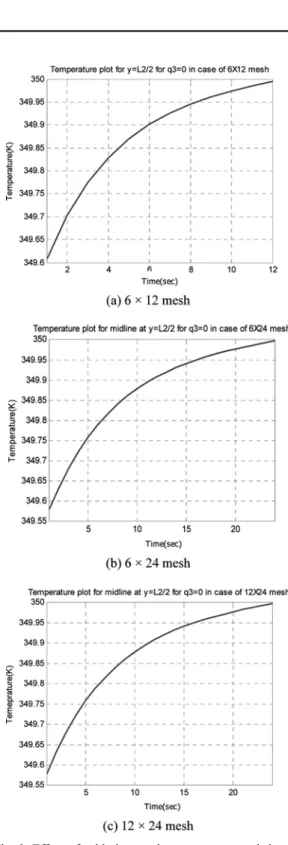
해석적인 연구의 결과는 일반적으로 해석 과정에서 적용되는 mesh grid size에 큰 영향을 받는다. 따라서, 본 연구에서는 grid size에 따른 해석 결과의 영향을 최 소화하기 위하여 Fig. 2와 같이 다양한 grid size 조건에 서 온도의 분포와 n-heptane droplet의 heating 특성을 비 교하였다.
비교 결과, Fig. 2(a)의 경우에는 동일 온도인 350℃에 도달하는 시간이 다른 두 경우보다 빨랐으며, 이는 연소 과정에서 액적의 소멸 시간에 관한 잘못된 정보를 제공 할 수 있다. 반면에 Fig. 2(b)와 (c) 결과의 경우에는 동 일 온도에 도달하는 시간 및 온도의 증가 경향이 매우 유사하였다. 따라서, 연구 결과의 정확성 향상 및 계산 시간의 단축을 위하여 Fig. 2(b)와 같이 6×24 mesh의 경 우에서 해석 연구를 수행하였다.
4.2 Droplet 및 Flame 직경의 변화 비교
Fig. 3은 n-heptane 의 초기 직경(d0)이 실시간 droplet 직경의 변화율로 정의되는 normalized droplet diame- m·v
dt 2=d02–Kt
K 8 kg(Tf–Ts)
ρl[cPl(Ts–T0)+∆HV+cPg(Tf–Ts)] ---
=
MO2=–vMV
MV
4πDfgP RTdf(1 r⁄ s–1 r⁄ f)
---ln 1 Aexp(–B T⁄ s) ---P
⎝ – ⎠
⎛ ⎞
=
MO2
8πDO2 1.5C π N– f
( )
---exp(–ηf2) t
=
ηf
rf
2 DO2t ---
=
Nf eηf
–2
ηf
---
⎝ ⎠
⎜ ⎟
⎛ ⎞
π erf η( )f
+
=
ln 1 PV.S
---P
⎝ – ⎠
⎛ ⎞cp1(Ts–T0)+∆HV+cpg(Tf–Ts) cpg(Tf–Ts)
=
ter(d/d0) 및 flame diameter(df)의 변화에 미치는 영향을 비교 연구한 것이다. 연구 결과에서 확인 가능한 바와
같이, droplet의 초기 직경이 작을수록, 연소로 인한 직 경의 감소율은 빠르게 증가하여droplet의 전체 연소에 걸리는 시간이 짧아졌다. 이는 droplet의 초기 직경은 연 료의 연소율(burning rate)에 크게 영향을 미치며, 미립 화가 잘 된 작은 직경의 droplet이 빠른 시간 안에 연소 를 완료하여 연소 성능을 향상 시키는 것으로 판단된다.
Droplet의 초기 직경이 연소과정에서 normalized drop- let diameter(d/d0)의 변화에 미치는 영향과는 달리 flame diameter(df)의 형성 및 발달에 미치는 영향은 크지 않은 것으로 나타났다. 이는 d2-law에서 확인할 수 있었듯이(11) flame의 위치는 oxygen concentration(O2)의 직접적인 영 향을 받으며, Fig. 3의 flame diameter(df)는 모두 동일한 21%의 oxygen concentration(O2)조건에서 해석한 결과이 므로, flame diameter의 변화는 크지 않은 것으로 판단된 다. 따라서, 초기 직경(d0)이 4 mm인 경우에, oxygen Fig. 2 Effect of grid size on the temperature and droplet
heating of single n-heptane droplet
Fig. 3 Normalized droplet diameter (d/d0) and flame diame- ter (df) of single n-heptane droplet (O2=21%)
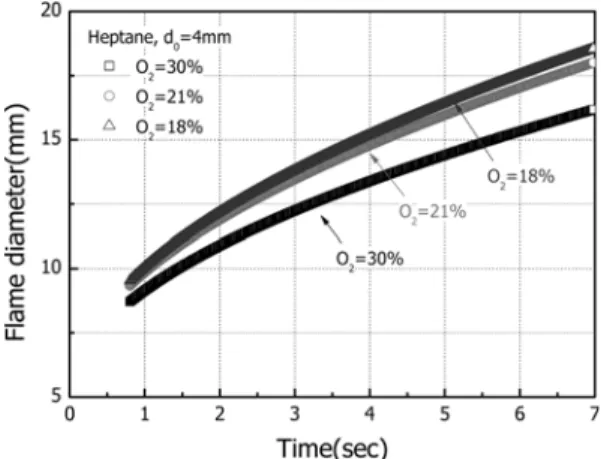
concentration(O2)이 flame diameter(df)의 형성에 미치는 영향을 Fig. 4에 비교하였다.
Fig. 3의 결과에서 예상하였듯이 oxygen concentration 이 증가할수록 flame diameter(df)가 감소하였다. 이는 높은 oxygen concentration 조건에서의 높은 flame tem- perature로 인해 flame front로 부터 droplet surface로의 heat conduction rate 이 증가하게 되고, 그 결과 droplet 의 burning rate 이 급격히 증가하며, 순간적인 연소가 발생하여 flame diameter의 확산에 필요한 충분한 시간 이 주어지지 않아 상대적으로 flame diameter 가 감소하 는 것으로 판단된다.(12, 14)
Fig. 5는 연소 과정에서 flame의 직경을 droplet의 직 경으로 나눈 값으로 정의되는 flame standoff ratio(FSR) 의 변화를 연소 기간에 따라 비교한 것이다. 비교 결과 Fig. 3에서 확인하였듯이, 액적의 초기 직경이 증가하면
FSR의 크기는 감소하였다. 특히, 초기 직경(d0)이 2 mm인 경우에는 시간의 경과에 따라 FSR의 값이 급격 히 증가하는 경향을 보였는데, 이는 Fig. 3(a)에서 확인 하였듯이 실시간 droplet 직경의 변화율로 정의된 nor- malized droplet diameter(d/d0)가 다른 직경의 해석 결과 에 비하여 훨씬 빨랐고, 그 결과 액적의 소멸과 동시에 flame diffusion이 발생하는 것으로 판단된다. 반면에 초 기 직경(d0)이 3 mm및 4 mm인 경우에는 상당한 연소 시간 동안 안정적인 화염을 형성하는 것으로 나타났다.
5. 결 론
본 연구에서는 n-heptane droplet의 초기 직경(d0)이 액 적의 연소 특성 및 화염면 형성에 미치는 영향을 수치 해석적으로 연구하여 다음과 같은 결론을 얻었다.
1) Droplet의 초기 직경이 작을수록, 연소로 인한 직경 의 감소율(normalized droplet diameter)은 빠르게 증가하 여 droplet의 전체 연소에 걸리는 시간이 짧아졌다. 이는 droplet의 초기 직경이 연료의 burning rate에 크게 영향 을 미친다고 판단된다.
2) Flame의 위치는 oxygen concentration(O2)의 직접적 인 영향을 받으므로, 모두 동일한 oxygen concentration 조건에서 해석한 결과에서는 droplet의 초기 직경이 flame diameter(df)의 형성 및 발달에 미치는 영향은 크 지 않은 것으로 나타났다.
3) Oxygen concentration이 증가할수록 flame diameter 가 감소하는 것으로 나타났다. 이는 높은 flame temper- ature로 인해 flame 으로부터 droplet surface로의 heat conduction rate이 증가하고, 그 결과 burning rate이 증가 하여 상대적으로 flame diameter가 감소하는 것으로 판 단된다.
4) 액적의 초기 직경이 증가하면 flame standoff ratio (FSR)의 크기는 감소하였다. 특히, 초기 직경(d0)이 2mm인 경우에는 시간의 경과에 따라 FSR의 값이 급격 히 증가하는 경향을 보인 반면에 초기 직경 (d0)이 3 mm및 4 mm인 경우에는 상당한 연소 시간 동안 안정적 인 화염을 형성하는 것으로 나타났다.
참고문헌
(1) T. I. Farouk, F. L. Dryer, On the extinction characteris- Fig. 4 Effect of oxygen concentration on the flame diam-
eter (d0=4 mm)
Fig. 5 Flame standoff ratio (FSR) of single n-heptane drop- let (O2=21%)
tics of alcohol droplet combustion under microgravity conditions – A numerical study, Combustion and Flame, 159, 3208-3223, 2012.
(2) G. M. Faeth, Current status of droplet and liquid com- bustion, Progress in Energy and Combustion Science, 3, 191-224, 1977.
(3) F. A. Williams, Droplet burning, in: T.H. Cochran (Eds.), Combustion Experiments in Zero-Gravity Lab- oratory, Progress in Astronautics and Aeronautics, 73, 31-48, 1981.
(4) C. K. Law, Recent Advances in droplet vaporization and combustion, Progress in Energy and Combustion Science, 8, 171-201, 1982.
(5) C. K. Law, and G. M. Faeth, Opportunities and chal- lenges of combustion in microgravity, Progress in Energy and Combustion Science, 20, 65-113, 1994.
(6) A. J. Marchese, F. L. Dryer, V. Nayagam, Numerical modeling of isolated n-alkane droplet flames: initial comparisons with ground and space-based micrograv- ity experiments, Combustion and flame, 116, 432-459, 1999.
(7) C. K. Law, Unsteady droplet combustion with droplet heating, Combustion and Flame, 26, 17-22, 1976.
(8) S. Y. Cho, R. A. Yetter, F. L. Dryer, A computer model for one-dimensional mass and energy transport in and around chemically reacting particles, including com- plex gas-phase chemistry, multicomponent molecular diffusion, surface evaporation, and heterogeneous reac- tion, Journal of Computational Physics, 102, 160-179, 1992.
(9) S. Y. Cho, F. L. Dryer, A numerical study of the unsteady burning behaviour of n-heptane droplets, Combustion Theory and Modelling, 3, 267-280, 1999.
(10) G. M. Faeth, Evaporation and combustion of sprays, Progress in Energy and Combustion Science, 9, 1-76, 1983.
(11) G. A. Godsave, Studies of the combustion of drops in a fuel spray-the burning of single drops of fuel, Proceed- ings of the Combustion Institute, 4, 818-830, 1953.
(12) S. Ulzama, E. Specht, An analytical study of droplet combustion under microgravity : Quasi-steady tran- sient approach, Proceedings of Combustion Institute, 31, 2301-2308, 2007.
(13) S. Kumagai, and H. Isoda, Combustion of fuel drop- lets in a falling chamber, Proceedings of combustion institute, 6, 726-731, 1957.
(14) S. Kumagai, T. Sakai, S. Okajima, Combustion of free fuel droplets in a freely falling chamber, Proceedings of combustion institute, 13, 779-785, 1971.
(15) J. C. Yang, C. T. Avedisian, The combustion of unsup- ported heptane/hexadecane mixture droplets at low gravity, Proceedings of combustion institute, 22, 2037- 2044, 1989.
(16) H. Hara, S. Kumagai, Experimental investigation of free droplet combustion under microgravity, Proceed- ings of combustion institute, 23, 1605-1610, 1991.
(17) M. Y. Choi, F. L. Dryer, J. B. Hagard, Observations on a slow burning regime for hydrocarbon droplets: n- Heptane/air results, Proceedings of combustion insti- tute, 23, 1597-1604, 1991.
(18) V. Nayagam, J. B. Haggard, R. Colantonio, A. J.
Marchese, B. J. Zhang, and F. A. Williams, Micrograv- ity n-Heptane Droplet Combustion in Oxygen-Helium Mixtures at Atmospheric Pressure, AIAA Journal, 26, 1369-1378, 1998.
(19) W.A. Sirignano, The Formulation of Spray Combus- tion Models: Resolution Compared to Droplet Spac- ing, Journal of Heat Transfer, 108, 633-639, 1986.
(20) G. M. Faeth, Mixing, transport and combustion in sprays, Progress in Energy and Combustion Science, 13, 293-345, 1987.
(21) S. R. Turns, An Introduction to Combustion: Concepts and Applications, McGraw-Hill Series, USA, 1996, p.
319.
(22) H. S. Carslaw, J.C. Jaeger, Conduction of Heat in Sol- ids, Second ed., Oxford University Press, New York, 1959.