28(2); 203~209; February 2019 https://doi.org/10.5322/JESI.2019.28.2.203
ORIGINAL ARTICLE
Identification of Biogas Production by Bio Methane Potential (BMP) Test During the Anaerobic Digestion Process of Organic
Wastewater from Polyester Manufacturing Processes
Choon-Hwan Shin
*, Jun-Seok Bae
1)Department of Energy & Environmental Engineering, Dongseo University, Busan 47011, Korea
1)
Division of Earth Science and Resource Engineering, CSIRO, Pullenvale, QLD 4069 Australia
Abstract
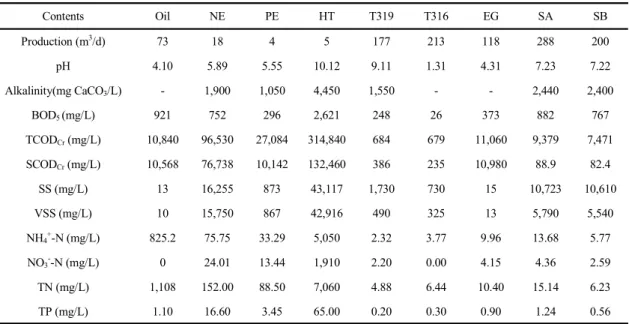
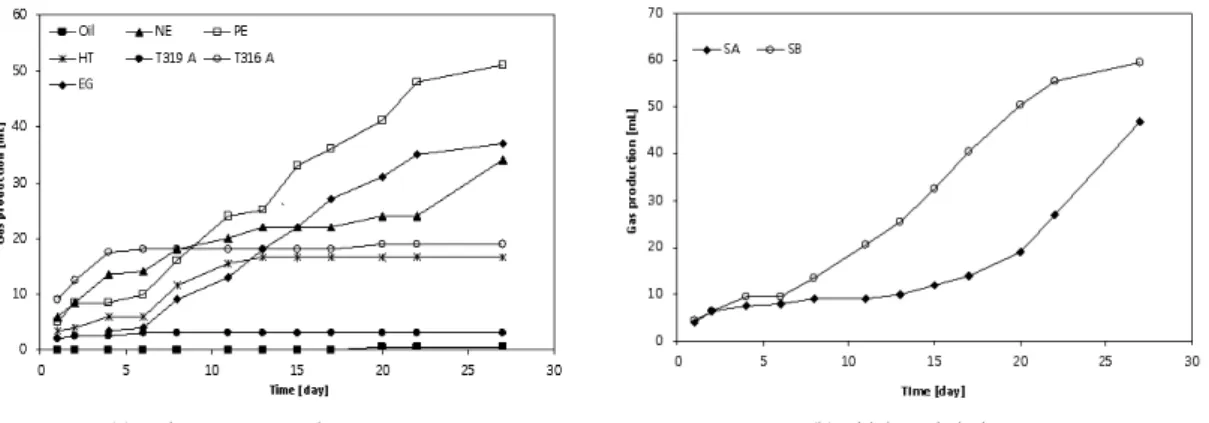
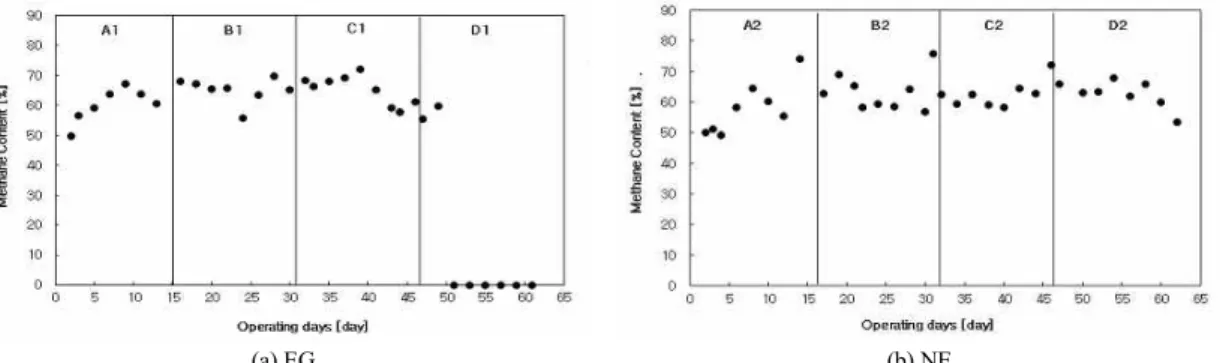
Organic wastewater generated from polyester manufacturing processes was selected from H company to investigate the feasibility of anaerobic digestion that produces gases including methane. Bio Methane Potential (BMP) tests were conducted to measure the gas production and methane concentration for 7 process wastewater and 2 kinds of sludges from the H company. Also, along with monitoring pH and alkalinity during the anaerobic digestion process, the concentrations of COD and 1,4-dioxane were measured with 4 different operating conditions for N Emulsion (NE) and Ethylene Glycol (EG) wastewater. The BMP tests showed that 65% of methane was produced from NE and EG wastewater. This suggests that the organic wastewater from H company can be effectively treated by an anaerobic digester by which more than 90% of COD was removed.
Key words : Anaerobic digestion, Biogas, Organic wastewater, BMP
1. Introduction 1)
As the process of manufacturing polyester uses terephtalic acid (TPA) and Ethylene Glycol (EG) as raw materials, involving esterification and condensation polymerization, the process wastewater contains high-level organic matter generated from unreacted monomers and polymers as well as 1,4-dioxane from ethylene glycol (HOCH
2-CH
2OH). The wastewater is usually treated by using conventional processes such as physio-chemical and biological wastewater treatment(Cho et al., 1993; Han et al., 2008; Woo and
Han, 2010). As the treated wastewater quality, however, exceeds permissible wastewater discharge standards and the generated sludge needs to be treated properly, this kind of wastewater has complicated issues in relation to treatment process improvement and process development for sludge treatment (Safarzadeh et al., 1997; Wang et al., 2016; Ziganshina et al., 2017).
Considering that there have been no stable and demonstrated treatment methods domestically as well as globally, it is important to present alternative plans for sludge treatment at this point of time(Stefan and
Received 8 November, 2018; Revised 21 February, 2019;
Accepted 22 February, 2019
*