Print ISSN: 2288-4637 / Online ISSN 2288-4645 doi:10.13106/jafeb.2021.vol8.no4.0777
Corporate Social Responsibility (CSR) Practices and Firm Performance:
Empirical Evidence from Hotel Industry in Thailand
Amornrat TEANPITTHAYAMAS
1, Muttanachai SUTTIPUN
2, Pankaewta LAKKANWANIT
3Received: December 20, 2020 Revised: March 07, 2021 Accepted: March 15, 2021
Abstract
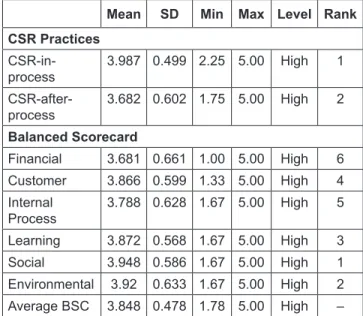
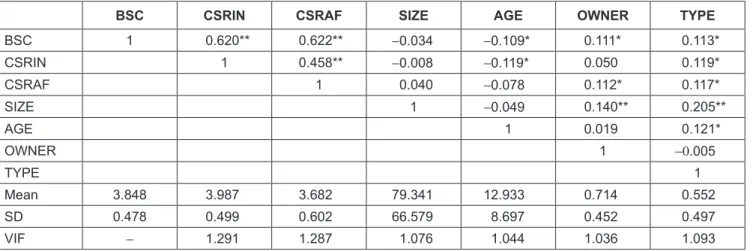
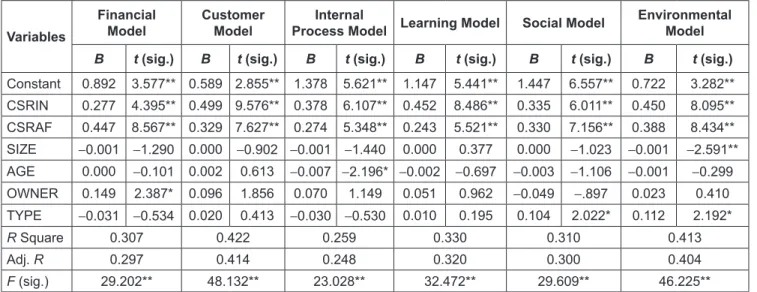
The main purposes of this study are (1) to investigate the extent and level of corporate social responsibility (CSR) practices of the hotel in Thailand, (2) to test the different level of CSR practices of the hotel between CSR-in-process and CSR-after-process, and (3) to examine the effect of CSR practices on hotel’s performance measured by balanced scorecard (BSC). This study employs survey data collected from 402 owners and executives of hotels in Thailand. Descriptive analysis, paired sample t-test, correlation matrix, and multiple regression were used to analyze the data from the mailed questionnaire. The results show that both CSR-in-process and CSR-after-process practices of hotels were at a high level. However, the level of CSR-in-process practice of hotels was significantly higher than CSR-after-process practice. Moreover, the study found the positive effect of both CSR-in-process and CSR-after-process practices on hotel performance measured by BSC. The results of sensitivity analysis also show the positive effect of CSR-in-process and CSR-after-process practices on each of all six perspectives of BSC. The findings of this study can point to the reasonable reason why hotels should implement CSR practices into their business strategies. In addition, the study demonstrates that stakeholder theory can explain the effect of CSR practices on corporate performance.
Keywords: CSR Practice, Firm Performance, Balance Scorecard, Hotel Industry, Thailand JEL Classification Code: M10, M14, M41, N15
social expectations as well as stakeholder needs. Moreover, they cannot be survived, if they focus on only their economic perspective by ignoring social and environmental impacts from their actions and activities (Hsu, 2014). Therefore, corporations need to balance economic, social, and environmental perspectives together. All perspectives can make the corporations have sustainable development, which is the leading business goal in today’s world (Holcomb et al., 2007). CSR practices are mainly divided into two practices as CSR-in-process and CSR-after-process. On the one hand, CSR-in-process practice is CSR practice included in the corporate processes (Li & Chiu, 2010).
The CSR-in-process practice is included human resource management responsibility, well-being, and safety in the workplace, an adaptation of economic, social, and policy changes, corporate resource and internal environmental management, and corporate governance. On the other hand, CSR-after-process practice is a CSR practice that is excluded by the corporate processes such as supplier and shareholder management responsibility, customer responsibility, and social and community responsibility (Lev et al., 2008).
1
First Author. Faculty of Management Sciences, Prince of Songkla University, Thailand. Email: [email protected]
2
Assistant Professor, Faculty of Management Sciences, Prince of Songkla University, Thailand. Email: [email protected]
3
Corresponding Author. Assistant Professor, Accounting Program, School of Management, Walailak University, Thailand [Postal Address: 222, Thai Buri, Nakhon Sri Thammarat 80160, Thailand]
Email: [email protected]
© Copyright: The Author(s)
This is an Open Access article distributed under the terms of the Creative Commons Attribution Non-Commercial License (https://creativecommons.org/licenses/by-nc/4.0/) which permits unrestricted non-commercial use, distribution, and reproduction in any medium, provided the original work is properly cited.