Print ISSN: 2288-4637 / Online ISSN 2288-4645 doi:10.13106/jafeb.2020.vol7.no8.509
1
First Author and Corresponding Author. Professor, Accounting Department, Faculty of Economics and Business, Universitas Diponegoro, Semarang, Indonesia [Postal Address: Jalan Prof.
Sudarto, Tembalang, Semarang, 50275, Indonesia]
2
Accounting Department, Faculty of Economics and Business, Universitas Diponegoro, Semarang, Indonesia.
3
Accounting Department, Faculty of Economics and Business, Universitas Diponegoro, Semarang, Indonesia.
4
Accounting Department, Faculty of Economics and Business, Universitas Diponegoro, Semarang, Indonesia.
© Copyright: The Author(s)
This is an Open Access article distributed under the terms of the Creative Commons Attribution
Non-Commercial License (http://Creativecommons.org/licenses/by-nc/4.0/) which permits
unrestricted noncommercial use, distribution, and reproduction in any medium, provided the
original work is properly cited.
The Role of Government Regulations in Enhancing Corporate Social Responsibility Disclosure and Firm Value
Faisal FAISAL
1, Lilis Suryani SITUMORANG
2, Tarmizi ACHMAD
3, Andri PRASTIWI
4
Received: May 23, 2020 Revised: May 31, 2020 Accepted: July 03, 2020
Abstract
This study investigates, first, whether the extent of corporate social and environmental responsibility disclosure (CSERD) differs between 2010 and 2014; second, whether government regulation affects the extent of CSERD; and, third, whether the CSERD is valued by investors.
Content analysis method was used to extract 466 companies’ annual reports to measure the extent of social and environmental responsibility disclosure based on the Global Reporting Initiative (GRI) checklist. Independent sample t-test and multivariate regression analysis were also conducted to test the differences of the extent of CSERD as well as determinants and consequence of CSERD. Our results show that the extent of CSERD in 2014 is 21.60 percent higher than in 2010 (13.39 percent). Government regulation has a significant effect on the extent of CSERD. This study also finds that market values positively CSER information disclosed by company. Given that government regulation has a positive impact, however, the findings of this study suggests that the extent of CSERD is still low. To enhance CSERD, government should continuously encourage companies to abide by the regulations as mandated. This study provides a more comprehensive insights of CSRED practices from an emerging country and the effect of government regulation in enhancing CSERD.
Keywords: CSR, Disclosure, Sustainability, Government Regulation, Firm Value JEL Classification Code: M14, M40, M41, M48
1. Introduction
Corporate social and environmental responsibility disclosure (CSERD) is a trend that developed in the last two decades. Companies have demonstrated increasing interest
in communicating their CSER information in their annual, stand-alone and integrated reports, and websites (Faisal et al., 2012; Garcia-Sanchez et al., 2016; Kuzey & Uyar, 2017).
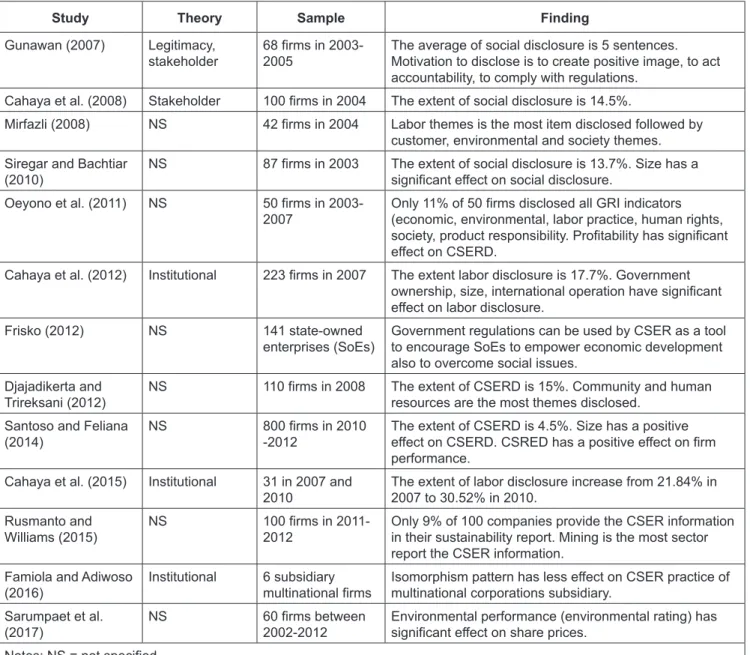
The increase in the number of CSERD also followed the increasing interest of researcher to investigate determinants and the motivation of companies in disclosing CSER information (Ali et al., 2017; Haji, 2013). Prior studies on CSERD argued that firm characteristics such as company size, industry type, capital structure, profitability, media visibility, ownership structure, and corporate governance predominantly appear to be as determinants both in developed and emerging countries (Ali et al., 2017; Dienes et al., 2016; Hahn & Kühnen, 2013). Although prior studies have examined factors influencing CSERD, however, little research has investigated the impact of government regulations on the extent of CSERD, especially in Indonesia (see Table 1).
The Indonesian government has issued several
regulations related to CSER activities. For example, some
regulations require companies that use natural resources (i.e.,
extractive sectors) in the company’s operational practices to