• 검색 결과가 없습니다.

The Effects of Total Quality Management and Corporate Social Responsibility on Firm Performance: A Future Research Agenda

N/A
N/A
Protected

Academic year: 2021

Share "The Effects of Total Quality Management and Corporate Social Responsibility on Firm Performance: A Future Research Agenda"

Copied!
11
0
0

로드 중.... (전체 텍스트 보기)

전체 글

(1)

Print ISSN: 2288-4637 / Online ISSN 2288-4645 doi:10.13106/jafeb.2021.vol8.no4.0277

The Effects of Total Quality Management and Corporate Social Responsibility on Firm Performance: A Future Research Agenda*

Yu-Hong TSOU

1

, Yung-Fu HUANG

2

, Su-Chuan LIU

3

, Manh-Hoang DO

4

Received: December 15, 2020 Revised: February 22, 2021 Accepted: March 02, 2021

Abstract

This article systematically reviews the adoption of total quality management (TQM) implementation and corporate social responsibility (CSR) initiatives on firm performance. A total of 233 published documents from 1996 to 2020 in international journals have been collected and listed on the SCOPUS database. It aims to fill the existing literature gap regarding TQM and CSR practices and point out a future research agenda. This study employed a systematic literature review approach to review those manuscripts related to TQM, CSR topics focused on firm performance. Consequently, the results stressed that TQM and CSR are excellent tools and have a similarity to support the firms to attain corporate sustainability; however, TQM practices have given more interest than CSR initiatives. Moreover, the results highlighted that only a few articles are interested in simultaneously combining TQM and CSR initiatives although this idea is rising in recent years. Thus, the statistical findings indicated several research gaps that remain unaddressed. It is worthy of considering TQM and CSR integration; however, other scholars need to identify the critical success factors that could enable TQM practices or barriers to CSR adoption. Particularly spending more attention on the transitional economies context, which is considering a promising future research context.

Keywords: Total Quality Management, Corporate Social Responsibility, Firm Performance, Sustainability JEL Classification Code: M11, M14, L21, O30

1. Introduction

Improving product quality and satisfying stakeholders have become the major targets for the firms to meet business sustainability and enhance competitiveness (Patyal & Koilakuntla, 2017; Quintana-García et al., 2018).

Total quality management (TQM) in the organization is a business philosophy that has been widely recognized and conducted globally. Moreover, thanks to TQM philosophy that managers can orient corporate development strategies to achieve sustainable competitive advantage. The TQM’s goal to achieve customer satisfaction and loyalty to businesses through TQM requires companies to improve processes continuously that can be bringing maximum profitability and productivity (Shafiq et al., 2019; Sweis et al., 2019). Thus, several prior studies on the correlation of TQM practices and firm performance (FP) have indicated the positive and negative impact of TQM philosophy on corporate performance (Tan et al., 2014). Hence, some studies have revealed that determining the TQM practices, particularly identifying TQM success critical factors existing and adopting to enterprises, will ensure improving corporate performance in its long-time strategy. Furthermore, the

*Acknowledgements:

The authors would like to thank the editor and anonymous reviewers for their valuable and constructive comments, which have led to a significant improvement in the manuscript. The author would like to thank the support by CYUT and the Ministry of Education, Taiwan, R.O.C. (Intelligence commerce and marketing craft the social practice model for the Prionailurus bengalensis and agricultural optimized regional revitalization in Chungliao).

1

First Author. Ph.D. Candidate, Department of Business Administration, Chaoyang University of Technology, Taichung, Taiwan. Email: [email protected]

2

Professor, Department of Marketing and Logistics Management, Chaoyang University of Technology, Taichung, Taiwan.

Email: [email protected]

3

Associate Professor, Department of Marketing and Logistics Management, Chaoyang University of Technology, Taichung, Taiwan. Email: [email protected]

4

Corresponding Author. [1] Lecturer, Faculty of Economics, Tay Nguyen University, Vietnam [2] Postdoctoral Research Fellow, Department of Marketing and Logistics Management, Chaoyang University of Technology, Taiwan [Postal Address: 168 Jifeng East Road., Wufeng District, Taichung City, 41349, Taiwan]

Email: [email protected]

© Copyright: The Author(s)

This is an Open Access article distributed under the terms of the Creative Commons Attribution Non-Commercial License (https://creativecommons.org/licenses/by-nc/4.0/) which permits unrestricted non-commercial use, distribution, and reproduction in any medium, provided the original work is properly cited.
(2)

TQM philosophy is so popular that it is possible to see TQM initiatives’ appearance in different industries (Bouranta et al., 2019; Carmona-Márquez et al., 2016).

Corporate social responsibility (CSR) has been considered a critical initiative to reach organizations’

competitive advantage (Gangi et al., 2019; Javed et al., 2020). CSR initiatives have been receiving special attention from top managers as well as scholars over the years, particularly in the emerging economies where CSR is increasingly considered an indispensable part of their corporate activities and also brings so many advantages for them (Gangi et al., 2019; Lee, 2020). Moreover, the globalization context has contributed to promoting development in the local community’s perceptions about the firms’ responsibility and their role to society (Huang et al., 2019; Tangngisalu et al., 2020). The discussions in terms of the CSR concepts and the benefit of CSR activities on corporate performance have risen significantly in recent years. This issue has become a motivation that impacts the businesses to become more active and selling better quality products aims to sustain a competitive advantage over other competitors (Gangi et al., 2019; Lee, 2020).

To date, despite there were several studies regarding the effect of CSR practices on firm performance; nonetheless, most of these have been restricted by the research context.

Thus, discussions on the impact of CSR implementation on corporate performance have yet to reach a consensus (Javed et al., 2020; Sharma, 2019).

Consequently, improving various superior performances is the dynamics for conducting TQM and CSR implementation into corporate, even simultaneously combining both these theories (Abbas, 2020; Sila, 2020). Hence, the purpose of this article aims to systematically review the adoption of CSR theory and TQM philosophy on the firm’s performance from previous studies. Consistent with that, it can then fulfill the literature gaps in terms of evaluating the correlation between TQM, CSR, and firm performance. Furthermore, those findings will help other authors have several new ideas for their research in terms of TQM and CSR in the future.

Hence, the research question of this article as:

RQ1. What are the effects of the TQM and CSR initiatives on firm performance?

RQ2. What are the relationships between TQM, CSR implementations, and firm performance?

In this article, the structure as follows: After introducing the reason for research this topic, the authors present the existing conceptual background about the definition of TQM and CSR in terms of firm performance. Then, the authors will descript the research approach and mention the resource for collecting data. After that, come to the two-section analysis results and discussion of this research to show this study’s findings. Finally, the authors will present the main

results and limitations of this study; besides, stress the future research trend will also be illustrated.

2. Conceptual Background 2.1. Total Quality Management

TQM’s concept has existed for a long time but began to be widely accessible and employed in developed nations in the early 90s to enhance corporate flexibility and competitive capability to satisfy customers’ needs (Samson & Terziovski, 1999). Total Quality management is defined as a continuous effort by the management as well as employees of a particular organization to ensure long- term customer loyalty and customer satisfaction. Enriched with that definition, Anil and Satish (2019) have considered TQM as an integrated management philosophy to achieve better customer satisfaction by continuously improving the quality of both products and processes (Anil & Satish, 2019).

Consistent with those perspectives, Shafiq et al. (2019) have emphasized again the role of TQM philosophy for the firms that helps improve the management performance for businesses, not only to satisfy and increase the number of customers but also to help enterprises to enhance financial performance by saving costs (Shafiq et al., 2019). Hence, most researchers have recognized the effectiveness and the role of TQM implementation on a firm’s performance in various industries’ contexts. It is also considered as the best tool to achieve sustainable competitive advantage for corporates (Anil & Satish, 2019; Shafiq et al., 2019; Trang

& Do, 2020).

2.2. Corporate Social Responsibility

The CSR initiatives have confirmed their important role in guiding ethical business companies as well as achieving sustainability (Javed et al., 2020; Kong et al., 2020).

Corporate social responsibility (CSR) is when a business takes

into account its overall impact socially, economically, and

environmentally, and launches initiatives to ensure its positive

impact (Carroll, 2016; Ruonan & Hong, 2019; Sharma,

2019), the CSR concept mentioned in previous studies is

continuously revised and modified to apply to different socio-

economic environment conditions as well as various contexts

(Javed et al., 2020; Sharma, 2019). Based on society’s

requirements, Carroll (2016) has defined CSR through four

critical dimensions of the pyramid model, namely economic,

legal, ethical, and philanthropic (has been renamed from

discretionary). In line with that, Carroll (2016) suggested

that organizations must have philanthropic responsibility to

broaden their image before the local community (Carroll,

2016). Regarding developed countries context, almost all

(3)

companies must have obligation to disclosure in terms of their CSR or sustainable development annual reporting. The firms must comply with environmental protection issues and should address relevant stakeholders’ issues (Kim & Kim, 2019;

Kowalczyk & Kucharska, 2020). Besides the popular exist of CSR definition by Carroll, aiming toward sustainability, several studies focused on the three-dimensional concerns involving social, environmental, and economic, respectively (Do et al., 2020; Svensson et al., 2018). Thus, depending on the difference of each national and industry context, leading scholars have developed a theoretical framework and filled a gap of knowledge regarding CSR implementation as well as sustainability perspective (Kowalczyk & Kucharska, 2020;

Tangngisalu et al., 2020).

3. Methodology

In this section, the author illustrates a systematic review of the literature focused on the firm performance or corporate performance manifestations. This systematic review approach is commonly used in previous review studies; hence, aiming to clarify the research issues as well as point out the research gap, the author must manually perform filtering and searching documents (Centobelli et al., 2019). Thanks to the approach, the other authors have conducted the evaluation and identify research trends based on the database (Amos, 2018; Saha et al., 2020). Hence, this study was inspired by these sources and structured the research process divided into four stages, including identification, selection, analysis, and findings.

Identification:

Following the target of this research to review existing literature regarding TQM and CSR impact on the firm performance so far; thus, this study used the key terms: “Total quality management”, “TQM”, “Quality management”, “Corporate Social Responsibility”, “CSR”,

“Social Responsibility”, “Firm performance”, “Business performance”, “Corporate performance”.

Selection:

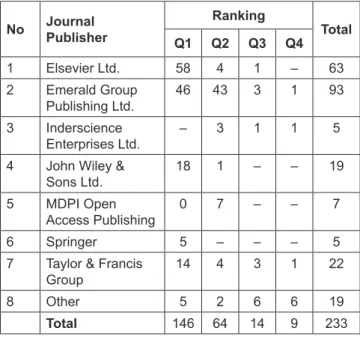
In this step, the sample of articles has been collected by the author from several reputation websites, which has the scope in terms of TQM and CSR topics. As a result, the author synthesized 233 documents that were research papers from prestigious publishers and summarized them in Table 1. Further, Table 1 provided information about different types of publishers released in the firm performance topics. Besides, based on the SCOPUS database to classification and ranking of all these academic documents.

Analysis:

After collecting listed articles on the SCOPUS database concerning TQM, CSR, and the firm performance topics,

Table 1: Describe the Data Source through the Journal Publisher

No Journal Publisher

Ranking

Total Q1 Q2 Q3 Q4

1 Elsevier Ltd. 58 4 1 – 63

2 Emerald Group

Publishing Ltd. 46 43 3 1 93

3 Inderscience

Enterprises Ltd. – 3 1 1 5

4 John Wiley &

Sons Ltd. 18 1 – – 19

5 MDPI Open

Access Publishing 0 7 – – 7

6 Springer 5 – – – 5

7 Taylor & Francis

Group 14 4 3 1 22

8 Other 5 2 6 6 19

Total 146 64 14 9 233

the author then conducted the coding of those articles and analyzed the content based on the thematic, such as the area research, the study types, authors.

Findings:

The author will analyze and points out research trends on the topic concerning the impact of CSR, TQM on firm performance. From that, the authors would highlight several research gaps and the trend research in the future.

4. Results Analysis

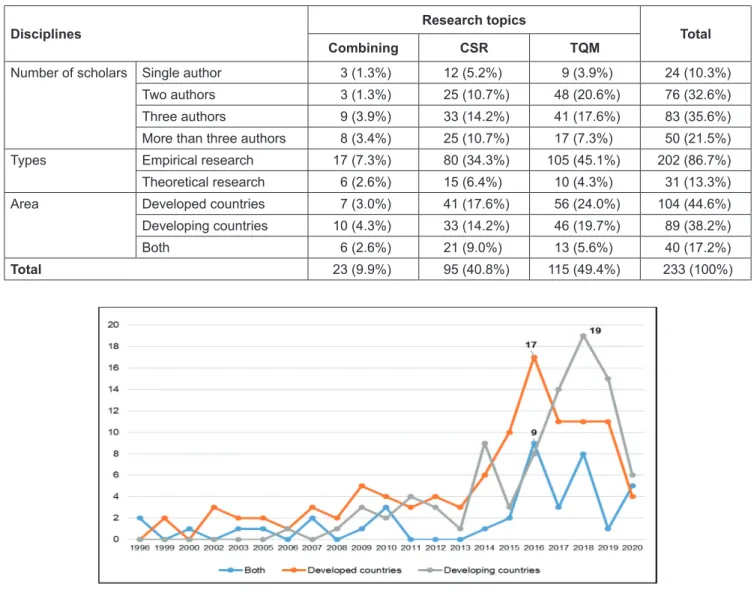
A total of 233 papers that have been employed in this study will be divided into three major contents, including CSR theory, TQM philosophy, and combining two of these theories into organization management (as represented in Table 2). First, in terms of the research topics, the analysis reveals that out of 233 studies, approximately 49.4 percent (n = 115) had adopted TQM principles to improve the firms’

performance, followed by 95 studies that were conducted

to explore the role of CSR and its impact on corporate

performance (around 40.8 percent). Whereas, only 23 papers

(9.9 percent) mentioned the simultaneous combination of

two of these theories on enterprise performance. Second, in

terms of the production of 233 manuscripts of this research, a

large number of authors participated in the study of enterprise

performance topics (a total of 648 authors), with an average

of 2.78 authors per article.

(4)

Table 2: Cross-Tabulation Among the Categories

Disciplines Research topics

Total

Combining CSR TQM

Number of scholars Single author 3 (1.3%) 12 (5.2%) 9 (3.9%) 24 (10.3%)

Two authors 3 (1.3%) 25 (10.7%) 48 (20.6%) 76 (32.6%)

Three authors 9 (3.9%) 33 (14.2%) 41 (17.6%) 83 (35.6%)

More than three authors 8 (3.4%) 25 (10.7%) 17 (7.3%) 50 (21.5%)

Types Empirical research 17 (7.3%) 80 (34.3%) 105 (45.1%) 202 (86.7%)

Theoretical research 6 (2.6%) 15 (6.4%) 10 (4.3%) 31 (13.3%)

Area Developed countries 7 (3.0%) 41 (17.6%) 56 (24.0%) 104 (44.6%)

Developing countries 10 (4.3%) 33 (14.2%) 46 (19.7%) 89 (38.2%)

Both 6 (2.6%) 21 (9.0%) 13 (5.6%) 40 (17.2%)

Total 23 (9.9%) 95 (40.8%) 115 (49.4%) 233 (100%)

Figure 1: Year of “Research Area” Publication Hence, this evaluation result is consistent with the findings

of Aquilani et al. (2017) and Amos (2018). Third, regarding types of research, theoretical and empirical research are two main types of research trends. In detail, a vast majority of 233 articles were empirical studies, that is, 202 papers (86.7 percent), whereas only 31 out of 233 documents (13.3 percent) were theoretical in terms of research orientation.

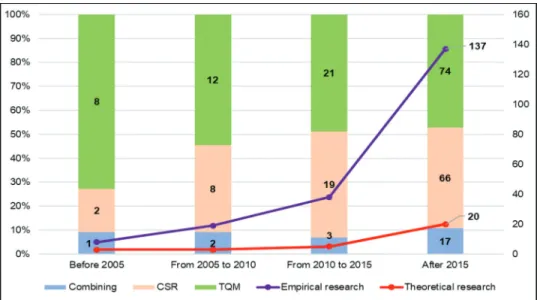
Besides, the trend of the three types of research topics (as per region) from 1996 to 2020 has been illustrated in Figure 1. Overall, the research orientation of employing TQM and CSR theory in corporates worldwide has increased significantly based on the database. The total number of studies to explore factors that can impact an organization’s performance increased sharply from 2014. Meanwhile, Figure 2 has shown that theoretical research comprises a

small percentage and focused on the latest period (from 2015 to 2020). Furthermore, most scholars’ focused on TQM. Our findings are consistent with the findings of Cherrafi et al.

(2016), who pointed out the drivers and barriers to integrating TQM philosophy into a sustainability perspective (Cherrafi et al., 2016).

The number of existing publications simultaneously

combining the TQM and CSR has accounted for a small ratio

compared to the rest (n = 23). Moreover, several previous

studies have also attempted to report that it is challenging

to combine these two initiatives in an enterprise due to its

unique characteristics. However, this combination will bring

many benefits to the business, especially for sustainability

goals, and enhance long-term competitive advantage

(Manzani et al., 2017).

(5)

CSFs (as a new research agenda) that may enable TQM in organizations. Hence, those findings have opened up many potential suggestions for studying the effects of TQM CSFs as well as barriers in future studies.

5.2. The Effect on the Firm Performance of CSR Corporate social responsibility can be referred to as a corporate initiative to assess and take responsibility for the company’s effects on the environment and impact on social welfare. The term generally applies to a company’s efforts that go beyond what may be required by regulators or environmental protection groups. Adopting CSR initiatives into the firm positively impacts comprehensive performance, including financial and non-financial. However, scholars favor studies related to financial performance over non- financial performance. Out of 80 articles of empirical research regarding CSR initiatives’ impact on firm performance, only 12 documents exclusively explored the impact on non-financial performance compared to 78 papers that focused on economic performance. It means there is a significant disparity between considering financial and non-financial performance. Hence, most of these studies stated that satisfying shareholders play an essential role in evaluating the total company’s performance compared to other benchmarks (Gangi et al., 2019; Hou, 2018;

Park et al., 2017). Regarding the impact of CSR initiatives on non-financial performance, most of these studies focused on the stakeholder and their perception. Unfortunately, the research context is conducted mainly in developed countries, such as comparing the stakeholder satisfaction between Poland and Germany (Kowalczyk & Kucharska, 2020), determining the corporate reputation via evidence from across nine developed nations (Pérez-Cornejo et al., 2020), the loyalty and performance of employees in Korea (Shin et al., 2016). The emerging economies witnessed a few CSR studies related to non-financial performance, for instance, the reputation of Pakistan enterprises (Javed et al., 2020) or Chinese firms (Lee, 2020); Brazilian employee performance (Story & Castanheira, 2019). Thus, to close this gap, they suggested extending research to the transitional economies, where CSR initiatives have been increasingly expanding their strong presence and role in various sectors (Huang et al., 2019; Jiang et al., 2018). This result is consistent with the research findings of Amos (2018) and Sharma (2019); they also pointed out the significant influence of CSR knowledge on these countries (Amos, 2018; Sharma, 2019). Research on CSR initiatives’ impact will be more comprehensive if the impact of CSR on overall firm performance consists of financial and non-financial. Unfortunately, there are not too many studies that deal with this issue (Cao et al., 2019;

Javed et al., 2020). Hence, attempting to employ the CSR implementation has opened up many potential research directions for other scholars.

5. Discussion

5.1. The Effect on the Firm Performance of TQM The statistical finding highlighted that the vast majority of studies on TQM’s influence on firm performance tend to favor a quantitative approach for their empirical studies (n = 105) than theoretical research. To determine whether positive relationships exist between TQM implementation and firm performance, exploring the critical role and impact of TQM philosophy on firm performance to gain sustainable competitive advantage had attracted considerable attention.

Most of the earlier studies have demonstrated that a company will increase its business performance if it implements TQM practices (Carmona-Márquez et al., 2016; Saleh & Sweis, 2017; Sweis et al., 2019).

Nonetheless, there are existing limitations from those studies, which have been suggested for future research.

First, the manufacturing industry dominated the number of research compared to the service industry. Firms implement TQM to gain a competitive advantage in terms of quality, productivity, customer satisfaction, and profitability. The findings of these studies related to the manufacturing sector indicated that TQM has a highly positive effect on firm performance. Out of empirical studies on TQM implementation’s influence, only thirteen articles have studied the impact of TQM philosophy on the service sector.

For example, Greece (Bouranta et al., 2017), and Taiwan (Yang & Yang, 2020). Meanwhile, the author noted that there were only five studies in the context of emerging economies from 2011 to the present, for example, Vietnam (Trang & Do, 2020), India (Singh et al., 2018), and Jordan (Rawashdeh, 2018; Sweis et al., 2019). Thus, based on these publications’

data, the findings pointed out that the number of recent studies in developing countries has significantly increased;

however, there is still a limitation in TQM implementation for those nations, especially service industries. Ideally, there is a shift in determining the TQM’s influence on the firm, focusing in more detail on the specific barriers and drivers, which may impact the TQM adoption in corporates.

However, existing literature found that only a few studies have addressed the effects of TQM CSFs on different types of performance. Examples are organizational performance (Firman et al., 2020; Habtoor, 2016); manufacturing SMEs performance in Australia and Japan, respectively (Gadenne

& Sharma, 2009; Georgiev & Ohtaki, 2019); or a few studies

mentioned about barriers that impact the implementation of

TQM philosophy such as Lean Six Sigma, Six Sigma tools

that can impact corporate performance (De Freitas et al.,

2017; Firman et al., 2020; Sreedharan et al., 2018). They

emphasized that the diversity of CSFs may affect TQM

implementation in different research contexts. Thereby,

those recommendations focused on identifying specific

(6)

5.3. Combination TQM and CSR as A New Research Direction

To attain a variety of benefits as a long-term competitive advantage, protecting the natural environment, enhancing reputation, or satisfying customer needs has encouraged corporates to offer customers the best products by adopting different tools into their operations. As discussed earlier, both TQM and CSR have similarly positive effects on enhancing various firm performance. Hence, identifying the nexus between TQM and CSR and how to combine both of these activities has been taken in some recent studies on, for example, in the Vietnamese coffee industries (Do et al., 2020); in Pakistan manufacturing firms (Abbas, 2020), or Turkish firms (Sila, 2020). Some scholars proposed the need to extending research that can evaluate these theories’ influence on firm performance in the various research contexts (Abbas, 2020; Do et al., 2020; Khurshid et al., 2018; Manzani et al., 2017;

Sila, 2020). Indeed, based on this study’s database, most of the TQM and CSR combination studies are in the recent period from 2015 to 2020, with 17 articles (see Figure 2).

However, it was apparent that the number of combination studies is insignificant compared to a large number of articles, which have chosen either CSR or the TQM philosophy to attempt to achieve corporate sustainability. First, it was apparent from prior studies’

recommendations that transitional economies are being considered as the potential context for future research, given the growing interest from academics, which has

also been supported by Khurshid et al. (2018), Abbas (2020), and Mahmoud and Hinson (2012).

Furthermore, an in-depth analysis of the different aspects concerning these two theories globally has been more recognized; however, only a few particular emerging economies like Pakistan, Vietnam, and Iran witnessed studies conducted with a combination of both TQM and CSR initiatives. They argued that these nations would be a potentially promising research context in the future for scholars due to the characteristic conditions and the need for continuous improvement of the firms.

(Abbas, 2020; Do et al., 2020; Mehralian et al., 2016).

Second, there is no consistent conceptual framework for integrating TQM and CSR initiatives on firm performance (Do et al., 2020; Khurshid et al., 2018). Notably, the main suggestion will revolve around determining the relationship between TQM and CSR, meanwhile, enhancing firm performance will be considered the final target. Thus, there are two major types of research models, which may offer some ideas related to the proposed model in the future for other scholars (as represented in Figure 3).

5.3.1. TQM Plays a Mediation Role Between CSR and FP (CSR ⇒ TQM ⇒ FP)

Surprisingly, TQM under the mediation role could be considered a positive linkage between CSR initiatives and firm performance. There have been several studies defining this relationship with TQM as a mediator (n = 9). Among them, scholars focused on identifying particular TQM CSFs,

Figure 2: Orientation of the Research Focused on Content and Types

(7)

Figure 3: The Integrated Model of TQM and CSR Initiatives (Note: Direct Impact; Indirect Impact)

which may have an association with CSR and positively impact firm performance. For instance, organizational learning (Carter, 2005); innovation (Mahmoud & Hinson, 2012; Reverte et al., 2016); management of people and process (Mehralian et al., 2016); continuous improvement (Yuen et al., 2016); transformational leadership (Masa’deh et al., 2018). Unfortunately, top managers struggle in terms of determining what factors enable TQM adoption. Hence, these studies suggested the need to extend future research related to identifying such factors and evaluate them under various sectors.

5.3.2. CSR Plays a Mediation Role Between TQM and FP (TQM => CSR => FP)

On the other hand, the relationship of those variables (TQM, CSR, FP) has been studied/evaluated in different research contexts, such as the Spanish hotel sector (Benavides-Velasco et al., 2014), Turkish firms (Sila, 2020), Bangladeshi organizations (Bhuiyan et al., 2020), Vietnamese coffee industries (Do et al., 2020). These findings have claimed that TQM CSFs positively correlate and significantly impact corporate social performance and firm performance. Considering CSR initiatives as a mediator in the relationship between TQM implementation and firm performance, identifying TQM CSFs can help corporate achieve sustainability. This has become an agreeable research trend in the future.

Hence, the findings indicated several research gaps that remain unaddressed.

(1) What are the barriers and critical success factors of TQM and CSR adoption?

(2) In the emerging economies condition, whether firm performance has been enhanced by conducting these theories?

Consequently, the findings of prior studies have suggested the integration of these two tools into the corporate blueprints that could meet corporate sustainability.

It is important to identify the CSFs that could enable TQM practices or barriers to CSR adoption that could impact enterprise performance, which represents a promising research agenda in the future.

6. Conclusion

In summary, these research results offer several

meaningful suggestions in terms of theoretical and practical

implications. Based on 233 samples of academic articles

from 1996 to 2020, this study provides a comprehensive view

of enterprise performance issues by assessing the impact of

adopting two different theories as TQM and CSR. First, the

study has classified the collected data based on distinguished

two topics as TQM implementation and CSR initiatives

considering their impact on firm performance. That database

has been analyzed under various criteria to illustrate the

research trends and to point out new ideas related to these

two theories. Most scholars agreed these useful tools can

enhance corporate performance. However, they suggested

that other scholars pay attention to clarifying which factors

(8)

may become the barriers or drivers to adopting TQM or CSR initiatives (Amos, 2018; Aquilani et al., 2017). Second, relying on existing publications, the findings indicated that the number of recent studies in emerging economies has significantly increased; however, there is still a research gap in these nations compared to developed countries in adopting CSR initiatives into corporates. Thus, they recommended that evaluating which TQM CSFs and CSR barriers can force firm performance under transitional economies will be an ideal research context in the future (Amos, 2018; Do et al., 2020). Last, among the documents, which combine both TQM and CSR tools, TQM and CSR have an interaction to help firms obtain superior performance as well as a sustainable competitive advantage. Thus, selecting either TQM or CSR under the mediation role in the relationship with firm performance depends on each research target and needs to extend research in various sectors globally, which has also stated by some authors like Yuen (2016), Abbas (2020), and Do et al. (2020).

On the other hand, this study also faced some limitations related to the number of publications focused on conducting TQM and CSR initiatives on organizational performance. The amount of keyword restriction has also led to a reduction in the number of publications employed for the systematic review.

The analysis conducted aims to provide many directions for future research. Indeed, it is evident from these findings shown that there is a lack of study in evaluating the concurrent combination of both TQM and CSR theories.

Hence, this study suggested that other scholars have opportunities to propose the research framework model, which attempts to adopt TQM implementation and CSR initiatives in a particular industry. Particularly, depending on research context and different research targets, it will lead to promising future research trends of identifying which CSFs or barriers impact adopting these theories.

References

Abbas, J. (2020). Impact of total quality management on corporate green performance through the mediating role of corporate social responsibility. Journal of Cleaner Production, 242(2020), 118458. https://doi.org/10.1016/j.jclepro.2019.118458

Amos, G. J. (2018). Researching corporate social responsibility in developing-countries context: A systematic review of the literature. International Journal of Law and Management, 60(2), 284–310. https://doi.org/10.1108/IJLMA-04-2017-0093 Anil, A. P., & Satish, K. (2019). TQM practices and its performance

effects: An integrated model. International Journal of Quality and Reliability Management, 36(8), 1318–1344. https://doi.

org/10.1108/IJQRM-10-2018-0266

Aquilani, B., Silvestri, C., Ruggieri, A., & Gatti, C. (2017).

A systematic literature review on total quality management

critical success factors and the identification of new avenues of research. TQM Journal, 29(1), 184–213. https://doi.

org/10.1108/TQM-01-2016-0003

Benavides-Velasco, C. A., Quintana-García, C., & Marchante- Lara, M. (2014). Total quality management, corporate social responsibility, and performance in the hotel industry.

International Journal of Hospitality Management, 41(2014), 77–87. https://doi.org/10.1016/j.ijhm.2014.05.003

Bhuiyan, F., Baird, K., & Munir, R. (2020). The association between organizational culture, CSR practices, and organizational performance in an emerging economy. Meditari Accountancy Research, 6(11), 96–132. https://doi.org/10.1108/

MEDAR-09-2019-0574

Bouranta, N., Psomas, E. L., & Pantouvakis, A. (2017). Identifying the critical determinants of TQM and their impact on company performance: Evidence from the hotel industry of Greece. The TQM Journal, 29(1), 147–166. https://doi.org/10.1108/TQM- 11-2015-0142

Bouranta, N., Psomas, E., Suárez-Barraza, M. F., & Jaca, C. (2019).

The key factors of total quality management in the service sector:

A cross-cultural study. Benchmarking: An International Journal, 26(3), 893–921. http://dx.doi.org/10.1108/BIJ-09-2017-0240 Cao, R. Q., Schniederjans, D. G., Gu, V. C., & Schniederjans,

M. J. (2019). Exploring the relationship between corporate responsibility and firm performance from a social media perspective. Social Responsibility Journal, 15(3), 296–317.

https://doi.org/10.1108/SRJ-09-2017-0176

Carmona-Márquez, F. J., Leal-Millán, A. G., Vázquez-Sánchez, A. E., Leal, A. L., & Eldridge, S. (2016). TQM and business success: Do all the TQM drivers have the same relevance?

An empirical study in Spanish firms. International Journal of Quality and Reliability Management, 33(3), 361–379.

Carroll, A. B. (1991). The pyramid of corporate social responsibility: toward the moral management of organizational stakeholders. Business Horizons, 34(4), 39–48. https://doi.

org/10.1177/0312896211432941

Carroll, A. B. (2016). Carroll’s pyramid of CSR: Taking another look. International Journal of Corporate Social Responsibility, 1(3), 1–8. https://doi.org/10.1186/s40991-016-0004-6

Carter, C. R. (2005). Purchasing social responsibility and firm performance. International Journal of Physical Distribution

& Logistics Management, 35(3), 177–194. https://doi.

org/10.1108/BIJ-09-2020-0469

Centobelli, P., Cerchione, R., Esposito, E., & Shashi. (2019).

Exploration and exploitation in the development of more entrepreneurial universities: A twisting learning path model of ambidexterity. Technological Forecasting and Social Change, 141(2019), 172–194. https://doi.org/10.1016/j.

techfore.2018.10.014

Cherrafi, A., Elfezazi, S., Chiarini, A., Mokhlis, A., & Benhida, K.

(2016). The integration of lean manufacturing, Six Sigma,

and sustainability: A literature review and future research

directions for developing a specific model. Journal of Cleaner

(9)

Production, 139(2016), 828–846. https://doi.org/10.1016/

j.jclepro.2016.08.101

De Freitas, J. G., Costa, H. G., & Ferraz, F. T. (2017). Impacts of Lean Six Sigma over organizational sustainability: A survey study. Journal of Cleaner Production, 156(2017), 262–275.

https://doi.org/10.1016/j.jclepro.2017.04.054

Do, M. H., Huang, Y. F., & Do, T. N. (2020). The effect of total quality management-enabling factors on corporate social responsibility and business performance: Evidence from Vietnamese coffee firms. Benchmarking: An International Journal, 2(2), 45–69.

https://doi.org/10.1108/BIJ-09-2020-0469

Firman, A., Mustapa, Z., Ilyas, G. B., & Putra, A. H. P. K.

(2020). Relationship of TQM on managerial performance:

Evidence from property sector in Indonesia. Journal of Distribution Science, 18(1), 47–57. https://doi.org/10.15722/

jds.18.01.20201.47

Gadenne, D., & Sharma, B. (2009). An investigation of the hard and soft quality management factors of Australian SMEs and their association with firm performance. International Journal of Quality and Reliability Management, 26(9), 865–880. https://

doi.org/10.1108/02656710910995064

Gangi, F., Mustilli, M., & Varrone, N. (2019). The impact of corporate social responsibility (CSR) knowledge on corporate financial performance: Evidence from the European banking industry. Journal of Knowledge Management, 23(1), 110–134.

https://doi.org/10.1108/JKM-04-2018-0267

Georgiev, S., & Ohtaki, S. (2019). Critical success factors for TQM implementation among manufacturing SMEs: Evidence from Japan. Benchmarking: An International Journal, 27(2), 473–498. https://doi.org/10.1108/BIJ-01-2019-0037

Habtoor, N. (2016). Influence of human factors on organizational performance: Quality improvement practices as a mediator variable. International Journal of Productivity and Performance Management, 65(4), 460–484. https://doi.org/10.1108/

IJPPM-02-2014-0016

Hou, T. C. T. (2018). The relationship between corporate social responsibility and sustainable financial performance: firm- level evidence from Taiwan. Corporate Social Responsibility and Environmental Management, 26(1), 19–28. https://doi.

org/10.1002/csr.1647

Huang, Y. F., Do, M. H., & Kumar, V. (2019). Consumers’ perception on corporate social responsibility: Evidence from Vietnam.

Corporate Social Responsibility and Environmental Management, 26(6), 1272–1284. https://doi.org/10.1002/csr.1746

Javed, M., Rashid, M. A., Hussain, G., & Ali, H. Y. (2020).

The effects of corporate social responsibility on corporate reputation and firm financial performance: Moderating role of responsible leadership. Corporate Social Responsibility and Environmental Management, 27(3), 1395–1409. https://doi.

org/10.1002/csr.1892

Jiang, Q., Liu, Z., Liu, W., Li, T., Cong, W., Zhang, H., & Shi, J.

(2018). A principal component analysis-based three-dimensional sustainability assessment model to evaluate corporate sustainable

performance. Journal of Cleaner Production, 187(2018), 625–

637. https://doi.org/10.1016/j.jclepro.2018.03.255

Khurshid, M. A., Amin, M., & Ismali, W. K. W. (2018). Total quality and socially responsible management (TQSR-M) An integrated conceptual framework. Benchmarking: An International Journal, 25(8), 2566–2588. https://doi.org/10.1108/BIJ-04- 2017-0084

Kim, S. J., & Kim, S. C. (2019). Review of corporate social responsibility effects studies. Journal of Industrial Distribution

& Business, 10(7), 17–27. https://doi.org/10.13106/ijidb.2019.

vol10.no7.17

Kong, Y., Antwi-Adjei, A., & Bawuah, J. (2020). A systematic review of the business case for corporate social responsibility and firm performance. Corporate Social Responsibility and Environmental Management, 27(2), 444–454. https://doi.

org/10.1002/csr.1838

Kowalczyk, R., & Kucharska, W. (2020). Corporate social responsibility practices incomes and outcomes: Stakeholders’

pressure, culture, employee commitment, corporate reputation, and brand performance. A Polish-German cross-country study. Corporate Social Responsibility and Environmental Management, 27(2), 595–615. https://doi.org/10.1002/csr.1823 Lee, J. W. (2020). CSR impact on the firm market value: Evidence

from tour and travel companies listed on the Chinese stock markets. Journal of Asian Finance, Economics, and Business, 7(7), 159–167. https://doi.org/10.13106/jafeb.2020.vol7.no7.159 Mahmoud, M. A., & Hinson, R. E. (2012). Market orientation,

innovation, and corporate social responsibility practices in Ghana’s telecommunication sector. Social Responsibility Journal, 8(3), 327–346. https://doi.org/10.1108/174711 11211247910

Manzani, Y. E., Sidmou, M. L., & Cegarra, J. J. (2017).

A conceptual framework of the relationship between total quality management, corporate social responsibility, innovation capability, and financial performance. International Journal of Quality and Innovation, 3(2/3/4), 188. https://hal.archives- ouvertes.fr/hal-02042575

Masa’deh, R., Alrowwad, A., Alkhalafat, F., Obeidat, B., &

Abualoush, S. (2018). The role of corporate social responsibility in enhancing firm performance from the perspective of IT employees in Jordanian banking sector: The mediating effect of transformational leadership. Modern Applied Science, 12(7), 1–26. https://doi.org/10.5539/mas.v12n7p1

Mehralian, G., Nazari, J. A., Zarei, L., & Rasekh, H. R.

(2016). The effects of corporate social responsibility on organizational performance in the Iranian pharmaceutical industry: The mediating role of TQM. Journal of Cleaner Production, 135(2016), 689–698. https://doi.org/10.1016/j.

jclepro.2016.06.116

Park, Y. J., Park, Y. W., Hong, P. C., & Yang, S. (2017). Clarity of

CSR orientation and firm performance: The case of Japanese

SMEs. Benchmarking: An International Journal, 24(6),

1581–1596. https://doi.org/10.1108/BIJ-03-2016-0035

(10)

Patyal, V. S., & Koilakuntla, M. (2017). The impact of quality management practices on performance: an empirical study.

Benchmarking: An International Journal, 24(2), 511–535.

https://doi.org/10.1108/BIJ-11-2015-0109

Pérez-Cornejo, C., De Quevedo-Puente, E., & Delgado-García, J. B. (2020). Reporting as a booster of the corporate social performance effect on corporate reputation. Corporate Social Responsibility and Environmental Management, 27(3), 1252–1263. https://doi.org/10.1002/csr.1881

Quintana-García, C., Marchante-Lara, M., & Benavides-Chicón, C. G. (2018). Social responsibility and total quality in the hospitality industry: Does gender matter? Journal of Sustainable Tourism, 26(5), 722–739. https://doi.org/10.1080/

09669582.2017.1401631

Rawashdeh, A. M. (2018). The effect of TQM on firm performance: Empirical study in Jordanian private airlines.

Modern Applied Science, 12(9), 140. https://doi.org/10.5539/

mas.v12n9p140

Reverte, C., Gómez-Melero, E., & Cegarra-Navarro, J. G. (2016).

The influence of corporate social responsibility practices on organizational performance: Evidence from Eco-Responsible Spanish firms. Journal of Cleaner Production, 112(2016), 2870–2884. https://doi.org/10.1016/j.jclepro.2015.09.128 Robson, A., Prabhu, V. B., & Mitchell, E. (2002). TQM enablers

and business sustainability: An empirical study of the service sector in the North East of England. International Journal of Quality and Reliability Management, 19(5), 610–632. https://

doi.org/10.1108/02656710210427566

Ruonan, Z., & Hong, Y. (2019). Corporate social responsibility disclosure, financing constraints, and investment-cash flow sensitivity. The Journal of Business Economics and Environmental Studies, 9(1), 21–28. https://doi.org/10.13106/

eajbm.2019.vol9.no1.21

Saha, R., Shashi, M., Cerchione, R., Singh, R., & Dahiya, R. (2020).

Effect of ethical leadership and corporate social responsibility on firm performance: A systematic review. Corporate Social Responsibility and Environmental Management, 27(2), 409–429. https://doi.org/10.1002/csr.1824

Saleh, R. A., & Sweis, R. J. (2017). The relationships between soft/hard total quality management practices and operational performance in Jordanian manufacturing organizations.

International Journal of Management Concepts and Philosophy, 10(4), 345. https://doi.org/10.1504/ijmcp.2017.087261 Samson, D., & Terziovski, M. (1999). The relationship between total

quality management practices and operational performance.

Journal of Operations Management, 17(1999), 393–409.

https://doi.org/10.1016/S0272-6963(98)00046-1

Shafiq, M., Lasrado, F., & Hafeez, K. (2019). The effect of TQM on organizational performance: Empirical evidence from the textile sector of a developing country using SEM. Total Quality Management and Business Excellence, 30(1–2), 31–52. https://

doi.org/10.1080/14783363.2017.1283211

Sharma, E. (2019). A review of corporate social responsibility in developed and developing nations. Corporate Social Responsibility and Environmental Management, 26(4), 712–720.

https://doi.org/10.1002/csr.1739

Shin, I., Hur, W., & Kang, S. (2016). Employees’ Perceptions of Corporate Social Responsibility and Job Performance : A Sequential Mediation Model. Sustainability, 8(5), 493–505.

https://doi.org/10.3390/su8050493

Sila, I. (2020). Investigating changes in TQM’s effects on corporate social performance and financial performance over time. Total Quality Management and Business Excellence, 31(1–2), 210–229. https://doi.org/10.1080/14783363.2018.1 458609

Singh, V., Kumar, A., & Singh, T. (2018). Impact of TQM on organizational performance: The case of Indian manufacturing and service industry. Operations Research Perspectives, 5(2018), 199–217. https://doi.org/10.1016/j.

orp.2018.07.004

Sreedharan, R. V., Sunder, V. M., & Raju, R. (2018). Critical success factors of TQM, Six Sigma, Lean and Lean Six Sigma: A literature review and key findings. Benchmarking:

An International Journal, 25(9), 3479–3504. https://doi.

org/10.1108/BIJ-08-2017-0223

Story, J. S. P., & Castanheira, F. (2019). Corporate social responsibility and employee performance: Mediation role of job satisfaction and affective commitment. Corporate Social Responsibility and Environmental Management, 26(6), 1361–1370. https://doi.org/10.1002/csr.1752

Svensson, G., Ferro, C., Høgevold, N., Padin, C., Carlos Sosa Varela, J., & Sarstedt, M. (2018). Framing the triple bottom line approach: Direct and mediation effects between economic, social, and environmental elements. Journal of Cleaner Production, 197(2018), 972–991. https://doi.org/10.1016/j.

jclepro.2018.06.226

Sweis, R. J., Elhawa, N. A., & Sweis, N. J. (2019). Total quality management practices and their impact on performance: A case study of Royal Jordanian Airlines. International Journal of Business Excellence, 17(2), 245–263. https://doi.org/10.1504/

IJBEX.2019.097546

Tan, B. I., Nadarajah, S., Sim, J. J., & Ng, C. C. (2014). Soft TQM practices, customer orientation and business performance: a proposed structural model. International Journal of Modelling in Operations Management, 4(1/2), 21. https://doi.org/10.1504/

ijmom.2014.063577

Tangngisalu, J., Mappamiring, M., Andayani, W., Yusuf, M., &

Putra, A. H. P. K. (2020). CSR and Firm Reputation from Employee Perspective. Journal of Asian Finance, Economics, and Business, 7(10), 171–182. https://doi.org/10.13106/

jafeb.2020.vol7.no10.171

Trang, T. Van, & Do, Q. H. (2020). Critical success factors of TQM

implementation in Vietnamese supporting industries. Journal

(11)

of Asian Finance, Economics, and Business, 7(7), 391–401.

https://doi.org/10.13106/jafeb.2020.vol7.no7.391

Yang, C. C., & Yang, K. J. (2020). The analyses of critical success factors for service industries to develop service brands. Total Quality Management and Business Excellence, 31(7–8), 800–813. https://doi.org/10.1080/14783363.2018.1446755

Yuen, K. F., Thai, V. V., & Wong, Y. D. (2016). The effect of continuous improvement capacity on the relationship between corporate social performance and business performance in maritime transport in Singapore. Transportation Research Part E: Logistics and Transportation Review, 95(2016), 62–75.

https://doi.org/10.1016/j.tre.2016.09.003

수치

Table 1: Describe the Data Source through the   Journal Publisher No Journal  Publisher Ranking Total Q1 Q2 Q3 Q4 1 Elsevier Ltd
Table 2: Cross-Tabulation Among the Categories
Figure 2: Orientation of the Research Focused on Content and Types
Figure 3: The Integrated Model of TQM and CSR Initiatives (Note: Direct Impact; Indirect Impact)

참조

관련 문서