패밀리레스토랑의 사회적 책임 활동이 고객신뢰 및 고객만족도에 미치는 영향
정효선ㆍ윤혜현†
경희대학교 조리ㆍ서비스경영학과
The Effects of Corporate Social Responsibility (CSR) Activities on Customer Trust and Customer Satisfaction in the Family Restaurant
Hyo Sun Jung and Hye Hyun Yoon†
Dept. Culinary Service Management, Kyung Hee University
Abstract
The purposes of this study were to understand the influence of customer perceptions of corporate social responsibility (CSR) activities in family restaurants on customer trust and satisfaction. Based on results form 395 family restaurant patrons obtained empirically, we reviewed the reliability and fitness of a research model and verified two hypotheses using the AMOS program. The hypothesized relationships in the model were simultaneously tested using a structural equation model (SEM). Hypothesis 1, which hypothesized a positive relationship between customer perception of CSR activities and customer trust was partially supported. Additionally, hypothesis 2, in which customer perception of CSR activities had significant positive effects on customer satisfaction, and customer trust had significant positive effect on customer satisfaction (Hypothesis 3 was supported). Finally, customer trust performed a partial role as a parameter in the causality between CSR activity in the family restaurant and customer satisfaction. Limitations and future research directions are also discussed.
Key words : CSR activity, customer trust, customer satisfaction, family restaurant
I. Introduction1)
Corporate social responsibility (CSR) is a high-profile notion that has strategic importance to many companies in today’s competitive market environment (Luo X and Bhattacharya CB 2006; Lee SK and Heo YJ 2009; Lee KH and Shin DY 2010).
CSR is a concept that has attracted worldwide attention and has acquired new resonance in the global economy.
Heightened interest in CSR in recent years has stemmed from the advent of globalization and international trade, which are
†Corresponding author : Hye Hyun Yoon, Department of Culinary Service Management, Kyung Hee University, 1 Hoeigi-dong, Dongdaemoon-gu, Seoul 130-701, Korea
Tel: +82-02-961-9403 Fax: +82-02-964-2537 E-mail: [email protected]
reflected in increased business complexity and new demands for enhanced transparency and corporate citizenship (Jamali D and Mirshak R 2007; Matten D and Moon J 2008; Tsai WH et al. 2010). Not surprisingly, this trend is also reflected in the pervasive belief among business leaders that CSR activities are an economic imperative in today’s national and global marketplaces (Kang KH et al. 2010). For example, Coca-Cola has signed an agreement to provide $60 million and significant staff time to the Boys and Girls Clubs of America over a 10 year period, and Starbucks is the largest North American contributor to CARE, an international relief organization with programs in coffee-growing countries.
However, CSR has only been evaluated in studies that focused on products as the tangible material. Prior research, which was implemented targeting companies offering services to customers such as the foodservice enterprise, was insufficient. The importance of the influence of CSR activities
on service companies was emphasized while stating that the influence of CSR activities on satisfaction is very direct, particularly because the service has intangible and extinctive characteristics unlike tangible goods (Brown TJ and Dacin PA 1997; Kim JK and Lim HC 2011). Therefore, in many parts of the globe, CSR has become a core element of good business practice (Holliday I 2005; Grosbois DD 2011) and may provide a general framework to structure the responsible use of corporate power and social involvement (Turker D 2009). Thus, several marketing studies have found that CSR has a significant influence on several customer-related outcomes (Bhattacharya CB and Sen S 2003; Lee SK and Heo YJ 2009). Most specifically, CSR affects, customer product attitudes (McWilliams A and Siegel D 2001; Berens G et al.
2005), purchase intentions (Mohr LA et al. 2001; Lee KH and Shin DY 2010), customer-company identities(Sen S and Bhattacharya CB 2001; David P et al. 2005; Yoon YS et al.
2006), and financial performance either directly or indirectly (Branco MC and Rodrigues LL 2006; Garay L and Font X 2011). However, CSR has no effect on improving attitudes toward product and brand or causes a negative recognition of company intentions, depending on the case, thereby bringing about an unfavorable attitude, and that the ultimate goal for a company to perform CSR activity is formed under a proposition called commerciality; there is even research stating that this effect as irrelevant to customer decision-making (Smith G and Stedghill R 1994; Caudron S 1997; Webb DJ and Mohr LA 1998).
However, relatively many overseas studies related to CSR activities of the hotel enterprise have been published (Lee and Park 2009; Kang KH et al. 2010; Tsai WH et al. 2010;
Grosbois DD 2011). In contrast, research targeting foodservice companies is very rare (Kim DJ and Kim YJ 2012; Park MY et al. 2011). A foodservice company is small scale compared to that of a hotel and has a resource limitation for performing social responsibility in the corporate environment.
Thus, even in a foodservice company, the recognition and practice of social responsibility are short. However, small-scale social responsibility activity is being performed in foodservice companies such as reducing disposable products, donating profits, or doing volunteering work (Kim and Kim, 2012).
Thus, customer recognition of a company, which is sincerely social responsible, can have a significant influence on reliability and satisfaction. Therefore, this study focused on customers to explore the relationship among CSR activities, customer trust, and satisfaction. The purposes of this study were to (1) examine the influence of customer perceptions of CSR activities in family restaurants on customer trust and satisfaction; (2) explore the mediating effect of customer trust between CSR activities and satisfaction.
Literature review and conceptual model
Corporate social responsibility (CSR) in hospitality industry CSR has deep roots in management and in academic inquiry (Stefan T and Claes O 2010). From 1950–1970, the concept of CSR was established by many researchers and, according to Bowen HR (1953), CSR is a businesses’
responsibility to society beyond their profit motives (McGuire JW 1963; Sethi SP 1975). Carroll AB (1979) shaped this concept in detail by defining CSR as the economic, legal, ethical, and philanthropic expectations that are given to a company by society. While there is a lack of scholarly research on CSR activity in the foodservice industry, this issue has been a topic of interest to scholars and practitioners in the hospitality industry (Damitio JW et al. 1992; Enghagen LK and Hott DD 1992). Rodriguez FJG and Cruz YDMA (2007) found that CSR in the hotel industry has a significant effect on accounting performance. Additionally, Lee SK and Heo YJ (2009) suggested that CSR affects customer satisfaction toward US hotels and restaurants, and that customer satisfaction does not seem to mediate the relationship between positive (negative) CSR activities and company value for both hotels and restaurants. Lee HJ and Park JC (2009) examined the impacts of CSR activities in the hotel industry on financial performance, but CSR activities have no effect on financial performance in the casino industry. Kang KH et al. (2010) also noted different impacts of positive and negative CSR activities on financial performance of hotel, casino, restaurant, and airline companies. CSR activities have significant influence on corporate hotel and restaurant value. However, in the case of the airline industry, positive CSR activities have a negative influence on profit. Negative activities have a negative effect on corporate value. Shin DJ (2011) reported that social responsibility activity has a significant influence on re-visits and recommendation intentions in a study targeting customers of Kangwon Land. Chung KY et al. (2011) stated that pursuit of a strategic decision-making plan is most important in the corporate environment for a hotel to perform successful social responsibility activity. As a study that targeted foodservice companies, Park MY et al. (2011) noted that the social contribution activity of a specialty coffee shop has a significant influence on customer re-use intentions. Also, Kim DJ and Kim YJ (2012) reported that customers strongly recognize the necessity of social responsibility activity in foodservice companies and that the appearance of performing social responsibility activity functions is an important factor given purchase decision making. From a different perspective, Lee YK et al. (2011), who targeted employees of a foodservice company, mentioned that the recognition of CSR activities in a company promotes employee satisfaction and performance. Humin G
and Ryan C (2011), who targeted Chinese hotel employees, stated that the recognition of CSR activities leads to low employee turnover. In this way, studies that considered CSR activities of the hospitality industry mentioned that favorable customer recognition of CSR activities leads mostly to customer satisfaction, thereby functioning as a positive aspect of corporate performance.
Model development and hypotheses Relationship between CSR activities and trust
It is a very important that increased recognition of CSR activities affects customer trust toward a company and that customer behavior is related to CSR activities. Park JC and Hong SJ (2009) established that CSR activities have a significant effect on customer trust, Lee SK and Park SY (2009) also verified the theoretical foundation that CSR activities have a positive effect on customer trust of a company. Hong SY and Rim H (2010) mentioned that consumer recognition of CSR activities has a positive effect on customer trust because recognition of a company’s ethical and philanthropic behavior has a significant influence on the trust of the entire company. These arguments led to the establishment of the following hypotheses:
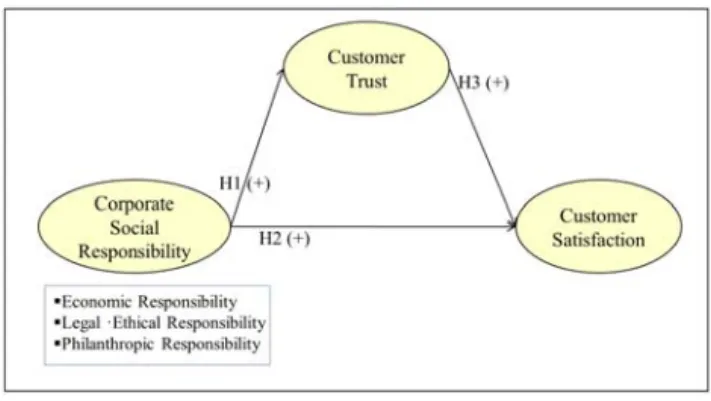
Hypothesis 1: CSR activities are positively related to customer trust.
Relationship between CSR and customer satisfaction
Lafferty B and Goldsmith RE (1999), Madrigal R (2000), and Mohr LA et al. (2001) verified that as the images of businesses that fulfill CSR are higher than those of other businesses, they would consequently form a positive brand image, thereby significantly affecting satisfaction and purchase intentions. Additionally, Maignan I et al. (1999) stated that CSR activities make people trust the relevant business, and Sen and Bhattacharya (2001) said that people become satisfied with the brands and services of certain businesses according to their CSR activities. Salmones MMG et al. (2005) reported that CSR activities of service businesses, perceived by customers, significantly affect customer preferences for the businesses. Luo X and Bhattacharya CB (2006) also found that customers were more satisfied with the products or services provided by those businesses that participated in CSR activities, and, thus, CSR activities contributed to enhancing customer satisfaction. Furthermore, Lee SK and Heo YJ (2009) suggested that CSR affects customer satisfaction. Given these findings, the following hypothesis was proposed:
Hypothesis 2: CSR activities are positively related to customer satisfaction
Relationship between customer trust and satisfaction
Customer trust, satisfaction, and commitment are the most important constructs in relationship marketing (Morgan R and Hunt S 1994). Lee J et al. (2000) found that satisfaction directly depends on the degree of customer trust. Jarvenpaa S et al. (2000) reported that trust is a critical factor stimulating a purchase. Garbarino E and Johnson MS (1999) and Flavian C et al (2006) found that customer trust causes customers to develop attitudes about a company. Given these findings, the following hypothesis was proposed (Figure 1):
Hypothesis 3: Customer trust is positively related to satisfaction.
Figure 1. Research model
Research Methodology
Sample and data collection
The data used for the current study were collected from customers in family restaurants in Seoul, the capital of Korea.
The convenience sampling method was used to select subjects of this study. In order to comply with our objectives and test our research hypotheses, we designed a study based on a personal survey of family restaurant customers. The participating family restaurants included Outback Steakhouse, Vips, TGIF, Bennigans, and Tony Romas. Before the questionnaire was finalized, ten managers at family restaurants and five faculty members familiar with the topic area further reviewed the questionnaire, and slight revisions in wording were made based on their suggestions. The data collection was carried out in the period from 1-20 Feb 2011. With the cooperation of the managers of the family restaurants involved, a questionnaire survey was conducted on customers waiting for their dessert. Of the 500 questionnaires distributed, 432 were returned. After eliminating unusable responses, 395 responses were analyzed for data (79.0%
response rate). We reviewed the reliability and fitness of a
research model and verified two hypotheses using the AMOS program.
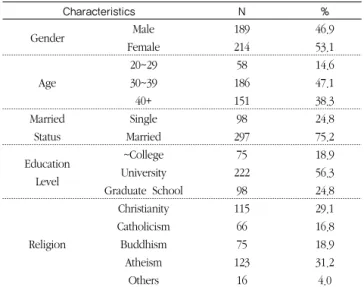
The demographic characteristics of the sample are presented in Table 1. Respondents consisted of 46.9% males and 53.1% females. In term of ages, 47.1% of the respondents were 30–39 years old, 38.3% were 40 or older, and 14.6% were 20–29 years. Approximately 24.8% were single and 75.2% were married. The majority of the respondents (81.1%) were highly educated, holding at least a university degree.
Characteristics N %
Gender Male 189 46.9
Female 214 53.1
Age
20~29 58 14.6
30~39 186 47.1
40+ 151 38.3
Married Status
Single 98 24.8
Married 297 75.2
Education Level
~College 75 18.9
University 222 56.3
Graduate School 98 24.8
Religion
Christianity 115 29.1
Catholicism 66 16.8
Buddhism 75 18.9
Atheism 123 31.2
Others 16 4.0
Table 1 Demographic characteristics of sample (N=395)
Instrument development
The survey instrument used to measure CSR activities and customer trust and satisfaction included a 7-point scale:
“How much do you agree or disagree with these statements?” (1: strongly disagree to 7: strongly agree). The measurement items for the study constructs are presented in Table 2.
CSR activities: McGuire JW (1963) defined CSR activities as
“businesses responsibility to society beyond their motives for profits.” Carroll AB (1979) shaped this concept in detail by defining CSR as the economic, legal, ethical, and philanthropic expectations that are given to a company by society. We adapted multi-item scales by Maignan I (2001) to measure customer perceptions of CSR activities, and modified them to fit the study settings. The study by Maignan I (2001) measured 16 items with four items in each by dividing the company's social responsibility into economic, legal, ethical, and philanthropic responsibilities. However, we measured 12 items referring to a study by Kim JK and Lim HC (2011), which considered CSR targeting foodservice companies.
Variables1) Mean ± SD
Corporate Social Responsibility
CSR1: Control their production costs strictly 4.91±1.40 CSR2: Plan for their long term success 5.42±1.45 CSR3: Always improve economic performance 5.16±1.37 CSR4: Ensure that their employees act within the
standards defined by the law 4.33±1.29 CSR5: Refrain from putting aside their contractual
obligations 4.37±1.27
CSR6: Always submit to the principles defined by
the regulatory system 4.31±1.35
CSR7: Ensure that the respect of ethical principles
has priority over economic performance 4.40±1.25 CSR8: Permit ethical concerns to negatively affect
economic performance 4.39±1.30
CSR9: Play a role in our society that goes beyond
the mere generation of profit 3.87±1.33 CSR10: Help solve social problems 3.80±1.39 CSR11: Participate in the management of public
affairs 3.91±1.38
CSR12: Allocate some of their resources to
philanthropic activities 4.01±1.50
Customer Trust
TR1: This restaurant can be trusted 4.66±1.42 TR2: This restaurant is safe 4.48±1.46 TR3: This restaurant is honest 4.19±1.44 TR4: This restaurant is like a friend 4.28±1.46 TR5: This restaurant will solve immediately given
the occurrence of a problem 4.59±1.36 Customer Satisfaction
CS1: I am pleased to visit this restaurant 4.75±1.28 CS2: I really enjoyed myself at the restaurant 4.77±1.24 CS3: This restaurant exceeded my expectations 4.76±1.26 CS4: Overall, I am satisfied with my experience at
this restaurant 4.81±1.32
Note: SD = Standard Deviation
1)All items were measured on a 7-point Likert scale from 1-strongly disagree to 7-strongly agree
Table 2 Descriptive statistics of variable
Customer trust: Gabarino E and Johnson MS (1999) conceptualized customer confidence by the quality and reliability of the service offered. We adapted Sirdeshmukh D et al (2002) and Vlashos PA et al. (2010) multi-item scales using five items.
Customer satisfaction: Howard JA and Sheth JN (1969) defined satisfaction as “a condition in which a purchaser recognizes that they have been rewarded in return for their consideration.” We adapted Chi CG and Gursoy D (2009), Fornell C et al. (1996), and Spreng RA et al. (1996) multi-item scales using four items.
Communalities Factor loading
F1 F2 F3 F4 F5
Economic Responsibility
CSR1 .67 .21 .11 .17 .09 .76
CSR2 .85 .09 .09 .16 -.05 .89
CSR3 .80 .14 .10 .13 -.01 .86
Legal-ethical Responsibility
CSR4 .79 .82 .18 .20 .17 .12
CSR5 .80 .83 .16 .19 .15 .14
CSR6 .74 .78 .20 .18 .18 .11
CSR7 .66 .64 .18 .22 .29 .29
CSR8 .69 .63 .25 .38 .22 .17
Philanthropic Responsibility
CSR9 .79 .36 .16 .16 .78 -.02
CSR10 .81 .32 .14 .12 .81 -.01
CSR11 .79 .15 .13 .15 .85 .07
CSR12 .75 .02 .11 .19 .83 .04
Customer Trust
TR1 .74 .24 .31 .64 .13 .39
TR2 .75 .19 .21 .74 .13 .32
TR3 .76 .21 .25 .78 .18 .11
TR4 .74 .20 .26 .74 .28 -.01
TR5 .71 .27 .22 .73 .13 .18
Customer Satisfaction
CS1 .86 .19 .81 .27 .11 .25
CS2 .89 .23 .86 .22 .14 .14
CS3 .85 .19 .83 .25 .21 .02
CS4 .87 .20 .86 .25 .16 .07
Eigen value 9.64 2.49 1.77 1.35 1.14
% of Variance 45.94 11.86 8.46 6.45 5.45
Total Cumulative 78.16%
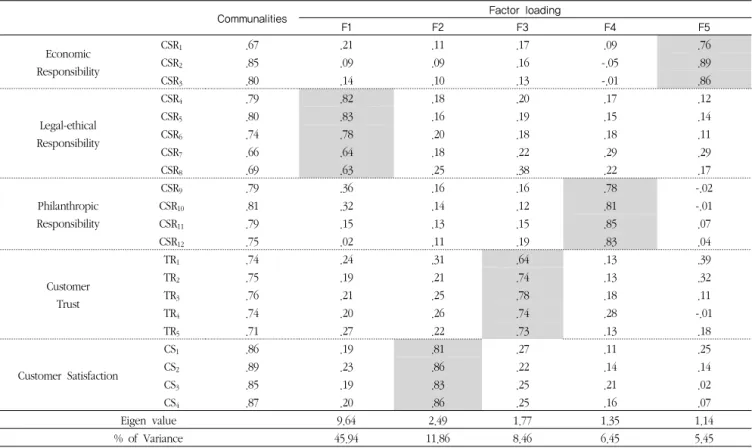
Table 3 Exploratory factor analysis properties
Results
Measurement model
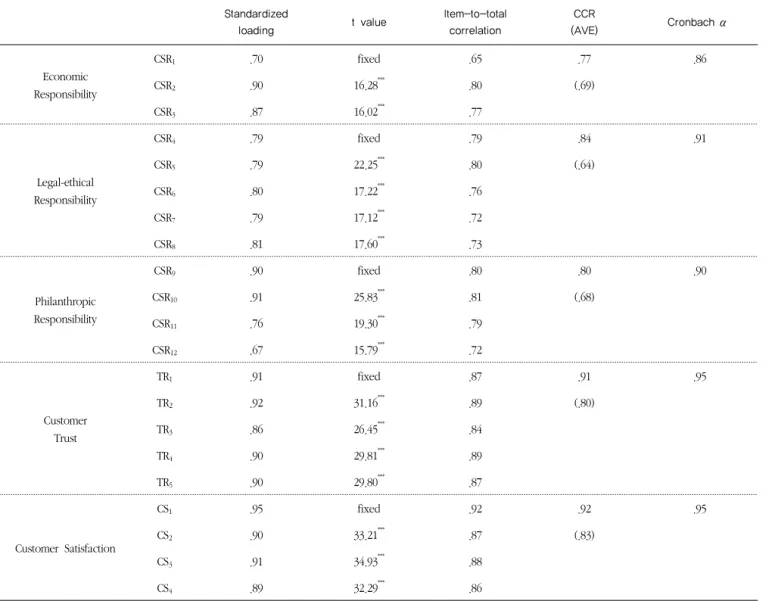
An exploratory factor analysis (EFA) was performed to verify the unidimensionality, reliability, and validity of the factors measured in this study. As a result of the EFA on five factors (economic responsibility, legal-ethical responsibility, philanthropic responsibility, trust, and satisfaction) were derived with a degree of fit of 78.16% (Table 3). This was consistent with three factors such as economic responsibility, legal-ethical responsibility, and philanthropic responsibility, as a result of considering consumer recognition on company social responsibility activity in the study by Salmones MMG et al. (2005). Following the two-step approach of Anderson JC and Gerbing DW (1988), the measurement properties are reported in Table 4. As shown in Table 4, the level of internal consistency in each construct was acceptable with Cronbach’s alpha estimates of .86–.95. Composite reliabilities estimates of .77–.92 above the recommended cutoff of .70 were considered acceptable. Convergent validity was observed, as all confirmatory factor loadings exceeded .68 and were significant at the alpha level of .001. Thus, these
results were evidence of convergent validity of the measures (Nunnally JC, 1978). Discriminant validity was assessed by comparing the average variance extracted with the squared correlation between constructs. Discriminant validity was shown, as the variance extracted estimates ranged from .64 to .83 and exceeded all squared correlations for each pair of constructs, ranging from .01 to .54. These results suggested that the five factors were distinct and unidimensional. In addition confirmatory measurement models demonstrated the soundness of measurement properties (χ2 (df=177) = 416.799;
p <.001; χ2/df = 2.35; Goodness of fit index (GFI) = .91;
Normed fit index (NFI) = .95; Comparative fit index (CFI) = .97; and root mean square error of approximation (RMSEA) = .05). Means, standard deviations, and correlations for the study’s constructs are presented in Table 5.
Standardized
loading t value Item-to-total
correlation
CCR
(AVE) Cronbach α
Economic Responsibility
CSR1 .70 fixed .65 .77 .86
CSR2 .90 16.28*** .80 (.69)
CSR3 .87 16.02*** .77
Legal-ethical Responsibility
CSR4 .79 fixed .79 .84 .91
CSR5 .79 22.25*** .80 (.64)
CSR6 .80 17.22*** .76
CSR7 .79 17.12*** .72
CSR8 .81 17.60*** .73
Philanthropic Responsibility
CSR9 .90 fixed .80 .80 .90
CSR10 .91 25.83*** .81 (.68)
CSR11 .76 19.30*** .79
CSR12 .67 15.79*** .72
Customer Trust
TR1 .91 fixed .87 .91 .95
TR2 .92 31.16*** .89 (.80)
TR3 .86 26.45*** .84
TR4 .90 29.81*** .89
TR5 .90 29.80*** .87
Customer Satisfaction
CS1 .95 fixed .92 .92 .95
CS2 .90 33.21*** .87 (.83)
CS3 .91 34.93*** .88
CS4 .89 32.29*** .86
Note: CCR=composite construct reliability; AVE=average variance extracted.
χ2=416.799; df=177; p<.001; χ2/df=2.35; Goodness of Fit Index (GFI)=.91; Normed Fit Index (NFI)=.95; Tucker Lewis Index (TLI)=.96; Comparative Fit Index (CFI)=.97; Incremental Fit Index (IFI)=.97; Root Square Error of Approximation (RMSEA)=.05; ***p<.001
Table 4 Reliability and confirmatory factor analysis properties
1 2 3 4 5 M±SD
1. Economic Responsibility 1.00 5.10±1.20
2. Legal-ethical Responsibility .41 1.00 4.30±1.09
3. Philanthropic Responsibility .14 .57 1.00 3.90±1.21
4. Customer Trust .33 .56 .42 1.00 4.44±1.32
5. Customer Satisfaction .54 .59 .37 .74 1.00 4.77±1.16
Note: All correlations are significant at p=<.001 (2-tailed) Table 5 Means, standard deviations, and correlations
Hypothesized Path
(stated as alternative hypothesis) β t-value Results
H1 Corporate Social Responsibility → Customer Trust Partially Supported
H1a ER → Customer Trust .14 2.74** Supported
H1b LER → Customer Trust .48 6.62*** Supported
H1c PR → Customer Trust .11 1.80ns Not Supported
H2 Corporate Social Responsibility → Customer Satisfaction Partially Supported
H2a ER → Customer Satisfaction .29 6.88*** Supported
H2b LER → Customer Satisfaction .21 3.57** Supported
H2c PR → Customer Satisfaction -.02 -.49ns Not Supported
H3 Customer Trust → Customer Satisfaction .52 12.01*** Supported
Goodness-of-fit statistics χ2(174)=370.97(p<.001)
χ2/df=2.13 GFI=.92 NFI=.95 CFI=.98 RMSEA=.05 Note: *p<.05, **p<.01, ***p<.001; ER=Economic Responsibility; LER=Legal-ethical Responsibility; PR=Philanthropic Responsibility Table 6 Structural parameter estimates
Structural Equation Model
SEM was conducted to test hypotheses 1 through 3.
Structural model fit was good (χ2=370.97; df=174; p<.001;
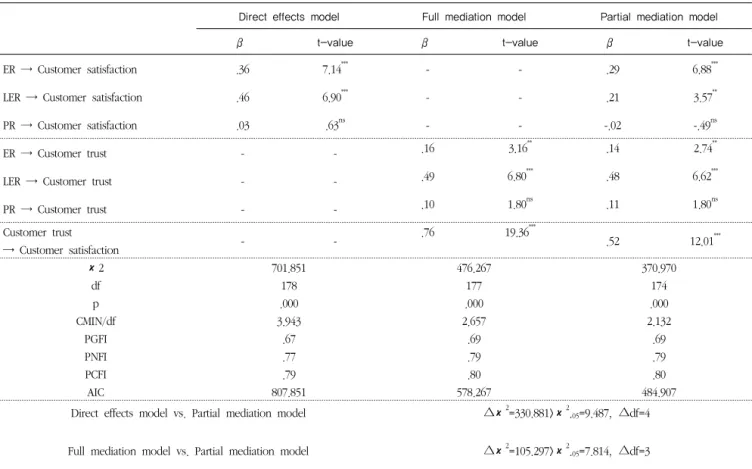
GFI=.92; NFI=.95; CFI=.98; RMSEA=.05). Table 6 presents the standardized path coefficients and associated t-values for all relationships in the structural model. Hypothesis 1 was that customer perception of the CSR activities of the family restaurant would significantly affect customer trust. This hypothesis was partially supported; although economic responsibility activities (β = .14), and legal-ethical responsibility activities (β = .48) significantly affected customer trust, philanthropic responsibility activities (β = .11) did not. These findings revealed that those who perceive legal-ethical and economic responsibility activities highly are more likely to believe in the value of customer trust.
Hypothesis 2 was that customer perception of the CSR activities of a family restaurant would significantly affect customer satisfaction of that restaurant. This hypothesis was also partially true; although economic responsibility activities (β = .29) and legal-ethical responsibility activities (β = .21) significantly affected customer satisfaction, philanthropic responsibility activities (β = -.02) did not significantly affect
customer satisfaction. However, the reason why only philanthropic responsibility activities did not affect customer satisfaction was that trust mediated customer satisfaction in the model. Hypothesis 3, which predicted a positive relationship between customer trust and satisfaction, was also supported (β = .52).
The mediating effect of customer trust
The four conditions of Baron RM and Kenny DA (1986) for mediating effects were examined. The first condition was satisfied if the independent variable (CSR activities) was significantly correlated with the mediator (trust). The second condition was satisfied if the mediator (trust) was significantly correlated with the dependent variable (customer satisfaction).
The third condition was satisfied if the independent variable (CSR activities) was significantly correlated with the dependent variable (customer satisfaction). The first three conditions were met (Table 5), given the significant correlation among the three constructs. The fourth condition was also satisfied (Table 6); thus, the basic requirements in Baron RM and Kenny DA (1986) for verifying a mediating role were satisfied: a significant relationship among the independent variable, dependent variable, and parameter through
Direct effects model Full mediation model Partial mediation model
β t-value β t-value β t-value
ER → Customer satisfaction .36 7.14*** - - .29 6.88***
LER → Customer satisfaction .46 6.90*** - - .21 3.57**
PR → Customer satisfaction .03 .63ns - - -.02 -.49ns
ER → Customer trust - - .16 3.16** .14 2.74**
LER → Customer trust - - .49 6.80*** .48 6.62***
PR → Customer trust - - .10 1.80ns .11 1.80ns
Customer trust
→ Customer satisfaction - - .76 19.36***
.52 12.01***
χ2 df
p CMIN/df
PGFI PNFI PCFI AIC
701.851 178 .000 3.943 .67 .77 .79 807.851
476.267 177 .000 2.657
.69 .79 .80 578.267
370.970 174 .000 2.132 .69 .79 .80 484.907 Direct effects model vs. Partial mediation model ∆χ2=330.881>χ2.05=9.487, ∆df=4
Full mediation model vs. Partial mediation model ∆χ2=105.297>χ2.05=7.814, ∆df=3 Note: *p<.05 **p<.01 ***p<.001; ER=Economic Responsibility; LER=Legal-ethical Responsibility; PR=Philanthropic Responsibility
Table 7 Mediating effects of customer trust
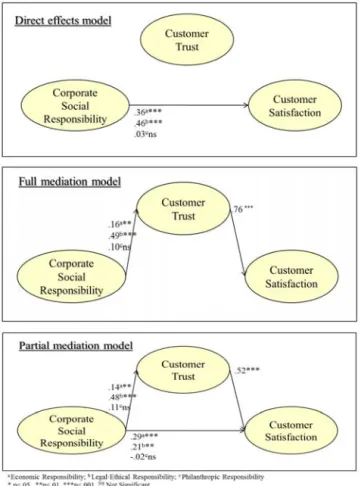
significance of the correlation result (Table 5) and path coefficient was observed (Table 6). However, an alternative model was additionally established and analyzed to verify a more strict hypothesis on the mediating role of the two variables. The alternative model 1 established that the direct path between social responsibility activity and customer satisfaction was not established. The alternative model 2 (partial mediator) additionally established that the path of CSR activities and customer satisfaction in all paths were established in the proposed model (full mediator). The result of comparing fitness between structural models is shown in Table 7 and Fig. 2. As a result of this analysis, legal-ethical responsibility activities were greater in total effect (β = .46) on customer satisfaction than a direct effect (β = .21). Thus, a customer trust effect existed. Also, the total effect (β =.36) on customer satisfaction was bigger than the direct effect in the case of economic responsibility activities (β = .29); thus, the mediating effect of customer trust was shown as well.
The mediating effect of customer trust existed; thus, this was judged to be a smaller influence on the independent variable.
As a result of additionally considering the improved fitness
for the full mediation model and the partial mediation model through a χ2-difference test, the partial mediation model had a smaller χ2 value by 105.297 compared to the full mediation model, and had fewer df by 3, there by it was better than that of the full mediation model (∆χ2 = 105.297
> χ2 (df=3) = 7.814; p < .05). Therefore, the influence of CSR activity of the family restaurant on customer satisfaction was mediated considerably by customer trust, even if incomplete. In other words, customer trust of the family restaurant had a mediating effect between the economic responsibility activity and the legal-ethical responsibility activities, which was recognized by customers by the CSR activities. In addition, economic and legal-ethical responsibility activities both had direct effects on customer satisfaction.
Figure 2. Mediating effects of customer trust
Discussion
We examined how foodservice industry customers perceive CSR activities in relation to customer trust and satisfaction.
The major findings are as follows:
First, the perception of CSR activities in the family restaurants had a positive effect on customer trust.
Specifically, economic responsibility, and legal-ethical responsibility among three CSR activities had a significant effect on customer trust. In particular, legal-ethical responsibility activities were considered to have the highest influence on customer trust. This result was partially consistent with the company’s social responsibility activity, which has significant influence on the corresponding company’s confidence in Park JC and Hong SJ (2009) of targeting general companies, and also with what Lee HJ and Park JC (2009) stated that the economic responsibility activity of a domestically large company social responsibility activity has the greatest influence on customer confidence. This occurs because the legal and ethical responsibility activity allows a company to observe the legal requirements demanded by society while performing economic activity.
Thus, this kind of social responsibility activity should have a strong influence on customer confidence. Second, the perceptions on CSR activities in the family restaurants had a partially positive effect on customer satisfaction. Specifically, economic and legal-ethical responsibility activities had a significant effect on customer satisfaction. However, the philanthropic responsibility activities did not have significant effects. These results were partially similar to the results of studies by Lafferty B and Goldsmith RE (1999), Mohr LA et al. (2001), and Salmones MMG et al. (2005), indicating that the image of businesses that fulfilled CSR eventually developed positive customer satisfaction, because the CSR activities became the basis of trust (Maignan I et al. 1999).
In addition, these results were partially consistent with Kim DJ and Kim YJ (2012) who mentioned that the appearance of performing social responsibility activity functions is an important factor given the purchase decision making for customers eating at restaurants. The case of philanthropic responsibility did not have significant influence on confidence or satisfaction. This was likely due to the average value that philanthropic responsibility had with the respondents of this study (3.90 ± 1.21), which was having shown the noticeably low compared to other social responsibility activities (economic responsibility, 5.10 ± 1.20; legal-ethical responsibility, 4.30 ± 1.09). In other words, many respondents perceived that the domestic foodservice companies did not make charitable donations. Furthermore philanthropic responsibility did not have a significant outcome on consumer confidence or satisfaction. Third, customer trust had a significant positive effect on customer satisfaction. This result was consistent with Morgan R and Hunt S (1994) who verified that customer trust is a very important factor affecting satisfaction and commitment. Accordingly, customer recognition of knowledge related to CSR activity in a foodservice company has a positive effect on customer satisfaction and creates trust in the service provided by the company performing the CSR activity. Fourth, the fitness of the partial mediation model for verifying the mediating effect of confidence as an influence CSR activities in family restaurant on customer satisfaction was excellent. Thus, the partial mediating effect of confidence was verified.
Consequently, the influence of legal-ethical responsibility activities among CSR activities in the foodservice industry on customer satisfaction was mediated considerably by customer trust. In particular, according to a number of studies, only this direct causality should be considered when stating that CSR activities have a positive effect on customer satisfaction even if there is no direct relationship with product attributes.
However, the role of customer trust was very significant.
The following implications can be stated based on the
results. First, a theoretical foundation was offered through an empirical analysis of the causality between CSR activity in a family restaurant and customer satisfaction. Most preceding research verified that CSR activity has a significant effect on customer purchase behavior from the perspective of valuation of particular products. However, many domestic and overseas studies have targeted the hospitality industry as a typical service company offering intangible services. This study will likely have value as the first study verifying the influence of customer recognition of CSR activities by a family restaurant on confidence and satisfaction. One important finding of the present study was that customer trust appeared to play a mediating role between perceived CSR activities and customer satisfaction. In other words, CSR activities indirectly affected customer satisfaction through customer trust. This suggests that CSR activities of a family restaurant not only have a direct influence on customer satisfaction but also have an indirect influence in which the CSR activities of the restaurant allow customers to develop confidence in the corresponding company, thereby increasing satisfaction. Hence, CSR activities not only promote customer satisfaction from the long-term perspective, but are also capable of contributing to building confidence between the customer and the company.
Limitations and future research
The representative characteristic may be questioned due to targeting of only family restaurant customers who resided in the Seoul metropolitan area. In addition, as the family restaurants selected cannot be judged as representative of all foodservice industries, there may be a problem with the representativeness of the samples. The questionnaire contents, which were used for measuring CSR activities, applied to companies in general, not to family restaurants specifically.
Thus, it is unreasonable to generalize these results to all family restaurants. In addition, perceptions of CSR activities may differ depending on individual differences, such as customer recognition of a company and an individual’s value system. The findings may have been possibly influenced by customer’s lack of recognition on social responsibility activity in foodservice companies and by low customer evaluation level caused by the currently insufficient social responsibility activity of domestic foodservice companies. However, considering that this is the first study that has considered the relationships between social responsibility activity and confidence and satisfaction targeting foodservice companies, a role of a catalyst is expected for performing strategically social responsibility activity based on these findings. It also follows that analysis of the results of this study may be insufficient due to the absence of relevant preceding research. Accordingly, additional research on
variables that can evaluate levels of CSR activities while reflecting characteristic propensity in family restaurants must be conducted. Thus, brisk follow-up research is necessary to elicit more objective and substantial results.
References
Anderson JC, Gerbing DW. 1988. Structural equation modeling in practice: A review and recommended two-step approach.
Psychological Bulletin 103(3):411-423
Baron RM, Kenny DA. 1986. The moderator-mediator variable distinction in social psychological research: conceptual, strategic and statistical considerations. J Pers Soc Psychol 51(6):1173-1182 Bentler PM, Bonett DG. 1980. Significance tests and goodness-of-fit
in the analysis of covariance structures. Psychological Bulletin 88(3):588-600
Berens G, Van Riel CBB, Van Bruggen GH. 2005. Corporate associations and consumer product responses: The moderating role of corporate brand dominance. J Marketing 69(1):35-18 Bhattacharya CB, Sen S. 2003. Consumer-company identification: A
framework for understanding consumers’ relationships with companies. J Marketing 67(1):76-88
Bowen HR. 1953. Social Responsibilities of the Businessman. New York, NY: Haper and Row.
Branco MC, Rodrigues LL. 2006. Corporate social responsibility and resource-based perspectives. J Business Ethics 69(2):111-132 Brown TJ, Dacin PA. 1997. The company and the product: corporate
associations and consumer product response. J Marketing 61(1):68-84
Carroll AB. 1979. A three-dimensional conceptual model of corporate social performance. Academy of Management Review 4(4):497-505
Caudron S. 1997. Forget image: it's reputation that matters. Industry Week 3(Feb):13
Chi CG, Gursoy D. 2009. Employee satisfaction, customer satisfaction, and financial performance: An empirical examination. Inter J Hospitality Management 18(2):245-253
Chung KY, Park JY, Oh MS. 2011. Exploration and importance-performance analysis of critical success factors for hotel corporate social responsibility. Korean Aca Soc Hospitality Administration 20(1):203-224
Damitio JW, Whitney DL, Schmidgall RS. 1992. Ethical orientation of
hospitality educators. Hospitality Research J 16(1):75-92
David P, Kline S, Dai Y. 2005. Corporate social responsibility practices, corporate identity and purchase intention: A dual-process model. J Public Relations Research 17(3):291-313 Enghagen LK, Hott DD. 1992. Students' perceptions of ethical issues
in the hospitality and tourism industry. Hospitality Research J 15(2):41-50
Flavián C, Guinalíu M, Gurrea R. 2006. The role played by perceived usability, satisfaction and consumer trust on website loyalty. Information and Management 43(1):1-14
Fornell C, Larcker DF. 1981. Evaluating structural equation models with unobservable variables and measurement error. J Marketing Research 18(1):39-50
Fornell C, Johnson MD, Anderson EW, Cha J, Bryant BE. 1996. The American customer satisfaction index: Nature, purpose and finding. J Marketing 60(4):7-18
Gabarino E, Johnson MS. 1999. The different roles of satisfaction, trust and commitment in consumer relationship. J Marketing 63(2):70–87
Garay L, Font X. 2011. Doing good to do well? corporate social responsibility reasons, practices and impacts in small and medium accommodation enterprises. Inter J Hospitality Management ARTICLE in PRESS
Grosbois DD. 2011. Corporate social responsibility reporting by the global hotel industry: Commitment, initiatives and performance.
Inter J Hospitality Management ARTICLE in PRESS
Hair JFJr, Anderson RE, Tatham RL, Black WC. 2006. Multivariate Data Analysis with Readings. 6th ed. New York, NY: Macmillam Publishing Company.
Holliday I. 2005. Doing business with rights violating regimes corporate social responsibility and Myanmar’s military junta. J Business Ethics 61(4):329-642
Hong SY, Rim H. 2010. The influence of customer use of corporate websites: Corporate social responsibility, trust, and word-of-mouth communication. Publish Relations Review 36(4):389-391
Howard JA, Sheth JN. 1969. The Theory of Buyer Behavior. New York, NY: John Wiley & Sons.
Huimin G, Ryan C. 2011. Ethics and corporate social responsibility:
An analysis of the views of Chinese hotel managers. Inter J Hospitality Management 30(4):875-885
Jamali D, Mirshak R. 2007. Corporate social responsibility theory and practice in a developing country context. J Business Ethics
72(3):243-262
Jarvenpaa S, Tractinsky N, Vitale M. 2000. Consumer trust in an internet store. Information Technology and Management 1(1/2):45-71
Kang KH, Lee SK, Huh C. 2010. Impact of positive and negative corporate social responsibility activities on company performance in the hospitality industry. Inter J Hospitality Management 29(1):72-82
Kim DJ, Kim YJ. 2012. A study on customer perception on a food service company`s corporate social responsibility activities.
Culinary Society of Korea 18(1):259-271
Kim JK, Lim HC. 2011. Effects of corporate social responsibility on service quality: Moderating effect of trust. Service Management Society 12(1):75-92
Lafferty B, Goldsmith RE. 1999. Corporate credibility’s role in consumer attitudes and purchase intentions when high versus a low credibility endorser is used in the ed. J Business Research 44(2):109-116
Lee HJ, Park JC. 2009. The effects of corporate social responsibility activities on product and corporate evaluation: the mediating role of trust. J Marketing Management Research 24(1):231-250 Lee J, Kim J, Moon J. 2000. What makes internet users visit cyber
stores again? Key design factors for customer loyalty in:
Proceedings of the Conference on Human Factors in Computing Systems CHI 2000, ACM, New York. 305-312
Lee KH, Shin DY. 2010. Consumers’ response to CSR activities: the linkage between increased awareness and purchase intention.
Public Relations Review 36:193-195
Lee SK, Heo YJ. 2009. Corporate social responsibility and customer satisfaction among US publicly traded hotel and restaurant. Inter J Hospitality Management 28(4):635-637
Lee SK, Park SY. 2009. Do socially responsible activities help hotel and casino achieve their financial goals? Inter J Hospitality Management 28(1):105-112
Lee YK, Kim YS, Lee KH, Li DX. 2011. The impact of CSR on relationship quality and relationship outcomes: A perspective of service employees. Inter J Hospitality Management ARTICLE in PRESS
Luo X, Bhattacharya CB. 2006. Corporate social responsibility, customer satisfaction, and market value. J Marketing 70(4):1-18 Madrigal R. 2000. The role of corporate associations in new product
evaluation. Advances in Consumer Research 27(1):80-86
Maignan I. 2001. Consumers' perception of corporate social