Corresponding author:Yang, Hongmo, Department of Landscape Architecture, College of Agriculture and Life Science, Chonnam National University, Kwang-Ju 500-757,
Tel:+82-62-530-2101, E-mail:[email protected]
- 89 -
하천수정화 여과습지에서 성장하는 갈대의 영양염류 흡수량
양 홍 모 전남대학교 조경학과
Nutrient Uptake by Reeds Growing in Subsurface-flow Wetland Constructed to Purify Stream Water
Yang, Hongmo
Department of Landscape Architecture, College of Agriculture and Life Science, Chonnam National University.
ABSTRACT
The growth and biomass of reeds( Phragmites australis ) growing in a subsurface treatment wetland system were investigated from April 2003 to October 2003. Nitrogen(N) and phosphorous(P) concentrations in above-ground(AG) and below-ground(BG) tissues of reeds were examined and the removal rate of N and P by reeds were analyzed. The system, 29 m in length, 9 m in width and 0.65 m in depth, was constructed in June 2001 on a floodplain in the down reach of the Kwangju Stream in Korea in order to purify polluted water of the stream. A bottom layer of 45 cm in depth was filled with crushed granites(15~30 mm in diameter) and a middle layer of 10 cm in depth was filled with pea pebbles(10 mm in diameter). An upper layer of 5 cm contained course sand. Reeds were transplanted on the surface of the system, which were dug out of natural wetlands, and their shoots were trimmed 40 cm in height.
The height and density of the shoots averaged 237.7 cm and 244.0 shoot/m 2 , respectively, when the reeds grew fully. The maximum biomass of AG and BG tissues were 1,964 and 1,577 g/m 2 , respectively, and the AG:BG ratio of biomass was 1.26. Mean AG and BG dry weights were recorded as 1,355 and 748 g/m 2 , respectively. The AG and BG tissue concentrations of N averaged 12.37 and 10.01 mg/g, respectively, and those of P 2.37 and 2.03 mg/g, respectively. Inflow to the system averaged 40 m 3 /day.
The concentrations of total nitrogen(T-N) in influent and effluent were 8.4 mg/L and 3.2 mg/L,
respectively, and those of total phosphorous(T-P) were 0.73 and 0.38 mg/L, respectively. The total
removal of T-N and T-P by the system during the investigation period averaged 140.2 and 9.7 g/m 2 ,
respectively, and the total uptake of N and P by the reeds were calculated as 24.39 and 4.73 g/m 2 , respectively. Average removals of about 17% of N and about 49% of P by reeds were recorded. The N and P concentrations in AG tissues were significantly different among the three zones of the system:
near to inflow(St1), in the middle of system(St2), and near to outflow(St3). The N and P concentrations in BG tissues were also significantly different among St1, St2 and St3. N and P concentrations in AG and BG tissues of reeds growing in St1 were higher than those in St2 and St3. The height and density of shoots of reeds in St1 were larger than those in St2 and St3. Significant amounts of N and P in the influent were taken up by reeds in St1.
Key Words: Above-ground biomass, Dry weight, Nutrient uptake, Shoot density, Subsurface flow wetland system.
I. 서 론
수질을 정화하기 위해 인위적으로 조성한 습 지를 인공습지라고 부르며, 구조적 특징에 따라 자유수면습지(surface flow wetlands)와 여과습지 (subsurface flow wetlands)로 구분한다(Corbitt and Bowen 1994; 양, 1999). 자유수면습지는 약 1 m 높이로 둑을 조성하고 습지바닥에 정수식물 을 식재하며, 수심을 20~30 cm로 유지하여 유입 수가 습지바닥과 정수식물 사이를 흐르면서 정화 된다. 여과습지는 0.6~1 m 깊이 트렌치(trench) 구조물을 땅속에 설치한 후 매질(자갈, 모래 등) 을 채우고 표면에 정수식물을 심으며, 유입수가 매질과 식물뿌리 사이를 흐르면서 정화된다. 여 과습지의 정수식물로 갈대를 많이 사용하고 있어 여과습지를 갈대상(reed bed)이라고도 부르며, 여 과습지의 정수식물은 성장에 필요한 양분을 대부 분 유입수에서 흡수하게 된다. 여과습지는 생활 하수(Reed, et al., 1988), 산업폐수(Vrhovsek, et al., 1996) 등을 정화하기 위해 주로 사용해 왔으며, 최근에는 오염정도가 상대적으로 낮은 하천수 및 강우유출수(Green and Martin, 1996; Higgins, et al., 1993)를 정화하기 위해서도 활용하고 있다.
인공습지의 정수식물은 다양한 물리적, 생물화 학적 기능을 제공한다. 정수식물은 유입수의 흐 름을 느리게 하여 미생물이 부착할 수 있는 표면
적을 증가시켜주는 역할을 한다. 햇빛을 차단하 여 녹조의 성장을 억제하고, 겨울철에 습지의 온 도가 내려가는 현상을 막아주는 역할을 하며, 잔 재물층은 단열막 역할을 하여 습지가 동결되는 것을 억제해 준다(Brix, 1997). 정수식물은 성장 과 번식에 필요한 영양염류를 뿌리로부터 흡수 하여, 인공습지로 부하된 질소와 인을 제거하는 역할을 한다. 정수식물의 통기조직은 대기 중의 산소를 뿌리로 전달할 수 있으며 뿌리로부터 방 출된 산소는 뿌리주변에 호기성 상태를 유지시 켜 유기물의 분해와 질산화를 높여주는 역할을 한다. 정수식물은 야생동물의 서식처와 시각적 아름다움을 제공해주는 보조적 기능도 가지고 있다.
자연습지에서 자라는 정수식물에 대한 성장,
밀도, 생체량에 관한 연구는 비교적 많으나 인공
습지의 정수식물에 대한 연구는 아주 적다. 여과
습지에서 성장하는 정수식물의 영양염류 흡수에
대한 연구는 소규모(mesocosm) 실험장치를 설치
하여 짧은 성장기간에 수행된 경우가 대부분이어
서 실험결과를 실규모 여과습지 조성에 적용하는
데는 한계가 있다. 여과습지에서 성장하는 갈대
가 흡수하는 영양염류량에 관한 연구들은 유입수
가 점오염원인 생활하수 혹은 산업폐수로 오염농
도가 비교적 고농도인 경우가 대부분이며, 오염
물농도가 저농도인 하천수를 정화하는 여과습지
의 갈대가 흡수하는 영양염류에 대한 연구는 거 의 없다. 국내의 경우 여과습지 정수식물의 생체 량과 영양염류 흡수에 관한 연구는 거의 찾아보 기 어려운 실정이다. 실규모로 운영중인 여과습지 의 정수식물 조사분석을 통하여 국내의 기후 및 환경여건에 적합한 인공습지 설계, 조성, 운영에 정보를 제공할 수 있는 연구가 절실히 요청된다.
오염농도가 상대적으로 낮은 오염하천수, 강우 유출수를 정화하기위해 인공습지를 조성하는 경 우 질소와 인의 제거가 인공습지 조성의 주목적 이 되는 경우가 많다. 인공습지에서 정수식물이 흡수하는 질소와 인은 질소와 인의 제거에 중요 한 역할을 한다. 하천으로 유입되는 영양염류의 양이 많아지면 부영양화를 야기시켜 하천의 생태 계에 나쁜 영향을 미치게 된다. 하천수에 함유되 어 있는 질소와 인을 제거하기 위해 다양한 기법 들이 활용되고 있으며, 최근 훼손된 하천생태계 를 복원하기위해 자연형하천정비 사업을 추진하 면서 하천에 습지를 조성하여 하천수를 자연생태 적으로 정화하면서 하천습지를 복원하는 방법에 관심이 높아지고 있다.
인공습지의 오염물질제거량에 관한 연구들은 인공습지로 유입되는 유입수와 인공습지에서 처 리되어 방류되는 유출수의 오염물질농도를 기준 으로 분석한 경우가 대부분이며, 인공습지의 수 질정화에서 중요한 역할을 하는 정수식물에 의해 흡수되어 제거되는 양에 관한 연구는 매우 적다.
본 연구는 오염하천수를 정화하기 위해 하천 고 수부지에 실규모로 조성한 여과습지 시스템에서 성장하는 갈대의 초장, 밀도, 생체량을 분석하고, 갈대의 지상부와 지하부에 흡수된 질소와 인의 함양을 분석하여 갈대에 흡수되어 제거되는 질소 와 인의 양을 연구하는데 목적이 있다.
II. 재료 및 방법
광주광역시를 흐르는 광주천 하류의 고수부지 에 2001년 6월에 여과습지 시스템을 조성하였다.
고수부지 표면으로부터 1 m 아래에 깊이 0.65 m 의 콘크리트 박스를 설치하고 쇄석을 45 cm 높 이로 채운 후, 콩자갈을 15 cm 깊이로 넣고, 그 위에 굵은 모래를 덮었다. 시스템은 길이 29 m, 폭 9 m로 면적이 260 m 2 이다(Figure 1). 시스템 은 광주천 수중보의 수심 약 20 cm 깊이에서 광 주천의 물이 자연유하로 유입되도록 조성하였다.
자생 갈대( Pragmatis autralis )를 채취하여 근부 에서 40 cm 높이로 줄기를 절단한 후 약 30 cm 간격으로 시스템 표면에 식재하였다. 2001년 식 재한 갈대는 그해 겨울에 잎과 줄기가 죽었고, 2002년 봄에 새줄기가 나와 성장한 후 겨울철에 다시 줄기와 잎이 죽고, 2003년 4월부터 새줄기 가 나오기 시작하였다.
시스템의 유입수와 유출수를 7~10일에 한번 샘플링하여, 환경부 수질오염공정시험방법(환경 부, 2000)을 기준으로 미국공중보건협회(APHA, 1998)의 수질분석방법을 참고하여 T-N, T-P를 분 석하였다. 2003년 4월부터 9월까지 갈대의 분지수 와 초장을 매월 하순 1회 조사하였다. 1 m × 1 m 격자 틀을 이용하여 분지수와 초장을 측정하였으 며, 조사지점은 시스템의 유입부(St1), 중앙부 (St2), 유출부(St3)에서 횡으로 각각 3군데씩 선 정하였다(Figure 1). 분지수는 각 조사지점의 격 자틀 내의 전수를 조사하였으며, 초장은 각 조사 지점의 격자틀 내 10개체를 3회 반복으로 30개체 를 측정하여 평균값으로 나타냈다.
갈대의 지상부(above-ground)와 지하부(below-
ground)의 생체량, 건중량, 질소와 인의 함량을
조사하기위해 갈대가 충분히 성장한 후 성장을
멈추는 2003년 10월 초에 시스템의 유입부, 중앙
부, 유출부에서 0.5 m × 0.5 m 방형 3곳의 갈대
를 채취하였다(Figure 1). 지상부를 잘라내 이물
질을 제거하고, 지하부는 자갈과 모래를 제거한
후 세척하여 무게를 측정하였다. 전년도에 성장
한 죽은 줄기와 뿌리는 제거하고 측정하였으며,
건중량은 80℃에서 48시간 이상 건조시켜 측정
하였다. 질소와 인의 함량은 채취한 각 방형에서
st1 st2 st3
29m9m
Inflow Outflow
Figure 1. Schematic plane of the subsurface-flow treat- ment wetland system constructed on a flood- plain in the down reach of the Kwangju Stream. Reeds( Phragmites australis ) were transplanted on the surface of the system.
Black squares represent the sampling locations for the examination of shoot height, shoot density, and nutrient uptake by reeds. St1 denotes the zone near to inflow, St2 represents one in the middle of the system and St3 designates one near to outflow.
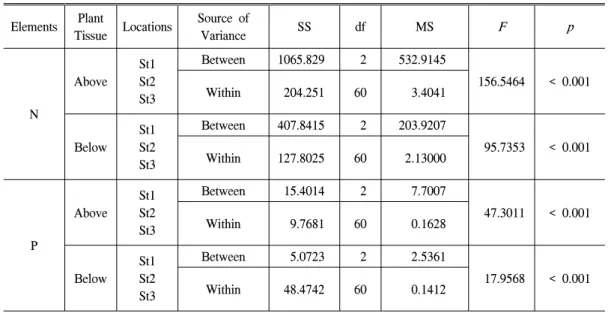
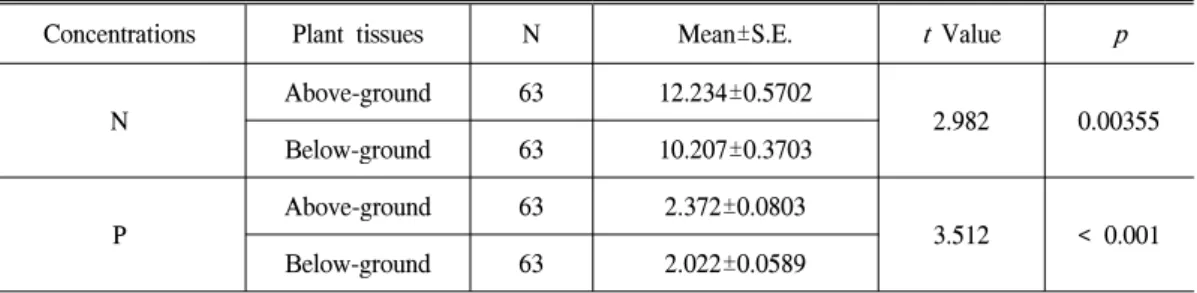
7개체를 선정하여 건조시켜 분쇄한 후 분석하였 다. 질소는 Kieldahl 분해방법을 활용하여 분석하 였으며, 인은 Vanadate법을 활용하였다(농업과학 기술원, 2000; Allen et al, 1974). 유입부, 중앙부, 유출부의 위치에 따른 지상부와 지하부의 N 함량 과 P함량에 차이가 있는지를 알아보기 위해 Oneway ANOVA 분석을 수행하였으며, 지상부와 지하부의 N과 P 함량에 차이가 있는지를 알아보 기 위해 t -검정을 수행하였다. ANOVA와 t -검정 에는 Excel(2003)에서 운영 되는 DDXL Program 을 활용하였다.
III. 결과 및 고찰
1. 갈대의 성장 및 생체량
조사기간 광주천 하천수가 시스템으로 하루 약 40 m 3 가 유입되도록 운영하였으며, 시스템 수 심을 0.6 m로 조절하여 유입수의 평균체류시간 은 약 1.5 days였다. 4월 초부터 갈대의 새줄기가 나오기 시작하여 9월 말까지 자랐으며, 10월 초 부터 일부 잎이 마르기 시작하였다.
시스템 유입부, 중앙부, 유출부의 4월 평균초 장은 각각 72.1, 65.3, 50.6 cm였으며, 7월에는 각 각 254.9, 224.4, 199.6 cm로 자랐다. 갈대가 충분
히 자란 9월 말에는 유입부의 초장이 264.5 cm에 달하였으며, 유출부는 218.1 cm로 약 46.4 cm의 차이를 보였다(Figure 2). 유입부, 중앙부, 유출부 의 4월 줄기밀도(이하 밀도)는 각각 168.1, 101.9, 87.3 shoot/m 2 였으며, 7월에는 각각 246.6, 231.3, 208.8 shoot/m 2 였다. 9월 말에는 유입부와 유출부 의 밀도가 각각 263.9, 218.1 shoot/m 2 로 유입부의 밀도가 45.8 shoot/m 2 높았다. 5월의 유입부 밀도 는 144.5 shoot/m 2 로 4월에 비해 23.6 shoot/m 2 낮 아지는 현상을 보였다(Figure 3). 이는 단일수종 재배에서 개체들이 커지면서 햇빛을 받는 양이 적어 밀도가 낮아지는 현상(self-thinning)에 원 인이 있으며, 줄기의 밀도는 낮아지나 개체의 무게는 증가하여 총 생체량은 증가하게 된다 (Parr, 1990).
Figure 4는 조사한 갈대의 초장과 밀도를 시스 템 평균으로 환산하여 나타낸 것이다. 4월에 평 균초장이 62.7 cm에서 7월에 226.3 cm로 왕성한 성장을 한 후 8월~9월에는 완만한 증가를 보였 다. 갈대가 충분히 자란 9월 말의 평균초장은 237.7 cm였다. 밀도도 초장과 비슷한 추이를 보 였다. 4월에 평균밀도 105.8 shoot/m 2 에서 7월에 228.9 shoot/m 2 로 급격히 증가하다가 8월~9월에 는 완만히 증가하는 추세를 보였다. 9월 말의 평 균밀도는 244.0 shoot/m 2 였다. 식재한 갈대가 2회 의 성장기를 거쳐 3회 성장기인 2003년 4월~9 월에 양호한 성장을 보였다.
시스템의 유입부, 중앙부, 유출부의 초장과 밀 도는 유입부가 높고 유출부가 낮았으며, 유입부 에서 유출부로 갈수록 초장과 밀도가 점점 낮아 지는 경향을 보였다(Figure 2, Figure 3). 이는 유 입부의 갈대가 유입수에 함유되어 들어오는 영양 염류를 먼저 흡수한데 원인이 있다.
수질정화 인공습지에서 성장하는 갈대의 최대
초장은 106~332 cm의 범위를 보이고 있다(Table
1). 범위가 넓은 이유는 유입수의 영양염류 농도
와 기후조건이 갈대의 성장에 영향을 미치기 때
문이다. 1차처리 하수를 정화하는 여과습지의 갈
Country Influent Length(cm) Source
Australia Tertiary 106~146 Greenway, 2002
Poland Sewage 216 Obarska-Pempkowiak and Ozimek, 2003
Germany Storm water 150~220 Gries and Grarbe, 1989
Czech Sewage 114~332 Vymazal and Krȍpfelová, 2005
Table 1. Above-ground biomass of Phragmites australis growing in constructed treatment wetlands.
0 100 200 300
Apr(03) May Jun Jul Aug Sep Month
Height (cm)
St 1 St 2 St 3
Figure 2. Monthly mean height (cm) of reed shoots at the three locations(St1, St2 and St3).
0 100 200 300
Apr(03) May Jun Jul Aug Sep Month
Density (shoot/m2)
St 1 St 2 St 3
Figure 3. Monthly mean density of reed shoots(shoot/m
2) at the three locations(St1, St2 and St3).
대초장은 114~332 cm(Vymazal and Krȍpfelová, 2005), 150~220 cm(Gries and Grarbe, 1989)를 보였고, 유입수의 농도가 비교적 낮은 시스템의 갈대초장은 106~146 cm를 나타냈다(Greenway, 2002). 본 연구의 갈대 평균초장은 237.7 cm로 Table 1에 제시된 초장의 중간정도 범위에 속한 다. 본 연구 시스템의 유입수 농도가 비교적 낮은 것을 고려하면 갈대의 초장은 비교적 양호한 수 준이다. 여과습지에서 성장하는 갈대의 밀도도 범위가 넓다. 자갈을 넣고 갈대를 식재한 소규모 (mesocosm) Tank(190ℓ)에 질소의 함량이 높은 축산폐수 1차처리 방류수(T-N 98.5 mg/L)를 주입
0 50 100 150 200 250 300
Apr(03) May Jun Jul Aug Sep
Month
D e n si ty (sh o o t/m
2)
0 50 100 150 200 250
H e ig h t ( cm )
Shoot Density Shoot Height
Figure 4. Average monthly height(cm) and density (shoot/m
2) of reeds growing on the subsurface wetland system from April 2003 to Sep- tember 2003. The height and density were calculated from the values of the nine sampling locations(Figure 1).
하였을 경우 갈대의 밀도가 758 shoot/m 2 에 달하 였다(Tanner, 1996). 체코에서 운영 중인 14개 오 폐수정화 여과습지의 연구에서 갈대 밀도는 11 4~332 shoot/m 2 범위를 보였으며(Vymazal and Krȍpfelová, 2005), 본 연구에서 조사된 갈대 평 균밀도는 224.0 shoot/m 2 는 체코에서 조사된 범 위의 중간 정도에 해당된다.
실험 여과습지의 유입부, 중앙부, 유출부의 지
상부 생체량은 각각 2,496, 1,852, 1,546 g/m 2 였
고, 지하부 생체량은 각각 2,117, 1,538, 1,078
g/m 2 였다(Figure 5). 시스템의 지상부와 지하부
평균생체량은 각각 1,964, 1,577 g/m 2 로 지상부
생체량이 다소 높게 나타났으며, 지하부:지상
부 생체량비는 0.80를 나타냈다. 외국의 호수 변
에서 자라는 갈대의 최대 생체량은 669~4,424
g/m 2 범위이며, 국내의 하구나 염습지에서성장하
는 갈대의 최대 생체량은 670~4,650 g/m 2 범위
를 보이고 있다(Table 2). 외국의 여과습지에서
0 500 1000 1500 2000 2500 3000
St 1 St 2 St 3
Location Biomass (g/m2)
Above-Ground Below -Ground
Figure 5. Biomass(g/m
2) of the fully-grown reeds in the surface of the subsurface wetland system at the three locations(St1, St2 and St3).
Table 2. Above-ground biomass of Phygrgmites australis growing in natural and constructed wetlands.
The biomass represents maximum values.
Wetland
types Locality Characteristics Biomass (g/m
2)
Natural
Scotland
1)Mesotrophic lake 669 Scotland
2)Eutrophyic lake 3,975 England
3)Polluted lake 4,424 Korea
4)Estuarine area 670-4,650 Korea
5)Salt marsh 2,980 Korea
6)Estuarine area 3,504
Constructed
Germany
7)Subsurface flow 1,360 Czech
8)Subsurface flow 2,088 Austria
9)Subsurface flow 3,100 Source:1) and 2):Ho, 1979, 3):Boar et al., 1989, 4):김철수, 1975, 5):김준호․민병미, 1983, 6):문 형태 등, 1999, 7):Gries and Garbe, 1989, 8):
Vymazal et al., 1999, 9):Harberl and Perfler, 1990.
성장하는 갈대의 지상부 최대 생체량은 1,360~
3,100 g/m 2 범위이다. Tanner(1996)의 연구에서 갈대 지상부 생체량은 1,800 g/m 2 를 보였고, 지하 부:지상부 생체량 비율은 1.29로 지하부 생체량 이 다소 높게 나타났다. Gries and Grabe(1989)의 연구에서는 갈대 지상부 생체량이 1.36 kg/m 2 였 고 지하부:지상부의 비율이 0.42로 지하부 생체 량이 낮았다. 본 연구의 지상부 평균생체량은 1,964 g/m 2 는 Table 2에 제시된 여과습지 지상부 생체량의 중간정도에 해당한다.
2. 건중량 및 질소․인 함량
유입부, 중앙부, 유출부의 지상부 건중량은 각 각 1,570, 1,321, 1,174 g/m 2 로, 지하부 건중량은 각각 886, 745, 614 g/m 2 로 조사되었다(Figure 6).
시스템 전체 지상부와 지하부의 평균건중량은 각 각 1,355, 748 g/m 2 였으며, 지상부와 지하부의 건 중량을 합한 총 건중량은 2,103 g/m 2 이다. 지하 부:지상부 건중량비는 0.83으로 지하부의 건중 량이 낮게 나타났다. 분석결과 건중량은 유입부 가 중앙부 및 유출부보다 높게 나타났다.
0 500 1000 1500 2000
St 1 St 2 St 3
Location D ry W e ig h t (g /m
2)
Above-Ground Below-Ground
Figure 6. Dry weight(g/m
2) of the fully-grown reeds in the subsurface wetland system at the three locations(St1, St2 and St3).
유입부, 중앙부, 유출부의 지상부 질소함량은 각각 18.3, 10.1, 8.7 mg/g로, 지하부 질소함량은 각각 13.5, 9.2, 7.3 mg/g로 분석되었다(Figure 7).
시스템 전체 지상부와 지하부의 평균질소함량은 각각 12.4, 10.1 mg/g로, 지상부의 질소함량이 지 하부보다 다소 높게 나타났다. 유입부, 중앙부, 유 출부의 지상부 인함량은 각각 3.06, 2.14, 1.91 mg/g였으며, 지하부 인함량은 각각 2.41, 1.95, 1.73 mg/g를 보였다(Figure 8). 시스템 지상부와 지하부의 평균인함량은 각각 2.37, 2.03 mg/g로 인의 함량도 지상부가 약간 높게 나타났다.
2차처리장 방류수를 정화하는 여과습지에 자라
는 갈대의 지상부 질소함량은 7.5 mg/g (Adcock
and Ganf, 1994)로 다소 낮은 반면, 1차처리장 방
류수를 정화하는 여과습지에서 자라는 갈대의 지
상부 질소함량은 15~26 mg/g (Burgoon et al.,
Elements Plant
Tissue Locations Source of
Variance SS df MS F p
N
Above St1
St2 St3
Between 1065.829 2 532.9145
156.5464 < 0.001
Within 204.251 60 3.4041
Below St1
St2 St3
Between 407.8415 2 203.9207
95.7353 < 0.001
Within 127.8025 60 2.13000
P
Above St1
St2 St3
Between 15.4014 2 7.7007
47.3011 < 0.001
Within 9.7681 60 0.1628
Below St1
St2 St3
Between 5.0723 2 2.5361
17.9568 < 0.001
Within 48.4742 60 0.1412
SS:Sum of Squares MS:Mean Square
Table 3. Summery of oneway ANOVA statistics. N and P concentrations in above-ground and below-ground tissues of reeds growing in the subsurface wetland system were tested at three locations. St1 denotes zone near to inflow, St2 represents zone in the middle of the system and St3 designates zone near to outflow.
0 5 10 15 20 25
St 1 St 2 St 3
Location
N m g /g
Above-GroundBelow-Ground
Figure 7. Above-ground and below-ground tissue con- centrations of N at the three locations(St1, St2 and St3). The concentrations were obtained from the fully-grown reeds in the subsurface wetland system. Bars represent standard devi- ations.
1991)로 다소 높게 나타났다. 본 연구의 갈대 지 상부 평균질소함량 12.4 mg/g는 이들 범위의 중 간 정도에 해당된다. 질소농도가 높은 축산폐수 1차처리장의 방류수를 이용한 실험에서 갈대의 지상부 질소함량은 32 mg/g로 다른 정수식물에 비해 높은 반면, 인의 함량은 2.6 mg/g로 낮게 나
타났다(Tanner, 1996).
DDXL 프로그램의 정규확률 그래프(normal probability plot)와 박스그래프(boxplot)을 활용 하여 통계분석에 활용한 데이터의 분포가 정규 분포곡선과 유사함을 확인하였다. 유의수준 α=
0.05에서 유입부, 중앙부, 유출부 간에 지상부
질소함량에 차이가 있는 것으로 분석되었으며
( p <0.001), 지상부 인함량도 차이가 있는 것으로
분석되었다( p <0.001). 세 위치 간에 지하부 질소
함량과 인함량도 차이가 있는 것으로 분석되었
다( p <0.001, Table 3). 유입부에서 자라는 갈대
의 지상부와 지하부의 질소함량과 인함량이 유
출부와 중앙부에서 성장하는 갈대의 질소함량
과 인함량보다 높음을 알 수 있다. 이는 유입부
에서 성장하는 갈대가 질소와 인을 먼저 흡수하
는데 원인이 있다. 유의수준 α=0.05에서 지상부
와 지하부의 질소함량에 차이를 보였고( p =
0.0035), 인함량도 지상부와 지하부간 차이를 보
였다( p <0.001, Table 4).
Concentrations Plant tissues N Mean±S.E. t Value p
N Above-ground 63 12.234±0.5702
2.982 0.00355
Below-ground 63 10.207±0.3703
P Above-ground 63 2.372±0.0803
3.512 < 0.001
Below-ground 63 2.022±0.0589
N:sample numbers, S.E.:standard error
Table 4. Summary of t -test statistics of N concentrations in above-ground and below-ground tissues of reeds growing in the subsurface wetland system. P concentrations in the above-ground and below-ground tissues of reeds were also tested.
0 1 2 3 4
St 1 St 2 St 3
Location
P mg/g Above-Ground
Below-Ground
Figure 8. Above-ground and below-ground tissue concen- trations of P at the three locations(St1, St2 and St3). The concentrations were obtained from the fully-grown reeds in the subsurface wetland system. Bars represent standard devi- ations.
2003년 4월부터 9월까지(약 170일) 시스템 유 입수의 평균 유입량과 유출량은 각각 약 40, 39 m 3 였다. 유입수와 유출수의 평균 T-N 농도는 각 각 8.4, 3.2 mg/L였으며, T-P 농도는 각각 0.73, 0.38 mg/L였다. 시스템의 T-N과 T-P 평균 제거 율은 각각 0.825, 0.057 g/m 2 ․day로 산출되었다.
약 170일간에 시스템에서 제거된 질소와 인의 양 은 각각 140.2, 9.7 g/m 2 이다. 갈대가 충분히 성장 한 10월 초에 채취한 갈대의 지상부와 지하부의 평균 건중량은 각각 1,355, 748 g/m 2 였으며, 지상 부와 지하부의 평균 질소함량은 각각 8.7, 7.3 mg/g였고, 지상부 및 지하부 평균 인함량은 3.06, 2.41 mg/g였다. 갈대가 4월 성장기부터 10월 초 까지 흡수한 질소와 인의 양은 각각 24.39, 4.73
g/m 2 로 산출되었다. 시스템에서 제거된 질소의 양(140.2 N g/m 2 )에서 갈대에 흡수되어 제거된 양(24.39 N g/m 2 )이 차지하는 비율은 약 17%이 며, 시스템에서 제거된 인의 양(9.7 P g/m 2 )에서 갈대에 흡수되어 제거된 인의 양(4.73 P g/m 2 )이 차지하는 비율은 약 49%이다. 시스템에서 제거 된 질소와 인중에서 갈대에 흡수되어 제거된 양 이 상당한 수준임을 알 수 있다. 갈대 채취 전 일 부 잎이 시들어 떨어진 양을 고려하면 갈대에 흡 수되어 제거된 질소의 양은 다소 높아질 것으로 예측된다.
여과습지 표면에 쌓이는 갈대 잔재물이 분해
되어 질소가 다시 수중으로 되돌아오는 데는 수
개월 혹은 수년의 장기간이 소요된다(Kadlec and
Knight, 1996). 갈대는 통기조직이 발달하여 대
기 중의 산소를 뿌리로 전달할 수 있어 뿌리주변
의 근권에서 일어나는 미생물에 의한 암모니아
화와 질산화 작용을 높여주는 역할을 한다. 정수
식물의 근권 밖은 혐기층이 발달하며, 혐기층으
로 이동한 질산태질소는 질소가스와 아산화질소
로 전환되어 대기로 이동한다. 습지에서 식물에
의해 흡수되는 질소의 양은 약 25% 정도이며,
탈질화에 의해서 제거되는 양이 약 60~70%이
다(Spiels and Mitsch, 2000). 갈대는 산소를 공급
하여 탈질화의 전단계인 질산화 작용에 중요한
역할을 한다. 여과습지에서 질소와 인은 매질사
이에 유기질소와 유기인이 고정되거나 매질표면
의 미생물막에 흡착되어 제거되기도 하며, 인은 다양한 인산염의 형태로 침강되기도 한다.
IV. 결 론
실험 여과습지에서 갈대가 충분히 성장한 시 기인 9월 말에 갈대의 평균초장은 237.7 cm였고, 평균밀도는 244.0 shoot/m 2 였다. 갈대의 초장과 밀도는 시스템 유입부 쪽이 높아 9월 말 유입부 의 갈대 초장은 263.9cm, 밀도는 264.5 shoot/m 2 에 달했다. 초장과 밀도 조사에서 시스템에 식재 한 갈대의 생육이 양호하였다. 갈대의 지상부 평 균생체량은 1,964 g/m 2 이었으며, 지하부 평균생 체량은 1,577 g/m 2 로 조사되었다. 지상부:지하 부 생체량의 비율은 1.25로 지상부의 생체량이 다소 높게 나타났다. 유입부의 생체량이 중앙부 와 유출부보다 높았으며, 유입부의 지상부와 지 하부 생체량은 각각 2,496, 2,117 g/m 2 를 보였다.
건중량 조사에서 지상부와 지하부 평균 건중 량은 각각 1,355, 748 g/m 2 를 보였다. 지상부:지 하부 건중량 비는 1.81로 지상부가 높게 나타났 다. 갈대의 지상부 평균 질소함량과 인함량은 각 각 12.37, 2.37 mg/g였으며, 지하부 평균 질소함 량과 인함량은 각각 10.01, 2.03 mg/g였다. 유의 수준 α=0.05에서 시스템의 유입부, 중앙부, 유출 부에서 자라는 갈대의 지상부에 함유된 질소와 인의 함량이 차이를 보였으며( p <0.001), 세 위치 간 지하부의 질소와 인의 함량도 차이가 있는 것 으로 나타났다( p <0.001). 유의수준 α=0.05에서 지 상부와 지하부에 함유된 질소의 함량에 차이가 있었으며( p =0.0035) 지상부와 지하부에 함유된 인의 함량도 차이를 보였다( p <0.001). 유입부에 서 유출부 쪽으로 갈수록 갈대의 초장과 밀도가 낮아지고 갈대에 함유된 질소와 인의 양도 적어 지는 것으로 나타났다. 유입수에 함유된 질소와 인이 유입부의 갈대에서 흡수된 후 중앙부와 유 출부으로 이동하면서 축차적으로 흡수된데 원인 이 있다.
실험기간 시스템에서 제거된 질소와 인의 양은 각각 140.2, 9.7 g/m 2 로 산출되었으며, 실험기간 갈대가 흡수한 질소와 인의 양은 각각 24.39 g/m 2 , 4.73 g/m 2 로 산정되었다. 실험기간 시스템 에서 처리된 질소와 인의 양에서 갈대가 흡수하 여 제거된 질소와 인의 양은 각각 17%와 49%로 나타났다. 갈대가 여과습지의 질소와 인 제거에 서 상당한 역할을 하였음을 알 수 있다.
본 연구에서는 갈대의 생체량과 질소와 인의 함량을 갈대가 충분히 성장한 후에 갈대를 채취 하여 분석하였다. 정수식물채취가 수질정화에 미 치는 교란을 억제하면서 성장기에 수회에 걸쳐 수행한 생체량과 질소의 흡수량 분석은 본 연구 의 미비 점을 보완할 수 있을 것으로 사료된다.
인 용 문 헌