인체 간암세포에서 Apigenin에 의한 TRAIL 유도 Apoptosis의 증진 효과
김은영·김안근# 숙명여자대학교 약학대학
(Received December 10, 2010; Revised February 3, 2011; Accepted February 9, 2011)
Enhancement of TRAIL-Induced Apoptosis in Human Hepatocellular Carcinoma Cells by Apigenin
Eun Young Kim and An Keun Kim#
College of Pharmacy, Sookmyung Women’s University, Seoul 140-742, Korea
Abstract — Tumor necrosis factor-related apoptosis inducing ligand (TRAIL) is one of the promising anti-cancer agent because of its ability to selectively induce apoptosis in tumor cell lines but not in normal cells. However, TRAIL resistance has been reported in some cancer cells including hepatocarcinoma cells. Therefore, studies of agents that sensitize TRAIL- resistant cancer cells could be a effective therapeutic approach in cancer management. In our study, we examined the effect of combination of TRAIL with apigenin in human hepatocellular carcinoma cells. As a result, the combined use of TRAIL and apigenin significantly enhanced the cytotoxicity in PLC-PRF5 cells. Flow cytometry analysis after annexin V-FITC/PI dual staining showed that this increase of cell cytotoxicity was related to enhanced apoptosis in combined treatment of TRAIL with apigenin. Furthermore, synergistic induction of apoptosis was also confirmed by observation of morphological changes and annexin V-FITC/PI fluorescence. Our findings suggests that apigenin has the potential to improve the efficiency of TRAIL-based therapies in human hepatocellular carcinoma cells. Further study is needed to reveal the molecular mech- anisms of this combined therapy.
Keywords □ TRAIL, hepatocarcinoma cells, apigenin, combination, apoptosis
최근 세계보건기구의 통계자료에 의하면 전 세계적으로 암으 로 인한 사망률이 계속 증가할 것으로 보이며, 2030년에는 1,200 만 명이 암으로 인해 사망할 것으로 추정되고 있다. 그 중에서도 간암은 암으로 인한 사망률의 4위를 차지하고 있다(2004년 기준).1)한국의 2005년 "국가 암 등록 사업 연례 보고서"와 "암 종별 사망건수 및 사망률"에 따르면 간암은 우리나라에서 위암, 대장암, 폐암에 이어 전체 암 발생률의 4위를 차지하고 있을 뿐 만 아니라 사망률 또한 높아 3년 생존율은 50%를 밑돌고 있는 실정이며 암 사망율은 3위를 차지하고 있다.2)또한, 간암은 1990 년대에 와서는 감소 추세로 들어서고 있으나 OECD 국가 중에 서 우리나라의 간암 사망률은 최고 수치를 기록하고 있는 실정 이다.3)현재 암 치료는 수술이나 방사선, 화학요법을 통해 이루
어지고 있다. 방사능 치료나 화학요법 치료는 DNA 손상, DNA 복제 억제, 세포자살 또는 유사분열 사멸을 유도하여 암세포가 죽음에 이르게 한다. 그러나 이러한 치료는 정상 세포도 함께 공 격하여 치료 과정에서 다양한 부작용이 야기될 수 있다. 따라서 암세포에만 선택적으로 작용을 나타내면서 정상세포에는 영향을 미치지 않는 치료방법의 개발은 매우 중요하다고 할 수 있다.
TNF(tumor necrosis factor) 사이토카인 종류 중의 하나인 TRAIL(Tumor necrosis factor-related apoptosis-inducing ligand) 은 death receptor 4(DR4, TRAIL-R1), death receptor 5(DR5, TRAIL-R2), Decoy receptor 1(DcR1, TRAIL-R3), Decoy receptor 2(DcR2, TRAIL-R4), osteoprotegerin(OPG) 등의 TRAIL 수용체를 통해 세포사멸을 유도한다.4-6) DR4, DR5는 apoptosis 유발 신호를 전달하고, DcR1, DcR2는 외부로부터 apoptosis 유발신호를 세포막으로 전달하는 domain이 결손 되어 DR4, DR5에 의한 apoptosis로부터 세포를 보호한다. TRAIL은 다양한 조직에 분포되어 있으며 암세포에서는 apoptosis를 유도
#본 논문에 관한 문의는 저자에게로
(전화) 02-710-9566 (팩스) 02-710-9871 (E-mail) [email protected]
종설
하는 반면, 정상세포에는 영향을 미치지 않아 기존 치료제들보 다 안전한 새로운 항암 치료제로 기대되고 있다.4,7) 그러나 관련 된 연구에 따르면 TRAIL에 의한 apoptosis의 감수성은 암세포 에 따라 다르며, TRAIL에 저항성을 가진 암세포도 존재한다는 것이 보고되고 있다.8-11)따라서 TRAIL 단독 치료만으로 항암 효과를 보이기 어려운 암세포에서 TRAIL에 의한 apoptosis 를 증가시키는 물질의 개발은 암세포 사멸 및 암의 치료에 효과적 인 방법이 될 수 있을 것으로 보인다. 이를 위해, 본 연구는 간 암 세포의 TRAIL에 대한 감수성을 증가시킬 수 있는 후보 물질 로서 apigenin을 이용하여 apigenin의 TRAIL에 대한 sensitizer 로서의 효과를 확인하였다.
재료 및 방법
시약
세포배양에 사용한 Dulbecco's modified eagle medium (DMEM) 및 RPMI 1640 배지, Dulbecoo's phosphate buffered saline(DPBS), fetal bovine serum(FBS), trypsin-EDTA, penicillin/streptomycin 항생제는 WelGENE(Daegu, South Korea)에서 구입하였으며 MTT 시약 [3-(4,5-dimethylthiazol-2- yl)-2,5-diphenyltetrazolium bromide], apigenin은 Sigma-Aldrich (St. Louis, MO, USA)사에서, Annexin V-FITC Apoptosis Detection Kit는 BD Biosciences(San Jose, CA, USA)에서 구 입하였다. Recombinant human TRAIL/Apo2L는 Peprotech (Rocky Hill, NJ, USA)에서 구매하였다.
실험기기
세포의 배양은 Forma Scientific(Marrietta, Ohio, USA)사의 CO2 incubator를 사용하였으며, MTT assay 에는 ELISA reader (BIO-TEK instruments, Winooski, VT, USA)를 사용하였다. 유 세포분석기로는 BD FACS CantoTMII Flow Cytometer(BD Biosciences, Sanjose, CA, USA)의 제품을 이용하였고, 도립현 미경은 Olympus(Tokyo, Japan)사의 제품을 사용하였다.
세포배양
Human hepatocellular carcinoma 로부터 유래된 PLC-PRF5 세포 및 SK-Hep1 세포는 한국 세포주 은행(Korea Cell Line Bank)으로부터 분양받았다. PLC-PRF5 세포는 10% heat- inactivated fetal bovine serum, 항생제(10,000 units/ml penicillin G sodium, 10,000µg/ml streptomycin sulfate)를 포함하는 RPMI 1640 배지를 배양액으로 하여 37oC, humidified 5% CO2 incubator에서 배양하였으며, SK-Hep1 세포는 10% heat- inactivated fetal bovine serum, 항생제(10,000 units/ml penicillin G sodium, 10,000µg/ml streptomycin sulfate)를 포함하는
DMEM 배지를 배양액으로 하여 37oC, humidified 5% CO2 incubator에서 배양하였다. Culture flask가 confluent 해졌을 때 trypsin-EDTA를 처리하여 실험에 이용하였다.
세포생존율 측정
세포생존율은 MTT assay를 통해 측정하였다. HCC cell suspension을 96-well plate에 분주하여 배양기에서 24시간 안정 화 시킨 다음 TRAIL, apigenin을 단독 또는 병용 투여하여 24 시간 동안 배양한 후 각 well에 MTT 용액 50 µl을 첨가하여 4 시간 동안 배양기에 방치하였다. 이 후 상층액을 제거하고 DMSO 를 well당 100 µl 가하여 formazan을 용해시킨 후 ELISA plate reader로 540 nm에서 흡광도를 측정하였다. 각 시료군에 대한 평 균 흡광도 값을 구하여 대조군의 흡광도 값과 비교하여 증식 억 제 정도를 확인하였다.12)
세포의 형태변화 측정
PLC-PRF5 세포를 6-well plate에 분주한 후, 다음날 TRAIL, apigenin을 단독 또는 병용 처리하여 24시간 배양한 다음 세포 의 형태학적 변화를 도립현미경으로 관찰하고 사진촬영 하였다.
유세포분석기를 통한 apoptosis의 확인
PLC-PRF5 세포를 6-well plate에 분주하고 24시간 안정화시 킨 후 TRAIL, apigenin을 단독 또는 병용 처리하여 24시간 배 양하였다. Trypsin-EDTA 처리 후 cell을 harvest하여 conical tube에서 원심분리시킨 뒤, FACS용 PBS로 두 번 washing 하고 원심분리하였다. 생성된 pellet을 1x binding buffer를 이용해 풀 어준 뒤, annexin V-FITC와 PI 시약으로 실온의 암소에서 15분 간 staining하였다. Apoptosis 발생은 유세포분석기로 분석하여 확인하였다.13)
Annexin V/PI 이중염색을 통한 형광의 관찰
PLC-PRF5 세포를 6-well plate에 분주하고 하룻밤 안정화시 킨 후 TRAIL, apigenin을 단독 또는 병용 처리하여 24시간 배 양하였다. Cell을 trypsin-EDTA 처리하여 conical tube에 모은 뒤, FACS용 PBS로 두 번 washing 하고 원심분리하였다. 생성 된 pellet을 1X binding buffer를 이용해 풀어준 뒤, annexin V- FITC와 PI 시약으로 실온의 암소에서 15분간 staining하고 형광 을 관찰하였다.
통계처리
실험 결과는 평균±SD로 표시하였으며, 통계처리는 one-way ANOVA를 이용하여 분석하고 사후검정으로 Turkey test를 이용 하였다. 모든 검정에서 P값이 0.05 미만인 경우를 유의성이 있 는 것으로 판정하였다.
결과 및 고찰
세포 생존율
TRAIL에 대한 PLC-PRF5, SK-Hep1 cell의 세포 생존율을 알 아보기 위해 MTT assay를 시행하였다. TRAIL 처리 시간은 24 시간으로 하였으며, 농도는 1~400 ng/ml 범위에서 실험을 실시
Fig. 1 − Effect of TRAIL on PLC-PRF5 human hepatocellular car- cinoma cell line. Cells were treated with different concentrations of TRAIL with indicated concentrations for 24 h. Cell viability was determined by MTT assay. Data is expressed as mean±S.D. of at least three independent experiments. Statistical significance: *p<0.05 and **p<
0.001 versus control TRAIL-untreated cells.
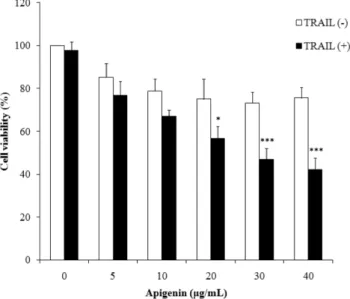
Fig. 3 − Apigenin sensitizes PLC-PRF5 cells to TRAIL-induced cell cytotoxicity. PLC/PRF-5 cells were incubated with or without TRAIL (10 ng/ml) and indicated concentrations of apigenin for 24 h. Cell viability was evaluated by MTT assay. Representative data from at least three different experiments with similar results are shown. Data is ex- pressed as mean±S.D. of three independent experiments.
Statistical significance: *p<0.05, **p<0.01 and ***p<
0.001 versus TRAIL-untreated cells.
Fig. 2 − Effect of TRAIL on SK-Hep1 human hepatocellular car- cinoma cell line. Cells were treated with different concentrations of TRAIL with indicated concentrations for 24 h. Cell viability was determined by MTT assay. Data is expressed as mean±S.D. of at least three independent experiments. Statistical significance: *p<0.05 and **p<
0.001 versus control TRAIL-untreated cells.
Fig. 4 − Apigenin have no effect on TRAIL-mediated cell cytotoxicity in SK-Hep1 cells. SK-Hep1 cells were incubated with or without TRAIL (10 ng/ml) and indicated concentrations of apigenin for 24 h. Cell viability was evaluated by MTT assay. Representative data from at least three different experiments with similar results are shown. Data is expressed as mean±S.D. of three independent experiments.
Statistical significance: *p<0.05, **p<0.01 and ***p<
0.001 versus TRAIL-untreated cells. There was no sig- nificance compared to control group in apigenin-treated SK- Hep1 cells.
하였다. 실험 결과 PLC-PRF5 cell은 가장 높은 농도인 TRAIL 400 ng/ml에서도 80% 이상의 세포생존율(84.07±1.63)을 보였으 며(Fig. 1) SK-Hep1 cell(Fig. 2)보다 TRAIL에 대한 저항성이 더 높게 나타났다. 이후의 실험은 두 간암세포 모두 90% 이상의 생 존율을 나타내는 TRAIL 10 ng/ml 농도(PLC-PRF5: 100.69±
1.74, SK-Hep1: 92.68±3.55)에서 진행하였다.
TRAIL과 apigenin의 병용 효과
두 세포 모두 apigenin 단독 처리시 50% 이상의 세포 생존율 을 나타내는 농도 범위 안에서 TRAIL 병용 효과를 알아보았다.
PLC-PRF5 세포의 경우, 70% 이상의 세포 생존율을 보이는 apigenin 농도(20 µg/ml)에서 TRAIL 병용에 의한 유의적인 효과 가 나타났으며, apigenin 농도가 높아질수록 병용에 의한 세포 증식 억제효과가 더 크게 나타난 것으로 관찰되었다. 특히, 가장 높은 농도인 apigenin 40 µg/ml 농도에서는 apigenin 단독 처리 보다 TRAIL과 병용 처리 했을 때의 세포 생존율이 약 33.4%
감소한 것으로 나타나, TRAIL과 apigenin의 병용에 의해 PLC-PRF5 세포의 생존 억제에 상승효과가 일어난 것을 확인할
수 있었다(Fig. 3). 반면, SK-Hep1 cell의 경우 apigenin 농도의 증가에 따른 TRAIL 병용 효과가 유의적으로 나타나지 않았다 (Fig. 4). 따라서, 이 후의 실험은 PLC-PRF5 cell을 위주로 진행 하였다.
세포의 형태학적 변화 관찰
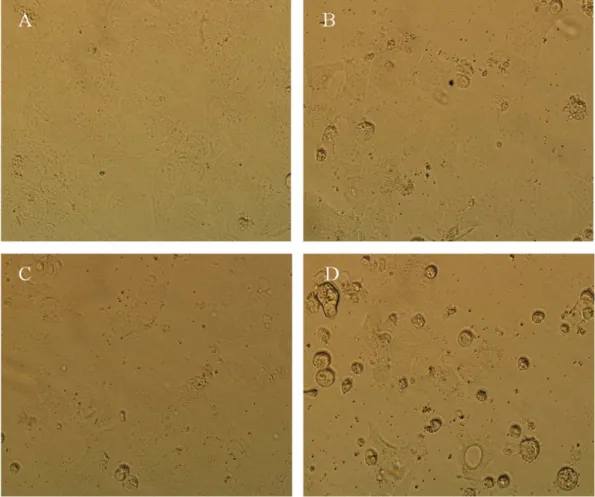
Apoptosis가 유발된 세포에는 세포막의 blebbing, 세포 크기의 수축, 세포 부착력의 감소, apoptotic body의 형성, chromatin 응 축 등 특징적인 형태학적 변화가 나타나게 된다.14,15) TRAIL과 apigenin 병용 처리시 나타나는 형태학적 변화를 관찰하기 위해 TRAIL(10 ng/ml), apigenin(30 µg/ml)을 단독 혹은 병용 처리하 고 24시간 후 도립 현미경을 이용하여 세포의 형태학적 변화를 관찰하였다. 대조군의 세포가 넓고 납작하게 퍼져 있는 모양을 보이는데 비하여 병용시의 세포는 세포의 부착력이 감소하여 배 지에 떠 있는 것이 확인되었으며 세포의 수축 및 세포질의 응축 이 관찰되었고 소포 형태(vesicles)가 나타나 정상세포와 다른 형 태를 나타내는 것이 뚜렷이 확인되었다(Fig. 5). 그에 비해 TRAIL 이나 apigenin을 단독 투여했을 때의 세포 모양은 유의적인 변
Fig. 5 − Effects of cotreatment with TRAIL and apigenin on PLC-PRF5 cell morphology. PLC-PRF5 cells were incubated with TRAIL (10 ng/
ml) and/or apigenin (30 µg/ml) for 24 h and cells were examined and photographed by inverted microscope (mignification 200×). (A) Negative control group. (B) TRAIL-treated group. (C) Apigenin-treated group. (D) Combination group.
화를 나타내지 않아, 병용에 의해 apoptosis 상승효과가 나타난 것을 확인할 수 있었다.
TRAIL과 apigenin 병용에 의한 apoptosis 상승효과의 확인 앞에서 TRAIL과 apigenin의 병용 효과에 의한 세포 생존율 감소가 apoptosis 유도에 의해 나타난 것인지 다시 한 번 확인 및 정량 하기 위해 annexin V-FITC와 PI로 이중형광염색하여 유세포분석기를 통해 apoptosis 유발 정도를 측정하였다.
Apoptosis가 발생하게 되면 초기에 세포질 쪽에 위치하고 있던 phosphatidyl serine(PS)이 세포막의 바깥쪽으로 노출되게 되는 데, 이 때 annexin V는 PS에 선택적으로 결합하여 형광을 나타 내게 된다. 또한, Propidium iodide(PI)는 세포 안의 핵과 결합하 여 형광을 나타내므로 PI 형광의 증가량을 통해 세포의 손상을 알 수 있다. 따라서 이 두가지 형광물질을 사용하여 유세포분석
기로 측정하면 apoptosis 유발 정도를 확인할 수 있다.13,16,17)본 실험에서는 TRAIL(10 ng/ml), apigenin(30 µg/ml)을 단독 혹은 병용 처리하여 apoptosis를 확인하였다. 실험결과 TRAIL이나 apigenin 단독처리에 비해 두 가지 물질을 병용했을 때 apoptosis 가 뚜렷하게 증가한 것을 확인할 수 있었다(Fig. 6). 또한, annexin V와 PI로 이중형광염색한 세포를 형광현미경으로 관찰한 결과, annexin V를 나타내는 녹색의 형광이 병용했을 때 확연히 증가 한 것으로 나타났다(Fig. 7).
결 론
본 연구는 TRAIL의 간암세포에 대한 감수성을 증가시키기 위 해 apigenin을 병용 처리하여 다음과 같은 결론을 얻었다. PLC- PRF5 간암세포주에서 TRAIL 단독 처리시에 독성을 나타내지 Fig. 6 − The effects of apigenin on TRAIL-induced apoptosis in TRAIL-resistant PLC-PRF5 cells. Flow cytometry analysis was used to detect apoptosis in cells exposed to cotreatment of TRAIL and apigenin. PLC-PRF5 cells were incubated with TRAIL (10 ng/ml) and/or apigenin (30µg/ml) for 24 h. Apoptosis was determined by annexin V-FITC/PI double staining analysis. Representative data are shown.
않는 농도범위 안에서 apigenin의 농도에 따라 세포독성이 증가 하였으며, TRAIL이나 apigenin 단독 처리시보다 병용 처리했을 때 세포독성이나 apoptosis 발생 정도가 유의적으로 증가하는 것 이 확인되었다. 이상의 결과를 통해 apigenin은 PLC-PRF5 간암 세포에 대한 TRAIL의 감수성을 증가시킨다는 것을 알 수 있으 며, 이는 향후 TRAIL을 이용한 새로운 간암 치료제 연구 및 개 발 가능성의 토대가 될 것으로 기대된다.
감사의 글
이 논문은 2010년도 정부(교육과학기술부)의 재원으로 한국연 구재단의 지원을 받아 수행된 기초연구사업으로, 이에 감사드립 니다(2010-0010538).
참고문헌
1) World Health Organization, Fact sheet 297. Available at: http:/
/www.who.int/mediacentre/factsheets/fs297/en/index.html.
Accessed 2009.
2) Ministry for Heath, Welfare and Family Affairs. Annual report of cancer incidence (2005) and survival (1993-2005) in Korea.
(2008).
3) Organization for Economic Co-operation and Development.
Health at a Glance 2009: OECD indicators (2009).
4) LeBlanc, H. N. and Ashkenazi, A. : Apo2L/TRAIL and its death and decoy receptors. Cell Death Differ. 10, 66 (2003).
5) Sheikh, M. S. and Huang, Y. : Death receptors as targets of cancer therapeutics. Curr. Cancer Drug Targets 4, 97 (2004).
6) Simonet, W. S., Lacey, D. L., Dunstan, C. R., Kelley, M., Chang, M. S., Luthy, R., Nguyen, H. Q., Wooden, S., Bennett, L., Boone, T., Shimamoto, G., DeRose, M., Elliott, R., Colombero, A., Tan, H. L., Trail, G., Sullivan, J., Davy, E., Bucay, N., Renshaw-Gegg, L., Hughes, T. M., Hill, D., Pattison, W., Campbell, P., Sander, S., Van, G., Tarpley, J., Derby, P., Lee, R.
and Boyle, W. J. : Osteoprotegerin: a novel secreted protein involved in the regulation of bone density. Cell 89, 309 (1997).
7) Holoch, P. A. and Griffith, T. S. : TNF-related apoptosis- Fig. 7 − Apoptosis Effects of cotreatment on PLC-PRF5 cell lines. PLC/PRF-5 cells were incubated with TRAIL (10 ng/ml) and/or apigenin (30µg/ml) for 24 h. Cells were stained with PI (red) and annexin V-FITC (green) and observed by fluorescent microscopy (magnification 100×). (A) Negative control group. (B) TRAIL-treated group. (C) Apigenin-treated group. (D) Combination group.
inducing ligand (TRAIL): A new path to anti-cancer therapies.
Eur. J. Pharmacol. 625, 63 (2009).
8) Oldenhuis, C., Stegehuis, J. H., Walenkamp, A. M. E., de Jong, S. and de Vries, E. G. E. : Targeting TRAIL death receptors.
Curr. Opin. Pharmacol. 8, 433 (2008).
9) Huang, Y. and Sheikh, M. S. : TRAIL death receptors and cancer therapeutics. Toxicol. Appl. Pharm. 224, 284 (2007).
10) Griffith, T. S. and Lynch, D. H. : TRAIL: a molecule with multiple receptors and control mechanisms. Curr. Opin.
Immunol. 10, 559 (1998).
11) Burns, T. F. and El-Deiry, W. S. : Identification of inhibitors of TRAIL-induced death (ITIDs) in the TRAIL-sensitive colon carcinoma cell line SW480 using a genetic approach. J. Biol.
Chem. 276, 37879 (2001).
12) Morgan, D. M. : Tetrazolium (MTT) assay for cellular viability and activity. Method. Mol. Biol. 79, 179 (1998).
13) Vermes, I., Haanen, C., Steffens-Nakken, H. and Reutellingsperger, C. : A novel assay for apoptosis Flow cytometric detection of phosphatidylserine expression on early apoptotic cells using fluorescein labelled Annexin V. J.
Immunol. Methods 184, 39 (1995).
14) Hacker, G. : The morphology of apoptosis. Cell Tissue Res.
301, 5 (2000).
15) Van Cruchten, S. and Van Den Broeck, W. : Morphological and biochemical aspects of apoptosis, oncosis and necrosis. Anat.
Histol. Embryol. 31, 214 (2002).
16) Bossy-Wetzel, E. and Green, D. R. [2]Detection of apoptosis by annexin V labeling. Academic Press, City (2000).
17) Shounan, Y., Feng, X. and O'Connell, P. J. : Apoptosis detection by annexin V binding: a novel method for the quantitation of cell-mediated cytotoxicity. J. Immunol. Methods 217, 61 (1998).