1. Introduction : background
Last year, Gresham, Smith and Partners (GS&P)
1)was retained to provide a new master plan for the Seoul National University Hospital (SNUH) campus.
The firm was selected for the project because of its extensive healthcare design experience, which spans more than 30 years and, literally, thousands of projects, including design experience in the Philipp- ines and China. The SNUH project has been challenging and also very rewarding especially since it was the firms first hospital project in Korea.
The hospital is committed to retaining its position
1)* Professor, Hanyang Univ., Ph.D ** Vice president/senior designer principal Gresham smith and partners, AIA
as the leading hospital in Korea, and the new millennium offered the perfect opportunity for SNUH to re-evaluate its campus and facilities. Even with its excellent reputation, the campus has been suffering from years of additions and expansions.
Without any long-term considerations, the result has been over crowding and inefficiency.
Developing a master plan requires commitment and dedication on the part of both representatives of the hospital and the design firm. Both groups must work together as a team to make the process and outcome a success. The process is made up of several steps that can be summed up into three major parts:
A study on the reshaping the prospect of a leading hospital in Korea
- a case study : Seoul National University Hospital Master Plan -
Lee, Jung Man* Kevin Kim**
………
한국의 선도병원으로서의 위상 재구축에 관한 연구 - 서울대학교 병원 마스터 플랜 사례 -
국문요약
서울대학병원의 마스터플랜 재구성에 대한 프로젝트로서 기존의 환경에 대한 조사와 분석 그리고 외국사례와의 비교를 통해 앞 으로 서울대학병원이 나아가야 할 목표 및 방향을 단기(1-2년), 중기(2-5년), 장기(10년 이상)계획으로 나누어 각 단계별 항목들을 분석, 구체화하였다. 단계계획에서는 응급실의 확장과 어린이 병원증축에 대한 내용을 제시하였고, 중기계획에서는 외래진료센타 (ambulatory care center)에 대한 공간구성을 통하여 기존 마스터플랜이 나아가야 할 방향을 제시하였다. 장기계획에서는 어린이 병원의 이전, 캠퍼스 기능구획을 연구, 교육, 병원으로의 분류, 공급시설의 개선과정을 제시하였다. 이 연구를 통하여, 한국의 병원 시장에 대한 경향을 다음과 같이 분석할 수 있었다. 1) 증축공간이 부족한 도심에 밀집한 한국병원의 경우, 리노베이션을 통한 마 스터플랜은 다양한 시설물을 개선, 관리, 통합할 수 있는 방법이다. 2) 편리성, 환자의 프라이버시, 전문성, 방문자 오락시설, 통합 적인 치료환경의 구축이다. 3) 예방 의약품의 증가, 건강센타, 건강중심의 프로그램, 확장된 진료시설 등 건강유지분야의 개발이다.
마스터 플랜은 계속 진행되는 과정의 일부분이며, 변화하는 조건 속에서 적용되어, 수정되어져야 할 것이다.
………
key words : master plan, renovation, organization concept, short-term, intermediate, long-term plan,
………
Fig. 1 photo of existing campus
2. Preparatory stages
2.1 Identifying the vision
The master plan process began with a period of assessment and discovery. This process included not only visual discovery an assessment of the physical campus, but also interviews with staff members and the hospitals steering committee. The first task in developing a master plan is to understand the long-term strategic goal of the hospital where it should be in 5 10 20 years. In this stage, it is essential to organize a strong master plan steering committee who has the responsibility of identifying the strategic goals, the vision, for the hospital. With guidance from GS&P, the committee began the rigorous task of sorting through the many diverse views and opinions common to the typical hospital environment.
Table 1. benchmarks/comparison of SNUH to US
2.2 Surveying and analyzing existing conditions This task is divided into site issues and facility issues. In reviewing the site the following was examined : the functional zoning, campus image, circulation patterns, development plans, and existing restrictions. In evaluating the facility, we considered the ages and conditions of each building, along with functional zoning, internal department deficiencies and circulation conflicts. The universal problem areas for both site and facilities are:
(a) no space for expansion;
(b) confusing and congested circulation, and (c) mixed functional zones causing inefficiencies.
Fig. 2 campus organization concept
To place these concerns in perspective and to create a point for benchmarking, the operations of SNUH were compared with that of an average North American teaching hospital. The final comparison indicated several differences between the average American hospital and SNUH. Operationally, most American hospitals are out-patient oriented while Korean hospitals, including SNUH, are in-patient environments.
In an in-patient hospital environment, the patient
stays in the hospital longer, which means that
rooms do not turn-over as quickly. This translates
into an extended wait time in the Emergency Room
because there is no room available for the ER
patient. Overall the comparison indicated that the
Korean hospital had less area per patient, less
efficient usage of the facility particularly in Surgery
and the Emergency Room, and inefficient scheduling
that is due to the inpatient environment and generally results in a longer than average length of stay (ALOS).
3. Designing a Master Plan : Developing a roadmap to show the hospital how to get to its destination.
Before devising a specific design solution, it was necessary to establish an overall campus organization concept. As exemplified in diagram N-6, we sought to reinforce the strength of SNUH as the top teaching hospital by realigning the inter-relationships among the three major healthcare roles of SNUH research, education and healing.
After establishing this guiding concept, the master plan was classified into short-term (1-2 years), intermediate-term (2-5 years) and long-term (10+
years) plans. Since the purpose of a master plan is not only to show the final destination, but also to provide a road map on how to get there, it is important to construct a master plan that has sequential and achievable phases.
3.1 The Short-Term Plan
The road map developed for SNUH begins with a short-term plan. This 1 to 2 year plan is focused on the most urgent needs of the hospital. These needs include expanding the Emergency Department and renovating and making additions to the child- rens hospital. These improvements will result in :
Fig. 3 short term plan
(a) A 60 percent area increase in the main hospital Emergency Department.
(b) Additions to the childrens hospital consisting of:
Fig. 4 pediatric/main hospital ED expansion-third floor
Fig. 5. pediatric/main hospital ED expan- sion perspective View01
Fig. 6. pediatric/main hospital ED expansion persp- ective View02
(1) Emergency Department expansion;
(2) Surgery expansion and new Day Surgery area
with 16 pre-op/post-op beds.
(3) A 200 percent area increase in NICU and PICU.
(4) A bridge connection from labor/delivery to NICU.
3.2 The Intermediate Plan
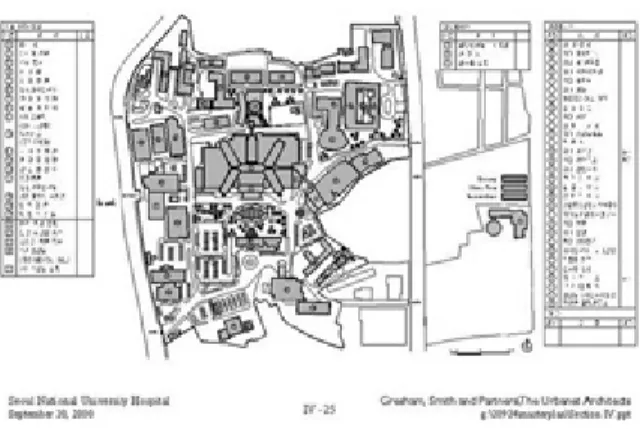
The most critical piece in the master plan road map is the intermediate plan, which covers the next two to five years. The center piece of this campus puzzle is a four-story underground Ambulatory Care Center located between the main hospital and the original hospital, which is now being used as the administration building. The focal point of this center is its interior two-story atrium garden with skylights.
Fig. 7. intermediate plan
The center will house out-patient clinics, several centers of excellence and various amenities, including shops and restaurants, and administrative offices in the top two floors. The total square footage for the center is 22,000 square meters. The bottom two floors is a parking garage with 750 spaces.
This design solution placing the Ambulatory Care Center underground was driven by the lack of any build-able space at ground level. The resulting design provides an elegant solution to many problems that the campus faces today
1) It separates the out-patient area from the in-patients reducing confusion and over crowdedn- ess in the main hospital.
2) It provides much needed expansion spaces in the Diagnostic/Treatment Departments by moving all clinic spaces out from the main hospital.
3) It serves as a convenient connection between the main hospital, the childrens hospital, the dental hospital and the parking garage.
4) It eliminates current parking spaces in front of the main hospital and creates a healing garden.
5) It creates a new pedestrian/patient access at the main public entry on the east side of the campus, which is located near a major subway reducing pedestrian traffic going up to the main hospital.
Fig. 8. ambulatory care center-overall plan
Fig. 9. ambulatory care center-section
Fig. 10. ambulatory care center-perspective
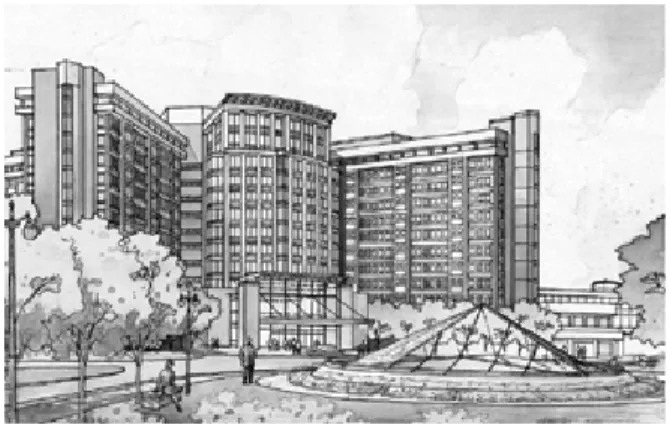
Fig. 11. main hospital-perspective
3.3 The Long-Term Plan
The long-term or long-range plan characterist- ically contains uncertainties. The variables and probabilities due to changing conditions and envi- ronments that can happen during the lifetime of the master plan are too numerous to contemplate.
Although we cannot predict the future with any accuracy, it is essential to contemplate and consider the ultimate plan for the campus. It is important to make sure that all the interim plans are coherently pointing toward this ultimate destination that picture of the end of the road. In devising this final solution, the following challenges were the focus
Fig. 12. photo of model 01
1) Relocation of the Children Hospital.
Based on current standards, the original building was designed too narrow and too small to be effective in providing for todays diagnostic/treatment services. Its location prohibits any future expansion, and, further more, is the main reason for the traffic battles enacted today. The recommendation by
GS&P is to eventually build a new womens and childrens hospital in the vacant area next to the western edge of the campus. The result will be a better functioning building one that will promote a more patient-friendly image and encourage better traffic flow.
Fig. 13. photo of model 02
2) Establish the campus functional zones into distinctive research, education and hospital.
One of the goals in the long-term plan is to develop the research center at the northwest section of the campus, thus completing the transformation of the hospital into a cutting edge research hospital.
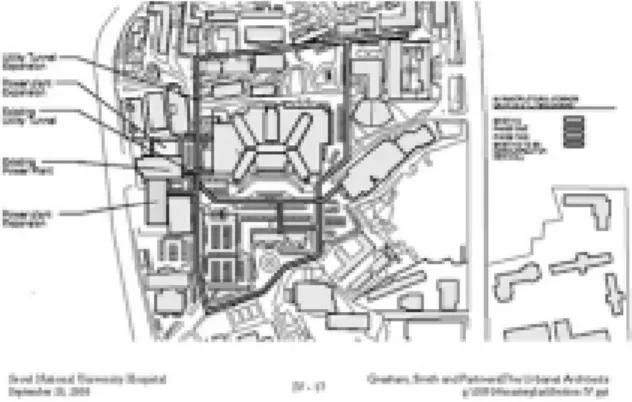
3) Finally, the long-term plan outlines a step-by-step process for upgrading the utility infrastructure system, which will ultimately integrate all current system into a more efficient, centrally managed system.
4. Conclusion : summary of the proposal
In concluding the master plan study, certain trends emerged regarding the Korean healthcare market.
These trends have both physical and fiscal impacts.
1) Most hospitals in Korea are situated in very
tight urban areas, usually with no space for future
expansion. The choices these hospitals face are
either move to a new site or renovate and add at
the existing location. Since there is a shortage of
available urban sites, and even tighter controls on
financial means, carrying out a very difficult
renovation program to the existing site is becoming
a growing reality.
In these tight urban situations, any minor facility project can have an unexpectedly large ripple or domino effect throughout a campus. Defining and setting goals of each project through careful strategic planning and implementing a long-term master plan becomes of paramount concern. The master plan offers the only way to manage and coordinate the numerous facility improvement projects.
2) Just like any other economic sector, todays healthcare is increasingly consumer focused. That trend appears to be happening in Korea at an even more accelerated pace than elsewhere in the world due to the changes in insurance policies and the expectations of Korean patients. The new focus is on convenience, patient privacy, specialty centers, visitor amenities and the creation of a total healing environment.
Fig. 14. infrastructure master plan
3) Lastly, as the healthcare insurance policies cover more treatments, the insurance providers will realize, as those in the West, that it is more cost effective to keep a person healthy than to treat a person who is ill. Therefore, the prospect for the healthcare industry in Korea will be a greater emphasis on health maintenance and will be evident in an increase in preventive medicine, wellness centers and wellness centered programs, and larger diagnostic facilities.
As we look at the prospect for the Seoul National University Hospital and for all hospitals in Korea, there are several aspects of the future you need to keep in mind. For one, the future of healthcare in Korea appears to be in the initial stages of mirroring that of the West more out-patient orientation, a greater emphasis on privacy and being more customer friendly, i.e. family friendly, and a need to be more operationally efficient. Secondly, change is a part of our lives and because of that we must plan with flexibility in mind. And, finally, please remember that a master plan in fact any planning is an on-going process and must have constant review. Your master plan will only be beneficial if it is used and revised with changing conditions.
Reference
1. Cox, A., Groves, P., design for health care, Butt- erworhs & Co Ltd., London, pp.47-57, 1981
2. GS & P (Gresham, Smith and Partners), Seoul National University Hospital campus master plan, Nashville, 2000
3. GS & P (Gresham, Smith and Partners), work- book for Seoul National University Hospital campus master plan, Nashville, 2000.
4. Marberry, S.O., healthcare design, John Wiley &
Sons. Inc. N.Y. 1997
5. Marberry, S.O, Innovations in Healthcare Design : Selected Presentations from the First Five Symposia on Healthcare Design, Van Nostrand Reinhold, N.Y.,1997
6. Miller, R.L., Swensson, E.S., hospital and healt- hcare facility design, W.W.Norton & Company, N.Y., 2002
7. Lee, J.M.(in discussion meeting), for ideal ward design, Journal of the Korea Institute of hospital architecture,, Vol.1, No.2, pp.136-144
8. Thomas, J., Building Type Basics for Healthcare Facilities, Wiley, John & Sons, N.Y., 2000
(接受:2002. 9. 24)