• 검색 결과가 없습니다.

Temporal Variation in the Reproductive Effort and Tissue Biochemical Composition in Manila Clam, Ruditapes philippinarum from a Sand Flat on the East Coast of Jeju Island Korea

N/A
N/A
Protected

Academic year: 2021

Share "Temporal Variation in the Reproductive Effort and Tissue Biochemical Composition in Manila Clam, Ruditapes philippinarum from a Sand Flat on the East Coast of Jeju Island Korea"

Copied!
8
0
0

로드 중.... (전체 텍스트 보기)

전체 글

(1)

Article

http://dx.doi.org/10.4217/OPR.2018.40.1.015

Temporal Variation in the Reproductive Effort and Tissue Biochemical Composition in Manila Clam, Ruditapes philippinarum from a

Sand Flat on the East Coast of Jeju Island Korea

Thao T.T. Ngo

1,2

, Hyun-Sung Yang

3

, and Kwang-Sik Choi

1*

1

School of Marine Biomedical Science (BK21 PLUS), Jeju National University Jeju 63243, Korea

2

Department of Coastal Aquaculture, College of Aquaculture & Fisheries Can Tho University, Campus II, 3/2 Street, Ninh Kieu District, Can Tho City, Vietnam

3

Jeju International Marine Science Research & Logistics Center, KIOST Jeju 63349, Korea

Abstract : In the present study, we investigated temporal variation in the reproductive effort and bio- chemical contents in adult Manila clam Ruditapes philippinarum at Shi-Heung-Ri beach on the east coast of Jeju Island. Gonad-somatic index (GSI), a ratio of the egg mass to the total biomass determined using ELISA increased dramatically from late May to June (7.1% to 19.5%). In mid-July, GSI dropped to 15.1%, indicating spawning on a small scale during this period. GSI also declined dramatically from late August (15.5%) to September (4.3%), suggesting that massive spawning occurred during this period. A positive correlation was observed between clam size and potential fecundity, while potential fecundity ranged between 1.19−8.40 million eggs/clam. Total proteins and lipids in the tissue increased from late spring to mid-summer, coinciding with an increase in GSI. Protein, lipid and carbohydrate contents in the tissue were lowest in January, indicating that clams were suffering from poor nutritional circumstances, which may be associated with poor food supply from the environment. Monthly increase and/or decrease in the body weight were closely related to gonad maturation and subsequent spawning, which was also linked to temporal changes in the contents of protein, lipid and carbohydrates in the tissue.

Key words : Ruditapes philippinarum, ELISA, gonad-somatic index, GSI, fecundity, Jeju Korea

1. Introduction

Widely distributed on intertidal sand or sandy-mud flats in the coastal Yellow Sea, Manila clam Ruditapes philippinarum is often a dominant species in terms of the abundance in the coastal benthic ecosystem (Okutani 2000; Min 2004; Koh and Khim 2014; Kim et al. 2017). In Jeju Island, off the south coast of Korea, where annual mean water temperature is higher than the west and south coasts, Manila clams also occurs widely on sand tidal flats in Jeju Island, although its population density is much

lower than the west and south coasts (Park and Choi 2001;

Ngo and Choi 2004; Lee et al. 2014). Despite its importance in the coastal ecosystem, few studies have carried out to understand reproductive ecology of clams in Jeju Island.

Kang et al. (2004) first investigated an annual reproductive cycle of the clams from Shi-Heung-Ri beach on the east coast of Jeju Island. According to Kang et al. (2004), clams at Shi-Heung-Ri beach initiated the gonial mitosis in March, as the water temperature remained 14 −15

o

C, then they spawned from early July to late August as the water temperature reached 24 −27

o

C.

Understanding annual gametogenesis and the amount of gametes produced in an annual reproductive cycle of

*Corresponding author. E-mail : [email protected]

(2)

marine bivalve is crucial in successful management of a natural population or aquaculture (Park et al. 2005; Ngo et al. 2006; Yang et al. 2018). Measuring quantity of gonad or gamete in marine bivalves is often challenging, since most of marine bivalves do not exhibit a discrete gonad to be isolated and measured; gonad of marine bivalves is an integral part of the mantle and the visceral mass (see Sastry 1979). As reproductive mature individual Manila clam also exhibit no discrete gonad, while the gametes are presented in the mantle and visceral mass (Park and Choi 2004).

To overcome the difficulty involved in the measurement, Park et al. (2004) developed polyclonal antibody specific to Manila clam egg protein. For the quantification, Park et al. (2004) applied an indirect enzyme-linked immunosorbent assay (ELISA), which is fast and sensitive. In ELISA, small quantity of homogenized clam tissue which contains unknown quantity of the egg protein is located on a microplate wall and reacted with the egg protein-specific polyclonal antibody. The microplate also includes known quantity of the clam egg proteins as the standard material and reacted with the antibody. Quantity of the egg protein in the clam tissue is finally referred from a regression curve of the egg standard included in the ELISA. ELISA was found to be sensitive, fast and affordable for the quantification. Accordingly, several different types of polyclonal antibodies have been developed to quantity reproductive effort of different marine bivalve species using ELISA (Kang et al. 2003; Park et al. 2003, 2005;

Uddin et al. 2012; Mondol et al. 2012; Kim and Choi

2012; Jeung et al. 2014).

Biochemical composition in marine bivalve tissues, including carbohydrate, protein and lipid often varies seasonally, due to the growth and reproductive condition.

According to Uddin et al. (2012), the total carbohydrate level in Manila clam in Incheon Bay on the west coast of Korea reaches its annual maximum in May, as level of chlorophyll a in the water column show its annual highest.

In contrast, the total carbohydrate level was markedly decreased during post spawning seasons in several marine bivalves (Ngo et al. 2006; Yang et al. 2011; Uddin et al.

2012).

In the present study, we attempted to utilize the polyclonal antibody to assess the reproductive effort of Manila clams from Shi-Heung-Ri beach on the east coast of Jeju Island. The present study also determined potential fecundity of clams during the spawning season, referred from the reproductive effort.

2. Materials and Methods

Sampling site and effort

Shi-Heung-Ri beach locates on the east coast of Jeju Island, where the fine sand flat extends approximately 800 m from the high tide to the low tide line (Fig. 1).

According to Kang et al. (2004), the sea surface temperature varied from 10 (January) to 28

o

C during the course of study. In this study, 30 to 40 adult clams were collected monthly or biweekly from May 2001 to April 2002 (Table 1). For the assay, clams were first placed in a 40 L seawater

Fig. 1. Sampling location, Shi-Heung-Ri sand flat on the east coast of Jeju Island (cited from Kang et al. 2004)

(3)

tank for 24 hrs to depurate their stomach contents. After measuring the shell length (i.e., the longest axis of the shell) to mm, the flesh was removed and weighed to mg using an electronic balance.

Analysis of biochemical composition of tissue

For the assay, whole body was lyophilized and homo- genized using mortar and pestle. Twenty to 25 mg of the homogenized tissue was taken from individual clam and further homogenized using an ultrasonicator. Level of carbohydrate in the tissue was determined according to Taylor (1995) using phenol-sulfuric acid with dextrose (anhydrous) as the standard. Quantity of protein in the tissue was estimated using the method described by Lowry et al. (1951), as bovine serum albumin was used as the standard material. The total lipid level was determined gravimetrically, as the lipid was extracted from the tissue using methanol and chloroform according to Bligh and Dyer (1959). Concept of standard animal was adapted in this study to exclude effect of the size, and absolute quantity of the proteins, carbohydrates, and lipids were estimated monthly (Beninger and Lucas 1984; Ruiz et al.

1992; Kang et al. 2000, 2007). The standard animal length, which was the mean shell length of the total analyzed clam, was found to be 31.6 mm. Tissue dry weight, protein, carbohydrate, and lipid of a standard animal were calculated for each sampling month. Allometric relationship of log

10

dry tissue weight against log

10

shell length for the clams at each sampling period was determined using linear regression analysis. All regressions were statistically

significant (P < 0.001).

Quantification of reproductive effort using ELISA An indirect enzyme-link immunosorbent assay (ELISA) was used to determine quantity of the eggs in a female clam. In ELISA, the rabbit anti-Manila clam egg protein IgG developed by Park and Choi (2004) was served as the primary antibody, and the alkaline phosphatase-labeled goat anti-rabbit IgG (Sigma) as a secondary antibody. For the analysis, triplicates of 100 µl of each clam tissue homogenate dissolved in 0.15 M PBS (pH 7.5) were included in a 96-well ELISA microplate. The microplate also included duplicates of the standard solution, which were known quantity of the purified clam egg homogenized in phosphate buffered saline. Optical density (OD) of the color product developed in ELISA (i.e., primary antibody- antigen complex) was red at 405 nm using a micro-plate spectrophotometer. From ELISA, a regression curve was plotted based on the optical densities of different concen- trations of the egg standard. Unknown quantity of the egg protein presented in the homogenized clam tissue was then referred from the standard regression curve. Finally, quantity of the egg mass was estimated as the quantity of egg protein obtained from ELISA times 2.44 (i.e., the ratio of egg protein in an individual egg, Park and Choi 2004).

The ratio of the egg mass to the total dry tissue weight was expressed as gonad somatic index (GSI). Potential fecundity of ripe female clams was also determined by dividing total quantity of the eggs estimated from ELISA by 22 ng, estimated weight of the single mature egg. Estimation of the potential fecundity was limited to the females exhibiting GSI over 20% during spawning season.

3. Result

Reproductive effort

Indirect ELISA assay applied in this study was fast and sensitive, which detected as little as a few milligrams of clam eggs contained in 100 to 300 mg dry weight of the somatic tissues. Over 12 months of sampling, the clam egg proteins could be detected as early as in March, as most of the females were in early to developing stage. It was noticeable that GSI of a clam collected in December 2001 contained substantial amount of the egg during post- spawning period, as the GSI was calculated to be 14.1%.

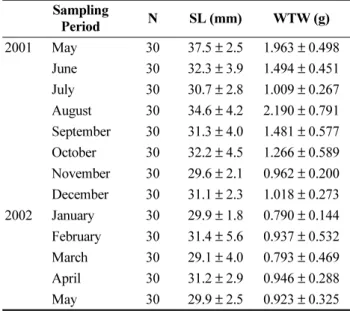
Fig. 2 plots monthly means and the standard errors of GSI estimated using ELISA. In 2001, GSI increased dramatically from May (2.5%), reached its annual highest in late June (18.9%). GSI remained stable during the Table 1. Biometry of clams used in this study. SL, shell

length in mm, WTW, wet tissue weight in gram Sampling

Period N SL (mm) WTW (g)

2001 May 30 37.5 ± 2.5 1.963 ± 0.498

June 30 32.3 ± 3.9 1.494 ± 0.451

July 30 30.7 ± 2.8 1.009 ± 0.267

August 30 34.6 ± 4.2 2.190 ± 0.791

September 30 31.3 ± 4.0 1.481 ± 0.577

October 30 32.2 ± 4.5 1.266 ± 0.589

November 30 29.6 ± 2.1 0.962 ± 0.200

December 30 31.1 ± 2.3 1.018 ± 0.273

2002 January 30 29.9 ± 1.8 0.790 ± 0.144

February 30 31.4 ± 5.6 0.937 ± 0.532

March 30 29.1 ± 4.0 0.793 ± 0.469

April 30 31.2 ± 2.9 0.946 ± 0.288

May 30 29.9 ± 2.5 0.923 ± 0.325

(4)

summer, from July (15.1%) to late August (15.5%). In late summer, GSI dropped rapidly (4.3% in September), as most of the female completed spawning. During January and February, ELISA failed to detect the egg protein in clams, when most of the clams were in resting phase (i.e., reproductively inactive). The highest GSI was recorded in July, as 36.3%.

From June to September 2001, a total of 20 clams showed their GSI over 20%. Accordingly, the potential fecundity of those female was determined. The potential fecundity ranged 1.193 million to 8.394 million eggs, with a mean of 3.443 million. A positive correlation was found between the size and the fecundity, as larger female produces more number of eggs during spawning season (P < 0.05, Fig. 3).

Tissue biochemical composition

Fig. 4 shows monthly changes in the total dry tissue

Fig. 3. Potential fecundity of Manila clam estimated from a clam population at Shi-Heung-Ri beach on the east coast of Jeju Island. N = 20, clams exhibited GSI over 20% were selectively included

Fig. 4. Seasonal changes in total dry tissue weight of clams. The observed tissue dry weight was con- verted to a standard animal weight as calculated from the standard clam with shell length of 31.6 mm obtained in this study

Fig. 2. Monthly variation in GSI of Manila clam at Shi- Heung-Ri beach in Jeju Island

Fig. 5. Seasonal changes in total protein, carbohydrate

and lipid in the tissue. The observed weight of

total protein, carbohydrate, and lipid was con-

verted to a standard animal weight as calculated

from the standard clam length of 31.6 mm in

shell length obtained in this study

(5)

weight. During May and June of 2001, the total tissue dry weight (mg) increased dramatically from 131.4 mg to 234.8 mg. The total tissue weight was slightly declined from June to July (204 mg), then, increased again from July to August (308.3 mg). From September 2001 to January 2002, the total tissue weight declined gradually, reaching its annual minima in January (126.0 mg).

Seasonal changes in the total protein, carbohydrate, and lipids are presented on Fig. 5. Monthly mean level of the total protein in the body tissue ranged 42.0 mg (February 2002) to 157.1 mg (August 2001), while the monthly mean of the total carbohydrate and lipid varied from 13.8 mg (January 2002) to 59.5 mg (November 2001), and 11.2 mg (January 2002) to 62.7 mg (August 2001), respectively.

The protein and lipid contents in the tissue increased from May to August and September, as quantity of the eggs increased until spawning. In contrast, the total carbohydrate increased gradually from August to January, then dropped dramatically.

4. Discussion

Indirect ELISA applied in this study enabled us to quantify reproductive effort of female Manila clams, and the ELISA was sensitive enough to assess a small quantity of the egg protein presented in a clam collected in March, when most of the females were reproductively inactive or in early gametogenic stage (Kang et al. 2004). It was also noticeable that ELISA detected the egg protein in an individual clam collected in December, as most of the females completed their spawning activities. Although the clam collected in December contained substantial amount of the eggs in the tissue (i.e., GSI = 14%) spawning of this clam is unlikely to occur, since the water temperature (12 − 13

o

C) is too cold to trigger spawning.

GSI of the females determined in this study represents a ratio of the egg mass to the total tissue weight. In an annual reproductive cycle of clam, GSI would elevate from the gonial mitosis to spawning, as the gametogenesis progresses; highest GSI could be observed just prior to spawning, while GSI declines after spawning, due to discharge of the eggs (Choi et al. 1993; Kang et al. 2003;

Park and Choi 2004; Uddin et al. 2012, 2013). GSI of the females at Shi-Heung-Ri beach increased dramatically from May (3.1%) to June (19.5%). GSI of the female stayed high during July (15.1%) and August (15.5%), then declined dramatically in September (4.3%). The observed changes in GSI during the summer indicate that clams become ready for spawning in June, while a certain

portion of the females in the population spawned in July.

Dramatic decrease in GSI from August to September suggests that most of clams actively discharged their gametes during this period, resulting in decline of both GSI and the body weight.

As previously reported, water temperature and available food in the environment are the key parameters that govern the time series of the gonad maturation and subsequent spawning. During the course of study, the sea surface temperature increased from June (19.0

o

C) to August (27.3

o

C), then dropped in September (24.7

o

C).

Accordingly, the rapidly elevated water temperature from June to July may trigger spawning of the female, and the highest temperature recorded in August enhanced the spawning.

Using ELISA data, potential fecundity (i.e., number of mature eggs present in an individual clam) was calculated, assuming that the mature clam egg weighs 22 ng (Park and Choi 2004). For the calculation clams exhibiting GSI over 20% were selectively included, as previous studies indicated that GSI of 20% is typical value for the clams in ready for spawning (Park and Choi 2004; Uddin et al. 2012, 2013).

The fecundity of Manila clam at Shi-Heung-Ri was positively correlated with the size, or age of clam, indicating that large clams produce more eggs during spawning period. It is noticeable that an individual clam size of 42 mm in shell length analyzed in this study may produce as much as 10 million eggs during a spawning season. Similarly, Park and Choi (2004) reported potential fecundity of Manila clams in Gomso Bay on the west coast Korea as 0.94 to 11.00 million. Using the clam egg protein-specific polyclonal antibody, Uddin et al. (2013) also determined GSI and fecundity of Manila clam occurring on intertidal of a small lagoon on the east coast of Jeju Island. During the summer of 2006, Manila clam at the lagoon spawned mostly in late August and the spawning activity completed in late September. Fecundity estimated from the clam population at the lagoon ranged 2.42 −8.97 million eggs, which is somewhat comparable to the present study (Table 2).

According to Uddin et al. (2013), GSI and the fecundity of clams from Jeju are somewhat lower than the values reported from the west coast of Korea, possibly due to the low food availability in Jeju.

Several studies attempted to assess fecundity of Manila

clam, which do not have a discrete gonad using various

methods (Table 2). Gravid clams are often induced to

spawn using various chemical stimulants including

ammonia and hydrogen peroxide solution. In Tokyo Bay

Japan, Toba and Miyama (1991) induced spawning of the

(6)

gravid females using ammonia, as they reported the fecundity as 0.24 −1.35 × 10

6

eggs/clam. Chung et al.

(2001) also applied ammonia and thermal shock to induce spawning in Manila clams, to quantify the amount of eggs released during induced spawning. According to Chung et al. (2001), some clams did not response to the chemical stimulation, and the induced spawning is somewhat incomplete and partial. Contrary to the induced spawning assay, ELISA used in this study estimates quantity of the egg proteins in the subsamples from whole clam homogenized. Since ELISA detect minute amount of the egg protein in a clam, regardless of the gametogenic stage, the fecundity estimated using ELISA is considered to be maximal. As many studies have reported, not all the mature eggs are released via spawning, as some of the residual eggs are phagocytized by the hemocytes and reabsorbed during post spawning period (i.e., spent or resting stage, Kang et al. 2004).

Seasonal variation in biochemical composition of clams is often closely related to the reproductive activities of the species (Robert et al. 1993; Ojea et al. 2004; Uddin et al.

2012). In this study, total protein and lipid levels increased at a fast rate from May to June, and reached the annual maxima in July. Such increases in the protein and lipids coincided with the rapid increase in GSI. Unlike lipid and protein, the carbohydrate level dropped from June to July and August. It is also noticeable that both protein and lipid level in the tissues dropped dramatically from August to October, as most of the females completed spawning during this period. In contrast, the carbohydrate level inclined from August to November, when Manila clams were in spent or resting stage, indicating that seasonal change in the carbohydrate in clam tissue is inversely related to the changes in protein and lipid. Such inverse correlation was also reported by Camacho et al. (2003) and

Serdar and Lok (2009).

Ojea et al. (2004) analyzed biochemical composition of different tissues of the carpet shell clam Ruditapes decussatus in an annual gametogenic cycle in Galicia Spain. In their study, both protein and lipid level in the gonad-visceral tissue increased from spring to summer, as the clam became sexually mature during period. In contrast, maximum level of glycogen in the tissue was observed during the resting stage, as was observed in this study. Similar seasonal variation was also confirmed by Serdar and Lok (2009); seasonal change in the lipid content in the carpet shell clams at Sufa Lagoon in Turkey was inversely related to change in the carbohydrate content. In marine bivalves, carbohydrates are used as the energy-rich fuel for the build-up of the gametes during vitellogenesis via conversion of the carbohydrate into lipid reserves (Gabbott 1975, 1976, 1983). After spawning, clams may reserve the assimilated energy as carbohydrate (i.e., mostly glycogen) in the tissues, then the reserved energy is mobilized and used as fuel during spawning (Robert et al. 1993; Camacho et al. 2003; Ojea et al. 2004).

It is believed that the observed high levels of protein and lipid in summer are associated with gonad maturation process, since the clam eggs contain high level of protein and lipid (Park and Choi 2004; Park et al. 2005). During November and January, the carbohydrate level dropped markedly, indicating that clam mobilized the reserved energy during this period, suggesting that nutritional status of the clams was in poor condition. In January, both lipid and protein also showed its annual minimum, suggesting that clams suffered from insufficient food supply which may lead the poor nutritional condition, although the level of available food for the clams was not determined in this study.

In summary, seasonal changes in the tissue biochemical Table 2. Summary of Ruditapes spp. fecundity

Species Location Methodology Fecundity

(×10

6

eggs) Author (s) R. philippinaum Tokyo Bay, Japan Induced spawning by ammonia 0.24−1.35 Toba & Miyama (1991) R. largillierti Launceston, Tasmania Induced spawning by thermal shock 0.5−0.9 Kent et al. (1999) R. philippinaum Gomso Bay, Korea Induced spawning by exposing to air,

feeding stimulus, and thermal shock

0.20 −1.79 Chung et al. (2002) R. philippinaum Gomso Bay, Korea Immunological method (ELISA) 0.94−11.00 Park & Choi (2004) R. philippinaum Bakmiri Tidal Flat, Korea Immunological method (ELISA) 2.54−13.40 Uddin et al. (2012) R. philippinaum Tong-bat-arl Lagoon,

Jeju, Korea

Immunological method (ELISA) 2.42−8.97 Uddin et al. (2013) R. philippinaum Shi-Heung-Ri Sand Flat,

Jeju, Korea

Immunological method (ELISA)

1.19 −8.40 Present study

(7)

composition and potential fecundity of Manila clam at Shi- Heung-Ri beach on the east coast of Jeju Island were monitored in an annual reproductive cycle of clam using ELISA. GSI increased dramatically from May to June then dropped from August to September, indicating that clams at the study site spawned in late summer. GSI was positively correlated with clam size, it was estimated that the females may release 3.443 million eggs during spawning.

Acknowledgements

This study was supported by Jeju National University 2017 Grant.

References

Beninger PG, Lucas A (1984) Seasonal variation in condition, reproductive activity and gross biochemical composition of two species of adult clam reared in common habitat: Tapes decusatus L. (Jeffreys) and Tapes philippinarum (Adam and Reeve). J Exp Mar Biol Ecol 79:19−37

Bligh EG, Dyer WF (1959) A rapid method of total lipid extraction and purification. Can J Biochem Phys 37:911−

917

Camacho AP, Delgado M, Fernandez-Reiriz MJ, Labarta U (2003) Energy balance, gonad development and biochem- ical composition in the clam Ruditapes decussatus. Mar Ecol-Prog Ser 258:133−145

Choi KS, Lewis DH, Powell EN, Ray SM (1993) Quantitative measurement of reproductive output in the American oyster, Crassostrea virginica (Gmelin), using an enzyme- linked immunosorbent assay (ELISA). Aquac Res 24:299 − 322

Choi KS, Park KI (2005) Current status of Perkinsus infection in Korean waters. In: Walker P, Lester R, Bondad-Reantaso MG (eds) Diseases in Asian aquaculture V. Fish Health Section, Asian Fisheries Society, Manila, pp 263 −274 Chung EY, Hur SB, Hur YB, Lee JS (2001) Gonadal maturation

and artificial spawning of the Manila clam Ruditapes philippinarum (Bivalve: Veneridae), on the coast of Kimje, Korea. Korean J Malacol 10:38−54

Chung EY, Lee JS, Lee CH, Hur SB (2002) Reproductive cycle of natural population and artificial control of gonadal development of Ruditapes philippinarum by the conditions of water temperature-feeding and starvation. Korean J Malaco 18:83−91

Gabbott PA (1975) Storage cycles in marine bivalve mollusks:

a hypothesis concerning the relationship between glycogen

metabolism and gametogenesis. In: Barnes H (ed) Ninth European Marine Biology Symposium. Aberdeen Univer- sity Press, Aberdeen, pp 191−211

Gabbott PA (1976) Energy metabolism. In: Bayne BL (ed) Marine mussels. Cambridge University Press, Cambridge, pp 293 −355

Gabbott PA (1983) Development and seasonal metabolic activities in marine mollusks. In: Hochachka PW (ed) The Mollusca Vol. 2 : environmetal biochemistry and physiology.

Academic Press, New York, pp 165−217

Jeung HD, Kang DH, Park HS, Moullac GL, Choi KS (2014) Quantification of eggs and sperm in the Black-lip pearl oyster Pinctada margaritifera using an enzyme-linked immunosorbent assay (ELISA). Fisheies Sci 80(3):451−

462

Kang CK, Kang YS, Choy EJ, Kim DS, Shim BT, Lee PY (2007) Condition, reproductive activity, and gross bio- chemical composition of the Manila clam, Tapes philip- pinarum in natural newly created sandy habitats of the southern coast of Korea. J Shellfish Res 26(2):401−412 Kang CK, Park MS, Lee PY, Choi WJ, Lee WC (2000) Sea-

sonal variations in condition, reproductive activity, and bio- chemical composition of the Pacific oyster, Crassostera gigas (Thunberg), in suspended culture in two coastal bays of Korea. J Shellfish Res 19:771−778

Kang DH, Ngo TTT, Koh KJ, Choi KS (2004) Seasonal changes in gonadal development of Manila clam, Ruditapes philippinarum from Shi-Heung-Ri, Jeju, Korea J Aquacult 17(1):81 −88

Kang SG, Choi KS, Bulgakov AA, Kim Y, Kim SY (2003) Enzyme-linked immunosorbent assay (ELISA) used in quantification of reproductive output in the pacific oyster, Crassostrea gigas, in Korea. J Exp Mar Biol Ecol 282:1−

21

Kent GN, Maguire GB, Duthie I, Pugh R (1999) Spawning, settlement, and growth of the New Zealand venerid Ruditapes largillierti (Philippi 1849) in Culture. New Zeal J Mar Fresh 33:55−62

Kim BK, Choi KS (2012) Development of an immunological probe to quantify reproductive effort in the Suminoe Oyster, Crassostrea ariakensis (Gould 1861). J Shellfish Res 31(4):1033 −1041

Kim SL, Kwon SH, Lee Hg, Yu OH (2017) Effects of envi- ronmental and biological conditions on the recruitment and growth of the Manila clam Ruditapes philippinarum on the west coast of Korea. Ocean Sci J 52:91 −101

Koh CH, Khim JS (2014) The Korean tidal flat of the Yellow

Sea: physical setting, ecosystem and management. Ocean

Coast Manage 102:398−414

(8)

Lee HJ, Noseworthy RG, Park SR, Hong HK, Lee BG, Choi KS (2014) Report on the molluscan fauna in Tongbatarl lagoon on the east coast of Jeju, Korea. Korean J Malacol 30:95 −99

Lowry OM, Roseborough NI, Farrand AL, Randall RJ (1951) Protein measurement with the Folin phenol reagent. J Biol Chem 193:263 −275

Min DK (2004) Mollusks in Korea. Hanguel Graphics, Busan, 113 p

Mondol MR, Kim CW, Kim BK, Kang CK, Choi KS (2012) Early growth and reproduction of hatchery-produced Pacific oyster Crassostrea gigas in Gamakman Bay off the southern coast of Korea. Fisheries Sci 78(6):1285−1292 Ngo TTT, Kang SG, Kang DH, Sorgeloos P, Choi KS (2006)

Effect of culture depth on the proximate composition and reproduction of the Pacific oyster, Crassostrea gigas from Gosung Bay, Korea. Aquaculture 253(1 −4):712−720 Ojea J, Pazos AJ, Martinez D, Novoa S, Sanchez JL, Abad M

(2004) Seasonal variation in weight and biochemical com- position of the tissue of Ruditapes decussatus in relation to the gametogenic cycle. Aquaculture 238:451 −468 Okutani T (2000) Marine mollusks in Japan. Tokai University

Press, Tokyo, 1173 p

Park KI, Choi JW, Choi KS (2003) Quantification of repro- ductive output of the butter clam, Saxidomus purpuratus (Sowerby, 1852) using enzyme-linked immunosorbent assay (ELISA). Ocean Polar Res 25:249 −256

Park KI, Choi KS (2001) Spatial distribution of the protozoan parasite Perkinsus sp. found in the Manila clams, Rudi- tapes philippinarum, in Korea. Aquaculture 203:9−22 Park KI, Choi KS (2004) Application of enzymed-linked

immunosorbent assay (ELISA) in study of Ruditapes philippinarum (Mollusca: Bivalvia) reproduction: I. Quan- tifying eggs. Aquaculture 241:667−687

Park KI, Choi JW, Choi KS (2005) Development of a Saxidomus purpuratus (Mollusca: Bivalvia) egg-specific antibody for the quantification of eggs using an enzyme-linked immu- nosorbent assay. J Shellfish Res 24:1079−1085

Robert R, Trut G, Laborde JL (1993) Growth, reproduction and gross biochemical composition of the Manila clam Ruditapes philippinarum in the Bay of Arcachon, France. Mar Biol 116:291 −299

Ruiz C, Abad M, Sedano F, Garcia-Martin LO, Sánchez López

JL (1992) Influence of seasonal environmental changes on the gamate production and biochemical composition of Crassostrea gigas (Thunberg) in suspended culture in El Grove, Galacia, Spain. J Exp Mar Biol Ecol 155:249−262 Sastry AN (1979) Pelecypoda (excluding Ostreidae). In: Giese AC, Pearse JS (eds) Reproduction of marine invertebrates.

Vol. V. Molluscs: pelecypods and lesser classes. Academic Press, New York, pp 191−292

Serder S, Lok A (2009) Gametogenic cycle and biochemical composition of the transplanted carpet shell clam Tapes decussatus, Linnaeus 1758 in Sufa (Homa) Lagoon, Izmir, Turkey. Aquaculture 293:81 −88

Taylor KACC (1995) A modification of the phenol sulfuric acid method of total sugar determination. Appl Biochem Biotech 53:207−214

Toba M, Miyama Y (1991) Gonadal development and spawn- ing induction in artificially conditioned Manila clams Rudi- tapes philippinarum. Nippon Susian Gakkaishi 57:1269−

1275

Uddin MJ, Yang HS, Park KJ, Kang CK, Kang HS, Choi KS (2012) Annual reproductive cycle and reproductive efforts of the Manila clam Ruditapes philippinarum in Incheon Bay off the west coast of Korea using a histology-ELISA combined assay. Aquaculture 364−365:25−32

Uddin MJ, Jeung HD, Yang HS, Kim BK, Ju SJ, Choi KS (2013) Quantitative assessment of reproductive effort of the Manila clam Ruditapes philippinarum in a lagoon on Jeju Island (Korea) using enzyme-linked immunosorbent assay. Invertebr Reprod Dev 57:316−324

Yang HS, Kang DH, Park HS, Choi KS (2011) Seasonal changes in reproduction and biochemical composition of the cockle, Fulvia mutica Reeve (1884), in Cheonsu Bay off the west coast of Korea. J Shellfish Res 30(1):95−101 Yang HS, Kang DH, Park, HS, Choi KS (2018) Annual game- togenesis and reproductive effort of the limpet Cellana grata (Gould, 1859) (Gastropoda: Nacellidae) in a rocky intertidal beach at Ulleungdo Island off the east coast of Korea. Ocean Sci J 52(4):519−526

Received Mar. 2, 2018

Revised Mar. 19, 2018

Accepted Mar. 20, 2018

수치

Fig. 1. Sampling location, Shi-Heung-Ri sand flat on the east coast of Jeju Island (cited from Kang et al
Fig. 2 plots monthly means and the standard errors of GSI estimated using ELISA. In 2001, GSI increased dramatically from May (2.5%), reached its annual highest in late June (18.9%)
Fig. 3. Potential fecundity of Manila clam estimated from a clam population at Shi-Heung-Ri beach on the east coast of Jeju Island

참조

관련 문서

Seasonal changes in the Perkinsus olseni infection in an annual reproduction of Manila Clam Ruditapes philippinarum from a tide flat on Jonghyun in Incheon bay on the west cost

(2012) The impact of sand addition to an intertidal area for the development of the Manila clam, Ruditapes philippinarum habitat on benthic community structure: the case

Growth patterns of the Manila clam, Ruditapes philippinarum in each tidal level were studied in the intertidal zone in Tae-an on the west coast of South Korea from April

Prevalence of a protozoan parasite Perkinsus olseni in Manila clam Ruditapes philippinarum was surveyed from July to December 2009 on the west and south coast of Korea..