Received August 1, 2017, Revised August 30, 2017, Accepted September 11, 2017 Corresponding author: Kun Hyung Kim
Pusan National University School of Korean Medicine, 49 Busandaehak-ro, Mulgeum-eup, Yangsan 50612, Korea Tel: +82-55-360-5971, Fax: +82-55-360-5509, E-mail: [email protected]
This work was supported by a 2-Year Research Grant of Pusan National University.
CCThis is an open access article distributed under the terms of the Creative Commons Attribution Non-Commercial License (http://creativecommons.org/licenses/ by-nc/4.0) which permits unrestricted non-commercial use, distribution, and reproduction in any medium, provided the original work is properly cited.
한의 의료와 연관된 조정 요청 이상반응:
한국의료분쟁조정중재원 접수사례 분석
황혜원ㆍ이지선ㆍ김건형
부산대학교 한의학전문대학원
Claimed Adverse Events of Korean Medicine in South Korea:
Analysis of Cases in the Korea Medical Dispute Mediation and Arbitration Agency Databases
Hye-Won Hwang, Ji-Sun Lee, Kun Hyung Kim
Pusan National University School of Korean Medicine
Objectives : The purpose of this study was to describe the type of claimed adverse events related to Korean Medicine practices in South Korea. Methods : Claims with regard to the Korean Medicine practice submitted to the Korea Medical Dispute Mediation and Arbitration Agency from April 2012 to December 2016 were collected. We analyzed claims that explicitly reported the type of Korean medicine intervention and were deemed as being adverse events as defined by the Korea Good Clinical Practice. Claims that did not mention the Korean medicine practice explicitly or those related to the patient’s dissatisfaction to the service rather than adverse health outcomes were excluded. Types, related interventions and the suspected severity of claimed adverse events were summarized. Results : Of 197 claims obtained, 140 claim cases were eligible and 144 claimed events were deemed as possible adverse events of the Korean medicine practice. Pain(16%), local infection/inflammation(12%) and neurological symptoms(11%) were the most frequently reported types of claimed adverse events. Thirty-nine claimed serious adverse events(SAE) were identified, including pneumothorax(28.2%) and death(17.9%). Conclusions : A wide range of claimed adverse events were identified. Routine monitoring of claims data may provide undetected safety information with regard to the Korean medicine practice. High risk of misclassification of the intervention and claimed adverse events due to insufficient information is the main caveat of this study.
Key words : Korean medicine, claims analysis, adverse events, Korea Medical Dispute Mediation and Arbitration Agency, acupuncture, herbal medicine
서 론
보건의료 중재의 이상반응은 의약품 투여 또는 비약물적 중재를 수행한 대상자에게 발생한 모든 유해하고 의도하지 않은 증후, 증
상 또는 질병을 의미하며 수행된 중재와 발생한 이상반응이 반드시 인과적 관계일 필요는 없다1). 중재의 위해 정보는 이득과 균형을 이루어 보건의료 의사 결정 시 제공되어야 하기 때문에, 체계적인 안전성 정보 수립은 근거-기반 보건의료에서 매우 중요하다. 한의
약 중재의 안전성 평가는 단일 사례 보고2), 체계적 문헌고찰3-7), 후향적 의무 기록 분석8) 또는 임상시험 맥락 내의 이상반응 보고9) 등으로 이루어져 왔다. 기존 연구들의 주요 약점은 이상반응 보고 가 의료진/연구진의 이상반응의 과소보고(under-reporting) 위험 을 배제할 수 없으며, 해당 중재를 실제보다 안전한 것으로 평가할 우려가 있다는 점이다10). 이러한 한계는 환자들의 이상반응 직접 보고를 통해 부분적으로 보완할 수 있으며, 경험적 근거는 환자들 의 소송 또는 불만 접수 사례를 통한 안전성 분석은 의료진이 보고 하지 않은 이상반응 정보를 제공할 수 있음을 시사한다11). 국내 한 의약 분야에도 판례 및 의료분쟁 사례 또는 한국소비자원의 피해 접수 사례를 분석한 선행 연구들이 있으나12-16) 일부 선별된 사례를 분석 대상으로 하거나12-14) 이상반응으로 볼 수 없는 서비스 불만족 사례 등도 분석 대상에 포함시켰다는15,16) 한계가 있다.
한국 의료분쟁 조정중재원(이하 조정중재원)은 의료사고의 원인 과 그에 대한 의료인의 과실 및 인과관계에 대해 전문적이고 원칙 적인 과정을 통한 조정/중재를 목적으로 하는 단체로17), 조정중재 원에 접수된 의료분쟁은 의료 및 법률 전문가에 의한 조정/중재 과정을 거치므로 조정중재원의 자료는 기타 의료분쟁 해결 방법들 의 자료보다 더욱 전문적이고 신뢰할 만한 의료분쟁에 관한 자료라 고 할 수 있다. 조정중재원은 의료사고로 접수된 사례에 대한 정보 를 웹사이트에 공개하고 있으나, 조정/중재가 이루어진 사례 중 일 부만을 게시하고 있으며, 현재까지 해당 자료를 이용한 환자 보고 한의약 관련 이상반응 분석은 이루어지지 않았다. 본 연구는 한국 의료분쟁 조정중재원에 접수된 한의약 관련 조정 중재 사례의 유형 을 서술적으로 분석하여, 향후 한의약 안전성 정보 체계 수립에 필 요한 기초 자료를 얻는 것을 목적으로 하였다.
연구대상 및 방법
1. 연구대상
정부공개 3.0을 통해 2012년 4월 기관 개원 후부터 2016년 12 월까지 한국 의료분쟁 조정중재원(이하 조정중재원)에 접수된 모든 한의약 관련 상담 접수 사례의 열람을 신청하여, 개인정보를 제외 한 197건의 조정 중재 사례를 제공받았다. 이에 대해 아래의 이상 반응, 조정 요청 이상반응의 정의와 사례 선정/배제 기준을 적용하 였다. 두 명의 저자가 공동 논의하여 사례의 선정 및 배제 여부를 평가하였으며, 교신 저자가 이를 검토하여 최종 분석 사례를 선정 하였다.
1) 이상반응(adverse event)의 정의: 중재와 사건 발생 간 인과
성 성립 여부와 무관하게, 중재 후 발생한 유해하고 의도하지 않은 증후, 증상 또는 질병 상태를 이상반응으로 정의하였다1).
2) 조정 요청 이상반응(claimed adverse event)의 정의: 의료 중재와 발생사건 간의 구체적 정보를 통한 기존의 ‘이상반응’ 평가 와 구분하기 위해, 본 연구에서는 한의약 중재와 사건 보고 간의 시간적 전후 관계를 기준으로 할 때 이상반응으로 분류할 수 있는 사건들을 ‘조정 요청 이상반응’으로 조작적 정의를 내렸다.
3) 선정 기준: 제공받은 접수 사례 개요에서, 한국한의표준의료 행위분류18)의 8개 중재 항목(침, 뜸, 한약, 약침, 봉침, 부항, 매선, 추나)의 적용이 명시되어 한의 의료 행위 이후 발생한 이상반응임 을 명확히 알 수 있는 사례를 분석 대상으로 선정하였다.
4) 배제 기준: 한의 의료행위 여부가 구체적으로 기술되지 않은 사례, 치료 효과 없음이나 서비스 불만족 등 이상반응으로 분류할 수 없는 사례는 배제하였다.
2. 연구방법
선정 배제 기준에 따른 검토 후 최종 분석에 포함된 사례들을 유형별, 중재 별, 중증도별로 분류하고 기술적 분석을 수행했다. 제 공받은 자료에는 사례 번호, 성별, 연령, 사례 접수 사유 정보만 기재되고 사례의 진단명에 대한 정보는 제공되지 않아 해당 진단의 타당성 여부는 확인할 수 없었다. 이에 조정중재원에서 제공한 사 례 접수 사유만을 토대로 분석이 이루어졌다. 중증도별 분류는 중 대 이상반응 발생 여부를 기준으로 이루어졌으며, 중대 이상반응 여부는 사망, 입원치료 또는 입원치료가 필요했을 것으로 보이는 사례로 정의하였다1). 본 분석에서 배제된 사례는 따로 분류하여 분 석에서 배제된 이유를 별도로 요약했다(Appendix 1). 이상반응 사 례의 유형별 분류 시, 봉독 약침은 약침의 하위분류로 간주하고 약 침으로 범주를 통합하였다.
자료의 정리는 엑셀 스프레드시트(Microsoft Office Excel 2007)를 이용했다. 두 명의 저자가 공동 논의하여 사례와 연관된 중재, 사건 내용, 중증도 별로 1차 사례 분류했고, 교신저자가 이를 검토한 후 분류를 확정했다.
3. 통계 분석
본 연구에서 별도의 통계분석은 수행하지 않았다. 그러나 분석 된 사례와 분석에서 배제된 사례 간 연령과 성별의 차이 여부를 확인하기 위해, 연속형 변수인 연령은 정규분포 시 two-sample t-test, 비모수분포 시 Wilcoxon rank sum test를 적용하고자 하 였으며, 범주형 변수인 성별은 카이-제곱 검정을 적용하였다. 영가 설(분석 사례와 배제 사례 간 연령, 성별의 차이 없음)은 양측 검정,
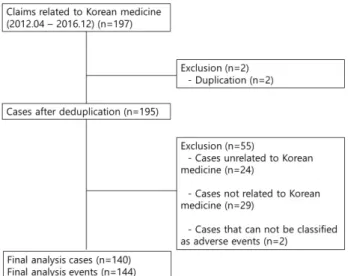
Fig. 1. Flow Diagram of Case Selection.
유의수준 5%로 하였다.
결 과
2012년 4월부터 2016년 12월까지 조정중재원에 접수된 ‘한의 의료’와 관련한 사례는 총 197건이었으며, 이 중 배제기준에 따라 분 분석에서 배제된 사례는 57건이었다(Fig. 1). 그 결과 총 140사 례가 최종적으로 분석 대상으로 선택되었다. 이 중 두 종류 이상의 이상반응이 함께 보고된 사례 4건으로 인해, 총 분석 대상으로 선정 된 조정 요청 이상반응 사건은 144건이었다. 총 140 사례 중 환자 본인이 스스로 접수한 사례는 108 례, 대리인이 접수한 사례는 32 례였다.
배제 사례 57건 중 중복사례 2건을 제외한 55건의 배제 사유는 직접적으로 한의 의료행위가 명시되지 않은 사례(n=29), 한의 의료 와 무관한 사례(n=24), 이상반응 기준에 부합하지 않는 사례(n=2) 등이었다. 배제 사유는 Appendix 1에 정리하였다.
총 분석 사례의 중위수 연령은 48.5세(35∼61)였으며, 그중 56%(79명)이 여성이었다. 분석된 사례(n=140)와 중복을 제외한 배 제 사례(n=55) 간 연령, 성별의 차이는 없었다(성별 2=0.0001, p=0.993/연령 Mann-Whitney test z=0.805, p=0.4207).
1. 조정 요청 이상반응의 유형별 분류
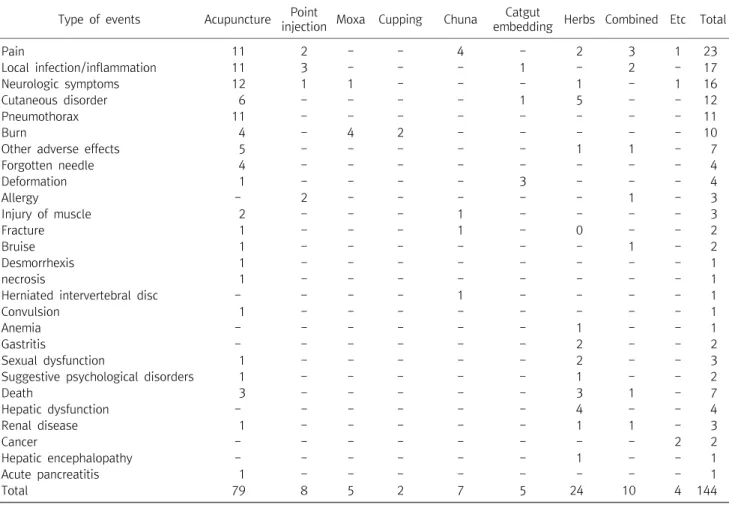
조정 요청 이상반응 유형은 총 28가지로 분류하였으며, 이 중 통증(16%), 국소감염/염증(12%), 신경학적 증상(11%)이 주요한 사 건으로 나타났다(Table 1).
2. 조정 요청 이상반응의 중재별 분류
침(79건, 55%), 한약(24건, 17%)과 연관된 조정 요청 이상반응 은 전체 사건 수의 72%를 차지했으며, 복합중재(8%), 약침(6%), 추 나(5%), 뜸(3%), 매선요법(3%), 부항(1%)이 뒤를 이었다. 침 치료 관련 조정 요청 이상반응(79건, 55%) 중에서는 신경학적 증상(12 건, 15%), 통증(11건, 14%), 국소감염/염증(11건, 14%), 기흉(11건, 14%)등이 가장 흔하게 보고되었다. 한약 복용과 연관된 조정 요청 이상반응(24건, 17%)으로는 피부질환(5건, 21%), 간 기능 이상(4 건, 17%) 등이 가장 흔히 보고되었다. 약침 관련 조정 요청 이상반 응(8건, 5.5%) 중에서는 국소감염/염증(3건, 38%), 뜸과 연관된 조 정 요청 이상반응(5건, 3.5%) 중에서는 2도 화상 2건, 1도 화상 및 정도가 명시되지 않은 화상 1건 등 총 4건(80%), 부항과 연관된 조정 요청 이상반응(2건, 1.4%) 중에서는 3도 화상 1건, 정도가 명 시되지 않은 화상 1건(100%), 추나 요법 관련 조정 요청 이상반응 (7건, 4.9%) 중에서는 통증(4건, 57%), 매선요법 관련 조정 요청 이상반응(5건, 3.5%) 중에서는 연부조직 변형(3건, 60%), 여러 중 재가 조합된 복합 중재와 연관된 조정 요청 이상반응(11건, 7.6%) 중에서는 통증(3건, 27%) 등이 흔한 사건으로 보고되었다(Table 1).
3. 조정 요청 이상반응의 중증도 별 분류
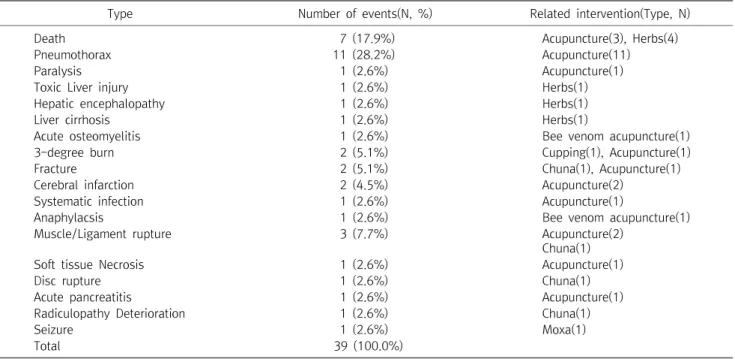
보고된 내용을 토대로 하여 본 연구에서의 중대 이상반응 분류 기준인 사망, 입원치료 및 입원치료가 필요했을 것으로 보이는 사 례는 총 39건(27.9%)으로 기흉(n=11), 사망(n=7), 근육/인대파열 (n=3), 3도 화상(n=2), 골절(n=2), 뇌경색(n=2) 및 사지마비, 신경 근병증 악화, 독성 간질환, 간성 뇌병증, 간 경변, 급성 골수염, 아나 필락시스, 전신 감염, 연부조직 괴사, 디스크 파열, 급성 췌장염, 발작이 각 1건씩 보고되었다. 중대 이상반응으로 분류된 사례들에 서 사용된 중재는 침(n=26), 한약(n=7) 으로 중대 이상반응 사례 중 84.6%를 차지하였다(Table 2). 사망 사례 7건 중 3건(침 시술 후 하반신 마비 증세로 전원 하였으나 사망한 사례, 유방암 수술 후 한약을 복용하고 상태가 악화되어 사망한 사례, 고도비만 치료 한약 복용 및 복부 전기침 시술 후 급성 심장사한 사례)은 피신청인 불참으로 조정 과정이 개시되지 않아 각하되었고, 조정 개시된 4건 중 2건(우울 증상에 대한 조제 한약 복용 후 사망한 사례, 반하백출 천마탕 한약제제 복용 후 장패혈증 및 호흡부전으로 사망한 사례) 은 취하되었으며, 나머지 2건(침 시술 후 발생한 구토 및 어지럼증 을 급체로 오진 후 뇌출혈에 의한 사망 사례, 침 시술 도중 심정지 로 사망한 사례)은 조정 합의 되었다.
Table 1. Claimed Adverse Events
Type of events Acupuncture Point
injection Moxa Cupping Chuna Catgut
embedding Herbs Combined Etc Total
Pain 11 2 - - 4 - 2 3 1 23
Local infection/inflammation 11 3 - - - 1 - 2 - 17
Neurologic symptoms 12 1 1 - - - 1 - 1 16
Cutaneous disorder 6 - - - - 1 5 - - 12
Pneumothorax 11 - - - - - - - - 11
Burn 4 - 4 2 - - - - - 10
Other adverse effects 5 - - - - - 1 1 - 7
Forgotten needle 4 - - - - - - - - 4
Deformation 1 - - - - 3 - - - 4
Allergy - 2 - - - - - 1 - 3
Injury of muscle 2 - - - 1 - - - - 3
Fracture 1 - - - 1 - 0 - - 2
Bruise 1 - - - - - - 1 - 2
Desmorrhexis 1 - - - - - - - - 1
necrosis 1 - - - - - - - - 1
Herniated intervertebral disc - - - - 1 - - - - 1
Convulsion 1 - - - - - - - - 1
Anemia - - - - - - 1 - - 1
Gastritis - - - - - - 2 - - 2
Sexual dysfunction 1 - - - - - 2 - - 3
Suggestive psychological disorders 1 - - - - - 1 - - 2
Death 3 - - - - - 3 1 - 7
Hepatic dysfunction - - - - - - 4 - - 4
Renal disease 1 - - - - - 1 1 - 3
Cancer - - - - - - - - 2 2
Hepatic encephalopathy - - - - - - 1 - - 1
Acute pancreatitis 1 - - - - - - - - 1
Total 79 8 5 2 7 5 24 10 4 144
고 찰
조정중재원에 접수된 한의 의료 관련 140건의 조정신청 사례로 파악한 조정 요청 이상반응 144건을 분석한 결과, 경도의 반응인 통증, 국소감염 및 염증부터 장기 손상, 사망 등 다양한 유형이 포 함되어 있었다. 중재에 따른 분류로는 침, 한약, 그리고 복합중재의 순으로 접수 건수가 많았다. 중대 이상반응으로 분류할 수 있는 사 례는 총 접수사례의 28%였다. 그러나 연관성 평가를 위해 기본적 으로 필요한 중재, 사건, 기타 환자 정보 등이 매우 제한적이고 시 간적 전후 관계 외에는 한의약 치료와 발생사건 간 연관성을 뒷받 침할 수 있는 단서가 없어 중재 및 사건의 오분류 위험을 배제할 수 없다. 종합적으로, 조정중재원의 접수 사례 분석은 다양한 유형 의 경도 이상반응 사례와 중대 이상반응 사례를 반영하고 있으나, 의미 있는 분석을 위해서는 추가 정보가 필요하며, 향후 이상반응 조사 연구 설계 및 다양한 맥락 내 이상반응 보고의 차이를 설명하 기 위한 조정 요청 이상반응에 대한 후속 연구의 기초 자료가 될 수 있다.
본 연구에서 관찰한 통증, 국소 감염 및 염증, 신경학적 증상 등 침 치료 관련 조정 요청 이상반응 유형은 한국소비자원, 대한한 의사협회 및 식품의약품안전처(이하 식약처)에 접수된 9,624건의 한의 진료 관련 이상반응 연구 결과19) 및 229,230 명의 환자 직접 보고를 통해 조사한 독일 침 이상반응 연구9)의 사례 유형과 유사했 다. 중대 이상반응으로 분류 가능한 기흉은 본 연구에서 총 11건이 확인되었다. 이는 기존의 전향적 및 후향적 관찰연구에서 보고된 10만 명 당 1건9), 10만 회 당 5건8) 발생 위험에 비해 자주 일어난 것처럼 보인다. 그러나 갈등 중재를 목적으로 하는 접수 사례 중 기흉 분율과, 임상 진료 시 이루어진 관찰 연구 맥락에서 계산된 기흉 발생 위험을 직접적으로 비교할 수는 없다. 또한, 기존 관찰 연구는 한의사8) 또는 침 시술 의사9)가 침 치료를 시행했음이 명확 한 반면 조정중재원의 자료에는 의료 행위 제공자 및 침 시술 행위 에 대한 구체적 정보가 명시되지 않았다. 따라서, 기흉처럼 시술자 의 자격 및 숙련도와 연관성이 높은 사건이 한의사가 아닌 시술자 로 인한 사례 포함 때문에 상대적으로 높은 빈도로 조정 요청 사례 접수되었는지는 현재 자료로는 알 수 없다. 또는 기존 관찰 연구가
Table 2. Number and Percentage of Claimed Serious Adverse Events
Type Number of events(N, %) Related intervention(Type, N)
Death 7 (17.9%) Acupuncture(3), Herbs(4)
Pneumothorax 11 (28.2%) Acupuncture(11)
Paralysis 1 (2.6%) Acupuncture(1)
Toxic Liver injury 1 (2.6%) Herbs(1)
Hepatic encephalopathy 1 (2.6%) Herbs(1)
Liver cirrhosis 1 (2.6%) Herbs(1)
Acute osteomyelitis 1 (2.6%) Bee venom acupuncture(1)
3-degree burn 2 (5.1%) Cupping(1), Acupuncture(1)
Fracture 2 (5.1%) Chuna(1), Acupuncture(1)
Cerebral infarction 2 (4.5%) Acupuncture(2)
Systematic infection 1 (2.6%) Acupuncture(1)
Anaphylacsis 1 (2.6%) Bee venom acupuncture(1)
Muscle/Ligament rupture 3 (7.7%) Acupuncture(2)
Chuna(1)
Soft tissue Necrosis 1 (2.6%) Acupuncture(1)
Disc rupture 1 (2.6%) Chuna(1)
Acute pancreatitis 1 (2.6%) Acupuncture(1)
Radiculopathy Deterioration 1 (2.6%) Chuna(1)
Seizure 1 (2.6%) Moxa(1)
Total 39 (100.0%)
*Three-degree burn by hot pack during acupuncture for rehabilitation treatment.
시술자의 숙련도 측면에서 다양성을 반영하지 못하고 특정 조건 하의 임상 진료 시 발생하는 이상반응의 측정에 그쳐 다양한 진료 조건하의 기흉 발생 위험을 과소 추정하였을 가능성도 있다. 이러 한 점은 추후 조정 중재원 자료 분석 시 시술자에 대한 추가적 정보 를 포함시키고, 다양한 진료 조건에서 이루어지는 침 안전성 연구 를 종합적으로 분석함으로써 다루어야 할 것이다.
부항 치료 관련 조정 요청 이상반응은 2건으로 3도 화상 1건과 손상 정도가 명시되지 않은 화상 1건이었다. 부항 이상반응에 대한 체계적 문헌고찰에서, 화상은 이상반응 유형으로 보고되지 않았으 나20), 화관법 수행 중 발생한 화상 이상반응은 충분히 발생 가능한
사례이다21-24). 국내 응급실에 전원 된 환자들의 한의 치료 후 이상
반응 사례를 분석한 한 연구에서는, 뜸 및 부항 시술 후 발생한 화상 사례 10건을 보고하였다25). 부항 시술에 의해 형성된 수포를 2차성 표재성 화상으로 분류한 사례도 있어21), 본 연구에서 손상 정도가 명시되지 않은 화상 사례 1건의 오분류 여부는 알 수 없다.
현재는 부항 이상 반응의 명확한 분류 기준이 세워져 있지 않으므 로, 향후 연구를 통해 부항 시술과 연관된 이상반응의 분류 체계 및 평가 체계 수립, 이를 통한 전향적, 체계적인 이상반응 자료 수 집이 필요하다.
한편 서양에서 보고된 부항 시술에 의한 화상 사례는 대부분 화 관법과 연관된 것이다21-24). 국내 한의사 대부분이 진공펌프 배기법 을 선호하나3), 부항요법 표준화를 위한 국내 동향조사26)와 문헌고
찰 및 부항 시술 현황조사20)에 따르면 일부에서는 부항 시술 시 화관법을 사용하고 있다. 국제 표준화 기구(International Organi- zation for Standardization)에서 출간한 부항컵 표준에서는, 부항 컵의 재질, 압력, 멸균 방법, 부항 컵의 포장 등에 대한 표준을 제시 하였다27). 그러나 부항 부착시간, 부착부위, 부착방법 등 구체적인 시술 과정에 대한 전문적 권고안이나 표준안은 아직 없으며, 시술 과정 및 부항 치료 후 이상반응에 대한 한의사의 인식에는 큰 편차 가 있는 것으로 알려져 있다28). 안전한 부항 시술 권고안이 만들어 지기 위해서는 발생 가능한 모든 이상반응(예, 부항 후 화상)이 체계 적 사례 수집 양식에 포함되어야 하며, 특정 이상반응과 연관된 시 술법(예, 화관법)에 대한 학계와 임상가의 각별한 주의가 필요하다.
본 접수 사례 분석에서 중대 이상반응으로 간주할 수 있는 사건 은 침 시술과 연관된 기흉, 한약 복용과 연관된 간 손상 및 사망 등이었다. 기흉은 시술자의 자격, 자침 부위 및 자침 술기와 연관된 중대 이상반응으로 기존 사례 보고29) 및 후향적 의무기록 분석8)에 서 보고된 바 있으며, 안전한 시술 방법을 준수할 경우 드물게 발생 하는 것으로 알려져 있다30). 한약 복용과 연관된 간 손상 사례 역시 증례 보고2)를 통해 알려져 있으나, 최근 이루어진 한방병원 입원환 자 1,001명으로 대상으로 이루어진 전향적 관찰연구 상 한약 복용 후 간 손상 발생 위험은 복용 후 68일 이내 1,000명당 6명으로 드물게 발생하였다31). 한약 복용 후 사망한 것으로 조정 요청된 사 건은, 한약의 구체적 성분, 환자의 기존 질환 및 직접 사인 등 인과
성 분석에 필수적인 정보가 누락되어 있어 접수된 사건들이 한약 복용과 실질적으로 연관된 반응인지 여부는 알 수 없다. 추나 시술 후 늑골 골절, 뜸 치료 후 경련, 봉독 약침 치료 후 급성 골수염 등은 기존 연구 문헌에서는 알려지지 않은 반응이다. 무작위 대조 연구에서 중대 이상반응 보고는 매우 드물며4), 한의약 중대 이상반 응에 대한 자료가 주로 증례 보고 등 제한된 정보에 의존함을 감안 할 때, 본 분석 및 다양한 자료원을 통해 확인한 여러 유형의 중대 이상반응 정보가 향후 연구 및 임상 진료 내의 안전성 평가 체계 수립에 반영되어야 할 것이다.
본 연구와 유사하게, 신 등19)은 한국소비자원, 대한한의사협회 및 식약처에 접수된 9,624건의 한의 진료 관련 조정 요청 이상반응 사례를 분석하였다. 그러나 식약처에서는 품목허가를 받은 한약제 제에 한정하여 약물 이상반응을 보고받고 있으며, 개별 조제 한약 에 대한 부작용 보고 체계는 마련되어 있지 않아 한약과 연관된 위해 사건이 자료에서 누락되었을 가능성이 있다32). 한국 소비자원 의 접수 자료는 한의 의료 이상 반응과 단순 불만족 사례가 구별되 어 있지 않다16). 한의사협회에 보고된 한방 의료와 관련된 이상반 응은 전체 사례 중 일부로서, 전체 이상반응 사례에 대한 정보는 제공하지 못한다14). 각 자료들의 특성 및 한계를 감안하였을 때, 전향적이고 체계적 한의약 이상반응 정보 수집 및 분석 체계가 마 련되기 전까지는 한의약 안전성에 대한 종합적 평가를 위해 가능한 여러 자료원들을 이용하여 과소보고 및 이상반응 보고 누락으로 인한 한의약 위해의 과소 추정 위험을 최대한 줄여야 할 것이며, 이를 위한 연구 방법론의 수립 역시 필요하다.
이 연구의 장점은 아래와 같다. 첫째, 이 연구는 조정중재원의 한의 의료 이상반응 접수 사례를 이용한 최초의 안전성 연구로, 조 정중재원의 공개 자료가 이상반응 정보를 분석하기 위한 자료원으 로서 가치가 있는지 파악할 수 있었다는 장점이 있다. 이 연구에 적용된 자료 공개 범위는 제한적이었으나, 향후 연구에서 더욱 구 체적인 정보를 얻을 수 있다면 임상에서 보고되지 않는 이상반응 유형을 파악할 수 있는 의미 있는 자료원이 될 가능성이 있다. 둘째, 의료인/연구자에 의한 이상반응이 아니라 환자의 경험과 관점에서 접수된 이상반응 사례라는 점에서 의무기록이나 의료인/연구자 기 반 이상반응 보고의 선택적 보고 바이어스 위험이 있는지 평가할 수 있는 보완자료로 활용할 수 있다는 의미가 있다. 예를 들어, 부 항 후 화상은 본 연구 및 손해배상청구 사례33) 등 미출간 자료에서 확인할 수 있었으나, 기존의 체계적 문헌고찰 또는 국내 사례보고 에는 없었던 내용이다.
본 연구의 약점은 아래와 같다. 첫째, 대중에 공개된 사례 개요 부분만을 이용한 분석이므로, 이상반응 유형과 중재 분류 측면에서
오분류(misclassification) 가능성을 배제할 수 없으며, 사건 개요가 구체적이지 않아 배제된 사례 중에서도 분석 대상에 포함될 수 있 었던 사례가 존재했을 가능성도 있다. 조정중재원 홈페이지에 공개 된 10건의 조정중재 사례에서 사고 발생 경위, 사안의 쟁점 내용, 손해배상 책임 내용, 처리결과 등의 정보를 제시하고 있는 것과 달 리34), 본 연구의 자료는 공개 범위가 매우 제한되어 구체적인 내용 을 확인하기 힘들었을 뿐만 아니라 상세 정보가 포함된 10건이 본 분석 사례 중 어떤 것에 해당하는지도 알 수 없었다. 구체적인 중재 와 사건 내용, 전문 의료진이 참여한 사건 기술 등을 확인할 수 있었더라면 오분류 가능성을 줄일 수 있었을 것이다. 조정중재원의 자료를 이용한 후속 이상반응 연구에서는, 사전에 충분한 협의를 통해 연구용 자료의 경우 조정중재원 홈페이지에 공개된 10건의 사례에 제시된 수준의 구체적인 정보를 활용할 수 있도록 해야 할 것이다. 둘째, 본 연구에서 활용한 조정 요청 이상반응 사례는 실제 한의 의료와는 연관성이 낮을 수 있다. 환자의 기존 상태 및 병행 약물과 치료는 보고된 한의 의료와 이상반응 사건 발생 간 연관성 의 교란요인(confounder)일 수 있으나, 제공된 자료에는 이에 대한 정보가 없어 본 연구에서 보정할 수 없었다. 이는 분석 결과의 신뢰 성을 떨어뜨릴 수 있는 요인이며, 추후 연구에서 구체적인 사건 개 요 정보 활용을 통해 개선해야 할 점이다. 셋째, 환자가 아닌 보호 자나 제 3자 등의 대리인에 의해 사례가 접수된 경우 사례 개요가 부정확할 수도 있으며, 이 경우 환자-보고 이상반응으로 분류할 수 없는 사례가 분석에 포함되었을 가능성도 있다. 넷째, 본 연구는 조정중재원에 접수된 사례만 분석하였으며 전체 한의 의료 건수 중 몇 사례가 발생한 것인지에 대한 정보는 없으므로, 이상반응 발 생 위험(incidence risk)에 대해서는 알 수 없다. 다섯째, 본 연구는 조정중재원에서 제공받은 한정된 자료를 분석한 것으로, 제공받은 자료에 구체적인 서술이 없으며, 공개된 사건 개요 내에 의료 행위 자 정보가 없어 시술의 품질과 보고된 이상반응 간의 연관성을 알 수 없다. 여섯째, World Health Organization-Uppsala Monitoring Centre 지표35,36), Naranjo 지표37), 인과성 한국형 알고리즘 2.038) 등 타당도가 검증된 여러 인과성 평가 도구들을 이용한다면, 제공 된 한의 중재와 발생사건 간 인과성 분석이 가능하겠지만 제공받은 자료의 한정된 정보로 인하여 인과성 평가가 포함된 분석은 하지 못했다.
결 론
조정중재원이 개원한 2012년 4월부터 2016년 12월까지 조정중
재원에 접수된 ‘한의약’에 대한 사례 중 연구 조건에 부합하는 144 건을 대상으로 연령, 성별, 한의 의료 유형, 중재, 중증도 등을 분석 한 결과 다음과 같은 결론을 얻었다.
1. 접수자들의 중위수 연령은 48세이며 여성이 약간 더 많았고 (56%), 분석에 포함된 사례와 배제된 사례 간 연령, 성별의 차이는 없었다.
2. 총 28종의 조정 요청 이상반응 유형이 확인되었으며, 이 중 통증, 국소감염/염증, 신경학적 증상이 가장 흔한 사건이었다.
3. 침, 한약, 복합 중재, 약침, 추나, 뜸, 매선, 부항 순으로 조정 요청 이상반응이 흔히 나타났다.
4. 중대 이상반응으로 분류 가능한 조정 요청 이상반응은 총 39 건이었고, 연관된 중재는 침과 한약이 대부분이었다.
5. 구체적인 정보 부족으로 인해 본 연구에서 분석한 조정 요청 이상 반응과 제공된 중재 간 인과성은 평가할 수 없으며, 중재와 사건의 오분류 위험이 높다.
이 연구는 환자 및 지정 대리인 보고에 기반을 두어 이상반응의 최소 요건에 부합하는 시간적 전후 관계상 한의치료 관련 이상반응 으로 분류할 수 있는 다양한 조정 요청 사건을 분석하였다. 향후 더욱 구체적인 자료 제공을 통한 사례 분석이 이루어진다면, 조정 중재원 사례는 보다 종합적인 안전성 분석에 필요한 의미 있는 정 보원으로 활용될 수 있을 것이다.
감사의 글
This work was supported by a 2-Year Research Grant of Pusan National University.
References
1. Korea Good Clinical Practice(KGCP). Ministry of Food and Drug Safety. 2014.
2. Lee KH, Yang JE, Chang GT. A Psoriasis Case Report on Liver Damage Related to Scutellaria Radix. J Korean Oriental Med.
2011 ; 32 : 149-58.
3. Kim TH, Kim KH, Choi JY, Lee MS. Adverse events related to cupping therapy in studies conducted in Korea: A systematic review. European Journal of Integrative Medicine. 2014 ; 6 : 434-40.
4. Lee JY, Jun SA, Hong SS, Ahn YC, Lee DS, Son CG. Systematic Review of Adverse Effects from Herbal Drugs Reported in Randomized Controlled Trials. Phytother Res. 2016.
5. Lee WJ, Kim HW, Lee HY, Son CG. Systematic review on herb-induced liver injury in Korea. Food Chem Toxicol. 2015 ; 84 : 47-54.
6. Oh SJ, Cho JH, Son CG. Systematic review of the incidence of herbal drug-induced liver injury in Korea. J Ethnopharmacol.
2015 ; 159 : 253-6.
7. Park JY, Kim SY, Chae YB, Chae H, Koo ST, Kim ST, et al.
Systematic Review of Adverse Events Related to Acupuncture and Moxibustion in Korea. The Journal of Korean Medicin.
2010 ; 31 : 78-90.
8. Kim MR, Shin JS, Lee J, Lee YJ, Ahn YJ, Park KB, et al. Safety of Acupuncture and Pharmacopuncture in 80, 523 Musculoskele- tal Disorder Patients: A Retrospective Review of Internal Safety Inspection and Electronic Medical Records. Medicine(Baltim- ore). 2016 ; 95 : e3635.
9. Witt CM, Pach D, Brinkhaus B, Wruck K, Tag B, Mank S, et al.
Safety of acupuncture: results of a prospective observational study with 229, 230 patients and introduction of a medical in- formation and consent form. Forsch Komplementmed. 2009 ; 16 : 91-7.
10. Hazell L, Shakir SA. Under-reporting of adverse drug reactions : a systematic review. Drug safety. 2006 ; 29 : 385-96.
11. Ohrn A, Elfstrom J, Tropp H, Rutberg H. What can we learn from patient claims? - A retrospective analysis of incidence and pat- terns of adverse events after orthopaedic procedures in Sweden. Patient safety in surgery. 2012 ; 6 : 2.
12. Lee MS, HwangBo M, Seo HS. The Judicial Precedent Analysis of Medical Litigation in the field of Pediatric Ophthalmology. The Journal of Korean Medicine Ophthalmology and Otolaryngology and Dermatology. 2012 ; 25 : 78-87.
13. Kim SH. Legal Practice Study : Traditional Korean Medicine and Malpractice. Bupjo. 2009 ; 58 : 358-88.
14. Lee ES, Oh JY, Cho HS, Kim KH, Lee SD, Kim KS, et al. Study about the Status and Prevention of Oriental Medical Disputes.
Journal of Korean Medicine. 2014 ; 35 : 58-67.
15. Jung MY. Research on the Rational Solution for Oriental Medical Conflicts - Focusing on the relieving role of KCA in oriental
medical disputes -. The Korean Society of Law and Medicine Semiannual. 2008; 9: 383-422.
16. Cha HY, Jeong AR, Kim KB, Cheon JH. Study about Analysis of Current Case for Oriental Medical Disputes. Journal of Korean Medicine. 2015 ; 36 : 111-25.
17. Charan J, Biswas T. How to calculate sample size for different study designs in medical research? Indian journal of psycho- logical medicine. 2013 ; 35 : 121-6.
18. The Association of Korean Medicine. Korean classification of procedures in Korean oriental medicine. The Association of Korean Medicine. 2001 : 153.
19. Shin HK, Jeong SJ, Lee MS, Ernst E. Adverse events attributed to traditional Korean medical practices: 1999-2010. Bull World Health Organ. 2013 ; 91 : 569-75.
20. Lee BY, Song YK, Lim HH. Literature Investigation Regarding Cupping Therapy and Analysis of Current Professional's Cupping Treatment. J Oriental Rehab Med. 2008 ; 18 : 169-91.
21. Iblher N, Stark B. Cupping treatment and associated burn risk:
a plastic surgeon's perspective. J Burn Care Res. 2007 ; 28 : 355-8.
22. Kose AA, Karabagli Y, Cetin C. An unusual cause of burns due to cupping: Complication of a folk medicine remedy. Burns.
2006 ; 32 : 126-7.
23. Kulahci Y, Sever C, Sahin C, Evinc R. Burn Caused by Cupping Therapy. Journal of Burn Care & Research. 2011 ; 32 : e31.
24. Sagi A, Ben-Meir P, Bibi C. Burn hazard from cupping-an an- cient universal medication still in practice. Burns. 1988 ; 14 : 323-5.
25. Lee SW. Cases of Side Effects of Oriental Medicine and Implications. Research Institute for Healthcare Policy Korean Medical Association. 2015 ; 13 : 73-9.
26. Kwon OS, Lee SH, Choi SM, Ryu YH. A Study of Research Patterns for Standardization of Cupping Therapy. Korean Journal of Acupuncture. 2012 ; 29 : 250-9.
27. ISO 19611:2017(en), Traditional Chinese medicine - Air ex- traction cupping device. the International Organization for
Standardization. 2017.
28. Son MJ, Jung UM, Han CH, Kwon OM. A Survey of medical con- tents in Korean Medical Textbooks and Intervention Usage.
Korea Institute of Oriental Medicine Symposium. 2014 ; 23 : 79-92.
29. Lee SH, Choi DY, Lee YH. A Case Report on the Traumatic Pneumothorax associated with Acupuncture. J Kor Acu Mox Soc. 2001 ; 18 : 205-11.
30. Xu S, Wang L, Cooper E, Zhang M, Manheimer E, Berman B, et al.
Adverse events of acupuncture: a systematic review of case reports. Evid Based Complement Alternat Med. 2013 ; 2013 : 581203.
31. Cho JH, Oh DS, Hong SH, Ko H, Lee NH, Park SE, et al. A nation- wide study of the incidence rate of herb-induced liver injury in Korea. Arch Toxicol. 2017.
32. Woo YJ, Chung SY, Park BJ. Current Status of Spontaneous Adverse Reactions Reporting System on Herbal Medicine in China Japan Korea and WHO. J Int Korean Med. 2014 ; 35 : 111-8.
33. SAMSUNG Fire & Marine Insurance Co. Medical Accidents asso- ciated with Cupping and Moxibustion. SAMSUNG Fire & Marine Insurance Co., Ltd. 2010.
34. Korea Medical Dispute Mediation and Arbitration Agency.
Available from: http://www.k-medi.or.kr
35. Edwards IR, Aronson JK. Adverse drug reactions: definitions, diagnosis, and management. Lancet. 2000 ; 356 : 1255-9.
36. Nebeker JR, Barach P, Samore MH. Clarifying adverse drung events: a clinician's guide to terminology, documentation, and reporting. Ann Intern Med. 2004 ; 140 : 795-801.
37. Naranjo CA, Busto U, Sellers EM, Sandor P, Ruiz I, Roberts EA, et al. A method for estimating the probability of adverse drug reactions. Clin Pharmacol Ther. 1981 ; 30 : 239-45.
38. Management KIoDSR. Adverse Drug Reaction Assessment Report. 1 ed. Korea Institute of Drug Safety & Risk Management.
2013 : 60-3.
Appendix 1. Description of Excluded Cases
Event summary Reasons for exclusion
Diagnosis of syncope, hyperglycemia after taking prescription drugs due to anorexia Duplicate Spinal stenosis, spinal stenosis, cervical stenosis after treatment 1 mistake, spinal
paralysis, sprained lumbar compression fracture, abscess
Duplicate Lower extremity edema was diagnosed with renal anemia received herbal medicine
but not cured
The medical treatment of Traditional Korean Medicine is not directly specified
Cerebral infarction after two cervical rotation therapy The medical treatment of Traditional Korean Medicine is not directly specified
Promised to cure within 4 weeks without surgery, but did not recover so underwent emergency surgery
The medical treatment of Traditional Korean Medicine is not directly specified
Left ankle 2 degree burns during physical therapy The medical treatment of Traditional Korean Medicine is not directly specified
Hair loss after treatment of seborrheic dermatitis The medical treatment of Traditional Korean Medicine is not directly specified
No improvement after treatment with low back pain, performing disc removal at another hospital
The medical treatment of Traditional Korean Medicine is not directly specified
Side effects after taking prescription drugs with rhinitis The medical treatment of Traditional Korean Medicine is not directly specified
Cancer Patients Ineffective After Prescription Drugs, Death The medical treatment of Traditional Korean Medicine is not directly specified
Treatment of other hospital by skin rash after physical therapy The medical treatment of Traditional Korean Medicine is not directly specified
Waist condition worsening after chiropractic procedure The medical treatment of Traditional Korean Medicine is not directly specified
Diagnosis of syncope, hyperglycemia after taking prescription drugs due to anorexia The medical treatment of Traditional Korean Medicine is not directly specified
Symptoms worsening after treatment of cerebral infarction, diagnosis of ischemic stroke grade 5 in another hospital
The medical treatment of Traditional Korean Medicine is not directly specified
Occurred in the right eye after treatment due to back pain, other hospital operations The medical treatment of Traditional Korean Medicine is not directly specified
Patients with lower back pain worsened after non-surgical treatment The medical treatment of Traditional Korean Medicine is not directly specified
Intensive pain after treatment under myalgia, intervertebral disc herniation in another hospital
The medical treatment of Traditional Korean Medicine is not directly specified
Muscle injury, inflammation after treatment with disc, etc. The medical treatment of Traditional Korean Medicine is not directly specified
Severe fracture site worsened by unreasonable physical therapy before union The medical treatment of Traditional Korean Medicine is not directly specified
Diagnosis of fibromyalgia after treatment, worsening of symptom, diagnosis of myelopathy in other hospital
The medical treatment of Traditional Korean Medicine is not directly specified
Staphylococcus aureus and Steven Johnson syndrome after taking prescription drugs due to poor circulation
The medical treatment of Traditional Korean Medicine is not directly specified
Treated with a diagnosis of nodular pneumonia but it was not effective. Diagnosis Scabies by other hospital
The medical treatment of Traditional Korean Medicine is not directly specified
Shoulder ligament rupture after physical treatment with right shoulder pain The medical treatment of Traditional Korean Medicine is not directly specified
Burns after hot-pack treatment on both legs with lower extremity muscle pain The medical treatment of Traditional Korean Medicine is not directly specified
Third degree burn occurred during abdominal fumigation The medical treatment of Traditional Korean Medicine is not directly specified
Fracture of lumbar vertebrae 1-2 after hand therapy for back pain The medical treatment of Traditional Korean Medicine is not directly specified
Third degree burns during physical therapy The medical treatment of Traditional Korea Medicine is not directly specified
Cardiac arrest after treatment of abdominal pain and vomiting symptoms, Death The medical treatment of Traditional Korean Medicine is not directly specified
Skin abscess after facial wrinkle treatment The medical treatment of Traditional Korean Medicine is not directly specified
Appendix 1. Continued
Event summary Reasons for exclusion
Decrease in elasticity of facial skin causes depression after procedure, skin discoloration, etc.
The medical treatment of Traditional Korean Medicine is not directly specified
After Acne treatment, acne spot, pus incidence The medical treatment of Traditional Korean Medicine is not directly specified
Claims of fracture due to hospital carelessness Not related to Traditional Korean Medicine Symptoms of leg palsy after exercise therapy Not related to Traditional Korean Medicine Chest pain complaint after gastrointestinal imaging. (*Medical Institution Application) Not related to Traditional Korean Medicine Hospitals provide walker badness to hurt lumbar pain Not related to Traditional Korean Medicine Burns by interfering low frequency therapy during shoulder physical therapy Not related to Traditional Korean Medicine Fracture and seizures caused by falling in bed during physical therapy Not related to Traditional Korean Medicine Missing prescription for angina in a nursing hospital. (Patient death) Not related to Traditional Korean Medicine Blepharoplasty after removal of cheek melanin cell nevus(dot) Not related to Traditional Korean Medicine After fracture acupuncture treatment, surgery after fracture diagnosis in another
hospital
Not related to Traditional Korean Medicine During physical therapy, limb compression circulation device explodes and leg
abrasions occur
Not related to Traditional Korean Medicine
Suffered from speech disorder during rehabilitation treatment but delayed treatment, resulting in secondary cerebral infarction
Not related to Traditional Korean Medicine
Acupuncture treatment such as indigestion, delayed diagnosis of Barter's stomach cancer
Not related to Traditional Korean Medicine During massage treatment with headache, fall due to inexperienced procedure Not related to Traditional Korean Medicine Pigmentation after dot removal procedure Not related to Traditional Korean Medicine
Burns during ankle physical therapy Not related to Traditional Korean Medicine
Burns after high frequency treatment Not related to Traditional Korean Medicine Hearing deterioration after self-regulatory therapy with hearing loss and tinnitus Not related to Traditional Korean Medicine During hospitalization due to cervical spine and lumbar sprain, aftereffect due to
insufficient treatment
Not related to Traditional Korean Medicine Dyspnea develops after lumbar disc treatment, refused request transfer to another
hospital
Not related to Traditional Korean Medicine
Bone infections and vascular damage after cartilage injection with arthritis Not related to Traditional Korean Medicine Diagnosis of atrophic skin damage after lifting of facial thread Not related to Traditional Korean Medicine Adverse effects such as rash deterioration, dyspnea, complications, etc. are caused
by stopping measures taken by the doctor during taking steroid medicines to treat skin diseases
Not related to Traditional Korean Medicine
Pain, limitation of movement after injection therapy after shoulder pain Not related to Traditional Korean Medicine Hip dislocation during palpation due to weakness Not related to Traditional Korean Medicine Pain is persistent after acupuncture treatment due to diagnosis of spinal stenosis Do not meet adverse event criteria Acupuncture treatment with panic disorder, depression, etc. but not effective Do not meet adverse event criteria