This is an Open Access article distributed under the terms of the Creative Commons Attribution Non-Commercial License (http://creativecommons.org/licenses/
by-nc/3.0) which permits unrestricted non-commercial use, distribution, and reproduction in any medium, provided the original work is properly cited.
Review Article
Bacteriocins of Lactic Acid Bacteria and Their Industrial Application
Bamgbose Timothy
1,2,*, Atta Habiba Iliyasu
2and Anupkumar R. Anvikar
11
National Institute of Malaria Research, ICMR-NIMR, Sector 8, Dwarka, New Delhi
2
Department of Microbiology, Ahmadu Bello University, Zaria, Nigeria
Abstract
Lactic acid bacteria produce different types of inhibitory compound that have a bactericidal effect. The inhibitory compounds produced include metabolic end products, bacteriocins that are antimicrobial peptides with antibiotic effect, hydrogen peroxides and numerous organic acids depending on their fermentation pathway. The inhibitory activity by bacteriocins produced by lactic acid bacteria is diverse, comprising of strains capable of inhibiting different types of Gram-positive micro- organisms to those that affect only organism of close general. With the growing concern over the spread of antibiotic-resistant microorganisms and the possibility of current therapies becoming inefficient, it is imperative to find antibiotics alternatives.
In food preservation, naturally occurring peptides with antimicrobial activity are favoured over chemical preservatives a more reason why there should be a holistic approach to taking advantage of bacteriocinogenic bacteria in medicine and food industry. This review focuses on the application of bacteriocin in food preservation, food industry, livestock and medicine.
Keywords
bacteriocin, lactic acid bacteria, antimicrobial activity, health, biopreservation
Received: Feb. 11, 2021 Revised: Apr. 21, 2021 Accepted: Apr. 26, 2021
*Corresponding author : Bamgbose Timothy National Institute of Malaria Research [ICMR-NIMR], Sector 8, Dwarka, New Delhi 110077, India Tel: +919818238270
E-mail: [email protected]
ORCID Bamgbose Timothy
http://orcid.org/0000-0002-7589-0621 Atta Habiba Iliyasu
https://orcid.org/0000-0003-3918-5666
INTRODUCTION
Several inhibitory factors are produced by lactic acid bacteria (LAB). This factor is often
from metabolic end-products that act like antibiotics and they are termed bacteriocins
since they are bactericidal proteins with antimicrobial activity (Oliveira et al., 2008). Many
of these peptides such as lactacin, nisin, pediocins and subtilosin with antimicrobial
activity (AMA) have been characterized and found to be potent with an activity similar to
that of antibiotics (Chandrakasan et al., 2019). There is growing concern over the rise of
antibiotic-resistant microorganisms and the likely inefficiency of current therapies in the
near future. These problems highlight the need to search for alternative strategies. On the
other hand, interest in the biopreservation of food has considerably increased due to the
adverse effects of chemical preservatives on human health. Well-characterized bacterial
peptides with antimicrobial activity, referred to as bac- teriocins, have been utilized in various sectors such as the food industry and medicine (Rahmdel et al., 2019).
The inhibitory factors which are made up of protein have been isolated from Gram-negative bacteria with more attention drawing to the same factor being produced by Gram-positive bacteria. The interest is basically due to the killing nature they possess against sensitive strain (Tagg et al., 1976; Mathur et al., 2017). Interestingly, the substances do not have a detrimental effect on the organism producing it. If this were the case, it would be self-limiting, hence, typically considered narrow-spectrum antibiotics, but sometimes they can be relatively broad-spectrum antibio- tics. Bacteriocins can be described as a conglomeration of different protein types that deter the growth of other organisms susceptible to it. They are heterogeneous as a group and can be mainly classified as molecular weight differences (Klaenhammer et al., 1993; López-Cuellar et al., 2016; Mahdi et al. 2018). They can be either peptide (19-37 amino acids) or polypeptides (of about 90kDa) that are produced during the logarithmic growth phase, as against antibiotics that are produced during the stationary phase with no form of recorded allergy by humans as in the case of antibiotics (Beasley et al., 2004). Specifically, we can separate bacteriocin from antibiotic on two main grounds: (a) bacteriocins are synthesized predominantly by the bacteria ribosomes; and (b) the inhibitory potency of bacteriocins are stronger against close genera, mainly on other bacteria whereas antibiotics are effective on diverse organism including insect and fungi (Cleveland et al., 2001).
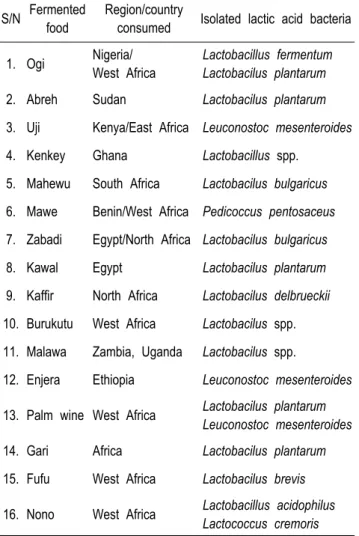
Consumption of bacteriocin has been part of our regular diet for several years through fermented foods (Oyewole, 1997) with no documentation of being harmful to humans even though, the knowledge of its importance was not known as at then (De Vuyst and Leroy, 2007). However, with the evolution of science and technology, the agent of fermentation is known (Table 1) (Franz et al., 2014) and bacteriocin discovered to be the active component (Tagg et al., 1976; Caplice and Fitzgerald, 1999). After that, more studies focused on how it can be of commercial importance,
its application in food preservation, and many ways to be utilized (Ghanbari et al., 2013; Mahdi et al., 2018).
Alongside bacteriocin, there are other types of inhibitory substances such as diacetyl, organic acids and hydrogen peroxide produced by lactic acid bacteria though dependent on their fermentation profile that could be homofer- mentative or heterofermentative. The genera of lactic acid bacteria are Lactobacillus, Streptococcus, Lactococcus, Leu- conostoc, Pediococcus and Enterococcus having varying degrees of inhibitory substances (Jamuna and Jeevarat- nam, 2006) produced by them that limit the growth of different types of microorganism as well (Mathur et al., 2017).
Table 1. Some traditional fermented food and implicated lactic acid bacteria
S/N Fermented food
Region/country
consumed Isolated lactic acid bacteria
1. Ogi Nigeria/
West Africa
Lactobacillus fermentum Lactobacilus plantarum
2. Abreh Sudan Lactobacilus plantarum 3. Uji Kenya/East Africa Leuconostoc mesenteroides 4. Kenkey Ghana Lactobacillus spp.
5. Mahewu South Africa Lactobacilus bulgaricus 6. Mawe Benin/West Africa Pedicoccus pentosaceus 7. Zabadi Egypt/North Africa Lactobacilus bulgaricus 8. Kawal Egypt Lactobacilus plantarum 9. Kaffir North Africa Lactobacilus delbrueckii 10. Burukutu West Africa Lactobacilus spp.
11. Malawa Zambia, Uganda Lactobacilus spp.
12. Enjera Ethiopia Leuconostoc mesenteroides
13. Palm wine West Africa Lactobacilus plantarum Leuconostoc mesenteroides
14. Gari Africa Lactobacilus plantarum 15. Fufu West Africa Lactobacilus brevis
16. Nono West Africa Lactobacillus acidophilus
Lactococcus cremoris
Oyewole, 1997; Franz et al., 2014.
HISTORICAL BACKGROUND
Research on bacteriocins stemmed from investigations on colicins - the bacteriocin of Enterobacteriaceae family (Jack et al., 1995), which led to increased knowledge of the genetic basis; study on how the substances are formed, the biochemical structure and the methods by which the molecules exact their antimicrobial properties (Pugsley, 1984). Nevertheless, the drive to know more about the antibiotic-like activities of Gram-positive bacteria, mainly from fermented food, never ceased. The study on these various food-grade organisms, which is now referred to as Generally Regarded as Safe (GRAS) organism, focused on their desirable attribute in the food industry as they are now applicable in food preservation to inhibit bacterial pathogens and spoilage microorganisms (Chandrakasan et al., 2019).
It has been reported that Pasteur, together with Joubert were first to systematically record the ability of some bacteria to inhibit another in an experiment where two different bacteria were co-inoculated (Jack et al., 1995).
The experiment was carried out using urine as a culture medium and an animal infected with Anthrax bacilli with some level of inhibitory action detected. From the findings, it can be adjudged that the presence of a particular organism can interfere with the normal growth of the other organism when they are co-inoculated in the same medium, but the mechanism of action was unknown (Mallesha et al., 2010). In order to know what inhibitory factor that brought about such an antagonistic relationship, a whole field of research opened up, which has been active from then till now.
Gratia was the first scientist that recorded his findings from an experiment conducted in 1925 about the nature of an unknown substance produced by E. coli having an activity like an antibiotic (Jack et al., 1995). In his experiment, Gratia used a virulent strain V that produces a heat-stable element in broth culture that can be dialyzed. This element which was later on termed colicin V has an inhibitory activity against E. coli and when tested at different dilution it was still potent at higher dilution
(Gratia, 2000).
Subsequently, different types of colicins were discovered over time, while Jacob et al. (1953) used the word bac- teriocin to give all the different substances a common name. The definition of bacteriocins considers that they are proteinaceous and act like antibiotics though of a different type (Jack et al., 1995). Further to this, they are molecules that, after biosynthesis, become leather to mostly close general microorganisms by adsorbing to their cell surface (Jack et al., 1995). Tagg et al. (1976) had opined in their review on the bacteriocins of Gram- positive bacteria that “most of the definitive investigations in the field of bacteriocins had centered on those of Gram-negative bacteria, but an increase in research emphasis on bacteriocins of Gram-positive lactic acid bacteria is needed”. Lactic acid bacteria have now turned to the most sought-out bacteria for bioprospecting for novel bacteriocin as they are considered a safe organism.
The renewed interest cannot be separated from the fact that bacteriocin has much practical application when it comes to food preservation, industrial usage, or medicine to manage other bacterial that might cause diseases (Rahmdel et al., 2019).
CLASSIFICATION OF BACTERIOCIN
The producing strains of bacteriocin are found in both Gram-positive and Gram-negative bacteria with the name generally derived from the producing genus or species (Rahmdel et al., 2019). Bacteriocins are classified based on criteria such as, production method – ribosomal and non-ribosomal (De Vuyst and Leroy, 2007), genetics – which could be chromosomal or the size of the plasmid, the type of sugar and protein present, molecular weight of the substance and chemistry reaction it undertakes (López-Cuellar et al., 2016) and the killing mechanism such as nuclease, murein production inhibition and pore formation (Rahmdel et al., 2019).
With all these different factors considered based on
physiochemical properties, bacteriocins are classified into
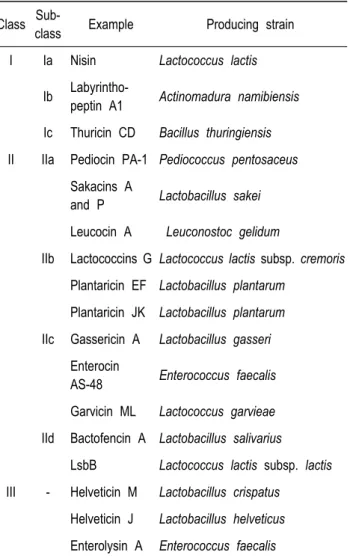
three major classes (Table 2) (Silva et al., 2018; Kumariya
et al., 2019). On sound scientific basis, Savadogo et al.
(2006) reported the establishment of three types of LAB bacteriocins: the lantibitiotics (class I); the non-lantibiotics (class II) and the heat sensitive (class III) bacteriocins.
Class IV was reported by Caplice and Fitzgerald (1999) as complex bacteriocins with glycol- and/or lipid moieties but it is no longer considered in the classification (Kumariya et al., 2019).
Class I bacteriocins are referred to as lantibiotics. Basically, bacteriocins which comprise modified amino acids and lanthionine in their structure are known as lantibiotics. They are inhibitors that target bacterial peptides with a weight of
about 10 kDa. Class I bacteriocin are heat stable and post-translationally modified (Prada et al., 2007). Nisin is an example of Class I bacteriocin and most common among the class (Lay et al., 2016). They are further classified into Class Ia, Ib, Ic corresponding to lantibiotics, labyrin- thopeptins and sanctibiotics, respectively (Kumariya et al., 2019).
Class II bacteriocins have different mode of action and are subdivided into IIa, IIb and IIc. Although, Kumariya et al.
(2019) reported subclass IId and Mahdi et al. (2018) reported subclass IIe. They are small proteins and are heat stable as well. Class IIa – with N-terminal forms the largest subclass of Class II. It is a bacteriocin with pediocin-like nature. They also contain certain sequence in the group that recognizes specific species having the activity of targeting the bacteria cell wall affecting its permeability, thereby causing leakage on the cell (Oppegård et al., 2007). It is also an anti-Listeria bacteriocin that is found in this class only (Drider et al., 2006). Class IIb is a two peptide bacteriocin. For its activity, it requires two different peptides for optimum inhibitory activity. Class IIc bac- teriocin is a circular and thiol activated peptide (López- Cuellar et al., 2016) that affects the pheromone as well as the permeability of the cell membrane of target cells, including the disruption of the formation of the cell wall (Klaenhammer et al., 1976). Class IId, a linear, non- pediocin-like, unmodified bacteriocins was described by Kumariya et al. (2019) while Class IIe contains three or four nonpediocin-like peptides (Mahdi et al., 2018).
Class III is a class of bacteriocins with a molecular weight greater than 30kDa and made up of proteins that are very sensitive to heat (Mahdi et al., 2018). The LAB of genus Lactobacillus have been the major producer (Klaenhammer et al., 1976) and from several studies they have shown to have a wide range of inhibitory effects on several common pathogenic organisms (Kumariya et al., 2019). It should be noted that Class IV has been reclassified as bacteriolysins that are made up of leuconocin S and lactocin (Kumariya et al., 2019). It is a complex bacteriocin containing different chemical compounds that include lipids (Klaenhammer et al., 1976).
Table 2. Classification of bacteriocin Class Sub-
class Example Producing strain I Ia Nisin Lactococcus lactis
Ib Labyrintho-
peptin A1 Actinomadura namibiensis Ic Thuricin CD Bacillus thuringiensis II IIa Pediocin PA-1 Pediococcus pentosaceus
Sakacins A
and P Lactobacillus sakei Leucocin A Leuconostoc gelidum
IIb Lactococcins G Lactococcus lactis subsp. cremoris Plantaricin EF Lactobacillus plantarum
Plantaricin JK Lactobacillus plantarum IIc Gassericin A Lactobacillus gasseri
Enterocin
AS-48 Enterococcus faecalis Garvicin ML Lactococcus garvieae IId Bactofencin A Lactobacillus salivarius
LsbB Lactococcus lactis subsp. lactis III - Helveticin M Lactobacillus crispatus
Helveticin J Lactobacillus helveticus Enterolysin A Enterococcus faecalis
López-Cuellar et al., 2016; Mahdi et al. 2018; Kumariya et al.,
2019.
NATURE AND MODE OF ACTION OF BACTERIOCIN
Bacteriocins are bactericidal protein that, when produ- ced by some bacteria genera are toxic and affect other bacteria stain growth. Usually, bacteriocin are classified as narrow-spectrum antibiotics, but such classification has been a subject of unending debate (López-Cuellar et al., 2016; Rahmdel et al., 2019). After the first discovery of bacteriocin termed colicin by Andre Gratia in 1925 as a result of its inhibitory effect on E. coli, they have been classified in several ways by their mode of inhibitory action with consideration on the type of strain producing them and mechanism by which they exert resistance (Gratia, 2000). Bacteriocins are very diverse, having several categories that are phenomenologically related. It has been discovered in Gram-negative bacteria, such as colicins (Cascales et al., 2007) and from Archaea that are termed microcins. Specifically, colicins are bacteriocins from E. coli, which are the most studied bacteriocins.
Warnericin is another bacteriocin produced by Staphy- lococcus warneri, while Colicin V is part of the oldest type of colicins discovered from Archea, which has been renamed as microcin V (Prema et al., 2006).
The mode of action of bacteriocin is often by attacking the bacterial membrane. They bind to specific sites on the cells and often affect cell membrane integrity and function, resulting in a bacteriostatic effect on bacterial species and bacteriocidal influence on other species (Arsi et al., 2015).
The absorption of bacteriocins may have different bio- chemical effects on a cell, such as interference with specific cleavage of 16S ribosomal RNA, degradation of cellular DNA, and peptidoglycan synthesis inhibition. The bacteriocins of lactic acid bacteria have been studied extensively and numerous reports show that their inhibi- tory effect is wide and effective against Gram-negative and Gram-positive bacteria. Some bacteriocins allow surfactant–like activities on cell membranes, thereby dis- rupting cellular functions (Muriana et al., 1990; Jamuna and Jeevaratnam, 2006), whereas as reported by Tagg et al. (1976) some have very specific bactericidal effect only
on some particular Gram-positive bacteria. Nisin is a good example of such inhibiting Staphylococci, Strepto- cocci, Bacilli, Clostridia, and Mycobacteria (Cleveland et al., 2001; López-Cuellar et al., 2016).
One question that might linger on how minds is, how does a particular strain not get affected by its own bacteriocin?
This is where specific immunity comes into play, whereby a strain producing a specific bacteriocin is not affected by it. This mechanism is believed not to be the same by which some Gram-negative and Gram-positive bacteria evade the killing effect of bacteriocin (Mathur et al., 2017). The most likely explanation to how this evading mechanism is possible would be the suggestion by Stevens et al. (1991) that there are some specific barriers on the outer membrane of a bacteria cell wall. Through the aide of this membrane, some Gram-positive and Gram-negative bacteria are able to develop an iota of a higher level of resistance to the inhibitory effect of bacteriocin (Kumariya et al., 2019).
Effects of bacteriocin on several pathogenic organisms cut across organisms responsible for food spoilage and also microorganisms that are food-borne pathogens (Schillinger et al., 1996). Nisin has this type of attribute and was also the first bacteriocin that was used as a food preservative on a commercial scale. However, a study on lactic acid bacteria bacteriocins has dramatically changed over the years (López-Cuellar et al., 2016) to bio-prospecting from different sources such as traditionally fermented foods and plant for new strains with the ability to produce bacteriocin which as lead to the discovery of many more bacteriocins (Cleveland et al., 2001; Chandrakasan et al., 2019).
FACTORS THAT CAN AFFECT BAC- TERIOCIN PRODUCTION
Temperature, pH, salinity and media components, which
are environmentally driven factors, are important external
factors for a higher amount of bacteriocin and biomass
production by lactic acid bacteria (Kanmani et al., 2011,
Sahar et al., 2017). Moreover, bacteriocin production by
LAB strains is growth associated and is, therefore, induced
by growth conditions, including temperature and medium pH. The temperature is one of the important culture para- meters which can significantly enhance the growth of bacterial strains by improving the fermentation conditions.
The major consequence of temperature during the growth of LAB is in the production of bacteriocin with little or no effect on their inactivation (Kim et al., 2006; Holtsmark et al., 2008).
The pH of the medium is another important cultural requirement for bacteriocin and biomass production by LAB strains (Kanmani et al., 2010). During the fermentation period of LAB strains, most of the by-products are organic acids that reduced the pH of the growth medium. The low pH of the medium can either slow down the growth rate or completely stop the growth of the bacterial cells. Thus, controlled pH fermentation can help improve the growth of bacterial cells and increase bacteriocin production (Anthony et al., 2009, Sahar et al., 2017).
Growth media and its components are other key factors for a higher bacteriocin production and a good fermentation process. Bacteriocin-producing lactic acid bacteria needed complex nutritious media to grow and bacteriocin produc- tion as the cell growth and metabolite production are greatly influenced by various carbon and nitrogen sources, growth factors and organic salts (De Vuyst and Leroy, 2007; Sahar et al., 2017).
APPLICATION OF BACTERIOCIN
Bacteriocins from lactic acid bacteria have been demon- strated as food preservatives (Rihakova et al., 2009) and as therapeutic agents for veterinary and medical uses (Tagg et al., 1976) also as phytosanitary for the protection of plants (Holtsmark et al., 2008). The growing interest in bacteriocin usage in medicine cannot be unconnected because the source is often from a non-pathogenic or- ganism commonly found in the gastrointestinal tract and is mainly used as a probiotic (Bamgbose, 2014).
Their usage has been predominantly in the food industry for the preservation of food products. Often, bacteriocin
can be used directly or alongside other treatment methods determined by reason of usage and nature of the food (Lade et al., 2006). Lactic acid bacteria bacteriocins are applied either in the form of protective culture or as an additive and they are known to satisfy industrial and consumer demands for minimally processed and fresh foods (Todorov, 2008). In essence, the bacteriocins produced by LABs are very desirable as they are known to be naturally produced by an organism that falls under GRAS. Their consumption is also safe due to the ease by which they can be digested (Cleveland et al., 2001).
BACTERIOCINS AS FOOD BIOPRE- SERVATIVES
Naturally, bacteriocin is produced by the LAB strain within the food matrix, this knowledge is important to its application as a food additive. One of the most successful applications in food industry is that of nisin that has been purified to a certain degree, mixed with pediocin and available in the market (Silva et al., 2018). To substitute adding bacteriocin directly into foods, a starter culture that can produce the same bacteriocin can be used or alongside a co-culture. A couple of studies have shown that lactic acid bacteria used as starter culture can directly produce their bacteriocins in food, thereby inhibiting food spoilage and pathogenic bacteria. For example, bacteriocin extraction has been demonstrated in Cheddar cheese, fermented sausages, sourdough (Foulquie′ et al., 2003) and milk (Bamgbose, 2014). The effectiveness of bacteriocin as food preservatives have been well documented by Cleveland et al. (2001) and the advances in the past 20 years in food and pharmaceuticals (Chandrakasan et al., 2019).
The methods that are commonly used in the bio-pre- servation of foods using bacteriocins include:
(1) The direct inclusion during food processing of lactic
acid bacteria that can produce bacteriocin (Silva et al.,
2018). Due to the inherent potential of the LAB to use
the food matrix as a growth medium and secret, the
desired metabolite is the main factor for utilizing this method (Schillinger et al., 1996; Cleveland et al., 2001).
(2) Another method is to extract the desired bacteriocin and apply it into food (Schillinger et al., 1996), which can be done either by using a purified bacteriocin extract or partially purified in a mixture of other substances (Silva et al., 2018) while several methods of nano-encapsulation is also being embraced (Chandra- kasan et al., 2019).
(3) Likewise, products that have been formerly produced using the desired LAB strain can be incorporated as part of the constituents in processing other foods (Schillinger et al., 1996).
BIO-PRESERVATION OF MEAT PRODUCTS
One of the most rigid policies regarding Listeria mono- cytogenes is that of The United States government that does not permit the existence of the slightest number of L. monocytogenes in any type of food (Mohamed et al., 2012). This food pathogen has been discovered as an agent responsible for food poisoning in meat (Ming et al., 1997) and are commonly found within abattoir, meat processing industry, cooked and even refrigerated meat (Cleveland et al., 2001). In order to curtail and control the incidences of L. monocytogenes in meat products, there have to be more aggressive research towards utilizing natural and safer methods with bacteriocin as a good metabolite to be considered. Moreover, there needs to be more intensive study to consolidate on the finding of Hugas et al. (1998) that reported the efficacy of bacteriocin produced by Lactobacillus sakei CTC494 that was dete- rrent to the growth of Listeria innocua, which he called sakacin. Vignolo et al. (2000) also reported that Lacto- bacillus casei CRL 705 secretes lactocin 705 that controls the growth of L. monocytogenes. Other studies have shown the potential benefit of using bacteriocin as a preservative agent in raw meat, cooked pork, and packaged
poultry products (Schillinger and Lucke, 1989; Rhamdel et al., 2019). Different bacteriocins used have been docu- mented by Cleveland et al. (2001), giving us insight on different ones used for various purposes. All the identified bacteriocin needs in-depth study to have a broader knowledge of their activity, the active compounds in them, and the fermentation condition for their optimum production.
BIOPRESERVATION OF DAIRY PRODUCTS
Listeria monocytogenes incidences are not limited to only meat; outbreaks associated with dairy products like cheese, pasteurized milk have also been documented (Schillinger et al., 1996; Mohamed et al., 2012). Nisin has also been applied in the dairy industry since it can control L.
monocytogenes (Vignolo et al., 2000). Its usage includes
adding it to the cheese during pasteurization to stop the
germination of clostridial spores, causing Clostridium-
associated butyric acid fermentation a problem in cheese
production (Schillinger et al., 1996). Another useful example
is the bacteriocin of Lactobacillus lactis subsp. lactis DPC
3147 (Lacticin 3147) has a two-component bacteriocin
having a broad-spectrum activity as diverse microorganisms
are sensitive to it. It was found to be useful in improving
the quality of cheddar cheese by limiting the growth of
other LAB that were not part of the starter culture,
especially during the ripening stage (Ross et al. 2002). It
has also been shown to have a potential in milk pre-
servation (Bamgbose, 2014) and also in keeping dairy
products in good condition for an extended time protecting
it from spoilage organism thereby maintaining its safety
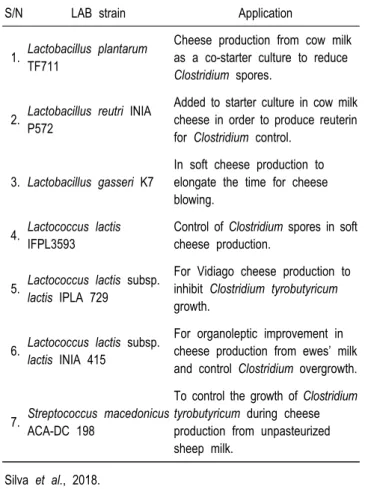
(Table 3) (Silva et al., 2018). Nisin, pediocins, lacticins and
enterocins have all been suitable except for the drawback
of using enterocins due to the pathogenic strain of the
producing genera (Silva et al., 2018).
BIO-PRESERVATION OF SEAFOOD PRODUCTS
At a lower temperature, when carbon dioxide is combined with nisin, it becomes more active in controlling Listeria monocytogenes as they found it difficult to survive in such conditions. This method has been successfully used in extending the shelf life of salmon (Nilsson et al., 1997).
Some lactic acid bacteria were isolated from sea creatures such as salmon and shrimp (Noordiana et al., 2012), with their metabolite being a good source of bio-preservation in seafood and seafood products (Ghanbari et al., 2013).
Also, from the bacteriocin study secreted by Lactobacillus plantarum F12, it was found to have a broad inhibitory spectrum against many indicator strains for food spoilage bacteria (Mohamed et al., 2012). Thus, in this era where
many reports claim how unhealthy red meats are and the need to switch to eating more seafood, there must be more efforts to treat and extend the shelf life of seafood and its product. Considering how tender seafood are which make them not suitable for rigorous chemical or physical treatment; to elude nutrient loss and taste, industries need to embrace the use of natural bio-preservative agents in which bacteriocin is a good agent for controlling spoilage microorganism while retaining the integrity of the seafood and/or its product (Ghanbari et al., 2013).
BACTERIOCINS IN HUMAN MEDICINE
In the human gut, there exists a continuous interaction between good and bad bacteria. Lactic acid bacteria fall under the category of good bacteria and they are the major source of bacteriocins which brought about the interest in medicine. The depletion of good bacteria - natural gut microbes by overuse of antibiotics might increase the population of undesirable pathogenic bacteria invading the gut, thereby causing diseases. A number of studies have focused on the possibility of bacteriocin being an effective anticancer agent (Kumar et al., 2010;
Kaur and Kaur, 2015; Prosekov et al., 2015) or diagnostic agent in some type of cancerous growth (Farkas-Himsley et al., 1995). Though, this has not been the main focus by an oncologist as it has only been on an experimental scale.
The fact that no strong link has been established between anti-bacteria agents and inhibition of mammalian tumor cells is a major factor for the shift in focus. As part of looking at its application in medicine, bacteriocins have also been studied as a potential agent in ameliorating AIDS (Farkas-Himsley et al., 1995; Martín et al., 2010). While working on Lactobacillus from various dairy products in America, Ali et al. (1996) from their study reported that L.
acidophilus has an inhibitory activity against food-borne microbial pathogens thus, concluding that their presence in yogurt and acidophilus milk has a positive impact on human health. A number of studies have also shown how different bacteriocin are important in medicine as do- cumented by Mathur et al. (2017).
Table 3. Some lactic acid bacteria in dairy industry
S/N LAB strain Application
1.
Lactobacillus plantarumTF711
Cheese production from cow milk as a co-starter culture to reduce
Clostridium spores.2.
Lactobacillus reutri INIAP572
Added to starter culture in cow milk cheese in order to produce reuterin for Clostridium control.
3. Lactobacillus gasseri K7
In soft cheese production to elongate the time for cheese blowing.
4.
Lactococcus lactisIFPL3593
Control of Clostridium spores in soft cheese production.
5.
Lactococcus lactis subsp.lactis IPLA 729
For Vidiago cheese production to inhibit Clostridium tyrobutyricum growth.
6.
Lactococcus lactis subsp.lactis INIA 415