Vol. 66, No. 1, January 2016, pp. 37∼43 http://dx.doi.org/10.3938/NPSM.66.37
First-order Eikonal Model Analysis of
6Li Elastic Scatterings on
12C and
28Si at E
lab= 318 MeV
Yong Joo Kim
∗Department of Physics and Research Institute for Basic Sciences, Jeju National University, Jeju 63243, Korea (Received 23 August 2015 : revised 16 October 2015 : accepted 19 October 2015)
An analysis of6Li + 12C and6Li +28Si elastic scatterings at Elab = 318 MeV has been made within the framework of the first-order eikonal model. The calculated angular distributions show fairly good agreement with the experimental data. Strong real and rather weak imaginary potentials are required to describe the elastic scatterings of these systems. We investigate the effect of the first-order eikonal phase-shift correction on the angular distributions, the optical potentials, the volume integrals of the optical potential, the phase shifts, the strong absorption radii, and the reaction cross sections. The introduction of the first-order correction in the eikonal phase shift is found to be important in the description of6Li +12C and6Li +28Si elastic scatterings at Elab= 318 MeV.
PACS numbers: 25.70.-z, 24.10.Ht
Keywords: First-order eikonal model, Effective potential, Eikonal phase shift, Elastic scattering,6Li +12C,
6Li +28Si
I. INTRODUCTION
Over the past years, the study of heavy-ion elas- tic scattering has been an important subject in nuclear physics. The elastic scattering can be used effectively to study the interaction potential by examining the elas- tic differential cross sections in the large angle region.
The data of elastic scattering are generally dominated by strong absorption and are relevant to the tail of the interaction potential. They imply that the data are only sensitive to the surface of the interaction region and, therefore the optical potential required to describe the measurements is not uniquely determined. However, re- fractive phenomena seen in the angular distribution of light heavy-ion elastic scattering (such as6Li +12C and
6Li + 28Si) are sensitive to the interaction potential at small radii rather than at the surface, and they provide useful information on the interaction potentials at small internuclear distance.
∗E-mail: [email protected]
During the last several decades, the eikonal model [1–
3] has been a useful tool in describing the heavy-ion elas- tic scattering. The physical assumption of the eikonal approximation is that the energy is sufficiently high that its classical trajectory is little deflected from a straight line. The eikonal phase shift is derived from the integral equation by further approximating the WKB result, and is expressed as a series involving powers and derivatives of the potential. The only input in the eikonal model is the optical potential. Due to its appealing simplic- ity, many types of eikonal models, including the higher- order eikonal corrections or using the effective impact pa- rameter related with the Coulomb trajectory, have been advanced to extend the study of heavy-ion elastic scat- tering at relatively low energies. There has been a great deal of efforts [4–9] to describe the heavy-ion elastic scat- tering within the framework of the eikonal model. The effects of the real potential on the absorption of light heavy-ions were discussed [6]. Aguiar et al. [7] have dis- cussed different schemes devised to extend the eikonal approximation to the regime of low bombarding ener- gies in heavy-ion collisions. In our earlier work [5], we
This is an Open Access article distributed under the terms of the Creative Commons Attribution Non-Commercial License (http://creativecommons.org/licenses/by-nc/3.0) which permits unrestricted non-commercial use, distribution, and reproduction in any medium, provided the original work is properly cited.
have presented the first- and second-order corrections to the zeroth-order eikonal phase shifts for heavy-ion elas- tic scatterings based on Coulomb trajectories of colliding nuclei and it has been applied satisfactorily to the 16O +40Ca and16O +90Zr systems at Elab = 1503 MeV.
The elastic scattering of 6Li ions on various targets has been studied [10–16] quite extensively. Nadasen et al. [12] have reported measurements of the elastic cross sections of 318 MeV 6Li from 12C and28Si. They have used optical and folding models to analyze the exper- imental data. The differential cross sections of these systems attracted considerable interest because the mea- surements show diffractive oscillations at forward angles and strongly refractive patterns at large angles. Fur- thermore, the feature seen in the elastic cross sections is expected to help to get the information on the optical potential at small internuclear distances. It is interesting to understand the 6Li +12C and6Li +28Si elastic scat- terings at Elab= 318 MeV within the framework of the first-order eikonal model including the first-order phase shift correction. The main points which will be of con- cern are as follows: (1) the χ2/N -fit to the angular dis- tributions, (2) the effective potential and phase shift, (3) the effect of first-order eikonal phase shift correction on the volume integrals per nucleon pair for potential, the critical angular momenta, the strong absorption radii, and the reaction cross sections, (4) the effect of real and imaginary potential depths on the differential and reac- tion cross sections. In the following section, the outline of the first-order eikonal model is presented. The results of the calculations and discussion are given in Sec. III.
Finally, we provide the concluding remarks in Sec. IV.
II. THEORY
According to the eikonal expansion [2,5] of the phase shift function δL(rc) based on the Coulomb trajectories of the colliding nuclei, the zeroth-order eikonal phase shift and its first-order correction are given by
δL0(rc) =− µ ℏ2k
∫ ∞
0
U (r)dz, (1)
and
δ1L(rc) =− µ2
2ℏ4k3(1 + rc
d drc)
∫ ∞
0
U2(r)dz, (2)
with r = √
rc2+ z2. Here µ is the reduced mass and rc
is the distance of closest approach written as
rc= 1 k
{ η +
√
η2+ (L +1 2)2
}
(3)
with the Sommerfeld parameter η. The first-order eikonal correction δL1(rc) in Eq. (2) can further be expressed as following
δ1L(rc) =− µ2 ℏ4k3
∫ ∞
0
[
U2(r) + rU (r)dU (r) dr
]
dz. (4)
The closed expression of the effective phase shift func- tion including up to the first-order correction term can be written as
δL(rc) = δ0L(rc) + δL1(rc) =− µ ℏ2k
∫ ∞
0
Ueff(r)dz, (5)
where Ueff(r) is the effective optical potential given by
Ueff(r) = U (r) {
1 + µ
ℏ2k2[U (r) + rd drU (r)]
}
. (6)
We can see that the effective phase shift expression of Eq. (5) is equivalent to the zeroth-order eikonal one of Eq. (1) with effective potential Ueff(r). The eikonal model with the phase shift described by δL(rc) = δ0L(rc)+δ1L(rc) is called as the ”first-order eikonal model”.
In this paper, we will use the effective phase shift (δL(rc) = δ0L(rc) + δ1L(rc)) instead of the commonly used eikonal phase shift (δL(rc) = δ0L(rc)), and take the nu- clear potential U (r) as the optical Woods-Saxon squared form given by
U (r) = − V0
(1 + exp[(r− Rv)/av])2
−i W0
(1 + exp[(r− Rw)/aw])2 (7) with Rv,w= rv,w(A1/31 + A1/32 ).
With these considerations, the elastic scattering angu- lar distributions for 6Li + 12C and 6Li + 28Si systems are then calculated by using the expression
dσ
dΩ =|f(θ)|2, (8)
where the elastic scattering amplitude f (θ) is given by
f (θ) = fR(θ)+1 ik
∑∞ L=0
(L+1
2) exp(2iσL)(SL−1)PL(cos θ).
(9)
Table 1. Input parameters of the fitted Woods-Saxon squared potential by using the first-order eikonal model for the
6Li +12C and6Li + 28Si systems at Elab = 318 MeV.
Target V0 rv av W0 rw aw χ2/Na
(MeV) (f m) (f m) (MeV) (f m) (f m) δ0 δ0+ δ1
12C 183 0.760 1.469 49.7 1.030 1.356 3.53 1.51
28Si 190 0.863 1.468 57.4 1.079 1.262 5.38 2.12
a10% error bars, χ2/N = (1/N )∑N i=1
[σ
th(θi)−σex(θi)
∆σex(θi)
]2
Fig. 1. (Color online) Elastic scattering angular distribu- tions for the 6Li +12C system at Elab= 318 MeV. The solid circles denote the experimental data taken from Ref. [12]. The dashed and solid curves are the calcu- lated results obtained from the zeroth-order and first- order eikonal models, respectively. The dotted curves are the best fitted results by using the zeroth-order eikonal model.
Here, fR(θ) is the usual Rutherford scattering amplitude, σL the Coulomb phase shift, and k the wave number. In this equation, the nuclear scattering matrix elements SL
can be obtained from the nuclear phase shift δL(rc) so that :
SL = exp[2iδL(rc)]. (10)
III. RESULTS AND DISCUSSION
The zeroth-order eikonal phase shifts δL0(rc) and its first-order correction δL1(rc) outlined in the previous above section have been applied to calculate the elastic scattering angular distributions for6Li +12C and6Li +
28Si systems at Elab = 318 MeV. To obtain the best fit between the experimental data and the theoretical cal- culations, we have carried out a χ2/N search to define
Fig. 2. (Color online) Elastic scattering angular distribu- tions for the6Li +28Si system at Elab = 318 MeV. The solid circles denote the experimental data taken from Ref. [12]. The dashed and solid curves are the calcu- lated results obtained from the zeroth-order and first- order eikonal models, respectively. The dotted curves are the best fitted results by using the zeroth-order eikonal model.
the potential parameters. The input parameters of the fitted Woods-Saxon squared potential and corresponding the χ2/N values are collected in Table 1. The calculated results of the differential cross section for6Li +12C and
6Li + 28Si systems at Elab = 318 MeV are depicted in Figs. 1 and 2 together with the observed data [12]. In these figures, the dashed and solid curves are the results for the zeroth-order (with the phase shift δ0L(rc)) and the first-order (with the phase shift δ0L(rc) + δL1(rc)) eikonal models, respectively. These figures show the substan- tial differences especially at large angle regions between the dashed and solid curves when compared to the ex- perimental data [12]. As a whole, the first-order eikonal model results (solid curves) provide better agreements with the experimental data [12], in comparison with the zeroth-order eikonal model results. Reasonable χ2/N
Table 2. The same as Table 1 but for the best-fitted potential parameters by using the zeroth-order eikonal model.
Target V0 (MeV) rv(f m) av(f m) W0 (MeV) rw(f m) aw(f m) χ2/N
12C 185 0.763 1.463 53.0 1.028 1.383 2.37
28Si 193 0.870 1.443 59.3 1.085 1.298 2.52
Fig. 3. (Color online) Real and imaginary parts of the optical potentials for the6Li + 12C and 6Li + 28Si sys- tems at Elab = 318 MeV. The dashed and solid curves are the nominal and the effective potentials, respectively.
values are obtained for 6Li + 12C and 6Li + 28Si sys- tems at Elab = 318 MeV, respectively, as listed in Table 1.
To investigate the necessity of introducing the first- order correction in the eikonal phase shift, we have also performed a zeroth-order eikonal model calculations by varying the potential parameters. The best fits results are shown in Figs. 1 and 2 as the dotted curves, and corresponding potential parameters are given in Table 2. We can see that the solid curves do better than the dotted curves in reproducing the experimental data [12].
As Tables 1 and 2 show, the χ2/N values are lower in the results by using δ0L(rc) + δ1L(rc) than the ones by using δL0(rc). The fairly good agreements between the first-order eikonal model calculations and the experimen- tal data indicate that the introduction of the first-order phase shift correction in the eikonal model is important in the description of the6Li +12C and6Li +28Si elastic scatterings at Elab= 318 MeV.
To examine the effect of the first-order eikonal correc- tion, we plotted in Fig. 3 the real and imaginary parts
of effective optical potential Ueff(r) given in Eq. (6). In this figure, the solid curves are the real and imaginary parts of the effective potential while the dashed curves denote the results of the nominal potential U (r) given in Eq. (7). As Fig. 3 shows, there is a noticeable dif- ference between two potentials, especially in the central regions. The drastic changes of the effective potential are due to the correction term given in Eq. (6). One of the characteristics appearing in this figure is that the ef- fective potentials show broad features compared to the nominal ones, though they have small depths at small r. The degree of changes was noticed more in the imag- inary potential than in the real one. In the zeroth-order eikonal model, the imaginary part of the optical poten- tial is related with the absorption process in the nuclear reaction, and its shape should not be affected by the real part. However in the first-order eikonal model, the effec- tive imaginary potential depends on the products of the real and the imaginary potentials and their derivatives as Eq. (6) shows. The increasing behavior of effective imaginary potential at the small r regions is due to the strong real potential compared with imaginary one. This means that the effect of the first-order eikonal correction on the imaginary potential is important when the real potential is strong and the imaginary potential is weak.
Our calculations of both systems have consistently re- sulted in an optical potential featuring the strong real and the rather weak imaginary ones as shown in Table 1 and Fig. 3. The potential values found in our calculations led to contributions to the scattering from the interior region and allowed refracted projectiles to populate the elastic channel so that the typical refractive phenomena were observed in the angular distribution.
Now we have calculated the the volume integral of the optical potential which is used as a sensitive measure of the potential strength, and the results are listed in Table 3. The volume integrals per interacting nucleon pair for the potential are determined by the relation [17]
Jv,w/A1A2=− 4π A1A2
∫ ∞
0
V (r), W (r)r2dr (11)
Table 3. Real (Jv/A1A2) and imaginary (Jw/A1A2) volume integrals per interacting nucleon pair for optical potentials, critical angular momenta (L1/2), strong absorption radii (Rs), and reaction cross sections (σR) values by using the first-order eikonal model for the6Li +12C and6Li +28Si systems at Elab= 318 MeV. The values in parentheses are the results obtained from the zeroth-order eikonal model
Target Jv/A1A2 Jw/A1A2 L1/2 Rs σRs σR
(MeV f m3) (MeV f m3) (f m) (mb) (mb)
12C 301 (289) 177 (163) 34.5 (34.0) 5.56 (5.48) 970 (943) 1024 (995)
28Si 279 (267) 162 (147) 50.7 (50.1) 6.62 (6.55) 1378 (1347) 1408 (1373)
where V (r) and W (r) are the real and the imaginary parts of the optical potential. The calculated results of the real and imaginary volume integrals are comparable to the those of other works [12–14]. We can see that the effective potentials have somewhat larger volume in- tegral values compared to nominal ones, indicating that the correction term in Eq. (6) increases the Jv,w/A1A2
values. Table 3 shows, the values of volume integral for
12C are larger than the ones for 28Si. This trend is in agreement with the results of Nadasen et al. [12]. The real volume integrals in both systems are much stronger compared to the imaginary ones. This tell us that the strong real potentials associated with rather weak imagi- nary ones are needed for describing the elastic scattering of6Li +12C and6Li +28Si systems at Elab= 318 MeV.
Due to the relation between the effective potential and phase shift given in Eq. (5), the behavior of the effective potentials is reflected in the phase shift functions. Fig. 4 shows the real and the imaginary parts of phase shifts in terms of angular momentum L. In this figure, the dashed and solid curves are the phase shifts obtained from the nominal and effective potentials, respectively.
As expected, we can see the apparent differences between the solid and dashed curves at the small angular momen- tum regions. From the qualitative differences of elastic cross sections obtained from the zeroth- and the first- order eikonal models shown in Figs. 1 and 2, we can infer that trajectories associated with small angular mo- menta deeply penetrate the nuclear interior and experi- ence a strong nuclear field, and the refractive patterns at large angles of angular distributions are influenced by the phase shift at small L values. Consequently, the large- angle behavior of elastic cross sections is sensitive to the details of the optical potential over a wide region from the nuclear surface toward the interior.
The correction term in the effective phase shift also has influenced on the critical angular momentum L1/2
Fig. 4. (Color online) Real and imaginary parts of the phase shifts for the6Li +12C and6Li +28Si systems at Elab= 318 MeV. The dashed and solid curves are eikonal phase shifts without and with the first-order correction, respectively.
corresponding to | exp(−Im[2δL(rc)])|2 = 1/2. As Ta- ble 3 shows, the L1/2 values obtained from the first- order eikonal model have slightly higher values compared with ones from the zeroth-order eikonal model. A lit- tle bit variations in L1/2 are reflected in the strong ab- sorption radius Rs (see also Table 3), defined as Rs = {η +√
η2+ (L1/2+ 0.5)2}
/k. The critical angular mo- menta L1/2, strong absorption radii Rs, and reaction cross sections σR are listed in Table 3, along with the real (Jv/A1A2) and imaginary (Jw/A1A2) volume inte- grals per nucleon pair for optical potential. The strong absorption radius provides a good estimate of the reac- tion cross section in terms of σRs = πR2s. The calculation from δ0L(rc) + δL1(rc) produces somewhat larger σR val- ues and its results are comparable to the optical model results [12], in comparison with the σRvalues calculated from only δ0L(rc).
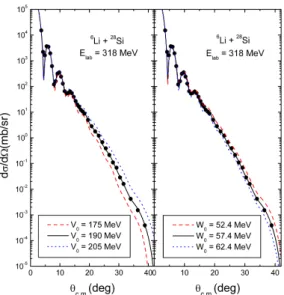
Fig. 5. (Color online) Elastic scattering angular distri- butions for the 6Li + 28Si system at Elab = 318 MeV obtained from the different potential depths in the first- order eikonal model. The potential shape parameters and potential depth (W0 for the left figure and V0 for the right figure) are given in Table 1.
In order to investigate the effect of the real and imagi- nary potential depths on the elastic cross sections in the first-order eikonal model, we have plotted the angular distributions of6Li +28Si system at Elab= 318 MeV in terms of the real (or imaginary) potential depths, where the potential shape parameters and imaginary (or real) potential depth are fixed. Since the V0 ≈ 3W0 was ob- tained (see Table 1) in the first-order eikonal model, the real (imaginary) potential strength was taken ±15 MeV (±5 MeV) from the best fits V0(W0) values, and the cal- culated results are displayed in Fig. 5. We can see that real potential depth V0 moves the elastic cross sections to upward (downward) as the V0 increased (decreased).
On the other hand, the elastic cross sections are moved downward (upward) as the imaginary potential depth W0 is increased (decreased). The potential depths also affect the reaction cross sections. Three V0values make similar reaction cross section values (σR= 1405 mb, 1408 mb, and 1410 mb for V0 = 175, 190, and 205 MeV, re- spectively) while W0values generate somewhat different values (σR = 1377 mb, 1408 mb, and 1436 mb for W0 = 52.4, 57.4, and 62.4 MeV, respectively). This indicates that the reaction cross sections of this system are mainly influenced by the W0rather than V0.
IV. CONCLUDING REMARKS
In this paper, we have analyzed the elastic scatter- ings of 6Li + 12C and 6Li + 28Si systems at Elab = 318 MeV within the framework of the first-order eikonal model based on Coulomb trajectories of colliding nuclei.
The calculated results, taking into account the first-order eikonal phase shift correction, show fairly good agree- ment with the experimental data of both systems. The results of first-order eikonal model were found to do bet- ter in reproducing the experimental data, especially at large angle regions, compared to the results of zeroth- order eikonal model. From the good agreements with the experimental data, we can see that the first-order correction in the eikonal phase shift function is impor- tant in the description of6Li +12C and6Li +28Si elastic scatterings at Elab = 318 MeV.
Compared to nominal potential, the effective poten- tials show broad curves in the small r regions, though they have shallow potential depths. The drastic differ- ences are due to the correction term seen in the effective potential. The degree of changes was more noticeable in the imaginary potential than in the real one. The real volume integrals of the optical potential are much stronger than the imaginary ones, indicating that strong real and rather weak imaginary potentials were required to describe the6Li +12C and6Li +28Si elastic scatter- ings. The weakenings of the absorption are thought to allow the colliding nuclei to interpenetrate deeper with- out being absorbed. The strong real part of nominal po- tential generates more noticeable change in the effective imaginary potential than in the effective real one. Owing to the relation between the optical potential and phase shift, the behavior of potentials is reflected in the phase shift functions. The phase shift with the first-order cor- rection have shown different features at small L regions compared to the phase shift without one. The fairly good agreement between our calculations and the exper- imental data tells us that the large-angle behaviors of elastic cross section are influenced by small angular mo- mentum regions of the phase shift. We have found that the effective potential produces somewhat larger volume integral values compared to the nominal one. The values of critical angular momentum L1/2, the strong absorp- tion radius Rs and reaction cross section σR obtained
from first-order eikonal model have a little larger values compared to the ones from zeroth-order eikonal model.
We can see that when the other potential parameters except of the real (imaginary) potential depth are fixed, the elastic cross sections are moved upward (downward) as the real potential depth V0(imaginary potential depth W0) increased.
REFERENCES
[1] T. W. Donnelly, J. Dubach and J. D. Walecka, Nucl.
Phys. A 232, 355 (1974).
[2] D. Waxman, C. Wilkin, J.-F. Germond and R. J.
Lombard, Phys. Rev. C 24, 578 (1981).
[3] R. da Silveria and Ch. Leclercq-Willain, J. Phys. G 13, 149 (1987).
[4] G. Faldt, A. Ingemarsson and J. Mahalanabis, Phys.
Rev. C 46, 1974 (1992).
[5] M. H. Cha and Y. J. Kim, Phys. Rev. C 51, 212 (1995).
[6] A. Ingemarsson, Phys. Rev. C 56, 950 (1997).
[7] C. E. Aguiar, F. Zardi and A. Vitturi, Phys. Rev. C 56, 1511 (1997).
[8] Y. J. Kim and M. H. Cha, Int. J. Mod. Phys. E 10, 373 (2001).
[9] Y. J. Kim, J. K. Woo and M. H. Cha, Int. J. Mod.
Phys. E 19, 1947 (2010).
[10] A. Nadasen, M. McMaster, G. Gunderson, A. Judd and S. Villanueva et al., Phys. Rev. C 37, 132 (1988).
[11] A. Nadasen, M. McMaster, M. Fingal, J. Tavormina and P. Schwandt et al., Phys. Rev. C 39, 536 (1989).
[12] A. Nadasen, T. Stevens, J. Farhat, J. Brusoe and P.
Schwandt et al., Phys. Rev. C 47, 674 (1993).
[13] M. E. Farid and M. A. Hassanain, Nucl. Phys. A.
678, 39 (2000).
[14] M. E. Farid and M. A. Hassanain, Nucl. Phys. A.
697, 183 (2002).
[15] S. Hossain, M. N. A. Abdullah, A. K. Basak, S. K.
Das and M. A. Uddin et al., Eur. Phys. J. A 41, 215 (2009).
[16] K. X. Chen, Y. -W. Lui, J. Button and D. H. Young- blood, Phys. Rev. C 81, 044612 (2010).
[17] M. A. Hassanain, A. A. Ibraheem, S. M. M. Al Se- biey, S. R. Mokhtar and M. A. Zaki, Phys. Rev. C 87, 064606 (2013).