
Journal of the Korean Chemical Society 2015, Vol. 59, No. 4
Printed in the Republic of Korea
http://dx.doi.org/10.5012/jkcs.2015.59.4.280
-280-
Hydrated Ferric Sulfate [Fe
2(SO
4)
3·xH
2O]: An Efficient and Reusable Catalyst for One-Pot Synthesis of 2H-Indazolo[2,1-b]phthalazine-triones
Abhik Choudhury†, Shahzad Ali†, and Abu T. Khan†,‡,*
†Department of Chemistry, Indian Institute of Technology Guwahati, Guwahati 781039, India
‡Vice-Chancellor, Aliah University, IIA/27, New Town, Nearby Eco-Space, Kolkata-700 156, West Bengal, India.
*E-mail: [email protected]
(Received September 2, 2013; Accepted May 20, 2015)
ABSTRACT. Hydrated ferric sulfate can be used as an efficient and reusable catalyst for the synthesis of 2H-indazolo[2,1- b]phthalazine-trione derivatives via one-pot three-component condensation reaction of phthalhydrazide, aromatic aldehydes and cyclic-1,3-diketones in ethanol under reflux conditions.
Key words: Ferric sulfate hydrate [Fe2(SO4)3·xH2O], Three component reactions, Phthalhydrazide, Cyclic-1,3-diketones, 2H- Indazolo[2,1-b] phthalazine-trione derivatives
INTRODUCTION
Hydrated ferric sulfate [Fe2(SO4)3·xH2O] has been found as a catalyst for various organic transformations such as tetrahydropyranlations of alcohols,1 preparation of acylals from aldehydes,2 2,3-unsaturated glycosides via Ferrier rear- rangement,3 per-O-acetylation of sugars,4 synthesis of tetra- hydroquinolines5 through Povarov reaction and synthesis of 1H-pyrazole-4-carbodithioate6 using MCRs. The unique solubility of the catalyst in ethanol and insolubility in DCMenables its usage as both homogenous and hetero- geneous catalyst; and is recoverable by DCM after the reac- tion. As a part of our ongoing research work by employing MCRs to synthesize new molecules,7 we conceived that Fe2(SO4)3·xH2O can be exploited further as a reusable cat- alyst for the synthesis of heterocycles by employing mul- ticomponent reactions.
The efficient high-throughput synthesis of biologically active organic compounds is one of the most important and challenging endeavors in modern drug discovery. Organic reactions should be fast, neat and clean, and the target prod- ucts should be easily separable with high purity and good yields. To cover all the above aspects, multicomponent reactions8 (MCRs) play an important role in combinato- rial chemistry because of their ability to synthesize target molecules with greater efficiency, higher atom-economy, structural diversity and complexity in a single step from three or more reactants. These reactions are very effective for synthesizing highly functionalized organic molecules from readily available starting materials.
The synthesis of heterocyclic compounds has gained
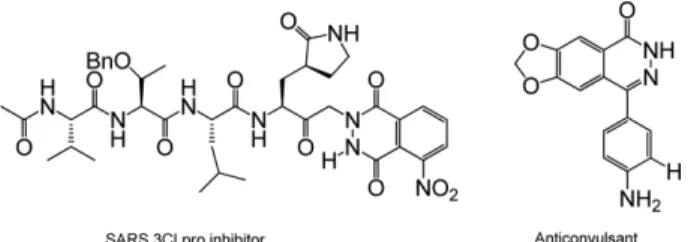
considerable attention among synthetic organic chemists due to their immense potentiality in pharmaceuticals. Het- erocyclic systems are found abundantly in nature as alka- loids, flavonoids and isoflavonoids9 and they are considered to be essential to life. Among various nitrogen containing heterocycles, phthalazine skeleton is present in many nat- urally occurring compounds and they exhibit interesting pharmacological properties (Fig. 1). The compounds having fused phthalazines possess many biological activities such as anticonvulsant,10cardiotonic,11 vasorelaxant,12 antimicro- bial,13 antifungal,14 anticancer,15 and anti-inflammatory16 activities. They are also highly potent inhibitors of vascular endothelial growth factor receptor II (VEGFR-2).17−19 Furthermore, these compounds might be useful materials for luminescence or fluorescence studies.20
The synthesis of 2H-indazolo[2,1-b]phthalazine-trione derivatives have been reported involving one-pot conden- sation of phthalhydrazide, aldehydes and 1,3-diketones using numerous catalysts.21,22 Though all these protocols are quite useful, still there is a need to develop a new meth- odology using a reusable catalyst.
Figure 1. Some biologically active compounds having phthal- azine skeleton.
2015, Vol. 59, No. 4
Hydrated Ferric Sulfate [Fe2(SO4)3·xH2O]: An Efficient and Reusable Catalyst for one-pot Synthesis of 2H-Indazolo[2,1-b]phthalazine-triones 281
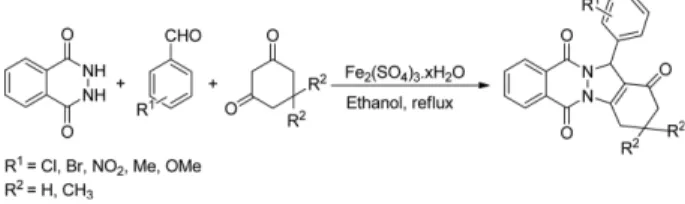
In this paper, we have reported hydrated ferric sulfate catalyzed one pot synthesis of 2H-indazolo[2,1-b]phthal- azine-trione derivatives via three-component condensa- tion reaction of phthalhydrazide, aromatic aldehydes and cyclic 1,3-dicarbonyl compounds in ethanol under reflux conditions as shown in Scheme 1.
EXPERIMENTAL
General experimental procedure for the Synthesis of 2H-indazolo[2,1-b]phthalazine-trione derivatives
Hydrated ferric sulfate (0.20 mol, 0.084 g) was added to a mixture of an aromatic aldehyde (1.2 mmol), a cyclic 1,3-dicarbonyl compound (1.0 mmol) and phthalhydra- zide (1.0 mmol) in 3 mL of ethanol. The reaction mixture was kept for refluxing in a preheated oil-bath. After com- pletion of the reaction (as monitored by TLC), it was brought to room temperature. The solid product precipitated out after adding 6 mL of water into it and it was filtered off through a Büchner funnel. The precipitate was washed with ethanol (2 mL) and dried in a vacuum pump.
For checking reusability, a reaction mixture of phthal- hydrazide (0.810 g, 5.0 mmol), 4-nirobenzaldehyde (0.831 g, 5.5 mmol) and dimedone (0.700 g, 5.0 mmol) in presence of hydrated ferric sulfate (0.418 g, 1 mmol) was refluxed in 10 mL of ethanol. After completion of the reaction, the catalyst was recovered by removing ethanol in a rotatory evaporator followed by addition of 15 mL of CH2Cl2. The catalyst was precipitated out due to its poor solubility in CH2Cl2 and it was filtered off through a Büchner funnel.
The desired product 4h was obtained after concentrating the organic solvent in a rotatory evaporator. The reusabil- ity of the recovered catalyst was examined for five con- secutive times using the same substrates and the results are summarized in Table 3. We have noted that the cat- alyst can be reused without losing much catalytic activity.
RESULTS AND DISCUSSION
To find out suitable reaction conditions, benzaldehyde
(1.2 mmol), dimedone (1 mmol), and phthalhydrazide (1 mmol) were chosen as the model substrates. The reactions were examined in presence of various catalysts in different solvent systems and the results are summarized in Table 1.
It was noted that the reaction did not provide any desired product in absence of catalyst after heating at 80 oC for 10 h either in neat or in ethanol (Table 1, entries 1 and 2). Inter- estingly, the desired product 4a was isolated in 40% yield (Table 1, entry 4) when the same reaction mixture was heated in presence of 5 mol% hydrated ferric sulfate. Fur- thermore, we have carried out similar set of reactions in the presence of 10 mol%, 15 mol%, 20 mol% and 25 mol%
(Table 1, entries 5-8), respectively. From these observa- tions, we have noted that 20 mol% of the catalyst is the suitable choice to obtain best yield. For scrutinizing a suit- able solvent system, the similar reaction was executed with similar boiling range of solvent such as dichloroethane, acetonitrile and water under identical reaction conditions.
We found that the maximum yield of product 4a was obtained in ethanol under reflux conditions (Table 1, entry 7). To examine the efficacy of the other catalysts, the sim- ilar reactions were performed in presence of FeCl3·6H2O, NiCl2, SnCl2 and CH3COOH (Table 1, entries 12-15), respec- Scheme 1. Synthesis of 2H-indazolo[2,1-b]phthalazine-trione deriv-
atives.
Table 1. Optimization for one-pot condensation of phthalhydra- zide, benzaldehyde and dimedonea
Entry Catalysts (mol%) Solvent Time (h) Yield (%b)
1 None Neat 10 0
2 None EtOH 10 0
3 X (5) Neat 10 Trace
4 X (5) EtOH 10 40
5 X (10) EtOH 7 56
6 X (15) EtOH 4 70
7 X (20) EtOH 3 87
8 X (25) EtOH 3 88
9 X (20) DCE 3 71
10 X (20) MeCN 3 72
11 X (20) H2O 3 Trace
12 FeCl3·6H2O(20) EtOH 3 75
13 NiCl2 (20) EtOH 3 60
14 SnCl2 (20) EtOH 3 74
15 AcOH (20) EtOH 3 40
aThe reactions were carried out using phthalhydrazide (1.0 mmol), benzaldehyde (1.2 mmol) and dimedone (1.0 mmol). bIsolated Yield. X = Fe2(SO4)3·xH2O.
Journal of the Korean Chemical Society
282 Abhik Choudhury, Shahzad Ali, and Abu T. Khan
tively and we have obtained moderate to good yield. How- ever, we have used hydrated ferric sulfate because of its reusability.
To generalize our protocol, a wide variety of aromatic aldehydes having electron-donating and electron- with- drawing substituents in the aromatic ring were reacted with phthalhydrazide, and dimedone under similar reac- tion condition and the desired 2H-indazolo[2,1-b]phthal- azine-trione derivatives (4b-o) were obtained in good yields.
Likewise, cyclohexane-1,3-dione also provided the desired 2H-indazolo[2,1-b]phthalazine-trione derivatives 4p-u in good yields under identical reaction conditions. It is worth- while to mention that aromatic aldehydes having electron- withdrawing group require relatively shorter reaction time as well as also provide good yields. Unfortunately, the similar kind of cyclized product was not obtained when the reaction carried out with acyclic 1,3-diketones. All the successful results (Table 2) clearly demonstrate that hydrated
ferric sulfate is an efficient catalyst for this three-compo- nent reaction.
The probable mechanism for the formation of product may be rationalized as follows: Aromatic aldehyde reacts with dimedone to provide Knoevenagel product 2-ben- zyli-dene-5,5-dimethylcyclohexane-1,3-dione in the pres- ence of hydrated ferric sulfate. Then the intermediate undergoes 1,4-Michael addition with phthalhydrazide fol- lowed by concomitant cyclization to give the desired prod- uct (Scheme 2).
RECYCLING OF THE CATALYST
In view of greener chemistry, efficient recovery and reuse of the catalyst are highly desirable. As a matter of fact, the catalyst Fe2(SO4)3·xH2O was recovered conveniently Table 2. Synthesis of 2H-indazolo[2,1-b]phthalazinetriones
Entry R1 R2 Time (h) Producta Yield (%)b
1 H CH3 3 4a 87
2 4-OCH3 CH3 4 4b 83
3 2-OCH3 CH3 4 4c 81
4 3,4-(OCH3)2 CH3 4 4d 86
5 3,4,5-(OCH3)3 CH3 4 4e 84
6 4-OH-3-OCH3 CH3 4 4f 85
7 4-CH3 CH3 4 4g 84
8 4-NO2 CH3 2 4h 93
9 3- NO2 CH3 2 4i 92
10 2- NO2 CH3 2 4j 87
11 4-Cl CH3 2 4k 89
12 2- Cl CH3 2 4l 84
13 4-Br CH3 2 4m 90
14 3-Br CH3 2 4n 91
15 3-OH CH3 4 4o 80
16 H H 3 4p 86
17 4-Cl H 2 4q 89
18 4-NO2 H 2 4r 90
19 4-OCH3 H 4 4s 83
20 4-OH-3-OCH3 H 4 4t 79
21 2-OCH3 H 4 4u 80
aAll the reactions were carried out using phthalhydrazide (1.0 mmol), aromatic aldehydes (1.2 mmol) and dimedone (1.0 mmol)/cyclo- hexane-1,3-dione (1.0 mmol) using 0.2 mmol of catalyst. bIsolated yield.
Scheme 2. Probable mechanism for the formation of product.
Table 3. Reusability of the catalyst [Fe2(SO4)3⋅xH2O]
Round Catalyst recovered (mg) Reaction time (h) Yieldb (%)
1 418 3 94
2 413 3 92
3 403 3 91
4 395 3 90
5 388 3 89
aThe same set of reaction was performed with phthalhydrazide (5.0 mmol), 4-nirobenzaldehyde (5.5 mmol) and dimedone (5.0 mmol) in each time. bIsolated yield.
2015, Vol. 59, No. 4
Hydrated Ferric Sulfate [Fe2(SO4)3·xH2O]: An Efficient and Reusable Catalyst for one-pot Synthesis of 2H-Indazolo[2,1-b]phthalazine-triones 283
from the reaction mixture at the end of the reactions and it was reused another four times for the same set of reaction.
CONCLUSION
In summary, we have shown that hydrated ferric sulfate is an efficient and reusable catalyst for the synthesis of 2H-indazolo[2,1-b]phthalazine-trione derivatives via one- pot three-component condensation reaction of phthalhy- drazide, aromatic aldehydes and cyclic-1,3-diketones in ethanol under reflux conditions.
Acknowledgments. AC is grateful to CSIR, New Delhi for his research fellowship and SA to UGC for his senior research fellowship. The authors also acknowledge to the Director, IIT Guwahati for providing laboratory facilities in Department of Chemistry. Publication cost of this paper was supported by the Korean Chemical Society.
REFERENCES
1. Li, L.; Zhu, L.; Zhang, X.; Zhang, G.; Qu, G. Can. J. Chem.
2005, 83, 1120.
2. Zhang, X.; Li, L.; Zhang, G. Green Chem. 2003, 5, 646.
3. Zhang, G.; Liu, Q.; Shi, L.; Wang, J. Tetrahedron 2008, 64, 339.
4. Shi, L.; Zhang, G.; Pan, F. Tetrahedron 2008, 64, 2572.
5. Khan, A. T.; Das, D. K.; Khan, M. M. Tetrahedron Lett.
2011, 52, 4539.
6. Khan, A. T.; Ghosh, A.; Basha, R. S.; Mir, M. H. Asian.
J. Org. Chem. 2012, 2, 126.
7. (a) Khan, A. T.; Basha, R. S.; Lal, M. Tetrahedron Lett.
2012, 53, 2211; (b) Khan, A. T.; Das, D. K. Tetrahedron Lett. 2012, 53, 2345.
8. (a) Domling, A. Chem. Rev. 2006, 106, 17; (b) D’Souza, D. M.; Muller, T. J. J. Chem. Soc. Rev. 2007, 36, 1095;
Harborne, J. B.; (c) Cariou, C. C. A.; Clarkson, G. J.; Ship- man, M. J. J. Org. Chem. 2008, 73, 9762; (d) Domling, A.; Ugi, I. Angew. Chem Int. Ed. 2000, 39, 3168 9. Baxter, H.; Moss, G. P. Phytochemical Dictionary - A Hand-
book of Bioactive Compounds from Plants, 2nd eds., Taylor
& Francis, London: UK, 1999.
10. Grasso, S.; De Sarro, G.; De Sarro, A.; Micale, N.; Zap- pala, M.; Puia, G.; Baraldi, M.; De Micheli, C. J. Med.
Chem. 2000, 43, 2851.
11. Nomoto, Y.; Obase, H.; Takai, H.; Teranishi, M.; Nakamura, J.; Kubo, K. Chem. Pharm. Bull. 1990, 38, 2179.
12. Watanabe, N.; Kabasawa, Y.; Takase, Y.; Matsukura, M.;
Miyazaki, K.; Ishihara, H.; Kodama, K.; Adachi, H. J. Med.
Chem. 1998, 41, 3367.
13. El-Sakka, S. S.; Soliman, A. H.; Imam, A. M. Afinidad 2009, 66, 167.
14. Ryu, C.-K.; Park, R.-E.; Ma, M.-Y.; Nho, J.-H. Bioorg. Med.
Chem. Lett. 2007, 17, 2577.
15. Li, J.; Zhao, Y. F.; Yuan, X. Y.; Xu, J. X.; Gong, P. Molecules 2006, 11, 574.
16. Sinkkonen, J.; Ovcharenko, V.; Zelenin, K. N.; Bezhan, I.
P.; Chakchir, B. A.; Al-Assar, F.; Pihlaja, K. Eur. J. Org.
Chem. 2002, 2046.
17. Sung, J. S.; Lee, H.-J.; Suh, M.-E.; Choo, H.-Y. P.; Lee, S. K.; Park, H. J.; Kim, C.; Park, S. W.; Lee, C.-O.; Bio- org. Med.Chem. 2004, 12, 3683.
18. Piatnitski, E. L.; Duncton, M. A. J.; Kiselyov, A. S.; Katoch- Rouse, R.; Sherman, D.; Milligan, D. L.; Balagtas, C.; Wong, W. C.; Kawakami, J.; Doody, J. F. Bioorg. Med. Chem.
Lett. 2005, 15, 4696.
19. Duncton, M. A. J.; Piatnitski, E. L.; Katoch-Rouse, R.; Smith, L. M.; Kiselyov, A. S.; Milligan, D. L.; Balagtas, C.; Wong, W. C.; Kawakami, J.; Doody, J. F. Bioorg. Med. Chem.
Lett. 2006, 16, 1579.
20. Wu, H.; Chen, X. M.; Wan, Y.; Xin, H. Q.; Xu, H. H.; Ma, R.; Yue, C. H.; Pang, L. L. Lett. Org. Chem. 2009, 6, 219.
21. (a) Shaterian, H. R.; Ghashang, M.; Feyzi, M. Appl. Catal.
A: Gen. 2008, 345, 128; (b) Khurana, J. M.; Devanshi, M.
Tetrahedron Lett. 2009, 50, 7300; (c) Sabitha, G.; Srinivas, C.; Raghavendar, A.; Yadav, J. S. Helv. Chim. Acta 2010, 93, 1375; (d) Ghorbani-Vaghei, R.; Karimi-Nami, R.; Toghraei- Semiromi, Z.; Amiri, M.; Ghavidel, M. Tetrahedron 2011, 67, 1930; (e) Mosaddegh, E.; Hassankhani, A. Tetrahedron Lett. 2011, 52, 488.
22. (a) Sheradsky, T.; Moshenberg, R. J. Org. Chem. 1986, 51, 3123; (b) Csampai, A.; Kormendy, K.; Ruff, F. Tetrahe- dron. 1991 47, 4457; (c) Ramtohup, Y. K.; James, M. N. G.;
Vederas, J. C. J. Org. Chem. 2002, 67, 3169; (d) Liu, L. P.;
Lu, J. M.; Shi, M. Org. Lett. 2007, 9, 1303; (e) Shukla, G.; Verma, R. K.; Verma, G. K.; Singh, M.S. Tetrahedron Lett. 2011, 52, 7195; (f) Kidwai, M.; Jahan, A., Chauhan, R., Mishra, N. K. Tetrahedron Lett. 2012, 53, 1728; (g) Shek- ouhy, M.; Hasaninejad, A. Ultrason. Sonochem. 2012, 19, 307; (h) Sayyafi, M.; Seyyedhamze, M.; Khavasi, H. R.;
Bazgir, A. Tetrahedron 2008, 64, 2375; (i) Shaterian, H.
R.; Hosseinian, A.; Ghashang, M. ARKIVOC 2009, ii, 59.
![Table 3. Reusability of the catalyst [Fe 2 (SO 4 ) 3 ⋅xH 2 O]](https://thumb-ap.123doks.com/thumbv2/123dokinfo/5298673.154104/3.892.462.805.149.384/table-reusability-catalyst-fe-xh-o.webp)
