• 검색 결과가 없습니다.

Journal of Korean Biological Nursing Science

N/A
N/A
Protected

Academic year: 2021

Share "Journal of Korean Biological Nursing Science"

Copied!
10
0
0

로드 중.... (전체 텍스트 보기)

전체 글

(1)

서  론

1. 연구의 필요성

여성은 약 50세 전후에 노화의 한 과정으로 난소 기능이 저하되 면서 자연스럽게 월경이 중단되는 폐경이 발생한다[1]. 이 과정에서 심혈관계, 근골격계, 면역계 등에 광범위한 생리학적 효과를 내는

호르몬인 에스트로겐 분비가 감소하여 정서적 변화뿐만 아니라 다 양한 신체적 증상으로 어려움을 겪는다[2]. 그러나 서구 사회를 비 롯한 다양한 나라에서 여성의 평균 수명이 80세 이상으로 빠르게 증가하면서 전체 생애 중 폐경 이후의 삶이 약 1/3을 차지하기에[2]

폐경 후 여성의 건강관리와 삶의 질을 높이는 것에 점차 관심이 높 아지고 있다.

비타민D 보충 요법이 폐경 후 여성 근력에 미치는 효과:

메타분석

강푸름 1 ·김지형 2 ·김명진 2

1

고려대학교 간호대학,

2

서울성심병원 정형외과

Effect of Vitamin D on Muscular Strength in Postmenopausal Women: A Meta-Analysis

Kang, Purum 1 · Kim, Jeehyoung 2 · Kim, Myung Jin 2

1

College of nursing, Korea University, Seoul;

2

Department of Orthopedic Surgery, Seoul Sacred Heart General Hospital, Seoul, Korea

Purpose: Postmenopausal women are a unique population with high risk for the degeneration of muscle. The aim of the present meta-analysis was to accurately evaluate the effects of vitamin D on muscular strength in postmenopausal women. Methods: A re- view was conducted using electronic databases, including PubMed, EMBASE, Ovid Medline, CINAHL complete, and the Cochrane Li- brary from inception through 19 March 2019. Included studies were selected by two independent reviewers. The meta-analysis were performed using Review Manager 5.3 software. Results: A total of nine randomized controlled clinical trials were included in this re- view. Vitamin D interventions led to no changes in the upper limb muscle strength (mean difference –0.16, 95% CI: –1.09 to 0.77), lower body muscle strength (standard mean difference 0.08, 95% CI: –0.11 to 0.26), and back/hip muscle strength (standard mean difference 0.06, 95% CI: –0.05 to 0.17). Conclusion: Pooled results from eight studies indicated that supplementation of vitamin D did not increase muscle strength in postmenopausal women. Apparently, the present review suggests that supplementation of vita- min D alone had no didn’t show any beneficial effects on muscle strength in postmenopausal women.

Key Words: Postmenopause; Vitamin D; Muscle strength; Meta-analysis as topic 국문주요어: 폐경, 비타민D, 근력, 메타분석

Corresponding author: Kim, Jeehyoung

Department of Orthopedic Surgery, Seoul Sacred Heart General Hospital, 259, Wangsan-ro, Dongdaemun-gu, 02488, Seoul, Republic of Korea Tel: +82-2-966-1616 Fax: +82-2-968-2394 E-mail: [email protected]

* 강푸름과 김지형은 공동 제1저자임.

* The first two authors (Purum Kang and Jeehyoung Kim) contributed equally to this work.

Received: September 30, 2019 Revised: November 5, 2019 Accepted: November 12, 2019

This is an Open Access article distributed under the terms of the Creative Commons Attribution Non-Commercial License (http://creativecommons.org/licenses/by-nc/4.0) which permits unrestricted non-commercial use, distribution, and reproduction in any medium, provided the original work is properly cited.

www.bionursingjournal.or.kr

https://doi.org/10.7586/jkbns.2019.21.4.239

Journal of Korean Biological Nursing Science 2019;21(4):239-248

(2)

에스트로겐 분비 저하는 근골격계 건강에 위협이 될 수 있다. 골 다공증의 위험이 높아질 뿐만 아니라 근육량과 근력이 감소하는데 [3], 이와 같은 근력 감소는 비슷한 나이의 남성이 점진적으로 근력 이 저하되는 것과는 달리 여성은 급격하게 이루어지는 경향이 있다 [4]. 또한 여성은 남성과 비교하여 근육의 절대량도 적기 때문에[5]

근력 저하와 이로 인한 허약은 여성 노인에게서 심각한 건강문제라 고 할 수 있다. 근력이 노년기 건강 관련 결과를 예측하는 지표의 하 나로서 노년기 사망률을 높이는 것과 관련이 있음을 고려할 때[6], 폐경 후 여성에게서 근력의 지속적인 평가와 함께 근력 감소를 막 기 위한 중재를 적용하는 것이 필요할 것이다.

비타민D는 체내 칼슘과 인의 대사를 조절하는 지용성 호르몬의 일종으로 뼈를 무기질화 하는 것을 포함하여 뼈와 근육의 기능에 영향을 준다[7]. 특히 골격근에 있는 비타민D 수용체와 결합하여 근육 성장 및 증식과 관련된 유전자를 전사하는 것으로 알려져 있 다[8]. 체내 비타민D 결핍은 근육 기능 약화와 관련이 있다는 보고 가 있었으며[9] 실제로 50세 이상의 남성을 대상으로 한 코호트 연 구 결과 체내 비타민D 농도와 악력이 유의한 상관관계가 있음이 확 인되었다[10]. 또한 2007년부터 2012년 사이에 시행한 국내 국민건 강영양조사를 이용한 연구에서 50세 이상의 여성 노인에서 낮은 체 내 비타민D 농도와 근기능 감소를 반영하는 근감소증이 유의한 연 관이 있음을 확인하였다[11]. 이에 체내 비타민D 양을 교정하여 근 력을 향상시키고 근골격계 건강을 유지하려는 중재도 빈번하게 사 용되고 있을 뿐만 아니라[7], 비타민D가 근력에 미치는 영향을 파악 하고자 하는 체계적 문헌 고찰 및 메타분석도 여러 차례 보고되었 다[12-15]. 그러나 이러한 연구 중 평균 21.5세에서 31.5세의 건강한 성인에게 비타민D 보충 요법을 하거나[12] 소아에서부터 노인까지 다양한 연령층을 포괄하여 비타민D 보충 요법의 효과를 평가한 논 문에서는[13] 근력이 유의하게 향상되었지만, 평균 연령이 60세인 노 인을 대상으로 했던 중재 연구를 분석한 결과나[14], 50세 이상을 대 상으로 한 중재 연구의 경우[15] 비타민D 보충요법과 근력 향상 사 이에 통계적 관련성이 없다고 보고되어 그 효과를 정확하게 평가하 는 것이 필요하다. 실제로 비타민D 수용체의 발현이 연령에 따라 다 르게 나타나는 것을 고려하면[16] 비타민D 보충 요법의 효과를 정 확히 분석하기 위해 연구참여자 제한이 필요할 것으로 보인다. 폐 경 후 여성은 근육 기능 퇴화의 위험이 높은 인구 집단이며 특히 여 성 노인에게서 체내 비타민D의 양과 근 기능 감소가 유의한 연관이 있다는 결과를 함께 고려해볼 때[11] 해당 집단에 비타민D 보충 요 법의 실제 효과를 평가하는 것이 의미가 있을 것이다.

체내 비타민D의 양은 대개 비타민D 대사물인 25-hydroxyvita- minD [25(OH)D]으로 측정하는데[17], 적정수준에는 논쟁의 여지가

있지만 대개 20 ng/mL (50 nmol/L)이하를 결핍, 21–29 ng/mL (52.5–

72.5 nmol/L)을 부족으로 간주한다[18]. 특히 노인은 피부 크기가 줄 어 들고 신체 활동이 제한되면서 체내 비타민D 양이 다양하게 분포 할 수 있으며 결핍 될 위험도 높아진다[19]. 이에 따라 보충하도록 권 고하는 비타민 D의 양이 젊은 성인이나 소아와 다르며[18] 중재의 효과에도 영향이 있을 가능성이 있다. 따라서 본 연구에서는 폐경 후 여성에서 비타민D 보충 요법이 근력에 미치는 영향을 무작위 대 조 연구 결과를 양적으로 종합하여 객관적인 근거를 제공할 수 있 는 메타분석을 통하여 알아보고자 하며, 중재를 적용하기 전 체내 비타민D 양과 나이가 결과에 영향을 주는지 확인할 예정이다.

2. 연구의 목적

본 연구의 목적은 폐경 후 여성에게 비타민D 보충 요법을 적용했 을 때 대상자의 근력에 유의미한 변화가 있는지 확인하여 추후 폐 경 후 여성 노인의 근력 증진을 위한 중재 선택 및 개발에 기초자료 를 제공하는 것이다. 연구의 구체적인 목적은 비타민D 보충 요법을 적용했을 때 폐경 후 여성의 근력에 미치는 효과크기를 상지, 하지, 중심 근육으로 분류하여 산출하고 파악하는 것이다. 또한 체내 비 타민D 양과 나이에 따른 중재의 효과를 분석하여 폐경 후 여성 근 력 향상을 위한 간호중재 개발 시 고려할 변수에 대한 자료를 제공 하고자 한다.

연구 방법

1. 연구설계

본 연구는 폐경 후 여성에 비타민D 보충 요법을 적용하고 근력 변화를 평가한 무작위 대조 연구 문헌을 체계적으로 수집하여 효 과 크기를 규명하기 위해 시행한 메타분석 연구이다.

2. 문헌 검색 전략

메타분석에 포함할 연구선정을 위하여 메타분석의 연구지침

(preferred reporting items for systematic reviews and meta-analysis,

PRISMA)에 따라 검색을 진행하였다[20]. 문헌 검색을 위해 MED-

LINE, EMBASE, Cochrane Library, Pubmed, CINAHL complete를 포

함한 전자 데이터베이스 검색을 시행하였다. 검색어는 선행연구를

참고하여 연구 주제에서 도출하였으며 MeSH (Medical Subjects

Headings)를 포함하였다. 주요 검색 전략은 다음과 같다. (AB ran-

dom* OR TI random*) AND (TI (Muscle OR Muscle strength OR mus-

cle power OR physical strength OR muscle volume) OR AB (Muscle OR

Muscle strength OR muscle power OR physical strength OR muscle vol-

(3)

ume), AND (woman OR menopause OR female) AND (AB “vitamin D”) 그 외에도 연구 주제와 관련된 중요한 참고문헌들을 수기로 검 토하며 분석에 참고 하였다. 검색을 통한 문헌 수집과 수기 문헌 수 집 시 출판 연도는 제한하지 않았다. 모든 단계에서 두 명의 저자가 독립적으로 검색한 논문을 평가하면서 주제와 관련이 없거나 무작 위 대조 연구가 아닌 논문들을 제외하였다. 메타분석에 포함할 구 체적인 선정기준은 Table 1에 제시하였다. 그 외에도 전문을 확인할 수 있는 무작위 대조연구만 선정하였으며, 비타민D 투여를 제외하 고 실험군에 적용한 모든 중재내용을 동일하게 대조군에 적용한 논문만 포함하였다.

3. 자료 수집 및 추출

자료 수집과 추출을 위하여 2명의 연구자가 독립적으로 문헌평 가를 시행하였다. 서지관리 프로그램인 엔드노트 (EndNote X9)를 이용하여 중복연구를 제거한 후 연구제목과 초록으로 1차적으로 부적합한 연구들을 제외하였다. 제목과 초록으로 선정기준에 알맞 은 문헌인지 판단할 수 없거나 연구자들간에 의견 차이가 있는 경 우에는 전문을 확인하며 최종 분석에 포함할 연구를 선택하였다.

4. 문헌의 질평가

문헌의 질평가를 위해 무작위 연구의 비뚤림 위험도를 평가할 수 있는 코크란 연합에서 제시한 평가도구(Cochrane Collaboration’s tool for assessing the risk of bias)를 사용하였다. 이 도구는 구체적인 평가항목을 7개의 영역으로 분류하여 평가자가 각 영역의 비뚤림 위험 정도를 높음(high risk of bias), 불확실함(unclear risk of bias), 낮 음(low risk of bias)로 체크하고 그 이유를 기술하여 주관적인 답변 을 최소화 할 수 있다. 두 명의 연구자가 독립적으로 메타분석에 포 함할 연구들의 질 평가를 시행하였다. 평가 영역은 각각 무작위 배 정 생성, 무작위 배정 은닉, 참여자와 연구자의 눈가림, 결과평가자 눈가림, 불완전한 결과자료, 결과의 선택적 보고, 그 외 기타 비뚤림 위험이었다. 평가는 2명의 연구자가 독립적으로 코딩하며 질 평가 를 하였으며 결과를 비교하여 차이가 있는 경우에는 논의를 통하 여 원문을 확인하며 조정하였다.

5. 자료분석

선정된 논문을 이용한 자료분석은 두 명의 연구자가 독립적으로 코딩표에 코딩하여 차이가 없는지 확인하고 진행하였다. 분석을 위 해 Review Manager (version 5.3, Copenhagen, The Nordic Cochrane Centre, The Cochrane Collaboration, 2014) 프로그램을 사용하였다.

연구에 포함된 논문들의 효과크기를 산출하기 위해 각 연구에서 근력의 결과값과 표준편차(standard deviation. SD) 혹은 표준화된 평균차(Standardized Mean Difference, SMD)를 추출하였다. 분석에 포함된 논문들이 동일한 척도를 사용하였을 때는 표준편차(SD)를 추출하였고 연구마다 다른 척도를 사용하였을 때는 표준화된 평균 차(SMD)를 사용하여 분석하였다.

연구들의 이질성을 평가하기 위해 연구 간 분산의 비율을 나타 내는 I 2 값을 이용하였다. I 2 값이 50% 미만인 경우에는 이질성이 적 은 것으로 간주하여 고정효과모형(fixed effect model)을 적용하였으 며 I 2 값이 50% 이상인 경우는 이질성이 높은 것으로 판단하여 변량 효과모형(random effect model)을 적용하였다. 메타분석에 사용한 문헌들의 출판편향을 파악하기 위해 R package ‘metafor’(designed by Jeehyoung Kim in Seoul Sacred Heart General Hospital)로 만든 깔대 기 도표(Trimmed funnel plot)를 사용하였다.

연구 결과

1. 연구대상 문헌의 일반적 특징

전자데이터베이스를 통해서 총 849개의 문헌이 검색되었으며 선 정기준에 따라 최종적으로 9개의 무작위대조연구를 분석에 사용 하였다(Figure 1). 최종 평가에 사용한 연구의 특징은 Table 2에 요약 하여 제시하였다. 9편의 논문 중 7편은 연령에 상관없이 폐경 여성 을 대상으로 하였으며 2편은 65세 이상의 여성 노인을 대상으로 하 였다.

비타민D 보충 요법에서는 비타민D의 종류(비타민D, 비타민D 유 사체), 용량, 중재 기간을 제한하지 않았다. 9편의 연구 중에서 비타 민D를 단독으로 사용한 연구는 2편이었으며, 4편은 칼슘, 1편은 골 흡수억제제(alendronate)를 함께 투약하였다. 그 외에 1편에서는 중 재로 생활습관교정 프로그램을 실험군과 대조군에 동등하게 적용 하였고, 칼슘과 골흡수억제제(alendronate)를 함께 투약하면서 운동 을 모든 군에 사용한 논문도 1편 있었다. 중재기간은 최소 12주에서 최대 1년까지 연구에 따라 다양했다.

상지 근력을 평가한 논문은 5편이었으며 모두 악력계(dynamom- eter)를 이용하여 악력을 평가하였다. 하지 근력의 평가는 다양한 도 구를 이용하였다. 적합한 자세로 스쿼트를 통해 사두근(quadriceps) Table 1. The PICO (Participants, Interventions, Comparison, and Out-

comes) of this Study

Participants Postmenopausal woman or Old woman > 65 years of age Interventions Vitamin D supplementation (Including all form and all dose) Comparison Did not receive vitamin D

Outcomes Muscle health variables (muscle strength)

(4)

Figure 1. Flowchart of literature search

Studies collected through database searching (n= 849)

Studies after duplicates removed (n= 655)

Full-text studies assessed for eligibility (n= 24)

Studies included in meta-analysis (n= 9)

Identification

Screening

Eligibility

Included

Excluded (631)

- Irrelevant outcomes or topics (563) - non RCT (68)

Excluded (15)

- Inappropriate outcome (7) - Inappropriate control group (5) - Study not limited to women (2) - P articipants had condition affection

metabolism (diabetes mellitus) (1)

Table 2. Summary of Baseline Characteristics of Included Studies 

Author (year) Study design Subjects

characteristics Intervention Control Outcome Length of

intervention Cangussu (2015) [A1] Double-blind, RCT 160 postmenopausal

women Age (50-65)

Vitamin D3 supplementation (1,000 IU)

Placebo Hand grip test

Chair rising test 9 month Saito (2016) [A2] Open-label, RCT 50 postmenopausal

women with osteoporosis Age (63-86)

Eldecalcitol (0.75ug/day) +alendronate (35mg/week)

Alendronate

(35mg/week) Hand grip test Back extensor strength Iliopsoas muscle strength

6 month

Janssen (2010) [A3] Double-blind, RCT 41 female geriatric patients Age (> 65)

Vitamin D (cholecalciferol) 400 IU/day + calcium 500 mg/day

Placebo/day+calcium

500 mg/day Hand grip test Knee extension strength Leg extension power

6 month

Zhu (2010) [A4] Double-blind, RCT 261 Women plasma 25(OH)D concentration less than 24 ng/mL Age (70-90)

1,000 IU ergocalciferol (vitamin D2)/day +1,000 mg/d of calcium

Placebo/day+

1,000 mg/d of calcium Ankle dorsiflexion Knee flexor & extensor Hip extensor & abductor Hip flexor & adductor

1 year

Mason (2016) [A5] Double-blind, RCT 218 overweight and obese

postmenopausal women Age (50-75)

Vitamin D3 supplementation (cholecalciferol, 2,000 IU/d)+lifestyle- based weight loss program (diet, exercise)

Placebo+lifestyle-based weight loss program (diet, exercise)

1 RM leg press 1 year

Wood (2014) [A6] Double-blind, RCT 265 postmenopausal women

Mean age (63.8)

400 or 1,000 I.U.

vitamin D3 Placebo Hand grip test 1 year

Suebthawinkul (2018) [A7] Double-blind, RCT 87 postmenopausal women Age (45-60)

Total ergocalciferol 40,000 IU per week +calcium carbonate tablet 1,000mg per day

Placebo capsules per week+calcium carbonate tablet 1,000mg per day

Hand grip test 12 week

Songpatanasilp (2009) [A8] Double-blind, RCT 39 postmenopausal women Age (> 65)

Alfacalcidol 0.5 mg/d +calcium carbonate 1,500 mg/d

Placebo 0.5 mg/d +calcium carbonate 1,500 mg/d

Quadriceps muscle strength at 30°/sec and at 60°/sec

12 week

Hara (2013) [A9] Open-label, RCT 94 postmenopausal women with osteoporosis Age (55-75)

Alfacalcidol 1.0μg/day +calcium 200mg/day + alendronate 35mg/week + back extensor exercise

Calcium 200mg/day +alendronate 35mg/week + back extensor exercise

Back extensor strength

RCT, Randomized Controlled Trial.

(5)

과 슬와부 근육(hamstring muscles)을 평가한 논문이 1편 있었고, 근 력을 평가하는 기구(dynamometry)를 이용하여 하지의 다양한 근 력을 측정한 논문도 4편 있었다. 근력 평가하는 기구(dynamometry) 로 둔부나 허리의 근력의 측정한 논문은 총 3편이 있었다.

2. 문헌의 질 평가

총 7개의 영역으로 나누어 문헌의 질 평가를 한 결과는 다음과 같다(Figure 2). 최종 분석 논문 9편 중 1편(불확실함)을 제외하고 적 합하게 무작위 배정 생성을 하였다. 무작위 배정 은닉 방법을 제대 로 기술하지 않아 확실하게 평가할 수 없는 논문이 2편 있었다. 2편 의 연구는 개방표지(open-label)방법을 사용하여 참여자와 연구자 눈가림 항목의 비뚤림 위험이 높게 평가되었다. 결과평가자 눈가림 항목에 관한 내용을 명확하게 기술하지 않아 평가할 수 없는 연구 가 3편 있었다. 결과를 선택적으로 보고했다는 근거가 있는 연구는 없었다. 마지막으로 중재 전 변수의 기저점을 제대로 기술하지 않아

비뚤림 위험이 있는 논문이 1편, 군간 차이가 있었던 논문이 1편 있 었다. 결과적으로, 최종 분석에 포함된 논문 9편은 비교적 비뚤림 위험이 적은 것으로 확인되었다.

3. 메타분석 결과

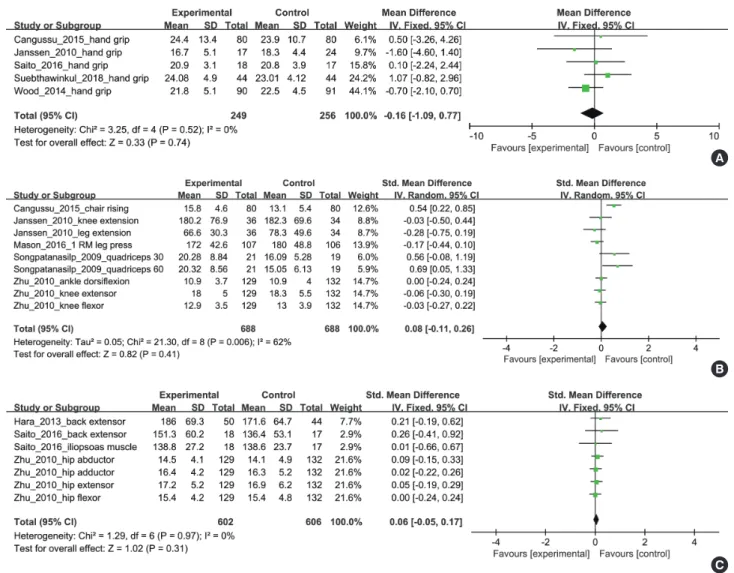
메타분석의 결과는 상지, 하지, 그리고 중심 근육의 근력의 평가 로 크게 3가지로 나누어 나타냈다. 고정효과모형을 사용하여 비타 민D 보충 요법이 폐경 후 여성의 상지 근력에 미치는 영향이 있는지 확인한 결과 효과가 없는 것으로 나타났다(mean difference –0.16, 95% CI: –1.09 to 0.77)(Figure3A). 폐경 후 여성의 하지 근육에 대한 효 과를 평가하기 위해 변량효과모형을 사용하였으며, 비타민D 보충 요법이 미치는 영향이 없는 것으로 나타났다(standard mean differ- ence 0.08, 95% CI: –0.11 to 0.26)(Figure3B). 마지막으로 폐경 후 여성 의 중심 근육에 비타민D 보충 요법이 변화를 주는지 확인하기 위 해 고정효과 모형을 사용하였으며 효과가 없는 것으로 나타났다 Figure 2. Risk of bias graph (a) and summary (b) among selected study

Random sequence generation (selection bias) Allocation concealment (selection bias) Blinding of participants and personnel (performance bias) Blinding of outcome assessment (detection bias) Incomplete outcome data (attrition bias) Selective reporting (reporting bias) Other bias

0 25 50 75 100

%

Low risk of bias Unclear risk of bias High risk of bias

A

Random sequence generation (selection bias)

Cangussu (2015)

Har a (2013)

Janssen (2010)

M ason (2016)

Sait o (2016)

Song pa tanasilp (2009)

Suebtha wink ul (2018)

W ood (2014)

Zhu (2010)

Allocation concealment (selection bias)

Blinding of participants and personnel (performance bias) Blinding of outcome assessment (detection bias) Incomplete outcome data (attrition bias) Selective reporting (reporting bias) Other bias

B

(6)

(standard mean difference 0.06, 95% CI: –0.05 to 0.17)(Figure3C).

비타민D 보충 요법이 근력에 미치는 효과가 연령에 따라 차이가 있는지 확인하기 위해 상대적으로 65세를 기준으로 젊은 폐경 연령 (65세 이상)과 높은 연령(65세 이상)를 나누어 하위 집단 분석을 하

였으며 결과는 Table 3에 나타내었다. 또한 연구참여자의 체내 비타 민D의 양이 비타민D 보충 요법이 근력에 미치는 효과에 영향을 미 치는지 확인하기 위해 연구참여자가 비타민D 결핍이었던 연구와 비타민D 부족 상태였던 연구를 나누어 하위 집단 분석을 하였다 Figure 3. Forest plot for upper limb muscle strength (a), lower body muscle strength (b) and back and hip muscle strength (c)

A

B

C

Table 3. Subgroup Analysis by Baseline Vitamin D Status and Age

Group Number of data

Mean difference†or Standard mean

difference

95% confidence interval overall effect (p) I

2

(%)

Upper limb muscle Age < 65 Vitamin D deficiency

5 2 4

–0.16

0.95

–0.21

–1.09 to 0.77 –0.73 to 2.64 –1.22 to 0.70

0.33 (0.74) 1.11 (0.27) 0.40 (0.69)

0 0 6 Lower body muscle

Vitamin D insufficient Vitamin D deficiency Age > 65

9 3 6 7

0.08 0.30 0.04 0.00

–0.11 to 0.26 –0.32 to 0.92 –0.16 to 0.24 –0.13 to 0.12

0.82 (0.41) 0.95 (0.34) 0.38 (0.70) 0.03 (0.97)

62 78 60 19 Back/hip muscle

Vitamin D deficiency

7 5

0.06 0.05

–0.05 to 0.17 –0.06 to 0.17

1.02 (0.31) 0.92 (0.36)

0

0

(7)

(Table 3). 결과적으로 모든 하위 집단에서 비타민D 보충 요법은 근 력 향상에 효과가 없는 것으로 나타났다.

4. 출판편향

연구에 포함된 문헌들의 출판편향을 검증하기 위해 R을 이용하 여 깔때기 그림(trimmed funnel plot)을 그렸으며 상지근력(Fig- ure4A), 하지근력(Figure4B), 중심근력(Figure4C)의 문헌들이 비교적 대칭적으로 나타나 출판 편항은 없는 것으로 판단하였다.

논  의

비타민D는 인체 전반에 광범위한 기능을 가진 지용성 호르몬으 로 근골격계 기능 향상을 위해 보충요법으로 빈번하게 사용되고 있 지만 근력에 미치는 효과는 명확하지 않다. 특히 폐경 후 여성은 호 르몬 변화로 인한 급격한 근력 감소가 일어날 수 있는 위험집단으 로 근력 증진을 위해 비타민D 보충 요법을 종종 사용하고 있다. 따 라서 본 연구는 체계적 검색 전략을 통해 폐경 후 여성을 대상으로 비타민D 보충 요법을 제공하고 근력 변화를 확인한 9편의 무작위 대조 연구를 수집하여 그 효과를 규명하였다. 포함된 논문은 모두 폐경 후 여성에게 시행한 무작위 대조 연구였으며 비타민D 보충 요 법을 중재군에 적용하고 대조군에 비타민D 대신 위약을 사용하였 다. 메타분석을 이용하여 폐경 후 여성의 근력 변화를 상지와 하지, 중심 근육의 근력으로 나누어 평가하였으며 결과적으로 비타민D 보충 요법은 근력을 직접적으로 변화시키지 않는 다는 것을 확인하 였다. 또한 하위 집단 분석을 통해 비타민D 보충 요법의 효과가 연 령이나 체내 비타민D 양에 상관없이 근력에 영향을 주지 않는 다는 것을 확인하였다.

비타민D는 골격근을 포함한 많은 조직에서 나타나는 호르몬 수 용체인 VDR(Vitamin D Receptor)를 통해 근육세포가 성장하고 증 식하도록 하는 유전자가 단백질로 전사되도록 조절할 뿐만 아니라

[8] 근육세포 내 소포체의 Ca 2+ 농도를 조절하는 것을 통해 근육 수 축력을 직접적으로 조절하는 것으로 알려져 있다[21]. 실제로 근육 세포의 VDR 유전자를 인위적으로 조절한 마우스에 실험한 결과 VDR을 통한 비타민D의 신호전달이 근육의 크기나 근력 조절에 영 향을 주었다[22]. 하지만 본 연구결과에서는 비타민D 보충 요법이 폐경기 여성에서 대조군과 비교하여 모든 종류의 근육의 근력이 향상되지 않았다고 나타났으며 이는 연구대상자의 평균 나이가 13.8세부터 80세 이상까지 다양하게 구성되어 있거나[13] 21.5세에 서 31.5세의 건강한 성인이 대상인[12] 이전 고찰 연구들에서 비타민 D 보충 요법이 근력을 유의미하게 향상된 것과 상이한 결과이다. 비 타민D 수용체는 노화가 진행됨에 따라 감소하는 특징이 있다[16].

본 연구에 포함된 연구 대상자들의 최소 나이는 45세이므로 골격 근에서 발현되는 비타민D 수용체가 감소하여 비타민D가 제대로 작용하지 못할 가능성이 있다. 이러한 결과는 이전 보고에서도 노 인을 대상으로 조사한 경우 비타민D 보충 요법이 근육 관련 요인을 변화시키지 않았던 것과 같은 맥락이다[23]. 게다가 여성은 남성과 비교하여 절대적인 근육량이 부족하다[5]. 따라서 절대적인 근육량 부족 또한 골격근 비타민 D 수용체 수에 영향을 주어 비타민D 보 충 요법의 효과가 충분히 나타나지 못했을 가능성이 있다.

본 연구의 하위 집단 분석 결과, 비타민D 보충 요법은 연령이나 체내 비타민D 양에 상관없이 효과가 없는 것으로 나타났다. 이러한 결과는 비타민D 결핍인 평균 연령 31.5세의 남녀에게 6개월간의 비 타민D 보충 요법을 한 결과 악력이 유의하게 상승했다는 보고나 [24], 체내 25-hydroxyvitaminD[25(OH)D] 값이 30 nmol/L 이하인 연 구참여자에게는 비타민D 보충 요법이 근력 향상에 효과가 있었다 는 연구와 대조적이다[13]. 이러한 결과는 여성에서 폐경으로 인한 에스트로겐의 급격한 감소는 단순한 노화로 인한 근육량 감소와 다르게 근육의 수축성 단백질의 질을 유지시켜주는 기능이 감소되 면서 근육 양과 질에 다각도로 영향을 준다는 보고와 함께 고려해 볼 때[25], 근력 향상을 위해서 체내 비타민D 양을 교정하는 것 이상 Figure 4. Funnel Plot for upper limb muscle strength (a), lower body muscle strength (b) and back and hip muscle strength (c)

0

0.085

0.169

0.254

0.338

0.12 0.25 0.5 1 2

Standar d er ror

Transformed standardized mean difference A 0

0.081

0.163

0.244

0.326

0.12 0.25 0.5 1 2

Standar d er ror

Transformed standardized mean difference B 0

0.085

0.17

0.255

0.34

0.12 0.25 0.5 1 2

Standar d er ror

Transformed standardized mean difference C

(8)

의 노력이 필요할 것이라는 시사점을 준다. 실제로 70세 이상의 지 역사회 거주 여성 노인에게 2년 동안 비타민D 보충 요법만 단독으 로 적용했을 했을 때는 대조군과 근력 차이가 나타나지 않았지만 비타민D 보충 요법과 운동을 함께 적용했을 때는 유의한 근력 향 상이 나타났다[26].

비록 단독으로 비타민D 보충 요법을 사용했을 때 직접적으로 폐 경 후 여성의 근력을 강화시키지는 않지만, 지속적인 비타민D 결핍 은 제2형 근섬유를 약화시켜 근력 감소를 유발할 수 있다[27]. 비타 민D는 체내에서 활용되기 위해 햇빛에 노출되는 과정이 필요하다 는 특징으로 노인에게서 결핍이 빈번하게 일어나는 점을 고려할 때 [28], 폐경 후 여성에게 비타민D 보충 요법이 근력에 유익한 효과를 보일 가능성을 완전히 배제하지 않고 근력 향상을 위한 중재 방안 으로 비타민D 보충 요법의 효과를 높일 수 있는 방법을 모색해야 할 것이다. 지역사회 거주 여성 노인을 대상으로 코호트 연구에서 도 비타민D 결핍이 허약함을 나타내는 지표 중 근력과 관련이 있다 는 것이 확인되어 건강한 노후를 위해 비타민D 수준을 유지하는 것을 권고하였다[29].

본 연구에 포함된 무작위 대조연구 9편은 모두 중재로 비타민D 보충을 사용하였고 그 외에 다른 모든 변수는 대조군에도 동일하 게 적용하였다. 이에 대조군도 중재 기간 동안 골흡수억제제 복용 [A2] 칼슘 복용[A3, A4, A7, A8], 중재군과 동일한 운동 및 식이조절 [A5], 칼슘 및 골흡수억제제 복용과 함께 운동 요법[A9]을 받았으며 중재 기간 이후에 근력이 다소 향상된 경우가 있었다[A2, A3, A4, A9]. 이와 같이 위약을 사용한 대조군의 근력 향상이 비타민D 보충 요법을 했던 중재군의 근력 향상 결과를 감추었을 가능성도 있다.

따라서 추후에는 비타민D와 함께 적용하면 근력 향상에 상승효과 가 있는 요인을 함께 평가하는 것이 필요할 것이다.

본 연구에서 무작위 대조 연구 9편을 분석한 결과 폐경 후 여성 에 비타민D 보충 요법이 근력 향상에 효과가 없었다. 또한 연령이나 체내 비타민D 양을 기준으로 하위 집단 분석을 한 결과에서도 모 든 하위 집단에서 비타민D 보충 요법이 효과가 없는 것으로 나타났 다. 따라서 폐경 여성에게 근력 향상을 목적으로 하는 비타민D의 요법의 선택은 신중해야 할 것으로 사료된다. 그러나 본 메타분석에 서 포함된 연구 중 5편은 비교적 작은 크기의 표본(n<100)을 사용 하였으며, 하체 근력을 평가한 문헌의 이질성이 높다는 취약점이 있 어 결과를 주의하여 해석할 필요는 있다. 추후에는 폐경 후 여성에 서 비타민D가 근력에 미치는 효과를 높일 수 있는 요인을 추가한 무작위 대조 연구가 필요할 것으로 사료된다.

결  론

본 연구는 폐경 후 여성을 대상으로 비타민D 보충 요법이 근력 향상에 영향을 주는가를 확인하기 위하여 체계적 검색 전략을 이 용하여 9편의 무작위 대조 연구를 선정하고 메타분석을 시행하였 다. 그 결과 폐경 후 여성을 대상으로 한 비타민D 보충 요법은 대조 군과 비교하여 유의한 근력향상 효과를 보이지 않았다. 따라서 폐 경 후 여성의 근력 향상을 위한 중재 방법을 선택할 때 비타민D 보 충 요법을 단독으로 사용하기 보다 상승효과를 낼 수 있는 중재 방 법의 개발과 연구가 필요하다고 생각한다.

Conflict of Interest The authors declared that they have no conflict of interest

Reference

1. Taebi M, Abdolahian S, Ozgoli G, Ebadi A, Kariman N. Strategies to improve menopausal quality of life: A systematic review. Journal of Education and Health Promotion. 2018;7(1):93. http://dx.doi.org/10.4103/jehp.jehp_137_17 2. Takahashi TA, Johnson KM. Menopause. The Medical Clinics of North Amer-

ica. 2015;99(3):521-534. http://dx.doi.org/10.1016/j.mcna.2015.01.006 3. Ikeda K, Horie-Inoue K, Inoue S. Functions of estrogen and estrogen receptor

signaling on skeletal muscle. The Journal of Steroid Biochemistry and Molecular Biology. 2019;191(1):105375. http://dx.doi.org/10.1016/j.jsbmb.2019.105375 4. Tiidus PM, Lowe DA, Brown M. Estrogen replacement and skeletal muscle:

mechanisms and population health. Journal of Applied Physiology.

2013;115(5):569-578. http://dx.doi.org/10.1152/japplphysiol.00629.2013 5. Janssen I, Heymsfield SB, Wang ZM, Ross R. Skeletal muscle mass and distribu-

tion in 468 men and women aged 18-88 yr. Journal of Applied Physiology.

2000;89(1):81-88. http://dx.doi.org/10.1152/jappl.2000.89.1.81

6. Li R, Xia J, Zhang XI, Gathirua-Mwangi WG, Guo J, Li Y, et al. Associations of Muscle Mass and Strength with All-Cause Mortality among US Older Adults.

Medicine and Science in Sports and Exercise. 2018;50(3):458-467. http://dx.doi.

org/10.1249/mss.0000000000001448

7. Ceglia L. Vitamin D and skeletal muscle tissue and function. Molecular aspects of Medicine. 2008;29(6):407-414. http://dx.doi.org/10.1016/j.mam.2008.07.002 8. Abrams GD, Feldman D, Safran MR. Effects of Vitamin D on Skeletal Muscle

and Athletic Performance. Journal of the American Academy of Orthopaedic Surgeons. 2018;26(8):278-285. http://dx.doi.org/10.5435/jaaos-d-16-00464 9. Gunton JE, Girgis CM. Vitamin D and muscle. Bone Reports. 2018;8(1):163-

167. http://dx.doi.org/10.1016/j.bonr.2018.04.004

10. Wang J, Wang X, Gu Y, Liu M, Chi VTQ, Zhang Q, et al. Vitamin D is related to handgrip strength in adult men aged 50 years and over: A population study from the TCLSIH cohort study. Clinical Endocrinology. 2019;90(5):753-765.

http://dx.doi.org/10.1111/cen.13952

11. Park S, Ham JO, Lee BK. A positive association of vitamin D deficiency and sar-

(9)

copenia in 50 year old women, but not men. Clinical Nutrition. 2014;33(5):900- 905. http://dx.doi.org/10.1016/j.clnu.2013.09.016

12. Tomlinson PB, Joseph C, Angioi M. Effects of vitamin D supplementation on upper and lower body muscle strength levels in healthy individuals. A system- atic review with meta-analysis. Journal of Science and Medicine in Sport.

2015;18(5):575-580. http://dx.doi.org/10.1016/j.jsams.2014.07.022

13. Beaudart C, Buckinx F, Rabenda V, Gillain S, Cavalier E, Slomian J, et al. The ef- fects of vitamin D on skeletal muscle strength, muscle mass, and muscle power:

a systematic review and meta-analysis of randomized controlled trials. The Journal of Clinical Endocrinology & Metabolism. 2014;99(11):4336-4345.

http://dx.doi.org/10.1210/jc.2014-1742

14. Latham NK, Anderson CS, Reid IR. Effects of vitamin D supplementation on strength, physical performance, and falls in older persons: a systematic review.

Journal of the American Geriatrics Society. 2003;51(9):1219-1226. http://

dx.doi.org/10.1046/j.1532-5415.2003.51405.x

15. Stockton KA, Mengersen K, Paratz JD, Kandiah D, Bennell KL. Effect of vita- min D supplementation on muscle strength: a systematic review and meta- analysis. Osteoporosis International. 2011;22(3):859-871. http://dx.doi.

org/10.1007/s00198-010-1407-y

16. Bischoff-Ferrari HA, Borchers M, Gudat F, Durmuller U, Stahelin HB, Dick W.

Vitamin D receptor expression in human muscle tissue decreases with age.

Journal of Bone and Mineral Research. 2004;19(2):265-269. http://dx.doi.

org/10.1359/jbmr.2004.19.2.265

17. Hollis BW, Wagner CL, Drezner MK, Binkley NC. Circulating vitamin D3 and 25-hydroxyvitamin D in humans: An important tool to define adequate nutri- tional vitamin D status. The Journal of Steroid Biochemistry and Molecular Bi- ology. 2007;103(3-5):631-634. http://dx.doi.org/10.1016/j.jsbmb.2006.12.066 18. Holick MF, Binkley NC, Bischoff-Ferrari HA, Gordon CM, Hanley DA, He-

aney RP, et al. Evaluation, treatment, and prevention of vitamin D deficiency: an Endocrine Society clinical practice guideline. The Journal of Clinical Endocri- nology & Metabolism. 2011;96(7):1911-1930. http://dx.doi.org/10.1210/

jc.2011-0385

19. Janssen HC, Samson MM, Verhaar HJ. Vitamin D deficiency, muscle function, and falls in elderly people. The American Journal of Clinical Nutrition.

2002;75(4):611-615. http://dx.doi.org/10.1093/ajcn/75.4.611

20. Moher D, Liberati A, Tetzlaff J, Altman DG. Preferred reporting items for sys- tematic reviews and meta-analyses: the PRISMA statement. Annals of Internal Medicine. 2009;151(4):264-269. http://dx.doi.org/10.7326/0003-4819-151-4- 200908180-00135

21. Choi M, Park H, Cho S, Lee M. Vitamin D3 supplementation modulates in- flammatory responses from the muscle damage induced by high-intensity ex- ercise in SD rats. Cytokine. 2013;63(1):27-35. http://dx.doi.org/10.1016/j.

cyto.2013.03.018

22. Girgis CM, Cha KM, So B, Tsang M, Chen J, Houweling PJ, et al. Mice with myocyte deletion of vitamin D receptor have sarcopenia and impaired muscle function. Journal of Cachexia, Sarcopenia and Muscle. 2019;Online ahead of print. http://dx.doi.org/10.1002/jcsm.12460

23. Rosendahl-Riise H, Spielau U, Ranhoff AH, Gudbrandsen OA, Dierkes J. Vita- min D supplementation and its influence on muscle strength and mobility in community-dwelling older persons: a systematic review and meta-analysis.

Journal of Human Nutrition and Dietetics. 2017;30(1):3-15. http://dx.doi.

org/10.1111/jhn.12394

24. Gupta R, Sharma U, Gupta N, Kalaivani M, Singh U, Guleria R, et al. Effect of

cholecalciferol and calcium supplementation on muscle strength and energy metabolism in vitamin D-deficient Asian Indians: a randomized, controlled trial. Clinical Endocrinology. 2010;73(4):445-451. http://dx.doi.org/10.1111/

j.1365-2265.2010.03816.x

25. Collins BC, Laakkonen EK, Lowe DA. Aging of the musculoskeletal system:

How the loss of estrogen impacts muscle strength. Bone. 2019;123(1):137-144.

http://dx.doi.org/10.1016/j.bone.2019.03.033

26. Uusi-Rasi K, Patil R, Karinkanta S, Kannus P, Tokola K, Lamberg-Allardt C, et al. A 2-Year Follow-Up After a 2-Year RCT with Vitamin D and Exercise: Ef- fects on Falls, Injurious Falls and Physical Functioning Among Older Women.

Journals of Gerontology Series A: Biomedical Sciences and Medical Sciences.

2017;72(9):1239-1245. http://dx.doi.org/10.1093/gerona/glx044

27. Sanders KM, Scott D, Ebeling PR. Vitamin D deficiency and its role in muscle- bone interactions in the elderly. Current Osteoporosis Reports. 2014;12(1):74- 81. http://dx.doi.org/10.1007/s11914-014-0193-4

28. Sahota O. Understanding vitamin D deficiency. Age and Ageing.

2014;43(5):589-591. http://dx.doi.org/10.1093/ageing/afu104

29. Buchebner D, Bartosch P, Malmgren L, McGuigan FE, Gerdhem P, Akesson KE.

Association Between Vitamin D, Frailty, and Progression of Frailty in Commu- nity-Dwelling Older Women. The Journal of Clinical Endocrinology & Metab- olism. 2019;104(12):6139-6147. http://dx.doi.org/10.1210/jc.2019-00573

Appendix 1: List of studies included in Meta-Analysis

A1. Cangussu LM, Nahas-Neto J, Orsatti CL, Bueloni-Dias FN, Nahas EAP. Effect of vitamin D supplementation alone on muscle function in postmenopausal women: a randomized, double-blind, placebo-controlled clinical trial. Osteo- porosis International. 2015;26(10):2413-2421. http://dx.doi.org/10.1007/

s00198-015-3151-9

A2. Saito K, Miyakoshi N, Matsunaga T, Hongo M, Kasukawa Y, Shimada Y. Elde- calcitol improves muscle strength and dynamic balance in postmenopausal women with osteoporosis: an open-label randomized controlled study. Journal of Bone Mineral Metabolism. 2016;34(5):547-554. http://dx.doi.org/10.1007/

s00774-015-0695-x

A3. Janssen HC, Samson MM, Verhaar HJ. Muscle strength and mobility in vita- min D-insufficient female geriatric patients: a randomized controlled trial on vitamin D and calcium supplementation. Aging Clinical Experimental Re- search. 2010;22(1):78-84. http://dx.doi.org/10.1007/bf03324819

A4. Zhu K, Austin N, Devine A, Bruce D, Prince RL. A randomized controlled trial of the effects of vitamin D on muscle strength and mobility in older women with vitamin D insufficiency. Journal of the American Geriatrics Society.

2010;58(11):2063-2068. http://dx.doi.org/10.1111/j.1532-5415.2010.03142.x A5. Mason C, Tapsoba JD, Duggan C, Imayama I, Wang CY, Korde L, et al. Effects

of Vitamin D3 Supplementation on Lean Mass, Muscle Strength, and Bone Mineral Density During Weight Loss: A Double‐Blind Randomized Con- trolled Trial. Journal of the American Geriatrics Society. 2016;64(4):769-778.

http://dx.doi.org/10.1111/jgs.14049

A6. Wood A, Secombes K, Thies F, Aucott L, Black A, Reid D, et al. A parallel group

double-blind RCT of vitamin D 3 assessing physical function: is the biochemi-

cal response to treatment affected by overweight and obesity? Osteoporosis In-

ternational. 2014;25(1):305-315. http://dx.doi.org/10.1007/s00198-013-2473-8

A7. Suebthawinkul C, Panyakhamlerd K, Yotnuengnit P, Suwan A, Chaiyasit N,

(10)

Taechakraichana N. The effect of vitamin D2 supplementation on muscle strength in early postmenopausal women: a randomized, double-blind, place- bo-controlled trial. Climacteric. 2018;21(5):491-497. http://dx.doi.org/10.1080 /13697137.2018.1480600

A8. Songpatanasilp T, Chailurkit LO, Nichachotsalid A, Chantarasorn M. Combi- nation of alfacalcidol with calcium can improve quadriceps muscle strength in elderly ambulatory Thai women who have hypovitaminosis D: a randomized

controlled trial. Journal of the Medical Association of Thailand. 2009;92(9):30- 41. http://dx.doi.org/10.1111/ggi.13201

A9. Hara S, Kishimoto KN, Okuno H, Tanaka M, Saito H, Oizumi A, et al. Effects of alfacalcidol on back extensor strength gained through back extensor exercise in postmenopausal women with osteoporosis. American Journal of Physical Medicine Rehabilitation. 2013;92(2):101-110. http://dx.doi.org/10.1097/

phm.0b013e31826ed991

수치

Figure 1. Flowchart of literature search
Table 3. Subgroup Analysis by Baseline Vitamin D Status and Age

참조

관련 문서

Animal Life Sciences Division of Applied Animal Science(Animal Biotechnology, Food Science and Technology in Animal Resources) Education Education, Korean

Department of Internal Medicine, Novosibirsk State University, Russia 1 , Department of Cardiology, Surgut State University, Russia 2 , Department Fundamental

한 광고 내에 제품이 있을 때 일어나는 상황과 없을 때 일어나는 상황을 동시에 보여주면 어떨까?... 광고가 실리는

william James Hall, M.D., Medical Missionary to the Slums of New York; Pioneer Mission of Korean Native Costumes, China Medical Journal, 1916.3; Medical Needs of Korean

자연적으로 일어나는 현상은 질서 있는 상태에서 무질서한 상태로, 즉, 낮은 엔트로피 상태에서 높은 엔트로피 상태로 되는 과정...

“Characteristics of Meteorological Variables in the Leeward Side associated with the Downslope Windstorm over the Yeongdong Region.” Journal of the Korean

Factors affecting post-traumatic stress of general hospital nurses after the epidemic of Middle East respiratory syndrome infection: Journal of Korean Clinical

향을 줄 수 있는 일본 서해 니가타 해상에서 발생한 지진과 비교적 짧은 재래주기로 대규모 지진이 빈번하게 일어나는 지역인 뉴브리튼 해구에서 발생한 솔로몬제도