ISSN: 2233-601X (Print) ISSN: 2093-6516 (Online)
− 130 −
Received: April 21, 2016, Revised: July 24, 2016, Accepted: July 29, 2016, Published online: April 5, 2017
Corresponding author: Jong Ho Cho, Department of Thoracic and Cardiovascular Surgery, Samsung Medical Center, Sungkyunkwan University School of Medicine, 81 Irwon-ro, Gangnam-gu, Seoul 06351, Korea
(Tel) 82-2-3410-1696 (Fax) 82-2-3410-6986 (E-mail) [email protected]
© The Korean Society for Thoracic and Cardiovascular Surgery. 2017. All right reserved.
This is an open access article distributed under the terms of the Creative Commons Attribution Non-Commercial License (http://creativecommons.org/
licenses/by-nc/4.0) which permits unrestricted non-commercial use, distribution, and reproduction in any medium, provided the original work is properly cited.
Harlequin Syndrome Following Resection of Mediastinal Ganglioneuroma
Yeong Jeong Jeon, M.D., Jongbae Son, M.D., Jong Ho Cho, M.D., Ph.D.
Department of Thoracic and Cardiovascular Surgery, Samsung Medical Center, Sungkyunkwan University School of Medicine
Harlequin syndrome is a rare disorder of the sympathetic nervous system characterized by unilateral facial flushing and sweating. Although its etiology is unknown, this syndrome appears to be a dysfunction of the autonomic nervous system. To the best of our knowledge, thus far, very few reports on perioperative Harlequin syndrome after thoracic surgery have been published in the thoracic surgical literature. Here, we present the case of a 6-year-old patient who developed this unusual syndrome following the resection of a posterior mediastinal mass.
Key words: 1. Harlequin syndrome 2. Mediastinal tumor 3. Ganglioneuroma
Case report
A previously healthy 6-year-old boy visited Samsung Medical Center with complaints of dyspnea and a barking cough lasting for 3 days. Chest radiography revealed a mass-like lesion in the right upper me- diastinum. Chest computed tomography demonstrated a well-defined posterior mediastinal mass measuring 4 cm, which was suspected to be a neural foraminal extension to the thoracic spine (T3–T4). Magnetic resonance imaging was conducted f or f urther evalua- tion; it showed a right upper paravertebral enhanc- ing mass with an adjacent neural foraminal extension to the T2–T5 spine (Fig. 1). A preoperative neuro- logic examination revealed that the patient had no abnormalities. He underwent mediastinal mass ex- cision by video-assisted thoracic surgery. The mass was in the right posterior mediastinum, was located at the T2–T5 level of the spine, and did not extend to the neural f oramen. It was resected by elect-
rocautery. The sympathetic chain at the T2 level was inevitably resected as part of the complete resection of the mediastinal tumor during the operation, be- cause the tumor originated from this sympathetic chain. The intraoperative course was uneventful, with a stable hemodynamic status throughout the surgery.
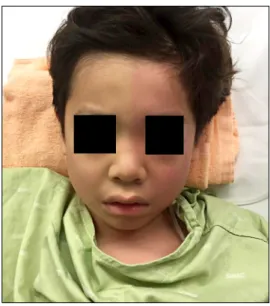
After the patient was sent to the post-anesthesia re- covery unit, a sharp midline f acial demarcation was observed, and the left face, neck, and chest (contra- lateral to the operation site) became f lushed and warm (Fig. 2). These findings were noted to increase in intensity when the patient cried. In contrast, the right face, neck, and chest (ipsilateral to the oper- ation site) were pale and cool and did not change in color when the patient cried. A neurologic examina- tion including that of the cranial nerves was normal, and miosis and ptosis were absent. The patient’s vi- tal signs and laboratory tests were normal. The symptoms, including the color and the warmness of the face, started to show minimal improvement with-
Korean J Thorac Cardiovasc Surg 2017;50:130-132 □ CASE REPORT □
https://doi.org/10.5090/kjtcs.2017.50.2.130
Harlequin Syndrome
− 131 −
Fig. 1. (A) Chest computed tomography showed a well-defined right posterior mediastinal mass measuring 4 cm. (B, C) Thoracic spine magnetic resonance imaging revealed a 4-cm right upper paravertebral enhancing mass lesion (T2–T5) with an adjacent neural foramina extension.
Fig. 2. Harlequin syndrome. Asymmetric flushing of the left face, neck, and upper chest after surgery.
in an hour and completely resolved without any treatment 3 hours after surgery. The patient was dis- charged on postoperative day 2. The permanent pathologic findings revealed that the resected tumor was a ganglioneuroma. During follow-up on post- operative day 30, there was no sign of color change on his f ace, neck, or chest.
Discussion
Harlequin syndrome was first described by Lance et al. [1] in 1988. It is a rare disorder of the auto- nomic nervous system characterized by asymmetric facial flushing and sweating.
The site of sympathetic nerve injury is known to be associated with normal face color. Excessive flush- ing and sweating on the unaffected side of the face are recognized as a compensatory overreaction of vasodilatation for thermoregulation [1]. The cervico- thoracic sympathetic chain consists of a 3-neuron pathway. The first neuron (central) originates from the hypothalamus and synapses onto the second neu- ron (preganglionic) in the lateral horn of the spinal cord. The second neuron synapses onto the third neuron (postganglionic) in the superior cervical ganglion. Most of the vasomotor and sudomotor neu- ral chain that innervates the face originates in T2 and T3 and connects to the superior cervical ganglion.
The postganglionic vasomotor and sudomotor neural chains innervating the medial forehead and the nose travel with the internal carotid artery; the other f a- cial areas are regulated by the postganglionic neural fiber traveling with the external carotid artery [2].
In the present case, the mass was adjacent to the right thoracic spine (T2–T5). Histology of the re- sected mass revealed a ganglioneuroma, which is a tumor of the sympathetic nervous system, arising from neural crest cells [3]. The sympathetic chain at the T2 level was inevitably resected to completely remove the mediastinal tumor during the operation, as the tumor originated from this sympathetic chain.
This caused a disturbance of the vasomotor regu- lation of the face. The patient suffered asymmetric flushing of the left face; his symptoms disappeared after 3 hours without complications.
Most cases of Harlequin syndrome are primary or idiopathic. Approximately one-fourth of the patients
Yeong Jeong Jeon, et al
− 132 − with Harlequin syndrome have secondary Harlequin syndrome or iatrogenic causes. Secondary Harlequin syndrome is caused by structural lesions and may be treated by surgical resection. According to a liter- ature review, 13 cases of Harlequin syndrome have been due to organic lesions. The most common or- ganic lesions are neurogenic tumors that compress the sympathetic trunk, such as mediastinal neurinoma and cervical syrinx [4,5]. Three patients underwent resection of thoracic neurogenic tumors. Among them, 2 patients recovered from their symptoms, but the third patient’s symptoms did not disappear post- operatively [5,6].
An increasing number of cases of iatrogenic Harle- quin syndrome have been reported. Thus f ar, 10 cas- es have been reported in the literature: following a paravertebral thoracic block (5 patients), resection of a neck mass (3 patients), jugular vein catheterization (1 patient), thoracic sympathectomy (1 patient), and lung resection (1 patient). Most of these cases re- solved spontaneously within a few hours. However, 2 cases, which followed thoracoscopic sympathectomy and thoracoscopic wedge resection of the lung, had long-term sequelae according to the literature [5,7].
The patient’s concerns are often relieved by explain- ing the pathophysiology and the benign nature of the condition. If the symptoms are not tolerable, a con- tralateral sympathectomy or a stellate ganglion block could be considered for symptom relief [8].
This is an extremely rare case report of iatrogenic Harlequin syndrome that developed following thora- cic surgery. We hope that this report will make
thoracic surgeons aware of this rare syndrome as a possible complication after thoracic mediastinal mass excision.
Conflict of interest
No potential conf lict of interest relevant to this ar- ticle was reported.
References
1. Lance JW, Drummond PD, Gandevia SC, Morris JG.
Harlequin syndrome: the sudden onset of unilateral flush- ing and sweating. J Neurol Neurosurg Psychiatry 1988;51:
635-42.
2. Morris JG, Lee J, Lim CL. Facial sweating in Horner’s syndrome. Brain 1984;107(Pt 3):751-8.
3. Kleihues P, Cavenee WK. Classification of tumors, pathol- ogy and genetics of tumors of the nervous system.
Geneva: World Health Organization; 2000.
4. Tascilar N, Tekin NS, Erdem Z, Alpay A, Emre U. Unnoticed dysautonomic syndrome of the face: Harlequin syndrome.
Auton Neurosci 2007;137:1-9.
5. Willaert WI, Scheltinga MR, Steenhuisen SF, Hiel JA.
Harlequin syndrome: two new cases and a management proposal. Acta Neurol Belg 2009;109:214-20.
6. Noda S. Harlequin syndrome due to superior mediastinal neurinoma. J Neurol Neurosurg Psychiatry 1991;54:744.
7. Jung JM, Lee MH, Won CH, et al. Iatrogenic harlequin syn- drome: a new case. Ann Dermatol 2015;27:101-2.
8. Reddy H, Fatah S, Gulve A, Carmichael AJ. Novel manage- ment of harlequin syndrome with stellate ganglion block.
Br J Dermatol 2013;169:954-6.